Question bank

Q&A: practice questions with answers

Search questions on any topic. Filter by exam category, exam, subject and topic, try the question, then open the answer and explanation.

Courses – airGurukul

3,200 questions found.

Q741.
Select the triad which follows the same pattern as that followed by the two triads given below. Both triads follow the same pattern.
JAIL - ALIJ - LIAJ
ZEAL - ELAZ - LAEZ
उस त्रिक का चयन कीजिए जो नीचे दिए गए दो त्रिकों द्वारा अनुसरित पैटर्न का ही अनुसरण करता है। दोनों त्रिक एक ही पैटर्न का अनुसरण करते हैं।
JAIL - ALIJ - LIAJ
ZEAL - ELAZ - LAEZ
  1. AMAIN - AMIN - NAIM
  2. BCOLD - ODLC - LCOD
  3. CGILE - GLIE - ELIG
  4. DBORE - OERB - EROB
Show answer

Concept: Number the letters of the first word 1 2 3 4 and track their order.

  1. JAIL (1234) → ALIJ =2431 → LIAJ =4321 (reverse).
  2. ZEAL → ELAZ (2431) → LAEZ (4321) – same.
  3. BORE → OERB (2431) → EROB (4321) – matches.

Trick: The third word is just the first word reversed – check that first to eliminate options fast.

Answer: (D) BORE - OERB - EROB

अवधारणा: पहले शब्द के अक्षरों को 1 2 3 4 क्रमांक दें और उनका क्रम देखें।

  1. JAIL (1234) → ALIJ =2431 → LIAJ =4321 (उल्टा)।
  2. ZEAL → ELAZ (2431) → LAEZ (4321) – वही।
  3. BORE → OERB (2431) → EROB (4321) – मेल खाता है।

ट्रिक: तीसरा शब्द पहले शब्द का उल्टा है – पहले यही जाँचकर विकल्प हटाएँ।

उत्तर: (D) BORE - OERB - EROB
RRB Technician Grade IIIGeneral Intelligence and ReasoningLetter Triads – Position PatternRRB Technician Grade III 2024 · 28 Dec Shift 2 →
Q742.
Read the given statements and conclusions carefully. You have to take the given statements to be true even if they seem to be at variance from commonly known facts and decide which conclusion(s) logically follow(s) from the given statements.
Statements:
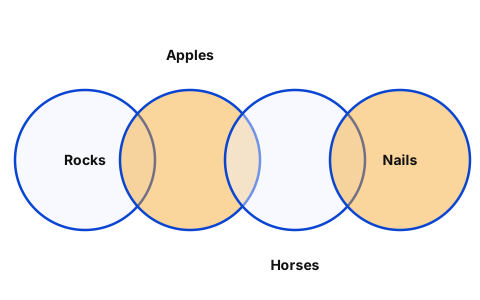
Some rocks are apples.
Some apples are horses.
Some horses are nails.
Conclusions:
(I) Some nails are apples.
(II) Some horses are rocks.
दिए गए कथनों और निष्कर्षों को ध्यानपूर्वक पढ़िए। आपको दिए गए कथनों को सत्य मानना है, भले ही वे सामान्य रूप से ज्ञात तथ्यों से भिन्न प्रतीत होते हों, और निर्णय लीजिए कि कौन-सा/से निष्कर्ष तार्किक रूप से दिए गए कथनों का अनुसरण करता/करते है/हैं।
कथन:
कुछ चट्टानें, सेब हैं।
कुछ सेब, घोड़े हैं।
कुछ घोड़े, कीलें हैं।
निष्कर्ष:
(I) कुछ कीलें, सेब हैं।
(II) कुछ घोड़े, चट्टानें हैं।
  1. AOnly conclusion (II) follows.केवल निष्कर्ष (II) अनुसरण करता है।
  2. BBoth conclusions (I) and (II) follow.निष्कर्ष (I) और (II) दोनों अनुसरण करते हैं।
  3. CNeither conclusion (I) nor (II) follows.न तो निष्कर्ष (I) और न ही (II) अनुसरण करता है।
  4. DOnly conclusion (I) follows.केवल निष्कर्ष (I) अनुसरण करता है।
Show answer

Concept: Two 'Some' statements in a chain give no definite link between the end terms.

  1. Rocks–Apples, Apples–Horses, Horses–Nails are each 'Some' links.
  2. I: Nails and Apples are linked only through Horses (Some + Some) – no definite conclusion.
  3. II: Horses and Rocks are linked only through Apples (Some + Some) – no definite conclusion.

Yaad rakhein: Some + Some = no conclusion. Draw a chain of just-touching circles to see it.

Answer: (C) Neither conclusion (I) nor (II) follows.

अवधारणा: शृंखला में दो 'कुछ' कथन सिरे के पदों में कोई निश्चित संबंध नहीं देते।

  1. Rocks–Apples, Apples–Horses, Horses–Nails – सभी 'कुछ' वाली कड़ियाँ।
  2. I: Nails और Apples केवल Horses से जुड़े (कुछ + कुछ) – निश्चित निष्कर्ष नहीं।
  3. II: Horses और Rocks केवल Apples से जुड़े (कुछ + कुछ) – निश्चित निष्कर्ष नहीं।

याद रखें: कुछ + कुछ = कोई निष्कर्ष नहीं। केवल छूते हुए वृत्तों की शृंखला बनाकर देखें।

उत्तर: (C) न तो निष्कर्ष (I) और न ही (II) अनुसरण करता है।

RRB Technician Grade IIIGeneral Intelligence and ReasoningSyllogismRRB Technician Grade III 2024 · 28 Dec Shift 2 →
Q743.
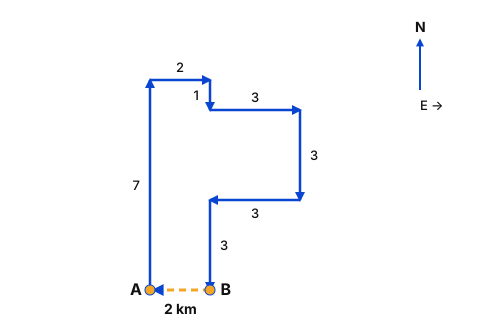
Kevin starts from point A and drives 7 km towards the North. He then takes two simultaneous right turns and drives 2 km and 1 km, respectively. He then takes a left turn and drives 3 km. He then takes two simultaneous right turns and drives 3 km each. He takes a final left turn and drives 3 km to reach point B. How far (shortest distance) and towards which direction should he drive to reach Point A again? (All turns are 90 degrees turns only unless specified.)
केविन बिंदु A से चलना शुरू करता है और उत्तर की ओर 7 km गाड़ी चलाता है। फिर वह लगातार दो बार दाएँ मुड़ता है और क्रमशः 2 km और 1 km गाड़ी चलाता है। फिर वह बाएँ मुड़ता है और 3 km गाड़ी चलाता है। फिर वह लगातार दो बार दाएँ मुड़ता है और प्रत्येक बार 3 km गाड़ी चलाता है। वह अंतिम बार बाएँ मुड़ता है और बिंदु B पर पहुँचने के लिए 3 km गाड़ी चलाता है। बिंदु A पर फिर से पहुँचने के लिए उसे कितनी दूरी (न्यूनतम दूरी) तक और किस दिशा में गाड़ी चलानी चाहिए? (जब तक निर्दिष्ट न हो, सभी मोड़ केवल 90 डिग्री के हैं।)
  1. A2 km South2 km दक्षिण
  2. B1 km West1 km पश्चिम
  3. C2 km North2 km उत्तर
  4. D2 km West2 km पश्चिम
Show answer

Concept: Trace each move on a grid with A at the origin (East = +x, North = +y).

  1. North 7: (0,7); right → East 2: (2,7); right → South 1: (2,6).
  2. Left → East 3: (5,6); right → South 3: (5,3); right → West 3: (2,3).
  3. Left → South 3: B =(2,0).
  4. A =(0,0) lies 2 km to the West of B.

Trick: Only net displacement matters: East 2+3−3=2, North 7−1−3−3=0.

Answer: (D) 2 km West

अवधारणा: A को मूल बिंदु मानकर ग्रिड पर हर चाल बनाएँ (पूर्व =+x, उत्तर =+y)।

  1. उत्तर 7: (0,7); दाएँ → पूर्व 2: (2,7); दाएँ → दक्षिण 1: (2,6)।
  2. बाएँ → पूर्व 3: (5,6); दाएँ → दक्षिण 3: (5,3); दाएँ → पश्चिम 3: (2,3)।
  3. बाएँ → दक्षिण 3: B =(2,0)।
  4. A =(0,0), B से 2 किमी पश्चिम में है।

ट्रिक: केवल कुल विस्थापन देखें: पूर्व 2+3−3=2, उत्तर 7−1−3−3=0।

उत्तर: (D) 2 km पश्चिम

RRB Technician Grade IIIGeneral Intelligence and ReasoningDirection SenseRRB Technician Grade III 2024 · 28 Dec Shift 2 →
Q744.
In a certain code language,
‘P + Q’ means ‘P is the mother of Q’,
‘P – Q’ means ‘P is the husband of Q’,
‘P x Q’ means ‘P is the sister of Q’ and
‘P ÷ Q’ means ‘P is the brother of Q’.
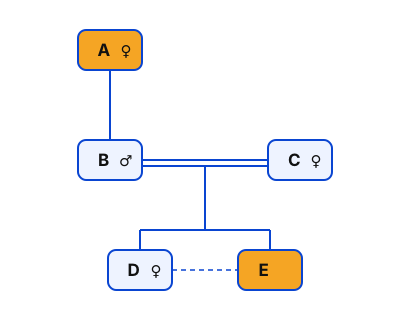
How is A related to E if ‘A + B – C + D x E’?
एक निश्चित कूट भाषा में,
‘P + Q’ का अर्थ है ‘P, Q की माता है’,
‘P – Q’ का अर्थ है ‘P, Q का पति है’,
‘P x Q’ का अर्थ है ‘P, Q की बहन है’ और
‘P ÷ Q’ का अर्थ है ‘P, Q का भाई है’।
यदि ‘A + B – C + D x E’ है, तो A का E से क्या संबंध है?
  1. AFather’s sisterपिता की बहन
  2. BFather’s motherपिता की माता
  3. CMother’s sisterमाता की बहन
  4. DMother’s motherमाता की माता
Show answer

Concept: Decode each symbol from left to right and draw the family tree.

  1. A + B: A is the mother of B.
  2. B − C: B is the husband of C; C + D: C is the mother of D.
  3. D × E: D is the sister of E, so E is a child of B and C.
  4. B is E's father and A is B's mother – A is E's father's mother.

Trick: Mark gender as soon as a relation reveals it (mother ♀, husband ♂, sister ♀).

Answer: (B) Father’s mother

अवधारणा: हर चिह्न को बाएँ से दाएँ समझें और वंश-वृक्ष बनाएँ।

  1. A + B: A, B की माता है।
  2. B − C: B, C का पति है; C + D: C, D की माता है।
  3. D × E: D, E की बहन है, अतः E, B और C की संतान है।
  4. B, E का पिता और A, B की माता – A, E की दादी (पिता की माता) है।

ट्रिक: संबंध से लिंग पता चलते ही चिह्नित करें (माता ♀, पति ♂, बहन ♀)।

उत्तर: (B) पिता की माता

RRB Technician Grade IIIGeneral Intelligence and ReasoningCoded Blood RelationsRRB Technician Grade III 2024 · 28 Dec Shift 2 →
Q745.
Read the given statements and conclusions carefully. You have to take the given statements to be true even if they seem to be at variance from commonly known facts and decide which conclusion(s) logically follow(s) from the given statements.
Statements:
All schools are colleges.
No college is a university.
Conclusions:
(I) Some colleges are schools.
(II) Some schools may be universities.
दिए गए कथनों और निष्कर्षों को ध्यानपूर्वक पढ़िए। आपको दिए गए कथनों को सत्य मानना है, भले ही वे सामान्य रूप से ज्ञात तथ्यों से भिन्न प्रतीत होते हों, और निर्णय लीजिए कि कौन-सा/से निष्कर्ष तार्किक रूप से दिए गए कथनों का अनुसरण करता/करते है/हैं।
कथन:
सभी स्कूल, कॉलेज हैं।
कोई कॉलेज, विश्वविद्यालय नहीं है।
निष्कर्ष:
(I) कुछ कॉलेज, स्कूल हैं।
(II) कुछ स्कूल, विश्वविद्यालय हो सकते हैं।
  1. ANeither conclusion I nor II followsन तो निष्कर्ष I और न ही II अनुसरण करता है
  2. BOnly conclusion II followsकेवल निष्कर्ष II अनुसरण करता है
  3. COnly conclusion I followsकेवल निष्कर्ष I अनुसरण करता है
  4. DBoth conclusions I and II followनिष्कर्ष I और II दोनों अनुसरण करते हैं
Show answer

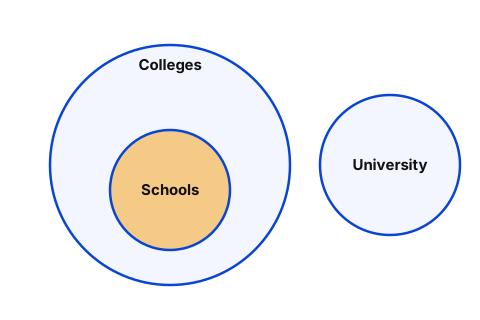
Concept: Draw the Schools circle inside the Colleges circle, with University completely separate.

  1. All schools are colleges ⇒ every school is a college, so some colleges (at least the schools) are schools ⇒ I follows.
  2. No college is a university and every school is a college ⇒ no school is a university, so 'Some schools may be universities' is impossible ⇒ II does not follow.

Yaad rakhein: 'All A are B' ⇒ 'Some B are A' always follows; 'All A are B' + 'No B is C' ⇒ 'No A is C', so 'A may be C' is false.

Answer: (C) Only conclusion I follows

अवधारणा: स्कूल का वृत्त कॉलेज के वृत्त के अंदर बनाएँ, और विश्वविद्यालय पूरी तरह अलग।

  1. सभी स्कूल कॉलेज हैं ⇒ हर स्कूल एक कॉलेज है, अतः कुछ कॉलेज (कम से कम स्कूल) स्कूल हैं ⇒ I अनुसरण करता है।
  2. कोई कॉलेज विश्वविद्यालय नहीं और हर स्कूल कॉलेज है ⇒ कोई स्कूल विश्वविद्यालय नहीं, अतः 'कुछ स्कूल विश्वविद्यालय हो सकते हैं' असंभव ⇒ II अनुसरण नहीं करता।

याद रखें: 'सभी A, B हैं' ⇒ 'कुछ B, A हैं' हमेशा अनुसरण करता है; 'सभी A, B हैं' + 'कोई B, C नहीं' ⇒ 'कोई A, C नहीं', अतः 'A, C हो सकता है' गलत है।

उत्तर: (C) केवल निष्कर्ष I अनुसरण करता है

RRB Technician Grade IIIGeneral Intelligence and ReasoningSyllogismRRB Technician Grade III 2024 · 28 Dec Shift 2 →
Q746.
Which of the following options should come in place of the question mark (?) in the given series based on the English alphabetical order?
YES, ZGV, AIY, BKB,?
अंग्रेजी वर्णमाला क्रम के आधार पर दी गई श्रृंखला में प्रश्न चिह्न (?) के स्थान पर निम्नलिखित में से कौन-सा विकल्प आना चाहिए?
YES, ZGV, AIY, BKB,?
  1. ACMD
  2. BCME
  3. CCMF
  4. DCNE
Show answer

Concept: Treat each letter position as its own series.

  1. 1st letters: Y, Z, A, B, C (+1).
  2. 2nd letters: E, G, I, K, M (+2).
  3. 3rd letters: S, V, Y, B, E (+3, wrapping Z → A).
  4. Next term: CME.

Trick: Split clusters column-wise; each column usually has a simple constant step.

Answer: (B) CME

अवधारणा: हर स्थान के अक्षर को अलग श्रृंखला मानें।

  1. पहले अक्षर: Y, Z, A, B, C (+1)।
  2. दूसरे अक्षर: E, G, I, K, M (+2)।
  3. तीसरे अक्षर: S, V, Y, B, E (+3, Z के बाद A)।
  4. अगला पद: CME।

ट्रिक: समूहों को कॉलम-वार बाँटें; हर कॉलम में प्रायः सरल स्थिर अंतर होता है।

उत्तर: (B) CME

RRB Technician Grade IIIGeneral Intelligence and ReasoningLetter SeriesRRB Technician Grade III 2024 · 28 Dec Shift 2 →
Q747.
Refer to the given number and symbol series and answer the question that follows. Counting to be done from left to right only.
(Left) 2 9 # 1 * £ & % 4 6 @ 8 $ 7 & 3 Ω 5 (Right)
How many such symbols are there, each of which is immediately preceded by a symbol and also immediately followed by an odd number?
दी गई संख्या और प्रतीक श्रृंखला का संदर्भ लीजिए और उसके बाद दिए गए प्रश्न का उत्तर दीजिए। गिनती केवल बाएँ से दाएँ की जानी है।
(Left) 2 9 # 1 * £ & % 4 6 @ 8 $ 7 & 3 Ω 5 (Right)
ऐसे कितने प्रतीक हैं, जिनमें से प्रत्येक के ठीक पहले एक प्रतीक है और ठीक बाद में एक विषम संख्या है?
  1. ANoneकोई नहीं
  2. BOneएक
  3. CTwoदो
  4. DMore than twoदो से अधिक
Show answer

Concept: Look at every symbol followed by an odd number, then check what is just before it.

  1. Symbols followed by odd numbers: # (1), $ (7), & (3), Ω (5).
  2. Before them: # ← 9, $ ← 8, & ← 7, Ω ← 3 – all numbers.
  3. No symbol has a symbol before it and an odd number after it.

Trick: Scan for the rarer condition first (odd number after a symbol) – it gives a short list to check.

Answer: (A) None

अवधारणा: विषम संख्या से पहले आने वाले हर प्रतीक को देखें, फिर उसके ठीक पहले क्या है जाँचें।

  1. विषम संख्या से पहले प्रतीक: # (1), $ (7), & (3), Ω (5)।
  2. इनसे पहले: # ← 9, $ ← 8, & ← 7, Ω ← 3 – सभी संख्याएँ।
  3. कोई प्रतीक ऐसा नहीं जिसके पहले प्रतीक और बाद में विषम संख्या हो।

ट्रिक: पहले दुर्लभ शर्त (प्रतीक के बाद विषम संख्या) ढूँढें – जाँचने को छोटी सूची मिलती है।

उत्तर: (A) कोई नहीं

RRB Technician Grade IIIGeneral Intelligence and ReasoningSymbol–Number SeriesRRB Technician Grade III 2024 · 28 Dec Shift 2 →
Q748.
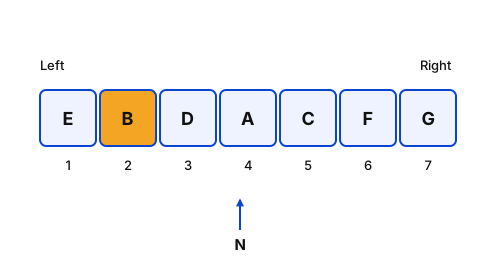
Seven people, A, B, C, D, E, F and G, are sitting in a row, facing north. Only three people sit to the right of A. B sits second from the left end. F is an immediate neighbour of C and G. D sits second to the left of C. How many people sit between E and D?
सात व्यक्ति, A, B, C, D, E, F और G, एक पंक्ति में उत्तर की ओर मुख करके बैठे हैं। A के दाईं ओर केवल तीन व्यक्ति बैठे हैं। B बाएँ छोर से दूसरे स्थान पर बैठा है। F, C और G का निकटतम पड़ोसी है। D, C के बाईं ओर दूसरे स्थान पर बैठा है। E और D के बीच कितने व्यक्ति बैठे हैं?
  1. AThreeतीन
  2. BFourचार
  3. COneएक
  4. DTwoदो
Show answer

Concept: All face north, so their left is our left. Fix A and B first.

  1. Three people right of A: A at 4. B at 2.
  2. F sits between C and G, so C, F, G are consecutive; D is second to the left of C.
  3. Only D at 3, C at 5, F at 6, G at 7 fits; E takes seat 1.
  4. Between E (1) and D (3): only B – one person.

Trick: 'Immediate neighbour of both C and G' means F sits exactly in the middle of them.

Answer: (C) One

अवधारणा: सभी उत्तर की ओर मुख किए हैं, अतः उनका बायाँ हमारा बायाँ है। पहले A और B तय करें।

  1. A के दाएँ तीन लोग: A स्थान 4 पर। B स्थान 2 पर।
  2. F, C और G के बीच है, अतः C, F, G क्रमागत; D, C के बाएँ दूसरा है।
  3. केवल D 3, C 5, F 6, G 7 ठीक बैठता है; E स्थान 1 पर।
  4. E (1) और D (3) के बीच: केवल B – एक व्यक्ति।

ट्रिक: 'C और G दोनों का निकटतम पड़ोसी' यानी F ठीक दोनों के बीच बैठा है।

उत्तर: (C) एक

RRB Technician Grade IIIGeneral Intelligence and ReasoningSeating Arrangement – LinearRRB Technician Grade III 2024 · 28 Dec Shift 2 →
Q749.
In a certain code language, ‘TREF’ is coded as ‘3528’ and ‘KERF’ is coded as ‘5438’. What is the code for ‘K’ in the given code language?
एक निश्चित कूट भाषा में, ‘TREF’ को ‘3528’ के रूप में कूटबद्ध किया जाता है और ‘KERF’ को ‘5438’ के रूप में कूटबद्ध किया जाता है। उसी कूट भाषा में ‘K’ के लिए कूट क्या है?
  1. A3
  2. B8
  3. C4
  4. D5
Show answer

Concept: Letters in a word are coded by digits in jumbled order; compare common letters and digits.

  1. TREF → 3528, KERF → 5438.
  2. Common letters R, E, F ↔ common digits 3, 5, 8.
  3. Remaining: T ↔ 2 and K ↔ 4.

Trick: The letter unique to a word takes the digit unique to its code.

Answer: (C) 4

अवधारणा: शब्द के अक्षरों के अंक अव्यवस्थित क्रम में हैं; उभयनिष्ठ अक्षर व अंक मिलाएँ।

  1. TREF → 3528, KERF → 5438।
  2. उभयनिष्ठ अक्षर R, E, F ↔ उभयनिष्ठ अंक 3, 5, 8।
  3. शेष: T ↔ 2 तथा K ↔ 4।

ट्रिक: शब्द का अनोखा अक्षर उसके कूट के अनोखे अंक से मेल खाता है।

उत्तर: (C) 4

RRB Technician Grade IIIGeneral Intelligence and ReasoningCoding–DecodingRRB Technician Grade III 2024 · 28 Dec Shift 2 →
Q750.
VSUR is related to KHJG in a certain way based on the English alphabetical order. In the same way, YVXU is related to NKMJ. To which of the following options is SPRO related, following the same logic?
अंग्रेजी वर्णमाला क्रम के आधार पर VSUR एक निश्चित प्रकार से KHJG से संबंधित है। उसी प्रकार, YVXU, NKMJ से संबंधित है। समान तर्क का अनुसरण करते हुए, SPRO निम्नलिखित में से किस विकल्प से संबंधित है?
  1. AHEGD
  2. BGEHD
  3. CGEDH
  4. DHEDG
Show answer

Concept: Each letter moves back by 11 positions.

  1. V(22)→K(11), S(19)→H(8), U(21)→J(10), R(18)→G(7): all −11.
  2. Check: Y(25)→N(14) – also −11.
  3. SPRO: S(19)→H(8), P(16)→E(5), R(18)→G(7), O(15)→D(4).

Trick: Shifting all letters by the same amount keeps the pattern – only the 1st letter must be checked to pick an option starting with H, then verify the order.

Answer: (A) HEGD

अवधारणा: हर अक्षर 11 स्थान पीछे जाता है।

  1. V(22)→K(11), S(19)→H(8), U(21)→J(10), R(18)→G(7): सभी −11।
  2. जाँच: Y(25)→N(14) – यह भी −11।
  3. SPRO: S(19)→H(8), P(16)→E(5), R(18)→G(7), O(15)→D(4)।

ट्रिक: सब अक्षर समान खिसकें तो पैटर्न वही रहता है – पहला अक्षर H वाले विकल्प चुनें, फिर क्रम मिलाएँ।

उत्तर: (A) HEGD

RRB Technician Grade IIIGeneral Intelligence and ReasoningLetter AnalogyRRB Technician Grade III 2024 · 28 Dec Shift 2 →
Q751.
Which of the following statements is correct related to male reproductive system?
पुरुष जनन तंत्र (male reproductive system) से संबंधित निम्नलिखित में से कौन-सा कथन सही है?
  1. ASperm formation requires higher temperature than the normal body temperature.शुक्राणु निर्माण के लिए शरीर के सामान्य ताप से अधिक ताप की आवश्यकता होती है।
  2. BTestes are located in the abdominal cavity.वृषण उदर गुहा में स्थित होते हैं।
  3. CTestes secrete testosterone hormone.वृषण टेस्टोस्टेरोन हॉर्मोन स्रावित करते हैं।
  4. DFormation of sperm takes place in seminal vessel.शुक्राणु का निर्माण शुक्राशय (seminal vesicle) में होता है।
Show answer

Concept: Testes are the male reproductive organs; they produce sperms and the hormone testosterone.

  1. Testes lie outside the abdominal cavity in the scrotum, because sperm formation needs a temperature lower than body temperature – so (A) and (B) are wrong.
  2. Sperms are formed in the testes, not in the seminal vesicles – (D) is wrong.
  3. Testes secrete testosterone, which controls sperm formation and male secondary sexual characters – (C) is correct.

Yaad rakhein: Testes = sperm + testosterone; scrotum keeps them cooler than the body.

Answer: (C) Testes secrete testosterone hormone.

अवधारणा: वृषण पुरुष जनन अंग हैं; ये शुक्राणु तथा टेस्टोस्टेरोन हॉर्मोन बनाते हैं।

  1. वृषण उदर गुहा के बाहर वृषणकोष में होते हैं, क्योंकि शुक्राणु बनने के लिए शरीर के ताप से कम ताप चाहिए – अतः (A) और (B) गलत हैं।
  2. शुक्राणु वृषण में बनते हैं, शुक्राशय में नहीं – (D) गलत है।
  3. वृषण टेस्टोस्टेरोन स्रावित करते हैं, जो शुक्राणु निर्माण व पुरुष लक्षणों को नियंत्रित करता है – (C) सही है।

याद रखें: वृषण = शुक्राणु + टेस्टोस्टेरोन; वृषणकोष इन्हें शरीर से ठंडा रखता है।

उत्तर: (C) वृषण टेस्टोस्टेरोन हॉर्मोन स्रावित करते हैं।

RRB Technician Grade IIIGeneral ScienceMale reproductive systemRRB Technician Grade III 2024 · 28 Dec Shift 2 →
Q752.
Rough endoplasmic reticulum looks rough under a microscope because it has particles called __________ attached to its surface.
खुरदरी अंतर्द्रव्यी जालिका (rough endoplasmic reticulum) सूक्ष्मदर्शी में खुरदरी दिखाई देती है क्योंकि इसकी सतह पर __________ नामक कण जुड़े होते हैं।
  1. Achromosomesगुणसूत्र (chromosomes)
  2. Bribosomesराइबोसोम (ribosomes)
  3. Cprotein particlesप्रोटीन कण
  4. Dlysosomesलयनकाय (lysosomes)
Show answer

Concept: Endoplasmic reticulum (ER) is of two types: rough ER (RER) and smooth ER (SER).

  1. RER has ribosomes attached to its surface, which give it a rough, granular look.
  2. Ribosomes are the sites of protein synthesis, so RER makes proteins.
  3. SER has no ribosomes and helps make fats (lipids).

Trick: Rough = Ribosomes (both start with R); Smooth = no ribosomes, makes lipids.

Answer: (B) ribosomes

अवधारणा: अंतर्द्रव्यी जालिका (ER) दो प्रकार की होती है: खुरदरी (RER) और चिकनी (SER)।

  1. RER की सतह पर राइबोसोम जुड़े रहते हैं, जिससे यह खुरदरी दिखती है।
  2. राइबोसोम प्रोटीन संश्लेषण के स्थल हैं, इसलिए RER प्रोटीन बनाती है।
  3. SER पर राइबोसोम नहीं होते; यह वसा (लिपिड) बनाने में सहायक है।

ट्रिक: Rough = Ribosome (दोनों R से); चिकनी ER = लिपिड।

उत्तर: (B) राइबोसोम (ribosomes)

RRB Technician Grade IIIGeneral ScienceCell organelles – ERRRB Technician Grade III 2024 · 28 Dec Shift 2 →
Q753.
When an object is thrown upward, the force of gravity is _____.
जब किसी वस्तु को ऊपर की ओर फेंका जाता है, तो गुरुत्व बल _____ होता है।
  1. AZeroशून्य
  2. Bopposite to the direction of motionगति की दिशा के विपरीत
  3. Cindependent of direction of motionगति की दिशा से स्वतंत्र
  4. Dthe same as the direction of motionगति की दिशा में ही
Show answer

Concept: Gravity always acts vertically downward, towards the centre of the Earth.

  1. When a body is thrown upward, its motion (velocity) is upward.
  2. Gravity acts downward, i.e. opposite to the motion, so the body slows down (a=−g).
  3. At the highest point v=0, then the body falls back.

Trick: Going up → gravity opposes motion; coming down → gravity along motion.

Answer: (B) opposite to the direction of motion

अवधारणा: गुरुत्व बल सदैव ऊर्ध्वाधर नीचे की ओर, पृथ्वी के केंद्र की ओर लगता है।

  1. वस्तु को ऊपर फेंकने पर उसकी गति (वेग) ऊपर की ओर होती है।
  2. गुरुत्व नीचे की ओर, अर्थात गति के विपरीत लगता है, इसलिए वेग घटता है (a=−g)।
  3. उच्चतम बिंदु पर v=0 होता है, फिर वस्तु नीचे गिरती है।

ट्रिक: ऊपर जाते समय गुरुत्व गति का विरोध करता है; नीचे आते समय गति की दिशा में।

उत्तर: (B) गति की दिशा के विपरीत

RRB Technician Grade IIIGeneral ScienceMotion under gravityRRB Technician Grade III 2024 · 28 Dec Shift 2 →
Q754.
Which of the following elements is extracted by electrolysis reduction?
निम्नलिखित में से किस तत्व का निष्कर्षण विद्युत-अपघटनी अपचयन (electrolytic reduction) द्वारा किया जाता है?
  1. AAg
  2. BZn
  3. CNa
  4. DPb
Show answer

Concept: Metals high in the reactivity series (K, Na, Ca, Mg, Al) cannot be reduced by carbon; they are obtained by electrolytic reduction.

  1. Sodium is obtained by electrolysis of molten sodium chloride.
  2. At cathode: Na++e−→Na; at anode chlorine gas is released.
  3. Zn and Pb are reduced by carbon; Ag is low in the series.

Yaad rakhein: Top of reactivity series (K, Na, Ca, Mg, Al) → electrolysis of molten salt.

Answer: (C) Na

अवधारणा: सक्रियता श्रेणी में ऊपर स्थित धातुएँ (K, Na, Ca, Mg, Al) कार्बन से अपचयित नहीं होतीं; इन्हें विद्युत-अपघटनी अपचयन से प्राप्त करते हैं।

  1. सोडियम, गलित सोडियम क्लोराइड के विद्युत-अपघटन से प्राप्त होता है।
  2. कैथोड पर: Na++e−→Na; एनोड पर क्लोरीन गैस निकलती है।
  3. Zn और Pb कार्बन से अपचयित होते हैं; Ag कम सक्रिय है।

याद रखें: सक्रियता श्रेणी के शीर्ष (K, Na, Ca, Mg, Al) → गलित लवण का विद्युत-अपघटन।

उत्तर: (C) Na

RRB Technician Grade IIIGeneral ScienceExtraction of metalsRRB Technician Grade III 2024 · 28 Dec Shift 2 →
Q755.
Which of the following is a characteristic property of acids?
निम्नलिखित में से कौन-सा अम्लों का एक अभिलाक्षणिक गुण है?
  1. AThey turn red litmus paper blue.वे लाल लिटमस पत्र को नीला कर देते हैं।
  2. BThey turn blue litmus paper red.वे नीले लिटमस पत्र को लाल कर देते हैं।
  3. CThey have a pH greater than 7.उनका pH 7 से अधिक होता है।
  4. DThey have a slippery feel.वे छूने में चिकने (साबुन जैसे) होते हैं।
Show answer

Concept: Acids are sour, release H+ ions in water and have pH less than 7.

  1. Acids turn blue litmus red – option (B).
  2. Turning red litmus blue, pH greater than 7 and slippery (soapy) feel are properties of bases.
  3. So only (B) is a property of acids.

Trick: Acid → Red (blue litmus turns red); Base → Blue.

Answer: (B) They turn blue litmus paper red.

अवधारणा: अम्ल खट्टे होते हैं, जल में H+ आयन देते हैं और इनका pH 7 से कम होता है।

  1. अम्ल नीले लिटमस को लाल कर देते हैं – विकल्प (B)।
  2. लाल लिटमस को नीला करना, pH 7 से अधिक तथा साबुन जैसा चिकना स्पर्श – ये क्षारकों के गुण हैं।
  3. अतः केवल (B) अम्ल का गुण है।

ट्रिक: अम्ल → लाल (नीला लिटमस लाल); क्षारक → नीला।

उत्तर: (B) वे नीले लिटमस पत्र को लाल कर देते हैं।

RRB Technician Grade IIIGeneral ScienceProperties of acidsRRB Technician Grade III 2024 · 28 Dec Shift 2 →
Q756.
A body is thrown up and it reaches a height of 5m and then falls down, the total displacement and the total distance covered by the body respectively would be:
एक पिंड को ऊपर की ओर फेंका जाता है और वह 5m की ऊँचाई तक पहुँचकर फिर नीचे गिर जाता है, पिंड द्वारा तय किया गया कुल विस्थापन और कुल दूरी क्रमशः होगी:
  1. A10m, 0m
  2. B0m, 0m
  3. C0m, 10m
  4. D5m, 5m
Show answer

Concept: Distance = total path length; displacement = shortest distance between initial and final positions.

  1. Upward journey =5 m, downward journey =5 m.
  2. Total distance =5+5=10 m.
  3. The body returns to the starting point, so displacement =0 m.

Trick: Back to the starting point → displacement is always zero, distance is not.

Answer: (C) 0m, 10m

अवधारणा: दूरी = तय किए गए पथ की कुल लंबाई; विस्थापन = प्रारंभिक व अंतिम स्थिति के बीच की न्यूनतम दूरी।

  1. ऊपर की यात्रा =5 m, नीचे की यात्रा =5 m।
  2. कुल दूरी =5+5=10 m।
  3. वस्तु प्रारंभिक बिंदु पर लौट आती है, इसलिए विस्थापन =0 m।

ट्रिक: प्रारंभिक बिंदु पर वापसी → विस्थापन सदैव शून्य, दूरी नहीं।

उत्तर: (C) 0m, 10m

RRB Technician Grade IIIGeneral ScienceDistance and displacementRRB Technician Grade III 2024 · 28 Dec Shift 2 →
Q757.
According to one of the laws of refraction, the _______ ray, the refracted ray and the normal to the interface of two transparent media at the point of incidence, all lie in the same plane.
अपवर्तन के नियमों में से एक के अनुसार, _______ किरण, अपवर्तित किरण तथा आपतन बिंदु पर दो पारदर्शी माध्यमों को पृथक करने वाले पृष्ठ पर अभिलंब, सभी एक ही तल में होते हैं।
  1. AParallelसमांतर
  2. BReflectedपरावर्तित
  3. CIncidentआपतित
  4. DEmergentनिर्गत
Show answer

Concept: First law of refraction: the incident ray, the refracted ray and the normal at the point of incidence all lie in the same plane.

  1. Second law (Snell's law): sinisinr=constant.
  2. The blank refers to the ray that strikes the interface – the incident ray.
  3. Reflected or emergent rays are not part of this law.

Yaad rakhein: Same-plane law has three members: incident ray, refracted ray, normal.

Answer: (C) Incident

अवधारणा: अपवर्तन का प्रथम नियम: आपतित किरण, अपवर्तित किरण और आपतन बिंदु पर अभिलंब तीनों एक ही तल में होते हैं।

  1. द्वितीय नियम (स्नेल का नियम): sinisinr=नियतांक।
  2. रिक्त स्थान में वह किरण आएगी जो सतह पर पड़ती है – आपतित किरण।
  3. परावर्तित या निर्गत किरण इस नियम में नहीं आतीं।

याद रखें: एक तल वाला नियम: आपतित किरण, अपवर्तित किरण, अभिलंब।

उत्तर: (C) आपतित

RRB Technician Grade IIIGeneral ScienceLaws of refractionRRB Technician Grade III 2024 · 28 Dec Shift 2 →
Q758.
What compound is formed when a small amount of hydrochloric acid is added to a beaker containing copper oxide?
जब कॉपर ऑक्साइड युक्त बीकर में थोड़ी मात्रा में हाइड्रोक्लोरिक अम्ल मिलाया जाता है, तो कौन-सा यौगिक बनता है?
  1. ACopper (I) chlorideकॉपर (I) क्लोराइड
  2. BCopper (IV) chlorideकॉपर (IV) क्लोराइड
  3. CCopper (III) chlorideकॉपर (III) क्लोराइड
  4. DCopper (II) chlorideकॉपर (II) क्लोराइड
Show answer

Concept: Metal oxides are basic; they react with acids to form salt and water.

  1. Copper oxide is CuO, in which copper is in +2 state.
  2. CuO+2HCl→CuCl2+H2O
  3. CuCl2 is copper(II) chloride; the solution turns blue-green.

Yaad rakhein: Metal oxide + acid → salt + water; blue-green colour = CuCl2.

Answer: (D) Copper (II) chloride

अवधारणा: धात्विक ऑक्साइड क्षारकीय होते हैं; ये अम्ल से अभिक्रिया कर लवण और जल बनाते हैं।

  1. कॉपर ऑक्साइड CuO है, जिसमें कॉपर +2 अवस्था में है।
  2. CuO+2HCl→CuCl2+H2O
  3. CuCl2 कॉपर(II) क्लोराइड है; विलयन नीला-हरा हो जाता है।

याद रखें: धात्विक ऑक्साइड + अम्ल → लवण + जल; नीला-हरा रंग = CuCl2।

उत्तर: (D) कॉपर (II) क्लोराइड

RRB Technician Grade IIIGeneral ScienceReaction of metal oxides with acidsRRB Technician Grade III 2024 · 28 Dec Shift 2 →
Q759.
Which of the following is NOT the characteristic of particles of the matter?
निम्नलिखित में से कौन-सा द्रव्य के कणों का अभिलक्षण नहीं है?
  1. AThey attract each other.वे एक-दूसरे को आकर्षित करते हैं।
  2. BThey are continuously moving.वे निरंतर गतिशील रहते हैं।
  3. CThey are very large in size.उनका आकार बहुत बड़ा होता है।
  4. DThey have space between them.उनके बीच रिक्त स्थान होता है।
Show answer

Concept: Matter is made of extremely small particles.

  1. Particles of matter have spaces between them.
  2. They are continuously moving (they have kinetic energy).
  3. They attract each other.
  4. They are very small, not very large – so (C) is NOT a characteristic.

Yaad rakhein: Three properties: space between, constant motion, mutual attraction – and tiny size.

Answer: (C) They are very large in size.

अवधारणा: द्रव्य अत्यंत छोटे-छोटे कणों से बना होता है।

  1. द्रव्य के कणों के बीच रिक्त स्थान होता है।
  2. कण निरंतर गतिशील रहते हैं (इनमें गतिज ऊर्जा होती है)।
  3. कण एक-दूसरे को आकर्षित करते हैं।
  4. कण बहुत छोटे होते हैं, बड़े नहीं – अतः (C) अभिलक्षण नहीं है।

याद रखें: तीन गुण: कणों के बीच रिक्त स्थान, निरंतर गति, परस्पर आकर्षण – और अति सूक्ष्म आकार।

उत्तर: (C) उनका आकार बहुत बड़ा होता है।

RRB Technician Grade IIIGeneral ScienceCharacteristics of particles of matterRRB Technician Grade III 2024 · 28 Dec Shift 2 →
Q760.
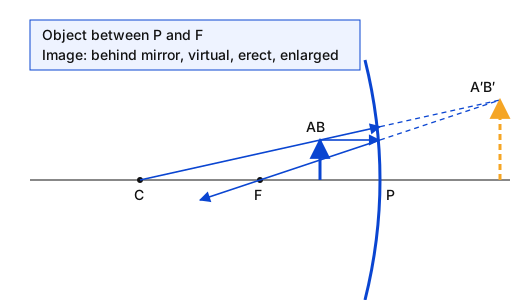
In a concave mirror, the object is placed between the pole and the focus point of the mirror. What is the nature of the image?
एक अवतल दर्पण में, वस्तु को दर्पण के ध्रुव और फोकस बिंदु के बीच रखा गया है। प्रतिबिंब की प्रकृति क्या है?
  1. AVirtual and invertedआभासी और उल्टा
  2. BReal and erectवास्तविक और सीधा
  3. CVirtual and erectआभासी और सीधा
  4. DReal and invertedवास्तविक और उल्टा
Show answer

Concept: For a concave mirror, an object placed between pole P and focus F gives an image behind the mirror.

  1. A ray parallel to the axis reflects through F; a ray through C reflects back on itself.
  2. The reflected rays diverge, so they meet only when extended behind the mirror.
  3. Hence the image is virtual, erect and enlarged (used in shaving/make-up mirrors).

Yaad rakhein: Concave mirror gives a virtual, erect image only when the object is between P and F.

Answer: (C) Virtual and erect

अवधारणा: अवतल दर्पण में, ध्रुव P और फोकस F के बीच रखी वस्तु का प्रतिबिंब दर्पण के पीछे बनता है।

  1. मुख्य अक्ष के समांतर किरण परावर्तन के बाद F से गुजरती है; C से जाने वाली किरण उसी पथ पर लौटती है।
  2. परावर्तित किरणें अपसारी होती हैं, इसलिए ये दर्पण के पीछे बढ़ाने पर ही मिलती हैं।
  3. अतः प्रतिबिंब आभासी, सीधा और बड़ा होता है (दाढ़ी बनाने का दर्पण)।

याद रखें: अवतल दर्पण आभासी व सीधा प्रतिबिंब केवल तब देता है जब वस्तु P और F के बीच हो।

उत्तर: (C) आभासी और सीधा

RRB Technician Grade IIIGeneral ScienceImage by concave mirrorRRB Technician Grade III 2024 · 28 Dec Shift 2 →