Question bank

Q&A: practice questions with answers

Search questions on any topic. Filter by exam category, exam, subject and topic, try the question, then open the answer and explanation.

Courses – airGurukul

3,200 questions found.

Q921.
The value of (−53)×(925)+(15−3)=?
(−53)×(925)+(15−3)=? का मान क्या है?
  1. A95
  2. B−175
  3. C0
  4. D−45
Show answer

Concept: Do the multiplication first, then the bracket, then add.

  1. (−53)×925=−35.
  2. 15−3=−145.
  3. −35−145=−175.

Trick: Use denominator 5 throughout: −35+15−155=−175.

Answer: (B) −175

अवधारणा: पहले गुणा, फिर कोष्ठक, फिर जोड़ें।

  1. (−53)×925=−35।
  2. 15−3=−145।
  3. −35−145=−175।

ट्रिक: सब का हर 5 रखें: −35+15−155=−175।

उत्तर: (B) −175

RRB Technician Grade IIIMathematicsFractionsRRB Technician Grade III 2024 · 27 Dec Shift 3 →
Q922.
Select the term which is not an identity.
उस पद का चयन कीजिए जो सर्वसमिका नहीं है।
  1. A(a+b)2=a2+b2
  2. B(a+b)2=a2+b2+2ab
  3. C(a+1)(a+2)=a2+3a+2
  4. D(a−b)2=a2+b2−2ab
Show answer

Concept: An identity is true for all values of the variables.

  1. (a+b)2=a2+b2+2ab, so (a+b)2=a2+b2 misses 2ab.
  2. Test a=b=1: LHS =4, RHS =2 – false.
  3. Options (B), (C), (D) are standard identities.

Trick: Put a=b=1 in each option; the one that fails is not an identity.

Answer: (A) (a+b)2=a2+b2

अवधारणा: सर्वसमिका चरों के सभी मानों के लिए सत्य होती है।

  1. (a+b)2=a2+b2+2ab, अतः (a+b)2=a2+b2 में 2ab छूट गया है।
  2. a=b=1 रखें: बायाँ पक्ष =4, दायाँ =2 – असत्य।
  3. विकल्प (B), (C), (D) मानक सर्वसमिकाएँ हैं।

ट्रिक: हर विकल्प में a=b=1 रखें; जो असत्य हो वही सर्वसमिका नहीं है।

उत्तर: (A) (a+b)2=a2+b2

RRB Technician Grade IIIMathematicsAlgebraic IdentitiesRRB Technician Grade III 2024 · 27 Dec Shift 3 →
Q923.
If 6 men and 8 boys can do a piece of work in 10 days while 26 men and 48 boys can do the same in 2 days, the time taken by 40 men and 20 boys in doing the same type of work will be:
यदि 6 पुरुष और 8 लड़के किसी कार्य को 10 दिनों में कर सकते हैं, जबकि 26 पुरुष और 48 लड़के उसी कार्य को 2 दिनों में कर सकते हैं, तो 40 पुरुषों और 20 लड़कों द्वारा उसी प्रकार के कार्य को करने में लगने वाला समय होगा:
  1. A4 days4 दिन
  2. B5 days5 दिन
  3. C2 days2 दिन
  4. D3 days3 दिन
Show answer

Concept: Equal work: (workers × days) must be equal in both cases.

  1. 10(6m+8b)=2(26m+48b)⇒60m+80b=52m+96b.
  2. 8m=16b⇒m=2b.
  3. Total work =10(12b+8b)=200 boy-days.
  4. 40m+20b=100b; time =200100=2 days.

Trick: Convert all to boys: 1 man=2 boys, then days =total workboys.

Answer: (C) 2 days

अवधारणा: कार्य समान है: दोनों स्थितियों में (श्रमिक × दिन) बराबर।

  1. 10(6m+8b)=2(26m+48b)⇒60m+80b=52m+96b।
  2. 8m=16b⇒m=2b।
  3. कुल कार्य =10(12b+8b)=200 लड़का-दिन।
  4. 40m+20b=100b; समय =200100=2 दिन।

ट्रिक: सबको लड़कों में बदलें: 1 पुरुष=2 लड़के।

उत्तर: (C) 2 दिन

RRB Technician Grade IIIMathematicsTime and Work (Men & Boys)RRB Technician Grade III 2024 · 27 Dec Shift 3 →
Q924.
A shopkeeper allows a 4% discount on his marked price. If the cost price of an article is ₹120 and he has to make a profit of 10%, then his marked price must be:
एक दुकानदार अपने अंकित मूल्य पर 4% की छूट देता है। यदि किसी वस्तु का क्रय मूल्य ₹120 है और उसे 10% का लाभ कमाना है, तो उसका अंकित मूल्य होना चाहिए:
  1. A₹120.50
  2. B₹117.50
  3. C₹127.50
  4. D₹137.50
Show answer

Concept: SP=CP×100+P%100 and SP=MP×100−D%100.

  1. SP =120×1.1=132 (₹).
  2. MP ×0.96=132.
  3. MP =1320.96=137.50 (₹).

Trick: MP=CP×100+P100−D=120×11096=137.5.

Answer: (D) ₹137.50

अवधारणा: वि.मू.=क्र.मू.×100+लाभ%100 तथा वि.मू.=अं.मू.×100−छूट%100।

  1. विक्रय मूल्य =120×1.1=132 (₹)।
  2. अंकित मूल्य ×0.96=132।
  3. अंकित मूल्य =1320.96=137.50 (₹)।

ट्रिक: अं.मू.=क्र.मू.×100+लाभ100−छूट=120×11096=137.5।

उत्तर: (D) ₹137.50

RRB Technician Grade IIIMathematicsDiscount and ProfitRRB Technician Grade III 2024 · 27 Dec Shift 3 →
Q925.
A train of 24 carriages, each of 60 m length, while an engine also of 60 m length is running at a speed of 50 km/h. In how much time will the train cross a bridge 1.5 km long?
24 डिब्बों वाली एक रेलगाड़ी, जिसमें प्रत्येक डिब्बे की लंबाई 60 m है तथा इंजन की लंबाई भी 60 m है, 50 km/h की चाल से चल रही है। रेलगाड़ी 1.5 km लंबे पुल को कितने समय में पार करेगी?
  1. A4.4 min4.4 मिनट
  2. B3 min3 मिनट
  3. C4 min4 मिनट
  4. D3.6 min3.6 मिनट
Show answer

Concept: To cross a bridge, the train covers (train length + bridge length).

  1. Train length =(24+1)×60=1500 m.
  2. Distance =1500+1500=3000 m =3 km.
  3. Time =350 h =350×60=3.6 min.

Trick: Keep km and hours: 3 km50 km/h×60 gives minutes directly.

Answer: (D) 3.6 min

अवधारणा: पुल पार करने में रेलगाड़ी (रेल की लंबाई + पुल की लंबाई) तय करती है।

  1. रेल की लंबाई =(24+1)×60=1500 मी।
  2. दूरी =1500+1500=3000 मी =3 किमी।
  3. समय =350 घंटा =350×60=3.6 मिनट।

ट्रिक: किमी और घंटे में ही गणना करें, फिर ×60 से मिनट।

उत्तर: (D) 3.6 मिनट

RRB Technician Grade IIIMathematicsSpeed, Time and Distance (Trains)RRB Technician Grade III 2024 · 27 Dec Shift 3 →
Q926.
JGOK is related to HEMI in a certain way based on the English alphabetical order. In the same way, TQYU is related to ROWS. To which of the following options is NKSO related, following the same logic?
अंग्रेजी वर्णमाला क्रम के आधार पर JGOK एक निश्चित प्रकार से HEMI से संबंधित है। उसी प्रकार, TQYU, ROWS से संबंधित है। समान तर्क का अनुसरण करते हुए, NKSO निम्नलिखित में से किस विकल्प से संबंधित है?
  1. ALIMQ
  2. BLIQM
  3. CILMQ
  4. DILQM
Show answer

Concept: Find the shift applied to each letter of the first pair and apply it to NKSO.

  1. J→H, G→E, O→M, K→I: each letter moves back 2 (−2).
  2. Check: T→R, Q→O, Y→W, U→S – also −2.
  3. N→L, K→I, S→Q, O→M gives LIQM.

Trick: Same position-wise shift in both example pairs → apply directly letter by letter.

Answer: (B) LIQM

अवधारणा: पहले युग्म में प्रत्येक अक्षर का खिसकाव ज्ञात करें और NKSO पर लगाएँ।

  1. J→H, G→E, O→M, K→I: प्रत्येक अक्षर 2 पीछे (−2)।
  2. जाँच: T→R, Q→O, Y→W, U→S – यहाँ भी −2।
  3. N→L, K→I, S→Q, O→M से LIQM।

ट्रिक: दोनों उदाहरणों में समान खिसकाव → सीधे अक्षर-दर-अक्षर लगाएँ।

उत्तर: (B) LIQM

RRB Technician Grade IIIGeneral Intelligence and ReasoningLetter AnalogyRRB Technician Grade III 2024 · 27 Dec Shift 3 →
Q927.
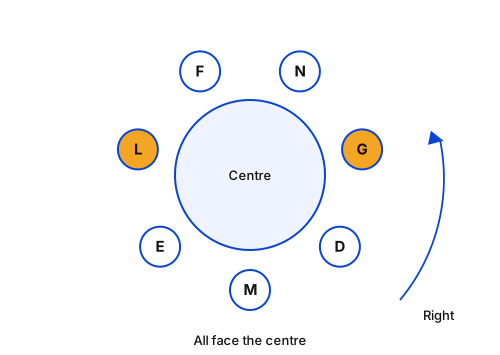
D, E, F, G, L, M and N are sitting around a circular table facing the centre. Only two people sit between M and N when counted from the right of M. Only two people sit between N and E when counted from the right of N. Only three people sit between M and F when counted from the right of M. D sits to the immediate left of G. Who sits third to the left of L?
D, E, F, G, L, M और N एक वृत्ताकार मेज के चारों ओर केंद्र की ओर मुख करके बैठे हैं। M के दाईं ओर से गिनने पर M और N के बीच केवल दो व्यक्ति बैठे हैं। N के दाईं ओर से गिनने पर N और E के बीच केवल दो व्यक्ति बैठे हैं। M के दाईं ओर से गिनने पर M और F के बीच केवल तीन व्यक्ति बैठे हैं। D, G के ठीक बाईं ओर बैठा है। L के बाईं ओर तीसरे स्थान पर कौन बैठा है?
  1. AN
  2. BD
  3. CM
  4. DG
Show answer

Concept: Facing the centre, 'right' is anticlockwise and 'left' is clockwise. Fix M first.

  1. Two people between M and N from M's right → N is 3rd seat to M's right.
  2. Two between N and E from N's right → E is 3rd to N's right, i.e. immediate left of M.
  3. Three between M and F from M's right → F is 4th to M's right.
  4. Remaining seats go to D, G, L; D immediate left of G → order M, D, G, N, F, L, E (going right).
  5. Third to the left of L: F, N, G → G.

Yaad rakhein: Draw the circle, place the fixed person, then count seats exactly – left/right flips when facing the centre.

Answer: (D) G

अवधारणा: केंद्र की ओर मुख होने पर 'दायाँ' वामावर्त और 'बायाँ' दक्षिणावर्त होता है। पहले M को रखें।

  1. M के दाएँ से गिनने पर M और N के बीच दो → N, M के दाएँ तीसरे स्थान पर।
  2. N के दाएँ से N और E के बीच दो → E, M के ठीक बाएँ।
  3. M के दाएँ से M और F के बीच तीन → F, M के दाएँ चौथे स्थान पर।
  4. बचे स्थान D, G, L के; D, G के ठीक बाएँ → क्रम M, D, G, N, F, L, E (दाईं ओर)।
  5. L के बाएँ तीसरा: F, N, G → G।

याद रखें: वृत्त बनाएँ, स्थिर व्यक्ति रखें, फिर स्थान गिनें – केंद्र की ओर मुख होने पर दिशाएँ उलट जाती हैं।

उत्तर: (D) G

RRB Technician Grade IIIGeneral Intelligence and ReasoningCircular Seating ArrangementRRB Technician Grade III 2024 · 27 Dec Shift 3 →
Q928.
Refer to the given number and symbol series and answer the question that follows. Counting to be done from left to right only.
(Left) & 3 Ω 9 # 2 & % 4 6 @ 8 $ 7 1 * £ 5 (Right)
If all the symbols are dropped from the series, which of the following will be seventh from the right?
दी गई संख्या और प्रतीक श्रृंखला को देखिए और उसके बाद दिए गए प्रश्न का उत्तर दीजिए। गिनती केवल बाएँ से दाएँ की जानी है।
(बाएँ) & 3 Ω 9 # 2 & % 4 6 @ 8 $ 7 1 * £ 5 (दाएँ)
यदि श्रृंखला से सभी प्रतीक हटा दिए जाएँ, तो निम्नलिखित में से कौन दाएँ से सातवाँ होगा?
  1. A2
  2. B1
  3. C7
  4. D9
Show answer

Concept: Remove all symbols, then count from the right end.

  1. Numbers only: 3 9 2 4 6 8 7 1 5.
  2. From the right: 5 (1st), 1 (2nd), 7 (3rd), 8 (4th), 6 (5th), 4 (6th), 2 (7th).

Trick: 7th from right among 9 numbers = (9−7+1)=3rd from left = 2.

Answer: (A) 2

अवधारणा: सभी प्रतीक हटाएँ, फिर दाएँ सिरे से गिनें।

  1. केवल संख्याएँ: 3 9 2 4 6 8 7 1 5।
  2. दाएँ से: 5 (1), 1 (2), 7 (3), 8 (4), 6 (5), 4 (6), 2 (7)।

ट्रिक: 9 संख्याओं में दाएँ से 7वाँ = बाएँ से (9−7+1)=3रा = 2।

उत्तर: (A) 2

RRB Technician Grade IIIGeneral Intelligence and ReasoningNumber–Symbol SeriesRRB Technician Grade III 2024 · 27 Dec Shift 3 →
Q929.
In a row of 45 students, facing north, Kevin is 16th from the right end. If Luther is 10th to the left of Kevin, what is Luther's position from the left end of the row?
उत्तर की ओर मुख करके खड़े 45 विद्यार्थियों की एक पंक्ति में, केविन दाएँ छोर से 16वें स्थान पर है। यदि लूथर, केविन के बाईं ओर 10वें स्थान पर है, तो पंक्ति के बाएँ छोर से लूथर का स्थान क्या है?
  1. A20th20वाँ
  2. B22nd22वाँ
  3. C21st21वाँ
  4. D23rd23वाँ
Show answer

Concept: Position from left =Total−Position from right+1.

  1. Kevin from left =45−16+1=30th.
  2. Facing north, left is the left end; Luther is 10 places to Kevin's left.
  3. Luther from left =30−10=20th.

Trick: Convert to one end first, then move left (subtract) or right (add).

Answer: (A) 20th

अवधारणा: बाएँ से स्थान=कुल−दाएँ से स्थान+1।

  1. केविन बाएँ से =45−16+1=30वाँ।
  2. लूथर, केविन के 10 स्थान बाएँ है।
  3. लूथर बाएँ से =30−10=20वाँ।

ट्रिक: पहले एक सिरे से स्थिति निकालें, फिर बाएँ (घटाएँ) या दाएँ (जोड़ें) चलें।

उत्तर: (A) 20वाँ

RRB Technician Grade IIIGeneral Intelligence and ReasoningRanking and OrderRRB Technician Grade III 2024 · 27 Dec Shift 3 →
Q930.
If ‘A’ stands for ‘÷’, ‘B’ stands for ‘×’, ‘C’ stands for ‘+’ and ‘D’ stands for ‘−’, what will come in place of the question mark ‘?’ in the following equation?
85 A 17 C 82 D 11 B 2 = ?
यदि ‘A’ का अर्थ ‘÷’, ‘B’ का अर्थ ‘×’, ‘C’ का अर्थ ‘+’ और ‘D’ का अर्थ ‘−’ है, तो निम्नलिखित समीकरण में प्रश्नचिह्न ‘?’ के स्थान पर क्या आएगा?
85 A 17 C 82 D 11 B 2 = ?
  1. A66
  2. B65
  3. C67
  4. D68
Show answer

Concept: Replace the letters by signs, then apply BODMAS.

  1. 85÷17+82−11×2.
  2. =5+82−22.
  3. =65.

Yaad rakhein: Do ÷ and × first, then + and − from left to right.

Answer: (B) 65

अवधारणा: अक्षरों के स्थान पर चिह्न रखें, फिर BODMAS लगाएँ।

  1. 85÷17+82−11×2।
  2. =5+82−22।
  3. =65।

याद रखें: पहले ÷ और ×, फिर बाएँ से दाएँ + और −।

उत्तर: (B) 65

RRB Technician Grade IIIGeneral Intelligence and ReasoningMathematical OperationsRRB Technician Grade III 2024 · 27 Dec Shift 3 →
Q931.
Read the given statements and conclusions carefully. You have to take the given statements to be true even if they seem to be at variance from commonly known facts and decide which conclusion(s) logically follow(s) from the given statements.
Statements:
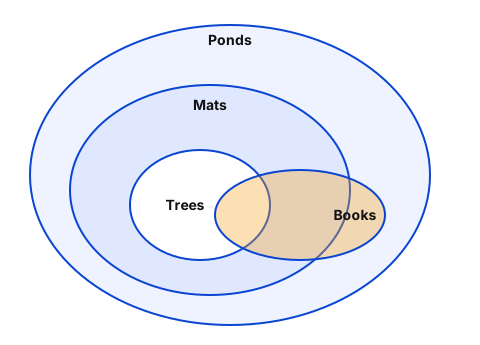
Some books are trees.
All trees are mats.
All mats are ponds.
Conclusions:
(I) Some ponds are books.
(II) Some mats are books.
दिए गए कथनों और निष्कर्षों को ध्यानपूर्वक पढ़िए। आपको दिए गए कथनों को सत्य मानना है, भले ही वे सामान्यतः ज्ञात तथ्यों से भिन्न प्रतीत होते हों, और तय कीजिए कि कौन-सा/से निष्कर्ष दिए गए कथनों का तार्किक रूप से अनुसरण करता है/करते हैं।
कथन:
कुछ किताबें, पेड़ हैं।
सभी पेड़, चटाइयाँ हैं।
सभी चटाइयाँ, तालाब हैं।
निष्कर्ष:
(I) कुछ तालाब, किताबें हैं।
(II) कुछ चटाइयाँ, किताबें हैं।
  1. ANeither conclusion (I) nor (II) follows.न तो निष्कर्ष (I) और न ही (II) अनुसरण करता है।
  2. BBoth conclusions (I) and (II) follow.निष्कर्ष (I) और (II) दोनों अनुसरण करते हैं।
  3. COnly conclusion (I) follows.केवल निष्कर्ष (I) अनुसरण करता है।
  4. DOnly conclusion (II) follows.केवल निष्कर्ष (II) अनुसरण करता है।
Show answer

Concept: 'Some' + 'All' gives a 'Some' conclusion.

  1. Some books are trees + all trees are mats → some books are mats. (II) follows.
  2. All mats are ponds → those books are also ponds → some ponds are books. (I) follows.

Yaad rakhein: Some A are B, all B are C ⇒ some A are C (and some C are A).

Answer: (B) Both conclusions (I) and (II) follow.

अवधारणा: 'कुछ' + 'सभी' से 'कुछ' वाला निष्कर्ष मिलता है।

  1. कुछ किताबें पेड़ हैं + सभी पेड़ चटाई हैं → कुछ किताबें चटाई हैं। (II) अनुसरण करता है।
  2. सभी चटाई तालाब हैं → वे किताबें तालाब भी हैं → कुछ तालाब किताबें हैं। (I) अनुसरण करता है।

याद रखें: कुछ A, B हैं, सभी B, C हैं ⇒ कुछ A, C हैं (और कुछ C, A हैं)।

उत्तर: (B) निष्कर्ष (I) और (II) दोनों अनुसरण करते हैं।

RRB Technician Grade IIIGeneral Intelligence and ReasoningSyllogismRRB Technician Grade III 2024 · 27 Dec Shift 3 →
Q932.
In a certain code language,
P + Q means ‘P is the father of Q’,
P − Q means ‘P is the son of Q’,
P × Q means ‘P is the wife of Q’ and
P ÷ Q means ‘P is the brother of Q’.
Based on the above, how is K related to R if ‘M ÷ N × O + K × L − R’?
एक निश्चित कूट भाषा में,
P + Q का अर्थ है ‘P, Q का पिता है’,
P − Q का अर्थ है ‘P, Q का पुत्र है’,
P × Q का अर्थ है ‘P, Q की पत्नी है’ और
P ÷ Q का अर्थ है ‘P, Q का भाई है’।
उपरोक्त के आधार पर, यदि ‘M ÷ N × O + K × L − R’ है, तो K का R से क्या संबंध है?
  1. ADaughterपुत्री
  2. BSon's wifeपुत्रवधू
  3. CMotherमाता
  4. DSonपुत्र
Show answer

Concept: Decode each symbol from left to right.

  1. M ÷ N: M is brother of N.
  2. N × O: N is wife of O.
  3. O + K: O is father of K.
  4. K × L: K is wife of L; L − R: L is son of R.
  5. So K is the wife of R's son.

Yaad rakhein: Read pair by pair and track gender: × makes K female, − makes L R's son.

Answer: (B) Son's wife

अवधारणा: चिह्नों को बाएँ से दाएँ एक-एक करके हल करें।

  1. M ÷ N: M, N का भाई है।
  2. N × O: N, O की पत्नी है।
  3. O + K: O, K का पिता है।
  4. K × L: K, L की पत्नी है; L − R: L, R का पुत्र है।
  5. अतः K, R के पुत्र की पत्नी (पुत्रवधू) है।

याद रखें: जोड़ी-दर-जोड़ी पढ़ें और लिंग पर ध्यान दें: × से K स्त्री, − से L, R का पुत्र।

उत्तर: (B) पुत्रवधू

RRB Technician Grade IIIGeneral Intelligence and ReasoningCoded Blood RelationsRRB Technician Grade III 2024 · 27 Dec Shift 3 →
Q933.
In the following number-pairs, the second number is obtained by applying certain mathematical operations to the first number. Which numbers should replace X and Y so that the pattern followed by the two numbers on the left side of :: is same as that on the right side of ::?
(NOTE: Operations should be performed on the whole numbers, without breaking down the numbers into its constituent digits. E.g. 13 – Operations on 13 such as adding/subtracting/multiplying etc. to 13 can be performed. Breaking down 13 into 1 and 3 and then performing mathematical operations on 1 and 3 is not allowed.)
X : 163 :: 74 : Y
निम्नलिखित संख्या-युग्मों में, पहली संख्या पर कुछ गणितीय संक्रियाएँ करके दूसरी संख्या प्राप्त की जाती है। X और Y के स्थान पर कौन-सी संख्याएँ आनी चाहिए ताकि :: के बाईं ओर की दोनों संख्याओं द्वारा अनुसरित पैटर्न वही हो जो :: के दाईं ओर की संख्याओं द्वारा अनुसरित है?
(ध्यान दें: संक्रियाएँ संख्याओं को उनके घटक अंकों में तोड़े बिना, पूर्ण संख्याओं पर की जानी चाहिए। उदाहरण: 13 – 13 पर संक्रियाएँ जैसे 13 में जोड़ना/घटाना/गुणा करना आदि किया जा सकता है। 13 को 1 और 3 में तोड़कर फिर 1 और 3 पर गणितीय संक्रियाएँ करने की अनुमति नहीं है।)
X : 163 :: 74 : Y
  1. AX = 81, Y = 149
  2. BX = 93, Y = 156
  3. CX = 86, Y = 129
  4. DX = 79, Y = 145
Show answer

Concept: Test each option to find one rule that works on both sides.

  1. Option (A): 81×2+1=163 ✓.
  2. Same rule: 74×2+1=149 ✓.
  3. Other options fail, e.g. 93×2+1=187≠163.

Trick: 163 is odd and close to 2×81 → try 2x+1 first.

Answer: (A) X = 81, Y = 149

अवधारणा: हर विकल्प जाँचें और ऐसा नियम खोजें जो दोनों ओर लागू हो।

  1. विकल्प (A): 81×2+1=163 ✓।
  2. वही नियम: 74×2+1=149 ✓।
  3. अन्य विकल्प असफल, जैसे 93×2+1=187≠163।

ट्रिक: 163 विषम और 2×81 के पास है → पहले 2x+1 आज़माएँ।

उत्तर: (A) X = 81, Y = 149

RRB Technician Grade IIIGeneral Intelligence and ReasoningNumber Pair AnalogyRRB Technician Grade III 2024 · 27 Dec Shift 3 →
Q934.
In a certain code language, ‘PILED’ is coded as ‘65428’ and ‘PEDAL’ is coded as ‘57628’. What is the code for ‘I’ in the given code language?
एक निश्चित कूट भाषा में, ‘PILED’ को ‘65428’ के रूप में कूटबद्ध किया जाता है और ‘PEDAL’ को ‘57628’ के रूप में कूटबद्ध किया जाता है। दी गई कूट भाषा में ‘I’ के लिए कूट क्या है?
  1. A8
  2. B2
  3. C4
  4. D6
Show answer

Concept: Common letters in two words share the common digits (order may be jumbled).

  1. PILED = {P, I, L, E, D}, digits {6, 5, 4, 2, 8}.
  2. PEDAL = {P, E, D, A, L}, digits {5, 7, 6, 2, 8}.
  3. Common letters P, L, E, D ↔ common digits 6, 5, 2, 8.
  4. Letter left in PILED is I, digit left is 4 → I = 4.

Trick: The letter present only in the first word takes the digit present only in its code.

Answer: (C) 4

अवधारणा: दो शब्दों के उभयनिष्ठ अक्षरों के कूट भी उभयनिष्ठ होते हैं (क्रम बदला हो सकता है)।

  1. PILED = {P, I, L, E, D}, अंक {6, 5, 4, 2, 8}।
  2. PEDAL = {P, E, D, A, L}, अंक {5, 7, 6, 2, 8}।
  3. उभयनिष्ठ अक्षर P, L, E, D ↔ उभयनिष्ठ अंक 6, 5, 2, 8।
  4. PILED में बचा अक्षर I और बचा अंक 4 → I = 4।

ट्रिक: केवल पहले शब्द में मौजूद अक्षर को उसके कूट में बचा हुआ अंक मिलता है।

उत्तर: (C) 4

RRB Technician Grade IIIGeneral Intelligence and ReasoningCoding–DecodingRRB Technician Grade III 2024 · 27 Dec Shift 3 →
Q935.
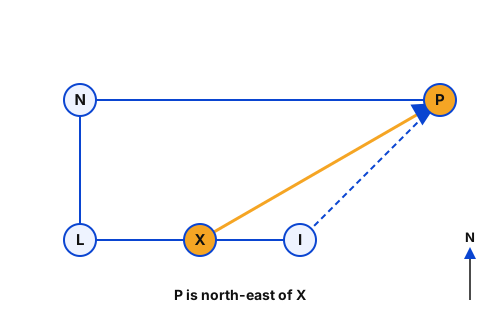
Town I is to the east of Town X. Town L is to the west of Town X. Town N is to the north of Town L. Town P is to the north-east of Town L. Town P is to the east of Town N. Town I is to the south-west of Town P. What is the position of Town P with respect to Town X?
नगर I, नगर X के पूर्व में है। नगर L, नगर X के पश्चिम में है। नगर N, नगर L के उत्तर में है। नगर P, नगर L के उत्तर-पूर्व में है। नगर P, नगर N के पूर्व में है। नगर I, नगर P के दक्षिण-पश्चिम में है। नगर X के सापेक्ष नगर P की स्थिति क्या है?
  1. AWestपश्चिम
  2. BNorth-eastउत्तर-पूर्व
  3. CSouth-westदक्षिण-पश्चिम
  4. DEastपूर्व
Show answer

Concept: Place the towns on a grid one statement at a time.

  1. L — X — I lie on a west–east line (L west, I east of X).
  2. N is north of L; P is east of N and north-east of L.
  3. I is south-west of P, so P lies north-east of I.
  4. X is west of I, so P is north and east of X → north-east.

Trick: If P is north-east of a town that is east of X, P is north-east of X too.

Answer: (B) North-east

अवधारणा: कथनों के अनुसार कस्बों को एक-एक कर ग्रिड पर रखें।

  1. L — X — I पश्चिम–पूर्व रेखा पर (L पश्चिम, I पूर्व)।
  2. N, L के उत्तर में; P, N के पूर्व में तथा L के उत्तर-पूर्व में।
  3. I, P के दक्षिण-पश्चिम में, अतः P, I के उत्तर-पूर्व में।
  4. X, I के पश्चिम में है, अतः P, X के उत्तर-पूर्व में।

ट्रिक: यदि P, X के पूर्व वाले कस्बे के उत्तर-पूर्व में है, तो P, X के भी उत्तर-पूर्व में होगा।

उत्तर: (B) उत्तर-पूर्व

RRB Technician Grade IIIGeneral Intelligence and ReasoningDirection SenseRRB Technician Grade III 2024 · 27 Dec Shift 3 →
Q936.
Based on the English alphabetical order, three of the following four letter-cluster pairs are alike in a certain way and thus form a group. Which pair does not belong to that group?
(Note: The odd one out is not based on the number of consonants/vowels or their position in the letter-cluster.)
अंग्रेजी वर्णमाला क्रम के आधार पर, निम्नलिखित चार अक्षर-समूह युग्मों में से तीन किसी निश्चित प्रकार से एकसमान हैं और इस प्रकार एक समूह बनाते हैं। कौन-सा युग्म उस समूह से संबंधित नहीं है?
(ध्यान दें: असंगत युग्म, व्यंजनों/स्वरों की संख्या या अक्षर-समूह में उनके स्थान पर आधारित नहीं है।)
  1. AIM-JL
  2. BFJ-GI
  3. CQU-RT
  4. DLP-MQ
Show answer

Concept: Compare letter positions of the first cluster with the second.

  1. IM-JL: I+1=J, M−1=L.
  2. FJ-GI: F+1=G, J−1=I; QU-RT: Q+1=R, U−1=T.
  3. LP-MQ: L+1=M but P+1=Q (not −1).
  4. So LP-MQ breaks the (+1, −1) pattern.

Trick: Write the shifts as (+1, −1) for each pair – the pair with a different sign is the odd one.

Answer: (D) LP-MQ

अवधारणा: पहले समूह के अक्षरों की तुलना दूसरे समूह से करें।

  1. IM-JL: I+1=J, M−1=L।
  2. FJ-GI: F+1=G, J−1=I; QU-RT: Q+1=R, U−1=T।
  3. LP-MQ: L+1=M पर P+1=Q (−1 नहीं)।
  4. अतः LP-MQ, (+1, −1) प्रतिरूप तोड़ता है।

ट्रिक: हर युग्म के लिए (+1, −1) लिखें – जिसका चिह्न अलग हो वही विषम है।

उत्तर: (D) LP-MQ

RRB Technician Grade IIIGeneral Intelligence and ReasoningOdd One Out (Letter Pairs)RRB Technician Grade III 2024 · 27 Dec Shift 3 →
Q937.
Which of the following options should come in place of the question mark (?) in the given series based on the English alphabetical order?
RMK, UOL, XQM, ASN, ?
अंग्रेजी वर्णमाला क्रम के आधार पर दी गई श्रृंखला में प्रश्न चिह्न (?) के स्थान पर निम्नलिखित में से कौन-सा विकल्प आना चाहिए?
RMK, UOL, XQM, ASN, ?
  1. ADUO
  2. BDUP
  3. CEUO
  4. DDQO
Show answer

Concept: Track each letter position separately.

  1. 1st letters: R, U, X, A → +3 each → D.
  2. 2nd letters: M, O, Q, S → +2 each → U.
  3. 3rd letters: K, L, M, N → +1 each → O.
  4. Next term: DUO.

Trick: After Z wrap to A: X + 3 = A, A + 3 = D.

Answer: (A) DUO

अवधारणा: प्रत्येक स्थान के अक्षर को अलग-अलग देखें।

  1. पहले अक्षर: R, U, X, A → हर बार +3 → D।
  2. दूसरे अक्षर: M, O, Q, S → हर बार +2 → U।
  3. तीसरे अक्षर: K, L, M, N → हर बार +1 → O।
  4. अगला पद: DUO।

ट्रिक: Z के बाद फिर A से गिनें: X + 3 = A, A + 3 = D।

उत्तर: (A) DUO

RRB Technician Grade IIIGeneral Intelligence and ReasoningLetter SeriesRRB Technician Grade III 2024 · 27 Dec Shift 3 →
Q938.
If each vowel in the word MAJORITY is changed to the letter following it in the English alphabetical order and each consonant is changed to the letter preceding it in the English alphabetical order, then how many letters are common between the original word and the group of letters thus formed?
यदि शब्द MAJORITY में प्रत्येक स्वर को अंग्रेजी वर्णमाला क्रम में उसके बाद आने वाले अक्षर में बदल दिया जाए और प्रत्येक व्यंजन को अंग्रेजी वर्णमाला क्रम में उसके पहले आने वाले अक्षर में बदल दिया जाए, तो मूल शब्द और इस प्रकार बने अक्षर-समूह में कितने अक्षर उभयनिष्ठ हैं?
  1. A3
  2. B2
  3. C4
  4. D1
Show answer

Concept: Vowels → next letter, consonants → previous letter.

  1. M→L, A→B, J→I, O→P, R→Q, I→J, T→S, Y→X.
  2. New group: L B I P Q J S X.
  3. Letters also in MAJORITY: I and J → 2.

Trick: J becomes I and I becomes J – they swap, so both stay common.

Answer: (B) 2

अवधारणा: स्वर → अगला अक्षर, व्यंजन → पिछला अक्षर।

  1. M→L, A→B, J→I, O→P, R→Q, I→J, T→S, Y→X।
  2. नया समूह: L B I P Q J S X।
  3. MAJORITY में भी मौजूद अक्षर: I और J → 2।

ट्रिक: J, I बनता है और I, J बनता है – दोनों अदला-बदली से उभयनिष्ठ रहते हैं।

उत्तर: (B) 2

RRB Technician Grade IIIGeneral Intelligence and ReasoningLetter CodingRRB Technician Grade III 2024 · 27 Dec Shift 3 →
Q939.
Given below is a statement followed by two possible reasons numbered I and II. Read the statement carefully and decide which of the two explain(s) the event/observation/information given in the statement.
Statement - The movement of a person or people from one country, locality, place of residence to settle in another country, locality, place of residence is known as migration.
Reasons:
I. Some person or people migrate in search of work or economic opportunities, to join family, or to study. Others migrate to escape conflict, persecution, terrorism, or human rights violations.
II. Some person or people migrate in response to the adverse effects of climate change, natural disasters, or other environmental factors.
नीचे एक कथन दिया गया है, जिसके बाद I और II क्रमांकित दो संभावित कारण दिए गए हैं। कथन को ध्यानपूर्वक पढ़िए और निर्णय लीजिए कि दोनों में से कौन-सा/से कारण कथन में दी गई घटना/अवलोकन/सूचना की व्याख्या करता/करते है/हैं।
कथन - किसी व्यक्ति या लोगों का एक देश, इलाके, निवास स्थान से दूसरे देश, इलाके, निवास स्थान में बसने के लिए जाना प्रवासन (migration) कहलाता है।
कारण:
I. कुछ व्यक्ति या लोग काम या आर्थिक अवसरों की तलाश में, परिवार के साथ रहने के लिए, या पढ़ाई के लिए प्रवास करते हैं। अन्य लोग संघर्ष, उत्पीड़न, आतंकवाद या मानवाधिकार उल्लंघनों से बचने के लिए प्रवास करते हैं।
II. कुछ व्यक्ति या लोग जलवायु परिवर्तन, प्राकृतिक आपदाओं या अन्य पर्यावरणीय कारकों के प्रतिकूल प्रभावों के कारण प्रवास करते हैं।
  1. AOnly I is a possible reason.केवल I एक संभावित कारण है।
  2. BOnly II is a possible reason.केवल II एक संभावित कारण है।
  3. CNeither I nor II is a possible reason.न तो I और न ही II एक संभावित कारण है।
  4. DBoth I and II are possible reasons.I और II दोनों संभावित कारण हैं।
Show answer

Concept: A valid reason must directly explain why people migrate.

  1. Reason I gives work, family, study, conflict and persecution – all genuine causes of migration.
  2. Reason II gives climate change and natural disasters – also genuine causes.
  3. Both explain the movement described in the statement.

Yaad rakhein: Push factors (conflict, disasters) and pull factors (jobs, study, family) both cause migration.

Answer: (D) Both I and II are possible reasons.

अवधारणा: मान्य कारण वह है जो सीधे बताए कि लोग प्रवास क्यों करते हैं।

  1. कारण I में काम, परिवार, पढ़ाई, संघर्ष और उत्पीड़न – सभी प्रवास के वास्तविक कारण हैं।
  2. कारण II में जलवायु परिवर्तन और प्राकृतिक आपदाएँ – ये भी वास्तविक कारण हैं।
  3. दोनों कथन में बताए गए आवागमन को स्पष्ट करते हैं।

याद रखें: धकेलने वाले (संघर्ष, आपदा) और खींचने वाले (नौकरी, पढ़ाई, परिवार) दोनों कारक प्रवास कराते हैं।

उत्तर: (D) I और II दोनों संभावित कारण हैं।

RRB Technician Grade IIIGeneral Intelligence and ReasoningStatement and ReasonsRRB Technician Grade III 2024 · 27 Dec Shift 3 →
Q940.
In the following number-pairs, the second number is obtained by applying certain mathematical operations to the first number. Which numbers should replace X and Y so that the pattern followed by the two numbers on the left side of :: is the same as that on the right side of :: ?
(NOTE: Operations should be performed on the whole numbers, without breaking down the numbers into its constituent digits. E.g. 13 – Operations on 13 such as adding /subtracting /multiplying etc. to 13 can be performed. Breaking down 13 into 1 and 3 and then performing mathematical operations on 1 and 3 is not allowed.)
X : 75 :: 29 : Y
निम्नलिखित संख्या-युग्मों में, पहली संख्या पर कुछ गणितीय संक्रियाएँ करके दूसरी संख्या प्राप्त की जाती है। X और Y के स्थान पर कौन-सी संख्याएँ आनी चाहिए ताकि :: के बाईं ओर की दोनों संख्याओं द्वारा अनुसरण किया गया पैटर्न वही हो जो :: के दाईं ओर है?
(नोट: संक्रियाएँ संख्याओं को उनके घटक अंकों में विभाजित किए बिना, पूर्ण संख्याओं पर की जानी चाहिए। उदाहरण के लिए 13 – 13 पर संक्रियाएँ जैसे 13 में जोड़ना/घटाना/गुणा करना आदि किया जा सकता है। 13 को 1 और 3 में विभाजित करना और फिर 1 और 3 पर गणितीय संक्रियाएँ करने की अनुमति नहीं है।)
X : 75 :: 29 : Y
  1. AX = 26, Y = 76
  2. BX = 28, Y = 74
  3. CX = 23, Y = 81
  4. DX = 21, Y = 89
Show answer

Concept: Find one operation that works on both pairs for an option.

  1. Option (C): 23+52=75.
  2. Same rule: 29+52=81 ✓.
  3. Others fail: (A) 26→75 is +49 but 29→76 is +47; (D) +54 vs +60.

Trick: For an addition rule, Y−29 must equal 75−X; only (C) gives 52=52.

Answer: (C) X = 23, Y = 81

अवधारणा: ऐसा एक नियम खोजें जो विकल्प के दोनों युग्मों पर लागू हो।

  1. विकल्प (C): 23+52=75।
  2. वही नियम: 29+52=81 ✓।
  3. अन्य असफल: (A) में +49 और +47; (D) में +54 और +60।

ट्रिक: जोड़ के नियम में Y−29=75−X होना चाहिए; केवल (C) में 52=52।

उत्तर: (C) X = 23, Y = 81

RRB Technician Grade IIIGeneral Intelligence and ReasoningNumber Pair AnalogyRRB Technician Grade III 2024 · 27 Dec Shift 3 →