Question bank

Q&A: practice questions with answers

Search questions on any topic. Filter by exam category, exam, subject and topic, try the question, then open the answer and explanation.

Courses – airGurukul

3,200 questions found.

Q1021.
By selling an article for ₹19.50, a dealer makes a profit of 30%. By how much should he increase his selling price so as to make a profit of 40%?
एक वस्तु को ₹19.50 में बेचने पर एक व्यापारी को 30% का लाभ होता है। 40% का लाभ प्राप्त करने के लिए उसे अपने विक्रय मूल्य में कितनी वृद्धि करनी चाहिए?
  1. A₹3
  2. B₹1.75
  3. C₹2
  4. D₹1.50
Show answer

Concept: CP=SP×100100+Profit%.

  1. CP=19.50×100130=15.
  2. New SP for 40% profit =15×1.4=21.
  3. Increase =21−19.50=1.50.

Trick: Extra 10% profit is on CP: 10% of 15 = ₹1.50.

Answer: (D) ₹1.50

अवधारणा: क्रय मूल्य=विक्रय मूल्य×100100+लाभ%.

  1. क्रय मूल्य =19.50×100130=15.
  2. 40% लाभ हेतु नया विक्रय मूल्य =15×1.4=21.
  3. वृद्धि =21−19.50=1.50.

ट्रिक: अतिरिक्त 10% लाभ क्रय मूल्य पर: 15 का 10%= ₹1.50.

उत्तर: (D) ₹1.50

RRB Technician Grade IIIMathematicsProfit and LossRRB Technician Grade III 2024 · 27 Dec Shift 2 →
Q1022.
If x+y=20 and xy=84, find the value of x2+y2.
यदि x+y=20 और xy=84 है, तो x2+y2 का मान ज्ञात कीजिए।
  1. A264
  2. B212
  3. C232
  4. D244
Show answer

Concept: x2+y2=(x+y)2−2xy.

  1. (x+y)2=202=400.
  2. x2+y2=400−2×84=400−168=232.

Trick: Here x,y=14,6: 142+62=196+36=232 ✓.

Answer: (C) 232

अवधारणा: x2+y2=(x+y)2−2xy.

  1. (x+y)2=202=400.
  2. x2+y2=400−2×84=400−168=232.

ट्रिक: यहाँ x,y=14,6: 142+62=196+36=232 ✓.

उत्तर: (C) 232

RRB Technician Grade IIIMathematicsAlgebraic IdentitiesRRB Technician Grade III 2024 · 27 Dec Shift 2 →
Q1023.
If 1.6 : 0.6 :: 0.6 : x, find the value of x.
यदि 1.6 : 0.6 :: 0.6 : x है, तो x का मान ज्ञात कीजिए।
  1. A0.275
  2. B0.225
  3. C0.25
  4. D0.98
Show answer

Concept: If a:b::b:x, then x=b2a (third proportional).

  1. 1.6:0.6::0.6:x ⇒ 1.6x=0.6×0.6=0.36.
  2. x=0.361.6=0.225.

Trick: Product of extremes = product of means: 1.6×x=0.6×0.6.

Answer: (B) 0.225

अवधारणा: यदि a:b::b:x, तो x=b2a (तृतीय समानुपाती)।

  1. 1.6:0.6::0.6:x ⇒ 1.6x=0.6×0.6=0.36.
  2. x=0.361.6=0.225.

ट्रिक: बाह्य पदों का गुणनफल = मध्य पदों का गुणनफल: 1.6×x=0.6×0.6.

उत्तर: (B) 0.225

RRB Technician Grade IIIMathematicsProportion – Third ProportionalRRB Technician Grade III 2024 · 27 Dec Shift 2 →
Q1024.
The sum of the present ages of Sarala and Kishore is 26 years. If 3 years ago, Kishore was 32 times as old as Sarala, then the present age of Sarala is:
सरला और किशोर की वर्तमान आयु का योग 26 वर्ष है। यदि 3 वर्ष पहले किशोर की आयु सरला की आयु की 32 गुना थी, तो सरला की वर्तमान आयु है:
  1. A10 years10 वर्ष
  2. B9 years9 वर्ष
  3. C12 years12 वर्ष
  4. D11 years11 वर्ष
Show answer

Concept: Let Sarala =S, Kishore =26−S. Three years ago: K−3=32(S−3).

  1. 23−S=32(S−3) ⇒ 46−2S=3S−9.
  2. 5S=55 ⇒ S=11.

Trick: 3 years ago their sum was 26−6=20, split 2:3 ⇒ Sarala 8, now 8+3=11.

Answer: (D) 11 years

अवधारणा: माना सरला =S, किशोर =26−S. 3 वर्ष पहले: K−3=32(S−3).

  1. 23−S=32(S−3) ⇒ 46−2S=3S−9.
  2. 5S=55 ⇒ S=11.

ट्रिक: 3 वर्ष पहले योग 26−6=20, अनुपात 2:3 ⇒ सरला 8, अभी 8+3=11.

उत्तर: (D) 11 वर्ष

RRB Technician Grade IIIMathematicsProblems on AgesRRB Technician Grade III 2024 · 27 Dec Shift 2 →
Q1025.
The value of M, satisfying 23×33×63=6M is:
23×33×63=6M को संतुष्ट करने वाले M का मान है:
  1. A6
  2. B8
  3. C4
  4. D2
Show answer

Concept: an×bn=(ab)n and am×an=am+n.

  1. 23×33=(2×3)3=63.
  2. 63×63=66 ⇒ M=6.

Trick: Same power 3 on all: (2×3×6)3=363=66.

Answer: (A) 6

अवधारणा: an×bn=(ab)n तथा am×an=am+n.

  1. 23×33=(2×3)3=63.
  2. 63×63=66 ⇒ M=6.

ट्रिक: सब पर घात 3: (2×3×6)3=363=66.

उत्तर: (A) 6

RRB Technician Grade IIIMathematicsIndicesRRB Technician Grade III 2024 · 27 Dec Shift 2 →
Q1026.
The marked price of an item was ₹2,000, but the shopkeeper offered successive discounts of 20% and 15% on its sale. How much did he finally sell the item for?
एक वस्तु का अंकित मूल्य ₹2,000 था, लेकिन दुकानदार ने उसकी बिक्री पर 20% और 15% की क्रमिक छूट दी। अंततः उसने वस्तु को कितने में बेचा?
  1. A₹1,360
  2. B₹1,380
  3. C₹1,260
  4. D₹1,280
Show answer

Concept: Successive discounts multiply: SP=MP×(1−d1)(1−d2).

  1. After 20%: 2000×0.8=1600.
  2. After 15%: 1600×0.85=1360.

Trick: Net discount =20+15−20×15100=32% ⇒ SP =68% of 2000 = ₹1,360.

Answer: (A) ₹1,360

अवधारणा: क्रमिक छूट गुणा होती हैं: विक्रय मूल्य=अंकित मूल्य×(1−d1)(1−d2).

  1. 20% के बाद: 2000×0.8=1600.
  2. 15% के बाद: 1600×0.85=1360.

ट्रिक: कुल छूट =20+15−20×15100=32% ⇒ विक्रय मूल्य = 2000 का 68%= ₹1,360.

उत्तर: (A) ₹1,360

RRB Technician Grade IIIMathematicsSuccessive DiscountRRB Technician Grade III 2024 · 27 Dec Shift 2 →
Q1027.
Read the given statements and conclusions carefully. You have to take the given statements to be true even if they seem to be at variance from commonly known facts and decide which conclusion(s) logically follow(s) from the given statements.
Statements:
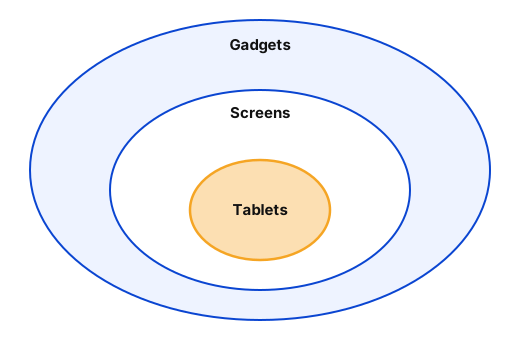
All tablets are screens.
All screens are gadgets.
Conclusions:
(I) Some gadgets are tablets.
(II) No gadgets are tablets.
दिए गए कथनों और निष्कर्षों को ध्यानपूर्वक पढ़ें। आपको दिए गए कथनों को सत्य मानना है, भले ही वे सामान्यतः ज्ञात तथ्यों से भिन्न प्रतीत होते हों, और निर्णय लें कि कौन-सा/से निष्कर्ष दिए गए कथनों का तार्किक रूप से अनुसरण करता है/करते हैं।
कथन:
सभी टैबलेट, स्क्रीन हैं।
सभी स्क्रीन, गैजेट हैं।
निष्कर्ष:
(I) कुछ गैजेट, टैबलेट हैं।
(II) कोई भी गैजेट, टैबलेट नहीं है।
  1. AOnly conclusion (II) followsकेवल निष्कर्ष (II) अनुसरण करता है
  2. BNeither conclusion (I) nor (II) followsन तो निष्कर्ष (I) और न ही (II) अनुसरण करता है
  3. CBoth conclusions (I) and (II) followदोनों निष्कर्ष (I) और (II) अनुसरण करते हैं
  4. DOnly conclusion (I) followsकेवल निष्कर्ष (I) अनुसरण करता है
Show answer

Concept: All tablets ⊂ screens ⊂ gadgets, so every tablet is a gadget.

  1. All tablets are gadgets ⇒ some gadgets are tablets: I follows.
  2. II (no gadgets are tablets) contradicts this: II does not follow.

Yaad rakhein: 'All A are B' always gives 'Some B are A' (conversion).

Answer: (D) Only conclusion (I) follows

अवधारणा: सभी टैबलेट ⊂ स्क्रीन ⊂ गैजेट, अतः हर टैबलेट गैजेट है।

  1. सभी टैबलेट गैजेट हैं ⇒ कुछ गैजेट टैबलेट हैं: I अनुसरण करता है।
  2. II (कोई गैजेट टैबलेट नहीं) इसके विपरीत है: II अनुसरण नहीं करता।

याद रखें: 'सभी A, B हैं' से सदैव 'कुछ B, A हैं' निकलता है।

उत्तर: (D) केवल निष्कर्ष (I) अनुसरण करता है

RRB Technician Grade IIIGeneral Intelligence and ReasoningSyllogismRRB Technician Grade III 2024 · 27 Dec Shift 2 →
Q1028.
Select the triad which follows the same pattern as that followed by the two triads given below. Both triads follow the same pattern.
SOLD - DLSO - SLOD
TEAR - RATE - TAER
उस त्रिक का चयन करें जो नीचे दिए गए दो त्रिकों द्वारा अनुसरण किए गए पैटर्न का ही अनुसरण करता है। दोनों त्रिक एक ही पैटर्न का अनुसरण करते हैं।
SOLD - DLSO - SLOD
TEAR - RATE - TAER
  1. AVOID - DIVO - VIOD
  2. BLANG - ANLG - ANGL
  3. CSALE - ELSA - ALSE
  4. DGROW - GORW - WORG
Show answer

Concept: Number letters of the first word 1 2 3 4. SOLD → DLSO =4312; SOLD → SLOD =1324.

  1. TEAR: 4312= RATE, 1324= TAER ✓.
  2. VOID: 4312= D I V O = DIVO; 1324= V I O D = VIOD ✓.
  3. Others fail, e.g. SALE gives ELSA but then SLAE, not ALSE.

Trick: Write position numbers under the first word once and apply the same order to each option.

Answer: (A) VOID - DIVO - VIOD

अवधारणा: पहले शब्द के अक्षरों को 1 2 3 4 क्रमांक दें। SOLD → DLSO =4312; SOLD → SLOD =1324.

  1. TEAR: 4312= RATE, 1324= TAER ✓.
  2. VOID: 4312= D I V O = DIVO; 1324= V I O D = VIOD ✓.
  3. अन्य विफल, जैसे SALE से ELSA तो बनता है पर फिर SLAE, ALSE नहीं।

ट्रिक: पहले शब्द के नीचे स्थान-क्रमांक लिखें और वही क्रम हर विकल्प पर लगाएँ।

उत्तर: (A) VOID - DIVO - VIOD

RRB Technician Grade IIIGeneral Intelligence and ReasoningLetter Rearrangement PatternRRB Technician Grade III 2024 · 27 Dec Shift 2 →
Q1029.
ROSP is related to WTXU in a certain way based on the English alphabetical order. In the same way, TQUR is related to YVZW. To which of the following options is OLPM related, following the same logic?
अंग्रेज़ी वर्णमाला क्रम के आधार पर ROSP एक निश्चित प्रकार से WTXU से संबंधित है। उसी प्रकार, TQUR, YVZW से संबंधित है। समान तर्क का अनुसरण करते हुए, OLPM निम्नलिखित में से किस विकल्प से संबंधित है?
  1. AQTRU
  2. BTQUR
  3. CTQRU
  4. DQTUR
Show answer

Concept: Each letter moves forward by the same number of places.

  1. R→W, O→T, S→X, P→U: each +5 (also TQUR→YVZW).
  2. OLPM: O+5=T, L+5=Q, P+5=U, M+5=R.

Trick: Check just the first letter of each option: O+5=T leaves only TQUR / TQRU, then check the third letter.

Answer: (B) TQUR

अवधारणा: हर अक्षर समान स्थान आगे बढ़ता है।

  1. R→W, O→T, S→X, P→U: प्रत्येक +5 (TQUR→YVZW भी)।
  2. OLPM: O+5=T, L+5=Q, P+5=U, M+5=R.

ट्रिक: पहला अक्षर देखें: O+5=T से केवल TQUR / TQRU बचते हैं, फिर तीसरा अक्षर जाँचें।

उत्तर: (B) TQUR

RRB Technician Grade IIIGeneral Intelligence and ReasoningLetter AnalogyRRB Technician Grade III 2024 · 27 Dec Shift 2 →
Q1030.
Based on the English alphabetical order, three of the following four letter-cluster pairs are alike in a certain way and thus form a group. Which pair does not belong to that group?
(Note: The odd one out is not based on the number of consonants/vowels or their position in the letter-cluster.)
अंग्रेज़ी वर्णमाला क्रम के आधार पर, निम्नलिखित चार अक्षर-समूह युग्मों में से तीन किसी निश्चित प्रकार से एकसमान हैं और इस प्रकार एक समूह बनाते हैं। कौन-सा युग्म उस समूह से संबंधित नहीं है?
(नोट: असंगत युग्म, अक्षर-समूह में व्यंजनों/स्वरों की संख्या या उनके स्थान पर आधारित नहीं है।)
  1. AGC-FH
  2. BJF-IL
  3. CMI-LN
  4. DEA-DF
Show answer

Concept: Compare first letters and second letters of the two clusters separately.

  1. GC-FH: G−1=F, C+5=H.
  2. MI-LN: M−1=L, I+5=N; EA-DF: E−1=D, A+5=F.
  3. JF-IL: J−1=I but F+6=L ✗.

Trick: Positions: C(3)→H(8), I(9)→N(14), A(1)→F(6), but F(6)→L(12).

Answer: (B) JF-IL

अवधारणा: दोनों समूहों के पहले अक्षरों और दूसरे अक्षरों की अलग-अलग तुलना करें।

  1. GC-FH: G−1=F, C+5=H.
  2. MI-LN: M−1=L, I+5=N; EA-DF: E−1=D, A+5=F.
  3. JF-IL: J−1=I पर F+6=L ✗.

ट्रिक: स्थान: C(3)→H(8), I(9)→N(14), A(1)→F(6), पर F(6)→L(12).

उत्तर: (B) JF-IL

RRB Technician Grade IIIGeneral Intelligence and ReasoningOdd Letter-PairRRB Technician Grade III 2024 · 27 Dec Shift 2 →
Q1031.
Given below is a statement followed by two possible reasons numbered I and II. Read the statement carefully and decide which of the two explain(s) the event/observation/information given in the statement.
Statement - Overweight and obesity are defined as abnormal or excessive fat accumulation that presents a risk to health.
Reasons:
I. Several factors can play a role in gaining and retaining excess weight. These include diet, lack of exercise, environmental factors, and genetics.
II. There are a number of scientifically proven ways you can keep the weight off, ranging from exercising, a proper diet to controlling stress.
नीचे एक कथन और उसके बाद I और II क्रमांकित दो संभावित कारण दिए गए हैं। कथन को ध्यानपूर्वक पढ़ें और निर्णय लें कि दोनों में से कौन-सा/से कारण कथन में दी गई घटना/अवलोकन/सूचना की व्याख्या करता है/करते हैं।
कथन - अधिक वज़न और मोटापे को असामान्य या अत्यधिक वसा संचय के रूप में परिभाषित किया जाता है, जो स्वास्थ्य के लिए जोखिम उत्पन्न करता है।
कारण:
I. अतिरिक्त वज़न बढ़ने और बने रहने में कई कारक भूमिका निभा सकते हैं। इनमें आहार, व्यायाम की कमी, पर्यावरणीय कारक और आनुवंशिकी शामिल हैं।
II. वज़न को नियंत्रित रखने के कई वैज्ञानिक रूप से सिद्ध तरीके हैं, जिनमें व्यायाम, उचित आहार से लेकर तनाव नियंत्रण तक शामिल हैं।
  1. ANeither I nor II is a possible reason.न तो I और न ही II संभावित कारण है।
  2. BBoth I and II are possible reasons.I और II दोनों संभावित कारण हैं।
  3. COnly I is a possible reason.केवल I संभावित कारण है।
  4. DOnly II is a possible reason.केवल II संभावित कारण है।
Show answer

Concept: A valid reason must explain why the statement's situation (obesity / excess fat) happens.

  1. I lists causes of weight gain – diet, no exercise, environment, genetics: it explains obesity.
  2. II tells how to keep weight off – a remedy, not a cause.

Yaad rakhein: Reason = cause; solutions or remedies are never reasons.

Answer: (C) Only I is a possible reason.

अवधारणा: वैध कारण वही है जो बताए कि कथन की स्थिति (मोटापा / अतिरिक्त वसा) क्यों होती है।

  1. I वजन बढ़ने के कारण बताता है – आहार, व्यायाम की कमी, पर्यावरण, आनुवंशिकी: यह मोटापे की व्याख्या करता है।
  2. II वजन कम रखने के उपाय बताता है – यह उपाय है, कारण नहीं।

याद रखें: कारण = वजह; समाधान या उपाय कभी कारण नहीं होते।

उत्तर: (C) केवल I संभावित कारण है।

RRB Technician Grade IIIGeneral Intelligence and ReasoningStatement and ReasonsRRB Technician Grade III 2024 · 27 Dec Shift 2 →
Q1032.
In the following number-pairs, the second number is obtained by applying certain mathematical operations to the first number. Which numbers should replace X and Y so that the pattern followed by the two numbers on the left side of :: is same as that on the right side of ::?
(NOTE: Operations should be performed on the whole numbers, without breaking down the numbers into its constituent digits. E.g. 13 – Operations on 13 such as adding/subtracting/multiplying etc. to 13 can be performed. Breaking down 13 into 1 and 3 and then performing mathematical operations on 1 and 3 is not allowed.)
X : 40 :: 18 : Y
निम्नलिखित संख्या-युग्मों में, पहली संख्या पर कुछ गणितीय संक्रियाएँ करके दूसरी संख्या प्राप्त की जाती है। X और Y के स्थान पर कौन-सी संख्याएँ आनी चाहिए ताकि :: के बाईं ओर की दोनों संख्याओं द्वारा अनुसरण किया गया पैटर्न :: के दाईं ओर के पैटर्न के समान हो?
(नोट: संक्रियाएँ पूर्ण संख्याओं पर की जानी चाहिए, संख्याओं को उनके घटक अंकों में तोड़े बिना। उदाहरण 13 – 13 पर संक्रियाएँ जैसे 13 में जोड़ना/घटाना/गुणा करना आदि किया जा सकता है। 13 को 1 और 3 में तोड़कर फिर 1 और 3 पर गणितीय संक्रियाएँ करने की अनुमति नहीं है।)
X : 40 :: 18 : Y
  1. AX = 24, Y = 38
  2. BX = 20, Y = 40
  3. CX = 28, Y = 56
  4. DX = 22, Y = 32
Show answer

Concept: Find one rule that works for both pairs; test each option.

  1. Option D: 22→40 and 18→32.
  2. Rule: 2n−4: 2×22−4=40, 2×18−4=32 ✓.
  3. Other options give no common rule (e.g. 24→40 is +16 but 18→38 is +20).

Trick: Equivalently (n−2)×2: 20×2=40, 16×2=32.

Answer: (D) X = 22, Y = 32

अवधारणा: दोनों युग्मों पर लागू एक नियम खोजें; हर विकल्प जाँचें।

  1. विकल्प D: 22→40 और 18→32.
  2. नियम: 2n−4: 2×22−4=40, 2×18−4=32 ✓.
  3. अन्य विकल्पों में कोई समान नियम नहीं (जैसे 24→40 में +16 पर 18→38 में +20)।

ट्रिक: समतुल्य रूप (n−2)×2: 20×2=40, 16×2=32.

उत्तर: (D) X = 22, Y = 32

RRB Technician Grade IIIGeneral Intelligence and ReasoningNumber Pair AnalogyRRB Technician Grade III 2024 · 27 Dec Shift 2 →
Q1033.
Read the given statements and conclusions carefully. You have to take the given statements to be true even if they seem to be at variance from commonly known facts and decide which conclusion(s) logically follow(s) from the given statements.
Statements:
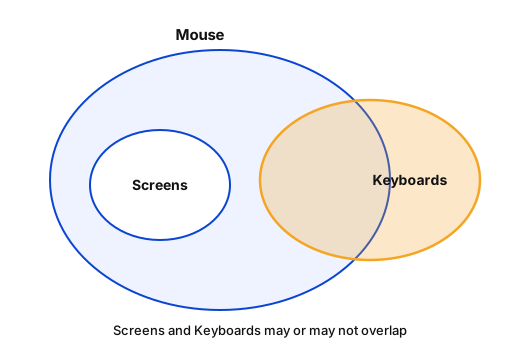
All screens are mouse.
Some mouses are keyboards.
Conclusions:
(I) Some screens are keyboards.
(II) No screen is a keyboard.
दिए गए कथनों और निष्कर्षों को ध्यानपूर्वक पढ़ें। आपको दिए गए कथनों को सत्य मानना है, भले ही वे सामान्यतः ज्ञात तथ्यों से भिन्न प्रतीत होते हों, और निर्णय लें कि कौन-सा/से निष्कर्ष दिए गए कथनों का तार्किक रूप से अनुसरण करता है/करते हैं।
कथन:
सभी स्क्रीन, माउस हैं।
कुछ माउस, कीबोर्ड हैं।
निष्कर्ष:
(I) कुछ स्क्रीन, कीबोर्ड हैं।
(II) कोई भी स्क्रीन, कीबोर्ड नहीं है।
  1. ANeither conclusion (I) nor (II) followsन तो निष्कर्ष (I) और न ही (II) अनुसरण करता है
  2. BBoth conclusions (I) and (II) followदोनों निष्कर्ष (I) और (II) अनुसरण करते हैं
  3. COnly conclusion (I) followsकेवल निष्कर्ष (I) अनुसरण करता है
  4. DOnly conclusion (II) followsकेवल निष्कर्ष (II) अनुसरण करता है
Show answer

Concept: Screens lie inside Mouse; Keyboards only partly overlap Mouse, so their link with Screens is uncertain.

  1. Keyboards may or may not touch Screens: 'Some screens are keyboards' is not definite – I fails.
  2. They may overlap, so 'No screen is a keyboard' is not definite – II fails.
  3. No either-or option is given, so neither follows.

Yaad rakhein: Two 'some' / no-link sets give only possibilities, never a definite conclusion.

Answer: (A) Neither conclusion (I) nor (II) follows

अवधारणा: स्क्रीन, माउस के अंदर है; कीबोर्ड माउस से आंशिक रूप से जुड़ा है, अतः स्क्रीन से उसका संबंध अनिश्चित है।

  1. कीबोर्ड स्क्रीन से जुड़ भी सकता है, नहीं भी: 'कुछ स्क्रीन कीबोर्ड हैं' निश्चित नहीं – I असफल।
  2. जुड़ सकता है, अतः 'कोई स्क्रीन कीबोर्ड नहीं' भी निश्चित नहीं – II असफल।
  3. 'या तो-या' विकल्प नहीं दिया है, अतः कोई भी अनुसरण नहीं करता।

याद रखें: बिना सीधे संबंध वाले समूहों से केवल संभावना बनती है, निश्चित निष्कर्ष नहीं।

उत्तर: (A) न तो निष्कर्ष (I) और न ही (II) अनुसरण करता है

RRB Technician Grade IIIGeneral Intelligence and ReasoningSyllogismRRB Technician Grade III 2024 · 27 Dec Shift 2 →
Q1034.
Which of the following options should come in place of the question mark (?) in the given series to make it logically complete?
52, 34, 69, 56, 86, 78, 103, ?
दी गई श्रृंखला को तार्किक रूप से पूर्ण करने के लिए प्रश्न चिह्न (?) के स्थान पर निम्नलिखित में से कौन-सा विकल्प आना चाहिए?
52, 34, 69, 56, 86, 78, 103, ?
  1. A94
  2. B120
  3. C108
  4. D100
Show answer

Concept: Alternate (two interleaved) series.

  1. Odd places: 52, 69, 86, 103 – each +17.
  2. Even places: 34, 56, 78, ? – each +22.
  3. ? =78+22=100.

Trick: When the series jumps up and down, split it into odd and even positions.

Answer: (D) 100

अवधारणा: एकांतर (दो मिली हुई) श्रृंखलाएँ।

  1. विषम स्थान: 52, 69, 86, 103 – प्रत्येक +17.
  2. सम स्थान: 34, 56, 78, ? – प्रत्येक +22.
  3. ? =78+22=100.

ट्रिक: जब श्रृंखला ऊपर-नीचे हो, तो विषम और सम स्थानों में बाँटें।

उत्तर: (D) 100

RRB Technician Grade IIIGeneral Intelligence and ReasoningNumber SeriesRRB Technician Grade III 2024 · 27 Dec Shift 2 →
Q1035.
In a row of 51 students, facing north, Tinu is 24th from the left end. If Shivangi is 11th to the right of Tinu, what is Shivangi's position from the right end of the row?
उत्तर की ओर मुख करके खड़े 51 छात्रों की एक पंक्ति में, टीनू बाएँ छोर से 24वें स्थान पर है। यदि शिवांगी, टीनू के दाईं ओर 11वें स्थान पर है, तो पंक्ति के दाएँ छोर से शिवांगी का स्थान क्या है?
  1. A18th18वाँ
  2. B16th16वाँ
  3. C15th15वाँ
  4. D17th17वाँ
Show answer

Concept: Position from right =Total−Position from left+1.

  1. Shivangi from left =24+11=35.
  2. From right =51−35+1=17.

Trick: Left + Right position = Total +1: 35+17=52 ✓.

Answer: (D) 17th

अवधारणा: दाएँ से स्थान =कुल−बाएँ से स्थान+1.

  1. शिवांगी बाएँ से =24+11=35वाँ।
  2. दाएँ से =51−35+1=17वाँ।

ट्रिक: बाएँ + दाएँ स्थान = कुल +1: 35+17=52 ✓.

उत्तर: (D) 17वाँ

RRB Technician Grade IIIGeneral Intelligence and ReasoningRanking and PositionRRB Technician Grade III 2024 · 27 Dec Shift 2 →
Q1036.
In a certain code language,
‘P + Q’ means ‘P is the son of Q’,
‘P – Q’ means ‘P is the husband of Q’,
‘P x Q’ means ‘P is the daughter of Q’ and
‘P ÷ Q’ means ‘P is the wife of Q’.
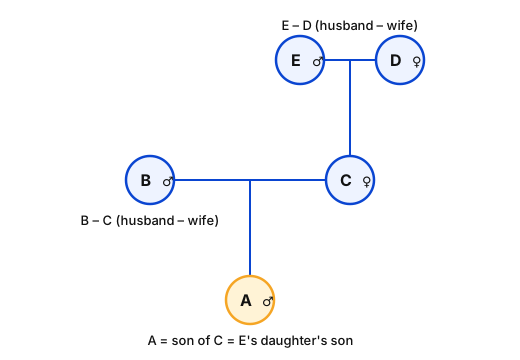
How is A related to E if ‘A + B – C x D ÷ E’?
एक निश्चित कूट भाषा में,
‘P + Q’ का अर्थ है ‘P, Q का पुत्र है’,
‘P – Q’ का अर्थ है ‘P, Q का पति है’,
‘P x Q’ का अर्थ है ‘P, Q की पुत्री है’ और
‘P ÷ Q’ का अर्थ है ‘P, Q की पत्नी है’।
यदि ‘A + B – C x D ÷ E’ है, तो A का E से क्या संबंध है?
  1. ASonपुत्र
  2. BBrotherभाई
  3. CDaughter's sonपुत्री का पुत्र
  4. DSon’s sonपुत्र का पुत्र
Show answer

Concept: Decode each sign: A + B (A son of B), B – C (B husband of C), C × D (C daughter of D), D ÷ E (D wife of E).

  1. D and E are wife and husband; C is their daughter.
  2. B is C's husband; A is the son of B (and C).
  3. So A is the son of E's daughter.

Trick: Decode left to right and draw couples on one line, children below.

Answer: (C) Daughter's son

अवधारणा: हर चिह्न को खोलें: A + B (A, B का पुत्र), B – C (B, C का पति), C × D (C, D की पुत्री), D ÷ E (D, E की पत्नी)।

  1. D और E पति-पत्नी; C उनकी पुत्री।
  2. B, C का पति; A, B (और C) का पुत्र।
  3. अतः A, E की पुत्री का पुत्र है।

ट्रिक: बाएँ से दाएँ खोलें; पति-पत्नी एक रेखा पर, संतान नीचे बनाएँ।

उत्तर: (C) पुत्री का पुत्र

RRB Technician Grade IIIGeneral Intelligence and ReasoningCoded Blood RelationsRRB Technician Grade III 2024 · 27 Dec Shift 2 →
Q1037.
In the following number-pairs, the second number is obtained by applying certain mathematical operations to the first number. Select the set in which the numbers are related in the same way as are the numbers of the following sets.
(NOTE: Operations should be performed on the whole numbers, without breaking down the numbers into its constituent digits. E.g. 13 – Operations on 13 such as adding/subtracting/multiplying etc. to 13 can be performed. Breaking down 13 into 1 and 3 and then performing mathematical operations on 1 and 3 is not allowed.)
16, 53
21, 68
निम्नलिखित संख्या-युग्मों में, पहली संख्या पर कुछ गणितीय संक्रियाएँ करके दूसरी संख्या प्राप्त की जाती है। उस समुच्चय का चयन करें जिसमें संख्याएँ उसी प्रकार संबंधित हैं जिस प्रकार निम्नलिखित समुच्चयों की संख्याएँ संबंधित हैं।
(नोट: संक्रियाएँ पूर्ण संख्याओं पर की जानी चाहिए, संख्याओं को उनके घटक अंकों में तोड़े बिना। उदाहरण 13 – 13 पर संक्रियाएँ जैसे 13 में जोड़ना/घटाना/गुणा करना आदि किया जा सकता है। 13 को 1 और 3 में तोड़कर फिर 1 और 3 पर गणितीय संक्रियाएँ करने की अनुमति नहीं है।)
16, 53
21, 68
  1. A25, 70
  2. B28, 84
  3. C19, 62
  4. D12, 31
Show answer

Concept: Find the rule from the given pairs: 16→53, 21→68.

  1. 16×3+5=53; 21×3+5=68 ⇒ rule 3n+5.
  2. 19×3+5=62 ✓.
  3. Check others: 25→80, 28→89, 12→41 – not matching.

Trick: Difference of outputs 68−53=15 for inputs differing by 5 ⇒ multiplier 3.

Answer: (C) 19, 62

अवधारणा: दिए गए युग्मों से नियम निकालें: 16→53, 21→68.

  1. 16×3+5=53; 21×3+5=68 ⇒ नियम 3n+5.
  2. 19×3+5=62 ✓.
  3. अन्य: 25→80, 28→89, 12→41 – मेल नहीं।

ट्रिक: आउटपुट का अंतर 68−53=15, इनपुट का अंतर 5 ⇒ गुणक 3.

उत्तर: (C) 19, 62

RRB Technician Grade IIIGeneral Intelligence and ReasoningNumber Pair AnalogyRRB Technician Grade III 2024 · 27 Dec Shift 2 →
Q1038.
If ‘A’ stands for ‘÷’, ‘B’ stands for ‘×’, ‘C’ stands for ‘+’ and ‘D’ stands for ‘−’, what will come in place of the question mark ‘?’ in the following equation?
44 A 4 C 12 B 2 D 1 = ?
यदि ‘A’ का अर्थ ‘÷’, ‘B’ का अर्थ ‘×’, ‘C’ का अर्थ ‘+’ और ‘D’ का अर्थ ‘−’ है, तो निम्नलिखित समीकरण में प्रश्न चिह्न ‘?’ के स्थान पर क्या आएगा?
44 A 4 C 12 B 2 D 1 = ?
  1. A32
  2. B33
  3. C31
  4. D34
Show answer

Concept: Replace letters with signs, then apply BODMAS.

  1. 44÷4+12×2−1.
  2. =11+24−1=34.

Trick: Do ÷ and × first, then + and − left to right.

Answer: (D) 34

अवधारणा: अक्षरों को चिह्नों से बदलें, फिर BODMAS लगाएँ।

  1. 44÷4+12×2−1.
  2. =11+24−1=34.

ट्रिक: पहले ÷ और ×, फिर बाएँ से दाएँ + और −.

उत्तर: (D) 34

RRB Technician Grade IIIGeneral Intelligence and ReasoningMathematical OperationsRRB Technician Grade III 2024 · 27 Dec Shift 2 →
Q1039.
What will come in the place of ‘?’ in the following equation, if ‘÷’ and ‘×’ are interchanged?
13 + 11 ÷ 32 × 4 – 10 = ?
यदि ‘÷’ और ‘×’ को आपस में बदल दिया जाए, तो निम्नलिखित समीकरण में ‘?’ के स्थान पर क्या आएगा?
13 + 11 ÷ 32 × 4 – 10 = ?
  1. A94
  2. B85
  3. C90
  4. D91
Show answer

Concept: Interchange ÷ and ×, then use BODMAS.

  1. New expression: 13+11×32÷4−10.
  2. 32÷4=8; 11×8=88.
  3. 13+88−10=91.

Trick: Swap signs carefully first – write the new expression before calculating.

Answer: (D) 91

अवधारणा: ÷ और × को आपस में बदलें, फिर BODMAS लगाएँ।

  1. नया व्यंजक: 13+11×32÷4−10.
  2. 32÷4=8; 11×8=88.
  3. 13+88−10=91.

ट्रिक: पहले चिह्न बदलकर नया व्यंजक लिखें, फिर गणना करें।

उत्तर: (D) 91

RRB Technician Grade IIIGeneral Intelligence and ReasoningMathematical OperationsRRB Technician Grade III 2024 · 27 Dec Shift 2 →
Q1040.
Which of the following options should come in place of the question mark (?) in the given series based on the English alphabetical order?
NPR, MOQ, LNP, KMO, ?
अंग्रेज़ी वर्णमाला क्रम के आधार पर दी गई श्रृंखला में प्रश्न चिह्न (?) के स्थान पर निम्नलिखित में से कौन-सा विकल्प आना चाहिए?
NPR, MOQ, LNP, KMO, ?
  1. ANJL
  2. BJNL
  3. CJLN
  4. DNLJ
Show answer

Concept: Each letter of a group moves one step back in the next group.

  1. N→M→L→K→J; P→O→N→M→L; R→Q→P→O→N.
  2. Next group = JLN.

Trick: Within each group letters skip one (N_P_R); the next group just shifts back by 1.

Answer: (C) JLN

अवधारणा: हर समूह का प्रत्येक अक्षर अगले समूह में एक स्थान पीछे जाता है।

  1. N→M→L→K→J; P→O→N→M→L; R→Q→P→O→N.
  2. अगला समूह = JLN.

ट्रिक: समूह के भीतर अक्षर एक छोड़कर हैं (N_P_R); अगला समूह बस 1 पीछे खिसकता है।

उत्तर: (C) JLN

RRB Technician Grade IIIGeneral Intelligence and ReasoningLetter SeriesRRB Technician Grade III 2024 · 27 Dec Shift 2 →