Question bank

Q&A: practice questions with answers

Search questions on any topic. Filter by exam category, exam, subject and topic, try the question, then open the answer and explanation.

Courses – airGurukul

3,200 questions found.

Q1221.
Which of the following is a Pythagorean triplet?
निम्नलिखित में से कौन-सा एक पाइथागोरस त्रिक है?
  1. A(6, 9, 11)
  2. B(8, 15, 17)
  3. C(2, 3, 5)
  4. D(5, 7, 9)
Show answer

Concept: (a,b,c) is a Pythagorean triplet if a2+b2=c2.

  1. (8,15,17): 64+225=289=172 ✔.
  2. Others fail, e.g. 36+81=117≠121; 4+9=13≠25; 25+49=74≠81.

Yaad rakhein: Standard triplets: (3,4,5), (5,12,13), (8,15,17), (7,24,25).

Answer: (B) (8, 15, 17)

अवधारणा: (a,b,c) पाइथागोरस त्रिक है यदि a2+b2=c2।

  1. (8,15,17): 64+225=289=172 ✔।
  2. अन्य असफल: 36+81=117≠121; 4+9=13≠25; 25+49=74≠81।

याद रखें: मानक त्रिक: (3,4,5), (5,12,13), (8,15,17), (7,24,25)।

उत्तर: (B) (8, 15, 17)

RRB Technician Grade IIIMathematicsPythagorean TripletRRB Technician Grade III 2024 · 26 Dec Shift 3 →
Q1222.
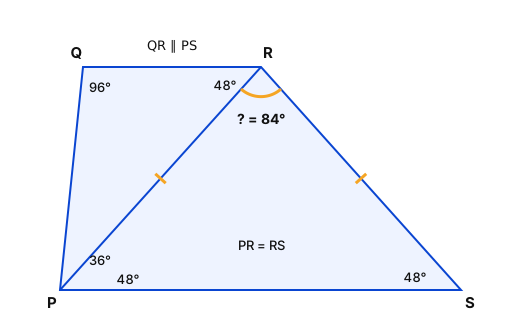
PQRS is a trapezium in which QR∥PS and PR=RS. If ∠PQR=96∘ and ∠QPR=36∘, then what is the measure of ∠PRS?
PQRS एक समलंब है जिसमें QR∥PS और PR=RS है। यदि ∠PQR=96∘ और ∠QPR=36∘ है, तो ∠PRS का माप क्या है?
  1. A80∘
  2. B70∘
  3. C84∘
  4. D75∘
Show answer

Concept: Angle sum of a triangle is 180∘; with QR∥PS, alternate angles are equal; equal sides face equal angles.

  1. In △PQR: ∠QRP=180∘−96∘−36∘=48∘.
  2. QR∥PS (transversal PR): ∠RPS=∠QRP=48∘.
  3. PR=RS⇒∠RSP=∠RPS=48∘.
  4. ∠PRS=180∘−48∘−48∘=84∘.

Trick: In fact ∠PRS=180∘−2∠QRP=180∘−2(180∘−96∘−36∘).

Answer: (C) 84∘

अवधारणा: त्रिभुज के कोणों का योग 180∘; QR∥PS होने से एकांतर कोण बराबर; बराबर भुजाओं के सामने के कोण बराबर।

  1. △PQR में: ∠QRP=180∘−96∘−36∘=48∘।
  2. QR∥PS (तिर्यक PR): ∠RPS=∠QRP=48∘।
  3. PR=RS⇒∠RSP=∠RPS=48∘।
  4. ∠PRS=180∘−48∘−48∘=84∘।

ट्रिक: सीधे: ∠PRS=180∘−2∠QRP=180∘−2(180∘−96∘−36∘)।

उत्तर: (C) 84∘

RRB Technician Grade IIIMathematicsGeometry – Trapezium & TrianglesRRB Technician Grade III 2024 · 26 Dec Shift 3 →
Q1223.
David owns a plot worth ₹10,000. He sells it to Rodney at 10% profit. Rodney sells the plot back to David at a loss of 10%. In the whole transaction, Rodney realises ______.
डेविड के पास ₹10,000 मूल्य का एक प्लॉट है। वह इसे रॉडनी को 10% लाभ पर बेचता है। रॉडनी वह प्लॉट 10% की हानि पर वापस डेविड को बेच देता है। पूरे लेन-देन में, रॉडनी को ______ होता है।
  1. Ano profit no lossन लाभ न हानि
  2. Bloss of ₹1,000₹1,000 की हानि
  3. Cprofit of ₹2,000₹2,000 का लाभ
  4. Dloss of ₹1,100₹1,100 की हानि
Show answer

Concept: Rodney’s gain or loss depends only on his own cost price and selling price.

  1. Rodney’s CP =10000×1.10=11000.
  2. Rodney’s SP =11000×0.90=9900.
  3. Loss =11000−9900=1100.

Trick: Loss =10% of his CP =10% of ₹11,000 = ₹1,100.

Answer: (D) loss of ₹1,100

अवधारणा: रॉडनी का लाभ/हानि केवल उसके अपने क्रय मूल्य और विक्रय मूल्य पर निर्भर है।

  1. रॉडनी का क्रय मूल्य =10000×1.10=11000।
  2. रॉडनी का विक्रय मूल्य =11000×0.90=9900।
  3. हानि =11000−9900=1100।

ट्रिक: हानि = उसके क्रय मूल्य ₹11,000 का 10%= ₹1,100।

उत्तर: (D) ₹1,100 की हानि

RRB Technician Grade IIIMathematicsProfit and LossRRB Technician Grade III 2024 · 26 Dec Shift 3 →
Q1224.
The weights (in kg) of 9 members of a school cricket team are 50, 63, x, 62, 64, 48, 51, 55, 48. If the mean weight is 57 kg, then the value of x is ______.
एक स्कूल क्रिकेट टीम के 9 सदस्यों के भार (kg में) 50, 63, x, 62, 64, 48, 51, 55, 48 हैं। यदि माध्य भार 57 kg है, तो x का मान ______ है।
  1. A64
  2. B72
  3. C57
  4. D63
Show answer

Concept: Sum of observations =mean×number of observations.

  1. Total =9×57=513.
  2. Known sum =50+63+62+64+48+51+55+48=441.
  3. x=513−441=72.

Trick: Deviation method: deviations from 57 of the known values add to −15, so x=57+15=72.

Answer: (B) 72

अवधारणा: प्रेक्षणों का योग =माध्य×प्रेक्षणों की संख्या।

  1. कुल =9×57=513।
  2. ज्ञात योग =50+63+62+64+48+51+55+48=441।
  3. x=513−441=72।

ट्रिक: विचलन विधि: ज्ञात मानों के 57 से विचलनों का योग −15, अतः x=57+15=72।

उत्तर: (B) 72

RRB Technician Grade IIIMathematicsMean (Average)RRB Technician Grade III 2024 · 26 Dec Shift 3 →
Q1225.
25% of 25% is equal to:
25% का 25% किसके बराबर है?
  1. A0.625
  2. B6.25
  3. C0.00625
  4. D0.0625
Show answer

Concept: a% of b%=a100×b100.

  1. 25100×25100=14×14=116.
  2. 116=0.0625.

Trick: 25%=0.25; 0.25×0.25=0.0625 (four decimal places).

Answer: (D) 0.0625

अवधारणा: a% का b%=a100×b100।

  1. 25100×25100=14×14=116।
  2. 116=0.0625।

ट्रिक: 25%=0.25; 0.25×0.25=0.0625 (चार दशमलव स्थान)।

उत्तर: (D) 0.0625

RRB Technician Grade IIIMathematicsPercentageRRB Technician Grade III 2024 · 26 Dec Shift 3 →
Q1226.
If the radius of a sphere is increased by 20%, then the new volume will become ______ of the original volume.
यदि किसी गोले की त्रिज्या में 20% की वृद्धि की जाती है, तो नया आयतन मूल आयतन का ______ हो जाएगा।
  1. A20%
  2. B120%
  3. C172.8%
  4. D72.8%
Show answer

Concept: V=43πr3, so volume varies as r3.

  1. New radius =1.2r.
  2. New volume =(1.2)3V=1.728V.
  3. 1.728V=172.8% of original.

Trick: Volume ratio =(65)3=216125=1.728; note the increase is 72.8%, the new volume is 172.8%.

Answer: (C) 172.8%

अवधारणा: V=43πr3, अतः आयतन r3 के अनुपात में बदलता है।

  1. नई त्रिज्या =1.2r।
  2. नया आयतन =(1.2)3V=1.728V।
  3. 1.728V= मूल का 172.8%।

ट्रिक: अनुपात =(65)3=216125=1.728; वृद्धि 72.8% है, नया आयतन 172.8%।

उत्तर: (C) 172.8%

RRB Technician Grade IIIMathematicsMensuration – Sphere VolumeRRB Technician Grade III 2024 · 26 Dec Shift 3 →
Q1227.
Find the value of 2sec2A+6cosec2A−2tan2A−6cot2A.
2sec2A+6cosec2A−2tan2A−6cot2A का मान ज्ञात कीजिए।
  1. A2
  2. B6
  3. C4
  4. D8
Show answer

Concept: sec2A−tan2A=1 and cosec2A−cot2A=1.

  1. Group: 2(sec2A−tan2A)+6(cosec2A−cot2A).
  2. =2(1)+6(1)=8.

Trick: Put A=45∘: 2(2)+6(2)−2(1)−6(1)=4+12−2−6=8.

Answer: (D) 8

अवधारणा: sec2A−tan2A=1 तथा cosec2A−cot2A=1।

  1. समूह बनाएँ: 2(sec2A−tan2A)+6(cosec2A−cot2A)।
  2. =2(1)+6(1)=8।

ट्रिक: A=45∘ रखें: 2(2)+6(2)−2(1)−6(1)=8।

उत्तर: (D) 8

RRB Technician Grade IIIMathematicsTrigonometric IdentitiesRRB Technician Grade III 2024 · 26 Dec Shift 3 →
Q1228.
Based on the English alphabetical order, three of the following four letter-clusters are alike in a certain way and thus form a group. Which letter-cluster does not belong to that group?
(Note: The odd one out is not based on the number of consonants/vowels or their position in the letter-cluster.)
अंग्रेजी वर्णमाला क्रम के आधार पर, निम्नलिखित चार अक्षर-समूहों में से तीन किसी निश्चित प्रकार से एकसमान हैं और इस प्रकार एक समूह बनाते हैं। कौन-सा अक्षर-समूह उस समूह से संबंधित नहीं है?
(ध्यान दें: असंगत अक्षर-समूह, व्यंजनों/स्वरों की संख्या या अक्षर-समूह में उनके स्थान पर आधारित नहीं है।)
  1. AQOL
  2. BVTR
  3. CMKH
  4. DYWT
Show answer

Concept: Check the gaps between consecutive letters using alphabet positions.

  1. QOL: 17,15,12 → −2,−3; MKH: 13,11,8 → −2,−3; YWT: 25,23,20 → −2,−3.
  2. VTR: 22,20,18 → −2,−2 (different).

Trick: Write each letter’s position number once; the odd gap pattern stands out immediately.

Answer: (B) VTR

अवधारणा: अक्षरों की वर्णमाला स्थिति लेकर क्रमागत अक्षरों का अंतर देखें।

  1. QOL: 17,15,12 → −2,−3; MKH: 13,11,8 → −2,−3; YWT: 25,23,20 → −2,−3।
  2. VTR: 22,20,18 → −2,−2 (भिन्न)।

ट्रिक: हर अक्षर की स्थिति संख्या लिखें; अलग पैटर्न तुरंत दिख जाता है।

उत्तर: (B) VTR

RRB Technician Grade IIIGeneral Intelligence and ReasoningOdd One Out – Letter ClustersRRB Technician Grade III 2024 · 26 Dec Shift 3 →
Q1229.
Based on the English alphabetical order, three of the following four letter-clusters are alike in a certain way and thus form a group. Which letter-cluster does not belong to that group?
(Note: The odd one out is not based on the number of consonants/vowels or their position in the letter-cluster.)
अंग्रेजी वर्णमाला क्रम के आधार पर, निम्नलिखित चार अक्षर-समूहों में से तीन किसी निश्चित प्रकार से एकसमान हैं और इस प्रकार एक समूह बनाते हैं। कौन-सा अक्षर-समूह उस समूह से संबंधित नहीं है?
(ध्यान दें: असंगत अक्षर-समूह, व्यंजनों/स्वरों की संख्या या अक्षर-समूह में उनके स्थान पर आधारित नहीं है।)
  1. ANPK
  2. BJLG
  3. CHJF
  4. DFHC
Show answer

Concept: Compare the position gaps between letters in each cluster.

  1. NPK: 14,16,11 → +2,−5; JLG: 10,12,7 → +2,−5; FHC: 6,8,3 → +2,−5.
  2. HJF: 8,10,6 → +2,−4 (different).

Trick: Here the first and third letters differ by 3 in the group (N–K, J–G, F–C), but H–F differ by 2.

Answer: (C) HJF

अवधारणा: हर समूह में अक्षरों की स्थितियों का अंतर तुलना करें।

  1. NPK: 14,16,11 → +2,−5; JLG: 10,12,7 → +2,−5; FHC: 6,8,3 → +2,−5।
  2. HJF: 8,10,6 → +2,−4 (भिन्न)।

ट्रिक: समूह में पहले व तीसरे अक्षर का अंतर 3 है (N–K, J–G, F–C), पर H–F में 2।

उत्तर: (C) HJF

RRB Technician Grade IIIGeneral Intelligence and ReasoningOdd One Out – Letter ClustersRRB Technician Grade III 2024 · 26 Dec Shift 3 →
Q1230.
If each vowel in the word FLOWING is changed to the letter immediately following it in the English alphabetical order and each consonant is changed to the letter immediately preceding it in the English alphabetical order, then how many vowels are there in the group of letters thus formed?
यदि शब्द FLOWING में प्रत्येक स्वर को अंग्रेजी वर्णमाला क्रम में उसके ठीक बाद वाले अक्षर से और प्रत्येक व्यंजन को अंग्रेजी वर्णमाला क्रम में उसके ठीक पहले वाले अक्षर से बदल दिया जाए, तो इस प्रकार बने अक्षरों के समूह में कितने स्वर होंगे?
  1. A2
  2. B0
  3. C3
  4. D1
Show answer

Concept: Vowels move one step forward (+1); consonants move one step back (−1).

  1. F→E, L→K, O→P, W→V, I→J, N→M, G→F.
  2. New group: EKPVJMF. Vowels: only E → 1.

Trick: Vowels +1 never give a vowel (A→B, E→F, I→J, O→P, U→V); only a consonant that turns into a vowel (here F→E) adds one.

Answer: (D) 1

अवधारणा: स्वर एक अक्षर आगे (+1) और व्यंजन एक अक्षर पीछे (−1) जाते हैं।

  1. F→E, L→K, O→P, W→V, I→J, N→M, G→F।
  2. नया समूह: EKPVJMF। स्वर: केवल E → 1।

ट्रिक: स्वर +1 करने पर कभी स्वर नहीं बनता (A→B, E→F, I→J, O→P, U→V); केवल वह व्यंजन जो स्वर बन जाए (यहाँ F→E) गिना जाएगा।

उत्तर: (D) 1

RRB Technician Grade IIIGeneral Intelligence and ReasoningLetter CodingRRB Technician Grade III 2024 · 26 Dec Shift 3 →
Q1231.
Refer to the given number and symbol series and answer the question that follows. Counting to be done from left to right only.
(Left) & 3 Ω 2 & % 4 6 @ 8 $ 7 ℧ 9 # 1 * £ 1 + & @ 5 (Right)
How many such symbols are there, each of which is immediately followed by a symbol and also immediately preceded by a symbol?
दी गई संख्या और प्रतीक श्रृंखला को देखें और उसके बाद आने वाले प्रश्न का उत्तर दें। गिनती केवल बाएँ से दाएँ की जानी है।
(बाएँ) & 3 Ω 2 & % 4 6 @ 8 $ 7 ℧ 9 # 1 * £ 1 + & @ 5 (दाएँ)
ऐसे कितने प्रतीक हैं, जिनमें से प्रत्येक के ठीक बाद एक प्रतीक है और ठीक पहले भी एक प्रतीक है?
  1. AOneएक
  2. BMore than twoदो से अधिक
  3. CNoneकोई नहीं
  4. DTwoदो
Show answer

Concept: Look for three symbols in a row: symbol – symbol – symbol; the middle one is counted.

  1. Scan the series for runs of consecutive symbols: (& %), (* £), (+ & @).
  2. Only “+ & @” has three symbols together, so only & qualifies.
  3. (& %) and (* £) have just two symbols – no middle symbol.

Trick: Mark every symbol, then circle only runs of length 3 or more; count the inner ones.

Answer: (A) One

अवधारणा: लगातार तीन प्रतीक खोजें: प्रतीक – प्रतीक – प्रतीक; बीच वाला गिना जाएगा।

  1. श्रृंखला में लगातार प्रतीकों के समूह: (& %), (* £), (+ & @)।
  2. केवल “+ & @” में तीन प्रतीक साथ हैं, अतः केवल & मान्य है।
  3. (& %) और (* £) में दो ही प्रतीक हैं – बीच का प्रतीक नहीं।

ट्रिक: सभी प्रतीकों पर निशान लगाएँ, फिर केवल 3 या अधिक लंबे समूहों के भीतरी प्रतीक गिनें।

उत्तर: (A) एक

RRB Technician Grade IIIGeneral Intelligence and ReasoningNumber–Symbol SeriesRRB Technician Grade III 2024 · 26 Dec Shift 3 →
Q1232.
In a certain code language, ‘EVIL’ is coded as ‘6824’ and ‘BONE’ is coded as ‘8753’.
What is the code for ‘E’ in the given code language?
एक निश्चित कूट भाषा में, ‘EVIL’ को ‘6824’ के रूप में और ‘BONE’ को ‘8753’ के रूप में कूटबद्ध किया जाता है।
दी गई कूट भाषा में ‘E’ के लिए कूट क्या है?
  1. A8
  2. B6
  3. C3
  4. D7
Show answer

Concept: A letter common to two words takes the digit common to both codes.

  1. EVIL → 6824 and BONE → 8753.
  2. Common letter: E; common digit: 8. So E = 8.

Trick: Common letter ↔ common digit – order of digits does not matter.

Answer: (A) 8

अवधारणा: दोनों शब्दों में समान अक्षर का कूट दोनों कोडों में समान अंक होता है।

  1. EVIL → 6824 तथा BONE → 8753।
  2. समान अक्षर: E; समान अंक: 8। अतः E = 8।

ट्रिक: समान अक्षर ↔ समान अंक – अंकों का क्रम मायने नहीं रखता।

उत्तर: (A) 8

RRB Technician Grade IIIGeneral Intelligence and ReasoningCoding–DecodingRRB Technician Grade III 2024 · 26 Dec Shift 3 →
Q1233.
Select the set in which the numbers are related in the same way as are the numbers of the following sets.
(NOTE: Operations should be performed on the whole numbers, without breaking down the numbers into its constituent digits. E.g. 13 – Operations on 13 such as adding/subtracting/multiplying etc. to 13 can be performed. Breaking down 13 into 1 and 3 and then performing mathematical operations on 1 and 3 is not allowed.)
(4, 12, 24)
(7, 21, 42)
उस समुच्चय का चयन कीजिए जिसमें संख्याएँ उसी प्रकार संबंधित हैं जिस प्रकार निम्नलिखित समुच्चयों की संख्याएँ संबंधित हैं।
(ध्यान दें: संख्याओं को उनके घटक अंकों में तोड़े बिना, पूर्ण संख्याओं पर संक्रियाएँ की जानी चाहिए। उदाहरण के लिए 13 – 13 पर संक्रियाएँ जैसे 13 में जोड़ना/घटाना/गुणा करना आदि किया जा सकता है। 13 को 1 और 3 में तोड़ना और फिर 1 और 3 पर गणितीय संक्रियाएँ करने की अनुमति नहीं है।)
(4, 12, 24)
(7, 21, 42)
  1. A(9, 36, 54)
  2. B(9, 27, 54)
  3. C(9, 27, 52)
  4. D(7, 27, 54)
Show answer

Concept: Find the operation linking the three numbers of each set.

  1. (4,12,24): 4×3=12, 12×2=24; (7,21,42): 7×3=21, 21×2=42.
  2. (9,27,54): 9×3=27, 27×2=54 ✔.

Trick: Pattern (a,3a,6a): third =6× first. Only (9,27,54) fits.

Answer: (B) (9, 27, 54)

अवधारणा: प्रत्येक समुच्चय की तीन संख्याओं को जोड़ने वाली संक्रिया ज्ञात करें।

  1. (4,12,24): 4×3=12, 12×2=24; (7,21,42): 7×3=21, 21×2=42।
  2. (9,27,54): 9×3=27, 27×2=54 ✔।

ट्रिक: पैटर्न (a,3a,6a): तीसरी =6× पहली। केवल (9,27,54) सही।

उत्तर: (B) (9, 27, 54)

RRB Technician Grade IIIGeneral Intelligence and ReasoningNumber Analogy (Sets)RRB Technician Grade III 2024 · 26 Dec Shift 3 →
Q1234.
Read the given statements and conclusions carefully. You have to take the given statements to be true even if they seem to be at variance from commonly known facts and decide which conclusion(s) logically follow(s) from the given statements.
Statements:
Some tables are knives.
All knives are paper.
Some papers are blue.
Conclusions:
(I) Some blues are tables.
(II) Some papers are tables.
दिए गए कथनों और निष्कर्षों को ध्यानपूर्वक पढ़िए। आपको दिए गए कथनों को सत्य मानना है, भले ही वे सामान्यतः ज्ञात तथ्यों से भिन्न प्रतीत होते हों, और निर्णय कीजिए कि दिए गए कथनों से कौन-सा/से निष्कर्ष तार्किक रूप से अनुसरण करता है/करते हैं।
कथन:
कुछ मेजें, चाकू हैं।
सभी चाकू, कागज़ हैं।
कुछ कागज़, नीले हैं।
निष्कर्ष:
(I) कुछ नीले, मेजें हैं।
(II) कुछ कागज़, मेजें हैं।
  1. ANeither conclusion (I) nor (II) follows.न तो निष्कर्ष (I) और न ही (II) अनुसरण करता है।
  2. BOnly conclusion (I) follows.केवल निष्कर्ष (I) अनुसरण करता है।
  3. COnly conclusion (II) follows.केवल निष्कर्ष (II) अनुसरण करता है।
  4. DBoth conclusions (I) and (II) follow.दोनों निष्कर्ष (I) और (II) अनुसरण करते हैं।
Show answer

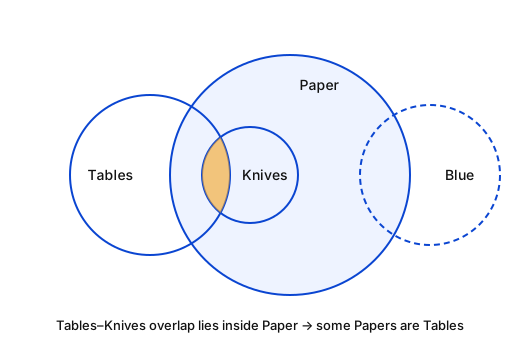
Concept: Draw the least-overlap Venn diagram; a conclusion follows only if it is true in every possible diagram.

  1. Some tables are knives and all knives are paper → the table–knife overlap lies inside paper, so some papers are tables: (II) follows.
  2. Blue only touches paper somewhere; it need not touch tables → (I) does not follow.

Yaad rakhein: “Some + All” gives a definite “Some”; a link through “Some + Some” gives no conclusion.

Answer: (C) Only conclusion (II) follows.

अवधारणा: न्यूनतम ओवरलैप वाला वेन आरेख बनाएँ; निष्कर्ष तभी मान्य है जब हर संभव आरेख में सत्य हो।

  1. कुछ मेज़ चाकू हैं और सभी चाकू कागज़ हैं → मेज़–चाकू का साझा भाग कागज़ के भीतर है, अतः कुछ कागज़ मेज़ हैं: (II) अनुसरण करता है।
  2. नीला केवल कागज़ के किसी भाग को छूता है; मेज़ को छूना ज़रूरी नहीं → (I) अनुसरण नहीं करता।

याद रखें: “कुछ + सभी” से निश्चित “कुछ” मिलता है; “कुछ + कुछ” से कोई निष्कर्ष नहीं।

उत्तर: (C) केवल निष्कर्ष (II) अनुसरण करता है।

RRB Technician Grade IIIGeneral Intelligence and ReasoningSyllogismRRB Technician Grade III 2024 · 26 Dec Shift 3 →
Q1235.
What will come in the place of ‘?’ in the following equation, if ‘+’ and ‘÷’ are interchanged and ‘×’ and ‘−’ are interchanged?
63+9×6÷13−4=?
यदि ‘+’ और ‘÷’ को आपस में बदल दिया जाए तथा ‘×’ और ‘−’ को आपस में बदल दिया जाए, तो निम्नलिखित समीकरण में ‘?’ के स्थान पर क्या आएगा?
63+9×6÷13−4=?
  1. A51
  2. B53
  3. C55
  4. D48
Show answer

Concept: Swap the signs first, then apply BODMAS.

  1. After swapping: 63÷9−6+13×4.
  2. =7−6+52=53.

Trick: Rewrite the whole expression with new signs before calculating – never solve mentally while swapping.

Answer: (B) 53

अवधारणा: पहले चिह्न बदलें, फिर BODMAS लगाएँ।

  1. बदलने के बाद: 63÷9−6+13×4।
  2. =7−6+52=53।

ट्रिक: गणना से पहले पूरा व्यंजक नए चिह्नों के साथ दोबारा लिखें।

उत्तर: (B) 53

RRB Technician Grade IIIGeneral Intelligence and ReasoningMathematical Operations – InterchangeRRB Technician Grade III 2024 · 26 Dec Shift 3 →
Q1236.
Select the triad which follows the same pattern as that followed by the two triads given below. Both triads follow the same pattern.
WEST - EWST - TSEW
POLE - OPLE - ELOP
उस त्रिक का चयन कीजिए जो उसी पैटर्न का अनुसरण करता है जिसका अनुसरण नीचे दिए गए दो त्रिक करते हैं। दोनों त्रिक एक ही पैटर्न का अनुसरण करते हैं।
WEST - EWST - TSEW
POLE - OPLE - ELOP
  1. AVIEW - IVEW - WEIV
  2. BFANG - AFNG - ANGF
  3. CGROW - GORW - WORG
  4. DROAD - ORAD - DOAR
Show answer

Concept: Second term = first two letters swapped; third term = first term written in reverse.

  1. WEST → EWST (swap W, E) → TSEW (reverse of WEST). POLE → OPLE → ELOP likewise.
  2. VIEW → IVEW (swap V, I) → WEIV (reverse of VIEW) ✔.
  3. FANG’s third term should be GNAF, GROW’s second should be RGOW, ROAD’s third should be DAOR – all fail.

Trick: Check the reverse (third term) first – it eliminates options fastest.

Answer: (A) VIEW - IVEW - WEIV

अवधारणा: दूसरा पद = पहले दो अक्षरों की अदला-बदली; तीसरा पद = पहला पद उल्टा।

  1. WEST → EWST (W, E बदले) → TSEW (WEST उल्टा)। POLE → OPLE → ELOP भी ऐसे ही।
  2. VIEW → IVEW (V, I बदले) → WEIV (VIEW उल्टा) ✔।
  3. FANG का तीसरा GNAF, GROW का दूसरा RGOW, ROAD का तीसरा DAOR होना चाहिए – सभी गलत।

ट्रिक: पहले तीसरा पद (उल्टा) जाँचें – विकल्प जल्दी हटते हैं।

उत्तर: (A) VIEW - IVEW - WEIV

RRB Technician Grade IIIGeneral Intelligence and ReasoningLetter Triads – PatternRRB Technician Grade III 2024 · 26 Dec Shift 3 →
Q1237.
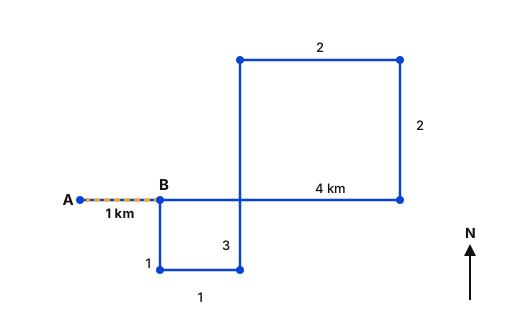
Shreya starts from point A and drives 4 km towards the East. She takes three simultaneous left turns and drives 2 km, 2 km and 3 km, respectively. She then takes a right turn and drives 1 km. She takes a final right turn and drives 1 km to reach point B.
How far (shortest distance) and towards which direction should she drive to reach Point A again? (All turns are 90 degrees turns only unless specified.)
श्रेया बिंदु A से चलना शुरू करती है और पूर्व की ओर 4 km गाड़ी चलाती है। वह लगातार तीन बार बाएँ मुड़ती है और क्रमशः 2 km, 2 km और 3 km गाड़ी चलाती है। फिर वह दाएँ मुड़ती है और 1 km गाड़ी चलाती है। वह अंतिम बार दाएँ मुड़ती है और बिंदु B तक पहुँचने के लिए 1 km गाड़ी चलाती है।
फिर से बिंदु A तक पहुँचने के लिए उसे कितनी दूरी (न्यूनतम दूरी) तक और किस दिशा में गाड़ी चलानी चाहिए? (जब तक निर्दिष्ट न हो, सभी मोड़ केवल 90 डिग्री के हैं।)
  1. A1 km North1 km उत्तर
  2. B1 km South1 km दक्षिण
  3. C1 km East1 km पूर्व
  4. D1 km West1 km पश्चिम
Show answer

Concept: Track position on a grid (East = +x, North = +y) after each turn.

  1. A(0,0) → 4 km East → (4,0). Left (North) 2 km → (4,2); left (West) 2 km → (2,2); left (South) 3 km → (2,−1).
  2. Right (West) 1 km → (1,−1); right (North) 1 km → B(1,0).
  3. B is 1 km East of A, so she must drive 1 km West.

Trick: Net East =4−2−1=1; net North =2−3+1=0 → B is 1 km East of A.

Answer: (D) 1 km West

अवधारणा: हर मोड़ के बाद स्थिति ग्रिड पर लिखें (पूर्व = +x, उत्तर = +y)।

  1. A(0,0) → 4 km पूर्व → (4,0)। बाएँ (उत्तर) 2 km → (4,2); बाएँ (पश्चिम) 2 km → (2,2); बाएँ (दक्षिण) 3 km → (2,−1)।
  2. दाएँ (पश्चिम) 1 km → (1,−1); दाएँ (उत्तर) 1 km → B(1,0)।
  3. B, A से 1 km पूर्व में है, अतः उसे 1 km पश्चिम जाना होगा।

ट्रिक: शुद्ध पूर्व =4−2−1=1; शुद्ध उत्तर =2−3+1=0 → B, A से 1 km पूर्व।

उत्तर: (D) 1 km पश्चिम

RRB Technician Grade IIIGeneral Intelligence and ReasoningDirection SenseRRB Technician Grade III 2024 · 26 Dec Shift 3 →
Q1238.
In a certain code language,
P + Q means ‘P is the father of Q’,
P – Q means ‘P is the son of Q’,
P × Q means ‘P is the wife of Q’ and
P ÷ Q means ‘P is the brother of Q’.
Based on the above, how is C related to E if ‘A – B × C ÷ D + E’?
एक निश्चित कूट भाषा में,
P + Q का अर्थ है ‘P, Q का पिता है’,
P – Q का अर्थ है ‘P, Q का पुत्र है’,
P × Q का अर्थ है ‘P, Q की पत्नी है’ और
P ÷ Q का अर्थ है ‘P, Q का भाई है’।
उपरोक्त के आधार पर, यदि ‘A – B × C ÷ D + E’ है, तो C का E से क्या संबंध है?
  1. AFather's brotherपिता का भाई
  2. BSonपुत्र
  3. CFather's fatherपिता के पिता
  4. DFatherपिता
Show answer

Concept: Decode each symbol one link at a time and build the family tree.

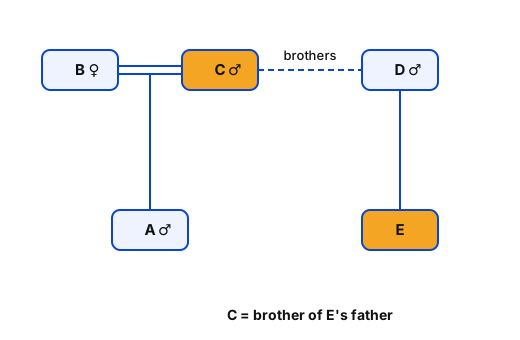
  1. A – B: A is the son of B. B × C: B is the wife of C (so C is A’s father).
  2. C ÷ D: C is the brother of D. D + E: D is the father of E.
  3. So C is the brother of E’s father.

Trick: Decode from the person asked about (C) to the target (E): C → brother of D → D is E’s father.

Answer: (A) Father's brother

अवधारणा: प्रत्येक चिह्न को एक-एक कड़ी में खोलें और वंश-वृक्ष बनाएँ।

  1. A – B: A, B का पुत्र है। B × C: B, C की पत्नी है (अतः C, A का पिता)।
  2. C ÷ D: C, D का भाई है। D + E: D, E का पिता है।
  3. अतः C, E के पिता का भाई (चाचा) है।

ट्रिक: पूछे गए व्यक्ति (C) से लक्ष्य (E) तक चलें: C → D का भाई → D, E का पिता।

उत्तर: (A) पिता का भाई

RRB Technician Grade IIIGeneral Intelligence and ReasoningBlood Relations – CodedRRB Technician Grade III 2024 · 26 Dec Shift 3 →
Q1239.
If + means −, − means ×, × means ÷, and ÷ means +, then what will come in place of the question mark (?) in the following equation?
65×13−7÷24+9=?
यदि + का अर्थ −, − का अर्थ ×, × का अर्थ ÷, और ÷ का अर्थ + है, तो निम्नलिखित समीकरण में प्रश्न चिह्न (?) के स्थान पर क्या आएगा?
65×13−7÷24+9=?
  1. A46
  2. B48
  3. C50
  4. D40
Show answer

Concept: Replace each sign by its meaning, then apply BODMAS.

  1. 65×13−7÷24+9 becomes 65÷13×7+24−9.
  2. =5×7+24−9=35+15=50.

Trick: Write the mapping (+→−, −→×, ×→÷, ÷→+) above the expression before substituting.

Answer: (C) 50

अवधारणा: हर चिह्न को उसके अर्थ से बदलें, फिर BODMAS लगाएँ।

  1. 65×13−7÷24+9 बन जाता है 65÷13×7+24−9।
  2. =5×7+24−9=35+15=50।

ट्रिक: प्रतिस्थापन से पहले नियम (+→−, −→×, ×→÷, ÷→+) व्यंजक के ऊपर लिख लें।

उत्तर: (C) 50

RRB Technician Grade IIIGeneral Intelligence and ReasoningMathematical Operations – SubstitutionRRB Technician Grade III 2024 · 26 Dec Shift 3 →
Q1240.
Which of the following options should come in place of the question mark (?) in the given series based on the English alphabetical order?
GJE, ILG, KNI, MPK, ?
अंग्रेजी वर्णमाला क्रम के आधार पर दी गई श्रृंखला में प्रश्न चिह्न (?) के स्थान पर निम्नलिखित में से कौन-सा विकल्प आना चाहिए?
GJE, ILG, KNI, MPK, ?
  1. ARMO
  2. BORM
  3. CROM
  4. DOMR
Show answer

Concept: Track each letter position separately across the terms.

  1. 1st letters: G, I, K, M, O (+2).
  2. 2nd letters: J, L, N, P, R (+2); 3rd letters: E, G, I, K, M (+2).
  3. Next term: ORM.

Trick: Every letter moves +2, so just add 2 to each letter of MPK.

Answer: (B) ORM

अवधारणा: हर स्थान के अक्षरों को अलग-अलग देखें।

  1. पहले अक्षर: G, I, K, M, O (+2)।
  2. दूसरे अक्षर: J, L, N, P, R (+2); तीसरे: E, G, I, K, M (+2)।
  3. अगला पद: ORM।

ट्रिक: हर अक्षर +2 बढ़ता है; MPK के हर अक्षर में 2 जोड़ दें।

उत्तर: (B) ORM

RRB Technician Grade IIIGeneral Intelligence and ReasoningLetter SeriesRRB Technician Grade III 2024 · 26 Dec Shift 3 →