Question bank

Q&A: practice questions with answers

Search questions on any topic. Filter by exam category, exam, subject and topic, try the question, then open the answer and explanation.

Courses – airGurukul

3,200 questions found.

Q1321.
25% of 30% of 45% of 1 is equal to:
1 के 45% का 30% का 25% किसके बराबर है?
  1. A0.3375
  2. B33.75
  3. C0.03375
  4. D3.375
Show answer

Concept: Percent of percent: multiply the decimal forms.

  1. 0.25×0.30=0.075.
  2. 0.075×0.45=0.03375.

Trick: 25×30×45=33750; three percents divide by 106: 0.03375.

Answer: (C) 0.03375

अवधारणा: प्रतिशत का प्रतिशत: दशमलव रूपों को गुणा करें।

  1. 0.25×0.30=0.075।
  2. 0.075×0.45=0.03375।

ट्रिक: 25×30×45=33750; तीन प्रतिशत, अतः 106 से भाग: 0.03375।

उत्तर: (C) 0.03375

RRB Technician Grade IIIMathematicsPercentageRRB Technician Grade III 2024 · 26 Dec Shift 2 →
Q1322.
Simplify the given expression.
5−[4−{3−(3−3−6)}]
दिए गए व्यंजक को सरल कीजिए।
5−[4−{3−(3−3−6)}]
  1. A10
  2. B0
  3. C6
  4. D4
Show answer

Concept: Open brackets from innermost: (), then {}, then [].

  1. (3−3−6)=−6.
  2. {3−(−6)}=9.
  3. [4−9]=−5; 5−(−5)=10.

Yaad rakhein: Minus before a bracket flips signs — watch −(−6)=+6.

Answer: (A) 10

अवधारणा: सबसे भीतरी कोष्ठक से खोलें: (), फिर {}, फिर []।

  1. (3−3−6)=−6।
  2. {3−(−6)}=9।
  3. [4−9]=−5; 5−(−5)=10।

याद रखें: कोष्ठक से पहले ऋण चिह्न हो तो चिह्न बदल जाते हैं — −(−6)=+6।

उत्तर: (A) 10

RRB Technician Grade IIIMathematicsSimplification (brackets)RRB Technician Grade III 2024 · 26 Dec Shift 2 →
Q1323.
Find the volume of a sphere whose diameter is 6 cm.
उस गोले का आयतन ज्ञात कीजिए जिसका व्यास 6 cm है।
  1. A42π cm3
  2. B36π cm3
  3. C28π cm3
  4. D48π cm3
Show answer

Concept: Volume of sphere =43πr3, with r=d2.

  1. r=62=3 cm.
  2. V=43π×33=43π×27=36π cm3.

Trick: For diameter d: V=πd36=216π6=36π.

Answer: (B) 36π cm3

अवधारणा: गोले का आयतन =43πr3, जहाँ r=d2।

  1. r=62=3 सेमी।
  2. V=43π×33=43π×27=36π cm3।

ट्रिक: व्यास d हो तो: V=πd36=216π6=36π।

उत्तर: (B) 36π cm3

RRB Technician Grade IIIMathematicsMensuration: sphereRRB Technician Grade III 2024 · 26 Dec Shift 2 →
Q1324.
First find the median of 46, 64, 87, 41, 58, 77, 35, 90, 55, 92, and 33. If 92 is replaced with 99 and 41 is replaced with 43 in the data, then find the new median. What is the difference between the old median and the new median?
पहले 46, 64, 87, 41, 58, 77, 35, 90, 55, 92 और 33 की माध्यिका ज्ञात कीजिए। यदि आँकड़ों में 92 को 99 से और 41 को 43 से बदल दिया जाए, तो नई माध्यिका ज्ञात कीजिए। पुरानी माध्यिका और नई माध्यिका के बीच कितना अंतर है?
  1. A2
  2. B3
  3. C6
  4. D0
Show answer

Concept: For n (odd) values in order, median =(n+12)th value.

  1. Sorted: 33,35,41,46,55,58,64,77,87,90,92; n=11, median =6th=58.
  2. New data: 33,35,43,46,55,58,64,77,87,90,99; median =58.
  3. Difference =58−58=0.

Trick: Changing values that stay on the same side of the median (92→99 above, 41→43 below) does not change the median.

Answer: (D) 0

अवधारणा: n (विषम) क्रमबद्ध मानों की माध्यिका =(n+12)वाँ मान।

  1. क्रम: 33,35,41,46,55,58,64,77,87,90,92; n=11, माध्यिका =6वाँ =58।
  2. नया क्रम: 33,35,43,46,55,58,64,77,87,90,99; माध्यिका =58।
  3. अंतर =58−58=0।

ट्रिक: जो मान माध्यिका की एक ही ओर रहते हुए बदलें (92→99 ऊपर, 41→43 नीचे), उनसे माध्यिका नहीं बदलती।

उत्तर: (D) 0

RRB Technician Grade IIIMathematicsMedianRRB Technician Grade III 2024 · 26 Dec Shift 2 →
Q1325.
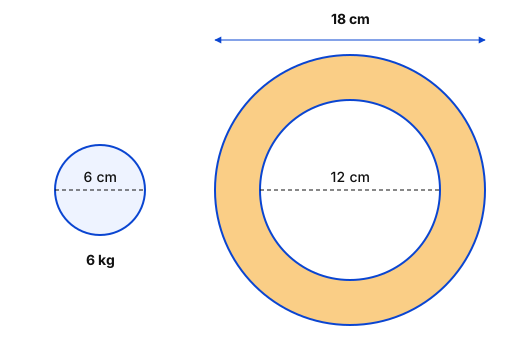
A solid rubber sphere weighs 6 kg when its diameter is 6 cm. Using the same material, a hollow sphere is made with outer diameter 18 cm and inner diameter 12 cm. What is its weight?
6 cm व्यास वाले एक ठोस रबर के गोले का भार 6 kg है। उसी पदार्थ से एक खोखला गोला बनाया जाता है जिसका बाहरी व्यास 18 cm और आंतरिक व्यास 12 cm है। उसका भार कितना है?
  1. A64.64 kg
  2. B72.64 kg
  3. C96 kg
  4. D114 kg
Show answer

Concept: Same material ⇒ weight ∝ volume. Hollow sphere volume ∝R3−r3; we can use diameters directly.

  1. Solid: 63=216 units → 6 kg.
  2. Hollow: 183−123=5832−1728=4104 units.
  3. Weight =4104216×6=19×6=114 kg.

Trick: Divide by 6 first: 33−23=27−8=19 times the solid sphere ⇒ 19×6=114 kg.

Answer: (D) 114 kg

अवधारणा: समान पदार्थ ⇒ भार ∝ आयतन। खोखले गोले का आयतन ∝R3−r3; सीधे व्यास ले सकते हैं।

  1. ठोस: 63=216 इकाई → 6 किग्रा।
  2. खोखला: 183−123=5832−1728=4104 इकाई।
  3. भार =4104216×6=19×6=114 किग्रा।

ट्रिक: पहले 6 से भाग दें: 33−23=27−8=19 गुना ⇒ 19×6=114 किग्रा।

उत्तर: (D) 114 kg

RRB Technician Grade IIIMathematicsMensuration: hollow sphereRRB Technician Grade III 2024 · 26 Dec Shift 2 →
Q1326.
How much time will a train of length 200 m, moving at a speed of 72 km/h take to cross another train of length 300 m completely, moving at 36 km/h in the same direction?
72 km/h की चाल से चल रही 200 m लंबी एक ट्रेन, उसी दिशा में 36 km/h की चाल से चल रही 300 m लंबी दूसरी ट्रेन को पूरी तरह से पार करने में कितना समय लेगी?
  1. A25 sec25 सेकंड
  2. B100 sec100 सेकंड
  3. C50 sec50 सेकंड
  4. D55 sec55 सेकंड
Show answer

Concept: Same direction: relative speed = difference; distance = sum of lengths. 1 km/h=518 m/s.

  1. Relative speed =72−36=36 km/h =36×518=10 m/s.
  2. Distance =200+300=500 m.
  3. Time =50010=50 s.

Yaad rakhein: Opposite direction → add speeds; same direction → subtract.

Answer: (C) 50 sec

अवधारणा: एक ही दिशा: सापेक्ष चाल = अंतर; दूरी = लंबाइयों का योग। 1 km/h=518 m/s।

  1. सापेक्ष चाल =72−36=36 km/h =36×518=10 m/s।
  2. दूरी =200+300=500 मी।
  3. समय =50010=50 सेकंड।

याद रखें: विपरीत दिशा → चाल जोड़ें; एक ही दिशा → घटाएँ।

उत्तर: (C) 50 सेकंड

RRB Technician Grade IIIMathematicsTrains (relative speed)RRB Technician Grade III 2024 · 26 Dec Shift 2 →
Q1327.
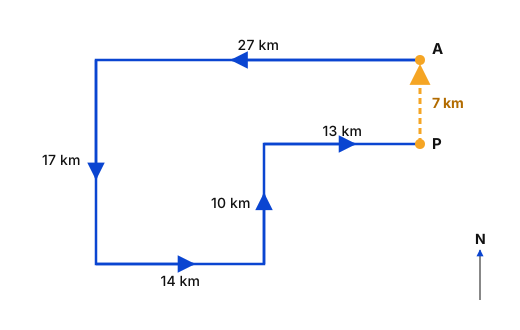
Pranit starts from Point A and drives 27 km towards West. He then takes a left turn, drives 17 km, turns left and drives 14 km. He then takes a left turn and drives 10 km. He takes a final right turn, drives 13 km and stops at Point P. How far (shortest distance) and towards which direction should he drive in order to reach Point A again?
(All turns are 90 degree turns only unless otherwise specified.)
प्रणीत बिंदु A से चलना शुरू करता है और पश्चिम की ओर 27 km ड्राइव करता है। फिर वह बाएँ मुड़ता है, 17 km ड्राइव करता है, बाएँ मुड़ता है और 14 km ड्राइव करता है। फिर वह बाएँ मुड़ता है और 10 km ड्राइव करता है। वह अंतिम बार दाएँ मुड़ता है, 13 km ड्राइव करता है और बिंदु P पर रुक जाता है। बिंदु A पर फिर से पहुँचने के लिए उसे कितनी दूरी (न्यूनतम दूरी) और किस दिशा में ड्राइव करना चाहिए?
(जब तक अन्यथा निर्दिष्ट न हो, सभी मोड़ केवल 90 डिग्री के मोड़ हैं।)
  1. A7 km towards Southदक्षिण की ओर 7 km
  2. B7 km towards Northउत्तर की ओर 7 km
  3. C5 km towards Northउत्तर की ओर 5 km
  4. D5 km towards Southदक्षिण की ओर 5 km
Show answer

Concept: Track the path on N–E–S–W axes; a left turn while facing West means South, etc.

  1. A → 27 km West; left (South) 17 km; left (East) 14 km.
  2. Left (North) 10 km; right (East) 13 km to P.
  3. East–West: −27+14+13=0; North–South: −17+10=−7 ⇒ P is 7 km South of A.
  4. To return, drive 7 km North.

Trick: Net displacement = (sum of East − West, sum of North − South); the 27 km West is cancelled by 14+13 East.

Answer: (B) 7 km towards North

अवधारणा: रास्ते को उत्तर–पूर्व–दक्षिण–पश्चिम अक्षों पर बनाएँ; पश्चिम की ओर मुँह करके बाएँ मुड़ना = दक्षिण।

  1. A → 27 किमी पश्चिम; बाएँ (दक्षिण) 17 किमी; बाएँ (पूर्व) 14 किमी।
  2. बाएँ (उत्तर) 10 किमी; दाएँ (पूर्व) 13 किमी, P पर रुका।
  3. पूर्व–पश्चिम: −27+14+13=0; उत्तर–दक्षिण: −17+10=−7 ⇒ P, A से 7 किमी दक्षिण में है।
  4. वापस जाने के लिए 7 किमी उत्तर चलें।

ट्रिक: शुद्ध विस्थापन = (पूर्व − पश्चिम, उत्तर − दक्षिण); 27 किमी पश्चिम को 14+13 पूर्व ने निरस्त कर दिया।

उत्तर: (B) उत्तर की ओर 7 km

RRB Technician Grade IIIGeneral Intelligence and ReasoningDirection senseRRB Technician Grade III 2024 · 26 Dec Shift 2 →
Q1328.
Read the given statements and conclusions carefully. You have to take the given statements to be true even if they seem to be at variance from commonly known facts and decide which conclusion(s) logically follow(s) from the given statements.
Statements:
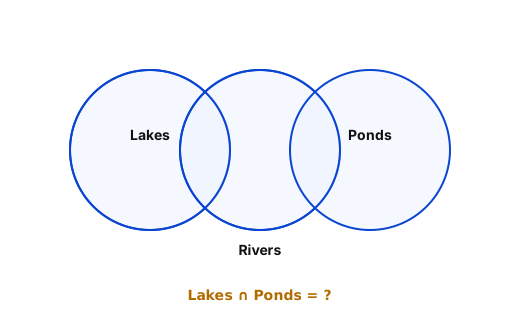
Some lakes are rivers.
Some rivers are ponds.
Conclusions:
(I) Some lakes are ponds.
(II) Some ponds are not rivers.
दिए गए कथनों और निष्कर्षों को ध्यानपूर्वक पढ़िए। आपको दिए गए कथनों को सत्य मानना है, भले ही वे सामान्य रूप से ज्ञात तथ्यों से भिन्न प्रतीत होते हों, और निर्णय लीजिए कि कौन-सा/से निष्कर्ष तार्किक रूप से दिए गए कथनों का अनुसरण करता है/करते हैं।
कथन:
कुछ झीलें, नदियाँ हैं।
कुछ नदियाँ, तालाब हैं।
निष्कर्ष:
(I) कुछ झीलें, तालाब हैं।
(II) कुछ तालाब, नदियाँ नहीं हैं।
  1. ABoth conclusions I and II followनिष्कर्ष I और II दोनों अनुसरण करते हैं
  2. BNeither conclusion I nor II followsन तो निष्कर्ष I और न ही II अनुसरण करता है
  3. COnly conclusion II followsकेवल निष्कर्ष II अनुसरण करता है
  4. DOnly conclusion I followsकेवल निष्कर्ष I अनुसरण करता है
Show answer

Concept: Two 'Some' statements give no definite link between the end terms.

  1. Lakes–Rivers overlap and Rivers–Ponds overlap, but Lakes and Ponds may not meet ⇒ I does not follow.
  2. All ponds can be rivers in a possible case ⇒ 'Some ponds are not rivers' is not certain ⇒ II does not follow.

Yaad rakhein: Some + Some = no conclusion. A 'Some … not' conclusion never follows from only positive statements.

Answer: (B) Neither conclusion I nor II follows

अवधारणा: दो 'कुछ' कथनों से दोनों सिरों के पदों में कोई निश्चित संबंध नहीं बनता।

  1. Lakes–Rivers और Rivers–Ponds जुड़े हैं, पर Lakes और Ponds का मिलना आवश्यक नहीं ⇒ I अनुसरण नहीं करता।
  2. संभव है कि सभी Ponds, Rivers हों ⇒ 'कुछ Ponds, Rivers नहीं हैं' निश्चित नहीं ⇒ II अनुसरण नहीं करता।

याद रखें: कुछ + कुछ = कोई निष्कर्ष नहीं। केवल सकारात्मक कथनों से 'कुछ … नहीं' निष्कर्ष कभी नहीं निकलता।

उत्तर: (B) न तो निष्कर्ष I और न ही II अनुसरण करता है

RRB Technician Grade IIIGeneral Intelligence and ReasoningSyllogismRRB Technician Grade III 2024 · 26 Dec Shift 2 →
Q1329.
In this question, a statement is followed by two courses of action, numbered I and II. You must assume everything in the statement to be true and on the basis of the information given in the statement, decide which of the courses of action logically follow(s) for pursuing.
Statement:
The literacy rate in Country X is significantly lower than the global average due to a lack of access to quality education, especially in rural areas.
Courses of Action:
I. Construct more schools and educational facilities in rural areas of Country X to improve accessibility.
II. Develop a digital education platform to provide online learning resources to students in both urban and rural areas of the country.
इस प्रश्न में, एक कथन के बाद दो कार्यवाहियाँ I और II दी गई हैं। आपको कथन में दी गई हर बात को सत्य मानना है और कथन में दी गई जानकारी के आधार पर निर्णय लेना है कि कौन-सी कार्यवाही/कार्यवाहियाँ अपनाने के लिए तार्किक रूप से अनुसरण करती है/करती हैं।
कथन:
गुणवत्तापूर्ण शिक्षा तक पहुँच की कमी के कारण, विशेष रूप से ग्रामीण क्षेत्रों में, देश X में साक्षरता दर वैश्विक औसत से काफ़ी कम है।
कार्यवाहियाँ:
I. पहुँच में सुधार के लिए देश X के ग्रामीण क्षेत्रों में अधिक विद्यालय और शैक्षिक सुविधाओं का निर्माण किया जाए।
II. देश के शहरी और ग्रामीण दोनों क्षेत्रों के विद्यार्थियों को ऑनलाइन अधिगम संसाधन उपलब्ध कराने के लिए एक डिजिटल शिक्षा मंच विकसित किया जाए।
  1. ANeither I nor II follows.न तो I और न ही II अनुसरण करती है।
  2. BBoth I and II follow.I और II दोनों अनुसरण करती हैं।
  3. COnly I follows.केवल I अनुसरण करती है।
  4. DOnly II follows.केवल II अनुसरण करती है।
Show answer

Concept: A course of action follows if it practically addresses the stated cause of the problem.

  1. Cause: lack of access to quality education, especially in rural areas.
  2. I: more rural schools directly improve access ⇒ follows.
  3. II: a digital platform extends learning resources to rural and urban students ⇒ also improves access ⇒ follows.

Yaad rakhein: Check each action against the cause given in the statement; both here attack 'lack of access'.

Answer: (B) Both I and II follow.

अवधारणा: कार्यवाही तभी अनुसरण करती है जब वह समस्या के बताए गए कारण को व्यावहारिक रूप से दूर करे।

  1. कारण: गुणवत्तापूर्ण शिक्षा तक पहुँच की कमी, विशेषकर ग्रामीण क्षेत्रों में।
  2. I: ग्रामीण क्षेत्रों में अधिक स्कूल सीधे पहुँच बढ़ाते हैं ⇒ अनुसरण करता है।
  3. II: डिजिटल प्लेटफ़ॉर्म ग्रामीण और शहरी दोनों छात्रों तक संसाधन पहुँचाता है ⇒ अनुसरण करता है।

याद रखें: हर कार्यवाही को कथन में दिए कारण से मिलाएँ; यहाँ दोनों 'पहुँच की कमी' को दूर करती हैं।

उत्तर: (B) I और II दोनों अनुसरण करती हैं।

RRB Technician Grade IIIGeneral Intelligence and ReasoningCourse of actionRRB Technician Grade III 2024 · 26 Dec Shift 2 →
Q1330.
Read the given statements and conclusions carefully. You have to take the given statements to be true even if they seem to be at variance from commonly known facts and decide which conclusion(s) logically follow(s) from the given statements.
Statements:
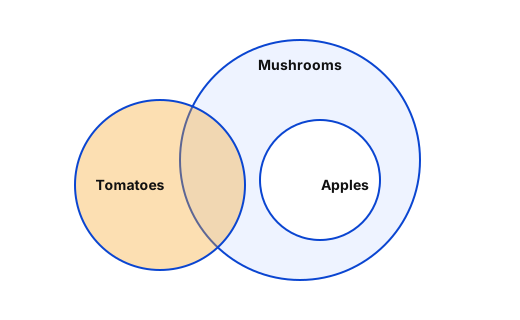
Some tomatoes are apples.
All apples are mushrooms.
Conclusions:
(I) Some mushrooms are tomatoes
(II) All apples are tomatoes
दिए गए कथनों और निष्कर्षों को ध्यानपूर्वक पढ़िए। आपको दिए गए कथनों को सत्य मानना है, भले ही वे सामान्य रूप से ज्ञात तथ्यों से भिन्न प्रतीत होते हों, और निर्णय लीजिए कि कौन-सा/से निष्कर्ष तार्किक रूप से दिए गए कथनों का अनुसरण करता है/करते हैं।
कथन:
कुछ टमाटर, सेब हैं।
सभी सेब, मशरूम हैं।
निष्कर्ष:
(I) कुछ मशरूम, टमाटर हैं
(II) सभी सेब, टमाटर हैं
  1. AOnly conclusion (II) followsकेवल निष्कर्ष (II) अनुसरण करता है
  2. BBoth conclusions (I) and (II) followनिष्कर्ष (I) और (II) दोनों अनुसरण करते हैं
  3. COnly conclusion (I) followsकेवल निष्कर्ष (I) अनुसरण करता है
  4. DNeither conclusion (I) nor (II) followsन तो निष्कर्ष (I) और न ही (II) अनुसरण करता है
Show answer

Concept: Some + All ⇒ Some (Some A are B, All B are C ⇒ Some A are C).

  1. Some tomatoes are apples, and all apples are mushrooms ⇒ those tomatoes are mushrooms ⇒ Some mushrooms are tomatoes. I follows.
  2. Only some tomatoes are apples; all apples being tomatoes is not certain ⇒ II does not follow.

Trick: Some + All = Some (the conclusion uses the first statement's subject and the second's predicate).

Answer: (C) Only conclusion (I) follows

अवधारणा: कुछ + सभी ⇒ कुछ (कुछ A, B हैं; सभी B, C हैं ⇒ कुछ A, C हैं)।

  1. कुछ टमाटर सेब हैं और सभी सेब मशरूम हैं ⇒ वे टमाटर मशरूम हैं ⇒ कुछ मशरूम टमाटर हैं। I अनुसरण करता है।
  2. केवल कुछ टमाटर सेब हैं; सभी सेब टमाटर हों, यह निश्चित नहीं ⇒ II अनुसरण नहीं करता।

ट्रिक: कुछ + सभी = कुछ (पहले कथन का कर्ता और दूसरे कथन का विधेय)।

उत्तर: (C) केवल निष्कर्ष (I) अनुसरण करता है

RRB Technician Grade IIIGeneral Intelligence and ReasoningSyllogismRRB Technician Grade III 2024 · 26 Dec Shift 2 →
Q1331.
Select the set in which the numbers are related in the same way as are the numbers of the following sets.
(NOTE: Operations should be performed on the whole numbers, without breaking down the numbers into its constituent digits. E.g. 13 – Operations on 13 such as adding/subtracting/multiplying etc. to 13 can be performed. Breaking down 13 into 1 and 3 and then performing mathematical operations on 1 and 3 is not allowed.)
(23, 47, 85)
(11, 20, 46)
उस समुच्चय का चयन कीजिए जिसमें संख्याएँ उसी प्रकार संबंधित हैं जिस प्रकार निम्नलिखित समुच्चयों की संख्याएँ संबंधित हैं।
(ध्यान दें: संक्रियाएँ संख्याओं को उनके घटक अंकों में तोड़े बिना, पूर्ण संख्याओं पर की जानी चाहिए। उदाहरण के लिए 13 – 13 पर संक्रियाएँ जैसे 13 में जोड़ना/घटाना/गुणा करना आदि किया जा सकता है। 13 को 1 और 3 में तोड़ना और फिर 1 और 3 पर गणितीय संक्रियाएँ करना वर्जित है।)
(23, 47, 85)
(11, 20, 46)
  1. A(9, 16, 42)
  2. B(17, 6, 38)
  3. C(8, 7, 35)
  4. D(21, 15, 50)
Show answer

Concept: Find one rule linking the three numbers that fits both sets.

  1. (23,47,85): 23+47+15=85.
  2. (11,20,46): 11+20+15=46. Rule: third = first + second +15.
  3. (17,6,38): 17+6+15=38 ✓. Others: 9+16+15=40, 8+7+15=30, 21+15+15=51 ✗.

Trick: Compute third − (first + second) for each set; a constant gap (15) reveals the rule.

Answer: (B) (17, 6, 38)

अवधारणा: तीनों संख्याओं को जोड़ने वाला ऐसा नियम खोजें जो दोनों समूहों पर लागू हो।

  1. (23,47,85): 23+47+15=85।
  2. (11,20,46): 11+20+15=46। नियम: तीसरी = पहली + दूसरी +15।
  3. (17,6,38): 17+6+15=38 ✓। अन्य: 9+16+15=40, 8+7+15=30, 21+15+15=51 ✗।

ट्रिक: हर समूह में तीसरी − (पहली + दूसरी) निकालें; स्थिर अंतर (15) नियम बता देता है।

उत्तर: (B) (17, 6, 38)

RRB Technician Grade IIIGeneral Intelligence and ReasoningNumber set analogyRRB Technician Grade III 2024 · 26 Dec Shift 2 →
Q1332.
In a certain code language, 'green leaves rustling' is coded as 'sa ka ta', and 'leaves are fresh' is coded as 'ka da na'. What is the code for 'leaves' in the given code language?
एक निश्चित कूट भाषा में, 'green leaves rustling' को 'sa ka ta' के रूप में कूटबद्ध किया जाता है, और 'leaves are fresh' को 'ka da na' के रूप में कूटबद्ध किया जाता है। दी गई कूट भाषा में 'leaves' का कूट क्या है?
  1. Aka
  2. Bna
  3. Csa
  4. Dda
Show answer

Concept: A word common to two sentences takes the code common to both.

  1. 'leaves' appears in both sentences.
  2. Common code in 'sa ka ta' and 'ka da na' is 'ka'.
  3. So 'leaves' = ka.

Trick: Match common words with common codes.

Answer: (A) ka

अवधारणा: दोनों वाक्यों में समान शब्द का कूट भी दोनों में समान होता है।

  1. 'leaves' दोनों वाक्यों में है।
  2. 'sa ka ta' और 'ka da na' में समान कूट 'ka' है।
  3. अतः 'leaves' = ka।

ट्रिक: समान शब्द ↔ समान कूट मिलाएँ।

उत्तर: (A) ka

RRB Technician Grade IIIGeneral Intelligence and ReasoningCoding-decodingRRB Technician Grade III 2024 · 26 Dec Shift 2 →
Q1333.
If ‘K’ stands for ‘×’, ‘L’ stands for ‘−’, ‘M’ stands for ‘÷’ and ‘N’ stands for ‘+’, what will come in place of the question mark ‘?’ in the following equation?
9 M 3 K 13 N 3 L 23 = ?
यदि ‘K’ का अर्थ ‘×’, ‘L’ का अर्थ ‘−’, ‘M’ का अर्थ ‘÷’ और ‘N’ का अर्थ ‘+’ है, तो निम्नलिखित समीकरण में प्रश्न चिह्न ‘?’ के स्थान पर क्या आएगा?
9 M 3 K 13 N 3 L 23 = ?
  1. A19
  2. B24
  3. C14
  4. D29
Show answer

Concept: Replace letters by signs (K =×, L =−, M =÷, N =+) and apply BODMAS.

  1. 9÷3×13+3−23.
  2. 9÷3=3; 3×13=39.
  3. 39+3−23=19.

Yaad rakhein: Substitute carefully first; then do ÷, × before +, −.

Answer: (A) 19

अवधारणा: अक्षरों के स्थान पर चिह्न रखें (K =×, L =−, M =÷, N =+) और BODMAS लगाएँ।

  1. 9÷3×13+3−23।
  2. 9÷3=3; 3×13=39।
  3. 39+3−23=19।

याद रखें: पहले ध्यान से प्रतिस्थापन करें; फिर +, − से पहले ÷, ×।

उत्तर: (A) 19

RRB Technician Grade IIIGeneral Intelligence and ReasoningMathematical operations (symbol substitution)RRB Technician Grade III 2024 · 26 Dec Shift 2 →
Q1334.
Based on the English alphabetical order, three of the following four letter-cluster pairs are alike in a certain way and thus form a group. Which pair does not belong to that group?
(Note: The odd one out is not based on the number of consonants/vowels or their position in the letter-cluster.)
अंग्रेज़ी वर्णमाला क्रम के आधार पर, निम्नलिखित चार अक्षर-समूह युग्मों में से तीन किसी निश्चित प्रकार से एकसमान हैं और इस प्रकार एक समूह बनाते हैं। कौन-सा युग्म उस समूह से संबंधित नहीं है?
(ध्यान दें: असंगत युग्म, व्यंजनों/स्वरों की संख्या या अक्षर-समूह में उनके स्थान पर आधारित नहीं है।)
  1. AOQ - NS
  2. BGI - FJ
  3. CTV - SW
  4. DMO - LP
Show answer

Concept: Compare each letter of the second cluster with the matching letter of the first.

  1. GI–FJ: G−1=F, I+1=J. TV–SW: T−1=S, V+1=W. MO–LP: M−1=L, O+1=P.
  2. OQ–NS: O−1=N but Q+2=S ✗.
  3. So OQ–NS is odd.

Trick: Pattern (−1, +1) holds in three pairs; the one with (−1, +2) is out.

Answer: (A) OQ - NS

अवधारणा: दूसरे समूह के हर अक्षर की तुलना पहले समूह के संगत अक्षर से करें।

  1. GI–FJ: G−1=F, I+1=J। TV–SW: T−1=S, V+1=W। MO–LP: M−1=L, O+1=P।
  2. OQ–NS: O−1=N पर Q+2=S ✗।
  3. अतः OQ–NS भिन्न है।

ट्रिक: तीन जोड़ों में (−1, +1) का नियम; (−1, +2) वाला अलग है।

उत्तर: (A) OQ - NS

RRB Technician Grade IIIGeneral Intelligence and ReasoningOdd one out (letter pairs)RRB Technician Grade III 2024 · 26 Dec Shift 2 →
Q1335.
Refer to the given series and answer the question that follows (all numbers are single-digit numbers only, and all counting is to be done from left to right).
(Left) 5 9 8 9 7 2 3 9 8 7 2 1 5 5 8 7 9 3 5 3 1 4 6 4 4 9 7 4 7 (Right)
How many such even digits are there, each of which is immediately preceded by a perfect square and immediately followed by an even digit? (Note: 1 will be considered as a perfect square.)
दी गई श्रृंखला का संदर्भ लीजिए और उसके बाद आने वाले प्रश्न का उत्तर दीजिए (सभी संख्याएँ केवल एक अंक वाली संख्याएँ हैं, और सभी गणना बाएँ से दाएँ की जानी है)।
(बाएँ) 5 9 8 9 7 2 3 9 8 7 2 1 5 5 8 7 9 3 5 3 1 4 6 4 4 9 7 4 7 (दाएँ)
ऐसे कितने सम अंक हैं, जिनमें से प्रत्येक के ठीक पहले एक पूर्ण वर्ग है और ठीक बाद एक सम अंक है? (ध्यान दें: 1 को पूर्ण वर्ग माना जाएगा।)
  1. A1
  2. B2
  3. C3
  4. D4
Show answer

Concept: Perfect squares among digits: 0,1,4,9. Find even digit X in pattern (square) X (even).

  1. Check each even digit: 8 after 9 → next 9 ✗; 8 after 9 → next 7 ✗; 2, 2, 8 not after a square.
  2. …1 4 6… : 4 after 1, next 6 ✓.
  3. …4 6 4… : 6 after 4, next 4 ✓. The 4 after 4 is followed by 9 ✗.
  4. Count =2.

Trick: Scan only even digits and test left and right neighbours — fewer checks.

Answer: (B) 2

अवधारणा: अंकों में पूर्ण वर्ग: 0,1,4,9। ढाँचा: (पूर्ण वर्ग) X (सम), जहाँ X सम अंक है।

  1. हर सम अंक जाँचें: 9 के बाद 8 → आगे 9 ✗; 9 के बाद 8 → आगे 7 ✗; 2, 2, 8 पूर्ण वर्ग के बाद नहीं।
  2. …1 4 6… : 4 से पहले 1, बाद में 6 ✓।
  3. …4 6 4… : 6 से पहले 4, बाद में 4 ✓। अगले 4 के बाद 9 है ✗।
  4. संख्या =2।

ट्रिक: केवल सम अंकों पर रुककर उनके बाएँ और दाएँ पड़ोसी देखें।

उत्तर: (B) 2

RRB Technician Grade IIIGeneral Intelligence and ReasoningNumber series (digit positions)RRB Technician Grade III 2024 · 26 Dec Shift 2 →
Q1336.
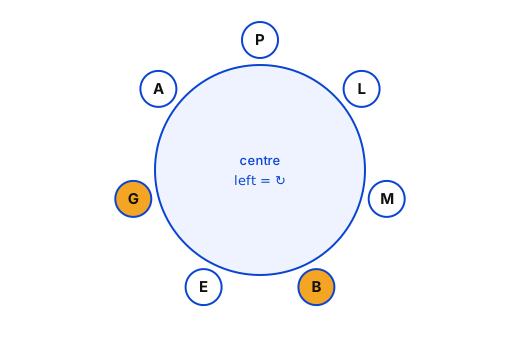
A, B, E, G, P, L and M are sitting around a circular table facing the centre. Only three people sit between P and E when counted from the left of P. Only three people sit between M and A when counted from the right of A . L sits to the immediate right of M. G is an immediate neighbour of A as well as E. Who sits to the second to the left of B?
A, B, E, G, P, L और M एक वृत्ताकार मेज के चारों ओर केंद्र की ओर मुख करके बैठे हैं। P के बाएँ से गिनने पर P और E के बीच केवल तीन व्यक्ति बैठे हैं। A के दाएँ से गिनने पर M और A के बीच केवल तीन व्यक्ति बैठे हैं। L, M के ठीक दाएँ बैठा है। G, A और E दोनों का निकटतम पड़ोसी है। B के बाएँ से दूसरे स्थान पर कौन बैठा है?
  1. AP
  2. BG
  3. CA
  4. DL
Show answer

Concept: Facing the centre, 'left' is clockwise and 'right' is anticlockwise.

  1. Fix P; going left 3 people then E ⇒ E is 4th to the left of P.
  2. G sits between A and E. If A–G–E were on the near side, L would clash with E; so seats (clockwise from P): P, _, _, _, E, G, A.
  3. From A going right, 3 people then M; L is immediately right of M ⇒ order: P, L, M, B, E, G, A.
  4. Second to the left of B (clockwise): B → E → G.

Trick: Fix the person with most clues first and test the two cases for the neighbour pair (A–G–E).

Answer: (B) G

अवधारणा: केंद्र की ओर मुख होने पर 'बाएँ' = दक्षिणावर्त और 'दाएँ' = वामावर्त।

  1. P को स्थिर करें; बाएँ 3 व्यक्ति छोड़कर E ⇒ E, P के बाएँ चौथा है।
  2. G, A और E के बीच बैठा है। दूसरी स्थिति में L और E टकराते हैं; अतः P से दक्षिणावर्त: P, _, _, _, E, G, A।
  3. A के दाएँ 3 व्यक्ति छोड़कर M; L, M के ठीक दाएँ ⇒ क्रम: P, L, M, B, E, G, A।
  4. B के बाएँ दूसरा (दक्षिणावर्त): B → E → G।

ट्रिक: सबसे अधिक सूचना वाले व्यक्ति को पहले स्थिर करें और A–G–E की दोनों स्थितियाँ जाँचें।

उत्तर: (B) G

RRB Technician Grade IIIGeneral Intelligence and ReasoningCircular seating arrangementRRB Technician Grade III 2024 · 26 Dec Shift 2 →
Q1337.
Which of the following options should come in place of the question mark (?) in the given series to make it logically complete?
691, 635, 714, 658, 737, ?
दी गई श्रृंखला को तार्किक रूप से पूर्ण करने के लिए प्रश्न चिह्न (?) के स्थान पर निम्नलिखित में से कौन-सा विकल्प आना चाहिए?
691, 635, 714, 658, 737, ?
  1. A701
  2. B628
  3. C696
  4. D681
Show answer

Concept: Look at differences between consecutive terms.

  1. 691−56=635, 635+79=714, 714−56=658, 658+79=737.
  2. Pattern: −56, +79 alternately.
  3. Next: 737−56=681.

Trick: Alternate terms also rise by 23: 635→658→681.

Answer: (D) 681

अवधारणा: क्रमागत पदों के अंतर देखें।

  1. 691−56=635, 635+79=714, 714−56=658, 658+79=737।
  2. नियम: बारी-बारी से −56, +79।
  3. अगला: 737−56=681।

ट्रिक: एकांतर पद भी 23 बढ़ते हैं: 635→658→681।

उत्तर: (D) 681

RRB Technician Grade IIIGeneral Intelligence and ReasoningNumber seriesRRB Technician Grade III 2024 · 26 Dec Shift 2 →
Q1338.
Which of the following options should come in place of the question mark (?) in the given series based on the English alphabetical order?
GFC, KJE, ONG, SRI, ?
अंग्रेजी वर्णमाला क्रम के आधार पर दी गई श्रृंखला में प्रश्न चिह्न (?) के स्थान पर निम्नलिखित में से कौन-सा विकल्प आना चाहिए?
GFC, KJE, ONG, SRI, ?
  1. AWXM
  2. BWXL
  3. CWVK
  4. DXYK
Show answer

Concept: Track each letter position separately (A =1 … Z =26).

  1. 1st letters: G, K, O, S → +4 → W.
  2. 2nd letters: F, J, N, R → +4 → V.
  3. 3rd letters: C, E, G, I → +2 → K. Answer: WVK.

Trick: 2nd letter is always one before the 1st (G-F, K-J …), so only W-V options fit.

Answer: (C) WVK

अवधारणा: हर स्थान के अक्षर को अलग-अलग देखें (A =1 … Z =26)।

  1. पहले अक्षर: G, K, O, S → +4 → W।
  2. दूसरे अक्षर: F, J, N, R → +4 → V।
  3. तीसरे अक्षर: C, E, G, I → +2 → K। उत्तर: WVK।

ट्रिक: दूसरा अक्षर पहले से ठीक एक पीछे है (G-F, K-J …), अतः केवल W-V वाला विकल्प सही।

उत्तर: (C) WVK

RRB Technician Grade IIIGeneral Intelligence and ReasoningAlphabet seriesRRB Technician Grade III 2024 · 26 Dec Shift 2 →
Q1339.
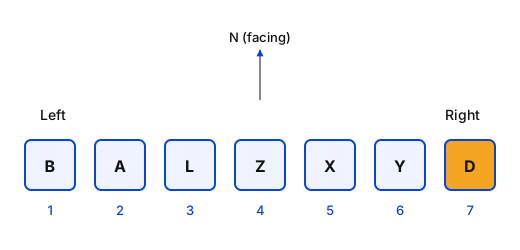
Seven people, A, B, D, L, X, Y and Z, are sitting in a row, facing north. No one sits to the left of B. Only four people sit between B and Y. Only three people sit to the right of Z. A sits to the immediate left of L. D is not an immediate neighbour of Z. Who sits at the rightmost end of the line?
सात व्यक्ति A, B, D, L, X, Y और Z एक पंक्ति में उत्तर की ओर मुख करके बैठे हैं। B के बाएँ कोई नहीं बैठा है। B और Y के बीच केवल चार व्यक्ति बैठे हैं। Z के दाएँ केवल तीन व्यक्ति बैठे हैं। A, L के ठीक बाएँ बैठा है। D, Z का निकटतम पड़ोसी नहीं है। पंक्ति के सबसे दाएँ छोर पर कौन बैठा है?
  1. AX
  2. BD
  3. CL
  4. DY
Show answer

Concept: Facing North, left end = position 1, right end = position 7.

  1. No one left of B ⇒ B at 1; four between B and Y ⇒ Y at 6.
  2. Three to the right of Z ⇒ Z at 4.
  3. A immediately left of L: only 2–3 is free ⇒ A 2, L 3.
  4. D not next to Z ⇒ D not at 5 ⇒ D at 7, X at 5.

Trick: Place the fixed-position clues (ends, counts) first, then pairs.

Answer: (B) D

अवधारणा: उत्तर की ओर मुख होने पर बायाँ सिरा = स्थान 1, दायाँ सिरा = स्थान 7।

  1. B के बाएँ कोई नहीं ⇒ B स्थान 1; B और Y के बीच चार ⇒ Y स्थान 6।
  2. Z के दाएँ तीन ⇒ Z स्थान 4।
  3. A, L के ठीक बाएँ: केवल 2–3 खाली ⇒ A 2, L 3।
  4. D, Z का पड़ोसी नहीं ⇒ D स्थान 5 पर नहीं ⇒ D 7, X 5।

ट्रिक: पहले निश्चित स्थान वाली सूचनाएँ (सिरे, गिनती) रखें, फिर जोड़े।

उत्तर: (B) D

RRB Technician Grade IIIGeneral Intelligence and ReasoningLinear seating arrangementRRB Technician Grade III 2024 · 26 Dec Shift 2 →
Q1340.
What will come in the place of '?' in the following equation, if '×' and '−' are interchanged and '÷' and '+' are interchanged?
55×45+5−8÷4=?
यदि '×' और '−' को आपस में बदल दिया जाए तथा '÷' और '+' को आपस में बदल दिया जाए, तो निम्नलिखित समीकरण में '?' के स्थान पर क्या आएगा?
55×45+5−8÷4=?
  1. A77
  2. B17
  3. C−13
  4. D47
Show answer

Concept: Swap signs as instructed, then apply BODMAS.

  1. Swap ×↔− and ÷↔+: 55−45÷5×8+4.
  2. 45÷5=9; 9×8=72.
  3. 55−72+4=−13.

Yaad rakhein: Rewrite the full expression after swapping before calculating — avoids sign mistakes.

Answer: (C) −13

अवधारणा: निर्देश अनुसार चिह्न बदलें, फिर BODMAS लगाएँ।

  1. ×↔− और ÷↔+: 55−45÷5×8+4।
  2. 45÷5=9; 9×8=72।
  3. 55−72+4=−13।

याद रखें: गणना से पहले बदला हुआ पूरा व्यंजक दोबारा लिखें — चिह्न की गलती नहीं होगी।

उत्तर: (C) −13

RRB Technician Grade IIIGeneral Intelligence and ReasoningMathematical operations (interchange)RRB Technician Grade III 2024 · 26 Dec Shift 2 →