Question bank

Q&A: practice questions with answers

Search questions on any topic. Filter by exam category, exam, subject and topic, try the question, then open the answer and explanation.

Courses – airGurukul

3,200 questions found.

Q1741.
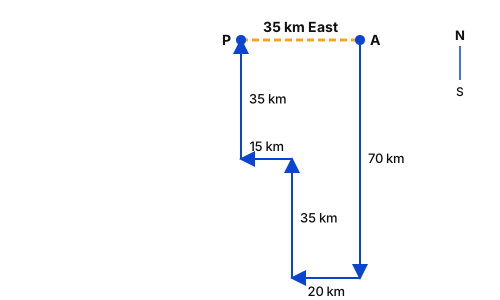
Benji starts from Point A and drives 70 km towards South. He then takes a right turn, drives 20 km, turns right and drives 35 km. He then takes a left turn and drives 15 km. He takes a final right turn, drives 35 km and stops at Point P. How far (shortest distance) and towards which direction should he drive in order to reach Point A again?
(All turns are 90 degree turns only unless otherwise specified.)
बेंजी बिंदु A से चलना शुरू करता है और दक्षिण की ओर 70 km गाड़ी चलाता है। फिर वह दाएँ मुड़ता है, 20 km गाड़ी चलाता है, दाएँ मुड़ता है और 35 km गाड़ी चलाता है। फिर वह बाएँ मुड़ता है और 15 km गाड़ी चलाता है। वह अंतिम बार दाएँ मुड़ता है, 35 km गाड़ी चलाता है और बिंदु P पर रुक जाता है। फिर से बिंदु A पर पहुँचने के लिए उसे कितनी दूर (न्यूनतम दूरी) और किस दिशा में गाड़ी चलानी चाहिए?
(जब तक अन्यथा निर्दिष्ट न हो, सभी मोड़ केवल 90 डिग्री के मोड़ हैं।)
  1. A20 km towards Eastपूर्व की ओर 20 km
  2. B30 km towards Eastपूर्व की ओर 30 km
  3. C15 km towards Eastपूर्व की ओर 15 km
  4. D35 km towards Eastपूर्व की ओर 35 km
Show answer

Concept: Track coordinates: East +x, North +y; start A at (0,0).

  1. 70 S →(0,−70); right (W) 20 →(−20,−70)
  2. Right (N) 35 →(−20,−35); left (W) 15 →(−35,−35)
  3. Right (N) 35 → P =(−35,0)
  4. A is 35 km to the East of P

Trick: Net N–S: −70+35+35=0, so only the E–W shift (20+15=35 km West) remains.

Answer: (D) 35 km towards East

अवधारणा: निर्देशांक लें: पूर्व +x, उत्तर +y; A =(0,0)।

  1. 70 दक्षिण →(0,−70); दाएँ (पश्चिम) 20 →(−20,−70)
  2. दाएँ (उत्तर) 35 →(−20,−35); बाएँ (पश्चिम) 15 →(−35,−35)
  3. दाएँ (उत्तर) 35 → P =(−35,0)
  4. A, P से 35 km पूर्व में है

ट्रिक: कुल उत्तर–दक्षिण: −70+35+35=0, केवल पूर्व–पश्चिम विस्थापन (20+15=35 km पश्चिम) बचा।

उत्तर: (D) पूर्व की ओर 35 km
RRB Technician Grade IIIGeneral Intelligence and ReasoningDirection senseRRB Technician Grade III 2024 · 24 Dec Shift 1 →
Q1742.
In the following number-pairs, the second number is obtained by applying certain mathematical operations to the first number. Which numbers should replace X and Y so that the pattern followed by the two numbers on the left side of :: is the same as that on the right side of ::?
(NOTE: Operations should be performed on the whole numbers, without breaking down the numbers into its constituent digits. E.g. 13 - Operations on 13 such as adding/subtracting/multiplying etc. to 13 can be performed. Breaking down 13 into 1 and 3 and then performing mathematical operations on 1 and 3 is not allowed.)
X : 38 :: 9 : Y
निम्नलिखित संख्या-युग्मों में, पहली संख्या पर कुछ गणितीय संक्रियाएँ करके दूसरी संख्या प्राप्त की जाती है। X और Y को किन संख्याओं से प्रतिस्थापित किया जाना चाहिए ताकि :: के बाईं ओर की दोनों संख्याओं द्वारा अनुसरण किया गया पैटर्न वही हो जो :: के दाईं ओर है?
(ध्यान दें: संक्रियाएँ पूर्ण संख्याओं पर की जानी चाहिए, संख्याओं को उनके घटक अंकों में तोड़े बिना। उदाहरण के लिए 13 - 13 पर संक्रियाएँ जैसे 13 में जोड़ना/घटाना/गुणा करना आदि किया जा सकता है। 13 को 1 और 3 में तोड़ना और फिर 1 और 3 पर गणितीय संक्रियाएँ करना वर्जित है।)
X : 38 :: 9 : Y
  1. AX = 14, Y = 28
  2. BX = 14, Y = 30
  3. CX = 15, Y = 48
  4. DX = 15, Y = 28
Show answer

Concept: Find one rule that works on both sides of :: for an option.

  1. Try (A): 14×2+10=38
  2. 9×2+10=28 ✓
  3. Other options fail, e.g. (D): 15×2+8=38 but 9×2+8=26≠28

Trick: Test options: the rule found from X must also give Y.

Answer: (A) X = 14, Y = 28

अवधारणा: ऐसा एक नियम खोजें जो किसी विकल्प के लिए :: के दोनों ओर लागू हो।

  1. (A) जाँचें: 14×2+10=38
  2. 9×2+10=28 ✓
  3. अन्य विकल्प असफल, जैसे (D): 15×2+8=38 पर 9×2+8=26≠28

ट्रिक: विकल्पों की जाँच करें: X से मिला नियम Y भी देना चाहिए।

उत्तर: (A) X = 14, Y = 28

RRB Technician Grade IIIGeneral Intelligence and ReasoningNumber analogyRRB Technician Grade III 2024 · 24 Dec Shift 1 →
Q1743.
In a certain code language, ‘travel know places’ is coded as ‘mh ca lu’ and ‘travel makes tourist’ is coded as ‘by ai ca’. What is the code for ‘travel’ in the given code language?
एक निश्चित कूट भाषा में, ‘travel know places’ को ‘mh ca lu’ के रूप में कूटबद्ध किया जाता है और ‘travel makes tourist’ को ‘by ai ca’ के रूप में कूटबद्ध किया जाता है। उस कूट भाषा में ‘travel’ के लिए कूट क्या है?
  1. Aby
  2. Bmh
  3. Clu
  4. Dca
Show answer

Concept: A word common to two sentences has the code common to both coded forms.

  1. 'travel' appears in both sentences
  2. Common code in 'mh ca lu' and 'by ai ca' is 'ca'
  3. travel = ca

Yaad rakhein: Common word ↔ common code.

Answer: (D) ca

अवधारणा: दो वाक्यों में उभयनिष्ठ शब्द का कोड दोनों कूटों में उभयनिष्ठ होता है।

  1. 'travel' दोनों वाक्यों में है
  2. 'mh ca lu' और 'by ai ca' में उभयनिष्ठ कोड 'ca'
  3. travel = ca

याद रखें: उभयनिष्ठ शब्द ↔ उभयनिष्ठ कोड।

उत्तर: (D) ca

RRB Technician Grade IIIGeneral Intelligence and ReasoningCoding – common wordsRRB Technician Grade III 2024 · 24 Dec Shift 1 →
Q1744.
Read the given statements and conclusions carefully. You have to take the given statements to be true even if they seem to be at variance from commonly known facts and decide which conclusion(s) logically follow(s) from the given statements.
Statements:
All legs are hands.
Some legs are ears.
Conclusions:
(I) Some hands are ears.
(II) Some ears are legs.
दिए गए कथनों और निष्कर्षों को ध्यानपूर्वक पढ़िए। आपको दिए गए कथनों को सत्य मानना है, भले ही वे सामान्यतः ज्ञात तथ्यों से भिन्न प्रतीत होते हों, और निर्णय लेना है कि कौन-सा/से निष्कर्ष दिए गए कथनों का तार्किक रूप से अनुसरण करता है/करते हैं।
कथन:
सभी पैर, हाथ हैं।
कुछ पैर, कान हैं।
निष्कर्ष:
(I) कुछ हाथ, कान हैं।
(II) कुछ कान, पैर हैं।
  1. AOnly conclusion II followsकेवल निष्कर्ष II अनुसरण करता है
  2. BOnly conclusion I followsकेवल निष्कर्ष I अनुसरण करता है
  3. CNeither conclusion I nor II followsन तो निष्कर्ष I और न ही II अनुसरण करता है
  4. DBoth conclusions I and II followनिष्कर्ष I और II दोनों अनुसरण करते हैं
Show answer

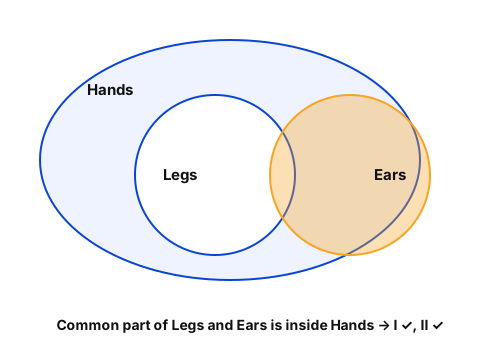
Concept: 'All A are B' puts A inside B; 'Some A are C' makes A and C overlap.

  1. Legs lie inside Hands
  2. The Legs–Ears overlap is therefore inside Hands ⇒ some hands are ears: I ✓
  3. 'Some legs are ears' converts to 'some ears are legs': II ✓

Trick: All + Some ⇒ Some (via the common term); a 'some' statement can always be reversed.

Answer: (D) Both conclusions I and II follow

अवधारणा: 'सभी A, B हैं' में A, B के अंदर; 'कुछ A, C हैं' में A और C आंशिक रूप से मिलते हैं।

  1. Legs, Hands के अंदर
  2. Legs–Ears का साझा भाग भी Hands के अंदर ⇒ कुछ hands, ears हैं: I ✓
  3. 'कुछ legs, ears हैं' उलटकर 'कुछ ears, legs हैं': II ✓

ट्रिक: सभी + कुछ ⇒ कुछ; 'कुछ' वाला कथन हमेशा उलटा जा सकता है।

उत्तर: (D) निष्कर्ष I और II दोनों अनुसरण करते हैं

RRB Technician Grade IIIGeneral Intelligence and ReasoningSyllogismRRB Technician Grade III 2024 · 24 Dec Shift 1 →
Q1745.
Select the set in which the numbers are related in the same way as are the numbers of the following sets.
(NOTE: Operations should be performed on the whole numbers, without breaking down the numbers into its constituent digits. E.g. 13 – Operations on 13 such as adding/subtracting/multiplying etc. to 13 can be performed. Breaking down 13 into 1 and 3 and then performing mathematical operations on 1 and 3 is not allowed.)
(2, 8, 32)
(5, 20, 80)
उस समुच्चय का चयन कीजिए जिसमें संख्याएँ उसी प्रकार संबंधित हैं जिस प्रकार निम्नलिखित समुच्चयों की संख्याएँ संबंधित हैं।
(ध्यान दें: संक्रियाएँ पूर्ण संख्याओं पर की जानी चाहिए, संख्याओं को उनके घटक अंकों में तोड़े बिना। उदाहरण के लिए 13 – 13 पर संक्रियाएँ जैसे 13 में जोड़ना/घटाना/गुणा करना आदि किया जा सकता है। 13 को 1 और 3 में तोड़ना और फिर 1 और 3 पर गणितीय संक्रियाएँ करना वर्जित है।)
(2, 8, 32)
(5, 20, 80)
  1. A(9, 36, 124)
  2. B(9, 36, 144)
  3. C(9, 36, 142)
  4. D(9, 39, 144)
Show answer

Concept: In each set, every number is 4 times the previous one.

  1. (2,8,32): 2×4=8, 8×4=32
  2. (5,20,80): ×4, ×4
  3. (9,36,144): 9×4=36, 36×4=144 ✓

Trick: Third number = first ×16: 9×16=144.

Answer: (B) (9, 36, 144)

अवधारणा: हर समूह में प्रत्येक संख्या पिछली की 4 गुना है।

  1. (2,8,32): 2×4=8, 8×4=32
  2. (5,20,80): ×4, ×4
  3. (9,36,144): 9×4=36, 36×4=144 ✓

ट्रिक: तीसरी संख्या = पहली ×16: 9×16=144।

उत्तर: (B) (9, 36, 144)

RRB Technician Grade IIIGeneral Intelligence and ReasoningNumber set analogyRRB Technician Grade III 2024 · 24 Dec Shift 1 →
Q1746.
Based on the English alphabetical order, three of the following four letter-clusters are alike in a certain way and thus form a group. Which letter-cluster does not belong to that group?
(Note: The odd one out is not based on the number of consonants/vowels or their position in the letter cluster.)
अंग्रेज़ी वर्णमाला क्रम के आधार पर, निम्नलिखित चार अक्षर-समूहों में से तीन किसी निश्चित प्रकार से एकसमान हैं और इस प्रकार एक समूह बनाते हैं। कौन-सा अक्षर-समूह उस समूह से संबंधित नहीं है?
(ध्यान दें: असंगत अक्षर-समूह, अक्षर-समूह में व्यंजनों/स्वरों की संख्या या उनके स्थान पर आधारित नहीं है।)
  1. ABEH
  2. BRUX
  3. CFIL
  4. DCEG
Show answer

Concept: Check the gap between consecutive letters.

  1. BEH: +3,+3; RUX: +3,+3; FIL: +3,+3
  2. CEG: +2,+2 – different

Trick: Position values help: B=2, E=5, H=8 (gap 3) vs C=3, E=5, G=7 (gap 2).

Answer: (D) CEG

अवधारणा: क्रमागत अक्षरों के बीच का अंतर जाँचें।

  1. BEH: +3,+3; RUX: +3,+3; FIL: +3,+3
  2. CEG: +2,+2 – भिन्न

ट्रिक: स्थानीय मान: B=2, E=5, H=8 (अंतर 3) बनाम C=3, E=5, G=7 (अंतर 2)।

उत्तर: (D) CEG

RRB Technician Grade IIIGeneral Intelligence and ReasoningOdd one out – letter clustersRRB Technician Grade III 2024 · 24 Dec Shift 1 →
Q1747.
Which of the following options should come in place of the question mark (?) in the given series?
7 20 59 176 ? 1580
दी गई श्रृंखला में प्रश्न चिह्न (?) के स्थान पर निम्नलिखित में से कौन-सा विकल्प आना चाहिए?
7 20 59 176 ? 1580
  1. A527
  2. B510
  3. C557
  4. D517
Show answer

Concept: Each term = previous ×3−1.

  1. 7×3−1=20, 20×3−1=59, 59×3−1=176
  2. 176×3−1=527
  3. Check: 527×3−1=1580 ✓

Trick: Ratio of terms is close to 3 ⇒ try ×3± small number.

Answer: (A) 527

अवधारणा: प्रत्येक पद = पिछला ×3−1।

  1. 7×3−1=20, 20×3−1=59, 59×3−1=176
  2. 176×3−1=527
  3. जाँच: 527×3−1=1580 ✓

ट्रिक: पदों का अनुपात लगभग 3 ⇒ ×3± छोटी संख्या आज़माएँ।

उत्तर: (A) 527

RRB Technician Grade IIIGeneral Intelligence and ReasoningNumber seriesRRB Technician Grade III 2024 · 24 Dec Shift 1 →
Q1748.
Read the given statements and conclusions carefully. You have to take the given statements to be true even if they seem to be at variance from commonly known facts and decide which conclusion(s) logically follow(s) from the given statements.
Statements:
Some doors are locks.
No lock is a key.
Conclusions:
(I) No door is a key.
(II) Some locks are doors.
दिए गए कथनों और निष्कर्षों को ध्यानपूर्वक पढ़िए। आपको दिए गए कथनों को सत्य मानना है, भले ही वे सामान्यतः ज्ञात तथ्यों से भिन्न प्रतीत होते हों, और निर्णय लेना है कि कौन-सा/से निष्कर्ष दिए गए कथनों का तार्किक रूप से अनुसरण करता है/करते हैं।
कथन:
कुछ दरवाज़े, ताले हैं।
कोई ताला, चाबी नहीं है।
निष्कर्ष:
(I) कोई दरवाज़ा, चाबी नहीं है।
(II) कुछ ताले, दरवाज़े हैं।
  1. ANeither conclusion I nor II followsन तो निष्कर्ष I और न ही II अनुसरण करता है
  2. BBoth conclusions I and II followनिष्कर्ष I और II दोनों अनुसरण करते हैं
  3. COnly conclusion I followsकेवल निष्कर्ष I अनुसरण करता है
  4. DOnly conclusion II followsकेवल निष्कर्ष II अनुसरण करता है
Show answer

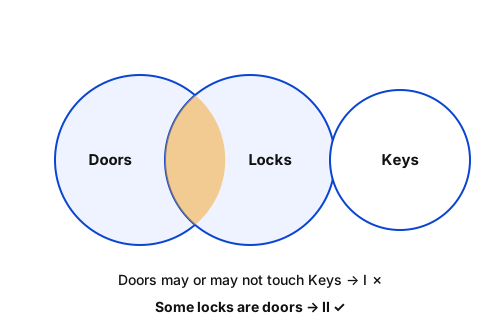
Concept: 'No A is B' keeps A and B apart; other sets may or may not touch B.

  1. Doors and Locks overlap; Locks and Keys are separate
  2. Doors may or may not overlap Keys ⇒ 'No door is a key' is not certain: I ✗
  3. 'Some doors are locks' reverses to 'some locks are doors': II ✓

Trick: Some + No ⇒ 'Some A are not C' only; a definite 'No' between the outer terms never follows.

Answer: (D) Only conclusion II follows

अवधारणा: 'कोई A, B नहीं' में A और B अलग; बाकी समूह B को छू भी सकते हैं, नहीं भी।

  1. Doors और Locks मिलते हैं; Locks और Keys अलग
  2. Doors, Keys से मिल भी सकता है ⇒ 'कोई door, key नहीं' निश्चित नहीं: I ✗
  3. 'कुछ doors, locks हैं' उलटकर 'कुछ locks, doors हैं': II ✓

ट्रिक: कुछ + कोई नहीं ⇒ केवल 'कुछ A, C नहीं हैं'; बाहरी पदों में निश्चित 'कोई नहीं' कभी नहीं निकलता।

उत्तर: (D) केवल निष्कर्ष II अनुसरण करता है

RRB Technician Grade IIIGeneral Intelligence and ReasoningSyllogismRRB Technician Grade III 2024 · 24 Dec Shift 1 →
Q1749.
Which of the following options should come in place of the question mark (?) in the given series based on the English alphabetical order?
CAN, FDP, IGR, LJT, ?
अंग्रेज़ी वर्णमाला क्रम के आधार पर दी गई श्रृंखला में प्रश्न चिह्न (?) के स्थान पर निम्नलिखित में से कौन-सा विकल्प आना चाहिए?
CAN, FDP, IGR, LJT, ?
  1. AOMV
  2. BLMV
  3. CLNV
  4. DLNR
Show answer

Concept: Track each letter position separately.

  1. 1st: C, F, I, L, O (+3)
  2. 2nd: A, D, G, J, M (+3)
  3. 3rd: N, P, R, T, V (+2)

Trick: First letters alone (C, F, I, L → O) leave only option (A).

Answer: (A) OMV

अवधारणा: हर स्थान के अक्षर को अलग से देखें।

  1. पहला: C, F, I, L, O (+3)
  2. दूसरा: A, D, G, J, M (+3)
  3. तीसरा: N, P, R, T, V (+2)

ट्रिक: केवल पहले अक्षर (C, F, I, L → O) से ही विकल्प (A) बचता है।

उत्तर: (A) OMV

RRB Technician Grade IIIGeneral Intelligence and ReasoningLetter seriesRRB Technician Grade III 2024 · 24 Dec Shift 1 →
Q1750.
Select the triad which follows the same pattern as that followed by the two triads given below. Both triads follow the same pattern.
ID-LG-OQ
LG-OJ-RT
उस त्रिक का चयन कीजिए जो उसी पैटर्न का अनुसरण करता है जिसका अनुसरण नीचे दिए गए दो त्रिकों द्वारा किया गया है। दोनों त्रिक एक ही पैटर्न का अनुसरण करते हैं।
ID-LG-OQ
LG-OJ-RT
  1. AMI-QL-TU
  2. BMI-QK-TV
  3. CNI-QL-TV
  4. DNI-QK-TU
Show answer

Concept: Follow first and second letters across the three pairs.

  1. ID-LG-OQ: I +3 L +3 O; D +3 G +10 Q
  2. LG-OJ-RT: L +3 O +3 R; G +3 J +10 T
  3. NI-QL-TV: N +3 Q +3 T; I +3 L +10 V ✓

Trick: First letters (+3,+3) leave A, C; then second letters (+3,+10) pick C.

Answer: (C) NI-QL-TV

अवधारणा: तीनों युग्मों में पहले और दूसरे अक्षर का अनुसरण करें।

  1. ID-LG-OQ: I +3 L +3 O; D +3 G +10 Q
  2. LG-OJ-RT: L +3 O +3 R; G +3 J +10 T
  3. NI-QL-TV: N +3 Q +3 T; I +3 L +10 V ✓

ट्रिक: पहले अक्षर (+3,+3) से A, C बचते हैं; दूसरे अक्षर (+3,+10) से C।

उत्तर: (C) NI-QL-TV

RRB Technician Grade IIIGeneral Intelligence and ReasoningLetter triads – patternRRB Technician Grade III 2024 · 24 Dec Shift 1 →
Q1751.
The motion of a freely falling body is an example of a:
स्वतंत्र रूप से गिरती हुई वस्तु की गति किसका उदाहरण है?
  1. Auniformly accelerated motionएकसमान त्वरित गति (uniformly accelerated motion)
  2. Bnon-uniformly accelerated motionअसमान त्वरित गति (non-uniformly accelerated motion)
  3. Cuniform speed motionएकसमान चाल वाली गति (uniform speed motion)
  4. Duniform velocity motionएकसमान वेग वाली गति (uniform velocity motion)
Show answer

Concept: A freely falling body moves only under gravity, so its acceleration is constant: g≈9.8 m s−2 (air resistance neglected).

  1. Velocity increases by the same amount every second (v=u+gt).
  2. Equal change in velocity in equal time intervals = uniform acceleration.
  3. Speed and velocity keep changing, so options (C) and (D) are wrong; acceleration is not changing, so (B) is wrong.

Yaad rakhein: Free fall = constant g = uniformly accelerated motion.

Answer: (A) uniformly accelerated motion

अवधारणा: स्वतंत्र रूप से गिरती वस्तु केवल गुरुत्व के अधीन चलती है, अतः उसका त्वरण नियत रहता है: g≈9.8 m s−2 (वायु प्रतिरोध नगण्य)।

  1. हर सेकंड वेग समान मात्रा में बढ़ता है (v=u+gt)।
  2. समान समय में वेग में समान परिवर्तन = एकसमान त्वरण।
  3. चाल और वेग बदलते रहते हैं, अतः (C) व (D) गलत; त्वरण नहीं बदलता, अतः (B) गलत।

याद रखें: मुक्त पतन = नियत g = एकसमान त्वरित गति।

उत्तर: (A) एकसमान त्वरित गति (uniformly accelerated motion)

RRB Technician Grade IIIGeneral ScienceUniformly accelerated motionRRB Technician Grade III 2024 · 24 Dec Shift 1 →
Q1752.
In a common salt/sodium chloride (NaCl), ions of which element is positively charged and negatively charged, respectively?
साधारण नमक/सोडियम क्लोराइड (NaCl) में, क्रमशः किस तत्व के आयन धनावेशित और ऋणावेशित होते हैं?
  1. ANa ions are positively charged, and Cl ions are negatively charged.Na आयन धनावेशित होते हैं, और Cl आयन ऋणावेशित होते हैं।
  2. BCl ions are positively charged, and Na ions are negatively charged.Cl आयन धनावेशित होते हैं, और Na आयन ऋणावेशित होते हैं।
  3. CIons of both Na and Cl are negatively charged.Na और Cl दोनों के आयन ऋणावेशित होते हैं।
  4. DIons of both Na and Cl are positively charged.Na और Cl दोनों के आयन धनावेशित होते हैं।
Show answer

Concept: NaCl is formed by transfer of one electron from sodium to chlorine.

  1. Na (2, 8, 1) loses 1 electron → Na+ (cation, positive).
  2. Cl (2, 8, 7) gains 1 electron → Cl− (anion, negative).
  3. Opposite charges attract strongly → ionic bond in Na+Cl−.

Yaad rakhein: Metals lose electrons → positive ions; non-metals gain electrons → negative ions.

Answer: (A) Na ions are positively charged, and Cl ions are negatively charged.

अवधारणा: NaCl सोडियम से क्लोरीन में एक इलेक्ट्रॉन के स्थानांतरण से बनता है।

  1. Na (2, 8, 1) 1 इलेक्ट्रॉन खोता है → Na+ (धनायन, धनावेशित)।
  2. Cl (2, 8, 7) 1 इलेक्ट्रॉन ग्रहण करता है → Cl− (ऋणायन, ऋणावेशित)।
  3. विपरीत आवेश प्रबल आकर्षण से Na+Cl− में आयनिक बंध बनाते हैं।

याद रखें: धातुएँ इलेक्ट्रॉन खोकर धनायन बनाती हैं; अधातुएँ इलेक्ट्रॉन लेकर ऋणायन।

उत्तर: (A) Na आयन धनावेशित होते हैं, और Cl आयन ऋणावेशित होते हैं।

RRB Technician Grade IIIGeneral ScienceIonic compound – NaClRRB Technician Grade III 2024 · 24 Dec Shift 1 →
Q1753.
Which of the following statements is/are correct regarding the effects of changes in pressure on the states of matter?
Statement I: Applying pressure and reducing temperature can liquefy gases.
Statement II: Solid carbon dioxide is stored under high pressure.
द्रव्य की अवस्थाओं पर दाब में परिवर्तन के प्रभावों के संबंध में निम्नलिखित में से कौन-सा/से कथन सही है/हैं?
कथन I: दाब लगाने और ताप कम करने से गैसों को द्रवित किया जा सकता है।
कथन II: ठोस कार्बन डाइऑक्साइड को उच्च दाब पर भंडारित किया जाता है।
  1. ANeither statement I nor II is correct.न तो कथन I और न ही II सही है।
  2. BOnly statement I is correct.केवल कथन I सही है।
  3. COnly statement II is correct.केवल कथन II सही है।
  4. DBoth statements I and II are correct.कथन I और II दोनों सही हैं।
Show answer

Concept: Pressure brings particles closer; lowering temperature reduces their kinetic energy. Both help change gas → liquid/solid.

  1. Statement I: gases (e.g. LPG) are liquefied by high pressure and low temperature – correct.
  2. Statement II: solid CO2 (dry ice) is stored under high pressure; when pressure drops to 1 atm it sublimes directly to gas – correct.
  3. So both statements are correct.

Yaad rakhein: Dry ice = solid CO2; at 1 atm it changes directly into gas (sublimation).

Answer: (D) Both statements I and II are correct.

अवधारणा: दाब कणों को पास लाता है; ताप घटाने से उनकी गतिज ऊर्जा कम होती है। दोनों मिलकर गैस को द्रव/ठोस में बदलने में सहायक हैं।

  1. कथन I: गैसें (जैसे LPG) उच्च दाब व निम्न ताप से द्रवित होती हैं – सही।
  2. कथन II: ठोस CO2 (शुष्क बर्फ) उच्च दाब पर रखी जाती है; दाब 1 atm होने पर यह सीधे गैस बन जाती है – सही।
  3. अतः दोनों कथन सही हैं।

याद रखें: शुष्क बर्फ = ठोस CO2; 1 atm पर सीधे गैस में बदलती है (ऊर्ध्वपातन)।

उत्तर: (D) कथन I और II दोनों सही हैं।

RRB Technician Grade IIIGeneral ScienceEffect of pressure on states of matterRRB Technician Grade III 2024 · 24 Dec Shift 1 →
Q1754.
Unit of pressure is:
दाब का मात्रक है:
  1. ANewton/meterन्यूटन/मीटर
  2. BNewtonन्यूटन
  3. CAngstromएंगस्ट्रॉम
  4. DPascalपास्कल
Show answer

Concept: Pressure is force acting per unit area: P=FA.

  1. SI unit = Nm2, named pascal (Pa).
  2. Newton is the unit of force; Newton/metre is the unit of surface tension or spring constant.
  3. Angstrom (10−10 m) is a unit of length.

Yaad rakhein: 1 Pa=1 N m−2 (area in the denominator, not length).

Answer: (D) Pascal

अवधारणा: दाब प्रति एकांक क्षेत्रफल पर लगने वाला बल है: P=FA।

  1. SI मात्रक = Nm2, जिसे पास्कल (Pa) कहते हैं।
  2. न्यूटन बल का मात्रक है; न्यूटन/मीटर पृष्ठ तनाव या स्प्रिंग नियतांक का मात्रक है।
  3. एंगस्ट्रॉम (10−10 m) लंबाई का मात्रक है।

याद रखें: 1 Pa=1 N m−2 (हर में क्षेत्रफल, लंबाई नहीं)।

उत्तर: (D) पास्कल

RRB Technician Grade IIIGeneral ScienceSI unit of pressureRRB Technician Grade III 2024 · 24 Dec Shift 1 →
Q1755.
If glucose :: six-carbon molecule, then pyruvate :: ________.
यदि ग्लूकोज़ :: छह-कार्बन अणु, तो पाइरुवेट :: ________।
  1. Afour-carbon moleculeचार-कार्बन अणु
  2. Bfive-carbon moleculeपाँच-कार्बन अणु
  3. Ctwo-carbon moleculeदो-कार्बन अणु
  4. Dthree-carbon moleculeतीन-कार्बन अणु
Show answer

Concept: In the first step of respiration (glycolysis, in the cytoplasm), glucose is broken into pyruvate.

  1. Glucose = C6H12O6, a six-carbon molecule.
  2. One glucose splits into two molecules of pyruvate.
  3. So each pyruvate has 62=3 carbon atoms.

Trick: Glucose (6C) ÷ 2 = pyruvate (3C) – think 'half'.

Answer: (D) three-carbon molecule

अवधारणा: श्वसन के पहले चरण (ग्लाइकोलाइसिस, कोशिकाद्रव्य में) में ग्लूकोज़ पाइरुवेट में टूटता है।

  1. ग्लूकोज़ = C6H12O6, छह-कार्बन अणु।
  2. एक ग्लूकोज़ टूटकर पाइरुवेट के दो अणु बनाता है।
  3. अतः प्रत्येक पाइरुवेट में 62=3 कार्बन परमाणु।

ट्रिक: ग्लूकोज़ (6C) ÷ 2 = पाइरुवेट (3C) – 'आधा' याद रखें।

उत्तर: (D) तीन-कार्बन अणु

RRB Technician Grade IIIGeneral ScienceGlycolysis – pyruvateRRB Technician Grade III 2024 · 24 Dec Shift 1 →
Q1756.
An object of height 30 cm is placed in front of a concave lens and an image of height 10 cm is formed. The magnification of the lens is:
30 cm ऊँचाई की एक वस्तु को एक अवतल लेंस (concave lens) के सामने रखा जाता है और 10 cm ऊँचाई का प्रतिबिंब बनता है। लेंस का आवर्धन (magnification) है:
  1. A1/3
  2. B−20
  3. C3
  4. D20
Show answer

Concept: Magnification m=h′h. A concave lens always forms a virtual, erect, diminished image, so m is positive and less than 1.

  1. Object height h=30 cm, image height h′=10 cm (erect, so positive).
  2. m=1030=13.
  3. Positive and <1 – matches a concave lens.

Trick: Concave lens: 0<m<1 always – pick the positive fraction.

Answer: (A) 1/3

अवधारणा: आवर्धन m=h′h। अवतल लेंस सदैव आभासी, सीधा, छोटा प्रतिबिंब बनाता है, अतः m धनात्मक और 1 से कम होता है।

  1. वस्तु की ऊँचाई h=30 cm, प्रतिबिंब की ऊँचाई h′=10 cm (सीधा, अतः धनात्मक)।
  2. m=1030=13।
  3. धनात्मक और <1 – अवतल लेंस से मेल खाता है।

ट्रिक: अवतल लेंस: सदैव 0<m<1 – धनात्मक भिन्न चुनें।

उत्तर: (A) 1/3

RRB Technician Grade IIIGeneral ScienceMagnification of a lensRRB Technician Grade III 2024 · 24 Dec Shift 1 →
Q1757.
Inside a bar magnet, the direction of magnetic field lines is from its:
एक छड़ चुंबक के अंदर, चुंबकीय क्षेत्र रेखाओं की दिशा होती है:
  1. ASouth pole to its North poleदक्षिण ध्रुव से उत्तर ध्रुव की ओर
  2. Balways perpendicular to the North poleसदैव उत्तर ध्रुव के लंबवत
  3. CNorth pole to its South poleउत्तर ध्रुव से दक्षिण ध्रुव की ओर
  4. Dalways perpendicular to the South poleसदैव दक्षिण ध्रुव के लंबवत
Show answer

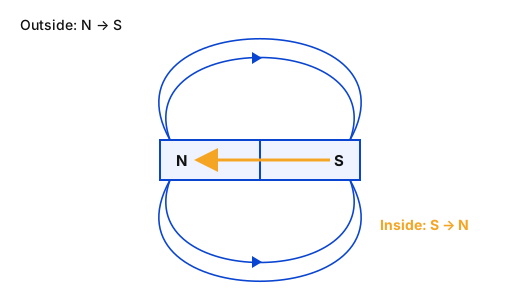
Concept: Magnetic field lines are closed continuous curves.

  1. Outside the magnet they emerge from the North pole and enter the South pole.
  2. To complete the closed loop, inside the magnet they go from the South pole to the North pole.
  3. They never intersect and are not 'perpendicular to a pole'.

Yaad rakhein: Outside N → S, inside S → N: a closed loop.

Answer: (A) South pole to its North pole

अवधारणा: चुंबकीय क्षेत्र रेखाएँ बंद, सतत वक्र होती हैं।

  1. चुंबक के बाहर ये उत्तरी ध्रुव से निकलकर दक्षिणी ध्रुव में प्रवेश करती हैं।
  2. बंद लूप पूरा करने के लिए चुंबक के अंदर ये दक्षिणी ध्रुव से उत्तरी ध्रुव की ओर जाती हैं।
  3. ये कभी एक-दूसरे को नहीं काटतीं।

याद रखें: बाहर N → S, अंदर S → N: बंद लूप।

उत्तर: (A) दक्षिण ध्रुव से उत्तर ध्रुव की ओर

RRB Technician Grade IIIGeneral ScienceMagnetic field lines of a bar magnetRRB Technician Grade III 2024 · 24 Dec Shift 1 →
Q1758.
Match the following columns I and II.
Column I | Column II
A. Placenta | i. Nutrition
B. Fallopian tube | ii. Fertilization
C. Uterus | iii. Implantation
निम्नलिखित स्तंभ I और II का मिलान कीजिए।
स्तंभ I | स्तंभ II
A. अपरा (Placenta) | i. पोषण (Nutrition)
B. अंडवाहिनी (Fallopian tube) | ii. निषेचन (Fertilization)
C. गर्भाशय (Uterus) | iii. रोपण (Implantation)
  1. AA-ii, B-i, C-iii
  2. BA-iii, B-ii, C-i
  3. CA-i, B-iii, C-ii
  4. DA-i, B-ii, C-iii
Show answer

Concept: Each part of the female reproductive system has a specific role in pregnancy.

  1. Placenta: disc-like tissue that passes nutrition (and oxygen) from mother's blood to the embryo → A-i.
  2. Fallopian tube (oviduct): site where sperm meets egg → fertilization → B-ii.
  3. Uterus: the embryo gets embedded (implanted) in its thick lining → C-iii.

Yaad rakhein: Tube = fertilization, Uterus = implantation, Placenta = nutrition.

Answer: (D) A-i, B-ii, C-iii

अवधारणा: मादा जनन तंत्र के प्रत्येक भाग की गर्भावस्था में विशिष्ट भूमिका है।

  1. अपरा (प्लेसेंटा): माँ के रक्त से भ्रूण तक पोषण (और ऑक्सीजन) पहुँचाती है → A-i।
  2. अंडवाहिनी (फैलोपियन नलिका): शुक्राणु व अंडाणु का मिलन → निषेचन → B-ii।
  3. गर्भाशय: भ्रूण इसकी मोटी भित्ति में स्थापित (रोपित) होता है → C-iii।

याद रखें: नलिका = निषेचन, गर्भाशय = रोपण, अपरा = पोषण।

उत्तर: (D) A-i, B-ii, C-iii

RRB Technician Grade IIIGeneral ScienceHuman female reproductive systemRRB Technician Grade III 2024 · 24 Dec Shift 1 →
Q1759.
Muscles present in our limbs move when we want them to and stop when we so decide. Such muscles are called:
हमारे अंगों में उपस्थित पेशियाँ तब गति करती हैं जब हम चाहते हैं और तब रुक जाती हैं जब हम ऐसा निर्णय लेते हैं। ऐसी पेशियों को कहा जाता है:
  1. Avoluntary musclesऐच्छिक पेशियाँ (voluntary muscles)
  2. Binvoluntary musclesअनैच्छिक पेशियाँ (involuntary muscles)
  3. Ccardiac musclesहृदय पेशियाँ (cardiac muscles)
  4. Dunstriated musclesअरेखित पेशियाँ (unstriated muscles)
Show answer

Concept: Muscles that move according to our will are called voluntary (striated/skeletal) muscles.

  1. Limb muscles (arms, legs) contract and relax when we decide – voluntary.
  2. Involuntary (unstriated/smooth) muscles, e.g. in the stomach and intestine, work on their own.
  3. Cardiac muscles of the heart are also involuntary and work rhythmically all life.

Yaad rakhein: Will = voluntary = striated (limbs); heart and gut = involuntary.

Answer: (A) voluntary muscles

अवधारणा: जो पेशियाँ हमारी इच्छा के अनुसार गति करती हैं, वे ऐच्छिक (रेखित/कंकाल) पेशियाँ कहलाती हैं।

  1. हाथ-पैर की पेशियाँ हमारी इच्छा से संकुचित व शिथिल होती हैं – ऐच्छिक।
  2. अनैच्छिक (अरेखित/चिकनी) पेशियाँ, जैसे आमाशय व आँत की, स्वतः कार्य करती हैं।
  3. हृदय की हृदय पेशियाँ भी अनैच्छिक हैं और जीवनभर लयबद्ध कार्य करती हैं।

याद रखें: इच्छा = ऐच्छिक = रेखित (अंग); हृदय व आँत = अनैच्छिक।

उत्तर: (A) ऐच्छिक पेशियाँ (voluntary muscles)

RRB Technician Grade IIIGeneral ScienceVoluntary musclesRRB Technician Grade III 2024 · 24 Dec Shift 1 →
Q1760.
A gas can be liquefied by ______.
किसी गैस को ______ द्वारा द्रवित किया जा सकता है।
  1. Alow pressure and high temperatureनिम्न दाब और उच्च ताप
  2. Blow pressure and low temperatureनिम्न दाब और निम्न ताप
  3. Chigh pressure and low temperatureउच्च दाब और निम्न ताप
  4. Dhigh pressure and high temperatureउच्च दाब और उच्च ताप
Show answer

Concept: In a gas, particles are far apart and move fast. To liquefy it, particles must be brought close and slowed down.

  1. High pressure compresses the gas → particles come closer.
  2. Low temperature reduces kinetic energy → attraction can hold particles together.
  3. Hence high pressure + low temperature liquefies a gas (e.g. LPG, liquid N2).

Trick: 'HP–LT': High Pressure, Low Temperature → liquid.

Answer: (C) high pressure and low temperature

अवधारणा: गैस में कण दूर-दूर व तीव्र गति में होते हैं। द्रवित करने हेतु कणों को पास लाना और धीमा करना पड़ता है।

  1. उच्च दाब गैस को संपीडित करता है → कण पास आते हैं।
  2. निम्न ताप गतिज ऊर्जा घटाता है → आकर्षण बल कणों को बाँध पाता है।
  3. अतः उच्च दाब + निम्न ताप से गैस द्रवित होती है (जैसे LPG, द्रव N2)।

ट्रिक: 'उच्च दाब–निम्न ताप' → द्रव।

उत्तर: (C) उच्च दाब और निम्न ताप

RRB Technician Grade IIIGeneral ScienceLiquefaction of gasesRRB Technician Grade III 2024 · 24 Dec Shift 1 →