Question bank

Q&A: practice questions with answers

Search questions on any topic. Filter by exam category, exam, subject and topic, try the question, then open the answer and explanation.

Courses – airGurukul

3,200 questions found.

Q1921.
If the mode of a data exceeds its mean by 16.2, then the mode exceeds the median by ______. (Use empirical formula to find the answer.)
यदि किसी आँकड़े का बहुलक उसके माध्य से 16.2 अधिक है, तो बहुलक माध्यिका से ______ अधिक है। (उत्तर ज्ञात करने के लिए आनुभविक सूत्र का प्रयोग कीजिए।)
  1. A12.4
  2. B10.8
  3. C8.25
  4. D10.2
Show answer

Concept: Empirical formula: Mode=3Median−2Mean, i.e. Mode−Mean=3(Median−Mean).

  1. 16.2=3(Median−Mean)⇒Median−Mean=5.4.
  2. Mode−Median=16.2−5.4=10.8.

Trick: Mode − Median =23 of (Mode − Mean) =23×16.2=10.8.

Answer: (B) 10.8

अवधारणा: आनुभविक सूत्र: बहुलक=3माध्यिका−2माध्य, अर्थात बहुलक−माध्य=3(माध्यिका−माध्य)।

  1. 16.2=3(माध्यिका−माध्य)⇒माध्यिका−माध्य=5.4।
  2. बहुलक−माध्यिका=16.2−5.4=10.8।

ट्रिक: बहुलक − माध्यिका =23×(बहुलक − माध्य) =23×16.2=10.8।

उत्तर: (B) 10.8

RRB Technician Grade IIIMathematicsStatistics – Empirical RelationRRB Technician Grade III 2024 · 23 Dec Shift 2 →
Q1922.
A retailer permits a trade discount of 15%, followed by a cash discount of 20%, on an article. The net percentage of discount is:
एक खुदरा विक्रेता किसी वस्तु पर 15% की व्यापारिक छूट और उसके बाद 20% की नकद छूट देता है। छूट का निवल प्रतिशत है:
  1. A32%
  2. B31%
  3. C33%
  4. D34%
Show answer

Concept: Two successive discounts a% and b% equal a single discount of (a+b−ab100)%.

  1. a=15, b=20.
  2. Net =15+20−15×20100=35−3=32%.

Trick: On ₹100: after 15% → 85; after 20% → 68; discount =32.

Answer: (A) 32%

अवधारणा: दो क्रमागत छूट a% और b% = एकल छूट (a+b−ab100)%।

  1. a=15, b=20।
  2. शुद्ध छूट =15+20−15×20100=35−3=32%।

ट्रिक: ₹100 पर: 15% के बाद 85; 20% के बाद 68; छूट =32।

उत्तर: (A) 32%

RRB Technician Grade IIIMathematicsSuccessive DiscountsRRB Technician Grade III 2024 · 23 Dec Shift 2 →
Q1923.
Out of an earning of ₹720, Rama spends 65%. How much does she save?
₹720 की आय में से रमा 65% खर्च करती है। वह कितनी बचत करती है?
  1. A₹316
  2. B₹252
  3. C₹350
  4. D₹390
Show answer

Concept: Saving % =100%− expenditure %.

  1. Saving =100%−65%=35%.
  2. 35% of 720 =35×720100=252.

Trick: 10%=72, 5%=36 → 35%=3×72+36=252.

Answer: (B) ₹252

अवधारणा: बचत % =100%− व्यय %।

  1. बचत =100%−65%=35%।
  2. 720 का 35%=35×720100=252।

ट्रिक: 10%=72, 5%=36 → 35%=3×72+36=252।

उत्तर: (B) ₹252

RRB Technician Grade IIIMathematicsPercentageRRB Technician Grade III 2024 · 23 Dec Shift 2 →
Q1924.
When the selling price of a TV is ₹18,700, the shopkeeper incurs a loss of 15%. What should be the selling price of that TV so as to gain 15%?
जब एक TV का विक्रय मूल्य ₹18,700 है, तो दुकानदार को 15% की हानि होती है। 15% का लाभ प्राप्त करने के लिए उस TV का विक्रय मूल्य क्या होना चाहिए?
  1. A₹43,200
  2. B₹25,300
  3. C₹19,800
  4. D₹34,200
Show answer

Concept: SP=CP×100±gain/loss%100.

  1. At 15% loss, SP =85% of CP =18700.
  2. CP =18700×10085=22000.
  3. SP for 15% gain =22000×115100=25300.

Trick: Direct: new SP =18700×11585=220×115=25300.

Answer: (B) ₹25,300

अवधारणा: विक्रय मूल्य=क्रय मूल्य×100±लाभ/हानि%100।

  1. 15% हानि पर, विक्रय मूल्य = क्रय मूल्य का 85%=18700।
  2. क्रय मूल्य =18700×10085=22000।
  3. 15% लाभ हेतु विक्रय मूल्य =22000×115100=25300।

ट्रिक: सीधे: नया विक्रय मूल्य =18700×11585=220×115=25300।

उत्तर: (B) ₹25,300

RRB Technician Grade IIIMathematicsProfit and LossRRB Technician Grade III 2024 · 23 Dec Shift 2 →
Q1925.
Anu is two years older than Kanu, who is twice as old as Tanu. If the total of their ages is 32, then what is the difference in age of Anu and Tanu?
अनु, कानु से दो वर्ष बड़ी है, और कानु की आयु तनु की आयु की दोगुनी है। यदि उनकी आयु का योग 32 है, तो अनु और तनु की आयु में कितना अंतर है?
  1. A14 years14 वर्ष
  2. B8 years8 वर्ष
  3. C7 years7 वर्ष
  4. D12 years12 वर्ष
Show answer

Concept: Take the youngest person's age as x and express the others through it.

  1. Tanu =x, Kanu =2x, Anu =2x+2.
  2. x+2x+2x+2=32⇒5x=30⇒x=6.
  3. Anu =14, Tanu =6; difference =8 years.

Trick: Difference Anu − Tanu =(2x+2)−x=x+2=8.

Answer: (B) 8 years

अवधारणा: सबसे छोटे की आयु x मानकर बाकी को उसी से लिखें।

  1. तनु =x, कनु =2x, अनु =2x+2।
  2. x+2x+2x+2=32⇒5x=30⇒x=6।
  3. अनु =14, तनु =6; अंतर =8 वर्ष।

ट्रिक: अंतर अनु − तनु =(2x+2)−x=x+2=8।

उत्तर: (B) 8 वर्ष

RRB Technician Grade IIIMathematicsProblems on AgesRRB Technician Grade III 2024 · 23 Dec Shift 2 →
Q1926.
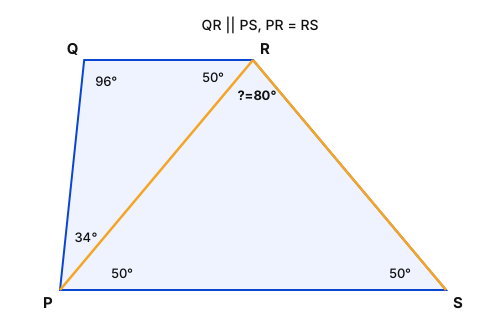
PQRS is a trapezium in which QR || PS and PR = RS. If ∠PQR=96∘ and ∠QPR=34∘, then what is the measure of ∠PRS?
PQRS एक समलंब है जिसमें QR || PS और PR = RS है। यदि ∠PQR=96∘ और ∠QPR=34∘ है, तो ∠PRS का माप क्या है?
  1. A75∘
  2. B70∘
  3. C80∘
  4. D65∘
Show answer

Concept: Angle sum of a triangle is 180∘; with parallel lines, alternate angles are equal; in an isosceles triangle, angles opposite equal sides are equal.

  1. In △PQR: ∠PRQ=180∘−96∘−34∘=50∘.
  2. QR∥PS → ∠RPS=∠PRQ=50∘ (alternate).
  3. PR=RS → ∠RSP=∠RPS=50∘.
  4. ∠PRS=180∘−50∘−50∘=80∘.

Trick: Diagonal PR is a transversal of the parallel sides – look for the alternate-angle pair first.

Answer: (C) 80∘

अवधारणा: त्रिभुज के कोणों का योग 180∘; समांतर रेखाओं में एकांतर कोण बराबर; समद्विबाहु त्रिभुज में बराबर भुजाओं के सामने के कोण बराबर।

  1. △PQR में: ∠PRQ=180∘−96∘−34∘=50∘।
  2. QR∥PS → ∠RPS=∠PRQ=50∘ (एकांतर)।
  3. PR=RS → ∠RSP=∠RPS=50∘।
  4. ∠PRS=180∘−50∘−50∘=80∘।

ट्रिक: विकर्ण PR समांतर भुजाओं की तिर्यक रेखा है – पहले एकांतर कोण देखें।

उत्तर: (C) 80∘

RRB Technician Grade IIIMathematicsGeometry – Trapezium & TrianglesRRB Technician Grade III 2024 · 23 Dec Shift 2 →
Q1927.
In a certain code language, ‘WIFE’ is coded as ‘1852’ and ‘FIRE’ is coded as ‘7258’. What is the code for ‘R’ in the given code language?
एक निश्चित कूट भाषा में, ‘WIFE’ को ‘1852’ के रूप में कूटबद्ध किया जाता है और ‘FIRE’ को ‘7258’ के रूप में कूटबद्ध किया जाता है। उस कूट भाषा में ‘R’ के लिए कूट क्या है?
  1. A7
  2. B2
  3. C5
  4. D8
Show answer

Concept: Letters common to two words share the common digits.

  1. WIFE = 1852, FIRE = 7258.
  2. Common letters: F, I, E; common digits: 8, 5, 2.
  3. Remaining letter R ↔ remaining digit 7.

Trick: Strike out the common letters/digits; what is left in FIRE (R) matches what is left in 7258 (7).

Answer: (A) 7

अवधारणा: दो शब्दों के समान अक्षरों के कोड भी समान अंक होते हैं।

  1. WIFE = 1852, FIRE = 7258।
  2. समान अक्षर: F, I, E; समान अंक: 8, 5, 2।
  3. बचा अक्षर R ↔ बचा अंक 7।

ट्रिक: समान अक्षर/अंक काट दें; FIRE में बचा R, 7258 में बचे 7 से मेल खाता है।

उत्तर: (A) 7

RRB Technician Grade IIIGeneral Intelligence and ReasoningCoding-DecodingRRB Technician Grade III 2024 · 23 Dec Shift 2 →
Q1928.
JGLI is related to NKPM in a certain way based on the English alphabetical order. In the same way, PMRO is related to TQVS. To which of the following options is MJOL related, following the same logic?
अंग्रेजी वर्णमाला क्रम के आधार पर JGLI एक निश्चित प्रकार से NKPM से संबंधित है। उसी प्रकार, PMRO, TQVS से संबंधित है। समान तर्क का अनुसरण करते हुए, MJOL निम्नलिखित में से किस विकल्प से संबंधित है?
  1. AQNPS
  2. BNQPS
  3. CQNSP
  4. DNQSP
Show answer

Concept: Find the shift applied to each letter by alphabet positions.

  1. J→N, G→K, L→P, I→M: each +4.
  2. PMRO→TQVS: also +4 each.
  3. MJOL: M→Q, J→N, O→S, L→P = QNSP.

Trick: Check only the first and last letters against options: Q…P → QNSP.

Answer: (C) QNSP

अवधारणा: अक्षरों की स्थिति से हर अक्षर में बदलाव ज्ञात करें।

  1. J→N, G→K, L→P, I→M: हर एक +4।
  2. PMRO→TQVS: भी हर एक +4।
  3. MJOL: M→Q, J→N, O→S, L→P = QNSP।

ट्रिक: विकल्पों में केवल पहला व अंतिम अक्षर जाँचें: Q…P → QNSP।

उत्तर: (C) QNSP

RRB Technician Grade IIIGeneral Intelligence and ReasoningLetter AnalogyRRB Technician Grade III 2024 · 23 Dec Shift 2 →
Q1929.
Refer to the given series and answer the question that follows (all numbers are single-digit numbers only, and all counting is to be done from left to right).
(Left) 9 1 1 5 7 8 0 4 5 9 9 4 6 9 4 1 6 6 8 1 4 3 5 0 2 1 9 8 6 1 (Right)
How many such odd digits are there, each of which is immediately preceded by a perfect square and immediately followed by an odd digit? (Note: 1 will be considered as a perfect square.)
दी गई श्रृंखला का संदर्भ लीजिए और उसके बाद दिए गए प्रश्न का उत्तर दीजिए (सभी संख्याएँ केवल एक अंक वाली संख्याएँ हैं, और सभी गणना बाएँ से दाएँ की जानी है)।
(बाएँ) 9 1 1 5 7 8 0 4 5 9 9 4 6 9 4 1 6 6 8 1 4 3 5 0 2 1 9 8 6 1 (दाएँ)
ऐसे कितने विषम अंक हैं, जिनमें से प्रत्येक के ठीक पहले एक पूर्ण वर्ग है और ठीक बाद एक विषम अंक है? (ध्यान दें: 1 को पूर्ण वर्ग माना जाएगा।)
  1. A5
  2. B2
  3. C1
  4. D3
Show answer

Concept: Perfect-square digits: 0, 1, 4, 9. Find odd digits with a perfect square just before and an odd digit just after.

  1. Scan pairs: 9-1-1, 1-1-5, 1-5-7.
  2. 4-5-9 (positions 8–10).
  3. 4-3-5 (near the end).
  4. Total =5.

Trick: First mark every odd–odd pair, then check only the digit before the first of each pair.

Answer: (A) 5

अवधारणा: पूर्ण वर्ग अंक: 0, 1, 4, 9। ऐसे विषम अंक खोजें जिनके ठीक पहले पूर्ण वर्ग और ठीक बाद विषम अंक हो।

  1. क्रम से देखें: 9-1-1, 1-1-5, 1-5-7।
  2. 4-5-9 (स्थान 8–10)।
  3. 4-3-5 (अंत के पास)।
  4. कुल =5।

ट्रिक: पहले सभी विषम–विषम जोड़े चिह्नित करें, फिर केवल उनके पहले अंक से ठीक पहले वाला अंक जाँचें।

उत्तर: (A) 5

RRB Technician Grade IIIGeneral Intelligence and ReasoningNumber Series CountingRRB Technician Grade III 2024 · 23 Dec Shift 2 →
Q1930.
Which of the following options should come in place of the question mark (?) in the given series based on the English alphabetical order?
GIN, JLQ, MOT, PRW, ?
अंग्रेजी वर्णमाला क्रम के आधार पर दी गई श्रृंखला में प्रश्न चिह्न (?) के स्थान पर निम्नलिखित में से कौन-सा विकल्प आना चाहिए?
GIN, JLQ, MOT, PRW, ?
  1. AZUS
  2. BSZU
  3. CZSU
  4. DSUZ
Show answer

Concept: Each letter of a term moves +3 to give the next term.

  1. G→J→M→P→S.
  2. I→L→O→R→U.
  3. N→Q→T→W→Z.
  4. Next term = SUZ.

Trick: Within each term the gaps are +2,+5 (G→I→N); S→U→Z keeps this.

Answer: (D) SUZ

अवधारणा: हर पद का प्रत्येक अक्षर +3 आगे बढ़कर अगला पद बनाता है।

  1. G→J→M→P→S।
  2. I→L→O→R→U।
  3. N→Q→T→W→Z।
  4. अगला पद = SUZ।

ट्रिक: हर पद के भीतर अंतर +2,+5 है (G→I→N); S→U→Z भी यही है।

उत्तर: (D) SUZ

RRB Technician Grade IIIGeneral Intelligence and ReasoningAlphabet SeriesRRB Technician Grade III 2024 · 23 Dec Shift 2 →
Q1931.
In the following number-pairs, the second number is obtained by applying certain mathematical operations to the first number. Which numbers should replace X and Y so that the pattern followed by the two numbers on the left side of :: is the same as that on the right side of ::?
(NOTE: Operations should be performed on the whole numbers, without breaking down the numbers into its constituent digits. E.g. 13 - Operations on 13 such as adding/subtracting/multiplying etc. to 13 can be performed. Breaking down 13 into 1 and 3 and then performing mathematical operations on 1 and 3 is not allowed.)
X : 87 :: 14 : Y
निम्नलिखित संख्या-युग्मों में, पहली संख्या पर कुछ गणितीय संक्रियाएँ करके दूसरी संख्या प्राप्त की जाती है। X और Y के स्थान पर कौन-सी संख्याएँ आनी चाहिए ताकि :: के बाईं ओर की दोनों संख्याओं द्वारा अपनाया गया पैटर्न वही हो जो :: के दाईं ओर है?
(ध्यान दें: संक्रियाएँ संख्याओं को उनके घटक अंकों में तोड़े बिना, पूर्ण संख्याओं पर की जानी चाहिए। उदाहरण के लिए 13 - 13 पर संक्रियाएँ जैसे 13 में जोड़ना/घटाना/गुणा करना आदि किया जा सकता है। 13 को 1 और 3 में तोड़कर फिर 1 और 3 पर गणितीय संक्रियाएँ करने की अनुमति नहीं है।)
X : 87 :: 14 : Y
  1. AX = 8, Y = 154
  2. BX = 8, Y = 153
  3. CX = 9, Y = 153
  4. DX = 9, Y = 155
Show answer

Concept: Test each option to find a single rule linking both pairs.

  1. Try X =8: 8×11−1=87 ✓
  2. Same rule: 14×11−1=154−1=153.
  3. So X =8, Y =153.

Trick: Options pair X with Y; fix the rule using X, then test Y – only (B) is consistent.

Answer: (B) X = 8, Y = 153

अवधारणा: दोनों युग्मों पर लागू होने वाला एक नियम विकल्पों की जाँच से खोजें।

  1. X =8 लें: 8×11−1=87 ✓
  2. वही नियम: 14×11−1=154−1=153।
  3. अतः X =8, Y =153।

ट्रिक: विकल्पों में X व Y साथ दिए हैं; X से नियम तय करें, फिर Y जाँचें – केवल (B) संगत है।

उत्तर: (B) X = 8, Y = 153

RRB Technician Grade IIIGeneral Intelligence and ReasoningNumber AnalogyRRB Technician Grade III 2024 · 23 Dec Shift 2 →
Q1932.
In a certain code language,
A + B means ‘A is the wife of B’,
A − B means ‘A is the brother of B’,
A × B means ‘A is the father of B’,
and A ÷ B means ‘A is the sister of B’.
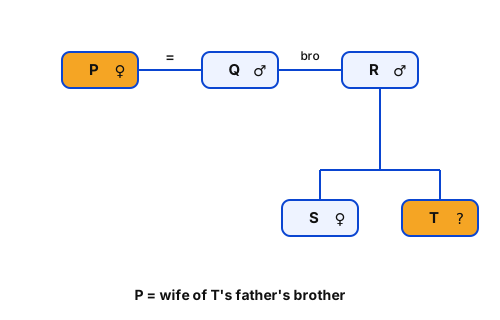
How is P related to T if ‘P + Q − R × S ÷ T’?
एक निश्चित कूट भाषा में,
A + B का अर्थ है ‘A, B की पत्नी है’,
A − B का अर्थ है ‘A, B का भाई है’,
A × B का अर्थ है ‘A, B का पिता है’,
और A ÷ B का अर्थ है ‘A, B की बहन है’।
यदि ‘P + Q − R × S ÷ T’ है, तो P, T से किस प्रकार संबंधित है?
  1. AMother’s brother’s wifeमाँ के भाई की पत्नी
  2. BFather’s sisterपिता की बहन
  3. CFather’s brother’s wifeपिता के भाई की पत्नी
  4. DMotherमाँ
Show answer

Concept: Decode each symbol and build a family tree.

  1. P + Q: P is Q's wife.
  2. Q − R: Q is R's brother.
  3. R × S: R is S's father; S ÷ T: S is T's sister → R is T's father.
  4. Q is T's father's brother, so P is T's father's brother's wife.

Trick: Read the chain from T backwards: T → father R → his brother Q → Q's wife P.

Answer: (C) Father’s brother’s wife

अवधारणा: हर चिह्न का अर्थ लिखकर वंश-वृक्ष बनाएँ।

  1. P + Q: P, Q की पत्नी है।
  2. Q − R: Q, R का भाई है।
  3. R × S: R, S का पिता; S ÷ T: S, T की बहन → R, T का पिता।
  4. Q, T के पिता का भाई है, अतः P, T के पिता के भाई की पत्नी (चाची) है।

ट्रिक: T से पीछे चलें: T → पिता R → उनका भाई Q → Q की पत्नी P।

उत्तर: (C) पिता के भाई की पत्नी

RRB Technician Grade IIIGeneral Intelligence and ReasoningBlood Relation (Coded)RRB Technician Grade III 2024 · 23 Dec Shift 2 →
Q1933.
In the following number-pairs, the second number is obtained by applying certain mathematical operations to the first number. Which numbers should replace X and Y so that the pattern followed by the two numbers on the left side of :: is the same as that on the right side of ::?
(NOTE: Operations should be performed on the whole numbers, without breaking down the numbers into its constituent digits. E.g. 13 - Operations on 13 such as adding/subtracting/multiplying etc. to 13 can be performed. Breaking down 13 into 1 and 3 and then performing mathematical operations on 1 and 3 is not allowed.)
X : 72 :: 22 : Y
निम्नलिखित संख्या-युग्मों में, पहली संख्या पर कुछ गणितीय संक्रियाएँ करके दूसरी संख्या प्राप्त की जाती है। X और Y के स्थान पर कौन-सी संख्याएँ आनी चाहिए ताकि :: के बाईं ओर की दोनों संख्याओं द्वारा अपनाया गया पैटर्न वही हो जो :: के दाईं ओर है?
(ध्यान दें: संक्रियाएँ संख्याओं को उनके घटक अंकों में तोड़े बिना, पूर्ण संख्याओं पर की जानी चाहिए। उदाहरण के लिए 13 - 13 पर संक्रियाएँ जैसे 13 में जोड़ना/घटाना/गुणा करना आदि किया जा सकता है। 13 को 1 और 3 में तोड़कर फिर 1 और 3 पर गणितीय संक्रियाएँ करने की अनुमति नहीं है।)
X : 72 :: 22 : Y
  1. AX = 18, Y = 96
  2. BX = 12, Y = 132
  3. CX = 18, Y = 132
  4. DX = 12, Y = 110
Show answer

Concept: Test the options to find one rule that fits both pairs.

  1. Try X =12: 12×6=72 ✓
  2. Same rule: 22×6=132.
  3. So X =12, Y =132.

Trick: Fix the rule from the left pair using X, then apply it to 22 – only (B) matches.

Answer: (B) X = 12, Y = 132

अवधारणा: दोनों युग्मों पर लागू होने वाला एक नियम विकल्पों से खोजें।

  1. X =12 लें: 12×6=72 ✓
  2. वही नियम: 22×6=132।
  3. अतः X =12, Y =132।

ट्रिक: X से बाएँ युग्म का नियम तय करें, फिर 22 पर लगाएँ – केवल (B) मेल खाता है।

उत्तर: (B) X = 12, Y = 132

RRB Technician Grade IIIGeneral Intelligence and ReasoningNumber AnalogyRRB Technician Grade III 2024 · 23 Dec Shift 2 →
Q1934.
In this question, a statement is followed by two courses of action, numbered I and II. You must assume everything in the statement to be true and on the basis of the information given in the statement, decide which of the courses of action logically follow(s) for pursuing.
Statement: The bee population in the region has been steadily declining due to the widespread use of pesticides in agriculture.
Courses of Action:
I. Introduce regulations that restrict the use of certain pesticides during peak pollination seasons.
II. Establish urban beekeeping programmes to artificially boost the bee population and pollination efforts.
इस प्रश्न में, एक कथन के बाद दो कार्यवाहियाँ I और II दी गई हैं। आपको कथन में दी गई सभी बातों को सत्य मानना है और कथन में दी गई जानकारी के आधार पर निर्णय लेना है कि कौन-सी कार्यवाही/कार्यवाहियाँ अपनाने के लिए तार्किक रूप से अनुसरण करती है/हैं।
कथन: कृषि में कीटनाशकों के व्यापक उपयोग के कारण क्षेत्र में मधुमक्खियों की संख्या लगातार घट रही है।
कार्यवाहियाँ:
I. चरम परागण मौसमों के दौरान कुछ कीटनाशकों के उपयोग को प्रतिबंधित करने वाले नियम लागू किए जाएँ।
II. मधुमक्खियों की संख्या और परागण प्रयासों को कृत्रिम रूप से बढ़ाने के लिए शहरी मधुमक्खी पालन कार्यक्रम स्थापित किए जाएँ।
  1. AOnly I followsकेवल I अनुसरण करती है
  2. BNeither I nor II followsन तो I और न ही II अनुसरण करती है
  3. COnly II followsकेवल II अनुसरण करती है
  4. DBoth I and II followI और II दोनों अनुसरण करती हैं
Show answer

Concept: A course of action follows if it practically addresses the stated problem or reduces its impact.

  1. Cause: pesticide use. I restricts pesticides during peak pollination – tackles the cause directly.
  2. Effect: falling bee numbers. II boosts bee populations and pollination – reduces the impact.
  3. Both are reasonable and practical.

Yaad rakhein: A valid action may attack the cause (I) or soften the effect (II).

Answer: (D) Both I and II follow

अवधारणा: कोई कार्यवाही तभी अनुसरण करती है जब वह समस्या को व्यावहारिक रूप से हल करे या उसका प्रभाव घटाए।

  1. कारण: कीटनाशक। I परागण के समय कीटनाशकों पर रोक लगाता है – सीधे कारण पर प्रहार।
  2. प्रभाव: मधुमक्खियों की कमी। II उनकी संख्या व परागण बढ़ाता है – प्रभाव घटाता है।
  3. दोनों व्यावहारिक और उचित हैं।

याद रखें: उचित कार्यवाही कारण पर (I) या प्रभाव कम करने पर (II) हो सकती है।

उत्तर: (D) I और II दोनों अनुसरण करती हैं

RRB Technician Grade IIIGeneral Intelligence and ReasoningCourse of ActionRRB Technician Grade III 2024 · 23 Dec Shift 2 →
Q1935.
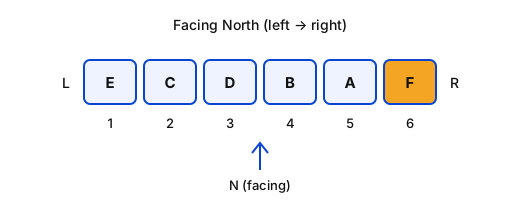
Six people—Adam, Brad, Clara, David, Emily and Farah—are sitting in a straight line, facing north. Only one person sits to the left of Clara. Only one person sits between Clara and Brad. David sits second to the right of Emily. Adam is neither an immediate neighbour of Clara nor sits at the extreme end of the line.
Q. Who sits at the extreme right end of the line?
छह व्यक्ति—Adam, Brad, Clara, David, Emily और Farah—एक सीधी पंक्ति में उत्तर की ओर मुख करके बैठे हैं। Clara के बाईं ओर केवल एक व्यक्ति बैठा है। Clara और Brad के बीच केवल एक व्यक्ति बैठा है। David, Emily के दाईं ओर दूसरे स्थान पर बैठा है। Adam न तो Clara का निकटतम पड़ोसी है और न ही पंक्ति के अंतिम छोर पर बैठा है।
प्रश्न: पंक्ति के दाएँ अंतिम छोर पर कौन बैठा है?
  1. ADavid
  2. BEmily
  3. CBrad
  4. DFarah
Show answer

Concept: Fix definite positions first (positions 1–6 from the left, all facing north).

  1. Only one to Clara's left → Clara at 2.
  2. One between Clara and Brad → Brad at 4.
  3. Adam not next to Clara (1, 3) and not at an end (6) → Adam at 5.
  4. Emily–David with David second to her right: only 1 and 3 → Emily 1, David 3; Farah at 6.

Trick: Place people with fixed positions first; the “second to the right” pair then has only one fit.

Answer: (D) Farah

अवधारणा: पहले निश्चित स्थान तय करें (बाएँ से स्थान 1–6, सभी उत्तर की ओर मुख)।

  1. Clara के बाएँ केवल एक → Clara स्थान 2 पर।
  2. Clara और Brad के बीच एक → Brad स्थान 4 पर।
  3. Adam, Clara का पड़ोसी नहीं (1, 3) और छोर पर नहीं (6) → Adam स्थान 5।
  4. David, Emily के दाएँ दूसरा: केवल 1 और 3 → Emily 1, David 3; Farah 6।

ट्रिक: पहले निश्चित स्थान वाले लोग बैठाएँ; फिर “दाएँ दूसरा” वाली जोड़ी का एक ही स्थान बचता है।

उत्तर: (D) Farah

RRB Technician Grade IIIGeneral Intelligence and ReasoningSeating Arrangement (Linear)RRB Technician Grade III 2024 · 23 Dec Shift 2 →
Q1936.
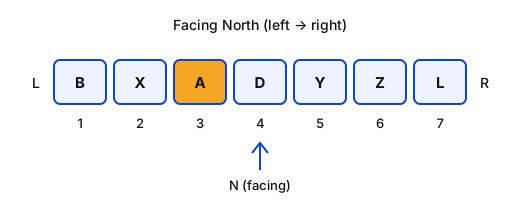
Seven people, A, B, D, L, X, Y and Z, are sitting in a row, facing north. Only five people sit between B and L. Z sits to the immediate left of L. Only one person sits between Z and D. A sits at some place to the left of Y but at some place to the right of X. Who sits third from the left end of the row?
सात व्यक्ति, A, B, D, L, X, Y और Z, एक पंक्ति में उत्तर की ओर मुख करके बैठे हैं। B और L के बीच केवल पाँच व्यक्ति बैठे हैं। Z, L के ठीक बाईं ओर बैठा है। Z और D के बीच केवल एक व्यक्ति बैठा है। A, Y के बाईं ओर किसी स्थान पर लेकिन X के दाईं ओर किसी स्थान पर बैठा है। पंक्ति के बाएँ छोर से तीसरे स्थान पर कौन बैठा है?
  1. AY
  2. BX
  3. CD
  4. DA
Show answer

Concept: Seven seats, 1–7 from the left, all facing north.

  1. Five between B and L → they occupy the ends 1 and 7.
  2. Z is immediately left of L, so L =7, Z =6, B =1.
  3. One between Z and D → D =4.
  4. Left seats 2, 3, 5 with X before A before Y → X =2, A =3, Y =5.

Trick: “Five between” in a row of seven always means the two ends.

Answer: (D) A

अवधारणा: सात स्थान, बाएँ से 1–7, सभी उत्तर की ओर मुख।

  1. B और L के बीच पाँच → दोनों छोर 1 और 7 पर।
  2. Z, L के ठीक बाएँ, अतः L =7, Z =6, B =1।
  3. Z और D के बीच एक → D =4।
  4. बचे स्थान 2, 3, 5; क्रम X, A, Y → X =2, A =3, Y =5।

ट्रिक: सात की पंक्ति में “बीच में पाँच” का मतलब हमेशा दोनों छोर।

उत्तर: (D) A

RRB Technician Grade IIIGeneral Intelligence and ReasoningSeating Arrangement (Linear)RRB Technician Grade III 2024 · 23 Dec Shift 2 →
Q1937.
In a certain code language, ‘over the top’ is written as ‘ak ot yh’ and ‘the rock is’ is coded as ‘ot gb tk’. How is ‘the’ coded in the given language?
एक निश्चित कूट भाषा में, ‘over the top’ को ‘ak ot yh’ लिखा जाता है और ‘the rock is’ को ‘ot gb tk’ के रूप में कूटबद्ध किया जाता है। उसी भाषा में ‘the’ को किस प्रकार कूटबद्ध किया जाता है?
  1. Asy
  2. Bot
  3. Cql
  4. Dmr
Show answer

Concept: A word common to two sentences has the code common to both coded sentences.

  1. ‘over the top’ → ‘ak ot yh’.
  2. ‘the rock is’ → ‘ot gb tk’.
  3. Common word ‘the’ ↔ common code ‘ot’.

Trick: Match common word with common code.

Answer: (B) ot

अवधारणा: दो वाक्यों में समान शब्द का कोड, दोनों कोडों में समान होता है।

  1. ‘over the top’ → ‘ak ot yh’।
  2. ‘the rock is’ → ‘ot gb tk’।
  3. समान शब्द ‘the’ ↔ समान कोड ‘ot’।

ट्रिक: समान शब्द = समान कोड।

उत्तर: (B) ot

RRB Technician Grade IIIGeneral Intelligence and ReasoningCoding-Decoding (Words)RRB Technician Grade III 2024 · 23 Dec Shift 2 →
Q1938.
Select the triad which follows the same pattern as that followed by the two triads given below. Both triads follow the same pattern.
TX-VS-WY
UY-WT-XZ
उस त्रिक का चयन कीजिए जो नीचे दिए गए दो त्रिकों द्वारा अनुसरण किए जाने वाले पैटर्न का ही अनुसरण करता है। दोनों त्रिक एक ही पैटर्न का अनुसरण करते हैं।
TX-VS-WY
UY-WT-XZ
  1. AOS-QN-RT
  2. BIM-KH-LO
  3. CLP-NK-OR
  4. DFJ-HE-IL
Show answer

Concept: Write letter positions and find the pattern: in ab-cd-ef: b=a+4, c=a+2, d=b−5, e=c+1, f=d+6.

  1. TX-VS-WY: T(20)→X(24) +4; V = T+2; S = X−5; W = V+1; Y = S+6.
  2. OS-QN-RT: O(15)→S(19) +4; Q = O+2; N(14) = S−5; R = Q+1; T(20) = N+6 ✓
  3. IM-KH-LO fails: H+6= N, not O.

Trick: Options often differ only in the last letter – check the final step (+6) first.

Answer: (A) OS-QN-RT

अवधारणा: अक्षरों के स्थान लिखकर नियम खोजें: ab-cd-ef में b=a+4, c=a+2, d=b−5, e=c+1, f=d+6।

  1. TX-VS-WY: T(20)→X(24) +4; V = T+2; S = X−5; W = V+1; Y = S+6।
  2. OS-QN-RT: O(15)→S(19) +4; Q = O+2; N(14) = S−5; R = Q+1; T(20) = N+6 ✓
  3. IM-KH-LO असफल: H+6= N, O नहीं।

ट्रिक: विकल्प अक्सर अंतिम अक्षर में ही भिन्न होते हैं – पहले अंतिम चरण (+6) जाँचें।

उत्तर: (A) OS-QN-RT

RRB Technician Grade IIIGeneral Intelligence and ReasoningLetter TriadsRRB Technician Grade III 2024 · 23 Dec Shift 2 →
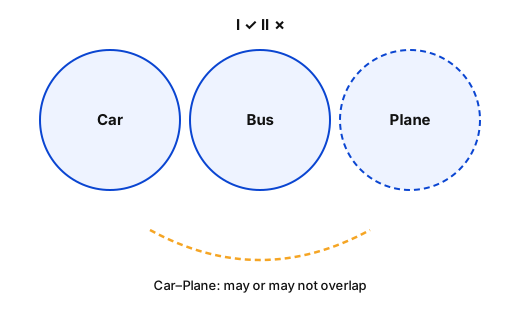
Q1939.
Read the given statements and conclusions carefully. You have to take the given statements to be true even if they seem to be at variance from commonly known facts and decide which conclusion(s) logically follow(s) from the given statements.
Statements:
No car is a bus.
No bus is a plane.
Conclusions:
(I) No bus is a car.
(II) No car is a plane.
दिए गए कथनों और निष्कर्षों को ध्यानपूर्वक पढ़िए। आपको दिए गए कथनों को सत्य मानना है, भले ही वे सामान्यतः ज्ञात तथ्यों से भिन्न प्रतीत होते हों, और निर्णय लीजिए कि कौन-सा/से निष्कर्ष दिए गए कथनों का तार्किक रूप से अनुसरण करता है/करते हैं।
कथन:
कोई भी कार, बस नहीं है।
कोई भी बस, विमान नहीं है।
निष्कर्ष:
(I) कोई भी बस, कार नहीं है।
(II) कोई भी कार, विमान नहीं है।
  1. AOnly conclusion I followsकेवल निष्कर्ष I अनुसरण करता है
  2. BBoth conclusions I and II followनिष्कर्ष I और II दोनों अनुसरण करते हैं
  3. CNeither conclusion I nor II followsन तो निष्कर्ष I और न ही II अनुसरण करता है
  4. DOnly conclusion II followsकेवल निष्कर्ष II अनुसरण करता है
Show answer

Concept: A universal negative (“No A is B”) can be reversed: “No B is A”. Two negatives give no definite conclusion about the end terms.

  1. “No car is a bus” → “No bus is a car”: I follows.
  2. Car and plane are linked only through two negative statements, so they may or may not overlap: II does not follow.

Yaad rakhein: Two negative premises → no conclusion between the end terms.

Answer: (A) Only conclusion I follows

अवधारणा: सार्वत्रिक नकारात्मक (“कोई A, B नहीं”) को उलटा जा सकता है: “कोई B, A नहीं”। दो नकारात्मक कथनों से अंतिम पदों पर निश्चित निष्कर्ष नहीं निकलता।

  1. “कोई कार बस नहीं” → “कोई बस कार नहीं”: I अनुसरण करता है।
  2. कार और विमान दो नकारात्मक कथनों से ही जुड़े हैं, वे मिल भी सकते हैं: II अनुसरण नहीं करता।

याद रखें: दो नकारात्मक कथन → अंतिम पदों के बीच कोई निष्कर्ष नहीं।

उत्तर: (A) केवल निष्कर्ष I अनुसरण करता है

RRB Technician Grade IIIGeneral Intelligence and ReasoningSyllogismRRB Technician Grade III 2024 · 23 Dec Shift 2 →
Q1940.
Based on the English alphabetical order, three of the following four letter-clusters are alike in a certain way and thus form a group. Which letter-cluster does not belong to that group?
(Note: The odd one out is not based on the number of consonants/vowels or their position in the letter-cluster.)
अंग्रेज़ी वर्णमाला क्रम के आधार पर, निम्नलिखित चार अक्षर-समूहों में से तीन किसी निश्चित प्रकार से एकसमान हैं और इस प्रकार एक समूह बनाते हैं। कौन-सा अक्षर-समूह उस समूह से संबंधित नहीं है?
(नोट: असंगत अक्षर-समूह, उस अक्षर-समूह में व्यंजनों/स्वरों की संख्या या उनके स्थान पर आधारित नहीं है।)
  1. ACEG
  2. BJLN
  3. CFUT
  4. DTVX
Show answer

Concept: Check the gaps between consecutive letters by alphabet position.

  1. CEG: +2,+2.
  2. JLN: +2,+2.
  3. TVX: +2,+2.
  4. FUT: F(6)→U(21)→T(20): +15,−1 – odd.

Trick: Three clusters are three alternate letters in order; FUT breaks the pattern.

Answer: (C) FUT

अवधारणा: अक्षरों के स्थानों से क्रमागत अंतर जाँचें।

  1. CEG: +2,+2।
  2. JLN: +2,+2।
  3. TVX: +2,+2।
  4. FUT: F(6)→U(21)→T(20): +15,−1 – भिन्न।

ट्रिक: तीन समूहों में एक-एक अक्षर छोड़कर क्रम है; FUT इसे तोड़ता है।

उत्तर: (C) FUT

RRB Technician Grade IIIGeneral Intelligence and ReasoningOdd One Out (Letters)RRB Technician Grade III 2024 · 23 Dec Shift 2 →