Question bank

Q&A: practice questions with answers

Search questions on any topic. Filter by exam category, exam, subject and topic, try the question, then open the answer and explanation.

Courses – airGurukul

3,200 questions found.

Q1941.
Refer to the given number and symbol series and answer the question that follows. Counting to be done from left to right only.
(Left) 2 % 8 4 5 3 @ # 1 * $ 7 & 9 + Ω 6 £ (Right)
How many such numbers are there, each of which is immediately preceded by another number and also immediately followed by a symbol?
दी गई संख्या और प्रतीक श्रृंखला का संदर्भ लीजिए और उसके बाद आने वाले प्रश्न का उत्तर दीजिए। गिनती केवल बाएँ से दाएँ की जानी है।
(बाएँ) 2 % 8 4 5 3 @ # 1 * $ 7 & 9 + Ω 6 £ (दाएँ)
ऐसी कितनी संख्याएँ हैं, जिनमें से प्रत्येक के ठीक पहले एक अन्य संख्या है और ठीक बाद एक प्रतीक है?
  1. A2
  2. B0
  3. C3
  4. D1
Show answer

Concept: Look for the pattern Number–Number–Symbol.

  1. Check each number: 8 (after %), 4 (followed by 5), 5 (followed by 3), 1 (after #), 7 (after $), 9 (after &), 6 (after Ω) – all fail.
  2. Only 5-3-@ fits.

Trick: Find each “number, number” pair, then check whether a symbol comes right after it.

Answer: (D) 1

अवधारणा: ढाँचा खोजें: संख्या–संख्या–प्रतीक।

  1. हर संख्या जाँचें: 8 (% के बाद), 4 (बाद में 5), 5 (बाद में 3), 1 (# के बाद), 7 ($ के बाद), 9 (& के बाद), 6 (Ω के बाद) – सभी असफल।
  2. केवल 5-3-@ सही बैठता है।

ट्रिक: पहले “संख्या, संख्या” जोड़े खोजें, फिर देखें कि उनके ठीक बाद प्रतीक है या नहीं।

उत्तर: (D) 1
RRB Technician Grade IIIGeneral Intelligence and ReasoningNumber–Symbol SeriesRRB Technician Grade III 2024 · 23 Dec Shift 2 →
Q1942.
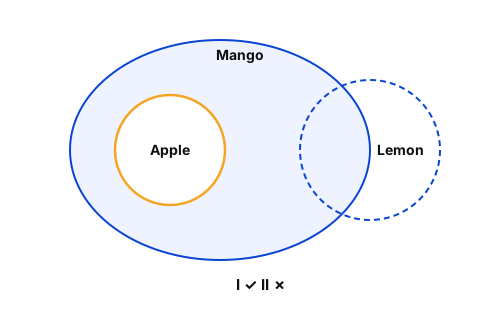
Read the given statements and conclusions carefully. You have to take the given statements to be true even if they seem to be at variance from commonly known facts and decide which conclusion(s) logically follow(s) from the given statements.
Statements:
All apples are mangoes.
Some mangoes are lemons.
Conclusions:
(I) At least some mangoes are apples.
(II) Some apples are lemons.
दिए गए कथनों और निष्कर्षों को ध्यानपूर्वक पढ़िए। आपको दिए गए कथनों को सत्य मानना है, भले ही वे सामान्यतः ज्ञात तथ्यों से भिन्न प्रतीत होते हों, और निर्णय लीजिए कि कौन-सा/से निष्कर्ष दिए गए कथनों का तार्किक रूप से अनुसरण करता है/करते हैं।
कथन:
सभी सेब, आम हैं।
कुछ आम, नींबू हैं।
निष्कर्ष:
(I) कम से कम कुछ आम, सेब हैं।
(II) कुछ सेब, नींबू हैं।
  1. AOnly conclusion II followsकेवल निष्कर्ष II अनुसरण करता है
  2. BNeither conclusion I nor II followsन तो निष्कर्ष I और न ही II अनुसरण करता है
  3. CBoth conclusions I and II followनिष्कर्ष I और II दोनों अनुसरण करते हैं
  4. DOnly conclusion I followsकेवल निष्कर्ष I अनुसरण करता है
Show answer

Concept: “All A are B” gives “Some B are A”. A “Some” link through the middle term does not connect the end terms.

  1. All apples are mangoes → some mangoes are apples: I follows.
  2. Lemons overlap only some mangoes; they may lie outside the apple region: II does not follow.

Yaad rakhein: All + Some (in this order) → no definite conclusion between the end terms.

Answer: (D) Only conclusion I follows

अवधारणा: “सभी A, B हैं” से “कुछ B, A हैं” निकलता है। मध्य पद के साथ “कुछ” संबंध अंतिम पदों को नहीं जोड़ता।

  1. सभी सेब आम हैं → कुछ आम सेब हैं: I अनुसरण करता है।
  2. नींबू कुछ आमों से ही मिलते हैं; वे सेब वाले भाग से बाहर भी हो सकते हैं: II अनुसरण नहीं करता।

याद रखें: सभी + कुछ (इसी क्रम में) → अंतिम पदों पर कोई निश्चित निष्कर्ष नहीं।

उत्तर: (D) केवल निष्कर्ष I अनुसरण करता है

RRB Technician Grade IIIGeneral Intelligence and ReasoningSyllogismRRB Technician Grade III 2024 · 23 Dec Shift 2 →
Q1943.
Based on the English alphabetical order, three of the following four letter-clusters are alike in a certain way and thus form a group. Which letter-cluster does not belong to that group?
(Note: The odd one out is not based on the number of consonants/vowels or their position in the letter-cluster.)
अंग्रेज़ी वर्णमाला क्रम के आधार पर, निम्नलिखित चार अक्षर-समूहों में से तीन किसी निश्चित प्रकार से एकसमान हैं और इस प्रकार एक समूह बनाते हैं। कौन-सा अक्षर-समूह उस समूह से संबंधित नहीं है?
(नोट: असंगत अक्षर-समूह, उस अक्षर-समूह में व्यंजनों/स्वरों की संख्या या उनके स्थान पर आधारित नहीं है।)
  1. AEZU
  2. BFAW
  3. CWRM
  4. DXSN
Show answer

Concept: Find the step between letters, counting backward cyclically (A comes after Z).

  1. EZU: E(5)→Z(26)→U(21): −5,−5 (cyclic).
  2. WRM: 23→18→13: −5,−5.
  3. XSN: 24→19→14: −5,−5.
  4. FAW: F(6)→A(1) −5, but A→W is −4 (should be V) – odd.

Trick: Reverse −5 steps: A −5 wraps to V, not W.

Answer: (B) FAW

अवधारणा: अक्षरों के बीच अंतर खोजें, चक्रीय रूप से पीछे गिनें (Z के बाद A)।

  1. EZU: E(5)→Z(26)→U(21): −5,−5 (चक्रीय)।
  2. WRM: 23→18→13: −5,−5।
  3. XSN: 24→19→14: −5,−5।
  4. FAW: F(6)→A(1) −5, पर A→W −4 है (V होना चाहिए) – भिन्न।

ट्रिक: −5 पीछे: A से −5 घूमकर V आता है, W नहीं।

उत्तर: (B) FAW

RRB Technician Grade IIIGeneral Intelligence and ReasoningOdd One Out (Letters)RRB Technician Grade III 2024 · 23 Dec Shift 2 →
Q1944.
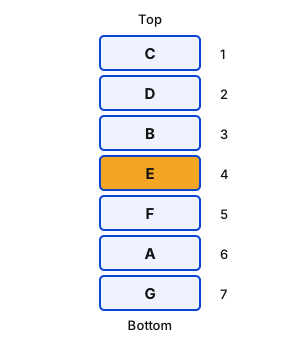
Seven boxes, A, B, C, D, E, F and G, are kept one over the other but not necessarily in the same order. Only C is kept above D. Only two boxes are kept between D and F. Only G is kept below A. B is not kept immediately above F. Which box is kept fourth from the top ?
सात बक्से, A, B, C, D, E, F और G, एक के ऊपर एक रखे गए हैं, लेकिन आवश्यक नहीं कि इसी क्रम में हों। केवल C को D के ऊपर रखा गया है। D और F के बीच केवल दो बक्से रखे गए हैं। केवल G को A के नीचे रखा गया है। B को F के ठीक ऊपर नहीं रखा गया है। ऊपर से चौथे स्थान पर कौन-सा बक्सा रखा गया है?
  1. AB
  2. BE
  3. CD
  4. DH
Show answer

Concept: Number the positions 1 (top) to 7 (bottom) and fix the definite clues first.

  1. Only C above D → C =1, D =2.
  2. Only G below A → G =7, A =6.
  3. Two between D and F → F =5.
  4. B not just above F → B ≠4, so B =3, E =4.

Trick: “Only X is above Y” puts X at the top and Y second.

Answer: (B) E

अवधारणा: स्थान 1 (ऊपर) से 7 (नीचे) तक मानें और पहले निश्चित संकेत लगाएँ।

  1. केवल C, D के ऊपर → C =1, D =2।
  2. केवल G, A के नीचे → G =7, A =6।
  3. D और F के बीच दो → F =5।
  4. B, F के ठीक ऊपर नहीं → B ≠4, अतः B =3, E =4।

ट्रिक: “केवल X, Y के ऊपर” का अर्थ X सबसे ऊपर और Y दूसरे स्थान पर।

उत्तर: (B) E

RRB Technician Grade IIIGeneral Intelligence and ReasoningBox ArrangementRRB Technician Grade III 2024 · 23 Dec Shift 2 →
Q1945.
What will come in the place of ‘?’ in the following equation, if ‘−’ and ‘×’ are interchanged and ‘+’ and ‘÷’ are interchanged?
23×13−7÷14+7=?
यदि ‘−’ और ‘×’ को आपस में बदल दिया जाए तथा ‘+’ और ‘÷’ को आपस में बदल दिया जाए, तो निम्नलिखित समीकरण में ‘?’ के स्थान पर क्या आएगा?
23×13−7÷14+7=?
  1. A−56
  2. B−76
  3. C−92
  4. D−66
Show answer

Concept: Swap the signs as told, then apply BODMAS.

  1. Swap − ↔ × and + ↔ ÷: 23−13×7+14÷7.
  2. 13×7=91, 14÷7=2.
  3. 23−91+2=−66.

Trick: Rewrite the whole expression first; don't swap and calculate at the same time.

Answer: (D) −66

अवधारणा: बताए अनुसार चिह्न बदलें, फिर BODMAS लगाएँ।

  1. − ↔ × और + ↔ ÷ बदलें: 23−13×7+14÷7।
  2. 13×7=91, 14÷7=2।
  3. 23−91+2=−66।

ट्रिक: पहले पूरा व्यंजक दोबारा लिखें; बदलना और हल करना एक साथ न करें।

उत्तर: (D) −66

RRB Technician Grade IIIGeneral Intelligence and ReasoningMathematical Operations (Interchange)RRB Technician Grade III 2024 · 23 Dec Shift 2 →
Q1946.
Refer to the following number and symbol series and answer the question that follows. Counting to be done from left to right only.
(Left) 2 9 + % 8 4 5 3 @ $ 7 & Ω 6 # 1 * £ (Right)
How many such symbols are there, each of which is immediately preceded by another symbol and also immediately followed by a number?
निम्नलिखित संख्या और प्रतीक श्रृंखला का संदर्भ लीजिए और उसके बाद आने वाले प्रश्न का उत्तर दीजिए। गिनती केवल बाएँ से दाएँ की जानी है।
(बाएँ) 2 9 + % 8 4 5 3 @ $ 7 & Ω 6 # 1 * £ (दाएँ)
ऐसे कितने प्रतीक हैं, जिनमें से प्रत्येक के ठीक पहले एक अन्य प्रतीक है और ठीक बाद एक संख्या है?
  1. A1
  2. B4
  3. C2
  4. D3
Show answer

Concept: Look for the pattern Symbol–Symbol–Number.

  1. + % 8 ✓
  2. @ $ 7 ✓
  3. & Ω 6 ✓
  4. Others (#, *, £, +, &, @) fail. Total =3.

Trick: Find symbol pairs, then check the item right after the second symbol.

Answer: (D) 3

अवधारणा: ढाँचा खोजें: प्रतीक–प्रतीक–संख्या।

  1. + % 8 ✓
  2. @ $ 7 ✓
  3. & Ω 6 ✓
  4. बाकी (#, *, £, +, &, @) असफल। कुल =3।

ट्रिक: पहले प्रतीक-जोड़े खोजें, फिर दूसरे प्रतीक के ठीक बाद वाला पद देखें।

उत्तर: (D) 3

RRB Technician Grade IIIGeneral Intelligence and ReasoningNumber–Symbol SeriesRRB Technician Grade III 2024 · 23 Dec Shift 2 →
Q1947.
If ‘A’ stands for ‘−’, ‘B’ stands for ‘×’, ‘C’ stands for ‘÷’ and ‘D’ stands for ‘+’, what will come in place of the question mark ‘?’ in the following equation?
23 D 18 C 3 B 5 A 17 = ?
यदि ‘A’ का अर्थ ‘−’, ‘B’ का अर्थ ‘×’, ‘C’ का अर्थ ‘÷’ और ‘D’ का अर्थ ‘+’ है, तो निम्नलिखित समीकरण में प्रश्न चिह्न ‘?’ के स्थान पर क्या आएगा?
23 D 18 C 3 B 5 A 17 = ?
  1. A26
  2. B46
  3. C36
  4. D56
Show answer

Concept: Replace letters with signs, then use BODMAS.

  1. 23+18÷3×5−17.
  2. 18÷3=6, 6×5=30.
  3. 23+30−17=36.

Trick: Decode first: A =−, B =×, C =÷, D =+.

Answer: (C) 36

अवधारणा: अक्षरों के स्थान पर चिह्न रखें, फिर BODMAS लगाएँ।

  1. 23+18÷3×5−17।
  2. 18÷3=6, 6×5=30।
  3. 23+30−17=36।

ट्रिक: पहले डिकोड करें: A =−, B =×, C =÷, D =+।

उत्तर: (C) 36

RRB Technician Grade IIIGeneral Intelligence and ReasoningMathematical Operations (Coded)RRB Technician Grade III 2024 · 23 Dec Shift 2 →
Q1948.
Which of the following options should come in place of the question mark (?) in the given series to make it logically complete?
859, 768, 677, 586, 495, ?
दी गई श्रृंखला को तार्किक रूप से पूर्ण करने के लिए प्रश्न चिह्न (?) के स्थान पर निम्नलिखित में से कौन-सा विकल्प आना चाहिए?
859, 768, 677, 586, 495, ?
  1. A388
  2. B426
  3. C404
  4. D462
Show answer

Concept: Check differences between consecutive terms.

  1. 859−768=91, 768−677=91, … each step is −91.
  2. Next =495−91=404.

Trick: Digits move as hundreds −1, tens −1, units +1: 4,9,5 → 4,0,4.

Answer: (C) 404

अवधारणा: क्रमागत पदों का अंतर देखें।

  1. 859−768=91, 768−677=91, … हर बार −91।
  2. अगला =495−91=404।

ट्रिक: अंक: सैकड़ा −1, दहाई −1, इकाई +1: 4,9,5 → 4,0,4।

उत्तर: (C) 404

RRB Technician Grade IIIGeneral Intelligence and ReasoningNumber SeriesRRB Technician Grade III 2024 · 23 Dec Shift 2 →
Q1949.
Which of the following options should come in place of the question mark (?) in the given series based on the English alphabetical order?
FJN, IMQ, LPT, OSW, ?
अंग्रेज़ी वर्णमाला क्रम के आधार पर दी गई श्रृंखला में प्रश्न चिह्न (?) के स्थान पर निम्नलिखित में से कौन-सा विकल्प आना चाहिए?
FJN, IMQ, LPT, OSW, ?
  1. ASUY
  2. BRVZ
  3. CRUY
  4. DRUZ
Show answer

Concept: Each letter of a term moves +3 to give the next term.

  1. F→I→L→O→R.
  2. J→M→P→S→V.
  3. N→Q→T→W→Z.
  4. Next = RVZ.

Trick: Inside each term the gap is +4,+4; R→V→Z keeps it.

Answer: (B) RVZ

अवधारणा: हर पद का प्रत्येक अक्षर +3 आगे बढ़कर अगला पद बनाता है।

  1. F→I→L→O→R।
  2. J→M→P→S→V।
  3. N→Q→T→W→Z।
  4. अगला = RVZ।

ट्रिक: हर पद के भीतर अंतर +4,+4; R→V→Z भी यही रखता है।

उत्तर: (B) RVZ

RRB Technician Grade IIIGeneral Intelligence and ReasoningAlphabet SeriesRRB Technician Grade III 2024 · 23 Dec Shift 2 →
Q1950.
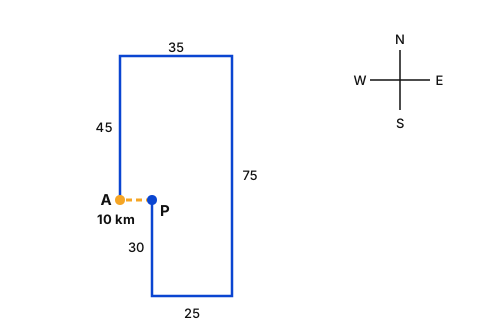
Pranay starts from Point A and drives 45 km towards North. He then takes a right turn, drives 35 km, turns right and drives 75 km. He then takes a right turn and drives 25 km. He takes a final right turn, drives 30 km and stops at Point P. How far (shortest distance) and towards which direction should he drive in order to reach Point A again?
(All turns are 90 degree turns only unless otherwise specified.)
प्रणय बिंदु A से चलना शुरू करता है और उत्तर की ओर 45 km ड्राइव करता है। फिर वह दाएँ मुड़ता है, 35 km ड्राइव करता है, दाएँ मुड़ता है और 75 km ड्राइव करता है। फिर वह दाएँ मुड़ता है और 25 km ड्राइव करता है। वह अंतिम बार दाएँ मुड़ता है, 30 km ड्राइव करता है और बिंदु P पर रुक जाता है। फिर से बिंदु A तक पहुँचने के लिए उसे कितनी दूरी (न्यूनतम दूरी) तक और किस दिशा में ड्राइव करना चाहिए?
(जब तक अन्यथा निर्दिष्ट न हो, सभी मोड़ केवल 90 डिग्री के मोड़ हैं।)
  1. A10 km towards Northउत्तर की ओर 10 km
  2. B10 km towards Southदक्षिण की ओर 10 km
  3. C10 km towards Eastपूर्व की ओर 10 km
  4. D10 km towards Westपश्चिम की ओर 10 km
Show answer

Concept: Track net north–south and east–west displacement from the start.

  1. North 45, then (right) east 35, then (right) south 75, then (right) west 25, then (right) north 30.
  2. N–S: 45−75+30=0.
  3. E–W: 35−25=10 km east of A.
  4. So P is 10 km east of A; he must drive 10 km towards west.

Trick: Net vertical is zero, so the answer is purely the horizontal gap.

Answer: (D) 10 km towards West

अवधारणा: आरंभ बिंदु से कुल उत्तर–दक्षिण और पूर्व–पश्चिम विस्थापन निकालें।

  1. उत्तर 45, फिर (दाएँ) पूर्व 35, फिर (दाएँ) दक्षिण 75, फिर (दाएँ) पश्चिम 25, फिर (दाएँ) उत्तर 30।
  2. उ–द: 45−75+30=0।
  3. पू–प: 35−25=10 किमी, A के पूर्व में।
  4. P, A से 10 किमी पूर्व में है; उसे 10 किमी पश्चिम की ओर जाना होगा।

ट्रिक: उत्तर–दक्षिण शून्य है, अतः केवल क्षैतिज दूरी ही उत्तर है।

उत्तर: (D) पश्चिम की ओर 10 km

RRB Technician Grade IIIGeneral Intelligence and ReasoningDirection and DistanceRRB Technician Grade III 2024 · 23 Dec Shift 2 →
Q1951.
To move an object on a horizontal table, one needs to apply:
किसी वस्तु को क्षैतिज मेज पर गति कराने के लिए, किसी को लगाना होगा:
  1. Aunbalanced forceअसंतुलित बल
  2. Ban equal amount of perpendicular forces on the object in both upward and downward directionsवस्तु पर ऊपर और नीचे दोनों दिशाओं में समान मात्रा में लंबवत बल
  3. Cbalanced forceसंतुलित बल
  4. Donly a single force perpendicular to the objectवस्तु पर लंबवत केवल एक ही बल
Show answer

Concept: A body at rest starts moving only when a net (unbalanced) force acts on it (Newton's first law).

  1. Balanced forces cancel each other: net force =0, so the object stays at rest.
  2. Upward and downward forces (weight and normal reaction) are vertical and balanced; they cannot produce horizontal motion.
  3. To slide the object along the table, the applied push must exceed friction, giving a net (unbalanced) horizontal force.

Yaad rakhein: Motion changes only when Fnet≠0 – i.e. an unbalanced force.

Answer: (A) unbalanced force

अवधारणा: विराम में रखी वस्तु तभी चलती है जब उस पर नेट (असंतुलित) बल लगे (न्यूटन का प्रथम नियम)।

  1. संतुलित बल एक-दूसरे को निरस्त कर देते हैं: नेट बल =0, वस्तु विराम में रहती है।
  2. ऊपर-नीचे के बल (भार और अभिलंब प्रतिक्रिया) ऊर्ध्वाधर व संतुलित हैं; ये क्षैतिज गति नहीं दे सकते।
  3. मेज़ पर खिसकाने के लिए लगाया गया धक्का घर्षण से अधिक होना चाहिए, यानी असंतुलित क्षैतिज बल।

याद रखें: गति में परिवर्तन तभी जब Fnet≠0, अर्थात असंतुलित बल।

उत्तर: (A) असंतुलित बल

RRB Technician Grade IIIGeneral ScienceForce and MotionRRB Technician Grade III 2024 · 23 Dec Shift 2 →
Q1952.
What is the primary difference between the particles of a solid and those of a gas?
ठोस के कणों और गैस के कणों के बीच प्राथमिक अंतर क्या है?
  1. ASolid particles have more energy than gas particles.ठोस कणों में गैस कणों की तुलना में अधिक ऊर्जा होती है।
  2. BSolid particles are made of different elements than gas particles.ठोस कण गैस कणों से भिन्न तत्वों से बने होते हैं।
  3. CSolid particles are more closely packed than gas particles.ठोस कण गैस कणों की तुलना में अधिक निकटता से संकुलित (closely packed) होते हैं।
  4. DSolid particles move more freely than gas particles.ठोस कण गैस कणों की तुलना में अधिक स्वतंत्र रूप से गति करते हैं।
Show answer

Concept: Solids and gases differ in how closely their particles are packed and how strongly they attract each other.

  1. In solids, particles are very closely packed with strong forces of attraction, so they only vibrate in place.
  2. In gases, particles are far apart, forces are negligible and they move freely at high speed.
  3. Particles of a substance are the same in every state; gas particles have more (not less) kinetic energy.

Yaad rakhein: Packing order: solid > liquid > gas; freedom of movement: gas > liquid > solid.

Answer: (C) Solid particles are more closely packed than gas particles.

अवधारणा: ठोस और गैस का अंतर कणों की निकटता और उनके बीच आकर्षण बल से है।

  1. ठोस में कण बहुत पास-पास और प्रबल आकर्षण से बंधे होते हैं, केवल अपने स्थान पर कंपन करते हैं।
  2. गैस में कण बहुत दूर-दूर, आकर्षण नगण्य, और वे स्वतंत्र रूप से तेज़ गति करते हैं।
  3. हर अवस्था में कण वही रहते हैं; गैस कणों की ऊर्जा ठोस से अधिक होती है, कम नहीं।

याद रखें: निकटता: ठोस > द्रव > गैस; गति की स्वतंत्रता: गैस > द्रव > ठोस।

उत्तर: (C) ठोस कण गैस कणों की तुलना में अधिक निकटता से संकुलित (closely packed) होते हैं।

RRB Technician Grade IIIGeneral ScienceStates of MatterRRB Technician Grade III 2024 · 23 Dec Shift 2 →
Q1953.
Which hormone is present in greater concentration in areas of rapid cell division and promote cell division?
कौन-सा हॉर्मोन तीव्र कोशिका विभाजन वाले क्षेत्रों में अधिक सांद्रता में उपस्थित होता है और कोशिका विभाजन को बढ़ावा देता है?
  1. AAbscisic acidएब्सिसिक अम्ल (Abscisic acid)
  2. BGibberellinsजिबरेलिन (Gibberellins)
  3. CCytokininसाइटोकाइनिन (Cytokinin)
  4. DAuxinsऑक्सिन (Auxins)
Show answer

Concept: Plant hormones (phytohormones) each have a typical role; the one promoting cell division is cytokinin.

  1. Cytokinins are present in higher concentration in areas of rapid cell division, such as fruits and seeds.
  2. Auxin – cell elongation and bending of shoots towards light; Gibberellins – stem growth.
  3. Abscisic acid inhibits growth and causes wilting of leaves (stress hormone).

Trick: Cytokinin = cytokinesis (cell division).

Answer: (C) Cytokinin

अवधारणा: प्रत्येक पादप हार्मोन का एक विशेष कार्य है; कोशिका विभाजन को बढ़ावा देने वाला हार्मोन साइटोकाइनिन है।

  1. साइटोकाइनिन तीव्र कोशिका विभाजन वाले भागों (जैसे फल और बीज) में अधिक सांद्रता में पाया जाता है।
  2. ऑक्सिन – कोशिका दीर्घीकरण, प्रकाश की ओर मुड़ना; जिबरेलिन – तने की वृद्धि।
  3. एब्सिसिक अम्ल वृद्धि रोकता है और पत्तियों का मुरझाना करता है।

ट्रिक: साइटोकाइनिन = साइटोकाइनेसिस (कोशिका विभाजन)।

उत्तर: (C) साइटोकाइनिन (Cytokinin)

RRB Technician Grade IIIGeneral SciencePlant HormonesRRB Technician Grade III 2024 · 23 Dec Shift 2 →
Q1954.
Which of the following statements is correct related to male reproductive system?
नर जनन तंत्र से संबंधित निम्नलिखित में से कौन-सा कथन सही है?
  1. ATestes are located in the abdominal cavity.वृषण उदर गुहा में स्थित होते हैं।
  2. BFormation of sperm takes place in seminal vessel.शुक्राणुओं का निर्माण शुक्राशय (seminal vessel) में होता है।
  3. CTestes secrete testosterone hormone.वृषण टेस्टोस्टेरॉन हॉर्मोन स्रावित करते हैं।
  4. DSperm formation requires higher temperature than the normal body temperature.शुक्राणु निर्माण के लिए सामान्य शरीर ताप से अधिक ताप की आवश्यकता होती है।
Show answer

Concept: The testes are the primary male reproductive organs: they produce sperm and secrete the hormone testosterone.

  1. Testes lie outside the abdominal cavity in the scrotum – so (A) is wrong.
  2. Sperm need a temperature lower than normal body temperature; that is why the scrotum is outside – (D) is wrong.
  3. Sperm are formed in the testes; seminal vesicles only add fluid – (B) is wrong.
  4. Testosterone regulates sperm formation and male secondary sexual characters – (C) is correct.

Yaad rakhein: Testes: outside body, cooler, make sperm + testosterone.

Answer: (C) Testes secrete testosterone hormone.

अवधारणा: वृषण (टेस्टिस) प्राथमिक नर जनन अंग हैं: ये शुक्राणु बनाते हैं और टेस्टोस्टेरोन हार्मोन स्रावित करते हैं।

  1. वृषण उदर गुहा के बाहर वृषणकोष (स्क्रोटम) में होते हैं – (A) गलत।
  2. शुक्राणु बनने के लिए शरीर के सामान्य तापमान से कम ताप चाहिए – (D) गलत।
  3. शुक्राणु वृषण में बनते हैं; शुक्राशय केवल द्रव मिलाते हैं – (B) गलत।
  4. टेस्टोस्टेरोन शुक्राणु निर्माण व द्वितीयक लैंगिक लक्षणों को नियंत्रित करता है – (C) सही।

याद रखें: वृषण: शरीर के बाहर, ठंडा, शुक्राणु + टेस्टोस्टेरोन।

उत्तर: (C) वृषण टेस्टोस्टेरॉन हॉर्मोन स्रावित करते हैं।

RRB Technician Grade IIIGeneral ScienceHuman ReproductionRRB Technician Grade III 2024 · 23 Dec Shift 2 →
Q1955.
What is the value of power if a man does 50 J of work in 10 s ?
यदि कोई व्यक्ति 10 s में 50 J कार्य करता है, तो शक्ति का मान क्या है?
  1. A0.5 W
  2. B50 W
  3. C500 W
  4. D5 W
Show answer

Concept: Power is the rate of doing work: P=Wt, SI unit watt (1 W=1 J/s).

  1. Work W=50 J, time t=10 s.
  2. P=5010=5 W.

Trick: Joules ÷ seconds = watts: 50÷10=5.

Answer: (D) 5 W

अवधारणा: शक्ति = कार्य करने की दर: P=Wt, SI मात्रक वाट (1 W=1 J/s)।

  1. कार्य W=50 J, समय t=10 s।
  2. P=5010=5 W।

ट्रिक: जूल ÷ सेकंड = वाट: 50÷10=5।

उत्तर: (D) 5 W

RRB Technician Grade IIIGeneral ScienceWork and PowerRRB Technician Grade III 2024 · 23 Dec Shift 2 →
Q1956.
What is the full form of CNG and LPG, respectively?
CNG और LPG का पूर्ण रूप क्रमशः क्या है?
  1. ACompressed Neutral Gas and Liquefied Pressured Gas
  2. BCompressed Natural Gas and Liquefied Petroleum Gas
  3. CCompressed Natural Gas and Liquefied Pressured Gas
  4. DCompressed Neutral Gas and Liquefied Petroleum Gas
Show answer

Concept: CNG and LPG are common gaseous fuels used in vehicles and kitchens.

  1. CNG = Compressed Natural Gas – mainly methane (CH4), stored under high pressure; used in vehicles.
  2. LPG = Liquefied Petroleum Gas – mainly butane (C4H10) with propane, liquefied under pressure; used as cooking gas.
  3. Words like 'Neutral' or 'Pressured' are distractors.

Yaad rakhein: CNG → Natural; LPG → Petroleum.

Answer: (B) Compressed Natural Gas and Liquefied Petroleum Gas

अवधारणा: CNG और LPG सामान्य गैसीय ईंधन हैं जो वाहनों व रसोई में प्रयोग होते हैं।

  1. CNG = Compressed Natural Gas (संपीडित प्राकृतिक गैस) – मुख्यतः मीथेन (CH4), वाहनों में प्रयोग।
  2. LPG = Liquefied Petroleum Gas (द्रवित पेट्रोलियम गैस) – मुख्यतः ब्यूटेन (C4H10), रसोई गैस।
  3. 'Neutral' या 'Pressured' जैसे शब्द भ्रम पैदा करने के लिए हैं।

याद रखें: CNG → Natural; LPG → Petroleum।

उत्तर: (B) Compressed Natural Gas and Liquefied Petroleum Gas

RRB Technician Grade IIIGeneral ScienceFuelsRRB Technician Grade III 2024 · 23 Dec Shift 2 →
Q1957.
The carbohydrates which are not used immediately are stored in the form of_________, which serves as the internal energy reserve to be used as and when required by the plant.
जो कार्बोहाइड्रेट तुरंत उपयोग नहीं होते, वे _________ के रूप में संचित हो जाते हैं, जो आंतरिक ऊर्जा भंडार के रूप में कार्य करता है और पौधे द्वारा आवश्यकता पड़ने पर उपयोग किया जाता है।
  1. Aglucoseग्लूकोज़
  2. Bcelluloseसेलुलोज़
  3. Cstarchमंड (स्टार्च)
  4. Dglycogenग्लाइकोजन
Show answer

Concept: Glucose made in photosynthesis that is not used immediately is stored by plants as starch.

  1. Leaves make glucose (C6H12O6) during photosynthesis.
  2. Extra glucose is converted to starch – the internal energy reserve of plants (test: iodine turns it blue-black).
  3. Glycogen is the storage form in animals and fungi; cellulose forms the cell wall, not a food reserve.

Yaad rakhein: Plants store starch, animals store glycogen.

Answer: (C) starch

अवधारणा: प्रकाश संश्लेषण में बना ग्लूकोज़ जो तुरंत उपयोग नहीं होता, पौधे उसे स्टार्च के रूप में संचित करते हैं।

  1. पत्तियाँ प्रकाश संश्लेषण से ग्लूकोज़ (C6H12O6) बनाती हैं।
  2. अतिरिक्त ग्लूकोज़ स्टार्च में बदल जाता है – पौधे का आंतरिक ऊर्जा भंडार (आयोडीन से नीला-काला रंग)।
  3. ग्लाइकोजन जंतुओं व कवकों का भंडार है; सेलुलोज़ कोशिका भित्ति बनाता है।

याद रखें: पौधे – स्टार्च, जंतु – ग्लाइकोजन।

उत्तर: (C) मंड (स्टार्च)

RRB Technician Grade IIIGeneral SciencePhotosynthesisRRB Technician Grade III 2024 · 23 Dec Shift 2 →
Q1958.
Select the INCORRECT pair.
गलत युग्म का चयन कीजिए।
  1. ARice – digested in our bodyचावल – हमारे शरीर में पच जाता है
  2. BProtein – digested in our bodyप्रोटीन – हमारे शरीर में पच जाता है
  3. CPlastic – does not breakdown by the action of bacteriaप्लास्टिक – जीवाणुओं की क्रिया द्वारा अपघटित नहीं होता
  4. DCoal – digested in our bodyकोयला – हमारे शरीर में पच जाता है
Show answer

Concept: Our digestive enzymes can break down food substances like carbohydrates, proteins and fats, but not materials like coal or plastic.

  1. Rice (carbohydrate) is digested by amylase – correct pair.
  2. Protein is digested by pepsin and trypsin – correct pair.
  3. Plastic is non-biodegradable; bacteria cannot break it down – correct pair.
  4. Coal is not a food; our body cannot digest it – so 'Coal – digested in our body' is the INCORRECT pair.

Trick: Only food (carbohydrate, protein, fat) is digested; coal, plastic are not.

Answer: (D) Coal – digested in our body

अवधारणा: हमारे पाचक एंज़ाइम कार्बोहाइड्रेट, प्रोटीन, वसा जैसे भोजन को तोड़ सकते हैं, पर कोयला या प्लास्टिक को नहीं।

  1. चावल (कार्बोहाइड्रेट) एमाइलेज़ से पचता है – सही युग्म।
  2. प्रोटीन पेप्सिन व ट्रिप्सिन से पचता है – सही युग्म।
  3. प्लास्टिक अजैव-निम्नीकरणीय है, जीवाणु इसे नहीं तोड़ पाते – सही युग्म।
  4. कोयला भोजन नहीं है, शरीर इसे नहीं पचा सकता – अतः 'कोयला – शरीर में पचता है' गलत युग्म है।

ट्रिक: केवल भोजन (कार्बोहाइड्रेट, प्रोटीन, वसा) पचता है; कोयला, प्लास्टिक नहीं।

उत्तर: (D) कोयला – हमारे शरीर में पच जाता है

RRB Technician Grade IIIGeneral ScienceDigestion and BiodegradabilityRRB Technician Grade III 2024 · 23 Dec Shift 2 →
Q1959.
Which body part in the human body is composed of stratified squamous epithelium?
मानव शरीर का कौन-सा भाग स्तरित शल्की उपकला (stratified squamous epithelium) से बना होता है?
  1. AStomachआमाशय
  2. BSkinत्वचा
  3. CLining of the kidney tubulesवृक्क नलिकाओं का आस्तर
  4. DLining of the intestineआंत्र का आस्तर
Show answer

Concept: Where cells face wear and tear, epithelial cells are arranged in many layers – stratified squamous epithelium.

  1. Skin needs protection from wear and tear, so its epithelium is stratified squamous (NCERT example).
  2. Kidney tubules have cuboidal epithelium; the lining of the stomach and intestine has columnar epithelium.
  3. Hence, among the given parts, only the skin is made of stratified squamous epithelium.

Yaad rakhein: Stratified = many layers = protection (skin).

Answer: (B) Skin

अवधारणा: जहाँ घिसाव-टूटफूट अधिक होती है, वहाँ उपकला कोशिकाएँ कई परतों में होती हैं – स्तरित शल्की उपकला।

  1. त्वचा को घिसाव से सुरक्षा चाहिए, इसलिए इसकी उपकला स्तरित शल्की होती है (NCERT उदाहरण)।
  2. वृक्क नलिकाओं में घनाकार उपकला; आमाशय और आंत के अस्तर में स्तंभाकार उपकला।
  3. अतः दिए गए भागों में केवल त्वचा स्तरित शल्की उपकला से बनी है।

याद रखें: स्तरित = कई परतें = सुरक्षा (त्वचा)।

उत्तर: (B) त्वचा

RRB Technician Grade IIIGeneral ScienceAnimal TissuesRRB Technician Grade III 2024 · 23 Dec Shift 2 →
Q1960.
According to the Bohr's model, what is the maximum number of electrons for the second energy level?
बोर मॉडल के अनुसार, दूसरे ऊर्जा स्तर में इलेक्ट्रॉनों की अधिकतम संख्या कितनी होती है?
  1. A8
  2. B2
  3. C4
  4. D6
Show answer

Concept: In Bohr's model, the maximum number of electrons in the nth shell is 2n2.

  1. Second energy level (L shell): n=2.
  2. Maximum electrons =2n2=2×22=8.
  3. K = 2, L = 8, M = 18, N = 32.

Yaad rakhein: Shell capacity 2n2: 2, 8, 18, 32.

Answer: (A) 8

अवधारणा: बोहर मॉडल में nवें कोश में अधिकतम इलेक्ट्रॉन 2n2 होते हैं।

  1. दूसरा ऊर्जा स्तर (L कोश): n=2।
  2. अधिकतम इलेक्ट्रॉन =2n2=2×22=8।
  3. K = 2, L = 8, M = 18, N = 32।

याद रखें: कोश क्षमता 2n2: 2, 8, 18, 32।

उत्तर: (A) 8

RRB Technician Grade IIIGeneral ScienceAtomic StructureRRB Technician Grade III 2024 · 23 Dec Shift 2 →