Question bank

Q&A: practice questions with answers

Search questions on any topic. Filter by exam category, exam, subject and topic, try the question, then open the answer and explanation.

Courses – airGurukul

4,800 questions found.

Q2061.
In an urban project, triangular plots with side ratios 8 : 15 : 17 are allocated. If the perimeter is 120 m, find the area.
एक शहरी परियोजना में 8 : 15 : 17 भुजा-अनुपात वाले त्रिभुजाकार भूखंड दिए जाते हैं। यदि परिमाप 120 m है, तो क्षेत्रफल ज्ञात कीजिए।
  1. A380 m²
  2. B320 m²
  3. C400 m²
  4. D540 m²
Show answer

Concept: 8 : 15 : 17 is a Pythagorean triplet ⇒ right triangle.
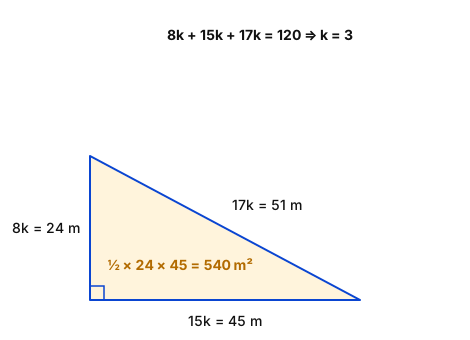
  1. Sum of parts = 40 ⇒ 1 part = 12040=3 m.
  2. Sides = 24 m, 45 m, 51 m (51 is the hypotenuse).
  3. Area = 12×24×45=540 m².

Trick: Area of a triplet triangle = ½ × (product of two smaller parts) ×k2 = 12×8×15×9=540.

Answer: (D) 540 m²

अवधारणा: 8 : 15 : 17 पाइथागोरस त्रिक है ⇒ समकोण त्रिभुज।

हल:

  1. भागों का योग = 40 ⇒ 1 भाग = 12040=3 m
  2. भुजाएँ = 24 m, 45 m, 51 m (51 कर्ण)
  3. क्षेत्रफल = 12×24×45=540 m²

ट्रिक: क्षेत्रफल = 12×8×15×32=540 — सीधा।

उत्तर: (D) 540 m²

SSC CGLQuantitative AptitudeMensuration – right triangle from tripletSSC CGL 2025 · 20 Sep Shift 1 →
Q2062.
A student's marks in English were 40% more than in Sanskrit. If he scored 80 in Sanskrit, how many marks did he score in English?
एक विद्यार्थी के अंग्रेज़ी के अंक संस्कृत से 40% अधिक थे। यदि उसने संस्कृत में 80 अंक पाए, तो अंग्रेज़ी में कितने अंक पाए?
  1. A82
  2. B108
  3. C104
  4. D112
Show answer

Concept: '40% more than A' =A×1.4.

  1. Sanskrit = 80.
  2. English = 80×140100=112.

Trick: 40% of 80 = 32; 80+32=112.

Answer: (D) 112

अवधारणा: 'A से 40% अधिक' =A×1.4।

हल:

  1. संस्कृत = 80
  2. अंग्रेज़ी = 80×140100=112

ट्रिक: 80 का 40% = 32; 80+32=112।

उत्तर: (D) 112

SSC CGLQuantitative AptitudePercentage – x% more thanSSC CGL 2025 · 20 Sep Shift 1 →
Q2063.
7 women and 6 men can complete a work in 8 days, while 5 women and 9 men complete it in 9 days. In how many days will 9 women complete it?
7 महिलाएँ और 6 पुरुष एक कार्य 8 दिनों में पूरा करते हैं, जबकि 5 महिलाएँ और 9 पुरुष उसे 9 दिनों में। 9 महिलाएँ उसे कितने दिनों में पूरा करेंगी?
  1. A13 days13 दिन
  2. B8 days8 दिन
  3. C16.5 days16.5 दिन
  4. D14 days14 दिन
Show answer

Concept: Equate total work from both groups to get the efficiency ratio.

  1. Work is equal: 8(7W+6M)=9(5W+9M).
  2. Collect terms: (56−45)W=(81−48)M⇒11W=33M ⇒ one woman = 3 men. Take M=1,W=3.
  3. Work = (21+6)×8=216 units; 9 women = 27 units/day.
  4. Days = 216÷27=8.

Trick: 7W+6M=7W+2W=9W — the first group equals 9 women, so 9 women take the same 8 days.

Answer: (B) 8 days

अवधारणा: दोनों समूहों का कुल कार्य बराबर रखकर कार्यक्षमता अनुपात निकालें।

हल:

  1. कार्य समान: 8(7W+6M)=9(5W+9M)
  2. पद एक ओर: (56−45)W=(81−48)M⇒11W=33M ⇒ 1 महिला = 3 पुरुष; M=1,W=3 लें
  3. कार्य = (21+6)×8=216 इकाई; 9 महिलाएँ = 27 इकाई/दिन
  4. दिन = 216÷27=8

ट्रिक: 6M=2W, तो 7W+6M=9W — यानी पहला समूह ही 9 महिलाएँ हैं, अतः 8 दिन।

उत्तर: (B) 8 दिन

SSC CGLQuantitative AptitudeWork – men and women efficiencySSC CGL 2025 · 20 Sep Shift 1 →
Q2064.
The average of a group of 8 consecutive even numbers is 43. What is the sum of the smallest and largest numbers in the group?
8 क्रमागत सम संख्याओं के समूह का औसत 43 है। समूह की सबसे छोटी और सबसे बड़ी संख्या का योग क्या है?
  1. A79
  2. B86
  3. C83
  4. D85
Show answer

Concept: In an AP, average = first+last2.

  1. Average = 43.
  2. First + last = 2×43=86.
  3. (Numbers: 36, 38, …, 50 → 36+50=86.)

Trick: No need to find the numbers — just double the average.

Answer: (B) 86

अवधारणा: समांतर श्रेढ़ी में औसत = पहला+अंतिम2।

हल:

  1. औसत = 43
  2. पहला + अंतिम = 2×43=86
  3. (संख्याएँ: 36, 38, …, 50 → 36+50=86)

ट्रिक: संख्याएँ निकालने की ज़रूरत नहीं — बस औसत को दोगुना करें।

उत्तर: (B) 86

SSC CGLQuantitative AptitudeAverage – consecutive even numbersSSC CGL 2025 · 20 Sep Shift 1 →
Q2065.
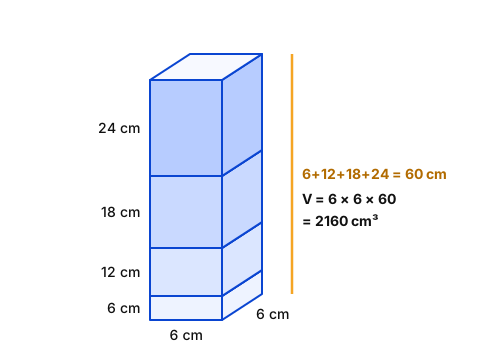
A prism with a square base of side 6 cm is constructed in layers. Its height follows an arithmetic progression, increasing from 6 cm in the first layer to 24 cm in the fourth layer. What is the total volume of the prism?
6 cm भुजा वाले वर्गाकार आधार का एक प्रिज़्म परतों में बना है। उसकी ऊँचाइयाँ समांतर श्रेढ़ी में हैं — पहली परत 6 cm से चौथी परत 24 cm तक। प्रिज़्म का कुल आयतन क्या है?
  1. A1800 cm³
  2. B1950 cm³
  3. C1210 cm³
  4. D2160 cm³
Show answer

Concept: Volume = base area × total height.

  1. Heights in AP: 6, 12, 18, 24 (d=6); total = 60 cm.
  2. Base area = 6×6=36 cm².
  3. Volume = 36×60=2160 cm³.

Trick: Sum of AP = n2×(first+last)=42×(6+24)=60.

Answer: (D) 2160 cm³

अवधारणा: आयतन = आधार क्षेत्रफल × कुल ऊँचाई।

हल:

  1. ऊँचाइयाँ: 6, 12, 18, 24 (d=6); कुल = 60 cm
  2. आधार क्षेत्रफल = 6×6=36 cm²
  3. आयतन = 36×60=2160 cm³

ट्रिक: AP का योग = n/2 × (पहला + अंतिम) = 2×30=60।

उत्तर: (D) 2160 cm³

SSC CGLQuantitative AptitudeMensuration – prism with AP layersSSC CGL 2025 · 20 Sep Shift 1 →
Q2066.
A vessel has 90 litres of a solution with sugar and soda in the ratio 7 : 2. If 18 litres of the solution are replaced with soda, what is the new ratio?
एक बर्तन में 90 लीटर घोल है जिसमें चीनी और सोडा 7 : 2 के अनुपात में हैं। यदि 18 लीटर घोल निकालकर उतना ही सोडा मिला दिया जाए, तो नया अनुपात क्या होगा?
  1. A20 : 17
  2. B28 : 17
  3. C31 : 15
  4. D13 : 23
Show answer

Concept: Removed solution carries both parts in the original ratio.

  1. Sugar = 70 L, soda = 20 L.
  2. 18 L is 15 of 90 L ⇒ sugar left = 70×45=56 L, soda left = 16 L.
  3. Add 18 L soda ⇒ soda = 34 L.
  4. Ratio = 56 : 34 = 28 : 17.

Trick: Only sugar shrinks by the fraction left (45); everything else in the vessel is soda: 90−56=34.

Answer: (B) 28 : 17

अवधारणा: निकाले गए घोल में दोनों घटक मूल अनुपात में जाते हैं।

हल:

  1. चीनी = 70 L, सोडा = 20 L
  2. 18 L, 90 का 15 है ⇒ शेष चीनी = 70×45=56 L
  3. बर्तन में फिर 90 L, तो सोडा = 90−56=34 L
  4. अनुपात = 56 : 34 = 28 : 17

ट्रिक: केवल चीनी की मात्रा घटती है (×45); बाकी सब सोडा: 90−56=34।

उत्तर: (B) 28 : 17

SSC CGLQuantitative AptitudeMixture – replacementSSC CGL 2025 · 20 Sep Shift 1 →
Q2067.
If cotA = 1160, then what is cosecA?
यदि cotA = 1160 है, तो cosecA क्या होगा?
  1. A6160
  2. B6061
  3. C6111
  4. D6159
Show answer

Concept: cosec2A=1+cot2A.

  1. cotA=1160.
  2. cosec2A=1+1213600=37213600.
  3. cosecA=6160.

Trick: 11, 60, 61 is a Pythagorean triplet: base 11, perpendicular 60, hypotenuse 61 ⇒ cosec=6160.

Answer: (A) 6160

अवधारणा: cosec2A=1+cot2A।

हल:

  1. cotA=1160
  2. cosec2A=1+1213600=37213600
  3. cosecA=6160

ट्रिक: 11, 60, 61 पाइथागोरस त्रिक है: आधार 11, लंब 60, कर्ण 61 ⇒ cosec=6160।

उत्तर: (A) 6160

SSC CGLQuantitative AptitudeTrigonometry – cosec from cotSSC CGL 2025 · 20 Sep Shift 1 →
Q2068.
Find the solution to the system: y = 7x − 4 and y = −2x + 14.
निकाय का हल ज्ञात कीजिए: y = 7x − 4 और y = −2x + 14।
  1. A(2, 10)
  2. B(17, 2)
  3. C(1.5, 3.5)
  4. D(1.5, −4.5)
Show answer

Concept: At the solution both expressions for y are equal.

  1. Subtract the second equation from the first: 0 = 9x − 18 ⇒ x = 2.
  2. Put x = 2 in y = −2x + 14 ⇒ y = 10.
  3. Solution = (2, 10).

Trick: Plug options: (2, 10) → 14 − 4 = 10 ✓ and −4 + 14 = 10 ✓.

Answer: (A) (2, 10)

अवधारणा: हल पर y के दोनों व्यंजक बराबर होते हैं।

हल:

  1. पहले समीकरण में से दूसरा घटाएँ: 0 = 9x − 18 ⇒ x = 2
  2. x = 2 को y = −2x + 14 में रखें ⇒ y = 10
  3. हल = (2, 10)

ट्रिक: विकल्प रखकर जाँचें: (2, 10) → 14 − 4 = 10 ✓, −4 + 14 = 10 ✓।

उत्तर: (A) (2, 10)

SSC CGLQuantitative AptitudeLinear equations – two linesSSC CGL 2025 · 20 Sep Shift 1 →
Q2069.
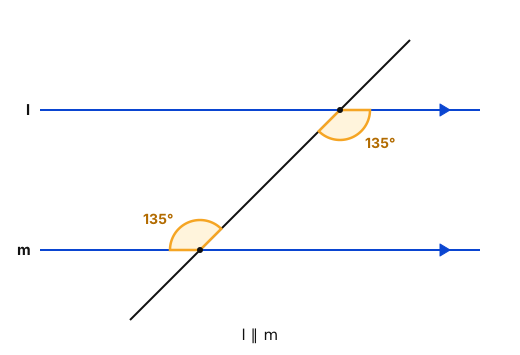
When a transversal intersects two parallel lines, one of the alternate interior angles is 135°. What is the measure of the angle that lies opposite to it on the alternate interior side?
जब कोई तिर्यक रेखा दो समांतर रेखाओं को काटती है, तो एकांतर अंतःकोणों में से एक 135° है। दूसरी ओर स्थित एकांतर अंतःकोण की माप क्या है?
  1. A75°
  2. B80°
  3. C160°
  4. D135°
Show answer

Concept: With parallel lines, alternate interior angles are equal.

  1. One alternate interior angle = 135°.
  2. Its pair on the other side = 135°.

Yaad rakhein: Co-interior (same-side) angles add up to 180° — that would give 45°, a common trap.

Answer: (D) 135°

अवधारणा: समांतर रेखाओं में एकांतर अंतःकोण बराबर होते हैं।

हल:

  1. एक एकांतर अंतःकोण = 135°
  2. दूसरी ओर का एकांतर कोण = 135°

याद रखें: एक ही ओर के अंतःकोणों का योग 180° होता है (45° वाला जाल)।

उत्तर: (D) 135°

SSC CGLQuantitative AptitudeLines and angles – alternate interior anglesSSC CGL 2025 · 20 Sep Shift 1 →
Q2070.
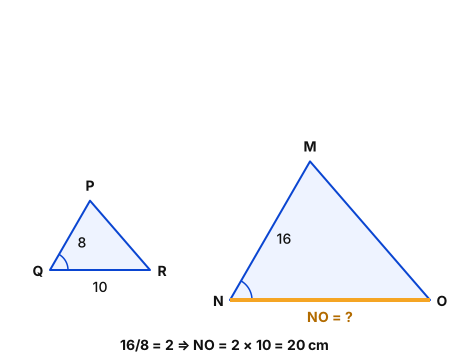
If △PQR ∼ △MNO and PQ = 8 cm, QR = 10 cm, MN = 16 cm, what is the length of NO?
यदि △PQR ∼ △MNO और PQ = 8 cm, QR = 10 cm, MN = 16 cm है, तो NO की लंबाई क्या है?
  1. A20 cm
  2. B8 cm
  3. C4 cm
  4. D12 cm
Show answer

Concept: Corresponding sides of similar triangles are in the same ratio.

  1. PQ ↔ MN, QR ↔ NO.
  2. Scale factor = MNPQ=168=2.
  3. NO=2×QR=2×10=20 cm.

Trick: Find the scale factor once (×2) and apply it to any side.

Answer: (A) 20 cm

अवधारणा: समरूप त्रिभुजों की संगत भुजाएँ समान अनुपात में होती हैं।

हल:

  1. PQ ↔ MN, QR ↔ NO
  2. पैमाना = MNPQ=168=2
  3. NO = 2×10=20 cm

ट्रिक: एक बार पैमाना (×2) निकालें और किसी भी भुजा पर लगाएँ।

उत्तर: (A) 20 cm

SSC CGLQuantitative AptitudeSimilar triangles – side ratioSSC CGL 2025 · 20 Sep Shift 1 →
Q2071.
If x = 4 + 15, find x − 1x.
यदि x = 4 + 15 है, तो x − 1x ज्ञात कीजिए।
  1. A15
  2. B215
  3. C315
  4. D515
Show answer

Concept: If x=a+b with a2−b=1, then 1x=a−b.

  1. x=4+15; 42−15=1.
  2. So 1x=4−15.
  3. x−1x=(4+15)−(4−15)=215.

Trick: When a2−b=1, x−1x=2b and x+1x=2a directly.

Answer: (B) 215

अवधारणा: यदि x=a+b और a2−b=1, तो 1x=a−b।

हल:

  1. x=4+15; 16−15=1
  2. अतः 1x=4−15
  3. x−1x=215

ट्रिक: a2−b=1 हो तो x−1x=2b और x+1x=2a सीधे।

उत्तर: (B) 215

SSC CGLQuantitative AptitudeSurds – x − 1/xSSC CGL 2025 · 20 Sep Shift 1 →
Q2072.
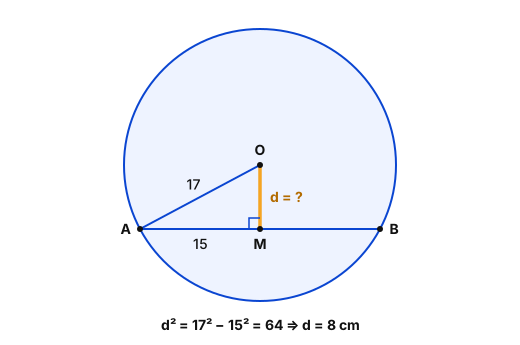
A circle has a radius of 17 cm and a chord measuring 30 cm. What is the distance from the centre of the circle to the chord?
एक वृत्त की त्रिज्या 17 cm और एक जीवा 30 cm लंबी है। केंद्र से जीवा की दूरी क्या है?
  1. A6 cm
  2. B8 cm
  3. C10 cm
  4. D12 cm
Show answer

Concept: The perpendicular from the centre bisects the chord: d2=r2−(chord2)2.

  1. Half-chord = 302=15 cm.
  2. d2=172−152=289−225=64.
  3. d=8 cm.

Trick: 8, 15, 17 is a triplet — with 17 and 15 known, the third side is 8 instantly.

Answer: (B) 8 cm

अवधारणा: केंद्र से डाला लंब जीवा को समद्विभाजित करता है: d2=r2−(जीवा2)2।

हल:

  1. आधी जीवा = 15 cm
  2. d2=289−225=64
  3. d=8 cm

ट्रिक: 8, 15, 17 त्रिक है — 17 और 15 दिए हैं, तो तीसरी भुजा 8।

उत्तर: (B) 8 cm

SSC CGLQuantitative AptitudeCircles – distance of chord from centreSSC CGL 2025 · 20 Sep Shift 1 →
Q2073.
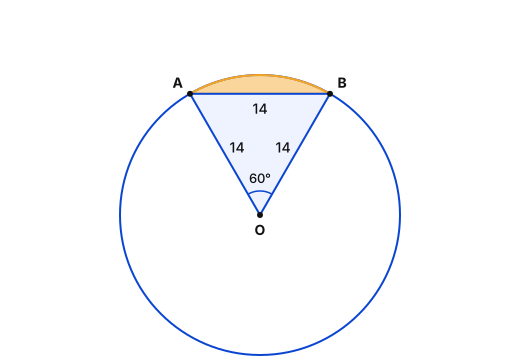
A circle has a radius of 14 cm. Two radii are drawn such that the chord connecting their endpoints is 14 cm. What is the area of the minor segment formed?
एक वृत्त की त्रिज्या 14 cm है। दो त्रिज्याएँ इस प्रकार खींची गई हैं कि उनके सिरों को जोड़ने वाली जीवा 14 cm की है। बने लघु वृत्तखंड का क्षेत्रफल क्या है?
  1. A(98π3 − 493) sq.cm(98π3 − 493) वर्ग सेमी
  2. B(98π3 − 593) sq.cm(98π3 − 593) वर्ग सेमी
  3. C(78π3 − 493) sq.cm(78π3 − 493) वर्ग सेमी
  4. D(68π3 − 493) sq.cm(68π3 − 493) वर्ग सेमी
Show answer

Concept: Segment = sector − triangle.

  1. Chord = radius = 14 ⇒ equilateral triangle ⇒ central angle 60°.
  2. Sector = 60360×π×142=196π6=98π3.
  3. Triangle = 34×142=493.
  4. Segment = 98π3−493cm2.

Trick: Chord equal to radius always means θ=60∘; triangle area = 34r2.

Answer: (A) (98π3 − 493) sq.cm

अवधारणा: वृत्तखंड = त्रिज्यखंड − त्रिभुज।

हल:

  1. जीवा = त्रिज्या = 14 ⇒ समबाहु त्रिभुज ⇒ केंद्रीय कोण 60°
  2. त्रिज्यखंड = 60360×π×196=98π3
  3. त्रिभुज = 34×196=493
  4. वृत्तखंड = 98π3−493cm2

ट्रिक: जीवा = त्रिज्या हो तो कोण हमेशा 60°; त्रिभुज = 34r2।

उत्तर: (A) (98π3 − 493) वर्ग सेमी

SSC CGLQuantitative AptitudeCircles – area of minor segmentSSC CGL 2025 · 20 Sep Shift 1 →
Q2074.
If sinx = 0.8 and x ∈ (0, π2), find sin2x + cos2x.
यदि sinx = 0.8 और x ∈ (0, π2) है, तो sin2x + cos2x ज्ञात कीजिए।
  1. A0.68
  2. B1.52
  3. C1.68
  4. D1.04
Show answer

Concept: sin2x=2sinxcosx; cos2x=1−2sin2x.

  1. sinx=0.8=45⇒cosx=35 (first quadrant).
  2. sin2x=2×45×35=2425=0.96.
  3. cos2x=1−2×0.64=−0.28.
  4. Sum = 0.96−0.28=0.68.

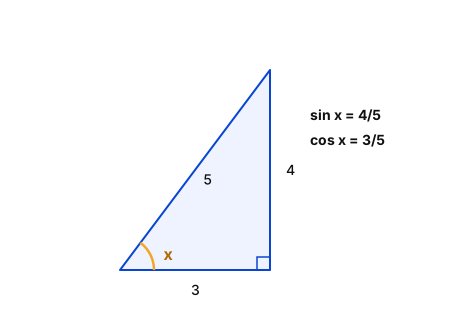
Trick: Use the 3-4-5 triangle: cos2x=cos2x−sin2x=0.36−0.64=−0.28.

Answer: (A) 0.68

अवधारणा: sin2x=2sinxcosx; cos2x=1−2sin2x।

हल:

  1. sinx=45⇒cosx=35 (प्रथम चतुर्थांश)
  2. sin2x=2×45×35=0.96
  3. cos2x=1−2×0.64=−0.28
  4. योग = 0.96−0.28=0.68

ट्रिक: 3-4-5 त्रिभुज: cos2x=0.36−0.64=−0.28।

उत्तर: (A) 0.68

SSC CGLQuantitative AptitudeTrigonometry – double angleSSC CGL 2025 · 20 Sep Shift 1 →
Q2075.
Multiply 14.345 by 0.037 and round your answer to 4 decimal places.
14.345 को 0.037 से गुणा कीजिए और उत्तर को चार दशमलव स्थानों तक पूर्णांकित कीजिए।
  1. A0.5308
  2. B0.5370
  3. C0.5037
  4. D0.5703
Show answer

Concept: Multiply as whole numbers, then place the decimal (3+3=6 places).

  1. 14345×37=5,30,765.
  2. Product = 0.530765.
  3. To 4 places: 0.5307|65 → the next digit 6≥5, so round up → 0.5308.

Trick: Estimate first: 14.345×0.037≈14×0.04=0.56 → only options starting with 0.53 are close; then check the digits.

Answer: (A) 0.5308

अवधारणा: पूर्ण संख्याओं की तरह गुणा करें, फिर 3+3=6 दशमलव स्थान लगाएँ।

  1. 14345×37=5,30,765
  2. गुणनफल = 0.530765
  3. 4 स्थानों तक: 0.5307|65 → अगला अंक 6≥5, अतः 0.5308

ट्रिक: पहले अनुमान: 14×0.04≈0.56 → 0.53 से शुरू होने वाले विकल्प; फिर अंक मिलाएँ।

उत्तर: (A) 0.5308

SSC CGLQuantitative AptitudeDecimals – multiplication and roundingSSC CGL 2025 · 20 Sep Shift 1 →
Q2076.
The following sentence has been divided into parts. One of them contains an error. Select the part that contains the error from the given options.
The newly discovered species was (1)/ quite unique, possessing characteristics (2)/ that set it apart (3)/ from all known organisms. (4)
  1. A(1)
  2. B(2)
  3. C(3)
  4. D(4)
Show answer

Concept: Absolute adjectives (unique, perfect, ideal, complete) are not used with degree words.

  1. 'Unique' already means 'the only one of its kind'.
  2. 'Quite unique' adds a degree to it — error in part (2).
  3. Correct: 'The newly discovered species was unique, possessing characteristics…'

Yaad rakhein: Avoid 'very unique', 'more perfect', 'most ideal', 'quite unique' in exam answers.

Answer: (B) (2)

अवधारणा: निरपेक्ष विशेषण (unique, perfect, ideal, complete) के साथ मात्रा-सूचक शब्द नहीं आते।

हल:

  1. 'Unique' का अर्थ ही है 'अपनी तरह का अकेला'।
  2. 'Quite unique' में मात्रा जोड़ी गई है — भाग (2) में त्रुटि।
  3. सही: 'The newly discovered species was unique, possessing characteristics…'

याद रखें: 'very unique', 'more perfect', 'most ideal', 'quite unique' जैसे प्रयोग गलत माने जाते हैं।

उत्तर: (B) (2)

SSC CGLEnglish ComprehensionError spotting – absolute adjective 'unique'SSC CGL 2025 · 20 Sep Shift 1 →
Q2077.
Select the most appropriate option to substitute the underline/Bold segment in the given sentence.
They present their findings on the conference when the power suddenly went out.
  1. Apresent their findings at the conference
  2. Bpresented their findings at the conference
  3. Chave been presenting their findings at the conference
  4. Dwere presenting their findings at the conference
Show answer

Concept: An ongoing past action interrupted by another past action → past continuous (was/were + V-ing).

  1. 'when the power suddenly went out' = the interrupting event (simple past).
  2. The longer action = 'were presenting'.
  3. We present something at a conference, not 'on' it.

Trick: 'When + simple past' interrupting another action → the other clause is was/were + -ing.

Answer: (D) were presenting their findings at the conference

अवधारणा: भूतकाल में चल रही क्रिया को जब दूसरी भूतकालिक क्रिया बीच में रोके → past continuous (was/were + V-ing)।

हल:

  1. 'when the power suddenly went out' = बीच में आई घटना (simple past)।
  2. चल रही क्रिया = 'were presenting'।
  3. सम्मेलन में प्रस्तुति के लिए 'at a conference' सही है, 'on' नहीं।

ट्रिक: 'When + simple past' से रुकावट हो तो दूसरी क्रिया was/were + -ing।

उत्तर: (D) were presenting their findings at the conference

SSC CGLEnglish ComprehensionSentence improvement – past continuous + 'at'SSC CGL 2025 · 20 Sep Shift 1 →
Q2078.
Select the correct indirect/direct form of the given sentence.
He said to his friend, "Kindly bring me a glass of water."
  1. AHe told his friend to bring him a glass of water.
  2. BHe requested his friend to bring him a glass of water.
  3. CHe persuaded his friend to bring him a glass of water.
  4. DHe suggested to his friend that he should bring him a glass of water.
Show answer

Concept: Imperatives with please/kindly become 'requested + object + to-infinitive'.

  1. 'Kindly bring me…' is a polite request.
  2. Reporting verb = requested; drop 'kindly'; 'me' → 'him'.
  3. He requested his friend to bring him a glass of water.

Trick: Kindly/please → requested; order → ordered/told; advice → advised.

Answer: (B) He requested his friend to bring him a glass of water.

अवधारणा: please/kindly वाले आज्ञार्थक वाक्य में 'requested + कर्म + to + क्रिया' लगता है।

हल:

  1. 'Kindly bring me…' एक विनम्र अनुरोध है।
  2. Reporting verb = requested; 'kindly' हटाएँ; 'me' → 'him'।
  3. He requested his friend to bring him a glass of water.

ट्रिक: Kindly/please → requested; आदेश → ordered/told; सलाह → advised।

उत्तर: (B) He requested his friend to bring him a glass of water.

SSC CGLEnglish ComprehensionNarration – request with 'kindly'SSC CGL 2025 · 20 Sep Shift 1 →
Q2079.
Select the option that expresses the given sentence in the Active/Passive voice.
She helped the students complete their assignments.
  1. AThe students were helped to complete their assignments by her.
  2. BThe students had been helped complete their assignments by her.
  3. CThe students are helped complete their assignments by her.
  4. DThe students will be helped to complete their assignments by her.
Show answer

Concept: Bare infinitive after help/make/see becomes a to-infinitive in the passive.

  1. Active tense: simple past (helped) → passive 'were helped'.
  2. Object 'the students' becomes subject.
  3. 'complete' → 'to complete': The students were helped to complete their assignments by her.

Trick: Check tense first: past active → 'was/were + V3'. This removes (C) and (D) at once.

Answer: (A) The students were helped to complete their assignments by her.

अवधारणा: help/make/see के बाद bare infinitive, passive में to-infinitive बन जाता है।

हल:

  1. Active में simple past (helped) → passive 'were helped'।
  2. कर्म 'the students' कर्ता बनता है।
  3. 'complete' → 'to complete': The students were helped to complete their assignments by her.

ट्रिक: पहले काल मिलाएँ: past → 'was/were + V3' — (C), (D) तुरंत बाहर।

उत्तर: (A) The students were helped to complete their assignments by her.

SSC CGLEnglish ComprehensionVoice – passive of 'help + object + verb'SSC CGL 2025 · 20 Sep Shift 1 →
Q2080.
Select the most appropriate option to substitute the underline/Bold segment in the given sentence.
He sat by his in the corner.
  1. Aby him
  2. Bby himself
  3. Cby his own
  4. Dby myself
Show answer

Concept: 'By + reflexive pronoun' means alone; it must agree with the subject.

  1. Subject = He → reflexive = himself.
  2. 'He sat by himself in the corner' = he sat alone.
  3. 'By his own' is incomplete; 'by myself' doesn't match 'He'.

Yaad rakhein: Reflexives: myself, yourself, himself, herself, itself, ourselves, yourselves, themselves ('hisself' is wrong).

Answer: (B) by himself

अवधारणा: 'By + reflexive pronoun' का अर्थ 'अकेले' होता है; यह कर्ता से मेल खाना चाहिए।

हल:

  1. कर्ता He → reflexive = himself।
  2. 'He sat by himself in the corner' = वह कोने में अकेला बैठा।
  3. 'by his own' अधूरा है; 'by myself', He से मेल नहीं खाता।

याद रखें: Reflexive रूप: myself, himself, herself, themselves आदि ('hisself' गलत है)।

उत्तर: (B) by himself

SSC CGLEnglish ComprehensionPronouns – reflexive 'by himself'SSC CGL 2025 · 20 Sep Shift 1 →