Question bank

Q&A: practice questions with answers

Search questions on any topic. Filter by exam category, exam, subject and topic, try the question, then open the answer and explanation.

Courses – airGurukul

4,800 questions found.

Q2161.
A tank is in the shape of a rectangular parallelepiped of size 30 m × 20 m × 5 m. Its capacity in kilolitres is:
एक टंकी 30 m × 20 m × 5 m आकार के आयताकार घनाभ के रूप में है। उसकी क्षमता किलोलीटर में कितनी है?
  1. A7,000 kilolitres7,000 किलोलीटर
  2. B3,000 kilolitres3,000 किलोलीटर
  3. C5,500 kilolitres5,500 किलोलीटर
  4. D3,500 kilolitres3,500 किलोलीटर
Show answer

Concept: 1 m³ holds 1000 L, which is exactly 1 kL.

  1. Volume = 30×20×5=3000 m³.
  2. 3000 m³ = 3000 kL.

Trick: m³ and kL are numerically equal – no conversion needed.

Answer: (B) 3,000 kilolitres

अवधारणा: 1 घन मीटर = 1000 लीटर = 1 किलोलीटर।

  1. आयतन = 30×20×5=3000 घन मी.।
  2. 3000 घन मी. = 3000 किलोलीटर।

ट्रिक: m³ और kL का मान बराबर होता है – सीधे लिख दें।

उत्तर: (B) 3,000 किलोलीटर
SSC CGLQuantitative AptitudeCuboid – capacity in kilolitresSSC CGL 2025 · 19 Sep Shift 3 →
Q2162.
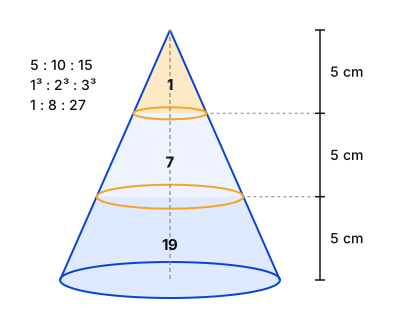
A right circular cone of height 15 cm is cut by two parallel planes at heights 5 cm and 10 cm from the base. What is the ratio of the volumes of the three parts (from top to bottom)?
15 cm ऊँचाई वाले लंब वृत्तीय शंकु को आधार से 5 cm और 10 cm की ऊँचाई पर दो समांतर तलों से काटा जाता है। तीनों भागों (ऊपर से नीचे) के आयतनों का अनुपात क्या है?
  1. A8 : 19 : 27
  2. B1 : 6 : 20
  3. C8 : 19 : 64
  4. D1 : 7 : 19
Show answer

Concept: Similar cones: volume ∝(height)3, heights measured from the vertex.

  1. From the top, cut heights are 5, 10, 15 → ratio 1 : 2 : 3.
  2. Cumulative volumes 1 : 8 : 27.
  3. Parts: 1, 8−1=7, 27−8=19.

Trick: For n equal height-slices, part volumes go 1, 7, 19, 37 … (differences of cubes).

Answer: (D) 1 : 7 : 19

अवधारणा: समरूप शंकु: आयतन∝(ऊँचाई)3, ऊँचाई शीर्ष से नापें।

  1. शीर्ष से ऊँचाइयाँ 5, 10, 15 → 1 : 2 : 3।
  2. कुल आयतन 1 : 8 : 27।
  3. भाग: 1, 7, 19।

ट्रिक: बराबर ऊँचाई के टुकड़े हों तो भाग 1, 7, 19, 37… (घनों का अंतर)।

उत्तर: (D) 1 : 7 : 19

SSC CGLQuantitative AptitudeCone cut by parallel planesSSC CGL 2025 · 19 Sep Shift 3 →
Q2163.
A solid sphere of radius P is melted and recast into n smaller spheres, each of radius q. Find the value of n.
P त्रिज्या वाले एक ठोस गोले को पिघलाकर q त्रिज्या वाले n छोटे गोले बनाए जाते हैं। n का मान ज्ञात कीजिए।
  1. A(Pq)³
  2. B(3P2q)³
  3. C(q3P)³
  4. D(qP)³
Show answer

Concept: Melting keeps total volume unchanged.

  1. (43)πP3=n×(43)πq3.
  2. n=P3q3=(Pq)3.

Trick: Number of small solids = (big dimensionsmall dimension)3 for similar shapes.

Answer: (A) (Pq)³

अवधारणा: पिघलाने पर कुल आयतन समान रहता है।

  1. (43)πP3=n×(43)πq3।
  2. n=P3q3=(Pq)3।

ट्रिक: समरूप ठोसों में संख्या=(बड़ी त्रिज्याछोटी त्रिज्या)3।

उत्तर: (A) (Pq)³

SSC CGLQuantitative AptitudeRecasting spheresSSC CGL 2025 · 19 Sep Shift 3 →
Q2164.
If tanA = 13, what is the value of (1 + secA)(1 + cosecA)?
यदि tanA = 13 है, तो (1 + secA)(1 + cosecA) का मान क्या है?
  1. A33+623
  2. B33+43
  3. C3+63
  4. D33+63
Show answer

Concept: tanA=13 means A=30∘.

  1. sec30∘=23,cosec30∘=2.
  2. (1+23)(1+2)=3(3+2)3.
  3. Rationalise: 3(3+2)33=33+63=3+2.

Trick: 33+63=3+2≈3.73; compute this decimal and match options.

Answer: (D) 33+63

अवधारणा: tanA=13 ⇒ A=30∘।

  1. sec30∘=23,cosec30∘=2।
  2. (1+23)×3=3(3+2)3।
  3. =33+63 (परिमेयकरण से)।

ट्रिक: मान ≈3.73; विकल्पों का दशमलव मान मिलाएँ।

उत्तर: (D) 33+63

SSC CGLQuantitative AptitudeTrigonometry – standard angle 30°SSC CGL 2025 · 19 Sep Shift 3 →
Q2165.
If secx + tanx = 2, what is the value of secx − tanx?
यदि secx + tanx = 2 है, तो secx − tanx का मान क्या है?
  1. A22
  2. B12
  3. C122
  4. D32
Show answer

Concept: sec2x−tan2x=1 factorises to (secx+tanx)(secx−tanx)=1.

  1. So secx−tanx=1secx+tanx.
  2. =12.

Trick: sec + tan and sec − tan are always reciprocals – same for cosec + cot and cosec − cot.

Answer: (B) 12

अवधारणा: sec2x−tan2x=1 ⇒ (secx+tanx)(secx−tanx)=1।

  1. अतः secx−tanx=1secx+tanx।
  2. =12।

ट्रिक: sec + tan और sec − tan हमेशा व्युत्क्रम होते हैं; cosec ± cot पर भी यही।

उत्तर: (B) 12

SSC CGLQuantitative AptitudeTrigonometric identity – sec & tanSSC CGL 2025 · 19 Sep Shift 3 →
Q2166.
Which point lies on y = 2x − 5?
कौन-सा बिंदु y = 2x − 5 पर स्थित है?
  1. A(0, −5)
  2. B(3, 1)
  3. C(1, −3)
  4. D(0, −5), (3, 1) and (1, −3) all(0, −5), (3, 1) और (1, −3) सभी
Show answer

Concept: A point lies on a line if its coordinates satisfy the equation.

  1. (0, −5): 2·0 − 5 = −5 ✓.
  2. (3, 1): 6 − 5 = 1 ✓.
  3. (1, −3): 2 − 5 = −3 ✓ – all three lie on it.

Trick: When a 'all of these' option exists, test every point – here each one works.

Answer: (D) (0, −5), (3, 1) and (1, −3) all

अवधारणा: बिंदु रेखा पर है यदि उसके निर्देशांक समीकरण को संतुष्ट करें।

  1. (0, −5): 0 − 5 = −5 ✓।
  2. (3, 1): 6 − 5 = 1 ✓।
  3. (1, −3): 2 − 5 = −3 ✓।

ट्रिक: 'सभी' वाला विकल्प हो तो हर बिंदु जाँचें।

उत्तर: (D) (0, −5), (3, 1) और (1, −3) सभी

SSC CGLQuantitative AptitudeCoordinate geometry – point on a lineSSC CGL 2025 · 19 Sep Shift 3 →
Q2167.
A sector has a central angle of 60° and a radius of 18 cm. Another sector has a central angle of 2π3 radians. What is the ratio of the area of the first sector to the area of the second sector?
एक त्रिज्यखंड का केंद्रीय कोण 60° और त्रिज्या 18 cm है। दूसरे त्रिज्यखंड का केंद्रीय कोण 2π3 रेडियन है। पहले और दूसरे त्रिज्यखंड के क्षेत्रफलों का अनुपात क्या है?
  1. A4 : 3
  2. B1 : 2
  3. C7 : 2
  4. D2 : 1
Show answer

Concept: Sector area = (θ360∘)×πr2; for equal radii, area ∝ angle.

  1. 2π3 rad=2×180∘3=120∘.
  2. Ratio = 60∘:120∘=1:2.

Trick: π rad=180∘, so just substitute 180 for π.

Answer: (B) 1 : 2

अवधारणा: त्रिज्यखंड क्षेत्रफल = (θ360∘)×πr2; समान त्रिज्या पर क्षेत्रफल ∝ कोण।

  1. 2π3 रेडियन =120∘।
  2. अनुपात = 60 : 120 = 1 : 2।

ट्रिक: π रेडियन =180∘; π की जगह 180 रखें।

उत्तर: (B) 1 : 2

SSC CGLQuantitative AptitudeSector area – degrees vs radiansSSC CGL 2025 · 19 Sep Shift 3 →
Q2168.
A regular polygon has each interior angle measuring 120°. Find the number of its sides.
एक सम बहुभुज का प्रत्येक अंतःकोण 120° है। उसकी भुजाओं की संख्या ज्ञात कीजिए।
  1. A6
  2. B1
  3. C13
  4. D8
Show answer

Concept: Exterior angle = 180° − interior angle; sides = 360° ÷ exterior.

  1. Exterior = 180∘−120∘=60∘.
  2. n=360÷60=6.

Trick: 120° interior = regular hexagon (like a honeycomb cell).

Answer: (A) 6

अवधारणा: बाह्य कोण = 180° − अंतः कोण; भुजाएँ = 360° ÷ बाह्य कोण।

  1. बाह्य = 60°।
  2. n=360÷60=6।

ट्रिक: 120° अंतः कोण = षट्भुज (मधुमक्खी के छत्ते का खाना)।

उत्तर: (A) 6

SSC CGLQuantitative AptitudeRegular polygon – sides from angleSSC CGL 2025 · 19 Sep Shift 3 →
Q2169.
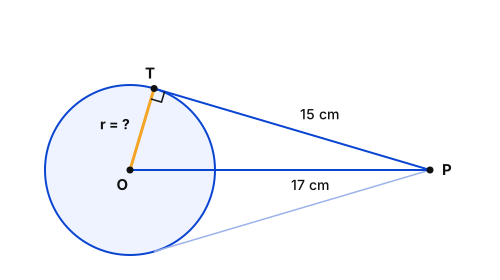
A point P is 17 cm away from the centre of a circle. A tangent drawn from P to the circle has length 15 cm. What is the area of the circle?
बिंदु P वृत्त के केंद्र से 17 cm दूर है। P से खींची गई स्पर्श रेखा की लंबाई 15 cm है। वृत्त का क्षेत्रफल क्या है?
  1. A121π cm²
  2. B512π cm²
  3. C64π cm²
  4. D16π cm²
Show answer

Concept: Radius ⟂ tangent, so centre–point distance is the hypotenuse.

  1. r2=172−152=289−225=64.
  2. r=8 cm.
  3. Area =64πcm2.

Trick: 8–15–17 is a Pythagorean triplet – spot it and skip the squares.

Answer: (C) 64π cm²

अवधारणा: त्रिज्या स्पर्शरेखा पर लंब होती है; केंद्र से बिंदु की दूरी कर्ण है।

  1. r2=289−225=64।
  2. r=8 सेमी।
  3. क्षेत्रफल =64π वर्ग सेमी।

ट्रिक: 8–15–17 पाइथागोरस त्रिक है – तुरंत पहचानें।

उत्तर: (C) 64π cm²

SSC CGLQuantitative AptitudeCircle – tangent length & radiusSSC CGL 2025 · 19 Sep Shift 3 →
Q2170.
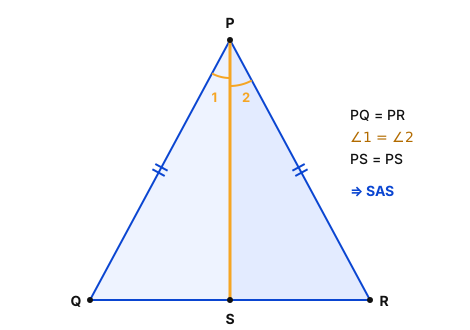
In △PQR, an angle bisector from P meets QR at S. If PS bisects ∠QPR and PQ = PR, are △PQS and △PRS congruent? If so, by what rule?
△PQR में P से खींची गई कोण-समद्विभाजक QR को S पर मिलती है। यदि PS, ∠QPR को समद्विभाजित करती है और PQ = PR है, तो क्या △PQS और △PRS सर्वांगसम हैं? यदि हाँ, तो किस नियम से?
  1. AYes, by SSSहाँ, SSS से
  2. BYes, by SASहाँ, SAS से
  3. CYes, by ASAहाँ, ASA से
  4. DNo, they are not congruentनहीं, वे सर्वांगसम नहीं हैं
Show answer

Concept: SAS: two sides and the angle between them equal.

  1. PQ = PR (given).
  2. ∠QPS = ∠RPS (PS is the bisector) – this angle lies between the sides.
  3. PS common ⇒ △PQS ≅ △PRS by SAS.

Trick: Check whether the equal angle is sandwiched between the equal sides – if yes, SAS.

Answer: (B) Yes, by SAS

अवधारणा: SAS: दो भुजाएँ और उनके बीच का कोण बराबर।

  1. PQ = PR (दिया है)।
  2. ∠QPS = ∠RPS (PS समद्विभाजक) – यह कोण दोनों भुजाओं के बीच है।
  3. PS उभयनिष्ठ ⇒ SAS से सर्वांगसम।

ट्रिक: बराबर कोण बराबर भुजाओं के बीच हो तो SAS।

उत्तर: (B) हाँ, SAS से

SSC CGLQuantitative AptitudeTriangle congruence – SASSSC CGL 2025 · 19 Sep Shift 3 →
Q2171.
Simplify: 15−2 + 15+2
सरल कीजिए: 15−2 + 15+2
  1. A5
  2. B523
  3. C257
  4. D253
Show answer

Concept: 1a−b+1a+b=2aa2−b2.

  1. Here a=5,b=2.
  2. Numerator = 25; denominator = 5−2=3.
  3. Sum = 253.

Trick: The 2 parts cancel, so only 5 can appear in the answer.

Answer: (D) 253

अवधारणा: 1a−b+1a+b=2aa2−b2।

  1. a=5,b=2।
  2. अंश = 25; हर = 5−2=3।
  3. योग = 253।

ट्रिक: 2 वाले भाग कट जाते हैं – उत्तर में केवल 5 होगा।

उत्तर: (D) 253

SSC CGLQuantitative AptitudeSurds – sum of reciprocalsSSC CGL 2025 · 19 Sep Shift 3 →
Q2172.
If cosecA = y, then what is cot²A in terms of y?
यदि cosecA = y है, तो cot²A का मान y के पदों में क्या होगा?
  1. Ay² − 3
  2. By² − 2
  3. Cy² − 1
  4. D2y² − 1
Show answer

Concept: 1+cot2A=cosec2A.

  1. cot2A=cosec2A−1.
  2. =y2−1.

Trick: Check with A=45∘: cosec=2, y2−1=1=cot245∘ ✓.

Answer: (C) y² − 1

अवधारणा: 1+cot2A=cosec2A।

  1. cot2A=cosec2A−1।
  2. =y2−1।

ट्रिक: A=45∘ रखकर जाँचें: y2−1=1=cot245∘ ✓।

उत्तर: (C) y² − 1

SSC CGLQuantitative AptitudeTrig identity – cosec & cotSSC CGL 2025 · 19 Sep Shift 3 →
Q2173.
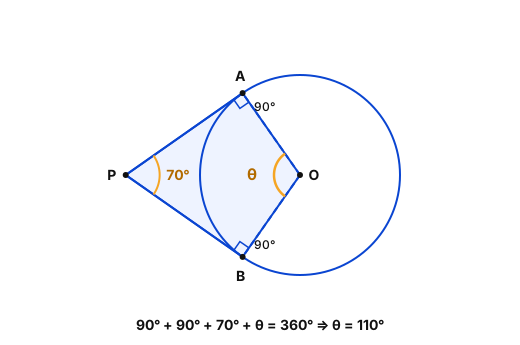
The angle between two tangents drawn from an external point to a circle is 70°. What is the angle subtended by the chord connecting their points of contact at the centre?
किसी बाह्य बिंदु से वृत्त पर खींची गई दो स्पर्श रेखाओं के बीच का कोण 70° है। उनके स्पर्श-बिंदुओं को जोड़ने वाली जीवा द्वारा केंद्र पर बनाया गया कोण क्या है?
  1. A80°
  2. B110°
  3. C115°
  4. D60°
Show answer

Concept: The angle between two tangents and the angle at the centre are supplementary.

  1. Each radius–tangent angle = 90°.
  2. Quadrilateral sum: 90 + 90 + 70 + θ = 360.
  3. θ = 110°.

Trick: Directly: angle at centre = 180° − 70° = 110°.

Answer: (B) 110°

अवधारणा: दो स्पर्शरेखाओं के बीच का कोण और केंद्र पर कोण संपूरक होते हैं।

  1. त्रिज्या-स्पर्शरेखा कोण = 90°।
  2. चतुर्भुज: 90 + 90 + 70 + θ = 360।
  3. θ = 110°।

ट्रिक: सीधे: 180° − 70° = 110°।

उत्तर: (B) 110°

SSC CGLQuantitative AptitudeTangents – angle at centreSSC CGL 2025 · 19 Sep Shift 3 →
Q2174.
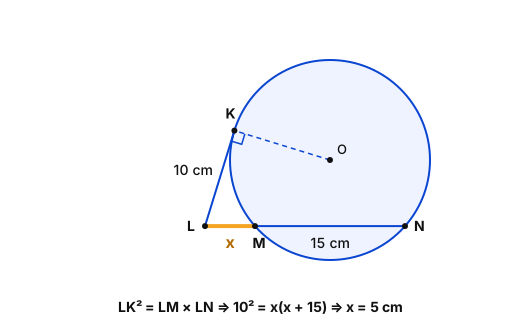
From a point L outside a circle, a tangent LK and a secant LMN are drawn. If LK = 10 cm and MN = 15 cm, what is the length of the segment LM?
वृत्त के बाहर बिंदु L से एक स्पर्श रेखा LK और एक छेदक LMN खींची गई है। यदि LK = 10 cm और MN = 15 cm है, तो LM की लंबाई क्या है?
  1. A6 cm
  2. B8 cm
  3. C5 cm
  4. D11 cm
Show answer

Concept: (Tangent)² = external part × whole secant.

  1. Let LM=x⇒LN=x+15.
  2. x(x+15)=100⇒x2+15x−100=0.
  3. (x+20)(x−5)=0⇒x=5 cm.

Trick: Try options: 5×20=100 ✓ instantly.

Answer: (C) 5 cm

अवधारणा: (स्पर्शरेखा)² = बाहरी भाग × पूरा छेदक।

  1. LM=x⇒LN=x+15।
  2. x(x+15)=100।
  3. (x+20)(x−5)=0⇒x=5 सेमी।

ट्रिक: विकल्प रखें: 5×20=100 ✓।

उत्तर: (C) 5 cm

SSC CGLQuantitative AptitudeTangent–secant theoremSSC CGL 2025 · 19 Sep Shift 3 →
Q2175.
What is the value of (0.3³ + 0.03³) ÷ (0.6³ + 0.06³)?
(0.3³ + 0.03³) ÷ (0.6³ + 0.06³) का मान क्या है?
  1. A0.065
  2. B0.005
  3. C0.225
  4. D0.125
Show answer

Concept: Take the common factor out of numerator and denominator.

  1. Numerator = 0.33(1+0.13); denominator = 0.63(1+0.13).
  2. Ratio = (0.30.6)3=(12)3.
  3. =18=0.125.

Trick: Each denominator term is exactly double the numerator term ⇒ answer is (12)3.

Answer: (D) 0.125

अवधारणा: अंश और हर से उभयनिष्ठ गुणनखंड बाहर निकालें।

  1. अंश = 0.33(1+0.001); हर = 0.63(1+0.001)।
  2. अनुपात = (12)3।
  3. = 0.125।

ट्रिक: हर का हर पद अंश का ठीक दोगुना ⇒ (12)3।

उत्तर: (D) 0.125

SSC CGLQuantitative AptitudeSimplification – cubes of decimalsSSC CGL 2025 · 19 Sep Shift 3 →
Q2176.
Find the correctly spelled word.
  1. AParsimonious
  2. BParsemonious
  3. CParsimunius
  4. DParcimoneous
Show answer

Concept: Correct spelling: P-A-R-S-I-M-O-N-I-O-U-S (meaning: extremely careful with money, stingy).

  1. Root word: parsimony + -ous.
  2. B uses 'e' after pars-, C drops the 'o' and changes '-ious', D starts with 'parc-'.

Trick: Break it up: PARSI + MONI + OUS – keep 'parsimony' intact and add '-ous'.

Answer: (A) Parsimonious

अवधारणा: सही वर्तनी: Parsimonious (अर्थ: बहुत कंजूस, पैसे खर्च करने में अत्यधिक सावधान)।

  1. मूल शब्द parsimony + -ous।
  2. B में 'e', C में '-unius', D में 'parc-' – सब गलत।

ट्रिक: टुकड़ों में याद करें: PARSI + MONI + OUS।

उत्तर: (A) Parsimonious

SSC CGLEnglish ComprehensionSpelling – ParsimoniousSSC CGL 2025 · 19 Sep Shift 3 →
Q2177.
Choose the correct one-word substitute for:
'In ancient times, some societies followed a system of government where priests rule in the name of God.'
  1. APlutocracy
  2. BTheocracy
  3. CAutocracy
  4. DAristocracy
Show answer

Concept: Theo = God, -cracy = rule: government by priests in God's name.

  1. Plutocracy – rule of the rich (pluto = wealth).
  2. Autocracy – rule of one person with absolute power.
  3. Aristocracy – rule by a privileged noble class.

Trick: Learn the prefix: theo-God, pluto-wealth, auto-self, aristo-best/noble.

Answer: (B) Theocracy

अवधारणा: Theo = ईश्वर, -cracy = शासन: ईश्वर के नाम पर पुरोहितों का शासन।

  1. Plutocracy – धनिकों का शासन।
  2. Autocracy – एक व्यक्ति का निरंकुश शासन।
  3. Aristocracy – कुलीन वर्ग का शासन।

ट्रिक: उपसर्ग याद रखें: theo-ईश्वर, pluto-धन, auto-स्वयं, aristo-कुलीन।

उत्तर: (B) Theocracy

SSC CGLEnglish ComprehensionOne-word substitution – TheocracySSC CGL 2025 · 19 Sep Shift 3 →
Q2178.
Choose the correct one-word substitute for:
'An inactive or harmless treatment that works because the person believes it will help.'
  1. APanacea
  2. BPlacebo
  3. CAntidote
  4. DPalliative
Show answer

Concept: Placebo – a dummy medicine that helps only because the patient believes in it.

  1. Panacea – a cure for all problems.
  2. Antidote – substance that neutralises a poison.
  3. Palliative – relieves symptoms without curing.

Trick: 'Placebo' is Latin for 'I shall please' – it pleases the mind, not the body.

Answer: (B) Placebo

अवधारणा: Placebo – नकली/निष्क्रिय दवा जो केवल रोगी के विश्वास से असर करती है।

  1. Panacea – हर रोग की दवा।
  2. Antidote – विष-नाशक।
  3. Palliative – केवल लक्षणों में आराम देने वाली।

ट्रिक: Placebo का लैटिन अर्थ 'मैं प्रसन्न करूँगा' – मन को, शरीर को नहीं।

उत्तर: (B) Placebo

SSC CGLEnglish ComprehensionOne-word substitution – PlaceboSSC CGL 2025 · 19 Sep Shift 3 →
Q2179.
Select the most appropriate option to fill in the blank.
The manager handled the crisis so ____ that everyone praised his calmness.
  1. Aefficiently
  2. Befficiency
  3. Cefficient
  4. Defficacious
Show answer

Concept: A word that tells how an action is done must be an adverb.

  1. 'so ___' modifies the verb 'handled'.
  2. efficiently = adverb ✓; efficiency = noun; efficient, efficacious = adjectives.

Trick: Blank after 'so' + verb before it → look for the '-ly' word.

Answer: (A) efficiently

अवधारणा: क्रिया 'कैसे' हुई यह बताने के लिए क्रियाविशेषण (adverb) चाहिए।

  1. रिक्त स्थान क्रिया 'handled' को बताता है।
  2. efficiently = adverb ✓; efficiency = noun; efficient/efficacious = adjective।

ट्रिक: क्रिया के बाद 'so ___' हो तो '-ly' वाला शब्द चुनें।

उत्तर: (A) efficiently

SSC CGLEnglish ComprehensionParts of speech – adverbSSC CGL 2025 · 19 Sep Shift 3 →
Q2180.
Sentences of a paragraph are given below in jumbled order. Arrange the sentences in the correct order to form a meaningful and coherent paragraph.
1. It helps them set clear goals and measure progress effectively.
2. Strategic planning is vital for organizational success.
3. It involves analyzing resources and assessing future opportunities.
4. Without a plan, companies may lose direction and efficiency.
  1. A2-3-1-4
  2. B3-2-1-4
  3. C2-1-3-4
  4. D1-3-2-4
Show answer

Concept: Start with the topic sentence; 'It' sentences must follow a clear noun.

  1. 2 introduces the subject (strategic planning).
  2. 3 defines what it involves; 1 gives its benefit.
  3. 4 ends with the result of not planning.

Trick: Sentences beginning with 'It' can never open a paragraph – this rules out B and D.

Answer: (A) 2-3-1-4

अवधारणा: पहले विषय-वाक्य रखें; 'It' वाले वाक्य किसी संज्ञा के बाद आते हैं।

  1. 2 – विषय का परिचय।
  2. 3 – इसमें क्या शामिल है; 1 – इसका लाभ।
  3. 4 – योजना न होने का परिणाम (निष्कर्ष)।

ट्रिक: 'It' से शुरू वाक्य पहला नहीं हो सकता – B, D तुरंत बाहर।

उत्तर: (A) 2-3-1-4

SSC CGLEnglish ComprehensionPara jumble – strategic planningSSC CGL 2025 · 19 Sep Shift 3 →