Question bank

Q&A: practice questions with answers

Search questions on any topic. Filter by exam category, exam, subject and topic, try the question, then open the answer and explanation.

Courses – airGurukul

4,800 questions found.

Q2301.
Select the letter-cluster from among the given options that can replace the question mark (?) in the following series.
HKO, MPT, RUY, ?
दी गई शृंखला में प्रश्न चिह्न (?) के स्थान पर आने वाला अक्षर-समूह चुनिए।
HKO, MPT, RUY, ?
  1. ARAS
  2. BRYS
  3. CTSG
  4. DWZD
Show answer

Concept: Each position of the cluster jumps by the same number of letters.

  1. Position 1: H(8) → M(13) → R(18): gap +5, so next = 23 = W.
  2. Position 2: K → P → U, next U+5 = Z.
  3. Position 3: O → T → Y, next Y+5 = 25+5 = 30 − 26 = 4 = D.

Trick: Check only the first letter: R+5 = W; only option (D) starts with W.

Answer: (D) WZD

अवधारणा: क्लस्टर के हर स्थान का अक्षर बराबर अंतर से आगे बढ़ता है।

  1. पहला अक्षर: H(8), M(13), R(18) → +5 से अगला 23 = W।
  2. दूसरा अक्षर: K, P, U → U+5 = Z।
  3. तीसरा अक्षर: O, T, Y → Y+5 = 30 − 26 = 4 = D।

ट्रिक: सिर्फ पहला अक्षर देखें: R+5 = W, और W से केवल (D) शुरू होता है।

उत्तर: (D) WZD
SSC CGLGeneral Intelligence & ReasoningLetter series – constant +5 jumpSSC CGL 2025 · 19 Sep Shift 1 →
Q2302.
Choose the address that is the same as the one given below.
Jantar Mantar, Gangori Bazaar, Near City Palace, Jaipur, Rajasthan - 302002
नीचे दिए गए पते के समान पता चुनिए।
Jantar Mantar, Gangori Bazaar, Near City Palace, Jaipur, Rajasthan - 302002
  1. AS-50, Gokul Dham, Ajmer Road, Jaipur, Haryana - 302006
  2. BS-50, Gokul Dham, Ajmer Road, Jaipur, Madhya Pradesh - 302006
  3. CS-50, Gokul Dham, Ajmer Road, Jaipur, Gujarat - 302006
  4. DJantar Mantar, Gangori Bazaar, Near City Palace, Jaipur, Rajasthan - 302002
Show answer

Concept: Find the option identical to the sample in every word, number and PIN.

  1. Sample begins with 'Jantar Mantar, Gangori Bazaar'.
  2. Options (A), (B), (C) begin with 'S-50, Gokul Dham' – a completely different address.
  3. Option (D) reproduces every part, ending 'Rajasthan - 302002'.

Trick: Match the first word first – three options are rejected in one glance.

Answer: (D) Jantar Mantar, Gangori Bazaar, Near City Palace, Jaipur, Rajasthan - 302002

अवधारणा: वही विकल्प चुनें जिसमें हर शब्द, संख्या और पिन कोड नमूने जैसा हो।

  1. नमूना 'Jantar Mantar, Gangori Bazaar' से शुरू होता है।
  2. (A), (B), (C) 'S-50, Gokul Dham' से शुरू होते हैं – पूरा पता ही अलग है।
  3. (D) में हर भाग, राज्य और पिन 302002 तक, एकदम समान है।

ट्रिक: पहला शब्द मिलाते ही तीन विकल्प बाहर हो जाते हैं।

उत्तर: (D) Jantar Mantar, Gangori Bazaar, Near City Palace, Jaipur, Rajasthan - 302002

SSC CGLGeneral Intelligence & ReasoningAddress matchingSSC CGL 2025 · 19 Sep Shift 1 →
Q2303.
Choose the address that is the same as the one given below.
Sample Address: 27, Black Orchid Complex, S.G. Highway, Ahmedabad, Gujarat - 380054
नीचे दिए गए पते के समान पता चुनिए।
नमूना पता: 27, Black Orchid Complex, S.G. Highway, Ahmedabad, Gujarat - 380054
  1. A27, Black Orchid Complex, S.G. Highway, Ahmedabad, Gujarat - 380054
  2. B27 Black Orchid Complex, SG Highway, Ahmedabad, Gujarat - 380054
  3. C27, Black Orchid Complex, SG. Highway, Ahmedabad, Gujarat - 380054
  4. D27, Black Orchid Complex, S.G Highway, Ahmadabad, Gujarat - 380054
Show answer

Concept: Exact copy means even commas, dots and spellings must match.

  1. (B): no comma after 27 and 'SG' without dots – rejected.
  2. (C): 'SG.' instead of 'S.G.' – rejected.
  3. (D): 'S.G' missing last dot and 'Ahmadabad' spelling – rejected.
  4. (A) is identical.

Trick: Scan the tricky part ('S.G.') across options; only one keeps both dots plus the comma.

Answer: (A) 27, Black Orchid Complex, S.G. Highway, Ahmedabad, Gujarat - 380054

अवधारणा: हूबहू मिलान में कॉमा, डॉट और स्पेलिंग तक एक जैसे होने चाहिए।

  1. (B): 27 के बाद कॉमा नहीं, 'SG' में डॉट नहीं – गलत।
  2. (C): 'S.G.' की जगह 'SG.' – गलत।
  3. (D): 'S.G' में आखिरी डॉट गायब और 'Ahmadabad' – गलत।
  4. (A) पूरी तरह समान है।

ट्रिक: सबसे पेचीदा हिस्सा ('S.G.') सभी विकल्पों में साथ-साथ देखें।

उत्तर: (A) 27, Black Orchid Complex, S.G. Highway, Ahmedabad, Gujarat - 380054

SSC CGLGeneral Intelligence & ReasoningAddress matching – punctuation checkSSC CGL 2025 · 19 Sep Shift 1 →
Q2304.
Consider the following statement and choose the option that follows.
Statement: In recent years, the number of cyclists in cities has increased.
Conclusions:
I. People are becoming environmentally conscious.
II. Car sales have stopped in cities.
निम्न कथन पर विचार कर सही विकल्प चुनिए।
कथन: हाल के वर्षों में शहरों में साइकिल चालकों की संख्या बढ़ी है।
निष्कर्ष:
I. लोग पर्यावरण के प्रति जागरूक हो रहे हैं।
II. शहरों में कारों की बिक्री बंद हो गई है।
  1. AOnly I followsकेवल I अनुसरण करता है
  2. BOnly II followsकेवल II अनुसरण करता है
  3. CBoth I and II followI और II दोनों अनुसरण करते हैं
  4. DNeither I nor II followsन I न II अनुसरण करता है
Show answer

Concept: A conclusion follows only if it is a reasonable inference, not an extreme claim.

  1. More people cycling suggests growing concern for clean, low-pollution travel – I is a fair inference.
  2. II says car sales have 'stopped' – nothing in the statement supports a total halt.
  3. So only I follows.

Trick: Words like 'stopped', 'completely', 'all', 'never' usually make a conclusion invalid.

Answer: (A) Only I follows

अवधारणा: निष्कर्ष तभी मान्य है जब वह कथन से तार्किक रूप से निकले, बढ़ा-चढ़ाकर न हो।

  1. साइकिल चलाने वाले बढ़े – इससे पर्यावरण के प्रति जागरूकता का अनुमान ठीक है, I सही।
  2. II कहता है कार की बिक्री 'बंद' हो गई – कथन से यह साबित नहीं होता।
  3. अतः केवल I।

ट्रिक: 'बंद', 'पूरी तरह', 'सभी', 'कभी नहीं' जैसे शब्द वाले निष्कर्ष प्रायः गलत होते हैं।

उत्तर: (A) केवल I अनुसरण करता है

SSC CGLGeneral Intelligence & ReasoningStatement and conclusions – cyclingSSC CGL 2025 · 19 Sep Shift 1 →
Q2305.
Consider the following statements and choose the option that follows.
Statements:
I. The government launched a road safety campaign.
II. The number of accidents on the roads has increased.
निम्न कथनों पर विचार कर सही विकल्प चुनिए।
कथन:
I. सरकार ने सड़क सुरक्षा अभियान शुरू किया।
II. सड़कों पर दुर्घटनाओं की संख्या बढ़ गई है।
  1. AI is the cause and II is the effect.I कारण है और II प्रभाव।
  2. BII is the cause and I is the effect.II कारण है और I प्रभाव।
  3. CBoth are effects of the same cause.दोनों एक ही कारण के प्रभाव हैं।
  4. DNo relation.कोई संबंध नहीं।
Show answer

Concept: The event that happens first and triggers action is the cause.

  1. Rising road accidents is a problem that already exists.
  2. A government safety campaign is a response to that problem.
  3. So II (accidents up) is the cause, I (campaign) is the effect.

Trick: Government action/steps are almost always the EFFECT of some problem.

Answer: (B) II is the cause and I is the effect.

अवधारणा: जो घटना पहले होती है और कदम उठाने को मजबूर करती है, वही कारण है।

  1. सड़क दुर्घटनाओं का बढ़ना पहले की समस्या है।
  2. सरकार का सुरक्षा अभियान उसी का जवाब है।
  3. इसलिए II कारण, I प्रभाव।

ट्रिक: सरकारी कदम या अभियान लगभग हमेशा किसी समस्या का प्रभाव होता है।

उत्तर: (B) II कारण है और I प्रभाव।

SSC CGLGeneral Intelligence & ReasoningCause and effect – road safetySSC CGL 2025 · 19 Sep Shift 1 →
Q2306.
Find out the WRONG number in the given series.
346, 256, 176, 104, 46, −4
दी गई शृंखला में गलत संख्या ज्ञात कीजिए।
346, 256, 176, 104, 46, −4
  1. A104
  2. B176
  3. C346
  4. D46
Show answer

Concept: Differences between terms fall by a fixed amount (10).

  1. 346 − 256 = 90, 256 − 176 = 80 → next gaps should be 70, 60, 50.
  2. 176 − 70 = 106, but series shows 104.
  3. Check: 106 − 60 = 46 ✓, 46 − 50 = −4 ✓. So 104 is wrong.

Trick: Work from both ends: 46 + 50 = −4 back-check confirms the tail; the misfit lies in the middle.

Answer: (A) 104

अवधारणा: क्रमागत पदों का अंतर हर बार 10 घटता है।

  1. 346 − 256 = 90, 256 − 176 = 80 → आगे अंतर 70, 60, 50 होने चाहिए।
  2. 176 − 70 = 106, पर श्रृंखला में 104 है।
  3. जाँच: 106 − 60 = 46 ✓, 46 − 50 = −4 ✓। अतः 104 गलत।

ट्रिक: दोनों सिरों से जाँचें; गड़बड़ी जहाँ पैटर्न टूटे, वहीं होती है।

उत्तर: (A) 104

SSC CGLGeneral Intelligence & ReasoningWrong number – decreasing differencesSSC CGL 2025 · 19 Sep Shift 1 →
Q2307.
Read the given statement and conclusions carefully. Decide which of the given conclusions is/are definitely TRUE from the statement.
Statement: A > B = C ≤ D < E ≥ F
Conclusions:
I. B < E
II. F > C
दिए गए कथन और निष्कर्षों को ध्यानपूर्वक पढ़िए तथा बताइए कौन-सा निष्कर्ष निश्चित रूप से सत्य है।
कथन: A > B = C ≤ D < E ≥ F
निष्कर्ष:
I. B < E
II. F > C
  1. AOnly Conclusion I is True.केवल निष्कर्ष I सत्य है।
  2. BOnly Conclusion II is True.केवल निष्कर्ष II सत्य है।
  3. CBoth Conclusion I and Conclusion II are True.निष्कर्ष I और II दोनों सत्य हैं।
  4. DBoth Conclusion I and Conclusion II are False.निष्कर्ष I और II दोनों असत्य हैं।
Show answer

Concept: Two terms can be compared only if the signs between them point the same way.

  1. I: B = C ≤ D < E → all signs open towards E, so B < E is TRUE.
  2. II: C ≤ D < E ≥ F → sign reverses at E, so C and F cannot be compared.
  3. Only I is true.

Trick: Opposite signs (< … ≥) between two terms = no definite relation.

Answer: (A) Only Conclusion I is True.

अवधारणा: दो पदों की तुलना तभी होती है जब बीच के सभी चिह्न एक ही दिशा में हों।

  1. I: B = C ≤ D < E → एक दिशा, अतः B < E सही।
  2. II: C ≤ D < E ≥ F → E पर चिह्न उलट गया, C और F की तुलना संभव नहीं।
  3. केवल I सही।

ट्रिक: बीच में विपरीत चिह्न (< और ≥) हों तो निष्कर्ष निश्चित नहीं।

उत्तर: (A) केवल निष्कर्ष I सत्य है।

SSC CGLGeneral Intelligence & ReasoningInequality – definite conclusionsSSC CGL 2025 · 19 Sep Shift 1 →
Q2308.
Which two signs should be interchanged to make the given equation CORRECT?
92 × 23 − 18 + 9 ÷ 3 = 13
दिए गए समीकरण को सही करने हेतु कौन-से दो चिह्न आपस में बदले जाने चाहिए?
92 × 23 − 18 + 9 ÷ 3 = 13
  1. A× and +× और +
  2. B× and ÷× और ÷
  3. C÷ and −÷ और −
  4. D+ and −+ और −
Show answer

Concept: Swap the given pair of signs and evaluate using BODMAS.

  1. Swap × and ÷: 92÷23−18+9×3.
  2. 92÷23=4; 9×3=27.
  3. 4−18+27=13 ✓.

Trick: 92 is a multiple of 23 – a strong hint that ÷ should come between them.

Answer: (B) × and ÷

अवधारणा: दिए गए दो चिह्नों को आपस में बदलकर BODMAS से हल करें।

  1. × और ÷ बदलें: 92÷23−18+9×3।
  2. 92÷23=4, 9×3=27।
  3. 4−18+27=13 ✓।

ट्रिक: 92, 23 का गुणज है – यानी इनके बीच ÷ आना चाहिए।

उत्तर: (B) × और ÷

SSC CGLGeneral Intelligence & ReasoningInterchanging signsSSC CGL 2025 · 19 Sep Shift 1 →
Q2309.
If "+" means subtraction, "−" means division, "×" means addition, and "÷" means multiplication, then find:
16 ÷ 16 − 32 + 3 × 10 = ?
यदि "+" का अर्थ घटाव, "−" का अर्थ भाग, "×" का अर्थ जोड़ और "÷" का अर्थ गुणा है, तो ज्ञात कीजिए:
16 ÷ 16 − 32 + 3 × 10 = ?
  1. A27
  2. B15
  3. C25
  4. D20
Show answer

Concept: Replace each symbol by its meaning, then apply BODMAS.

  1. 16 ÷ 16 − 32 + 3 × 10 → 16×16÷32−3+10.
  2. 256÷32=8.
  3. 8−3+10=15.

Trick: Rewrite the full expression once before calculating – avoids mixing old and new signs.

Answer: (B) 15

अवधारणा: हर चिह्न को उसके अर्थ से बदलें, फिर BODMAS लगाएँ।

  1. 16 ÷ 16 − 32 + 3 × 10 → 16×16÷32−3+10।
  2. 256÷32=8।
  3. 8−3+10=15।

ट्रिक: गणना से पहले पूरा व्यंजक नए चिह्नों के साथ एक बार लिख लें।

उत्तर: (B) 15

SSC CGLGeneral Intelligence & ReasoningSymbol substitutionSSC CGL 2025 · 19 Sep Shift 1 →
Q2310.
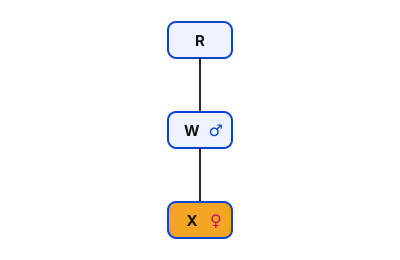
X is the only daughter of W, who is the only son of R. How is X related to R?
X, W की इकलौती पुत्री है, और W, R का इकलौता पुत्र है। X का R से क्या संबंध है?
  1. ADaughterपुत्री
  2. BSisterबहन
  3. CGranddaughterपोती
  4. DCousinचचेरी बहन
Show answer

Concept: Count generations: son's daughter is two generations below.

  1. W is R's son → one generation below R.
  2. X is W's daughter → two generations below R.
  3. So X is R's granddaughter.

Trick: 'Only son' / 'only daughter' are just fillers – trace the generations.

Answer: (C) Granddaughter

अवधारणा: पीढ़ियाँ गिनें: बेटे की बेटी दो पीढ़ी नीचे होती है।

  1. W, R का बेटा → R से एक पीढ़ी नीचे।
  2. X, W की बेटी → R से दो पीढ़ी नीचे।
  3. अतः X, R की पोती है।

ट्रिक: 'इकलौता बेटा' जैसे शब्द केवल भरावन हैं – पीढ़ी गिनें।

उत्तर: (C) पोती

SSC CGLGeneral Intelligence & ReasoningBlood relation – grandchildSSC CGL 2025 · 19 Sep Shift 1 →
Q2311.
In the following question, find out the alternative that will replace the question mark.
RBAT : TBAR :: MNPE : ?
निम्न प्रश्न में प्रश्न चिह्न के स्थान पर आने वाला विकल्प ज्ञात कीजिए।
RBAT : TBAR :: MNPE : ?
  1. APMEN
  2. BENPM
  3. CNPEM
  4. DPENM
Show answer

Concept: Find the position change in the first pair and repeat it.

  1. RBAT → TBAR: 1st and 4th letters swap, middle 'BA' unchanged.
  2. MNPE: swap M and E, keep 'NP'.
  3. Result: ENPM.

Trick: Middle letters stay → answer must contain 'NP' in the middle: only ENPM.

Answer: (B) ENPM

अवधारणा: पहले जोड़े में अक्षरों का स्थान-परिवर्तन पहचानें और वही दोहराएँ।

  1. RBAT → TBAR: पहला और चौथा अक्षर आपस में बदले, बीच का 'BA' वैसा ही।
  2. MNPE में M और E बदलें, 'NP' वैसा ही।
  3. परिणाम: ENPM।

ट्रिक: बीच में 'NP' होना चाहिए – ऐसा सिर्फ ENPM में है।

उत्तर: (B) ENPM

SSC CGLGeneral Intelligence & ReasoningLetter analogy – swap end lettersSSC CGL 2025 · 19 Sep Shift 1 →
Q2312.
What comes next: 3, 5, 9, 17, 33, 65, ?
आगे क्या आएगा: 3, 5, 9, 17, 33, 65, ?
  1. A129
  2. B138
  3. C145
  4. D154
Show answer

Concept: Each term is double the previous minus 1.

  1. 5=3×2−1, 9=5×2−1, 17, 33, 65 follow the same rule.
  2. Next = 65×2−1=129.

Trick: Differences 2, 4, 8, 16, 32 double each time → next difference 64: 65+64=129.

Answer: (A) 129

अवधारणा: हर पद = पिछला ×2−1।

  1. 5=3×2−1, 9=5×2−1, फिर 17, 33, 65 इसी नियम से।
  2. अगला = 65×2−1=129।

ट्रिक: अंतर 2, 4, 8, 16, 32 दोगुने हो रहे हैं → अगला अंतर 64: 65+64=129।

उत्तर: (A) 129

SSC CGLGeneral Intelligence & ReasoningNumber series – ×2 − 1SSC CGL 2025 · 19 Sep Shift 1 →
Q2313.
Read the following statement carefully and identify the conclusion that follows.
Statement: The sale of electric vehicles is rapidly increasing in the city.
Conclusions:
I. People want to reduce pollution.
II. Petrol vehicles have now been completely stopped.
निम्न कथन को ध्यानपूर्वक पढ़कर अनुसरण करने वाला निष्कर्ष पहचानिए।
कथन: शहर में विद्युत वाहनों की बिक्री तेज़ी से बढ़ रही है।
निष्कर्ष:
I. लोग प्रदूषण घटाना चाहते हैं।
II. पेट्रोल वाहन अब पूरी तरह बंद हो चुके हैं।
  1. AOnly Conclusion I followsकेवल निष्कर्ष I अनुसरण करता है
  2. BOnly Conclusion II followsकेवल निष्कर्ष II अनुसरण करता है
  3. CBoth I and II followI और II दोनों अनुसरण करते हैं
  4. DNeither I nor II followsन I न II अनुसरण करता है
Show answer

Concept: Accept a conclusion only if it reasonably follows; reject absolute claims.

  1. Rising EV sales indicate people prefer cleaner vehicles → I follows.
  2. II claims petrol vehicles are 'completely stopped' – rising EV sales do not prove that.
  3. So only I follows.

Trick: 'Completely' makes II an over-statement – eliminate it at once.

Answer: (A) Only Conclusion I follows

अवधारणा: वही निष्कर्ष मानें जो तर्कसंगत हो; पूर्ण/चरम दावे अस्वीकार करें।

  1. EV की बिक्री बढ़ना साफ वाहनों की पसंद दिखाता है → I सही।
  2. II कहता है पेट्रोल वाहन 'पूरी तरह बंद' – यह साबित नहीं होता।
  3. केवल I।

ट्रिक: 'पूरी तरह' शब्द देखते ही II को हटा दें।

उत्तर: (A) केवल निष्कर्ष I अनुसरण करता है

SSC CGLGeneral Intelligence & ReasoningStatement and conclusions – EV salesSSC CGL 2025 · 19 Sep Shift 1 →
Q2314.
Read the following statement carefully and identify the conclusion that follows.
Statement: The use of plastic bags has been banned in many cities.
Conclusions:
I. Plastic harms the environment.
II. People will not use any bags now.
निम्न कथन को ध्यानपूर्वक पढ़कर अनुसरण करने वाला निष्कर्ष पहचानिए।
कथन: कई शहरों में प्लास्टिक थैलों के उपयोग पर प्रतिबंध लगा दिया गया है।
निष्कर्ष:
I. प्लास्टिक पर्यावरण को हानि पहुँचाता है।
II. अब लोग किसी भी प्रकार का थैला उपयोग नहीं करेंगे।
  1. AOnly Conclusion I followsकेवल निष्कर्ष I अनुसरण करता है
  2. BOnly Conclusion II followsकेवल निष्कर्ष II अनुसरण करता है
  3. CBoth I and II followI और II दोनों अनुसरण करते हैं
  4. DNeither I nor II followsन I न II अनुसरण करता है
Show answer

Concept: The reason behind a ban is an implied, valid conclusion.

  1. A ban on plastic bags exists because plastic damages the environment → I follows.
  2. People will switch to cloth/paper bags; 'no bags at all' does not follow → II fails.
  3. Only I follows.

Trick: A ban removes one type, not the need – so 'not use any bags' is illogical.

Answer: (A) Only Conclusion I follows

अवधारणा: किसी प्रतिबंध का कारण एक मान्य, निहित निष्कर्ष होता है।

  1. प्लास्टिक पर्यावरण को हानि पहुँचाता है, इसीलिए प्रतिबंध है → I सही।
  2. लोग कपड़े/कागज़ के थैले अपनाएँगे; 'कोई थैला नहीं' गलत → II नहीं।
  3. केवल I।

ट्रिक: प्रतिबंध एक प्रकार की चीज़ हटाता है, ज़रूरत नहीं।

उत्तर: (A) केवल निष्कर्ष I अनुसरण करता है

SSC CGLGeneral Intelligence & ReasoningStatement and conclusions – plastic banSSC CGL 2025 · 19 Sep Shift 1 →
Q2315.
If "QNLD" is coded as "URPH", what is the code for "FQDDBD"?
यदि "QNLD" का कूट "URPH" है, तो "FQDDBD" का कूट क्या होगा?
  1. AJUHHFH
  2. BJUHHFG
  3. CUJHHFH
  4. DJUHFHH
Show answer

Concept: Every letter moves forward by the same number.

  1. Q→U, N→R, L→P, D→H: each +4.
  2. FQDDBD: F→J, Q→U, D→H, D→H, B→F, D→H.
  3. Code = JUHHFH.

Trick: Last letter D+4 = H: rejects (B); order J-U-H-H rejects (C), (D).

Answer: (A) JUHHFH

अवधारणा: हर अक्षर समान अंक से आगे बढ़ता है।

  1. Q→U, N→R, L→P, D→H: हर अक्षर +4।
  2. FQDDBD: F→J, Q→U, D→H, D→H, B→F, D→H।
  3. कोड = JUHHFH।

ट्रिक: आखिरी अक्षर D+4 = H से (B) बाहर; क्रम J-U-H-H से (C), (D) बाहर।

उत्तर: (A) JUHHFH

SSC CGLGeneral Intelligence & ReasoningLetter coding – each letter +4SSC CGL 2025 · 19 Sep Shift 1 →
Q2316.
What comes next?
BY, KR, TK, ?
आगे क्या आएगा?
BY, KR, TK, ?
  1. ABA
  2. BCD
  3. CZC
  4. DYC
Show answer

Concept: Track each letter of the pair separately by its alphabet number.

  1. First letters: B(2), K(11), T(20) → +9 → 29 − 26 = 3 = C.
  2. Second letters: Y(25), R(18), K(11) → −7 → 4 = D.
  3. Next pair = CD.

Trick: Use EJOTY (5, 10, 15, 20, 25) to find positions fast.

Answer: (B) CD

अवधारणा: युग्म के दोनों अक्षरों को अलग-अलग उनकी क्रम-संख्या से देखें।

  1. पहले स्थान पर B, K, T हैं – क्रम-संख्या 2 से 11 से 20, यानी हर बार 9 आगे; 20 + 9 = 29 → 29 − 26 = 3 = C।
  2. दूसरे स्थान पर Y, R, K हैं – 25 से 18 से 11, यानी हर बार 7 पीछे; 11 − 7 = 4 = D।
  3. अगला युग्म = CD।

ट्रिक: EJOTY (5, 10, 15, 20, 25) से स्थान जल्दी निकालें।

उत्तर: (B) CD

SSC CGLGeneral Intelligence & ReasoningLetter pairs – +9 and −7SSC CGL 2025 · 19 Sep Shift 1 →
Q2317.
Find the odd one out from the given alternatives:
दिए गए विकल्पों में से असंगत चुनिए:
  1. AShershah Suriशेरशाह सूरी
  2. BBabarबाबर
  3. CAkbarअकबर
  4. DHumayunहुमायूँ
Show answer

Concept: Group the rulers by dynasty.

  1. Babur, Humayun, Akbar – Mughal emperors.
  2. Sher Shah Suri – founder of the Sur dynasty, who defeated Humayun at Kannauj (1540).
  3. So Sher Shah is the odd one.

Yaad rakhein: Mughal order: Babur → Humayun → Akbar → Jahangir → Shah Jahan → Aurangzeb.

Answer: (A) Shershah Suri

अवधारणा: शासकों को उनके वंश के अनुसार समूह में बाँटें।

  1. बाबर, हुमायूँ, अकबर – मुग़ल सम्राट।
  2. शेरशाह सूरी – सूर वंश के संस्थापक, जिन्होंने 1540 में कन्नौज में हुमायूँ को हराया।
  3. अतः शेरशाह भिन्न है।

याद रखें: मुग़ल क्रम: बाबर → हुमायूँ → अकबर → जहाँगीर → शाहजहाँ → औरंगज़ेब।

उत्तर: (A) शेरशाह सूरी

SSC CGLGeneral Intelligence & ReasoningOdd one out – Mughal vs SurSSC CGL 2025 · 19 Sep Shift 1 →
Q2318.
If FNZK is coded as GOAL, what is the code for EZHK?
यदि FNZK का कूट GOAL है, तो EZHK का कूट क्या होगा?
  1. AFAIL
  2. BILFA
  3. CFBIL
  4. DGAFB
Show answer

Concept: Each letter shifts one place forward (Z wraps to A).

  1. F→G, N→O, Z→A, K→L: +1.
  2. EZHK: E→F, Z→A, H→I, K→L.
  3. Code = FAIL.

Trick: The code of FNZK spells GOAL – the pattern makes a word; EZHK gives FAIL.

Answer: (A) FAIL

अवधारणा: हर अक्षर एक स्थान आगे (Z के बाद A)।

  1. F→G, N→O, Z→A, K→L: +1।
  2. EZHK: E→F, Z→A, H→I, K→L।
  3. कोड = FAIL।

ट्रिक: Z→A ध्यान रखें: दूसरा अक्षर A होना चाहिए – (A) और (D) बचे, (D) पहले अक्षर पर ही गलत।

उत्तर: (A) FAIL

SSC CGLGeneral Intelligence & ReasoningLetter coding – each letter +1SSC CGL 2025 · 19 Sep Shift 1 →
Q2319.
X invested ₹50,000 for 8 months and Y invested ₹40,000 for 12 months. The total profit is ₹33,000. What is X's share?
X ने ₹50,000, 8 माह के लिए और Y ने ₹40,000, 12 माह के लिए निवेश किए। कुल लाभ ₹33,000 है। X का हिस्सा क्या है?
  1. A₹12,000
  2. B₹15,000
  3. C₹20,000
  4. D₹18,000
Show answer

Concept: Profit is divided in the ratio of capital × time.

  1. Ratio of investments = (50×8):(40×12) in thousands =400:480.
  2. Simplify by 80 → 5 : 6, total 11 parts.
  3. X gets 511 of ₹33,000 = ₹15,000.

Trick: Total 11 parts and ₹33,000 → 1 part = ₹3,000; X = 5×3,000.

Answer: (B) ₹15,000

अवधारणा: लाभ, पूँजी × समय के अनुपात में बँटता है।

  1. निवेश अनुपात (हज़ार में) = (50×8):(40×12) =400:480।
  2. 80 से भाग देकर 5 : 6, कुल 11 भाग।
  3. X को ₹33,000 का 511 = ₹15,000 मिलेगा।

ट्रिक: 11 भाग = ₹33,000 → 1 भाग = ₹3,000; X = 5×3,000।

उत्तर: (B) ₹15,000

SSC CGLGeneral Intelligence & ReasoningPartnership – share of profitSSC CGL 2025 · 19 Sep Shift 1 →
Q2320.
If 11 # 2 = 121 and 10 # 2 = 100, what is 15 # 2?
यदि 11 # 2 = 121 और 10 # 2 = 100 है, तो 15 # 2 = ?
  1. A225
  2. B245
  3. C231
  4. D243
Show answer

Concept: Find the operation that fits both given examples.

  1. 11 # 2 =112=121; 10 # 2 =102=100 → a # b = ab.
  2. 15 # 2 =152=225.

Trick: Numbers ending in 5: 152=(1×2) followed by 25 = 225.

Answer: (A) 225

अवधारणा: वह संक्रिया खोजें जो दोनों उदाहरणों पर लागू हो।

  1. 11 # 2 =112=121; 10 # 2 =102=100 → a # b = ab।
  2. 15 # 2 =152=225।

ट्रिक: 5 पर खत्म होने वाली संख्या: 152=(1×2) के बाद 25 = 225।

उत्तर: (A) 225

SSC CGLGeneral Intelligence & ReasoningSymbol operation – powerSSC CGL 2025 · 19 Sep Shift 1 →