Question bank

Q&A: practice questions with answers

Search questions on any topic. Filter by exam category, exam, subject and topic, try the question, then open the answer and explanation.

Courses – airGurukul

4,800 questions found.

Q2561.
Two hemispheres of radii 9 cm and 10 cm respectively are melted and recast into another hemisphere. What is the approximate total surface area of the newly formed hemisphere?
9 cm और 10 cm त्रिज्या वाले दो अर्धगोलों को पिघलाकर एक नया अर्धगोला बनाया जाता है। नए अर्धगोले का अनुमानित कुल पृष्ठीय क्षेत्रफल क्या है?
  1. A1633 cm²
  2. B1425 cm²
  3. C1358 cm²
  4. D1385 cm²
Show answer

Concept: Volume is conserved, so R3=r13+r23; TSA of hemisphere = 3πR2.

  1. R3=93+103=729+1000=1729→R≈12 cm (123=1728).
  2. TSA = 3×227×144≈1357.7 cm².
  3. ≈ 1358 cm².

Trick: 1729=93+103=123+1 (Ramanujan's number) — so R is just above 12.

Answer: (C) 1358 cm²

अवधारणा: आयतन समान रहता है: R3=r13+r23; अर्धगोले का कुल पृष्ठ = 3πR2।

हल:

  1. R3=729+1000=1729→R≈12 cm (123=1728)।
  2. कुल पृष्ठ = 3×227×144≈1357.7 cm²।
  3. ≈ 1358 cm²।

ट्रिक: 1729=93+103=123+1 (रामानुजन संख्या) — R लगभग 12।

उत्तर: (C) 1358 cm²
SSC CGLQuantitative AptitudeRecasting hemispheres – surface areaSSC CGL 2025 · 18 Sep Shift 2 →
Q2562.
If all three dimensions of a cuboid are increased by 25%, the volume increases by what percentage?
यदि किसी घनाभ की तीनों विमाएँ 25% बढ़ा दी जाएँ, तो आयतन में कितने प्रतिशत वृद्धि होगी?
  1. A95.31%
  2. B89.21%
  3. C75.01%
  4. D82.15%
Show answer

Concept: Each dimension ×54, so volume ×(54)3.

  1. (54)3=12564=1.953125.
  2. Increase = 0.953125×100≈95.31%.

Trick: For x% rise in all three: 3x+3x2100+x3104=75+18.75+1.5625=95.31%.

Answer: (A) 95.31%

अवधारणा: हर विमा ×54, इसलिए आयतन ×(54)3।

हल:

  1. (54)3=12564=1.953125।
  2. वृद्धि = 0.953125×100≈95.31%।

ट्रिक: तीनों में x% वृद्धि: 3x+3x2100+x3104=75+18.75+1.5625=95.31%।

उत्तर: (A) 95.31%

SSC CGLQuantitative AptitudeVolume change – all sides +25%SSC CGL 2025 · 18 Sep Shift 2 →
Q2563.
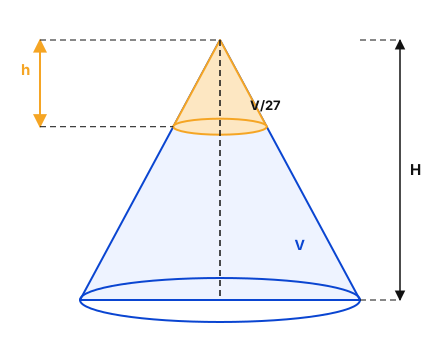
A cone is sliced into two sections by a plane that is parallel to its base, with the upper section representing 127 of the overall volume. What is the ratio of the heights of the smaller cone to the original cone?
एक शंकु को आधार के समांतर तल से दो भागों में काटा जाता है; ऊपरी भाग पूरे आयतन का 127 है। छोटे शंकु और मूल शंकु की ऊँचाइयों का अनुपात क्या है?
  1. A1 : 4
  2. B1 : 6
  3. C5 : 1
  4. D1 : 3
Show answer

Concept: The top piece is a smaller cone similar to the full cone; volume ratio=(height ratio)3.

  1. (hH)3=127.
  2. hH=1273=13.
  3. Ratio = 1 : 3.

Trick: Volume ratio → take cube root; area ratio → take square root.

Answer: (D) 1 : 3

अवधारणा: ऊपरी भाग छोटा शंकु है जो पूरे शंकु के समरूप है; आयतन अनुपात=(ऊँचाई अनुपात)3।

हल:

  1. (hH)3=127।
  2. hH=13।
  3. अनुपात = 1 : 3।

ट्रिक: आयतन अनुपात → घनमूल; क्षेत्रफल अनुपात → वर्गमूल।

उत्तर: (D) 1 : 3

SSC CGLQuantitative AptitudeFrustum – similar conesSSC CGL 2025 · 18 Sep Shift 2 →
Q2564.
If tanA = 12 and tanB = 13, with A and B ∈ (0, π2), find tan(A + B).
यदि tanA = 12 और tanB = 13 है, तथा A, B ∈ (0, π2) हैं, तो tan(A + B) ज्ञात कीजिए।
  1. A3
  2. B1
  3. C7
  4. D9
Show answer

Concept: tan(A+B)=tanA+tanB1−tanAtanB.

  1. Numerator = 12+13=56.
  2. Denominator = 1−16=56.
  3. tan(A+B)=1, so A+B=45∘.

Trick: Whenever tanA=12 and tanB=13, A+B=45∘ — a frequently repeated pair.

Answer: (B) 1

अवधारणा: tan(A+B)=tanA+tanB1−tanAtanB।

हल:

  1. अंश = 12+13=56।
  2. हर = 1−16=56।
  3. tan(A+B)=1, अर्थात A+B=45∘।

ट्रिक: tanA=12, tanB=13 हो तो A+B=45∘ — यह जोड़ी बार-बार आती है।

उत्तर: (B) 1

SSC CGLQuantitative AptitudeTrigonometry – tan(A + B)SSC CGL 2025 · 18 Sep Shift 2 →
Q2565.
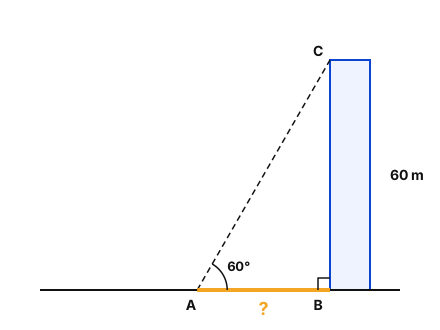
A tower is 60 metres tall. When the sun's angle of elevation is 60 degrees, what is the length of the shadow of the tower?
एक मीनार 60 मीटर ऊँची है। जब सूर्य का उन्नयन कोण 60° हो, तो मीनार की छाया की लंबाई क्या होगी?
  1. A453 m
  2. B382 m
  3. C203 m
  4. D192 m
Show answer

Concept: tan(elevation)=heightshadow.

  1. tan60∘=3=60shadow.
  2. Shadow =603=203 m.

Trick: At 60∘ the shadow is height3; at 30∘ it is height ×3.

Answer: (C) 203 m

अवधारणा: tan(उन्नयन कोण) = ऊँचाई/छाया।

हल:

  1. tan60∘=3= 60/छाया।
  2. छाया =603=203 m।

ट्रिक: 60∘ पर छाया = ऊँचाई/3; 30∘ पर छाया = ऊँचाई ×3।

उत्तर: (C) 203 m

SSC CGLQuantitative AptitudeHeights – shadow of a towerSSC CGL 2025 · 18 Sep Shift 2 →
Q2566.
A line y = mx + 3 passes through (2, 9). Find the value of m.
रेखा y = mx + 3, बिंदु (2, 9) से गुजरती है। m का मान ज्ञात कीजिए।
  1. A3
  2. B4
  3. C6
  4. D9
Show answer

Concept: A point on a line satisfies its equation.

  1. Put x=2,y=9: 9=2m+3.
  2. 2m=6→m=3.

Trick: Slope = y−cx=9−32=3, since 3 is the y-intercept.

Answer: (A) 3

अवधारणा: रेखा पर स्थित बिंदु उसके समीकरण को संतुष्ट करता है।

हल:

  1. x=2,y=9 रखें: 9=2m+3।
  2. 2m=6→m=3।

ट्रिक: ढाल = y−cx=9−32=3, क्योंकि 3 y-अंतःखंड है।

उत्तर: (A) 3

SSC CGLQuantitative AptitudeCoordinate geometry – slope from a pointSSC CGL 2025 · 18 Sep Shift 2 →
Q2567.
A sector of a circle has a central angle of 150° and a radius of 6 cm. Another sector of the same circle has a central angle of 180°. What is the ratio of the area of the first sector to the area of the second sector?
एक वृत्त के त्रिज्यखंड का केंद्रीय कोण 150° और त्रिज्या 6 cm है। उसी वृत्त के दूसरे त्रिज्यखंड का केंद्रीय कोण 180° है। पहले और दूसरे त्रिज्यखंड के क्षेत्रफलों का अनुपात क्या है?
  1. A6 : 5
  2. B3 : 4
  3. C2 : 3
  4. D5 : 6
Show answer

Concept: In the same circle, sector area ∝ central angle.

  1. Ratio = 150° : 180°.
  2. Divide by 30 → 5 : 6.

Trick: Radius (6 cm) is a distractor — it cancels out.

Answer: (D) 5 : 6

अवधारणा: एक ही वृत्त में त्रिज्यखंड का क्षेत्रफल ∝ केंद्रीय कोण।

हल:

  1. अनुपात = 150° : 180°।
  2. 30 से भाग → 5 : 6।

ट्रिक: त्रिज्या (6 cm) केवल भ्रम के लिए है — यह कट जाती है।

उत्तर: (D) 5 : 6

SSC CGLQuantitative AptitudeSector area – ratioSSC CGL 2025 · 18 Sep Shift 2 →
Q2568.
What is the measure of each interior angle in a regular twelve-sided polygon?
एक सम बारह-भुजी बहुभुज के प्रत्येक अंतःकोण की माप क्या है?
  1. A120°
  2. B150°
  3. C180°
  4. D90°
Show answer

Concept: Exterior angle = 360°/n; interior = 180° − exterior.

  1. Exterior = 360°/12 = 30°.
  2. Interior = 180° − 30° = 150°.

Trick: Exterior-angle route is faster than (n − 2) × 180°/n.

Answer: (B) 150°

अवधारणा: बाह्य कोण = 360°/n; आंतरिक = 180° − बाह्य।

हल:

  1. बाह्य = 360°/12 = 30°।
  2. आंतरिक = 180° − 30° = 150°।

ट्रिक: (n − 2) × 180°/n से तेज़ है बाह्य कोण वाला तरीका।

उत्तर: (B) 150°

SSC CGLQuantitative AptitudeRegular polygon – interior angleSSC CGL 2025 · 18 Sep Shift 2 →
Q2569.
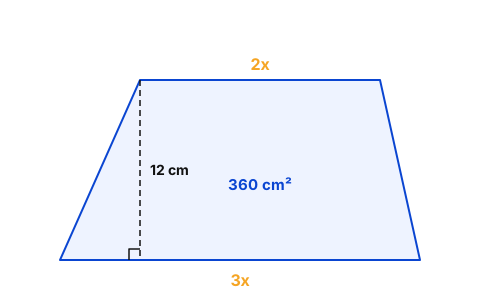
In a trapezoid, the two parallel sides are in the ratio 2 : 3. If the height of the trapezoid is 12 cm and its total area is 360 cm², determine the lengths of the parallel sides.
एक समलंब की दोनों समांतर भुजाएँ 2 : 3 के अनुपात में हैं। यदि उसकी ऊँचाई 12 cm और कुल क्षेत्रफल 360 cm² है, तो समांतर भुजाओं की लंबाई ज्ञात कीजिए।
  1. A26 cm and 38 cm26 cm और 38 cm
  2. B12 cm and 24 cm12 cm और 24 cm
  3. C24 cm and 36 cm24 cm और 36 cm
  4. D17 cm and 23 cm17 cm और 23 cm
Show answer

Concept: Area of trapezium = ½ × (sum of parallel sides) × height.

  1. Let sides = 2x,3x. 360=12×5x×12=30x.
  2. x=12 → sides = 24 cm and 36 cm.

Trick: Sum of sides = 2×36012=60; only option C (24+36) adds to 60 in ratio 2 : 3.

Answer: (C) 24 cm and 36 cm

अवधारणा: समलंब का क्षेत्रफल = ½ × (समांतर भुजाओं का योग) × ऊँचाई।

हल:

  1. भुजाएँ = 2x,3x। 360=12×5x×12=30x।
  2. x=12 → भुजाएँ 24 cm और 36 cm।

ट्रिक: भुजाओं का योग = 2×36012=60; केवल (C) 24+36=60 और 2 : 3 में है।

उत्तर: (C) 24 cm और 36 cm

SSC CGLQuantitative AptitudeTrapezium – parallel sides from areaSSC CGL 2025 · 18 Sep Shift 2 →
Q2570.
△PQR has sides PQ = 8 cm, QR = 9 cm, RP = 10 cm. △MNO is congruent to △PQR. What is the perimeter of △MNO?
△PQR की भुजाएँ PQ = 8 cm, QR = 9 cm, RP = 10 cm हैं। △MNO, △PQR के सर्वांगसम है। △MNO का परिमाप क्या है?
  1. A27 cm
  2. B32 cm
  3. C25 cm
  4. D21 cm
Show answer

Concept: Congruent triangles have all corresponding sides equal, hence equal perimeters.

  1. Perimeter of △PQR = 8 + 9 + 10 = 27 cm.
  2. △MNO ≅ △PQR → perimeter = 27 cm.

Yaad rakhein: Congruent = same shape and same size; similar = same shape only.

Answer: (A) 27 cm

अवधारणा: सर्वांगसम त्रिभुजों की संगत भुजाएँ बराबर होती हैं, इसलिए परिमाप भी बराबर।

हल:

  1. △PQR का परिमाप = 8 + 9 + 10 = 27 cm।
  2. △MNO ≅ △PQR → परिमाप = 27 cm।

याद रखें: सर्वांगसम = आकार और माप दोनों समान; समरूप = केवल आकार समान।

उत्तर: (A) 27 cm

SSC CGLQuantitative AptitudeCongruent triangles – perimeterSSC CGL 2025 · 18 Sep Shift 2 →
Q2571.
Given m + 1m = 7, then what is m + 1m?
यदि m + 1m = 7 है, तो m + 1m क्या होगा?
  1. A55
  2. B29
  3. C47
  4. D36
Show answer

Concept: (m+1m)2=m+1m+2.

  1. 72=49=m+1m+2.
  2. m+1m=47.

Trick: If x+1x=k, then x2+1x2=k2−2; here x=m.

Answer: (C) 47

अवधारणा: (m+1m)2=m+1m+2।

हल:

  1. 72=49=m+1m+2।
  2. m+1m=47।

ट्रिक: यदि x+1x=k, तो x2+1x2=k2−2; यहाँ x=m।

उत्तर: (C) 47

SSC CGLQuantitative AptitudeAlgebra – square of √m + 1/√mSSC CGL 2025 · 18 Sep Shift 2 →
Q2572.
If secA = 2, then tanA − cosecA = ?
यदि secA = 2 है, तो tanA − cosecA = ?
  1. A26
  2. B13
  3. C0
  4. D13
Show answer

Concept: secA=2 means cosA=12, so A=60∘.

  1. tan60∘=3; csc60∘=23.
  2. 3−23=3−23=13.

Trick: Use a triangle: hyp = 2, base = 1 → perpendicular =3; then tan=3, csc=23.

Answer: (B) 13

अवधारणा: secA=2 यानी cosA=12, अतः A=60∘।

हल:

  1. tan60∘=3; csc60∘=23।
  2. 3−23=3−23=13।

ट्रिक: त्रिभुज लें: कर्ण 2, आधार 1 → लंब 3; तब tan=3, csc=23।

उत्तर: (B) 13

SSC CGLQuantitative AptitudeTrigonometric ratios – sec A = 2SSC CGL 2025 · 18 Sep Shift 2 →
Q2573.
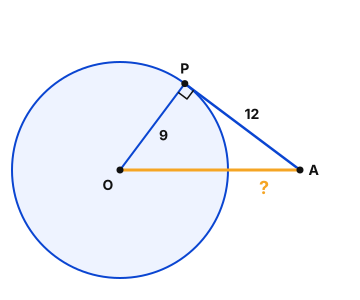
A circle has radius 9 cm. A tangent is drawn from an external point A. If the length of the tangent is 12 cm, what is the distance from A to the centre of the circle?
एक वृत्त की त्रिज्या 9 cm है। बाहरी बिंदु A से स्पर्श रेखा खींची गई है। यदि स्पर्श रेखा की लंबाई 12 cm है, तो A से केंद्र की दूरी क्या है?
  1. A16 cm
  2. B35 cm
  3. C41 cm
  4. D15 cm
Show answer

Concept: Radius ⟂ tangent at the point of contact, so Pythagoras applies.

  1. Distance2=92+122=81+144=225.
  2. Distance = 15 cm.

Trick: 9 : 12 : 15 is the 3-4-5 triple × 3.

Answer: (D) 15 cm

अवधारणा: स्पर्श बिंदु पर त्रिज्या ⟂ स्पर्शरेखा, इसलिए पाइथागोरस लगाएँ।

हल:

  1. दूरी² =92+122=81+144=225।
  2. दूरी = 15 cm।

ट्रिक: 9 : 12 : 15 = 3-4-5 त्रिक × 3।

उत्तर: (D) 15 cm

SSC CGLQuantitative AptitudeCircle – tangent and distance to centreSSC CGL 2025 · 18 Sep Shift 2 →
Q2574.
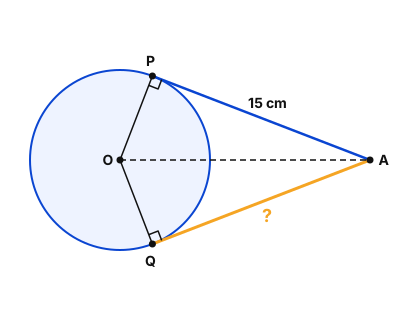
From a point outside a circle, two tangents are drawn to the circle. If one of the tangents measures 15 cm, what is the length of the other tangent?
वृत्त के बाहर एक बिंदु से दो स्पर्श रेखाएँ खींची गई हैं। यदि एक स्पर्श रेखा 15 cm की है, तो दूसरी की लंबाई क्या होगी?
  1. A15 cm
  2. B13 cm
  3. C12 cm
  4. D14 cm
Show answer

Concept: The two tangents from one external point to a circle are equal in length.

  1. One tangent = 15 cm.
  2. So the other is also 15 cm.

Yaad rakhein: The line joining the external point to the centre bisects the angle between the two tangents.

Answer: (A) 15 cm

अवधारणा: एक बाह्य बिंदु से वृत्त पर खींची दोनों स्पर्शरेखाएँ बराबर होती हैं।

हल:

  1. एक स्पर्शरेखा = 15 cm।
  2. इसलिए दूसरी भी 15 cm।

याद रखें: बाह्य बिंदु को केंद्र से मिलाने वाली रेखा दोनों स्पर्शरेखाओं के बीच का कोण समद्विभाजित करती है।

उत्तर: (A) 15 cm

SSC CGLQuantitative AptitudeTangents from an external pointSSC CGL 2025 · 18 Sep Shift 2 →
Q2575.
Evaluate: (0.09³ + 0.03³) ÷ (0.3³ + 0.1³)
मान ज्ञात कीजिए: (0.09³ + 0.03³) ÷ (0.3³ + 0.1³)
  1. A0.028
  2. B0.056
  3. C0.003
  4. D0.027
Show answer

Concept: Write the numerator terms as multiples of the denominator terms.

  1. Numerator bases (0.09, 0.03) are 0.3 times the denominator bases (0.3, 0.1).
  2. Hence numerator = 0.027× (denominator).
  3. Value = 0.027.

Trick: Each numerator term is 0.3 × the matching denominator term, so answer =0.33.

Answer: (D) 0.027

अवधारणा: अंश के पदों को हर के पदों के गुणज के रूप में लिखें।

हल:

  1. अंश के आधार (0.09, 0.03), हर के आधारों (0.3, 0.1) के 0.3 गुना हैं।
  2. अतः अंश = 0.027× (हर)।
  3. मान = 0.027।

ट्रिक: अंश का हर पद, हर के पद का 0.3 गुना है — उत्तर =0.33।

उत्तर: (D) 0.027

SSC CGLQuantitative AptitudeSimplification – common factor in cubesSSC CGL 2025 · 18 Sep Shift 2 →
Q2576.
Select the most appropriate meaning of the given idiom.
The sudden cancellation of the exam result was gall and wormwood for the students.
  1. ALingering curiosity
  2. BHarmless envy
  3. CSudden realization or enlightenment
  4. DDeep frustration or resentment
Show answer

Concept: Gall (bile) and wormwood (a herb) are both extremely bitter; together they stand for bitter disappointment.

  1. The students felt bitter and angry when results were cancelled.
  2. So the idiom means deep frustration or resentment.
  3. Curiosity, envy or enlightenment do not carry this bitterness.

Trick: Bitter taste → bitter feeling: any idiom built on bitter things ('a bitter pill') signals resentment.

Answer: (D) Deep frustration or resentment

अवधारणा: Gall (पित्त) और wormwood (एक कड़वी जड़ी) दोनों बहुत कड़वे हैं; मिलकर इसका अर्थ है गहरी कड़वाहट/निराशा।

हल:

  1. परिणाम रद्द होने पर छात्रों में कड़वा गुस्सा था।
  2. अतः अर्थ: Deep frustration or resentment (गहरी निराशा या आक्रोश)।
  3. Curiosity, envy या enlightenment में यह कड़वाहट नहीं है।

ट्रिक: कड़वा स्वाद → कड़वी भावना: 'bitter' से जुड़े मुहावरे अक्सर नाराज़गी दर्शाते हैं।

उत्तर: (D) Deep frustration or resentment

SSC CGLEnglish ComprehensionIdiom – gall and wormwoodSSC CGL 2025 · 18 Sep Shift 2 →
Q2577.
Choose the correct spelling of a word meaning 'To cheat, sabotage, or cripple'.
  1. ANobble
  2. BNoblie
  3. CNoble
  4. DNobel
Show answer

Concept: Similar-looking words have different meanings.

  1. Nobble (double b) = to tamper with, cheat or disable (e.g., nobble a racehorse).
  2. Noble = honourable; Nobel = the prize; 'Noblie' is not a word.

Trick: Double 'bb' → the 'bad' word (cheat); single 'b' → noble.

Answer: (A) Nobble

अवधारणा: मिलते-जुलते शब्दों के अर्थ अलग होते हैं।

हल:

  1. Nobble (दो b) = धोखा देना, बिगाड़ देना, अपंग करना।
  2. Noble = सज्जन/उदात्त; Nobel = पुरस्कार; 'Noblie' कोई शब्द नहीं।

ट्रिक: दो 'bb' वाला शब्द = बुरा काम (धोखा); एक 'b' = noble।

उत्तर: (A) Nobble

SSC CGLEnglish ComprehensionSpelling – nobbleSSC CGL 2025 · 18 Sep Shift 2 →
Q2578.
Select the correct spelling.
  1. AExpostulation
  2. BExpostuletion
  3. CExpostelation
  4. DExposetulation
Show answer

Concept: Break the word into parts: ex + postul + ation.

  1. Expostulation = a strong protest or reasoning against something; verb: expostulate.
  2. The pattern '-ulation' (as in postulate → postulation) is fixed; options B, C, D distort the vowels.

Trick: Think of 'postulate' and add 'ex-' in front: ex-postul-ation.

Answer: (A) Expostulation

अवधारणा: शब्द को भागों में बाँटें: ex + postul + ation।

हल:

  1. Expostulation = किसी बात पर ज़ोरदार आपत्ति/विरोध; क्रिया: expostulate।
  2. '-ulation' (postulate → postulation) का रूप तय है; बाकी विकल्पों में स्वर गलत हैं।

ट्रिक: 'postulate' याद करें और आगे 'ex-' जोड़ें: ex-postul-ation।

उत्तर: (A) Expostulation

SSC CGLEnglish ComprehensionSpelling – expostulationSSC CGL 2025 · 18 Sep Shift 2 →
Q2579.
Choose the correct one-word substitute for:
'A person who is too particular about rules, correctness, or minor details'.
  1. ACritic
  2. BGrammarian
  3. CPerfectionist
  4. DPedant
Show answer

Concept: A pedant fusses over small rules and showy correctness.

  1. Pedant = one overly concerned with rules, accuracy and minor details.
  2. Perfectionist wants a flawless result, not necessarily rule-bound.
  3. Critic judges works; grammarian is a grammar expert.

Trick: Pedantic = 'nit-picking'. Remember: pedant ↔ petty details.

Answer: (D) Pedant

अवधारणा: Pedant = छोटे-छोटे नियमों और शुद्धता पर ज़रूरत से ज़्यादा ध्यान देने वाला।

हल:

  1. Pedant = नियम, शुद्धता और बारीकियों पर अत्यधिक ज़ोर देने वाला व्यक्ति।
  2. Perfectionist = हर काम त्रुटिहीन चाहने वाला।
  3. Critic = आलोचक; Grammarian = व्याकरणाचार्य।

ट्रिक: Pedantic = बाल की खाल निकालने वाला। pedant ↔ petty details।

उत्तर: (D) Pedant

SSC CGLEnglish ComprehensionOne-word substitution – pedantSSC CGL 2025 · 18 Sep Shift 2 →
Q2580.
Choose the correct one-word substitute for:
After hearing the police sirens, the thief decided to leave suddenly and hurriedly.
  1. AAbscond
  2. BPerambulate
  3. CCircumambulate
  4. DLoiter
Show answer

Concept: Abscond = to run away suddenly and secretly, often to escape the law.

  1. The thief fled on hearing sirens → he absconded.
  2. Perambulate = walk around leisurely; circumambulate = walk around something (e.g., a temple).
  3. Loiter = hang around idly.

Trick: Abscond is used for thieves, debtors, accused persons — anyone escaping justice.

Answer: (A) Abscond

अवधारणा: Abscond = कानून से बचने के लिए अचानक चुपके से भाग जाना।

हल:

  1. सायरन सुनकर चोर भागा → absconded।
  2. Perambulate = टहलना; Circumambulate = परिक्रमा करना।
  3. Loiter = बेकार घूमते रहना।

ट्रिक: Abscond चोर, कर्ज़दार, आरोपी आदि के लिए प्रयोग होता है — जो न्याय से भागे।

उत्तर: (A) Abscond

SSC CGLEnglish ComprehensionOne-word substitution – abscondSSC CGL 2025 · 18 Sep Shift 2 →