Question bank

Q&A: practice questions with answers

Search questions on any topic. Filter by exam category, exam, subject and topic, try the question, then open the answer and explanation.

Courses – airGurukul

4,800 questions found.

Q2601.
Select the letter-cluster from among the given options that can replace the question mark (?) in the following series.
FIM, ILP, LOS, ?
दी गई शृंखला में प्रश्न चिह्न (?) के स्थान पर आने वाला अक्षर-समूह चुनिए।
FIM, ILP, LOS, ?
  1. AORU
  2. BORV
  3. COVU
  4. DNOU
Show answer

Concept: Each position of the cluster moves forward by a fixed number of letters.

  1. Position 1: F → I → L, a jump of +3 each time, so next is L+3 = O.
  2. Position 2: I → L → O, so next is O+3 = R.
  3. Position 3: M → P → S, so next is S+3 = V.
  4. Missing cluster = ORV.

Trick: Check only the last letter first: S+3 = V. Only option (B) ends in V with O, R before it.

Answer: (B) ORV

अवधारणा: समूह का हर स्थान एक तय संख्या से आगे बढ़ता है।

  1. पहला अक्षर: F → I → L (हर बार +3), अगला L+3 = O।
  2. दूसरा अक्षर: I → L → O, अगला R।
  3. तीसरा अक्षर: M → P → S, अगला V।
  4. अतः ORV।

ट्रिक: पहले केवल अंतिम अक्षर जाँचें: S+3 = V — यह सिर्फ विकल्प (B) में सही क्रम के साथ है।

उत्तर: (B) ORV
SSC CGLGeneral Intelligence & ReasoningLetter-cluster series (+3 shift)SSC CGL 2025 · 18 Sep Shift 1 →
Q2602.
A statement is given followed by two conclusions. Find which conclusion is TRUE based on the given statement.
Statement: P ≥ L; X = Y ≥ M; R ≥ Y < Z; L ≥ X
Conclusions:
I. X ≤ M
II. P ≥ R
एक कथन के बाद दो निष्कर्ष दिए गए हैं। बताइए कौन-सा निष्कर्ष सत्य है।
कथन: P ≥ L; X = Y ≥ M; R ≥ Y < Z; L ≥ X
निष्कर्ष:
I. X ≤ M
II. P ≥ R
  1. AEither I or IIया तो I या II
  2. BOnly IIकेवल II
  3. COnly Iकेवल I
  4. DNeither I nor IIन I न II
Show answer

Concept: A conclusion is true only if an unbroken chain of same-direction signs connects the two terms.

  1. Chain: P ≥ L ≥ X = Y ≥ M and R ≥ Y < Z.
  2. I: X = Y ≥ M gives X ≥ M, so "X ≤ M" is not definite → false.
  3. II: P and R both sit above Y (P ≥ Y, R ≥ Y); signs face opposite ways at Y → no relation → false.
  4. Neither conclusion follows.

Trick: Two terms that are both "bigger than" the same middle term can never be compared.

Answer: (D) Neither I nor II

अवधारणा: निष्कर्ष तभी सत्य है जब दोनों पदों के बीच एक ही दिशा के चिह्नों की पूरी शृंखला हो।

  1. शृंखला: P ≥ L ≥ X = Y ≥ M तथा R ≥ Y < Z।
  2. I: X = Y ≥ M से X ≥ M मिलता है; "X ≤ M" निश्चित नहीं → असत्य।
  3. II: P ≥ Y और R ≥ Y — Y पर चिह्न उल्टी दिशा में → कोई संबंध नहीं → असत्य।
  4. अतः न I न II।

ट्रिक: यदि दोनों पद एक ही बीच वाले पद से "बड़े" हों, तो उनकी तुलना कभी नहीं हो सकती।

उत्तर: (D) न I न II

SSC CGLGeneral Intelligence & ReasoningInequality – direct comparisonSSC CGL 2025 · 18 Sep Shift 1 →
Q2603.
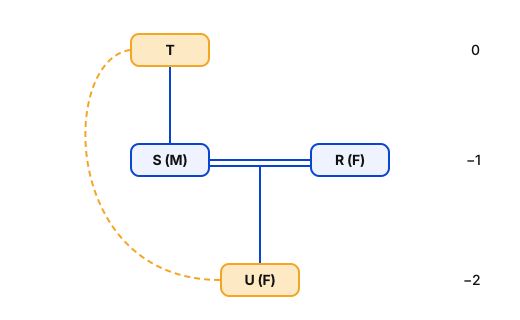
R is the wife of S. S is the son of T. U is the daughter of R. How is U related to T?
R, S की पत्नी है। S, T का पुत्र है। U, R की पुत्री है। U का T से क्या संबंध है?
  1. AGranddaughterपोती
  2. BDaughterपुत्री
  3. CSisterबहन
  4. DNieceभतीजी
Show answer

Concept: Track generations: the child of one's son is one's grandchild.

  1. S is the son of T, so S is one generation below T.
  2. R is S's wife; U is R's daughter, so U is the daughter of S as well.
  3. U is the daughter of T's son → T's granddaughter.

Trick: Count generations: T (0) → S (−1) → U (−2), and U is female, so granddaughter.

Answer: (A) Granddaughter

अवधारणा: पीढ़ी गिनें: बेटे की संतान = पोता/पोती।

  1. S, T का पुत्र है।
  2. R, S की पत्नी है और U, R की बेटी है, यानी U, S की भी बेटी है।
  3. T के बेटे की बेटी = T की पोती (Granddaughter)।

ट्रिक: पीढ़ी गिनें: T (0) → S (−1) → U (−2); U महिला है → पोती।

उत्तर: (A) पोती

SSC CGLGeneral Intelligence & ReasoningBlood relation – grandchildSSC CGL 2025 · 18 Sep Shift 1 →
Q2604.
Solve: TIME : ? :: LEAF : FAEL
हल कीजिए: TIME : ? :: LEAF : FAEL
  1. AEMIS
  2. BEMIT
  3. CEMTI
  4. DETMI
Show answer

Concept: The second word is the first word written in reverse order.

  1. LEAF read from the end = F, A, E, L = FAEL.
  2. So the missing word is the reverse of TIME.
  3. TIME reversed = E, M, I, T = EMIT.

Trick: Word pair rule first: last letter of LEAF (F) became the first letter — so the answer must start with E (last of TIME) and end with T.

Answer: (B) EMIT

अवधारणा: दूसरा शब्द पहले शब्द को उल्टा लिखकर बना है।

  1. LEAF को पीछे से पढ़ें: F, A, E, L = FAEL।
  2. इसी प्रकार TIME को उल्टा लिखें।
  3. TIME → E, M, I, T = EMIT।

ट्रिक: उत्तर E से शुरू और T पर खत्म होना चाहिए — केवल EMIT में यह है।

उत्तर: (B) EMIT

SSC CGLGeneral Intelligence & ReasoningWord analogy – reversalSSC CGL 2025 · 18 Sep Shift 1 →
Q2605.
What comes next: 2, 4, 12, 48, ?
आगे क्या आएगा: 2, 4, 12, 48, ?
  1. A240
  2. B250
  3. C290
  4. D210
Show answer

Concept: Each term is the previous term multiplied by 2, 3, 4, … in turn.

  1. Ratios of neighbours: 42=2, 124=3, 4812=4.
  2. The multiplier grows by 1 each step, so the next one is 5.
  3. Missing term = 48×5=240.

Trick: Pattern ×2, ×3, ×4, ×5 is the same as n! × 2: 2×1, 2×2, 2×6, 2×24, 2×120 = 240.

Answer: (A) 240

अवधारणा: हर पद को क्रमशः 2, 3, 4, … से गुणा किया गया है।

  1. 2×2=4
  2. 4×3=12
  3. 12×4=48
  4. अगला: 48×5=240

ट्रिक: पास-पास के पदों का भाग लें: 2, 3, 4 → अगला 5।

उत्तर: (A) 240

SSC CGLGeneral Intelligence & ReasoningNumber series – increasing multipliersSSC CGL 2025 · 18 Sep Shift 1 →
Q2606.
Read the following statement carefully and identify the conclusion that follows.
Statement: All drivers must wear seat belts while driving.
Conclusions:
I. Drivers who do not wear seat belts are violating the law.
II. Wearing a seat belt ensures safety while driving.
निम्न कथन को ध्यानपूर्वक पढ़कर अनुसरण करने वाला निष्कर्ष पहचानिए।
कथन: सभी चालकों को वाहन चलाते समय सीट बेल्ट पहननी चाहिए।
निष्कर्ष:
I. जो चालक सीट बेल्ट नहीं पहनते, वे नियम का उल्लंघन कर रहे हैं।
II. सीट बेल्ट पहनने से वाहन चलाते समय सुरक्षा सुनिश्चित हो जाती है।
  1. AOnly Iकेवल I
  2. BOnly IIकेवल II
  3. CBoth followदोनों अनुसरण करते हैं
  4. DNeither followsकोई नहीं
Show answer

Concept: A conclusion must follow directly from the statement; claims of certainty not given in it are rejected.

  1. "Must wear seat belts" makes it a rule; not wearing one breaks that rule → I follows.
  2. II says a belt ENSURES safety — the statement gives a rule, not a guarantee of safety → II does not follow.

Trick: Words like "ensures", "always", "all" in a conclusion are a red flag unless the statement says the same.

Answer: (A) Only I

अवधारणा: निष्कर्ष वही मान्य है जो कथन से सीधे निकले; अतिरिक्त गारंटी वाले दावे अस्वीकार।

  1. "Must wear" = नियम; बेल्ट न लगाना नियम तोड़ना है → I सही।
  2. II कहता है बेल्ट सुरक्षा "सुनिश्चित" करती है — कथन में ऐसी गारंटी नहीं → II गलत।

ट्रिक: निष्कर्ष में "ensures", "always", "all" जैसे शब्द आएँ तो सावधान रहें।

उत्तर: (A) केवल I

SSC CGLGeneral Intelligence & ReasoningStatement and conclusion – rule-basedSSC CGL 2025 · 18 Sep Shift 1 →
Q2607.
Identify the assumptions that must hold for the statement to be valid, then choose the correct option.
Statement: To reduce traffic congestion in metropolitan cities, authorities should enhance public transportation facilities, even though it involves large initial investments.
Assumptions:
I. Better public transport can reduce traffic congestion.
II. Large investments in public transport are worth making.
III. People will readily give up their private vehicles.
कथन को वैध बनाने हेतु आवश्यक पूर्वधारणाओं की पहचान कर सही विकल्प चुनिए।
कथन: महानगरों में यातायात भीड़ घटाने हेतु प्राधिकरणों को सार्वजनिक परिवहन सुविधाएँ बेहतर करनी चाहिए, भले ही इसमें बड़ा प्रारंभिक निवेश लगे।
पूर्वधारणाएँ:
I. बेहतर सार्वजनिक परिवहन यातायात भीड़ घटा सकता है।
II. सार्वजनिक परिवहन में बड़ा निवेश करने योग्य है।
III. लोग अपने निजी वाहन सहर्ष छोड़ देंगे।
  1. AOnly I and II are implicitकेवल I और II अंतर्निहित हैं
  2. BOnly II and III are implicitकेवल II और III अंतर्निहित हैं
  3. CAll I, II and III are implicitI, II और III सभी अंतर्निहित हैं
  4. DOnly I is implicitकेवल I अंतर्निहित है
Show answer

Concept: An assumption is the unstated belief without which the advice would make no sense.

  1. Advising better public transport to cut congestion presumes it can actually reduce congestion → I implicit.
  2. "Even though it involves large investments" shows the speaker thinks the cost is worth it → II implicit.
  3. The statement says nothing about people giving up their own vehicles readily; it is an extra, strong claim → III not implicit.

Trick: Reject assumptions with strong words like "readily", "all", "only" unless the statement needs them.

Answer: (A) Only I and II are implicit

अवधारणा: पूर्वधारणा वह अनकही बात है जिसके बिना सुझाव का कोई अर्थ न रहे।

  1. बेहतर सार्वजनिक परिवहन का सुझाव तभी है जब वह जाम घटा सके → I निहित।
  2. "भारी निवेश के बावजूद" — यानी खर्च उचित माना गया है → II निहित।
  3. लोग "आसानी से" निजी वाहन छोड़ देंगे — कथन में इसका कोई आधार नहीं → III निहित नहीं।

ट्रिक: "readily", "all", "only" जैसे कठोर शब्दों वाली पूर्वधारणा प्रायः गलत होती है।

उत्तर: (A) केवल I और II अंतर्निहित हैं

SSC CGLGeneral Intelligence & ReasoningStatement and assumptionsSSC CGL 2025 · 18 Sep Shift 1 →
Q2608.
Read the following statement carefully and identify the conclusion that follows.
Statement: Millions of candidates registered for the national scholarship test this year.
Conclusions:
I. The test is widely taken and competitive.
II. All candidates who registered will receive the scholarship.
निम्न कथन को ध्यानपूर्वक पढ़कर अनुसरण करने वाला निष्कर्ष पहचानिए।
कथन: इस वर्ष लाखों अभ्यर्थियों ने राष्ट्रीय छात्रवृत्ति परीक्षा के लिए पंजीकरण कराया।
निष्कर्ष:
I. यह परीक्षा व्यापक रूप से दी जाती है और प्रतिस्पर्धी है।
II. पंजीकरण कराने वाले सभी अभ्यर्थियों को छात्रवृत्ति मिलेगी।
  1. AOnly Conclusion I followsकेवल निष्कर्ष I अनुसरण करता है
  2. BOnly Conclusion II followsकेवल निष्कर्ष II अनुसरण करता है
  3. CBoth I and II followI और II दोनों अनुसरण करते हैं
  4. DNeither I nor II followsन I न II अनुसरण करता है
Show answer

Concept: Accept only what is a reasonable inference; reject sweeping "all" claims.

  1. Millions of registrations mean many people take the test and compete → I follows.
  2. A scholarship is given to a limited number; nothing says every registrant gets it → II does not follow.

Trick: "All candidates will receive" is an extreme claim — such conclusions almost never follow.

Answer: (A) Only Conclusion I follows

अवधारणा: केवल तर्कसंगत अनुमान स्वीकार करें; "सभी" वाले व्यापक दावे अस्वीकार करें।

  1. लाखों पंजीकरण = परीक्षा बहुत लोकप्रिय और प्रतिस्पर्धी → I सही।
  2. छात्रवृत्ति सीमित होती है; कथन में नहीं कहा कि सबको मिलेगी → II गलत।

ट्रिक: "सभी को मिलेगा" जैसा चरम दावा लगभग कभी नहीं निकलता।

उत्तर: (A) केवल निष्कर्ष I अनुसरण करता है

SSC CGLGeneral Intelligence & ReasoningStatement and conclusion – large participationSSC CGL 2025 · 18 Sep Shift 1 →
Q2609.
Read the following statements carefully and identify the conclusion that follows.
Statements:
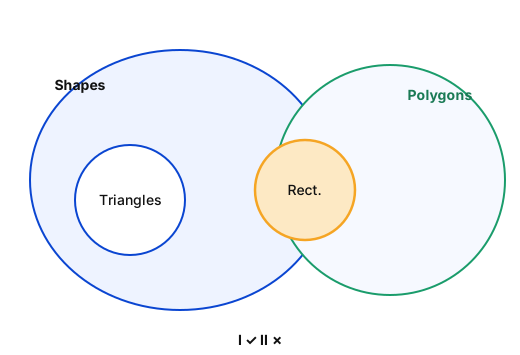
All triangles are shapes.
Some shapes are rectangles.
All rectangles are polygons.
Conclusions:
I. Some shapes are polygons.
II. Some polygons are triangles.
निम्न कथनों को ध्यानपूर्वक पढ़कर अनुसरण करने वाला निष्कर्ष पहचानिए।
कथन:
सभी त्रिभुज आकृतियाँ हैं।
कुछ आकृतियाँ आयत हैं।
सभी आयत बहुभुज हैं।
निष्कर्ष:
I. कुछ आकृतियाँ बहुभुज हैं।
II. कुछ बहुभुज त्रिभुज हैं।
  1. AOnly I followsकेवल I अनुसरण करता है
  2. BOnly II followsकेवल II अनुसरण करता है
  3. CBoth I and II followI और II दोनों अनुसरण करते हैं
  4. DNeither I nor II followsन I न II अनुसरण करता है
Show answer

Concept: "Some A are B" + "All B are C" gives "Some A are C".

  1. Some shapes are rectangles + All rectangles are polygons → Some shapes are polygons. I follows.
  2. Triangles are linked only to "shapes"; no statement connects triangles to polygons → II is only a possibility, not certain.

Trick: Some + All = Some (in that order). Any term joined only through a broad middle group (shapes) gives no definite conclusion.

Answer: (A) Only I follows

अवधारणा: "कुछ A, B हैं" + "सभी B, C हैं" = "कुछ A, C हैं"।

  1. कुछ shapes, rectangles हैं + सभी rectangles, polygons हैं → कुछ shapes, polygons हैं। I सही।
  2. Triangles का polygons से कोई सीधा संबंध नहीं → II निश्चित नहीं।

ट्रिक: कुछ + सभी = कुछ। केवल बड़े समूह (shapes) से जुड़े पदों में निश्चित निष्कर्ष नहीं बनता।

उत्तर: (A) केवल I अनुसरण करता है

SSC CGLGeneral Intelligence & ReasoningSyllogism – some + allSSC CGL 2025 · 18 Sep Shift 1 →
Q2610.
Find the odd one out:
Rose, Jasmine, Banyan, Lily, Daffodil
असंगत चुनिए:
गुलाब, चमेली, बरगद, लिली, डैफ़ोडिल
  1. ARoseगुलाब
  2. BJasmineचमेली
  3. CBanyanबरगद
  4. DLilyलिली
Show answer

Concept: Find the word that does not share the common category.

  1. Rose, Jasmine, Lily, Daffodil are flowers.
  2. Banyan is a large tree (India's national tree), not a flower.

Yaad rakhein: Banyan (Ficus benghalensis) is the national tree of India.

Answer: (C) Banyan

अवधारणा: वह शब्द चुनें जो सामान्य श्रेणी में न आए।

  1. गुलाब, चमेली, लिली, डैफोडिल — सब फूल हैं।
  2. बरगद (Banyan) एक वृक्ष है, फूल नहीं।

याद रखें: बरगद भारत का राष्ट्रीय वृक्ष है।

उत्तर: (C) बरगद

SSC CGLGeneral Intelligence & ReasoningOdd one out – flowers vs treeSSC CGL 2025 · 18 Sep Shift 1 →
Q2611.
In each of the following questions, the second word is formed by applying a specific rearrangement or transformation to the first. Identify the same pattern and apply it to the third word to find the correct answer from the given alternatives.
FRUITS : STIURF :: FLOWER : ?
दूसरा शब्द पहले शब्द के एक विशेष रूपांतरण से बना है। वही पैटर्न पहचानकर तीसरे शब्द पर लगाइए और सही उत्तर चुनिए।
FRUITS : STIURF :: FLOWER : ?
  1. AREWOFL
  2. BREWOLF
  3. CREWFLO
  4. DREFLOW
Show answer

Concept: The second word is the first word spelt backwards.

  1. FRUITS backwards: S-T-I-U-R-F = STIURF.
  2. FLOWER backwards: R-E-W-O-L-F = REWOLF.

Trick: The answer must end with F (first letter of FLOWER) and start with R — only REWOLF fits.

Answer: (B) REWOLF

अवधारणा: दूसरा शब्द पहले शब्द को उल्टा लिखने से बना है।

  1. FRUITS उल्टा: STIURF।
  2. FLOWER उल्टा: R-E-W-O-L-F = REWOLF।

ट्रिक: उत्तर R से शुरू और F पर खत्म होना चाहिए — केवल REWOLF।

उत्तर: (B) REWOLF

SSC CGLGeneral Intelligence & ReasoningWord analogy – reversalSSC CGL 2025 · 18 Sep Shift 1 →
Q2612.
If MANGO is coded as LZODO, how is LEMON written?
यदि MANGO का कूट LZODO है, तो LEMON कैसे लिखा जाएगा?
  1. AKDNLN
  2. BLZLFP
  3. CLZMFQ
  4. DLZLFO
Show answer

Concept: Find the letter shift for each position, then apply the same shifts in order.

  1. Compare MANGO with LZODO letter by letter: L is one before M, Z is one before A, O is one after N, D is three before G, last O unchanged.
  2. Apply the same moves to LEMON in order.
  3. K (before L), D (before E), N (after M), L (three before O), N (same) → KDNLN.

Trick: First letter alone decides: L−1 = K, and only option (A) starts with K.

Answer: (A) KDNLN

अवधारणा: हर स्थान का खिसकाव ज्ञात करें, फिर उसी क्रम में लागू करें।

  1. MANGO और LZODO की तुलना: पहले दो अक्षर एक पीछे, तीसरा एक आगे, चौथा तीन पीछे, पाँचवाँ वही।
  2. यही बदलाव LEMON पर क्रम से लगाएँ।
  3. K, D, N, L, N → KDNLN।

ट्रिक: पहला अक्षर ही काफी है: L−1 = K, केवल (A) K से शुरू होता है।

उत्तर: (A) KDNLN

SSC CGLGeneral Intelligence & ReasoningCoding–decoding – position-wise shiftsSSC CGL 2025 · 18 Sep Shift 1 →
Q2613.
Rearrange the letters of the word "NAILS" to form the name of an animal.
शब्द "NAILS" के अक्षरों को पुनर्व्यवस्थित कर एक जीव का नाम बनाइए।
  1. ASLAIN
  2. BSNAIL
  3. CLAINS
  4. DNILAS
Show answer

Concept: Use all letters exactly once to make a meaningful word of the asked category.

  1. Letters: N, A, I, L, S.
  2. Rearranged: S-N-A-I-L = SNAIL, a shelled creature (an animal).
  3. SLAIN is a verb form; LAINS and NILAS are not animals.

Trick: Look for a familiar animal ending: "-AIL" → SNAIL.

Answer: (B) SNAIL

अवधारणा: सभी अक्षरों का एक-एक बार प्रयोग करके माँगी गई श्रेणी का शब्द बनाएँ।

  1. अक्षर: N, A, I, L, S।
  2. SNAIL (घोंघा) — एक जीव।
  3. SLAIN क्रिया रूप है; LAINS, NILAS जानवर नहीं।

ट्रिक: "-AIL" अंत देखें → SNAIL।

उत्तर: (B) SNAIL

SSC CGLGeneral Intelligence & ReasoningJumbled letters – animal nameSSC CGL 2025 · 18 Sep Shift 1 →
Q2614.
Complete the series.
3, 5, 10, 12, ?, 26, 52
शृंखला पूरी कीजिए।
3, 5, 10, 12, ?, 26, 52
  1. A24
  2. B21
  3. C22
  4. D20
Show answer

Concept: Two operations repeat alternately.

  1. Pattern of steps: add 2, double, add 2, double …
  2. After 12 (which came from adding 2), the next step is doubling: 24.
  3. Continue: 24 → 26 (add 2) → 52 (double) ✓

Trick: Work backwards: 26−2=24 — instantly gives the gap.

Answer: (A) 24

अवधारणा: दो क्रियाएँ बारी-बारी से दोहराई जाती हैं।

  1. 3 +2 = 5, ×2 = 10, +2 = 12
  2. अगली क्रिया ×2: 12×2=24
  3. जाँच: 24+2=26, 26×2=52 ✓

ट्रिक: पीछे से चलें: 26−2=24 — तुरंत उत्तर।

उत्तर: (A) 24

SSC CGLGeneral Intelligence & ReasoningNumber series – alternate +2, ×2SSC CGL 2025 · 18 Sep Shift 1 →
Q2615.
What comes next?
NPB, OQC, PRD, QSE, ?
आगे क्या आएगा?
NPB, OQC, PRD, QSE, ?
  1. ARTE
  2. BSTE
  3. CRST
  4. DRTF
Show answer

Concept: Every letter of the cluster moves one step forward.

  1. Read the clusters column-wise: N O P Q, then P Q R S, then B C D E — each column is alphabetical.
  2. Next in each column: R, T, F.
  3. Answer: RTF

Trick: Just add 1 to each letter of QSE → RTF.

Answer: (D) RTF

अवधारणा: समूह का हर अक्षर एक कदम आगे बढ़ता है।

  1. पहला: N, O, P, Q → R
  2. दूसरा: P, Q, R, S → T
  3. तीसरा: B, C, D, E → F
  4. उत्तर: RTF

ट्रिक: QSE के हर अक्षर में +1 करें → RTF।

उत्तर: (D) RTF

SSC CGLGeneral Intelligence & ReasoningLetter-cluster series (+1 shift)SSC CGL 2025 · 18 Sep Shift 1 →
Q2616.
Find the odd one out from the given alternatives:
दिए गए विकल्पों में से असंगत चुनिए:
  1. ADholaviraधोलावीरा
  2. BKalibanganकालीबंगन
  3. CMohenjodaroमोहनजोदड़ो
  4. DVikramashilaविक्रमशिला
Show answer

Concept: Three options belong to one historical group; one does not.

  1. Dholavira (Gujarat), Kalibangan (Rajasthan) and Mohenjodaro (Sindh) are Indus Valley (Harappan) sites.
  2. Vikramashila is a Buddhist monastic university in Bihar founded by Pala king Dharmapala — much later.

Yaad rakhein: Vikramashila was founded by Dharmapala (Pala dynasty), c. 8th–9th century CE.

Answer: (D) Vikramashila

अवधारणा: तीन विकल्प एक ऐतिहासिक समूह के हैं, एक नहीं।

  1. धोलावीरा (गुजरात), कालीबंगा (राजस्थान), मोहनजोदड़ो (सिंध) — सिंधु घाटी सभ्यता के स्थल।
  2. विक्रमशिला — बिहार का बौद्ध विश्वविद्यालय, बहुत बाद का।

याद रखें: विक्रमशिला की स्थापना पाल राजा धर्मपाल ने की थी।

उत्तर: (D) विक्रमशिला

SSC CGLGeneral Intelligence & ReasoningOdd one out – Harappan sitesSSC CGL 2025 · 18 Sep Shift 1 →
Q2617.
Find the odd one out from the given alternatives.
दिए गए विकल्पों में से असंगत चुनिए।
  1. AGuitarगिटार
  2. BViolinवायलिन
  3. CSarangiसारंगी
  4. DTablaतबला
Show answer

Concept: Group instruments by how they produce sound.

  1. Guitar, Violin, Sarangi — sound from vibrating strings (string instruments).
  2. Tabla — struck with hands; a percussion (membrane) instrument.

Yaad rakhein: Sarangi and violin are bowed; guitar is plucked — all are still string instruments.

Answer: (D) Tabla

अवधारणा: वाद्यों को ध्वनि उत्पन्न करने के तरीके से वर्गीकृत करें।

  1. गिटार, वायलिन, सारंगी — तार वाद्य।
  2. तबला — हाथ से थाप देकर बजाया जाने वाला ताल (अवनद्ध) वाद्य।

याद रखें: सारंगी और वायलिन गज (bow) से, गिटार उंगली से बजता है — फिर भी सब तार वाद्य हैं।

उत्तर: (D) तबला

SSC CGLGeneral Intelligence & ReasoningOdd one out – musical instrumentsSSC CGL 2025 · 18 Sep Shift 1 →
Q2618.
Which of the following groups does not follow the same arithmetic rule?
निम्न में से कौन-सा समूह वही अंकगणितीय नियम नहीं मानता?
  1. A6, 18, 54
  2. B5, 10, 20
  3. C2, 4, 8
  4. D3, 6, 12
Show answer

Concept: Find the common multiplier in each group.

  1. 5, 10, 20 → ×2 each step.
  2. 2, 4, 8 → ×2; 3, 6, 12 → ×2.
  3. 6, 18, 54 → ×3 each step — different.

Trick: Check last ÷ first: 205=82=123=4, but 546=9.

Answer: (A) 6, 18, 54

अवधारणा: हर समूह में समान गुणक खोजें।

  1. 5, 10, 20 → हर बार ×2।
  2. 2, 4, 8 और 3, 6, 12 → ×2।
  3. 6, 18, 54 → ×3 — अलग।

ट्रिक: अंतिम ÷ प्रथम: 4, 4, 4 पर 546=9।

उत्तर: (A) 6, 18, 54

SSC CGLGeneral Intelligence & ReasoningOdd group – ratio ruleSSC CGL 2025 · 18 Sep Shift 1 →
Q2619.
If 7 ∗ 3 = 30 and 5 ∗ 4 = 36, then what is 6 ∗ 5?
यदि 7 ∗ 3 = 30 और 5 ∗ 4 = 36 है, तो 6 ∗ 5 क्या है?
  1. A53
  2. B50
  3. C55
  4. D59
Show answer

Concept: Find a rule that fits both examples, then apply it.

  1. 7 ∗ 3: (7+3) × 3 = 30 ✓
  2. 5 ∗ 4: (5+4) × 4 = 36 ✓
  3. 6 ∗ 5 = (6+5) × 5 = 55

Trick: Results are multiples of the second number (30 of 3, 36 of 4) → answer must be a multiple of 5: only 50 or 55; 50 needs sum 10, but 6+5 = 11 → 55.

Answer: (C) 55

अवधारणा: ऐसा नियम खोजें जो दोनों उदाहरणों पर लागू हो।

  1. 7 ∗ 3: (7+3) × 3 = 30 ✓
  2. 5 ∗ 4: (5+4) × 4 = 36 ✓
  3. 6 ∗ 5 = (6+5) × 5 = 55

ट्रिक: परिणाम दूसरी संख्या का गुणज है → उत्तर 5 का गुणज: 50 या 55; 6+5 = 11 → 55।

उत्तर: (C) 55

SSC CGLGeneral Intelligence & ReasoningSymbol operation – (a+b)×bSSC CGL 2025 · 18 Sep Shift 1 →
Q2620.
In a code language, "The plants grow tall" is coded as "to ko co po", "The plants grow short" is coded as "to ko do po", "The grass grows tall" is coded as "bo to co po".
Question: What is the code for "The grass grows short"?
एक कूट भाषा में "The plants grow tall" का कूट "to ko co po", "The plants grow short" का कूट "to ko do po" और "The grass grows tall" का कूट "bo to co po" है।
प्रश्न: "The grass grows short" का कूट क्या होगा?
  1. Abo to po do
  2. Bso lo to fo
  3. Cpo ko go jo
  4. Dno ko mo no
Show answer

Concept: Words common to two sentences share the common codes.

  1. Lines 1 & 2 differ only in tall/short: co = tall, do = short.
  2. Lines 1 & 3 share "The … tall": to, po, co are common; ko = plants, bo = grass.
  3. "The grass grows short" = to, po (common) + bo + do → bo to po do.

Trick: Answer must contain both "bo" (grass) and "do" (short) — only option (A).

Answer: (A) bo to po do

अवधारणा: दो वाक्यों में समान शब्दों के कूट भी समान होते हैं।

  1. वाक्य 1 और 2 में केवल tall/short अलग: co = tall, do = short।
  2. वाक्य 1 और 3 से: ko = plants, bo = grass; to, po सामान्य।
  3. "The grass grows short" = bo, to, po, do।

ट्रिक: उत्तर में "bo" और "do" दोनों होने चाहिए — केवल (A)।

उत्तर: (A) bo to po do

SSC CGLGeneral Intelligence & ReasoningCoding – word codes by comparisonSSC CGL 2025 · 18 Sep Shift 1 →