Question bank

Q&A: practice questions with answers

Search questions on any topic. Filter by exam category, exam, subject and topic, try the question, then open the answer and explanation.

Courses – airGurukul

4,800 questions found.

Q2941.
The classical dance form Vilasini Natyam, which was once performed in temples and royal courts, originated and was revived in which Indian state?
शास्त्रीय नृत्य विलासिनी नाट्यम, जो कभी मंदिरों और राजदरबारों में किया जाता था, किस राज्य में उत्पन्न हुआ और पुनर्जीवित किया गया?
  1. AAndhra Pradeshआंध्र प्रदेश
  2. BTamil Naduतमिलनाडु
  3. CKeralaकेरल
  4. DOdishaओडिशा
Show answer

Concept: Regional origin of temple dance traditions.

  1. Vilasini Natyam was the dance of the temple and court artistes (devadasis) of the Telugu region – Andhra Pradesh.
  2. In modern times it was revived and popularised by the dancer Swapnasundari.
  3. Tamil Nadu's equivalent temple form developed into Bharatanatyam.

Yaad rakhein: Andhra Pradesh's recognised classical dance is Kuchipudi, named after a village in Krishna district.

Answer: (A) Andhra Pradesh

अवधारणा: मंदिर नृत्य परंपराओं का क्षेत्रीय उद्गम।

  1. विलासिनी नाट्यम तेलुगु क्षेत्र – आंध्र प्रदेश – के मंदिरों और दरबारों की नर्तकियों (देवदासियों) का नृत्य था।
  2. आधुनिक काल में नृत्यांगना स्वप्नसुंदरी ने इसे पुनर्जीवित किया।
  3. तमिलनाडु का मंदिर नृत्य भरतनाट्यम के रूप में विकसित हुआ।

याद रखें: आंध्र प्रदेश का शास्त्रीय नृत्य कुचिपुड़ी है, जो कृष्णा ज़िले के एक गाँव के नाम पर है।

उत्तर: (A) आंध्र प्रदेश
SSC CGLGeneral AwarenessIndian dance – Vilasini NatyamSSC CGL 2025 · 17 Sep Shift 1 →
Q2942.
Consider the following statements regarding the Production Possibility Frontier (PPF):
1. It depicts the trade-offs and opportunity costs that an economy encounters.
2. It helps in estimating the total income and expenditure of the government.
उत्पादन संभावना वक्र (PPF) के संबंध में निम्न कथनों पर विचार कीजिए:
1. यह अर्थव्यवस्था के समक्ष आने वाले विनिमय (trade-off) और अवसर लागत को दर्शाता है।
2. यह सरकार की कुल आय और व्यय का अनुमान लगाने में सहायक है।
  1. AOnly Statement 2 is correctकेवल कथन 2 सही है
  2. BOnly Statement 1 is correctकेवल कथन 1 सही है
  3. CBoth statements are correctदोनों कथन सही हैं
  4. DNeither statement is correctकोई भी कथन सही नहीं है
Show answer

Concept: PPF shows the most of two goods an economy can make with given resources and technology.

  1. Producing more of one good means giving up some of the other – this sacrifice is the opportunity cost; so statement 1 is correct.
  2. Government income and expenditure are shown in the Budget, not by a PPF – statement 2 is wrong.

Yaad rakhein: A PPF is usually concave to the origin because the opportunity cost rises as more of one good is produced.

Answer: (B) Only Statement 1 is correct

अवधारणा: PPF दिखाता है कि दिए गए संसाधनों और तकनीक से अर्थव्यवस्था दो वस्तुओं का अधिकतम कितना उत्पादन कर सकती है।

  1. एक वस्तु अधिक बनाने के लिए दूसरी की कुछ मात्रा छोड़नी पड़ती है – यही अवसर लागत है; कथन 1 सही।
  2. सरकार की आय-व्यय बजट से पता चलती है, PPF से नहीं – कथन 2 गलत।

याद रखें: PPF प्रायः मूल बिंदु की ओर अवतल (concave) होता है क्योंकि अवसर लागत बढ़ती जाती है।

उत्तर: (B) केवल कथन 1 सही है

SSC CGLGeneral AwarenessProduction Possibility FrontierSSC CGL 2025 · 17 Sep Shift 1 →
Q2943.
In the 2025 Index of Economic Freedom, which factor is assessed under the category "Government Size"?
2025 के इकोनॉमिक फ्रीडम सूचकांक में "सरकार का आकार" श्रेणी में किस कारक का आकलन किया जाता है?
  1. AGovernment Spending Levelsसरकारी व्यय का स्तर
  2. BEducation Sector Expenditureशिक्षा क्षेत्र पर व्यय
  3. CNational Security Budgetराष्ट्रीय सुरक्षा बजट
  4. DOverseas Development Assistanceविदेशी विकास सहायता
Show answer

Concept: The index (by The Heritage Foundation) rates countries on 12 factors under 4 pillars.

  1. Pillars: Rule of Law, Government Size, Regulatory Efficiency, Open Markets.
  2. Government Size covers government spending, tax burden and fiscal health.
  3. So 'Government Spending Levels' is the factor assessed; the other options are not separate factors.

Yaad rakhein: Singapore has topped the Index of Economic Freedom in recent editions.

Answer: (A) Government Spending Levels

अवधारणा: यह सूचकांक (The Heritage Foundation) 4 स्तंभों के 12 घटकों पर देशों को आँकता है।

  1. स्तंभ: क़ानून का शासन, सरकार का आकार, नियामक दक्षता, खुले बाज़ार।
  2. सरकार का आकार = सरकारी खर्च, कर बोझ और राजकोषीय स्वास्थ्य।
  3. अतः 'सरकारी खर्च का स्तर' ही सही घटक है; बाकी विकल्प अलग घटक नहीं हैं।

याद रखें: हाल के संस्करणों में सिंगापुर इस सूचकांक में शीर्ष पर रहा है।

उत्तर: (A) सरकारी व्यय का स्तर

SSC CGLGeneral AwarenessIndex of Economic Freedom – Government SizeSSC CGL 2025 · 17 Sep Shift 1 →
Q2944.
Which among the following Five-Year Plans emphasized the growth of heavy industries in India?
निम्न में से किस पंचवर्षीय योजना ने भारत में भारी उद्योगों के विकास पर बल दिया?
  1. ASecond Planद्वितीय योजना
  2. BFirst Planप्रथम योजना
  3. CSixth Planछठी योजना
  4. DFifth Planपाँचवीं योजना
Show answer

Concept: Each early plan had a distinct priority.

  1. First Plan (1951–56, Harrod–Domar model): agriculture and irrigation.
  2. Second Plan (1956–61, P.C. Mahalanobis model): rapid industrialisation with stress on heavy and basic industries.
  3. Steel plants at Bhilai, Durgapur and Rourkela came up in this period.

Trick: Remember 'Second = Steel' – the three steel plants belong to the Second Plan.

Answer: (A) Second Plan

अवधारणा: आरंभिक हर योजना की अलग प्राथमिकता थी।

  1. पहली योजना (1951–56, हैरड–डोमर मॉडल): कृषि और सिंचाई।
  2. दूसरी योजना (1956–61, पी.सी. महालनोबिस मॉडल): तीव्र औद्योगीकरण, भारी व आधारभूत उद्योगों पर ज़ोर।
  3. भिलाई, दुर्गापुर, राउरकेला इस्पात संयंत्र इसी दौर में बने।

ट्रिक: 'दूसरी = स्टील' – तीनों इस्पात संयंत्र दूसरी योजना के हैं।

उत्तर: (A) द्वितीय योजना

SSC CGLGeneral AwarenessFive-Year Plans – focus areasSSC CGL 2025 · 17 Sep Shift 1 →
Q2945.
Which project supported by NAFCC focuses on enhancing micro-climate resilience through collective water harvesting in semi-arid regions?
NAFCC द्वारा समर्थित कौन-सी परियोजना अर्ध-शुष्क क्षेत्रों में सामूहिक जल संचयन से सूक्ष्म-जलवायु अनुकूलन बढ़ाने पर केंद्रित है?
  1. AClimate Resilient Watershed Programmeक्लाइमेट रेज़िलिएंट वाटरशेड प्रोग्राम
  2. BPaani Sanchay Yojanaपानी संचय योजना
  3. CNeeranchal Missionनीरांचल मिशन
  4. DGram Jal Suraksha Schemeग्राम जल सुरक्षा योजना
Show answer

Concept: NAFCC (National Adaptation Fund for Climate Change, 2015) funds state projects that help communities adapt to climate change.

  1. The Climate Resilient Watershed Programme under it works in semi-arid, drought-prone areas.
  2. It builds micro-climate resilience through community water harvesting and watershed works.
  3. The other names are not NAFCC-supported projects of this kind.

Trick: The question's key words – 'climate', 'resilience', 'water harvesting' – all appear together only in option (A).

Answer: (A) Climate Resilient Watershed Programme

अवधारणा: NAFCC (राष्ट्रीय जलवायु परिवर्तन अनुकूलन कोष, 2015) राज्यों की उन परियोजनाओं को धन देता है जो जलवायु परिवर्तन से निपटने में मदद करें।

  1. इसके अंतर्गत Climate Resilient Watershed Programme अर्ध-शुष्क, सूखा-प्रवण क्षेत्रों में चलता है।
  2. यह सामुदायिक जल संचयन और वाटरशेड कार्यों से सूक्ष्म-जलवायु लचीलापन बढ़ाता है।
  3. अन्य नाम इस प्रकार की NAFCC परियोजनाएँ नहीं हैं।

ट्रिक: प्रश्न के मुख्य शब्द – 'climate', 'resilience', 'water harvesting' – एक साथ केवल (A) में मिलते हैं।

उत्तर: (A) क्लाइमेट रेज़िलिएंट वाटरशेड प्रोग्राम

SSC CGLGeneral AwarenessClimate adaptation – NAFCC projectsSSC CGL 2025 · 17 Sep Shift 1 →
Q2946.
The process of economic liberalisation primarily influences which of the following sectors?
आर्थिक उदारीकरण की प्रक्रिया मुख्यतः निम्न में से किन क्षेत्रों को प्रभावित करती है?
  1. AOnly Primaryकेवल प्राथमिक
  2. BOnly Secondaryकेवल द्वितीयक
  3. CPrimary, Secondary, and Tertiaryप्राथमिक, द्वितीयक और तृतीयक
  4. DSecondary and Tertiaryद्वितीयक और तृतीयक
Show answer

Concept: Liberalisation means removing government controls on economic activity.

  1. Primary: easier export of farm goods and private agri-business.
  2. Secondary: end of industrial licensing for most industries.
  3. Tertiary: banking, insurance, telecom and IT opened to private and foreign firms.
  4. So all three sectors are influenced.

Trick: Reforms of 1991 were economy-wide (LPG) – an 'only one sector' option is almost always wrong.

Answer: (C) Primary, Secondary, and Tertiary

अवधारणा: उदारीकरण = आर्थिक गतिविधियों पर सरकारी नियंत्रण हटाना।

  1. प्राथमिक: कृषि उत्पादों का निर्यात और निजी कृषि-व्यवसाय आसान हुआ।
  2. द्वितीयक: अधिकांश उद्योगों से लाइसेंस प्रणाली हटी।
  3. तृतीयक: बैंकिंग, बीमा, दूरसंचार, IT निजी व विदेशी कंपनियों के लिए खुले।
  4. अतः तीनों क्षेत्र प्रभावित हुए।

ट्रिक: 1991 के सुधार (LPG) पूरी अर्थव्यवस्था के लिए थे – 'केवल एक क्षेत्र' वाला विकल्प प्रायः गलत होता है।

उत्तर: (C) प्राथमिक, द्वितीयक और तृतीयक

SSC CGLGeneral AwarenessEconomic liberalisation – sectors affectedSSC CGL 2025 · 17 Sep Shift 1 →
Q2947.
Read the following statements and select the correct option:
Assertion (A): The 1991 economic reforms led to a remarkable rise in India's foreign exchange reserves.
Reason (R): The relaxation of trade and investment rules encouraged greater export earnings and capital inflows.
निम्न कथनों को पढ़कर सही विकल्प चुनिए:
अभिकथन (A): 1991 के आर्थिक सुधारों से भारत के विदेशी मुद्रा भंडार में उल्लेखनीय वृद्धि हुई।
कारण (R): व्यापार और निवेश नियमों में ढील से निर्यात आय और पूँजी प्रवाह बढ़ा।
  1. ABoth A and R are true, and R correctly explains A.A और R दोनों सत्य हैं और R, A की सही व्याख्या करता है।
  2. BBoth A and R are true, but R does not explain A.A और R दोनों सत्य हैं, परंतु R व्याख्या नहीं करता।
  3. CA is true, but R is false.A सत्य है, परंतु R असत्य है।
  4. DA is false, but R is true.A असत्य है, परंतु R सत्य है।
Show answer

Concept: Check A and R separately, then see whether R is the reason for A.

  1. In 1991 India's reserves could pay for only about two weeks of imports; after the reforms they grew sharply – A true.
  2. Easier trade rules and opening to FDI/FPI raised export earnings and capital inflows – R true.
  3. These inflows are what added to the reserves, so R explains A.

Yaad rakhein: To raise money in the 1991 crisis, India pledged gold with the Bank of England and the Bank of Japan.

Answer: (A) Both A and R are true, and R correctly explains A.

अवधारणा: A और R को अलग-अलग जाँचें, फिर देखें कि R, A का कारण है या नहीं।

  1. 1991 में भंडार केवल लगभग दो सप्ताह के आयात के बराबर था; सुधारों के बाद तेज़ी से बढ़ा – A सत्य।
  2. व्यापार नियमों में ढील और FDI/FPI के लिए खुलेपन से निर्यात आय और पूँजी प्रवाह बढ़ा – R सत्य।
  3. यही प्रवाह भंडार में जुड़ा, अतः R, A की सही व्याख्या है।

याद रखें: 1991 संकट में धन जुटाने के लिए भारत ने बैंक ऑफ़ इंग्लैंड और बैंक ऑफ़ जापान के पास सोना गिरवी रखा।

उत्तर: (A) A और R दोनों सत्य हैं और R, A की सही व्याख्या करता है।

SSC CGLGeneral Awareness1991 reforms and forex reserves (A–R)SSC CGL 2025 · 17 Sep Shift 1 →
Q2948.
Which one of the following statements is incorrect regarding Indian Folk Dances?
1. Panthi dance of Chhattisgarh is associated with the Satnami community and features devotional hymns dedicated to Guru Ghasidas.
2. Gotipua dance of Odisha primarily depicts the stories of Shiva and Parvati.
3. Kalbelia dance of Rajasthan often uses serpent metaphors in its songs and movements.
4. Tippani dance of Gujarat traditionally evolved as a work-song performed while pounding floors in groups.
भारतीय लोक नृत्यों के संबंध में निम्न में से कौन-सा कथन गलत है?
1. छत्तीसगढ़ का पंथी नृत्य सतनामी समुदाय से जुड़ा है और इसमें गुरु घासीदास को समर्पित भक्ति गीत होते हैं।
2. ओडिशा का गोटीपुआ नृत्य मुख्यतः शिव-पार्वती की कथाएँ दर्शाता है।
3. राजस्थान का कालबेलिया नृत्य अपने गीतों और गतियों में प्रायः सर्प-रूपकों का प्रयोग करता है।
4. गुजरात का टिप्पणी नृत्य पारंपरिक रूप से समूह में फर्श कूटते समय गाए जाने वाले श्रम-गीत के रूप में विकसित हुआ।
  1. A1 onlyकेवल 1
  2. B2 onlyकेवल 2
  3. C3 onlyकेवल 3
  4. D4 onlyकेवल 4
Show answer

Concept: Check each dance against its region and theme.

  1. Panthi (Chhattisgarh) – Satnami community, songs for Guru Ghasidas: correct.
  2. Kalbelia (Rajasthan) – snake-charmer community, serpent-like moves: correct.
  3. Tippani (Gujarat, Saurashtra) – women beat the floor with sticks while singing: correct.
  4. Gotipua (Odisha) – young boys dressed as girls, themes from Radha–Krishna/Jagannath, not Shiva–Parvati: statement 2 is incorrect.

Trick: Gotipua is the boys' forerunner of Odissi, and Odissi is Krishna/Jagannath centred – so a Shiva–Parvati theme is the odd claim.

Answer: (B) 2 only

अवधारणा: हर नृत्य को उसके क्षेत्र और विषय से मिलाएँ।

  1. पंथी (छत्तीसगढ़) – सतनामी समुदाय, गुरु घासीदास के भजन: सही।
  2. कालबेलिया (राजस्थान) – सपेरा समुदाय, साँप जैसी मुद्राएँ: सही।
  3. टिप्पणी (गुजरात, सौराष्ट्र) – महिलाएँ गाते हुए डंडों से फ़र्श कूटती हैं: सही।
  4. गोटीपुआ (ओडिशा) – लड़कियों के वेश में लड़के, विषय राधा–कृष्ण/जगन्नाथ, शिव–पार्वती नहीं: कथन 2 गलत।

ट्रिक: गोटीपुआ ओडिसी का पूर्वरूप है और ओडिसी कृष्ण/जगन्नाथ-केंद्रित है – इसलिए शिव–पार्वती वाला दावा गलत।

उत्तर: (B) केवल 2

SSC CGLGeneral AwarenessFolk dances of India – spotting the wrong statementSSC CGL 2025 · 17 Sep Shift 1 →
Q2949.
The Sixth Schedule of the Indian Constitution mainly deals with which of the following?
भारतीय संविधान की छठी अनुसूची मुख्यतः किससे संबंधित है?
  1. AAdministration of tribal areas in the North-Eastern states through Autonomous District Councilsस्वायत्त जिला परिषदों के माध्यम से पूर्वोत्तर राज्यों के जनजातीय क्षेत्रों का प्रशासन
  2. BSpecial provisions for Nagaland and Arunachal Pradeshनागालैंड और अरुणाचल प्रदेश हेतु विशेष उपबंध
  3. CPowers of the Governor in relation to scheduled areasअनुसूचित क्षेत्रों के संबंध में राज्यपाल की शक्तियाँ
  4. DPanchayati Raj administration in tribal regionsजनजातीय क्षेत्रों में पंचायती राज प्रशासन
Show answer

Concept: The Sixth Schedule (Articles 244(2), 275(1)) covers tribal-area administration in four NE states.

  1. States: Assam, Meghalaya, Tripura, Mizoram.
  2. Autonomous District Councils can make laws on land, forests, village administration and customs.
  3. Nagaland (Art. 371A) and Arunachal (Art. 371H) have special provisions elsewhere; scheduled areas of other states fall under the Fifth Schedule.

Trick: Remember 'AMTM' – Assam, Meghalaya, Tripura, Mizoram – for the Sixth Schedule.

Answer: (A) Administration of tribal areas in the North-Eastern states through Autonomous District Councils

अवधारणा: छठी अनुसूची (अनु. 244(2), 275(1)) चार पूर्वोत्तर राज्यों के जनजातीय क्षेत्रों के प्रशासन से संबंधित है।

  1. राज्य: असम, मेघालय, त्रिपुरा, मिज़ोरम।
  2. स्वायत्त ज़िला परिषदें भूमि, वन, ग्राम प्रशासन और रीति-रिवाज़ पर क़ानून बना सकती हैं।
  3. नागालैंड (अनु. 371A) और अरुणाचल (अनु. 371H) के लिए अलग प्रावधान हैं; अन्य राज्यों के अनुसूचित क्षेत्र पाँचवीं अनुसूची में आते हैं।

ट्रिक: छठी अनुसूची के राज्य याद रखें – 'AMTM': असम, मेघालय, त्रिपुरा, मिज़ोरम।

उत्तर: (A) स्वायत्त जिला परिषदों के माध्यम से पूर्वोत्तर राज्यों के जनजातीय क्षेत्रों का प्रशासन

SSC CGLGeneral AwarenessSixth Schedule – tribal areas of the North-EastSSC CGL 2025 · 17 Sep Shift 1 →
Q2950.
Consider the following statements regarding the James Webb Space Telescope (JWST):
1. JWST primarily studies celestial objects in the near and mid-infrared wavelengths.
2. It is stationed at the second Sun-Earth Lagrange point (L2).
3. The telescope includes a coronagraph to help identify exoplanets.
Which of these statements are correct?
जेम्स वेब स्पेस टेलीस्कोप (JWST) के संबंध में निम्न कथनों पर विचार कीजिए:
1. JWST मुख्यतः निकट और मध्य अवरक्त तरंगदैर्घ्य में खगोलीय पिंडों का अध्ययन करता है।
2. यह सूर्य-पृथ्वी के दूसरे लैग्रेंज बिंदु (L2) पर स्थित है।
3. इसमें बाह्यग्रहों की पहचान हेतु कोरोनाग्राफ लगा है।
इनमें से कौन-से कथन सही हैं?
  1. AOnly 1 and 2 are correctकेवल 1 और 2 सही हैं
  2. BOnly 1 and 3 are correctकेवल 1 और 3 सही हैं
  3. CAll 1, 2 and 3 are correct1, 2 और 3 सभी सही हैं
  4. DAll 1, 2 and 3 are incorrect1, 2 और 3 सभी गलत हैं
Show answer

Concept: Key features of JWST (NASA with ESA and CSA, launched 25 Dec 2021).

  1. It is an infrared observatory, working mainly in near- and mid-infrared – 1 correct.
  2. It is parked near the second Lagrange point (L2) of the Sun–Earth system, roughly 1.5 million km away on the night side – 2 correct.
  3. Its NIRCam and MIRI instruments carry coronagraphs that block starlight so faint planets can be seen – 3 correct.

Yaad rakhein: Hubble works mainly in visible/UV light and orbits Earth; JWST sees infrared and sits at L2 – a favourite comparison question.

Answer: (C) All 1, 2 and 3 are correct

अवधारणा: JWST (NASA, ESA व CSA; प्रक्षेपण 25 दिसंबर 2021) की मुख्य विशेषताएँ।

  1. यह इन्फ्रारेड वेधशाला है, मुख्यतः निकट और मध्य इन्फ्रारेड में काम करती है – 1 सही।
  2. यह सूर्य–पृथ्वी L2 बिंदु के आसपास, पृथ्वी से लगभग 15 लाख किमी दूर घूमती है – 2 सही।
  3. NIRCam और MIRI उपकरणों में कोरोनाग्राफ़ हैं जो तारे की रोशनी रोककर ग्रह दिखाते हैं – 3 सही।

याद रखें: हबल मुख्यतः दृश्य/UV प्रकाश में, पृथ्वी की कक्षा में; JWST इन्फ्रारेड में, L2 पर – यह तुलना अक्सर पूछी जाती है।

उत्तर: (C) 1, 2 और 3 सभी सही हैं

SSC CGLGeneral AwarenessJames Webb Space TelescopeSSC CGL 2025 · 17 Sep Shift 1 →
Q2951.
Simplify: 14+65
सरल कीजिए: 14+65
  1. A2 + 5
  2. B3 + 5
  3. C3 + 25
  4. D9 + 5
Show answer

Concept: x+2ab=a+b when a+b=x.

  1. Write 65 as 2×35=29×5=245.
  2. Need two numbers with sum 14 and product 45: 9 and 5.
  3. So 14+65=(9+5)2=(3+5)2.
  4. 14+65=3+5.

Trick: Square the options: (3+5)2=9+5+65=14+65 ✓ – done in 5 seconds.

Answer: (B) 3 + 5

अवधारणा: x+2ab=a+b, जहाँ a+b=x।

  1. 65=2×35=29×5=245 लिखें।
  2. ऐसी दो संख्याएँ जिनका योग 14 और गुणनफल 45 हो: 9 और 5।
  3. अतः 14+65=(9+5)2=(3+5)2।
  4. 14+65=3+5।

ट्रिक: विकल्पों का वर्ग करें: (3+5)2=9+5+65=14+65 ✓।

उत्तर: (B) 3 + 5

SSC CGLQuantitative AptitudeSquare root of a surd – (a + √b)² formSSC CGL 2025 · 17 Sep Shift 1 →
Q2952.
Given that W : X = 3 : 5, X : Y = 5 : 7, and Y : Z = 7 : 9, find the compound ratio W : X : Y : Z.
यदि W : X = 3 : 5, X : Y = 5 : 7 और Y : Z = 7 : 9 है, तो संयुक्त अनुपात W : X : Y : Z ज्ञात कीजिए।
  1. A20 : 24 : 56 : 63
  2. B3 : 5 : 7 : 9
  3. C5 : 6 : 14 : 9
  4. D20 : 24 : 42 : 63
Show answer

Concept: To join ratios, the common term must have the same value in both.

  1. W : X = 3 : 5 and X : Y = 5 : 7 – X is 5 in both, no scaling needed.
  2. Y : Z = 7 : 9 – Y is 7 in both, again no scaling.
  3. So W : X : Y : Z = 3 : 5 : 7 : 9.

Trick: When the linking terms already match, just write the numbers one after another.

Answer: (B) 3 : 5 : 7 : 9

अवधारणा: अनुपात जोड़ने के लिए साझा पद का मान दोनों में समान होना चाहिए।

  1. W : X = 3 : 5 और X : Y = 5 : 7 – दोनों में X = 5, बदलाव की ज़रूरत नहीं।
  2. Y : Z = 7 : 9 – दोनों में Y = 7।
  3. अतः W : X : Y : Z = 3 : 5 : 7 : 9।

ट्रिक: जोड़ने वाले पद पहले से बराबर हों तो संख्याएँ क्रम से लिख दें।

उत्तर: (B) 3 : 5 : 7 : 9

SSC CGLQuantitative AptitudeContinued ratio of four quantitiesSSC CGL 2025 · 17 Sep Shift 1 →
Q2953.
What is the value of 20+20+20+…
20+20+20+… का मान क्या है?
  1. A4
  2. B7
  3. C5
  4. D6
Show answer

Concept: If x=n+n+…, then x2=n+x.

  1. x2=20+x→x2−x−20=0.
  2. Factorise: (x−5)(x+4)=0.
  3. A square root is positive, so x=5.

Trick: Write 20=a(a−1): 20=5×4, so 20+20+…=5 (the larger factor). For minus signs it is the smaller one.

Answer: (C) 5

अवधारणा: यदि x=n+n+…, तो x2=n+x।

  1. x2=20+x→x2−x−20=0।
  2. गुणनखंड: (x−5)(x+4)=0।
  3. वर्गमूल धनात्मक होता है, अतः x=5।

ट्रिक: 20 को क्रमागत संख्याओं के गुणनफल में तोड़ें: 20=5×4; '+' वाले में बड़ा गुणनखंड (5) उत्तर है, '−' वाले में छोटा।

उत्तर: (C) 5

SSC CGLQuantitative AptitudeInfinite nested square rootSSC CGL 2025 · 17 Sep Shift 1 →
Q2954.
A vendor purchases 5 shirts at the marked price of 4 shirts. If he sells each shirt after giving an 8% discount on its marked price, what is his profit percentage?
एक विक्रेता 4 शर्टों के अंकित मूल्य पर 5 शर्ट खरीदता है। यदि वह हर शर्ट अंकित मूल्य पर 8% छूट देकर बेचता है, तो उसका लाभ प्रतिशत क्या है?
  1. A10%
  2. B11%
  3. C15%
  4. D13%
Show answer

Concept: Take a convenient marked price and compare total CP with total SP.

  1. Let MP of one shirt = ₹100. He pays for 4 but gets 5: CP of 5 = ₹400.
  2. Selling price per shirt = 100−8%= ₹92; for 5 shirts = ₹460.
  3. Profit = 460−400= ₹60.
  4. Profit% = 60400×100=15%.

Trick: Per-shirt view: CP = 45 of MP =80, SP = 92 → profit 12 on 80 = 15%.

Answer: (C) 15%

अवधारणा: सुविधाजनक अंकित मूल्य मानकर कुल क्रय मूल्य और कुल विक्रय मूल्य की तुलना करें।

  1. एक शर्ट का MP = ₹100 मानें। 5 शर्ट 4 के दाम पर: CP = ₹400।
  2. हर शर्ट का SP = 100−8%= ₹92; 5 शर्ट = ₹460।
  3. लाभ = 460−400= ₹60।
  4. लाभ% = 60400×100=15%।

ट्रिक: एक शर्ट पर: CP = MP का 45=80, SP = 92 → 80 पर 12 लाभ = 15%।

उत्तर: (C) 15%

SSC CGLQuantitative AptitudeProfit and discount – buy 5 pay 4SSC CGL 2025 · 17 Sep Shift 1 →
Q2955.
Pipe P is capable of filling a tank in 32 minutes while Pipe Q can fill the same tank in 48 minutes. Both pipes are opened together, but after 8 minutes, the rate of Pipe P doubles and the rate of Pipe Q becomes half of its original. How many more minutes will it take to fill the tank completely?
पाइप P एक टंकी 32 मिनट में और पाइप Q वही टंकी 48 मिनट में भरता है। दोनों साथ खोले जाते हैं, पर 8 मिनट बाद P की दर दोगुनी और Q की दर आधी हो जाती है। टंकी पूरी भरने में और कितने मिनट लगेंगे?
  1. A4 min4 मिनट
  2. B5 min5 मिनट
  3. C6 min6 मिनट
  4. D8 min8 मिनट
Show answer

Concept: Take tank capacity = LCM of the times and work in units per minute.

  1. LCM(32,48)=96 units. P fills 9632=3 units/min, Q fills 9648=2 units/min.
  2. First 8 min together: (3+2)×8=40 units. Left = 56 units.
  3. New rates: P=3×2=6, Q=2÷2=1 → 7 units/min.
  4. Time = 56÷7=8 min.

Trick: LCM method avoids fractions; once rates are whole numbers the rest is simple division.

Answer: (D) 8 min

अवधारणा: टंकी की क्षमता = समयों का LCM मानें और प्रति मिनट इकाइयों में हल करें।

  1. LCM(32,48)=96 इकाई। P = 9632=3 इकाई/मिनट, Q = 9648=2 इकाई/मिनट।
  2. पहले 8 मिनट साथ: (3+2)×8=40 इकाई। शेष = 56 इकाई।
  3. नई दर: P=3×2=6, Q=2÷2=1 → 7 इकाई/मिनट।
  4. समय = 56÷7=8 मिनट।

ट्रिक: LCM विधि से भिन्न नहीं आतीं; दरें पूर्णांक हों तो बाकी केवल भाग है।

उत्तर: (D) 8 मिनट

SSC CGLQuantitative AptitudePipes and cisterns – rates change midwaySSC CGL 2025 · 17 Sep Shift 1 →
Q2956.
If a + b = 7 and ab = 12, find: (a³ + b³)² − 8a²b²(a + b)².
यदि a + b = 7 और ab = 12 है, तो ज्ञात कीजिए: (a³ + b³)² − 8a²b²(a + b)²।
  1. A−48167
  2. B68752
  3. C38761
  4. D38767
Show answer

Concept: Use a3+b3=(a+b)3−3ab(a+b).

  1. a3+b3=73−3×12×7=343−252=91; square = 8281.
  2. 8a2b2(a+b)2=8×(ab)2×72=8×144×49=56448.
  3. Value = 8281−56448=−48167.

Trick: The second term is clearly larger than the first, so the answer must be negative – only (A) is negative.

Answer: (A) −48167

अवधारणा: a3+b3=(a+b)3−3ab(a+b) का प्रयोग करें।

  1. a3+b3=73−3×12×7=343−252=91; वर्ग = 8281।
  2. 8a2b2(a+b)2=8×(ab)2×72=8×144×49=56448।
  3. मान = 8281−56448=−48167।

ट्रिक: दूसरा पद पहले से बहुत बड़ा है, अतः उत्तर ऋणात्मक – केवल (A) ऋणात्मक है।

उत्तर: (A) −48167

SSC CGLQuantitative AptitudeAlgebraic identities – value from a + b and abSSC CGL 2025 · 17 Sep Shift 1 →
Q2957.
A sum of ₹15,000 is lent out in two parts, one at 14% simple interest and the other at 20% simple interest. If the annual interest is ₹2,400, the sum lent at 20% is:
₹15,000 दो भागों में उधार दिए जाते हैं — एक 14% और दूसरा 20% साधारण ब्याज पर। यदि वार्षिक ब्याज ₹2,400 है, तो 20% पर दी गई राशि क्या है?
  1. A₹5500
  2. B₹4400
  3. C₹4000
  4. D₹5000
Show answer

Concept: Find the average rate and split the sum by alligation.

  1. Average rate = 240015000×100=16%.
  2. Alligation: 14% part : 20% part = (20−16):(16−14)=4:2=2:1.
  3. Sum at 20% = 13×15000= ₹5000.
  4. Check: 10000×14%+5000×20%=1400+1000=2400 ✓

Trick: Assume all at 14%: interest 2100. Extra 300 comes from 6% extra on the 20% part → 300÷6%= ₹5000.

Answer: (D) ₹5000

अवधारणा: औसत दर निकालें और मिश्रण (alligation) से धन बाँटें।

  1. औसत दर = 240015000×100=16%।
  2. Alligation: 14% वाला भाग : 20% वाला भाग = (20−16):(16−14)=2:1।
  3. 20% पर धन = 13×15000= ₹5000।
  4. जाँच: 10000×14%+5000×20%=1400+1000=2400 ✓

ट्रिक: मानें सारा धन 14% पर: ब्याज 2100। बचा 300, जो 20% वाले भाग पर 6% अतिरिक्त से आया → 300÷6%= ₹5000।

उत्तर: (D) ₹5000

SSC CGLQuantitative AptitudeSimple interest – sum split at two ratesSSC CGL 2025 · 17 Sep Shift 1 →
Q2958.
₹1800 is lent at a certain rate of simple interest. After 9 months, another ₹1200 is lent at a rate that is 1.5 times the original rate. If the total simple interest after 1 year is ₹144, find the original rate.
₹1800 किसी दर पर साधारण ब्याज पर दिए जाते हैं। 9 माह बाद ₹1200 उससे 1.5 गुनी दर पर दिए जाते हैं। यदि 1 वर्ष बाद कुल साधारण ब्याज ₹144 है, तो मूल दर ज्ञात कीजिए।
  1. A6.4%
  2. B6.5%
  3. C4.2%
  4. D4.6%
Show answer

Concept: SI=P×R×T100; the second sum earns interest only for the remaining 3 months.

  1. First: 1800×r×1100=18r.
  2. Second: rate 1.5r for 3 months =14 year → 1200×1.5r×14÷100=4.5r.
  3. 18r+4.5r=22.5r=144.
  4. r=144÷22.5=6.4%.

Trick: Check the option directly: at 6.4%, 1800 earns 115.2 and 1200 at 9.6% for 14 yr earns 28.8; total 144 ✓.

Answer: (A) 6.4%

अवधारणा: SI=P×R×T100; दूसरा धन केवल शेष 3 महीने ब्याज कमाता है।

  1. पहला: 1800×r×1100=18r।
  2. दूसरा: दर 1.5r, समय 3 माह =14 वर्ष → 1200×1.5r×14÷100=4.5r।
  3. 18r+4.5r=22.5r=144।
  4. r=144÷22.5=6.4%।

ट्रिक: विकल्प से जाँचें: 6.4% पर 1800 का ब्याज 115.2; 1200 का 9.6% पर 14 वर्ष का 28.8; कुल 144 ✓।

उत्तर: (A) 6.4%

SSC CGLQuantitative AptitudeSimple interest – second loan for part of the yearSSC CGL 2025 · 17 Sep Shift 1 →
Q2959.
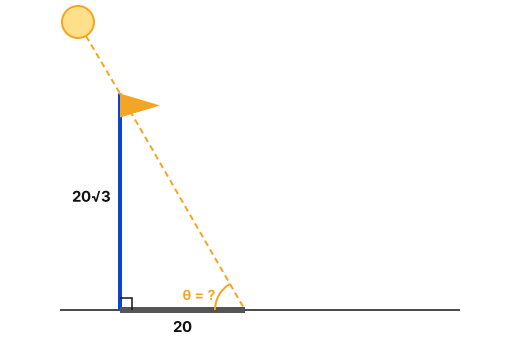
A flagpole has a shadow measuring 20 metres. Given that the height of the flagpole is 203 metres, what is the angle at which the sun is elevated?
एक ध्वजदंड की छाया 20 मीटर है। यदि ध्वजदंड की ऊँचाई 203 मीटर है, तो सूर्य का उन्नयन कोण क्या है?
  1. A45°
  2. B30°
  3. C60°
  4. D90°
Show answer

Concept: tanθ=height÷shadow length.

  1. tanθ=20320=3.
  2. tan60∘=3.
  3. So the sun's angle of elevation = 60°.

Trick: Height : shadow = 3:1→60∘;1:1→45∘;1:3→30∘.

Answer: (C) 60°

अवधारणा: tanθ= ऊँचाई ÷ छाया की लंबाई।

  1. tanθ=20320=3।
  2. tan60∘=3।
  3. अतः सूर्य का उन्नयन कोण = 60°।

ट्रिक: ऊँचाई : छाया = 3:1→60∘;1:1→45∘;1:3→30∘।

उत्तर: (C) 60°

SSC CGLQuantitative AptitudeHeights and distances – angle of elevationSSC CGL 2025 · 17 Sep Shift 1 →
Q2960.
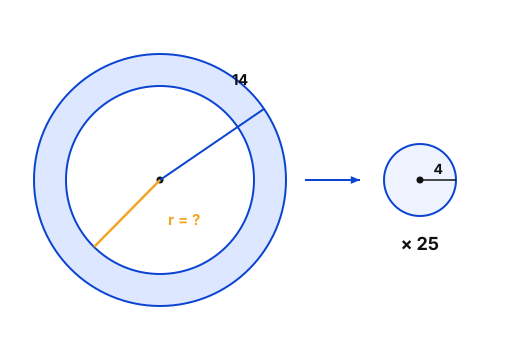
A hollow metallic sphere has outer radius 14 cm and is melted to make 25 smaller solid spheres of radius 4 cm. What is the inner radius of the original sphere?
एक खोखले धात्विक गोले की बाह्य त्रिज्या 14 cm है; उसे पिघलाकर 4 cm त्रिज्या के 25 छोटे ठोस गोले बनाए जाते हैं। मूल गोले की आंतरिक त्रिज्या क्या है?
  1. A10.45 cm
  2. B17.48 cm
  3. C15.46 cm
  4. D16.44 cm
Show answer

Concept: Volume of metal stays the same: 43π(R3−r3)=n×43πa3.

  1. Cancel 43π: 143−r3=25×43.
  2. 2744−r3=25×64=1600→r3=1144.
  3. r=11443≈10.45 cm (since 103=1000 and 113=1331).

Trick: Inner radius must be less than 14 and r3 between 1000 and 1331 – only 10.45 lies between 10 and 11.

Answer: (A) 10.45 cm

अवधारणा: धातु का आयतन नहीं बदलता: 43π(R3−r3)=n×43πa3।

  1. 43π हटाएँ: 143−r3=25×43।
  2. 2744−r3=25×64=1600→r3=1144।
  3. r=11443≈10.45 सेमी (103=1000, 113=1331)।

ट्रिक: आंतरिक त्रिज्या 14 से कम और r3 1000 से 1331 के बीच – केवल 10.45 ही 10 और 11 के बीच है।

उत्तर: (A) 10.45 cm

SSC CGLQuantitative AptitudeMensuration – recasting a hollow sphereSSC CGL 2025 · 17 Sep Shift 1 →