Question bank

Q&A: practice questions with answers

Search questions on any topic. Filter by exam category, exam, subject and topic, try the question, then open the answer and explanation.

Courses – airGurukul

4,800 questions found.

Q3101.
Count consonants between the 1st and 7th letter of EXAMINATION.
EXAMINATION के पहले और सातवें अक्षर के बीच व्यंजनों की संख्या गिनिए।
  1. A3
  2. B4
  3. C5
  4. D6
Show answer

Concept: Only letters strictly between positions 1 and 7 are counted; then remove vowels.

  1. In EXAMINATION, the 7th letter is the second A.
  2. Letters in positions 2 to 6 read X-A-M-I-N.
  3. Remove the vowels (A, I): left with X, M, N → 3 consonants.

Trick: 'Between' means exclude both end letters – count only positions 2 to 6.

Answer: (A) 3

अवधारणा: 1st और 7th अक्षर के 'बीच' वाले अक्षर लें, फिर स्वर हटाएँ।

  1. EXAMINATION में 7वाँ अक्षर दूसरा A है।
  2. स्थान 2 से 6 तक: X-A-M-I-N।
  3. स्वर (A, I) हटाने पर X, M, N बचते हैं → 3 व्यंजन।

ट्रिक: 'बीच में' का मतलब – दोनों सिरे वाले अक्षर नहीं गिने जाते।

उत्तर: (A) 3
SSC CGLGeneral Intelligence & ReasoningCounting consonants in a rangeSSC CGL 2025 · 16 Sep Shift 2 →
Q3102.
Choose the address that is the same as the one given below.
14/B, Silver Oaks Apartment, Linking Road, Mumbai, Maharashtra - 400050
नीचे दिए गए पते के समान पता चुनिए।
14/B, Silver Oaks Apartment, Linking Road, Mumbai, Maharashtra - 400050
  1. A14/B, Silver Oak Apartment, Linking Road, Mumbai, Maharashtra - 400050
  2. B14/B, Silver Oaks Apartments, Linking Road, Mumbai, Maharashtra - 400050
  3. C14/B, Silver Oaks Apartment, Linking Road, Mumbai, Maharashtra - 400050
  4. D41/B, Silver Oaks Apartment, Linking Road, Mumbai, Maharashtra - 400050
Show answer

Concept: Find the option identical to the given address, character by character.

  1. Check the number: (D) has 41/B – rejected.
  2. Check 'Silver Oaks Apartment': (A) writes 'Oak', (B) writes 'Apartments' – rejected.
  3. (C) matches every word, comma and PIN 400050.

Trick: Scan for small changes first – digit swaps and an extra/missing 's' are the usual traps.

Answer: (C) 14/B, Silver Oaks Apartment, Linking Road, Mumbai, Maharashtra - 400050

अवधारणा: दिए गए पते से अक्षर-दर-अक्षर बिल्कुल समान विकल्प चुनें।

  1. (D) में 14/B की जगह 41/B है – गलत।
  2. (A) में 'Oak' और (B) में 'Apartments' लिखा है – गलत।
  3. (C) हर शब्द और PIN 400050 तक पूरा मेल खाता है।

ट्रिक: अंकों की अदला-बदली और 's' का जुड़ना/हटना – यही आम जाल होते हैं।

उत्तर: (C) 14/B, Silver Oaks Apartment, Linking Road, Mumbai, Maharashtra - 400050

SSC CGLGeneral Intelligence & ReasoningAddress matchingSSC CGL 2025 · 16 Sep Shift 2 →
Q3103.
Select the letter-cluster from among the given options that can replace the question mark (?) in the following series:
LGB PJD TMF XPH ?
दी गई शृंखला में प्रश्न चिह्न (?) के स्थान पर आने वाला अक्षर-समूह चुनिए:
LGB PJD TMF XPH ?
  1. AASJ
  2. BATK
  3. CBTJ
  4. DBSJ
Show answer

Concept: Track each letter position separately; each has its own fixed jump.

  1. 1st letters L→P→T→X: +4 each, so X+4 = B (after Z restart at A).
  2. 2nd letters G→J→M→P: +3, so P+3 = S.
  3. 3rd letters B→D→F→H: +2, so H+2 = J.
  4. Next term = BSJ.

Trick: Positional values: X = 24, 24 + 4 = 28 → 28 − 26 = 2 = B.

Answer: (D) BSJ

अवधारणा: हर स्थान के अक्षर को अलग-अलग देखें; हर एक का अपना अंतर है।

  1. पहले अक्षर L→P→T→X: +4, अतः X+4 = B (Z के बाद फिर A से)।
  2. दूसरे अक्षर G→J→M→P: +3, अतः S।
  3. तीसरे अक्षर B→D→F→H: +2, अतः J।
  4. अगला पद = BSJ।

ट्रिक: X = 24; 24 + 4 = 28; 28 − 26 = 2 = B।

उत्तर: (D) BSJ

SSC CGLGeneral Intelligence & ReasoningLetter-cluster seriesSSC CGL 2025 · 16 Sep Shift 2 →
Q3104.
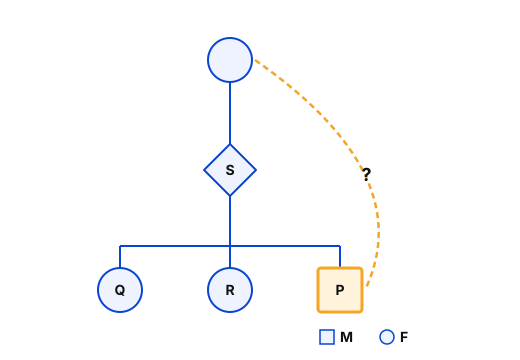
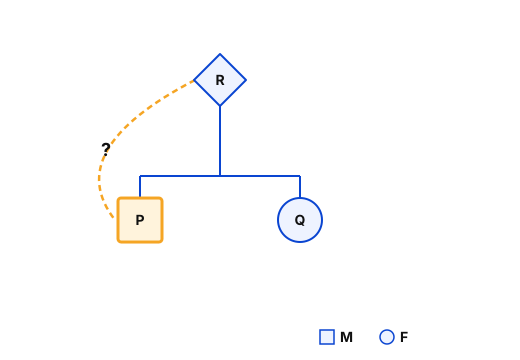
P is the brother of Q. Q is the daughter of R. How is P related to R?
P, Q का भाई है। Q, R की पुत्री है। P का R से क्या संबंध है?
  1. ADaughterपुत्री
  2. BSonपुत्र
  3. CFatherपिता
  4. DBrotherभाई
Show answer

Concept: A brother of someone's child is also that person's child.

  1. Q is R's daughter → R is a parent of Q.
  2. P is Q's brother → P is male and has the same parent R.
  3. So P is R's son.

Trick: Gender of the answer comes from P himself: 'brother' → male → son.

Answer: (B) Son

अवधारणा: किसी के बच्चे का भाई भी उसी का बच्चा होता है।

  1. R की बेटी Q है, अतः R उसका अभिभावक है।
  2. P, Q का भाई है → P पुरुष है और उसका भी माता/पिता R है।
  3. अतः P, R का पुत्र है।

ट्रिक: उत्तर का लिंग P से तय होता है: 'भाई' → पुरुष → पुत्र।

उत्तर: (B) पुत्र

SSC CGLGeneral Intelligence & ReasoningBlood relation – sibling's parentSSC CGL 2025 · 16 Sep Shift 2 →
Q3105.
Q is the sister of P. P is the brother of R. R is the daughter of S. How is P related to S's mother?
Q, P की बहन है। P, R का भाई है। R, S की पुत्री है। P का S की माता से क्या संबंध है?
  1. ADaughterपुत्री
  2. BSisterबहन
  3. CSonपुत्र
  4. DGrandsonपौत्र/नाती
Show answer

Concept: Find P's relation to S first, then go one generation up.

  1. R is S's daughter; P is R's brother → P is S's son.
  2. S's mother is P's grandmother.
  3. A male grandchild = grandson.

Trick: Q is extra information – it does not change the answer.

Answer: (D) Grandson

अवधारणा: पहले P का S से संबंध निकालें, फिर एक पीढ़ी ऊपर जाएँ।

  1. S की बेटी R का भाई P है → P भी S की पुरुष संतान = पुत्र।
  2. S की माँ = P की दादी।
  3. पुरुष पोता = Grandson (पोता)।

ट्रिक: Q वाली जानकारी अनावश्यक है – उत्तर पर असर नहीं।

उत्तर: (D) पौत्र/नाती

SSC CGLGeneral Intelligence & ReasoningBlood relation – grandparentSSC CGL 2025 · 16 Sep Shift 2 →
Q3106.
What comes next:
3, 10, 15, 26, 35, 50, ?
आगे क्या आएगा:
3, 10, 15, 26, 35, 50, ?
  1. A63
  2. B57
  3. C75
  4. D59
Show answer

Concept: Terms sit next to perfect squares, alternately 1 less and 1 more.

  1. 3=22−1,10=32+1,15=42−1,26=52+1.
  2. 35=62−1,50=72+1.
  3. Next: 82−1=64−1=63.

Trick: If terms are close to 4, 9, 16, 25…, check n2±1 immediately.

Answer: (A) 63

अवधारणा: पद पूर्ण वर्गों के पास हैं – बारी-बारी से 1 कम और 1 ज़्यादा।

  1. 3=22−1,10=32+1,15=42−1,26=52+1।
  2. 35=62−1,50=72+1।
  3. अगला: 82−1=63।

ट्रिक: पद 4, 9, 16, 25… के पास हों तो तुरंत n2±1 जाँचें।

उत्तर: (A) 63

SSC CGLGeneral Intelligence & ReasoningNumber series – squares ±1SSC CGL 2025 · 16 Sep Shift 2 →
Q3107.
Choose the group in which all numbers belong to the same category:
वह समूह चुनिए जिसमें सभी संख्याएँ एक ही श्रेणी की हैं:
  1. A1, 3, 5, 7
  2. B2, 5, 8, 11
  3. C4, 9, 16, 25
  4. D6, 10, 14, 18
Show answer

Concept: Pick the group whose numbers share one special property.

  1. 4, 9, 16, 25 = 22,32,42,52 – all perfect squares.
  2. Other groups are only equal-gap sequences (gap 2, 3, 4) with no common special type.
  3. 1, 3, 5, 7 contains 1, which is not prime – not a prime group either.

Trick: Common difference alone is weak; a named property (squares, primes, cubes) wins.

Answer: (C) 4, 9, 16, 25

अवधारणा: वह समूह चुनें जिसकी सभी संख्याओं में एक खास गुण हो।

  1. 4, 9, 16, 25 = 22,32,42,52 – सभी पूर्ण वर्ग।
  2. बाकी समूह केवल समान अंतर वाली संख्याएँ हैं।
  3. 1, 3, 5, 7 में 1 अभाज्य नहीं है।

ट्रिक: केवल समान अंतर कमजोर आधार है; वर्ग/घन/अभाज्य जैसा गुण निर्णायक होता है।

उत्तर: (C) 4, 9, 16, 25

SSC CGLGeneral Intelligence & ReasoningClassification – perfect squaresSSC CGL 2025 · 16 Sep Shift 2 →
Q3108.
What will come at the place of the question mark?
2, 6, 14, 30, 62, ?
प्रश्न चिह्न के स्थान पर क्या आएगा?
2, 6, 14, 30, 62, ?
  1. A126
  2. B128
  3. C130
  4. D132
Show answer

Concept: Each term = previous term × 2 + 2.

  1. 2 → 6 → 14 → 30 → 62 (check 30×2+2=62).
  2. Next = 62×2+2=126.

Trick: Differences 4, 8, 16, 32 double each time → next difference 64; 62+64=126.

Answer: (A) 126

अवधारणा: हर पद = पिछला पद × 2 + 2।

  1. 2 → 6 → 14 → 30 → 62 (30×2+2=62)।
  2. अगला = 62×2+2=126।

ट्रिक: अंतर 4, 8, 16, 32 दोगुने हो रहे हैं → अगला अंतर 64; 62+64=126।

उत्तर: (A) 126

SSC CGLGeneral Intelligence & ReasoningNumber series – ×2 + 2SSC CGL 2025 · 16 Sep Shift 2 →
Q3109.
Identify the assumptions that must hold for the statement to be valid, then choose the correct option.
Statement: To effectively mitigate climate change, a global carbon tax must be implemented immediately across all industrial sectors.
Assumptions:
I. Current voluntary carbon reduction efforts by individual nations are insufficient to achieve significant mitigation.
II. Placing a financial cost on carbon emissions will alter the economic behavior of industrial sectors.
III. The technology for completely carbon-neutral energy production is already universally affordable and deployed.
कथन को वैध बनाने हेतु आवश्यक पूर्वधारणाओं की पहचान कर सही विकल्प चुनिए।
कथन: जलवायु परिवर्तन को प्रभावी रूप से कम करने के लिए सभी औद्योगिक क्षेत्रों में तुरंत वैश्विक कार्बन कर लागू किया जाना चाहिए।
पूर्वधारणाएँ:
I. अलग-अलग देशों के वर्तमान स्वैच्छिक कार्बन-कटौती प्रयास पर्याप्त शमन के लिए अपर्याप्त हैं।
II. कार्बन उत्सर्जन पर वित्तीय लागत लगाने से औद्योगिक क्षेत्रों का आर्थिक व्यवहार बदलेगा।
III. पूर्णतः कार्बन-तटस्थ ऊर्जा उत्पादन की तकनीक पहले से सर्वत्र सस्ती और तैनात है।
  1. AOnly I and II are implicitकेवल I और II अंतर्निहित हैं
  2. BOnly I is implicitकेवल I अंतर्निहित है
  3. CAll are implicitसभी अंतर्निहित हैं
  4. DOnly II and III are implicitकेवल II और III अंतर्निहित हैं
Show answer

Concept: An assumption is what the speaker must take for granted for the advice to make sense.

  1. Calling for a tax 'immediately' implies present voluntary efforts are not enough → I is implicit.
  2. A tax works only if a cost changes how industries behave → II is implicit.
  3. If carbon-neutral energy were already cheap and everywhere, no tax would be needed – III is not assumed.

Trick: Extreme words like 'completely' and 'universally' usually make an assumption invalid.

Answer: (A) Only I and II are implicit

अवधारणा: पूर्वधारणा वह बात है जिसे मानकर ही कथन दिया गया हो।

  1. 'तुरंत' टैक्स की माँग का अर्थ – वर्तमान स्वैच्छिक प्रयास पर्याप्त नहीं → I निहित।
  2. टैक्स तभी असर करेगा जब लागत से उद्योगों का व्यवहार बदले → II निहित।
  3. यदि कार्बन-न्यूट्रल ऊर्जा पहले से सस्ती व हर जगह होती तो टैक्स की ज़रूरत ही न होती → III निहित नहीं।

ट्रिक: 'पूरी तरह', 'सर्वत्र' जैसे चरम शब्द प्रायः पूर्वधारणा को अमान्य कर देते हैं।

उत्तर: (A) केवल I और II अंतर्निहित हैं

SSC CGLGeneral Intelligence & ReasoningStatement and assumptionsSSC CGL 2025 · 16 Sep Shift 2 →
Q3110.
Read the following statement carefully and identify the conclusion that follows.
Statement: The government has made it mandatory for all car manufacturers to install airbags in new vehicles.
Conclusions:
I. All new cars will have airbags.
II. Airbags were not being installed in new cars earlier.
निम्न कथन को ध्यानपूर्वक पढ़कर अनुसरण करने वाला निष्कर्ष पहचानिए।
कथन: सरकार ने सभी कार निर्माताओं के लिए नए वाहनों में एयरबैग लगाना अनिवार्य कर दिया है।
निष्कर्ष:
I. सभी नई कारों में एयरबैग होंगे।
II. पहले नई कारों में एयरबैग नहीं लगाए जा रहे थे।
  1. AOnly Conclusion I followsकेवल निष्कर्ष I अनुसरण करता है
  2. BOnly Conclusion II followsकेवल निष्कर्ष II अनुसरण करता है
  3. CBoth I and II followI और II दोनों अनुसरण करते हैं
  4. DNeither I nor II followsन I न II अनुसरण करता है
Show answer

Concept: A conclusion must follow directly from the statement, not from guesswork about the past.

  1. Airbags are now compulsory for every manufacturer → all new cars will have them: I follows.
  2. The rule says nothing about earlier practice; some makers may already have fitted airbags → II does not follow.

Trick: Statements about the future rule rarely prove anything about the past.

Answer: (A) Only Conclusion I follows

अवधारणा: निष्कर्ष सीधे कथन से निकलना चाहिए, अनुमान से नहीं।

  1. सभी निर्माताओं के लिए एयरबैग अनिवार्य → सभी नई कारों में एयरबैग होंगे: I सही।
  2. पहले क्या होता था, कथन यह नहीं बताता; कई कंपनियाँ पहले से लगा रही होंगी → II नहीं।

ट्रिक: नया नियम भविष्य के बारे में बताता है, अतीत के बारे में कुछ सिद्ध नहीं करता।

उत्तर: (A) केवल निष्कर्ष I अनुसरण करता है

SSC CGLGeneral Intelligence & ReasoningStatement and conclusionsSSC CGL 2025 · 16 Sep Shift 2 →
Q3111.
Arrange the following in chronological order (Based on Age/History):
1. Renaissance Period
2. Ancient Greek Civilization
3. Medieval Period
4. Roman Empire
5. Industrialization Era
निम्न को कालक्रम (आयु/इतिहास के आधार पर) में व्यवस्थित कीजिए:
1. पुनर्जागरण काल
2. प्राचीन यूनानी सभ्यता
3. मध्यकाल
4. रोमन साम्राज्य
5. औद्योगीकरण युग
  1. A2, 4, 3, 1, 5
  2. B2, 4, 1, 3, 5
  3. C5, 1, 4, 2, 3
  4. D2, 5, 3, 1, 4
Show answer

Concept: Arrange the historical periods from oldest to latest.

  1. Ancient Greece (from c. 8th century BCE) is earliest, then the Roman Empire (27 BCE–476 CE).
  2. After Rome's fall: Medieval Period (c. 5th–15th century).
  3. Then Renaissance (c. 14th–17th century), and finally Industrialization (from mid-18th century) → 2, 4, 3, 1, 5.

Trick: Only (A) and (B) start 2, 4; Medieval must come before Renaissance ('rebirth' after the Middle Ages) → (A).

Answer: (A) 2, 4, 3, 1, 5

अवधारणा: ऐतिहासिक कालों को सबसे पुराने से नवीनतम क्रम में रखें।

  1. प्राचीन यूनानी सभ्यता सबसे पहले, फिर रोमन साम्राज्य (27 ई.पू.–476 ई.)।
  2. रोम के पतन के बाद मध्यकाल (लगभग 5वीं–15वीं सदी)।
  3. फिर पुनर्जागरण (14वीं–17वीं सदी) और अंत में औद्योगीकरण (18वीं सदी से) → 2, 4, 3, 1, 5।

ट्रिक: Renaissance = मध्यकाल के बाद 'पुनर्जन्म', इसलिए 3 हमेशा 1 से पहले।

उत्तर: (A) 2, 4, 3, 1, 5

SSC CGLGeneral Intelligence & ReasoningChronological order of erasSSC CGL 2025 · 16 Sep Shift 2 →
Q3112.
Choose the correct option to complete the series.
Scalpel : Incise :: Microscope : ?
शृंखला पूरी करने हेतु सही विकल्प चुनिए।
Scalpel : Incise :: Microscope : ?
  1. AResearch
  2. BEnlarge
  3. CDiscover
  4. DAnalyze
Show answer

Concept: Pair each instrument with the direct action it performs.

  1. Scalpel (surgical knife) → incise (cut).
  2. Microscope → enlarge (magnify) small objects.
  3. Research, discover, analyze are human goals, not the instrument's own action.

Trick: Ask 'what does the tool physically do?' – the answer is a verb of action.

Answer: (B) Enlarge

अवधारणा: उपकरण को उसके प्रत्यक्ष कार्य से जोड़ें।

  1. Scalpel (शल्य चाकू) → Incise (चीरा लगाना)।
  2. Microscope → Enlarge (वस्तु को बड़ा दिखाना)।
  3. Research, Discover, Analyze मनुष्य के उद्देश्य हैं, उपकरण का कार्य नहीं।

ट्रिक: पूछें – 'उपकरण खुद क्या करता है?' – उत्तर एक क्रिया होगा।

उत्तर: (B) Enlarge

SSC CGLGeneral Intelligence & ReasoningAnalogy – tool and its actionSSC CGL 2025 · 16 Sep Shift 2 →
Q3113.
Find the word that does not fit in the series:
Tranquil, Serene, Turbulent, Calm, Peaceful
वह शब्द चुनिए जो शृंखला में फिट नहीं बैठता:
Tranquil, Serene, Turbulent, Calm, Peaceful
  1. ASerene
  2. BTranquil
  3. CPeaceful
  4. DTurbulent
Show answer

Concept: Four words share a meaning; the odd one has the opposite sense.

  1. Tranquil, Serene, Calm, Peaceful = quiet, undisturbed.
  2. Turbulent = stormy, full of disorder – an antonym of the rest.

Trick: When four words are synonyms, the antonym is the odd one.

Answer: (D) Turbulent

अवधारणा: चार शब्दों का अर्थ एक जैसा है; विषम शब्द का अर्थ उल्टा है।

  1. Tranquil, Serene, Calm, Peaceful = शांत, स्थिर।
  2. Turbulent = उथल-पुथल वाला, अशांत – बाकी का विलोम।

ट्रिक: चार समानार्थी हों तो विलोम शब्द ही विषम होता है।

उत्तर: (D) Turbulent

SSC CGLGeneral Intelligence & ReasoningOdd word – meaningSSC CGL 2025 · 16 Sep Shift 2 →
Q3114.
Find the unit that does not fit in the series:
Meter, Gram, Second, Ampere, Candela
वह इकाई चुनिए जो शृंखला में फिट नहीं बैठती:
Meter, Gram, Second, Ampere, Candela
  1. AMeter
  2. BGram
  3. CSecond
  4. DAmpere
Show answer

Concept: Identify which is not one of the seven SI base units.

  1. Metre (length), second (time), ampere (current), candela (luminous intensity) are SI base units.
  2. The base unit of mass is the kilogram; gram is only 11000 of it.

Yaad rakhein: 7 base units: m, kg, s, A, K, mol, cd – 'kg' is the only base unit with a prefix.

Answer: (B) Gram

अवधारणा: सात SI मूल इकाइयों में जो नहीं है, उसे पहचानें।

  1. मीटर (लंबाई), सेकंड (समय), एम्पियर (धारा), कैंडेला (ज्योति-तीव्रता) – मूल इकाइयाँ।
  2. द्रव्यमान की मूल इकाई किलोग्राम है; ग्राम उसका 11000 भाग है।

याद रखें: 7 मूल इकाइयाँ: m, kg, s, A, K, mol, cd – केवल kg में उपसर्ग (kilo) लगा है।

उत्तर: (B) Gram

SSC CGLGeneral Intelligence & ReasoningSI base unitsSSC CGL 2025 · 16 Sep Shift 2 →
Q3115.
In each of the following questions, a specific rearrangement of letters has been applied to the first word to form the second. Apply the same rearrangement pattern to the third word and choose the correct answer from the given options.
COMPUTER : OCPMTURE :: GENERATE : ?
पहले शब्द पर अक्षरों का एक विशेष पुनर्विन्यास लागू कर दूसरा शब्द बनाया गया है। वही पैटर्न तीसरे शब्द पर लगाकर सही उत्तर चुनिए।
COMPUTER : OCPMTURE :: GENERATE : ?
  1. AEGRANEET
  2. BETARENEG
  3. CEGENARET
  4. DEGNEARET
Show answer

Concept: Break the word into pairs of two letters and reverse each pair.

  1. COMPUTER → CO|MP|UT|ER → OC|PM|TU|RE = OCPMTURE ✓
  2. GENERATE → GE|NE|RA|TE.
  3. Swap each: EG|EN|AR|ET = EGENARET.

Trick: Answer must start 'EG' and end 'ET' – only (C) fits.

Answer: (C) EGENARET

अवधारणा: शब्द को दो-दो अक्षरों के जोड़ों में बाँटकर हर जोड़ा उलट दें।

  1. COMPUTER → CO|MP|UT|ER → OC|PM|TU|RE ✓
  2. GENERATE → GE|NE|RA|TE।
  3. उलटने पर: EG|EN|AR|ET = EGENARET।

ट्रिक: उत्तर 'EG' से शुरू और 'ET' पर खत्म होना चाहिए – केवल (C)।

उत्तर: (C) EGENARET

SSC CGLGeneral Intelligence & ReasoningLetter rearrangement – pair swapSSC CGL 2025 · 16 Sep Shift 2 →
Q3116.
In each of the following questions, a word is transformed into a combination of letters and numbers following a specific pattern. Analyze the transformation used in the first pair and apply the same rule to find the missing term in the second pair.
HUNT : 159U :: JUMP : ?
एक शब्द को एक विशेष पैटर्न से अक्षरों-अंकों के संयोजन में बदला गया है। पहले युग्म का रूपांतरण समझकर वही नियम दूसरे युग्म पर लगाइए।
HUNT : 159U :: JUMP : ?
  1. AK58Q
  2. BK76P
  3. CK95T
  4. DK52Q
Show answer

Concept: End letters shift forward and middle letters get number codes; similar letters get related numbers.

  1. HUNT: last letter T → U (+1); so in JUMP, P → Q and J → K (as all options start with K).
  2. Middle letters: U → 5, N → 9.
  3. JUMP has U (code 5) and M, which is just before N → 9 − 1 = 8.
  4. Code = K58Q.

Trick: Eliminate fast: last letter must be Q (A, D) and U must stay 5 → only K58Q.

Answer: (A) K58Q

अवधारणा: सिरे के अक्षर आगे खिसकते हैं, बीच के अक्षरों को अंक मिलते हैं।

  1. HUNT में अंतिम T → U (+1); अतः JUMP में P → Q और J → K (सभी विकल्प K से शुरू)।
  2. बीच के अक्षर: U → 5, N → 9।
  3. JUMP में U (कोड 5) और M है, जो N से ठीक पहले है → 9 − 1 = 8।
  4. कोड = K58Q।

ट्रिक: अंतिम अक्षर Q होना चाहिए (A, D) और U = 5 रहना चाहिए → केवल K58Q।

उत्तर: (A) K58Q

SSC CGLGeneral Intelligence & ReasoningLetter–number codingSSC CGL 2025 · 16 Sep Shift 2 →
Q3117.
Which of these words will come last in a dictionary?
इनमें से कौन-सा शब्द शब्दकोश में सबसे अंत में आएगा?
  1. Atravel
  2. Btrap
  3. Ctractor
  4. Dtrace
Show answer

Concept: Compare letters left to right until they differ.

  1. All begin with 'tra'; 4th letters: trace (c), tractor (c), trap (p), travel (v).
  2. v is latest in the alphabet → travel comes last.
  3. Order: trace, tractor, trap, travel.

Trick: Find the first position where words differ – the largest letter there is last.

Answer: (A) travel

अवधारणा: बाएँ से दाएँ अक्षरों की तुलना करें, जब तक अंतर न मिले।

  1. सभी 'tra' से शुरू; चौथा अक्षर: trace (c), tractor (c), trap (p), travel (v)।
  2. v वर्णमाला में सबसे बाद → travel अंतिम।
  3. क्रम: trace, tractor, trap, travel।

ट्रिक: पहला अलग अक्षर देखें – जिसका अक्षर सबसे बाद आए, वह अंतिम।

उत्तर: (A) travel

SSC CGLGeneral Intelligence & ReasoningDictionary orderSSC CGL 2025 · 16 Sep Shift 2 →
Q3118.
Comprehension:
In a certain number system there are only two notations to represent numbers: # and $. 0 is represented by # and 1 by $. The subsequent numbers are represented in the following manner: 2 is represented as $#, 3 is represented as $$, 4 is represented as $##, 5 is represented as $#$ and so on.
How will you represent 241 in the given number system?
बोध:
एक संख्या-प्रणाली में संख्याएँ दर्शाने हेतु केवल दो संकेत हैं: # और $। 0 को # से और 1 को $ से दर्शाया जाता है। आगे की संख्याएँ इस प्रकार हैं: 2 = $#, 3 = $$, 4 = $##, 5 = $#$ इत्यादि।
इस प्रणाली में 241 को कैसे दर्शाएँगे?
  1. A$##$#$##
  2. B$#$#$#$#
  3. C$#$##$$$
  4. D$$$$###$
Show answer

Concept: # = 0 and $ = 1, so the system is plain binary.

  1. 241 = 128 + 64 + 32 + 16 + 1.
  2. Binary: 1111 0001.
  3. Replace 1 → $, 0 → #: $$$$###$.

Trick: 241 = 255 − 14; 255 is eight 1s, removing 8, 4, 2 gives 11110001.

Answer: (D) $$$$###$

अवधारणा: # = 0 और $ = 1, यानी यह साधारण बाइनरी है।

  1. 241 = 128 + 64 + 32 + 16 + 1।
  2. बाइनरी: 1111 0001।
  3. 1 → $, 0 → #: $$$$###$।

ट्रिक: 241 = 255 − 14; 255 = आठ 1, उसमें से 8, 4, 2 हटाने पर 11110001।

उत्तर: (D) $$$$###$

SSC CGLGeneral Intelligence & ReasoningBinary coding with symbolsSSC CGL 2025 · 16 Sep Shift 2 →
Q3119.
Find the odd one out from the given alternatives.
दिए गए विकल्पों में से असंगत चुनिए।
  1. ASaturnशनि
  2. BVenusशुक्र
  3. CJupiterबृहस्पति
  4. DMoonचंद्रमा
Show answer

Concept: Group by what the body orbits.

  1. Saturn, Venus, Jupiter are planets revolving around the Sun.
  2. The Moon is Earth's natural satellite – it revolves around a planet.

Yaad rakhein: Venus and Mercury are the only planets with no moon at all.

Answer: (D) Moon

अवधारणा: पिंड किसकी परिक्रमा करता है, इस आधार पर वर्गीकरण करें।

  1. शनि, शुक्र, बृहस्पति – सूर्य की परिक्रमा करने वाले ग्रह।
  2. चंद्रमा पृथ्वी का प्राकृतिक उपग्रह है – यह ग्रह की परिक्रमा करता है।

याद रखें: शुक्र और बुध – इन दोनों ग्रहों का कोई उपग्रह नहीं है।

उत्तर: (D) चंद्रमा

SSC CGLGeneral Intelligence & ReasoningOdd one out – celestial bodiesSSC CGL 2025 · 16 Sep Shift 2 →
Q3120.
In a certain code language, FROGS is written as HTQIU. How is VAPOR written in that code?
एक कूट भाषा में FROGS को HTQIU लिखा जाता है। उसी कूट में VAPOR कैसे लिखा जाएगा?
  1. AXCRQT
  2. BXCQRT
  3. CXCPRT
  4. DXCQTS
Show answer

Concept: Each letter is moved a fixed number of places forward.

  1. F→H, R→T, O→Q, G→I, S→U: every letter +2.
  2. VAPOR: V→X, A→C, P→R, O→Q, R→T.
  3. Code = XCRQT.

Trick: Check just the 3rd letter: P + 2 = R → only (A) has R there.

Answer: (A) XCRQT

अवधारणा: हर अक्षर निश्चित स्थान आगे खिसकता है।

  1. F→H, R→T, O→Q, G→I, S→U: हर अक्षर +2।
  2. VAPOR: V→X, A→C, P→R, O→Q, R→T।
  3. कोड = XCRQT।

ट्रिक: केवल तीसरा अक्षर देखें: P + 2 = R → केवल (A) में।

उत्तर: (A) XCRQT

SSC CGLGeneral Intelligence & ReasoningCoding – fixed shiftSSC CGL 2025 · 16 Sep Shift 2 →