Question bank

Q&A: practice questions with answers

Search questions on any topic. Filter by exam category, exam, subject and topic, try the question, then open the answer and explanation.

Courses – airGurukul

4,800 questions found.

Q3201.
Sentence: "Reflections are clearer in calm waters." If each letter is mirrored using alphabetical symmetry (A↔Z, B↔Y…), what is the 4th letter of the 3rd word after mirroring?
वाक्य: "Reflections are clearer in calm waters." यदि हर अक्षर को वर्णमाला-समरूपता (A↔Z, B↔Y…) से प्रतिबिंबित किया जाए, तो प्रतिबिंबन के बाद तीसरे शब्द का चौथा अक्षर क्या होगा?
  1. Ac
  2. BW
  3. Cx
  4. Dz
Show answer

Concept: Opposite-letter pairs: a letter at position n pairs with the letter at position 27 − n.

  1. Third word of the sentence = clearer.
  2. Its letters: c, l, e, a … → 4th letter is a (position 1).
  3. Opposite of position 1 = 27 − 1 = 26 → z.

Trick: Remember pairs with sum 27: A–Z, B–Y, C–X … just subtract from 27.

Answer: (D) z

अवधारणा: विपरीत अक्षर: n वें स्थान का अक्षर (27 − n) वें स्थान वाले अक्षर से जुड़ता है।

  1. वाक्य का तीसरा शब्द = clearer।
  2. इसके अक्षर c, l, e, a → चौथा अक्षर a (स्थान 1)।
  3. 27 − 1 = 26 → z।

ट्रिक: जोड़ी का योग हमेशा 27 होता है: A–Z, B–Y, C–X; बस 27 में से घटाइए।

उत्तर: (D) z
SSC CGLGeneral Intelligence & ReasoningOpposite letters – word in a sentenceSSC CGL 2025 · 16 Sep Shift 1 →
Q3202.
Choose the address that is exactly the same as the one given below.
Flat 203, Sapphire building, Garia Station Rd., Kolkata, West Bengal - 600084
नीचे दिए गए पते के बिल्कुल समान पता चुनिए।
Flat 203, Sapphire building, Garia Station Rd., Kolkata, West Bengal - 600084
  1. AFlat 203, Saphire building, Garia Station Rd., Kolkata, West Bengal - 600084
  2. BFlat 203, Sapphire building, Garia Station Rd., Kolkata, West Bengal - 600084
  3. CFlat 203, Sapphire building, Gariya Station Rd., Kolkata, West Bengal - 600084
  4. DFlat 203, Sapphire building, Garia Station Road, Kolkata, West Bengal - 600084
Show answer

Concept: Compare the given address with each option piece by piece.

  1. (A) spells 'Saphire' – one p missing.
  2. (C) has 'Gariya' instead of 'Garia'.
  3. (D) expands 'Rd.' to 'Road'.
  4. (B) matches every word, digit and dot.

Trick: Scan names and abbreviations first – most changes hide in spellings, not in the PIN code here.

Answer: (B) Flat 203, Sapphire building, Garia Station Rd., Kolkata, West Bengal - 600084

अवधारणा: दिए गए पते को हर विकल्प से शब्द-दर-शब्द मिलाइए।

  1. (A) में 'Saphire' – एक p कम है।
  2. (C) में 'Garia' की जगह 'Gariya' है।
  3. (D) में 'Rd.' को 'Road' लिखा है।
  4. (B) हर शब्द, अंक और बिंदु में समान है।

ट्रिक: पहले नाम की वर्तनी और संक्षिप्त रूप देखिए – ज़्यादातर अंतर वहीं छिपे होते हैं।

उत्तर: (B) Flat 203, Sapphire building, Garia Station Rd., Kolkata, West Bengal - 600084

SSC CGLGeneral Intelligence & ReasoningAddress comparisonSSC CGL 2025 · 16 Sep Shift 1 →
Q3203.
Which of the following alternative will fill the blanks?
s_u_sg_b_gu_
निम्न में से कौन-सा विकल्प रिक्त स्थान भरेगा?
s_u_sg_b_gu_
  1. Ag, b, u, s, b
  2. Bg, b, u, b, s
  3. Cb, u, u, b, s
  4. Db, b, u, s, g
Show answer

Concept: The 12-letter string is one 4-letter group written three times.

  1. Visible letters suggest the group s _ u _.
  2. Put g, b, u, s, b in order: sgub sgub sgub.
  3. Result: sgub | sgub | sgub ✓

Trick: Length 12 → try blocks of 3 or 4; the first block usually reveals the pattern.

Answer: (A) g, b, u, s, b

अवधारणा: 12 अक्षरों की श्रृंखला एक ही 4-अक्षरी समूह की तीन बार पुनरावृत्ति है।

  1. दिखते अक्षरों से समूह s _ u _ बनता है।
  2. g, b, u, s, b भरने पर: sgub sgub sgub।
  3. परिणाम: sgub | sgub | sgub ✓

ट्रिक: कुल अक्षर 12 हों तो 3 या 4 के खंड बनाकर देखें; पहला खंड ही पैटर्न बता देता है।

उत्तर: (A) g, b, u, s, b

SSC CGLGeneral Intelligence & ReasoningMissing letters – repeating groupSSC CGL 2025 · 16 Sep Shift 1 →
Q3204.
Select the letter-cluster from among the given options that can replace the question mark (?) in the following series:
TBDF, THMR, TNVD, TTEP, ?
दी गई शृंखला में प्रश्न चिह्न (?) के स्थान पर आने वाला अक्षर-समूह चुनिए:
TBDF, THMR, TNVD, TTEP, ?
  1. ATZMB
  2. BTZNC
  3. CTZNB
  4. DTYNB
Show answer

Concept: Track each letter position separately; each moves by a fixed jump (wrap after Z).

  1. 1st letter: always T.
  2. 2nd: B(2)→H(8)→N(14)→T(20) : +6 → 26 = Z.
  3. 3rd: D(4)→M(13)→V(22)→E(31−26=5) : +9 → 14 = N.
  4. 4th: F(6)→R(18)→D(30−26=4)→P(16) : +12 → 28−26 = 2 = B. So TZNB.

Trick: After 2nd letter is fixed as Z, only TZNC and TZNB remain; +12 on P gives B, not C.

Answer: (C) TZNB

अवधारणा: हर स्थान के अक्षर को अलग से देखिए; हर एक निश्चित अंतर से बढ़ता है (Z के बाद फिर A)।

  1. पहला अक्षर: हमेशा T।
  2. दूसरा: B(2)→H(8)→N(14)→T(20) : +6 → 26 = Z।
  3. तीसरा: D→M→V→E : +9 → 14 = N।
  4. चौथा: F→R→D→P : +12 → 28 − 26 = 2 = B। अतः TZNB।

ट्रिक: दूसरा अक्षर Z तय होते ही केवल TZNC और TZNB बचते हैं; P + 12 = B, इसलिए TZNB।

उत्तर: (C) TZNB

SSC CGLGeneral Intelligence & ReasoningLetter-cluster series – position jumpsSSC CGL 2025 · 16 Sep Shift 1 →
Q3205.
If 'A' denotes 'addition', 'C' denotes 'multiplication', 'B' denotes 'division', and 'D' denotes 'subtraction', then what will be the value of the following expression?
3.2 A (0.56 B 1.4 C 4) D 4 C 5 B 20 A 5
यदि 'A' का अर्थ 'जोड़', 'C' का अर्थ 'गुणा', 'B' का अर्थ 'भाग' और 'D' का अर्थ 'घटाव' है, तो निम्न व्यंजक का मान क्या होगा?
3.2 A (0.56 B 1.4 C 4) D 4 C 5 B 20 A 5
  1. A5.9
  2. B8.8
  3. C8.3
  4. D7.8
Show answer

Concept: Swap each letter for its sign, then solve using BODMAS.

  1. Decode: A → +, B → ÷, C → ×, D → −.
  2. Inside the bracket: 0.561.4 is 0.4, and four times that is 1.6.
  3. Middle part: 4 times 5 is 20, divided by 20 leaves 1.
  4. Add up: 3.2+1.6+5=9.8, minus 1 → 8.8.

Trick: 0.56÷1.4=56÷140=25 – drop decimals by scaling both numbers.

Answer: (B) 8.8

अवधारणा: हर अक्षर की जगह उसका चिह्न रखकर BODMAS से हल कीजिए।

  1. कूट खोलें: A → +, B → ÷, C → ×, D → −।
  2. कोष्ठक में: 0.561.4 का मान 0.4, उसका चार गुना 1.6।
  3. बीच का भाग: 4 गुणा 5 बराबर 20, उसे 20 से भाग देने पर 1।
  4. जोड़ें: 3.2+1.6+5=9.8, उसमें से 1 घटाकर 8.8।

ट्रिक: 0.56÷1.4=56÷140=25 – दोनों को 100 से गुणा कर दशमलव हटाइए।

उत्तर: (B) 8.8

SSC CGLGeneral Intelligence & ReasoningCoded operations – BODMASSSC CGL 2025 · 16 Sep Shift 1 →
Q3206.
Find the odd one out:
असंगत चुनिए:
  1. AC@3C
  2. BE@5E
  3. CF@5F
  4. DG@7G
Show answer

Concept: In each term the middle number should equal the alphabet position of the letter.

  1. C = 3 → C@3C ✓
  2. E = 5 → E@5E ✓; G = 7 → G@7G ✓
  3. F = 6, but written 5 → F@5F breaks the rule.

Trick: EJOTY: E5, J10, O15, T20, Y25 – F is just after E, so it is 6.

Answer: (C) F@5F

अवधारणा: हर पद में बीच की संख्या अक्षर के वर्णमाला-स्थान के बराबर होनी चाहिए।

  1. C = 3 → C@3C ✓
  2. E = 5 ✓; G = 7 ✓
  3. F = 6 है, पर 5 लिखा है → F@5F नियम तोड़ता है।

ट्रिक: EJOTY याद रखें: E5, J10, O15, T20, Y25 – F, E के ठीक बाद है, अतः 6।

उत्तर: (C) F@5F

SSC CGLGeneral Intelligence & ReasoningOdd one out – letter and its positionSSC CGL 2025 · 16 Sep Shift 1 →
Q3207.
What will come at the place of question mark?
3, 7, 15, 31, 63, ?
प्रश्न चिह्न के स्थान पर क्या आएगा?
3, 7, 15, 31, 63, ?
  1. A117
  2. B127
  3. C137
  4. D107
Show answer

Concept: Each term is twice the previous term plus 1 (terms are 2n−1).

  1. 3 → 7 → 15 → 31 → 63: each = 2 × previous + 1.
  2. Next = 2×63+1=127.

Trick: Terms are one less than powers of 2: 4, 8, 16, 32, 64, 128 → 128−1=127.

Answer: (B) 127

अवधारणा: हर पद = पिछला पद × 2 + 1 (पद 2n−1 रूप के हैं)।

  1. 3 → 7 → 15 → 31 → 63: हर पद = 2 × पिछला + 1।
  2. अगला = 2×63+1=127।

ट्रिक: पद 2 की घातों से 1 कम हैं: 4, 8, 16, 32, 64, 128 → 128−1=127।

उत्तर: (B) 127

SSC CGLGeneral Intelligence & ReasoningNumber series – double plus oneSSC CGL 2025 · 16 Sep Shift 1 →
Q3208.
Identify the assumptions that must hold for the statement to be valid, then choose the correct option.
Statement: The use of electric vehicles (EVs) in cities can significantly reduce air pollution and dependence on fossil fuels.
Assumptions:
I. Electric vehicles produce less pollution compared to petrol or diesel vehicles.
II. A major part of urban air pollution is caused by conventional fuel-based vehicles.
III. The production of electricity for EVs does not involve any pollution.
कथन को वैध बनाने हेतु आवश्यक पूर्वधारणाओं की पहचान कर सही विकल्प चुनिए।
कथन: शहरों में विद्युत वाहनों (EVs) का उपयोग वायु प्रदूषण और जीवाश्म ईंधन पर निर्भरता को उल्लेखनीय रूप से घटा सकता है।
पूर्वधारणाएँ:
I. विद्युत वाहन पेट्रोल/डीज़ल वाहनों की तुलना में कम प्रदूषण करते हैं।
II. शहरी वायु प्रदूषण का बड़ा हिस्सा पारंपरिक ईंधन वाले वाहनों से होता है।
III. EVs के लिए बिजली उत्पादन में कोई प्रदूषण नहीं होता।
  1. AOnly I and II are implicitकेवल I और II अंतर्निहित हैं
  2. BOnly II and III are implicitकेवल II और III अंतर्निहित हैं
  3. COnly I is Implicitकेवल I अंतर्निहित है
  4. DAll I, II and III are implicitI, II और III सभी अंतर्निहित हैं
Show answer

Concept: An assumption is what the speaker must take for granted for the claim to make sense.

  1. Claim 'EVs reduce pollution' needs EVs to be cleaner than petrol/diesel cars → I is assumed.
  2. 'Significantly reduce' needs vehicles to be a big source of city pollution → II is assumed.
  3. III is extreme ('does not involve any pollution'); the claim works even if power plants pollute somewhat → not assumed.

Trick: Words like 'any', 'only', 'never' in an assumption usually make it non-implicit.

Answer: (A) Only I and II are implicit

अवधारणा: पूर्वधारणा वह बात है जिसे माने बिना कथन का अर्थ ही नहीं बनता।

  1. 'EV प्रदूषण घटाते हैं' – तभी संभव जब EV पेट्रोल/डीज़ल वाहनों से कम प्रदूषण करें → I निहित।
  2. 'काफ़ी कमी' – तभी जब शहरी प्रदूषण का बड़ा हिस्सा वाहनों से हो → II निहित।
  3. III अतिवादी है ('कोई प्रदूषण नहीं'); बिजली बनने में कुछ प्रदूषण हो तब भी कथन सही रहता है → निहित नहीं।

ट्रिक: पूर्वधारणा में 'कोई भी', 'केवल', 'कभी नहीं' जैसे शब्द हों तो वह प्रायः निहित नहीं होती।

उत्तर: (A) केवल I और II अंतर्निहित हैं

SSC CGLGeneral Intelligence & ReasoningStatement and assumptionsSSC CGL 2025 · 16 Sep Shift 1 →
Q3209.
Read the following statement carefully and identify the conclusion that follows.
Statement: The city recorded its highest rainfall in the last 30 years.
Conclusions:
I. The city’s drainage system might have failed.
II. Such heavy rainfall happens regularly.
निम्न कथन को ध्यानपूर्वक पढ़कर अनुसरण करने वाला निष्कर्ष पहचानिए।
कथन: शहर ने पिछले 30 वर्षों की सर्वाधिक वर्षा दर्ज की।
निष्कर्ष:
I. शहर की जल-निकासी प्रणाली विफल हो सकती है।
II. ऐसी भारी वर्षा नियमित रूप से होती है।
  1. AOnly Conclusion I followsकेवल निष्कर्ष I अनुसरण करता है
  2. BOnly Conclusion II followsकेवल निष्कर्ष II अनुसरण करता है
  3. CBoth I and II followI और II दोनों अनुसरण करते हैं
  4. DNeither I nor II followsन I न II अनुसरण करता है
Show answer

Concept: A conclusion follows only if it is a reasonable, non-contradicting inference from the statement.

  1. Record rainfall can overload drains; 'might have failed' is a cautious, logical inference → I follows.
  2. 'Highest in 30 years' means such rain is rare → II ('happens regularly') goes against the statement.

Trick: Soft words like 'might/may' make a conclusion easier to accept; a conclusion that contradicts the data never follows.

Answer: (A) Only Conclusion I follows

अवधारणा: निष्कर्ष तभी निकलता है जब वह कथन से तर्कसंगत रूप से निकले और उसका विरोध न करे।

  1. रिकॉर्ड वर्षा से नालियाँ भर सकती हैं; 'might have failed' सावधानी भरा, तर्कसंगत अनुमान है → I सही।
  2. '30 साल में सबसे अधिक' का अर्थ है ऐसी वर्षा दुर्लभ है → II ('नियमित होती है') कथन के विपरीत है।

ट्रिक: 'might/may' वाले निष्कर्ष आसानी से मान्य होते हैं; जो निष्कर्ष तथ्य के विपरीत हो वह कभी नहीं निकलता।

उत्तर: (A) केवल निष्कर्ष I अनुसरण करता है

SSC CGLGeneral Intelligence & ReasoningStatement and conclusionsSSC CGL 2025 · 16 Sep Shift 1 →
Q3210.
How many meaningful four-letter English words can be formed using the first, third, fourth and sixth letters of the word "PLANET" (when counted from left to right), using each letter only once in each word?
शब्द "PLANET" के पहले, तीसरे, चौथे और छठे अक्षरों (बाएँ से दाएँ) से, प्रत्येक अक्षर का एक बार प्रयोग करते हुए, कितने सार्थक चार-अक्षरी अंग्रेजी शब्द बन सकते हैं?
  1. AOneएक
  2. BTwoदो
  3. CThreeतीन
  4. DFourचार
Show answer

Concept: Pick the letters at the asked positions, then look for meaningful four-letter words.

  1. P-L-A-N-E-T → 1st P, 3rd A, 4th N, 6th T.
  2. Letters available: P, A, N, T.
  3. Only one meaningful word can be formed: PANT.

Trick: With one vowel (A) fixed in the middle, try each consonant pair around it – only P_NT works.

Answer: (A) One

अवधारणा: पूछे गए स्थानों के अक्षर लेकर चार-अक्षरी सार्थक शब्द खोजिए।

  1. P-L-A-N-E-T → पहला P, तीसरा A, चौथा N, छठा T।
  2. उपलब्ध अक्षर: P, A, N, T।
  3. केवल एक सार्थक शब्द बनता है: PANT।

ट्रिक: एकमात्र स्वर A को बीच में रखकर व्यंजनों के जोड़े जाँचें – केवल PANT बनता है।

उत्तर: (A) एक

SSC CGLGeneral Intelligence & ReasoningWord formation from chosen lettersSSC CGL 2025 · 16 Sep Shift 1 →
Q3211.
In the following question, a pair of letters is given, followed by its corresponding product of alphabetical positions (A=1, B=2, …, Z=26). A second pair of letters is given without its product. Identify the correct product for the second pair that maintains the same relationship as the first.
M × O : 13 × 15 :: G × I : ?
नीचे अक्षरों का एक युग्म उसके वर्णमाला-स्थानों के गुणनफल (A=1, B=2, …, Z=26) सहित दिया गया है। दूसरे युग्म के लिए वही संबंध बनाए रखने वाला सही गुणनफल पहचानिए।
M × O : 13 × 15 :: G × I : ?
  1. A7 × 9
  2. B5 × 9
  3. C6 × 10
  4. D7 × 8
Show answer

Concept: Each letter is replaced by its position in the alphabet; the × sign stays.

  1. M = 13, O = 15 → 13 × 15 ✓
  2. G = 7, I = 9.
  3. So G × I → 7 × 9.

Trick: G and I are 2 apart, just like M and O – the numbers must also differ by 2; only 7 × 9 does.

Answer: (A) 7 × 9

अवधारणा: हर अक्षर की जगह उसका वर्णमाला-स्थान लिखा जाता है; × चिह्न वैसा ही रहता है।

  1. M = 13, O = 15 → 13 × 15 ✓
  2. G = 7, I = 9।
  3. अतः G × I → 7 × 9।

ट्रिक: G और I में 2 का अंतर है (M, O जैसा) – संख्याओं में भी 2 का अंतर चाहिए; केवल 7 × 9 सही बैठता है।

उत्तर: (A) 7 × 9

SSC CGLGeneral Intelligence & ReasoningLetter pair to place-value productSSC CGL 2025 · 16 Sep Shift 1 →
Q3212.
Complete the series.
A1, Z2, Y3, X4, ?
शृंखला पूरी कीजिए।
A1, Z2, Y3, X4, ?
  1. AW5
  2. BV4
  3. CU5
  4. DX5
Show answer

Concept: Letters move backward from Z after the first term; numbers rise by 1.

  1. Letters: A, Z, Y, X → next W (one step back).
  2. Numbers: 1, 2, 3, 4 → next 5.
  3. Term = W5.

Trick: A then Z = wrap-around: think of the alphabet as a circle running backward.

Answer: (A) W5

अवधारणा: पहले पद के बाद अक्षर Z से उल्टे क्रम में चलते हैं; संख्या 1-1 बढ़ती है।

  1. अक्षर: A, Z, Y, X → अगला W।
  2. संख्या: 1, 2, 3, 4 → अगली 5।
  3. पद = W5।

ट्रिक: A के बाद Z – वर्णमाला को उल्टी दिशा वाला वृत्त मानिए।

उत्तर: (A) W5

SSC CGLGeneral Intelligence & ReasoningAlpha-numeric seriesSSC CGL 2025 · 16 Sep Shift 1 →
Q3213.
Find the odd one out from the given alternatives:
दिए गए विकल्पों में से असंगत चुनिए:
  1. AArticle 15अनुच्छेद 15
  2. BArticle 16अनुच्छेद 16
  3. CArticle 18अनुच्छेद 18
  4. DArticle 352अनुच्छेद 352
Show answer

Concept: Group the articles by the Part of the Constitution they belong to.

  1. Art. 15 (no discrimination), 16 (equal opportunity in public jobs), 18 (abolition of titles) – all Right to Equality, Part III.
  2. Art. 352 – proclamation of National Emergency, Part XVIII.
  3. So Article 352 is the odd one.

Yaad rakhein: Right to Equality = Articles 14–18; Emergency provisions = Articles 352–360.

Answer: (D) Article 352

अवधारणा: अनुच्छेदों को संविधान के भाग के अनुसार समूहित कीजिए।

  1. अनु. 15 (भेदभाव निषेध), 16 (सरकारी नौकरी में समान अवसर), 18 (उपाधियों का अंत) – सभी समानता का अधिकार, भाग III।
  2. अनु. 352 – राष्ट्रीय आपातकाल, भाग XVIII।
  3. अतः अनुच्छेद 352 विषम है।

याद रखें: समानता का अधिकार = अनुच्छेद 14–18; आपात उपबंध = अनुच्छेद 352–360।

उत्तर: (D) अनुच्छेद 352

SSC CGLGeneral Intelligence & ReasoningOdd one out – Constitution articlesSSC CGL 2025 · 16 Sep Shift 1 →
Q3214.
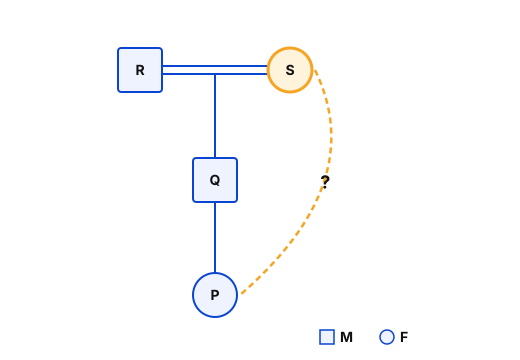
P is the daughter of Q. Q is the son of R. S is the wife of R. How is S related to P?
P, Q की पुत्री है। Q, R का पुत्र है। S, R की पत्नी है। S का P से क्या संबंध है?
  1. AAuntचाची/मौसी
  2. BMotherमाता
  3. CGrandmotherदादी
  4. DSisterबहन
Show answer

Concept: Place each person in a generation and connect them.

  1. R and S are husband–wife; Q is their son.
  2. P is Q's daughter → one generation below Q.
  3. S is the mother of P's father → paternal grandmother.

Trick: Count generations: S is two levels above P and female → grandmother.

Answer: (C) Grandmother

अवधारणा: हर व्यक्ति को उसकी पीढ़ी में रखकर जोड़िए।

  1. R और S पति-पत्नी; Q उनका पुत्र।
  2. P, Q की पुत्री → Q से एक पीढ़ी नीचे।
  3. S, P के पिता की माँ → दादी (Grandmother)।

ट्रिक: पीढ़ी गिनें: S, P से दो पीढ़ी ऊपर और स्त्री → दादी।

उत्तर: (C) दादी

SSC CGLGeneral Intelligence & ReasoningBlood relation – three generationsSSC CGL 2025 · 16 Sep Shift 1 →
Q3215.
If 4 + 5 = 29 and 3 + 6 = 27, what is 1 + 6 = ?
यदि 4 + 5 = 29 और 3 + 6 = 27 है, तो 1 + 6 = ?
  1. A14
  2. B13
  3. C10
  4. D12
Show answer

Concept: Find the hidden rule that turns a + b into the given result.

  1. 4 + 5: 4×5 = 20, 4+5 = 9 → 29 ✓
  2. 3 + 6: 18 + 9 = 27 ✓
  3. 1 + 6: 6 + 7 = 13.

Trick: ab+a+b=(a+1)(b+1)−1→(2)(7)−1=13.

Answer: (B) 13

अवधारणा: a + b को दिए परिणाम में बदलने वाला छिपा नियम खोजिए।

  1. 4 + 5: 4×5 = 20, 4+5 = 9 → 29 ✓
  2. 3 + 6: 18 + 9 = 27 ✓
  3. 1 + 6: 6 + 7 = 13।

ट्रिक: ab+a+b=(a+1)(b+1)−1→2×7−1=13।

उत्तर: (B) 13

SSC CGLGeneral Intelligence & ReasoningNumber puzzle – product plus sumSSC CGL 2025 · 16 Sep Shift 1 →
Q3216.
In a certain code language, each letter is assigned a unique digit. Based on the given codes for specific words, determine the code for the target word using the same logic.
If TQFFE is coded as 83551 and DPPM is coded as 9226, then how will TDPPQ be coded?
एक कूट भाषा में हर अक्षर को एक विशिष्ट अंक दिया गया है। दिए गए कूटों के आधार पर लक्ष्य शब्द का कूट ज्ञात कीजिए।
यदि TQFFE का कूट 83551 और DPPM का कूट 9226 है, तो TDPPQ का कूट क्या होगा?
  1. A89231
  2. B89726
  3. C89223
  4. D83927
Show answer

Concept: Each letter has one fixed digit; read the digits from the given words in order.

  1. Match letter by position in the first word: E = 1, F = 5, Q = 3, T = 8.
  2. From the second word: M = 6, P = 2, D = 9.
  3. Reading T-D-P-P-Q with these digits gives 89223.

Trick: TDPPQ ends in Q = 3 and has a repeated P (22) – only 89223 fits both.

Answer: (C) 89223

अवधारणा: हर अक्षर का एक निश्चित अंक है; दिए शब्दों से क्रम से अंक पढ़िए।

  1. पहले शब्द से स्थान-अनुसार: E = 1, F = 5, Q = 3, T = 8।
  2. दूसरे शब्द से: M = 6, P = 2, D = 9।
  3. T-D-P-P-Q को इन अंकों से पढ़ने पर 89223।

ट्रिक: अंत में Q = 3 और बीच में PP = 22 – केवल 89223 दोनों शर्तें पूरी करता है।

उत्तर: (C) 89223

SSC CGLGeneral Intelligence & ReasoningLetter-to-digit codingSSC CGL 2025 · 16 Sep Shift 1 →
Q3217.
If 5 ∗ 3 = 34 and 6 ∗ 4 = 52, what is 7 ∗ 2?
यदि 5 ∗ 3 = 34 और 6 ∗ 4 = 52 है, तो 7 ∗ 2 क्या है?
  1. A58
  2. B45
  3. C53
  4. D50
Show answer

Concept: The result is the sum of the squares of the two numbers.

  1. 5 ∗ 3: squares are 25 and 9, total 34 ✓
  2. 6 ∗ 4: squares are 36 and 16, total 52 ✓
  3. 7 ∗ 2: squares are 49 and 4, total 53.

Trick: Results 34 and 52 are not products/sums – near-square numbers hint at a2+b2.

Answer: (C) 53

अवधारणा: परिणाम दोनों संख्याओं के वर्गों का योग है।

  1. 52+32=34 ✓
  2. 62+42=52 ✓
  3. 72+22=49+4=53।

ट्रिक: 34, 52 जैसे परिणाम वर्ग संख्याओं के पास हों तो a2+b2 आज़माइए।

उत्तर: (C) 53

SSC CGLGeneral Intelligence & ReasoningNumber puzzle – sum of squaresSSC CGL 2025 · 16 Sep Shift 1 →
Q3218.
If 'READ' is coded as T2#3, and 'DEAR' is coded as 32#T, then what is the code for 'DARE'?
यदि 'READ' का कूट T2#3 और 'DEAR' का कूट 32#T है, तो 'DARE' का कूट क्या होगा?
  1. A3#T2
  2. BT#23
  3. C#32T
  4. D#32Y
Show answer

Concept: Same letters, same codes – the code only reorders with the word.

  1. Pair READ with T2#3 letter by letter: D = 3, A = #, R = T, E = 2.
  2. DEAR gives 32#T with the same pairs – rule confirmed.
  3. DARE is simply D, A, R, E in that order → 3#T2.

Trick: DARE starts with D (3) – only option (A) begins with 3.

Answer: (A) 3#T2

अवधारणा: अक्षर वही तो कोड वही – शब्द बदलने पर केवल क्रम बदलता है।

  1. READ और T2#3 को अक्षर-दर-अक्षर मिलाएँ: D = 3, A = #, R = T, E = 2।
  2. DEAR का कोड 32#T भी यही जोड़ियाँ देता है।
  3. DARE का क्रम D, A, R, E है → 3#T2।

ट्रिक: DARE, D (= 3) से शुरू होता है – केवल विकल्प (A) 3 से शुरू है।

उत्तर: (A) 3#T2

SSC CGLGeneral Intelligence & ReasoningLetter-symbol codingSSC CGL 2025 · 16 Sep Shift 1 →
Q3219.
What is the average of 5 consecutive odd numbers starting from 11?
11 से शुरू होने वाली 5 क्रमागत विषम संख्याओं का औसत क्या है?
  1. A17
  2. B15
  3. C20
  4. D25
Show answer

Concept: For numbers in equal steps, average = middle term.

  1. Numbers: 11, 13, 15, 17, 19.
  2. Middle (3rd) term = 15.
  3. Check: sum 75÷5=15.

Trick: Average = first +(n−1)=11+4=15 for consecutive odd numbers.

Answer: (B) 15

अवधारणा: समान अंतर वाली संख्याओं का औसत = बीच वाला पद।

  1. संख्याएँ: 11, 13, 15, 17, 19।
  2. बीच का (तीसरा) पद = 15।
  3. जाँच: योग 75÷5=15।

ट्रिक: क्रमागत विषम संख्याओं का औसत = पहला पद +(n−1)=11+4=15।

उत्तर: (B) 15

SSC CGLGeneral Intelligence & ReasoningAverage of consecutive odd numbersSSC CGL 2025 · 16 Sep Shift 1 →
Q3220.
If the given symbols mean:
'+' means 'divided by', '−' means 'multiplied by', '×' means 'minus', '÷' means 'plus'
Then, find the value of the following expression: 30×5÷32+16−2 = ?
यदि दिए गए प्रतीकों का अर्थ है:
'+' का अर्थ 'भाग', '−' का अर्थ 'गुणा', '×' का अर्थ 'घटाव', '÷' का अर्थ 'जोड़'
तो निम्न व्यंजक का मान ज्ञात कीजिए: 30×5÷32+16−2 = ?
  1. A59
  2. B27
  3. C29
  4. D36
Show answer

Concept: Replace every symbol as told, then apply BODMAS.

  1. 30 × 5 ÷ 32 + 16 − 2 → 30 − 5 + 32 ÷ 16 × 2.
  2. 32 ÷ 16 = 2; 2 × 2 = 4.
  3. 30 − 5 + 4 = 29.

Trick: Rewrite the whole line first – changing signs mid-calculation causes most errors.

Answer: (C) 29

अवधारणा: हर चिह्न को बताए अनुसार बदलकर BODMAS लगाइए।

  1. 30 × 5 ÷ 32 + 16 − 2 → 30 − 5 + 32 ÷ 16 × 2।
  2. 32 ÷ 16 = 2; 2 × 2 = 4।
  3. 30 − 5 + 4 = 29।

ट्रिक: पहले पूरा व्यंजक नए चिह्नों से दोबारा लिखिए, फिर गणना कीजिए।

उत्तर: (C) 29

SSC CGLGeneral Intelligence & ReasoningSymbol substitution – BODMASSSC CGL 2025 · 16 Sep Shift 1 →