Question bank

Q&A: practice questions with answers

Search questions on any topic. Filter by exam category, exam, subject and topic, try the question, then open the answer and explanation.

Courses – airGurukul

4,800 questions found.

Q3361.
A stationery shop owner buys three types of pencils. The first type costs him 10 pencils for ₹20, the second 3 pencils for ₹9, and the third 9 pencils for ₹45. He mixes them in the ratio 3 : 4 : 3. If he sells all the pencils at 4 for ₹21, what is his approximate gain or loss percentage?
एक दुकानदार तीन प्रकार की पेंसिलें खरीदता है: पहली 10 पेंसिल ₹20 में, दूसरी 3 पेंसिल ₹9 में, तीसरी 9 पेंसिल ₹45 में। वह उन्हें 3 : 4 : 3 के अनुपात में मिलाता है। यदि वह सारी पेंसिलें 4 के ₹21 की दर से बेचता है, तो अनुमानित लाभ/हानि प्रतिशत क्या है?
  1. ALoss of 59.09%59.09% हानि
  2. BProfit of 59.09%59.09% लाभ
  3. CProfit of 60%60% लाभ
  4. DLoss of 60%60% हानि
Show answer

Concept: Find cost per pencil of each type, take a batch in the given ratio, compare SP and CP.

  1. Cost per pencil: 2010= ₹2, 93= ₹3, 459= ₹5.
  2. Batch of 10 (3 : 4 : 3): CP = 6+12+15= ₹33.
  3. SP = 10×214= ₹52.50 → profit = 19.50.
  4. Profit% = 19.533×100≈ 59.09%.

Trick: SP per pencil (₹5.25) is far above average CP (₹3.30) → it must be a profit; 60% is the rounded trap.

Answer: (B) Profit of 59.09%

अवधारणा: हर प्रकार की एक पेंसिल का CP निकालें, अनुपात में एक बैच लें, फिर SP और CP मिलाएँ।

  1. प्रति पेंसिल CP: ₹2, ₹3, ₹5
  2. 10 पेंसिल (3 : 4 : 3): CP = 6+12+15= ₹33
  3. SP = 10×214= ₹52.50 → लाभ 19.50
  4. लाभ% = 19.533×100≈ 59.09%

ट्रिक: प्रति पेंसिल SP ₹5.25 > औसत CP ₹3.30 → लाभ निश्चित; 60% केवल गोल किया हुआ जाल है।

उत्तर: (B) 59.09% लाभ
SSC CGLQuantitative AptitudeProfit & loss – mixing itemsSSC CGL 2025 · 15 Sep Shift 3 →
Q3362.
A seller bought three different types of mobile covers, M1, M2, and M3. The ratio of their selling prices was 3 : 4 : 5. He made a profit of 25% on M1, 10% on M2, but incurred a loss of 20% on M3. What was his approximate percent gain or loss in the entire transaction?
एक विक्रेता ने तीन प्रकार के मोबाइल कवर M1, M2 और M3 खरीदे। उनके विक्रय मूल्यों का अनुपात 3 : 4 : 5 था। उसे M1 पर 25% लाभ, M2 पर 10% लाभ, परंतु M3 पर 20% हानि हुई। पूरे सौदे में उसका अनुमानित लाभ/हानि प्रतिशत क्या रहा?
  1. Aprofit of 3.3%3.3% लाभ
  2. Bloss of 2.3%2.3% हानि
  3. Closs of 2.6%2.6% हानि
  4. Dprofit of 3.6%3.6% लाभ
Show answer

Concept: When selling prices are given, work backwards to each cost price: CP=SP÷(1±r%).

  1. SPs: 3, 4, 5 (total 12).
  2. CPs: 31.25=2.4; 41.1≈3.636; 50.8=6.25 → total ≈ 12.286.
  3. Loss = 0.286 → 0.28612.286×100≈ 2.3% loss.

Trick: The 20% loss sits on the biggest SP (5), so expect an overall loss – drop both profit options first.

Answer: (B) loss of 2.3%

अवधारणा: जब विक्रय मूल्य दिए हों, तो हर वस्तु का CP उल्टा निकालें: CP=SP÷(1±r%)।

  1. SP: 3, 4, 5 (कुल 12)
  2. CP: 31.25=2.4; 41.1≈3.636; 50.8=6.25 → कुल ≈ 12.286
  3. हानि = 0.286 → 0.28612.286×100≈ 2.3%

ट्रिक: 20% हानि सबसे बड़े SP (5) पर है, अतः कुल हानि होगी – लाभ वाले विकल्प हटाएँ।

उत्तर: (B) 2.3% हानि

SSC CGLQuantitative AptitudeProfit & loss – overall % from SP ratioSSC CGL 2025 · 15 Sep Shift 3 →
Q3363.
A high-end watch is initially marked up by 60% above its cost price. During a sale, it is offered at a discount of 25% on its marked price. However, a special customer receives an additional discount of y% on the discounted price, bringing the final selling price to ₹6480. If the shopkeeper still makes a profit of 8% on the cost price, find the cost price and y.
एक महँगी घड़ी पर पहले क्रय मूल्य से 60% अधिक अंकित किया जाता है। सेल में अंकित मूल्य पर 25% छूट दी जाती है। एक विशेष ग्राहक को छूट वाली कीमत पर y% अतिरिक्त छूट मिलती है, जिससे अंतिम विक्रय मूल्य ₹6480 हो जाता है। यदि दुकानदार को फिर भी क्रय मूल्य पर 8% लाभ होता है, तो क्रय मूल्य और y ज्ञात कीजिए।
  1. ACP = ₹6000, y = 10%
  2. BCP = ₹6500, y = 5%
  3. CCP = ₹6800, y = 12.5%
  4. DCP = ₹6000, y = 8%
Show answer

Concept: Use the final profit to get CP, then the price chain to get the extra discount.

  1. 1.08×CP=6,480 → CP = ₹6,000.
  2. After markup and 25% off: 6,000×1.6×0.75= ₹7,200.
  3. 7,200 → 6,480 is a drop of 720 = 10% → y = 10.

Trick: 6,480÷1.08=6,000 rules out B and C; then 6,4807,200=0.9 picks y = 10%.

Answer: (A) CP = ₹6000, y = 10%

अवधारणा: अंतिम लाभ से CP निकालें, फिर मूल्य-श्रृंखला से अतिरिक्त छूट।

  1. 1.08×CP=6,480 → CP = ₹6,000
  2. 60% बढ़ोतरी और 25% छूट के बाद: 6,000×1.6×0.75= ₹7,200
  3. 7,200 से 6,480 = 720 की कमी = 10% → y = 10

ट्रिक: CP = 6,000 से B, C हटते हैं; 6,4807,200=0.9 → y = 10%।

उत्तर: (A) CP = ₹6000, y = 10%

SSC CGLQuantitative AptitudeMarked price – successive discountsSSC CGL 2025 · 15 Sep Shift 3 →
Q3364.
Vinay and Ram can complete a task in 12 days and 18 days, respectively. They begin the work together, but Ram leaves after 4 days. How many more days will Vinay take to finish the remaining work?
विनय और राम किसी कार्य को क्रमशः 12 और 18 दिनों में पूरा कर सकते हैं। वे साथ काम शुरू करते हैं, पर राम 4 दिन बाद छोड़ देता है। शेष कार्य पूरा करने में विनय को और कितने दिन लगेंगे?
  1. A513 days513 दिन
  2. B234 days234 दिन
  3. C115 days115 दिन
  4. D867 days867 दिन
Show answer

Concept: Take total work as LCM of the days; find work done together, then the rest alone.

  1. Total = LCM(12,18)=36 units; Vinay 3/day, Ram 2/day.
  2. 4 days together: 4×5=20 units → left 16 units.
  3. Vinay alone: 16÷3= 513 days.

Trick: Remaining work 16 is not a multiple of 3 → the answer must be a fraction with denominator 3.

Answer: (A) 513 days

अवधारणा: कुल कार्य = दिनों का LCM; पहले साथ का कार्य, फिर शेष अकेले।

  1. कुल = LCM(12,18)=36 इकाई; विनय 3/दिन, राम 2/दिन
  2. 4 दिन साथ: 4×5=20 → शेष 16
  3. विनय अकेले: 16÷3= 513 दिन

ट्रिक: शेष 16, 3 का गुणज नहीं → उत्तर का हर 3 होगा।

उत्तर: (A) 513 दिन

SSC CGLQuantitative AptitudeTime & work – one person leavesSSC CGL 2025 · 15 Sep Shift 3 →
Q3365.
A shopkeeper mixes two qualities of Rice. The first quality costs ₹150 per kg and is mixed with the second quality in the ratio 4 : 5. If the mixture is sold at ₹130 per kg (at no profit, no loss), what is the cost per kg of the second quality of Rice?
एक दुकानदार दो किस्मों के चावल मिलाता है। पहली किस्म ₹150 प्रति किग्रा की है और उसे दूसरी किस्म के साथ 4 : 5 के अनुपात में मिलाया जाता है। यदि मिश्रण ₹130 प्रति किग्रा (बिना लाभ-हानि) बेचा जाता है, तो दूसरी किस्म का प्रति किग्रा मूल्य क्या है?
  1. A₹100
  2. B₹110
  3. C₹114
  4. D₹120
Show answer

Concept: No profit, no loss → selling price = cost of mixture (₹130/kg).

  1. Take 4 kg at ₹150 and 5 kg at ₹x: 600+5x=9×130=1,170.
  2. 5x=570→x= ₹114.

Trick: Alligation: (150−130):(130−x)=5:4→130−x=16→x=114.

Answer: (C) ₹114

अवधारणा: न लाभ न हानि → बिक्री मूल्य = मिश्रण का लागत मूल्य (₹130/kg)।

  1. 4 kg ₹150 वाला + 5 kg ₹x वाला: 600+5x=9×130=1,170
  2. 5x=570→x= ₹114

ट्रिक: एलीगेशन: (150−130):(130−x)=5:4→130−x=16→114।

उत्तर: (C) ₹114

SSC CGLQuantitative AptitudeMixture – price of second varietySSC CGL 2025 · 15 Sep Shift 3 →
Q3366.
A and B can complete a certain task together in 20 days. After A works for 10 days, B is left to finish the remaining work by himself in 30 days. How many days would it take for B to complete the entire task on his own?
A और B साथ मिलकर एक कार्य 20 दिनों में पूरा करते हैं। A के 10 दिन काम करने के बाद शेष कार्य B अकेले 30 दिनों में पूरा करता है। पूरा कार्य अकेले करने में B को कितने दिन लगेंगे?
  1. A40 days40 दिन
  2. B50 days50 दिन
  3. C60 days60 दिन
  4. D70 days70 दिन
Show answer

Concept: Together they need 20 days; compare the actual split with that.

  1. A works 10 days alone instead of 20 → 10 A-days short.
  2. B works 30 days instead of 20 → 10 extra B-days cover it.
  3. So 10 A-days = 10 B-days → A = B; each alone = 2×20= 40 days.

Trick: Check: rates a+b=120,10a+30b=1→20b=12→b=140.

Answer: (A) 40 days

अवधारणा: साथ में 20 दिन लगते हैं; वास्तविक बँटवारे की उससे तुलना करें।

  1. A ने 20 के बजाय 10 दिन काम किया → 10 A-दिन कम
  2. B ने 20 के बजाय 30 दिन → 10 अतिरिक्त B-दिन
  3. 10 A-दिन = 10 B-दिन → A = B; B अकेले = 2×20= 40 दिन

ट्रिक: जाँच: a+b=120,10a+30b=1→20b=12→b=140।

उत्तर: (A) 40 दिन

SSC CGLQuantitative AptitudeTime & work – compare daysSSC CGL 2025 · 15 Sep Shift 3 →
Q3367.
A container holds a mixture of Mango, Apple, and Pomegranate juices in the ratio of 5 : 7 : 4 respectively. 24 litres of this mixture is taken out, and then 10 litres of Mango juice and 6 litres of Pomegranate juice are added to the vessel. If the resultant quantity of apple juice is 14 litres more than the resultant quantity of Mango juice, what was the total initial quantity (in litres)?
एक पात्र में आम, सेब और अनार के रस 5 : 7 : 4 के अनुपात में हैं। 24 लीटर मिश्रण निकालकर 10 लीटर आम रस और 6 लीटर अनार रस मिलाया जाता है। यदि परिणामी सेब रस, परिणामी आम रस से 14 लीटर अधिक है, तो प्रारंभिक कुल मात्रा (लीटर में) क्या थी?
  1. A216
  2. B210
  3. C214
  4. D235
Show answer

Concept: Removing some mixture keeps the ratio; added liquid changes only its own component.

  1. Let remaining mixture = R litres (ratio 5 : 7 : 4, 16 parts).
  2. Apple − Mango = 7R16−(5R16+10)=14→2R16=24→R=192.
  3. Initial = 192+24= 216 litres.

Trick: Initial quantity must be a multiple of 16 after adding 24 back – 216−24=192=16×12 ✓.

Answer: (A) 216

अवधारणा: मिश्रण निकालने पर अनुपात वही रहता है; जो द्रव मिलाया जाए केवल वही घटक बढ़ता है।

  1. शेष मिश्रण = R लीटर (5 : 7 : 4, कुल 16 भाग)
  2. सेब − आम = 7R16−(5R16+10)=14→2R16=24→R=192
  3. प्रारंभिक = 192+24= 216 लीटर

ट्रिक: 216−24=192, जो 16 से विभाज्य है – पुष्टि।

उत्तर: (A) 216

SSC CGLQuantitative AptitudeMixture – removal and additionSSC CGL 2025 · 15 Sep Shift 3 →
Q3368.
A delivery van travels at a constant speed of 84 km/h to cover a certain route in 1 hour and 45 minutes. If traffic increases the time taken by 15 minutes, by what percentage must the van's average speed decrease to complete the route?
एक डिलीवरी वैन 84 km/h की चाल से एक मार्ग 1 घंटे 45 मिनट में तय करती है। यदि यातायात के कारण समय 15 मिनट बढ़ जाए, तो मार्ग पूरा करने के लिए औसत चाल कितने प्रतिशत घटानी होगी?
  1. A12.5%
  2. B16.25%
  3. C15%
  4. D20%
Show answer

Concept: For fixed distance, speed ∝1time.

  1. Time changes from 105 min to 120 min → ratio 7 : 8.
  2. Speed ratio = 8 : 7 → new speed = 84×78=73.5 km/h.
  3. Decrease = 18= 12.5%.

Trick: Time up by 17 → speed down by 17+1=18=12.5%.

Answer: (A) 12.5%

अवधारणा: दूरी स्थिर हो तो चाल ∝ 1/समय।

  1. समय 105 मिनट से 120 मिनट → अनुपात 7 : 8
  2. चाल अनुपात 8 : 7 → नई चाल = 84×78=73.5 km/h
  3. कमी = 18= 12.5%

ट्रिक: समय 17 बढ़े तो चाल 18 घटती है = 12.5%।

उत्तर: (A) 12.5%

SSC CGLQuantitative AptitudeSpeed – percentage changeSSC CGL 2025 · 15 Sep Shift 3 →
Q3369.
A student walks from his home to school at a speed of 6 km/h and reaches 15 minutes late. If he increases his speed to 8 km/h, he reaches 5 minutes early. What is the distance (in km) from his home to school?
एक विद्यार्थी 6 km/h की चाल से विद्यालय जाता है और 15 मिनट देर से पहुँचता है। चाल 8 km/h करने पर वह 5 मिनट पहले पहुँच जाता है। घर से विद्यालय की दूरी (km में) क्या है?
  1. A4 km
  2. B6 km
  3. C8 km
  4. D10 km
Show answer

Concept: The gap between the two arrival times equals the difference of the two travel times.

  1. Gap = 15+5=20 min =13 h.
  2. d6−d8=13→d24=13.
  3. d = 8 km.

Trick: Distance = S1×S2S2−S1× time gap =482×13=8.

Answer: (C) 8 km

अवधारणा: दोनों पहुँचने के समयों का अंतर = दोनों यात्रा-समयों का अंतर।

  1. अंतर = 15+5=20 मिनट =13 घंटा
  2. d6−d8=13→d24=13
  3. d = 8 km

ट्रिक: दूरी = S1×S2S2−S1× समय-अंतर =24×13=8।

उत्तर: (C) 8 km

SSC CGLQuantitative AptitudeSpeed – late and earlySSC CGL 2025 · 15 Sep Shift 3 →
Q3370.
The cost of building a wall around a circular field at the rate of ₹120 per metre is ₹3,768. Find the diameter of the field.
एक वृत्ताकार मैदान के चारों ओर ₹120 प्रति मीटर की दर से दीवार बनाने की लागत ₹3,768 है। मैदान का व्यास ज्ञात कीजिए।
  1. A5 m
  2. B10 m
  3. C15 m
  4. D20 m
Show answer

Concept: Wall length = circumference =πd.

  1. Length = 3,768÷120=31.4 m.
  2. πd=31.4→d=31.4÷3.14= 10 m.

Trick: 31.4 is 10×3.14 – read the diameter directly.

Answer: (B) 10 m

अवधारणा: दीवार की लंबाई = परिधि =πd।

  1. लंबाई = 3,768÷120=31.4 m
  2. πd=31.4→d=31.4÷3.14= 10 m

ट्रिक: 31.4 = 10×3.14 – व्यास सीधे 10।

उत्तर: (B) 10 m

SSC CGLQuantitative AptitudeMensuration – circumference from costSSC CGL 2025 · 15 Sep Shift 3 →
Q3371.
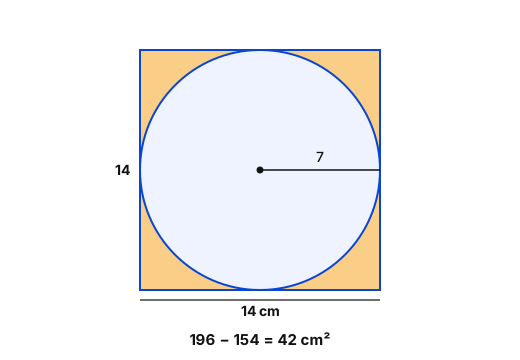
A circular logo of radius 7 cm is fitted perfectly inside a square plaque. Find the area of unused square space around the circle.
7 cm त्रिज्या का एक वृत्ताकार लोगो एक वर्गाकार पट्टिका के भीतर पूर्णतः फिट है। वृत्त के चारों ओर बचे वर्ग-भाग का क्षेत्रफल ज्ञात कीजिए।
  1. A42 cm²
  2. B48 cm²
  3. C50.54 cm²
  4. D55 cm²
Show answer

Concept: A circle fitting exactly in a square has diameter = side.

  1. Side = 14 cm → square = 196 cm².
  2. Circle = 227×7×7=154 cm².
  3. Unused = 196−154= 42 cm².

Trick: Unused area = (314)×side2=314×196=42 (true for any inscribed circle with π=227).

Answer: (A) 42 cm²

अवधारणा: वर्ग में ठीक फिट वृत्त का व्यास = वर्ग की भुजा।

  1. भुजा = 14 cm → वर्ग = 196 cm²
  2. वृत्त = 227×7×7=154 cm²
  3. खाली भाग = 196−154= 42 cm²

ट्रिक: खाली क्षेत्र = (314)× भुजा² =42 (π=227 पर)।

उत्तर: (A) 42 cm²

SSC CGLQuantitative AptitudeMensuration – circle inside squareSSC CGL 2025 · 15 Sep Shift 3 →
Q3372.
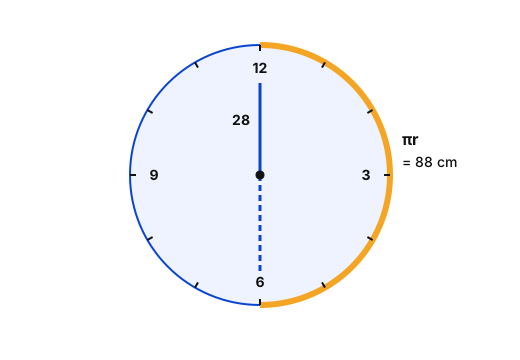
A circular clock has a radius of 28 cm. Calculate the distance covered by the tip of the minute hand in 30 minutes, assuming it is positioned at the edge of the clock face. (Use π = 227)
एक वृत्ताकार घड़ी की त्रिज्या 28 cm है। यदि मिनट की सुई का सिरा घड़ी के किनारे पर हो, तो 30 मिनट में वह कितनी दूरी तय करेगा? (π = 227 लीजिए)
  1. A88 cm
  2. B84 cm
  3. C82 cm
  4. D44 cm
Show answer

Concept: In 60 minutes the minute hand tip traces the full circle; in 30 minutes, half.

  1. Half circumference =πr.
  2. =227×28= 88 cm.

Trick: r = 28 is a multiple of 7 → πr=22×4=88 instantly.

Answer: (A) 88 cm

अवधारणा: 60 मिनट में मिनट की सुई पूरा वृत्त, 30 मिनट में आधा वृत्त बनाती है।

  1. आधी परिधि =πr
  2. =227×28= 88 cm

ट्रिक: 28, 7 का गुणज → πr=22×4=88।

उत्तर: (A) 88 cm

SSC CGLQuantitative AptitudeCircle – arc traced by clock handSSC CGL 2025 · 15 Sep Shift 3 →
Q3373.
What is the slope of the line perpendicular to y = −5x + 2?
y = −5x + 2 के लंबवत रेखा की प्रवणता क्या है?
  1. A−15
  2. B5
  3. C15
  4. D−5
Show answer

Concept: For perpendicular lines, m1×m2=−1.

  1. y=−5x+2 has slope m1=−5.
  2. m2=−1÷(−5)= 15.

Trick: Perpendicular slope = negative reciprocal: flip the number and change its sign.

Answer: (C) 15

अवधारणा: लंब रेखाओं के लिए m1×m2=−1।

  1. y=−5x+2 की ढाल m1=−5
  2. m2=−1÷(−5)= 15

ट्रिक: लंब ढाल = ऋणात्मक व्युत्क्रम: संख्या उलटें और चिह्न बदलें।

उत्तर: (C) 15

SSC CGLQuantitative AptitudeCoordinate geometry – perpendicular slopeSSC CGL 2025 · 15 Sep Shift 3 →
Q3374.
Given, x − 1x = 4, find the value of x⁴ + 1x⁴.
दिया है, x − 1x = 4, तो x⁴ + 1x⁴ का मान ज्ञात कीजिए।
  1. A322
  2. B318
  3. C320
  4. D325
Show answer

Concept: Square step by step: (x−1x)2=x2+1x2−2, and (x2+1x2)2=x4+1x4+2.

  1. x2+1x2=42+2=18.
  2. x4+1x4=182−2=324−2= 322.

Trick: Chain: k→k2+2→(k2+2)2−2. For k=4: 18→322.

Answer: (A) 322

अवधारणा: क्रम से वर्ग करें: (x−1x)2=x2+1x2−2 और (x2+1x2)2=x4+1x4+2।

  1. x2+1x2=16+2=18
  2. x4+1x4=182−2=324−2= 322

ट्रिक: श्रृंखला: k→k2+2→(k2+2)2−2; k=4 पर 18→322।

उत्तर: (A) 322

SSC CGLQuantitative AptitudeAlgebra – x⁴ + 1/x⁴SSC CGL 2025 · 15 Sep Shift 3 →
Q3375.
2.5% of 100 = ?
100 का 2.5% = ?
  1. A6
  2. B2
  3. C3
  4. D2.5
Show answer

Concept: “Per cent” means “out of 100”.

  1. 2.5% of 100 =2.5100×100.
  2. = 2.5.

Trick: x% of 100 is always x itself – no calculation needed.

Answer: (D) 2.5

अवधारणा: “प्रतिशत” का अर्थ है “100 में से”।

  1. 100 का 2.5% =2.5100×100
  2. = 2.5

ट्रिक: 100 का x% हमेशा x ही होता है।

उत्तर: (D) 2.5

SSC CGLQuantitative AptitudePercentage – basicSSC CGL 2025 · 15 Sep Shift 3 →
Q3376.
Select the idiom that means: To neglect a major crisis by focusing on trivial matters.
  1. AFiddle while Rome burns
  2. BBark up the wrong tree
  3. CBurn the midnight oil
  4. DHit the nail on the head
Show answer

Concept: Match the idiom whose meaning is “wasting time on small things while disaster strikes”.

  1. Fiddle while Rome burns – stay busy with trifles during an emergency (from the story of Emperor Nero).
  2. Bark up the wrong tree – blame or chase the wrong thing.
  3. Burn the midnight oil – study/work late; Hit the nail on the head – say exactly the right thing.

Trick: “Burns” + “fiddle” (play music) = careless amusement amid disaster – the picture explains the meaning.

Answer: (A) Fiddle while Rome burns

अवधारणा: उस मुहावरे को चुनें जिसका अर्थ है – बड़े संकट के समय छोटी बातों में उलझे रहना।

  1. Fiddle while Rome burns – संकट में तुच्छ कामों में लगे रहना (सम्राट नीरो की कथा से)।
  2. Bark up the wrong tree – गलत दिशा में प्रयास/गलत व्यक्ति पर दोष।
  3. Burn the midnight oil – देर रात तक मेहनत; Hit the nail on the head – बिल्कुल सही बात कहना।

ट्रिक: रोम जल रहा है और राजा वाद्य बजा रहा है – यही चित्र अर्थ समझा देता है।

उत्तर: (A) Fiddle while Rome burns

SSC CGLEnglish ComprehensionIdioms – ignoring a crisisSSC CGL 2025 · 15 Sep Shift 3 →
Q3377.
Select the correctly spelt word.
  1. ASerendipitous
  2. BSerenitty
  3. CSentimentall
  4. DSensasion
Show answer

Concept: Spot the word that needs no correction.

  1. Serendipitous (found by lucky chance) – correct.
  2. Serenitty → Serenity; Sentimentall → Sentimental; Sensasion → Sensation.

Trick: Doubled letters at the end (-tty, -ll) and “-sion” for “sensation” are the usual traps.

Answer: (A) Serendipitous

अवधारणा: वह शब्द चुनें जिसमें सुधार की ज़रूरत नहीं।

  1. Serendipitous (संयोग से मिली अच्छी चीज़) – सही।
  2. Serenitty → Serenity; Sentimentall → Sentimental; Sensasion → Sensation।

ट्रिक: अंत में दोहरे अक्षर (-tty, -ll) और गलत “-sion” – ये आम जाल हैं।

उत्तर: (A) Serendipitous

SSC CGLEnglish ComprehensionSpelling – correctly spelt wordSSC CGL 2025 · 15 Sep Shift 3 →
Q3378.
Select the option that can be used as a one-word substitute for the given group of words:
A feeling of weariness and dissatisfaction arising from a lack of excitement.
  1. ALanguor
  2. BEnnui
  3. CTorpor
  4. DBoredom
Show answer

Concept: Choose the word for listless dissatisfaction caused by lack of excitement.

  1. Ennui – weariness and discontent from having nothing interesting to do.
  2. Languor – pleasant laziness/tiredness; Torpor – sluggish inactivity.
  3. Boredom is general; ennui adds the sense of dissatisfaction.

Yaad rakhein: Ennui is a French loanword; pronounced “on-WEE”.

Answer: (B) Ennui

अवधारणा: उत्साह की कमी से उपजी थकान और असंतोष के लिए एक शब्द।

  1. Ennui – कुछ रोचक न होने से उपजी ऊब और असंतोष।
  2. Languor – सुखद आलस्य; Torpor – सुस्ती/निष्क्रियता।
  3. Boredom सामान्य शब्द है; Ennui में असंतोष का भाव भी है।

याद रखें: Ennui फ्रेंच से आया शब्द है; उच्चारण “ऑन-वी”।

उत्तर: (B) Ennui

SSC CGLEnglish ComprehensionOne-word substitution – EnnuiSSC CGL 2025 · 15 Sep Shift 3 →
Q3379.
Select the option that expresses the given sentence in the Active/Passive voice.
The classic novel was being read by millions worldwide.
  1. AMillions worldwide are reading the classic novel.
  2. BThe classic novel was read across millions worldwide.
  3. CMillions worldwide were the classic novel of reading.
  4. DMillions worldwide were reading the classic novel.
Show answer

Concept: was/were being + V3 (passive) ↔ was/were + V-ing (active).

  1. Agent “millions” becomes the subject.
  2. Plural subject → were reading.
  3. Millions worldwide were reading the classic novel.

Trick: Keep the tense: options with “are reading” (present) or “was read” (no continuity) go out.

Answer: (D) Millions worldwide were reading the classic novel.

अवधारणा: was/were being + V3 (Passive) ↔ was/were + V-ing (Active)।

  1. कर्ता “millions” को subject बनाएँ।
  2. बहुवचन subject → were reading
  3. Millions worldwide were reading the classic novel.

ट्रिक: काल न बदलें – “are reading” (वर्तमान) और “was read” (continuous नहीं) हटाएँ।

उत्तर: (D) Millions worldwide were reading the classic novel.

SSC CGLEnglish ComprehensionVoice – past continuous passive to activeSSC CGL 2025 · 15 Sep Shift 3 →
Q3380.
Select the most appropriate option to fill in the blank.
Had he arrived on time, he ____ the beginning of the presentation.
  1. Awould catch
  2. Bwould have caught
  3. Cwill catch
  4. Dhad caught
Show answer

Concept: “Had + subject + V3” = If + subject + had + V3 → main clause takes would have + V3.

  1. “Had he arrived on time” = If he had arrived on time (past, unreal).
  2. Result clause: he would have caught the beginning.

Trick: “Had” at the start of a clause = past imagination → look for “would have”.

Answer: (B) would have caught

अवधारणा: “Had + subject + V3” = If + subject + had + V3 → मुख्य वाक्य में would have + V3।

  1. “Had he arrived on time” = If he had arrived on time (भूतकाल की काल्पनिक शर्त)।
  2. परिणाम: he would have caught the beginning.

ट्रिक: वाक्य की शुरुआत में “Had” = भूतकाल की कल्पना → “would have” चुनें।

उत्तर: (B) would have caught

SSC CGLEnglish ComprehensionConditionals – third conditional (inverted)SSC CGL 2025 · 15 Sep Shift 3 →