Question bank

Q&A: practice questions with answers

Search questions on any topic. Filter by exam category, exam, subject and topic, try the question, then open the answer and explanation.

Courses – airGurukul

4,800 questions found.

Q3661.
A solution consists of milk and water in the ratio 3 : 5. If 8 litres of water is added, the new ratio becomes 3 : 7. What is the original quantity of milk in the solution?
एक विलयन में दूध और पानी का अनुपात 3 : 5 है। यदि 8 लीटर पानी मिलाया जाए, तो नया अनुपात 3 : 7 हो जाता है। विलयन में दूध की मूल मात्रा क्या है?
  1. A12 litres12 लीटर
  2. B15 litres15 लीटर
  3. C20 litres20 लीटर
  4. D30 litres30 लीटर
Show answer

Concept: Milk stays constant; only water changes.

  1. Milk = 3 parts in both ratios, so 1 part means the same amount before and after.
  2. Water: 5 → 7 parts, increase 2 parts = 8 L → 1 part = 4 L.
  3. Milk = 3×4=12 L.

Trick: Same milk term (3) in both ratios → compare water parts directly.

Answer: (A) 12 litres

अवधारणा: दूध नहीं बदलता, केवल पानी बढ़ता है।

  1. दोनों अनुपात में दूध 3 भाग — इसलिए भाग का मान समान।
  2. पानी 5 → 7 भाग, 2 भाग = 8 L → 1 भाग = 4 L
  3. दूध = 3×4=12 L

ट्रिक: दूध का भाग दोनों में 3 है — सीधे पानी के भाग तुलना करें।

उत्तर: (A) 12 लीटर
SSC CGLQuantitative AptitudeMixture – adding waterSSC CGL 2025 · 14 Sep Shift 3 →
Q3662.
Ram alone can complete a job in 12 days and Shyam alone in 18 days. Ram and Shyam agree to do the work for ₹3600. With Ghanshyam's help they finished it in 5 days. How much is Ghanshyam's share?
राम अकेले एक काम 12 दिन में और श्याम अकेले 18 दिन में कर सकता है। राम और श्याम ₹3600 में काम करने को तैयार हुए। घनश्याम की सहायता से काम 5 दिन में पूरा हो गया। घनश्याम का हिस्सा कितना है?
  1. A₹1,800
  2. B₹1,400
  3. C₹1,600
  4. D₹1,100
Show answer

Concept: Wages are shared in proportion to work done.

  1. Total work = LCM(12,18)=36 units; Ram = 3/day, Shyam = 2/day.
  2. In 5 days: Ram 15, Shyam 10 → 25 units.
  3. Ghanshyam did 36−25=11 units → 1136×3600= ₹1,100.

Trick: ₹3600 ÷ 36 units = ₹100 per unit → 11 units = ₹1,100.

Answer: (D) ₹1,100

अवधारणा: मज़दूरी किए गए काम के अनुपात में बँटती है।

  1. कुल काम = LCM(12,18)=36 इकाई; राम = 3/दिन, श्याम = 2/दिन
  2. 5 दिन में: राम 15, श्याम 10 = 25 इकाई
  3. घनश्याम = 11 इकाई → 1136×3600= ₹1,100

ट्रिक: ₹3600 ÷ 36 = ₹100 प्रति इकाई → 11 इकाई = ₹1,100।

उत्तर: (D) ₹1,100

SSC CGLQuantitative AptitudeWork and wagesSSC CGL 2025 · 14 Sep Shift 3 →
Q3663.
A tank has a mixture of solutions A, B, and C in the respective ratio of 5 : 3 : 2. 10 litres of this mixture is drained out, and subsequently, 5 litres of solution A and 3 litres of solution C are added to the tank. If the resultant quantity of solution A is 25 litres more than the resultant quantity of solution B, what was the initial quantity of mixture in the tank (in litres)?
एक टंकी में विलयन A, B और C का मिश्रण 5 : 3 : 2 के अनुपात में है। 10 लीटर मिश्रण निकाला जाता है, फिर 5 लीटर विलयन A और 3 लीटर विलयन C टंकी में डाला जाता है। यदि परिणामी विलयन A की मात्रा परिणामी विलयन B से 25 लीटर अधिक है, तो टंकी में मिश्रण की प्रारंभिक मात्रा (लीटर में) क्या थी?
  1. A140
  2. B240
  3. C120
  4. D110
Show answer

Concept: Liquid drawn out has the same ratio as the mixture.

  1. Let total = 10x: A = 5x, B = 3x, C = 2x.
  2. 10 L removed = 5 L A, 3 L B, 2 L C.
  3. Then +5 L A → A = 5x; B = 3x − 3.
  4. 5x − (3x − 3) = 25 → 2x = 22 → x = 11 → total = 110 L.

Trick: A loses 5 and gets 5 back — so A is unchanged; only B drops by 3.

Answer: (D) 110

अवधारणा: निकाला गया मिश्रण उसी अनुपात में होता है।

  1. कुल = 10x: A = 5x, B = 3x, C = 2x
  2. 10 L निकालने पर A 5 L, B 3 L, C 2 L कम
  3. फिर A में 5 L जोड़ा → A = 5x, B = 3x − 3
  4. 5x − 3x + 3 = 25 → x = 11 → कुल 110 L

ट्रिक: A से 5 निकला और 5 ही वापस आया — A अपरिवर्तित, केवल B में 3 कम।

उत्तर: (D) 110

SSC CGLQuantitative AptitudeMixture – draw out and addSSC CGL 2025 · 14 Sep Shift 3 →
Q3664.
The ratio of the time taken by A and B to complete a task is 5 : 4. If B can complete the task alone in 18 hours, how many hours will they take to complete the task if they work together?
एक कार्य पूरा करने में A और B द्वारा लिए गए समय का अनुपात 5 : 4 है। यदि B अकेला कार्य 18 घंटे में कर सकता है, तो दोनों मिलकर कितने घंटों में कार्य पूरा करेंगे?
  1. A12 hours12 घंटे
  2. B10 hours10 घंटे
  3. C9 hours9 घंटे
  4. D11 hours11 घंटे
Show answer

Concept: Find A's time, then use T=aba+b.

  1. A : B = 5 : 4 and B = 18 h → A = 18×54=22.5 h.
  2. Together = 22.5×1822.5+18=40540.5=10 h.

Trick: Efficiency ratio = 4 : 5 (inverse); B's 5 units/h × 18 h = 90 units; together 9 units/h → 10 h.

Answer: (B) 10 hours

अवधारणा: A का समय निकालें, फिर T=aba+b।

  1. A : B = 5 : 4, B = 18 घंटे → A = 22.5 घंटे
  2. साथ में = 22.5×1840.5=10 घंटे

ट्रिक: क्षमता अनुपात 4 : 5; कुल काम = 5×18=90; साथ में 9/घंटा → 10 घंटे।

उत्तर: (B) 10 घंटे

SSC CGLQuantitative AptitudeTime and work – time ratioSSC CGL 2025 · 14 Sep Shift 3 →
Q3665.
Three friends, X, Y, and Z, are cycling on a circular track with a circumference of 3 km. They all start from the same point at 9:00 a.m. and travel in the same direction with speeds of 15 km/h, 10 km/h, and 12 km/h respectively. How many times will all three of them meet at the starting point if they continue cycling until 3:00 p.m.?
तीन मित्र X, Y और Z, 3 km परिधि वाले एक वृत्ताकार ट्रैक पर साइकिल चला रहे हैं। तीनों सुबह 9:00 बजे एक ही बिंदु से एक ही दिशा में क्रमशः 15 km/h, 10 km/h और 12 km/h की चाल से चलते हैं। यदि वे दोपहर 3:00 बजे तक चलते रहें, तो तीनों प्रारंभिक बिंदु पर कितनी बार मिलेंगे?
  1. A1 time1 बार
  2. B2 times2 बार
  3. C3 times3 बार
  4. D4 times4 बार
Show answer

Concept: All meet at the start after LCM of their lap times.

  1. Lap time = 3speed: X = 12 min, Y = 18 min, Z = 15 min.
  2. LCM(12,18,15)=180 min = 3 h.
  3. In 6 hours (9 a.m.–3 p.m.) the 3-hour cycle gives the start moment plus two more (noon, 3 p.m.) → 3 times, counting the start.

Trick: Lap times in minutes = 180speed (since 3km×60).

Answer: (C) 3 times

अवधारणा: सभी आरंभ बिंदु पर अपने चक्कर-समय के LCM के बाद मिलते हैं।

  1. एक चक्कर का समय: X = 12 मिनट, Y = 18 मिनट, Z = 15 मिनट
  2. LCM(12,18,15)=180 मिनट = 3 घंटे
  3. आरंभ बिंदु पर एक साथ: 9:00, 12:00 और 3:00 → 3 बार (आरंभ सहित)।

ट्रिक: मिनट में चक्कर-समय = 180/चाल (3km×60)।

उत्तर: (C) 3 बार

SSC CGLQuantitative AptitudeCircular track – meeting at startSSC CGL 2025 · 14 Sep Shift 3 →
Q3666.
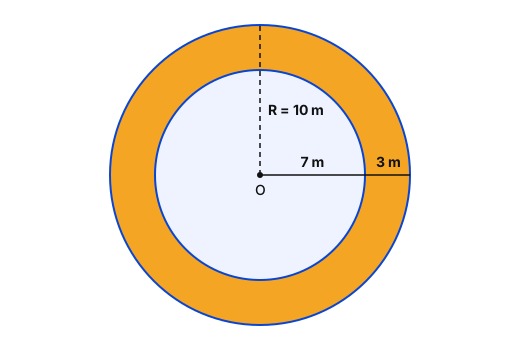
A circular path of 3 m width runs around a circular park with radius 7 m. What is the area of the path?
7 m त्रिज्या वाले एक वृत्ताकार पार्क के चारों ओर 3 m चौड़ा वृत्ताकार पथ है। पथ का क्षेत्रफल क्या है?
  1. A160.28 m²
  2. B161.29 m²
  3. C158.02 m²
  4. D164.05 m²
Show answer

Concept: Area of ring = π(R2−r2).

  1. r = 7 m, R=7+3=10 m.
  2. Area = 227×(100−49)=227×51=11227≈160.28 m².

Trick: R2−r2=(R+r)(R−r)=17×3=51.

Answer: (A) 160.28 m²

अवधारणा: वलय का क्षेत्रफल = π(R2−r2)।

  1. r = 7 m, R = 10 m
  2. क्षेत्रफल = 227×51=11227≈160.28 m²

ट्रिक: R2−r2=(R+r)(R−r)=17×3=51।

उत्तर: (A) 160.28 m²

SSC CGLQuantitative AptitudeMensuration – circular pathSSC CGL 2025 · 14 Sep Shift 3 →
Q3667.
Find the slope of the line perpendicular to y = 13x + 7
y = 13x + 7 रेखा पर लंब रेखा की प्रवणता (slope) ज्ञात कीजिए।
  1. A−3
  2. B3
  3. C−13
  4. D13
Show answer

Concept: For perpendicular lines, m1×m2=−1.

  1. y=(13)x+7 → m1=13.
  2. m2=−1÷(13)=−3.

Trick: Perpendicular slope = flip the fraction and change the sign: 13→−3.

Answer: (A) −3

अवधारणा: लंब रेखाओं में m1×m2=−1।

  1. y=(13)x+7 → m1=13
  2. m2=−1÷13=−3

ट्रिक: भिन्न उलटें और चिह्न बदलें: 13→−3।

उत्तर: (A) −3

SSC CGLQuantitative AptitudeCoordinate geometry – perpendicular slopeSSC CGL 2025 · 14 Sep Shift 3 →
Q3668.
Convert 3.5 radians to degrees.
3.5 रेडियन को डिग्री में बदलिए।
  1. A130°
  2. B143.24°
  3. C180°
  4. D200.56°
Show answer

Concept: Degrees = radians ×180π.

  1. 3.5×180π=630π.
  2. 630÷3.1416≈200.5∘ → nearest option 200.56°.

Trick: 1 radian ≈ 57.3°, so 3.5 rad ≈ 200° — only option (D) is near.

Answer: (D) 200.56°

अवधारणा: डिग्री = रेडियन ×180π।

  1. 3.5×180π=630π
  2. 630÷3.1416≈200.5∘ → निकटतम विकल्प 200.56°

ट्रिक: 1 रेडियन ≈ 57.3°, अतः 3.5 रेडियन ≈ 200° — केवल (D) पास है।

उत्तर: (D) 200.56°

SSC CGLQuantitative AptitudeRadian to degreeSSC CGL 2025 · 14 Sep Shift 3 →
Q3669.
A sector of a circle having a radius of 5 cm has a central angle of π3 radians. What is the area of the sector?
5 cm त्रिज्या वाले वृत्त के एक त्रिज्यखंड का केंद्रीय कोण π3 रेडियन है। त्रिज्यखंड का क्षेत्रफल क्या है?
  1. A13.09 cm²
  2. B8.33 cm²
  3. C10.47 cm²
  4. D12.5 cm²
Show answer

Concept: Sector area = 12r2θ (θ in radians).

  1. 12×25×π3=25π6.
  2. 25×3.1416÷6≈13.09 cm².

Trick: π3=60∘ = 16 of the circle → πr26=78.546≈13.09.

Answer: (A) 13.09 cm²

अवधारणा: त्रिज्यखंड का क्षेत्रफल = 12r2θ (θ रेडियन में)।

  1. 12×25×π3=25π6
  2. ≈78.54÷6≈13.09 cm²

ट्रिक: π3=60∘ = वृत्त का 16 भाग → πr26≈13.09।

उत्तर: (A) 13.09 cm²

SSC CGLQuantitative AptitudeArea of sector – radian angleSSC CGL 2025 · 14 Sep Shift 3 →
Q3670.
If sin A = cos(2A − 30°), then what is the value of A?
यदि sin A = cos(2A − 30°) है, तो A का मान क्या है?
  1. A40°
  2. B25°
  3. C18°
  4. D30°
Show answer

Concept: If sin x = cos y (acute angles), then x + y = 90°.

  1. A + (2A − 30°) = 90°.
  2. 3A = 120° → A = 40°.

Trick: Check: sin 40° = cos(80° − 30°) = cos 50° ✓.

Answer: (A) 40°

अवधारणा: यदि sin x = cos y (न्यून कोण), तो x + y = 90°।

  1. A + 2A − 30° = 90°
  2. 3A = 120° → A = 40°

ट्रिक: जाँच: sin 40° = cos 50° ✓

उत्तर: (A) 40°

SSC CGLQuantitative AptitudeTrigonometry – complementary anglesSSC CGL 2025 · 14 Sep Shift 3 →
Q3671.
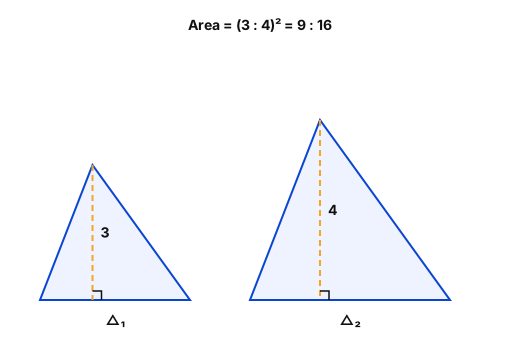
In similar triangles, the ratio of corresponding altitudes is 3 : 4. What is the ratio of their areas?
समरूप त्रिभुजों में संगत शीर्षलंबों का अनुपात 3 : 4 है। उनके क्षेत्रफलों का अनुपात क्या है?
  1. A2 : 5
  2. B9 : 16
  3. C2 : 25
  4. D5 : 2
Show answer

Concept: Area ratio = (ratio of any corresponding lengths)2.

  1. Altitudes 3 : 4.
  2. Areas = 32:42=9:16.

Trick: Side, altitude, median, perimeter – all in the same ratio; area is its square.

Answer: (B) 9 : 16

अवधारणा: क्षेत्रफल अनुपात = (संगत लंबाइयों का अनुपात)2।

  1. शीर्षलंब 3 : 4
  2. क्षेत्रफल = 9 : 16

ट्रिक: भुजा, शीर्षलंब, माध्यिका, परिमाप — सबका अनुपात समान; क्षेत्रफल उसका वर्ग।

उत्तर: (B) 9 : 16

SSC CGLQuantitative AptitudeSimilar triangles – area ratioSSC CGL 2025 · 14 Sep Shift 3 →
Q3672.
Given, b = 7, what is (b + 1)² + (b − 1)²?
यदि b = 7 है, तो (b + 1)² + (b − 1)² का मान क्या है?
  1. A13
  2. B12
  3. C14
  4. D16
Show answer

Concept: (b+1)2+(b−1)2=2(b2+1).

  1. b=7→b2=7.
  2. Value = 2(7+1)=16.

Trick: The cross terms +2b and −2b cancel, so 7 never needs expanding.

Answer: (D) 16

अवधारणा: (b+1)2+(b−1)2=2(b2+1)।

  1. b=7→b2=7
  2. मान = 2(7+1)=16

ट्रिक: +2b और −2b कट जाते हैं, इसलिए 7 का विस्तार नहीं करना पड़ता।

उत्तर: (D) 16

SSC CGLQuantitative AptitudeAlgebraic identitySSC CGL 2025 · 14 Sep Shift 3 →
Q3673.
Simplify: 98 + 32 − 50
सरल कीजिए: 98 + 32 − 50
  1. A72
  2. B62
  3. C52
  4. D82
Show answer

Concept: Write each surd as (perfect square) × 2.

  1. 98=72,32=42,50=52.
  2. 72+42−52=62.

Trick: Just add the outside numbers: 7+4−5=6.

Answer: (B) 62

अवधारणा: हर करणी को (पूर्ण वर्ग) × 2 में लिखें।

  1. 98=72,32=42,50=52
  2. 72+42−52=62

ट्रिक: बाहर की संख्याएँ जोड़ें: 7+4−5=6।

उत्तर: (B) 62

SSC CGLQuantitative AptitudeSurds – simplificationSSC CGL 2025 · 14 Sep Shift 3 →
Q3674.
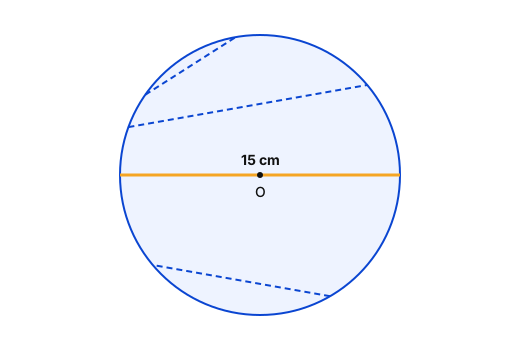
The diameter of a circle measures 15 cm. What is the maximum length of a chord in this circle?
एक वृत्त का व्यास 15 cm है। इस वृत्त में किसी जीवा की अधिकतम लंबाई क्या होगी?
  1. A15 cm
  2. B35 cm
  3. C65 cm
  4. D90 cm
Show answer

Concept: A chord through the centre is the longest one — the diameter.

  1. Any chord not passing through the centre is shorter than the diameter.
  2. Diameter = 15 cm → maximum chord = 15 cm.

Yaad rakhein: No chord can exceed the diameter, so options above 15 cm are impossible.

Answer: (A) 15 cm

अवधारणा: केंद्र से होकर जाने वाली जीवा (व्यास) सबसे लंबी होती है।

  1. केंद्र से न गुज़रने वाली हर जीवा व्यास से छोटी होती है।
  2. व्यास = 15 cm → अधिकतम जीवा = 15 cm

याद रखें: कोई जीवा व्यास से बड़ी नहीं हो सकती।

उत्तर: (A) 15 cm

SSC CGLQuantitative AptitudeCircle – longest chordSSC CGL 2025 · 14 Sep Shift 3 →
Q3675.
If sin A + cos A = 2 cos A, then what is the value of cot A?
यदि sin A + cos A = 2 cos A है, तो cot A का मान क्या है?
  1. A2
  2. B1
  3. C2 + 1
  4. D2 − 1
Show answer

Concept: Bring sin and cos to one side, form tanA.

  1. Move cosA to the right: sinA=cosA(2−1).
  2. Divide by cosA: tanA equals 2−1, hence cotA=12−1.
  3. Rationalise: 2+12−1=2+1.

Trick: (2−1)(2+1)=1, so they are reciprocals of each other.

Answer: (C) 2 + 1

अवधारणा: sin और cos को एक ओर लाकर tanA बनाएँ।

  1. cosA को दाईं ओर ले जाएँ: sinA=cosA(2−1)
  2. cosA से भाग देने पर tanA बराबर 2−1, अतः cotA=12−1
  3. परिमेयीकरण: 2+1

ट्रिक: (2−1)(2+1)=1 — दोनों एक-दूसरे के व्युत्क्रम हैं।

उत्तर: (C) 2 + 1

SSC CGLQuantitative AptitudeTrigonometry – finding cot ASSC CGL 2025 · 14 Sep Shift 3 →
Q3676.
Select the most appropriate synonym of the given word:
Peak
  1. ABeginning
  2. BApogee
  3. CNadir
  4. DBase
Show answer

Concept: Peak = the highest point.

  1. Apogee = the highest point / climax (also the farthest point of an orbit from Earth) → same as peak.
  2. Nadir = lowest point (antonym); Base = bottom; Beginning = start.

Trick: Pair to remember: Apogee/Zenith = top; Perigee/Nadir = bottom.

Answer: (B) Apogee

अवधारणा: Peak = सबसे ऊँचा बिंदु, शिखर।

  1. Apogee = चरम बिंदु / उत्कर्ष → Peak का समानार्थी।
  2. Nadir = सबसे निचला बिंदु (विलोम), Base = आधार, Beginning = आरंभ।

ट्रिक: Apogee/Zenith = शिखर; Perigee/Nadir = निम्नतम।

उत्तर: (B) Apogee

SSC CGLEnglish ComprehensionSynonym – PeakSSC CGL 2025 · 14 Sep Shift 3 →
Q3677.
Select the most appropriate meaning of the given idiom:
She threw cold water on his dreams.
  1. ADiscouraging or opposing something
  2. BMaking something widely liked
  3. CRemoving worries completely
  4. DEncouraging with enthusiasm
Show answer

Concept: 'Throw cold water on' something = to discourage it or show no enthusiasm for it.

  1. She threw cold water on his dreams → she discouraged/opposed his plans.
  2. Options (B), (C), (D) are positive meanings, the reverse of the idiom.

Trick: Cold water cools excitement — so the meaning is always negative.

Answer: (A) Discouraging or opposing something

अवधारणा: 'Throw cold water on' = किसी योजना/उत्साह को हतोत्साहित करना, पानी फेर देना।

  1. वाक्य का अर्थ: उसने उसके सपनों पर पानी फेर दिया, यानी उन्हें हतोत्साहित किया।
  2. (B), (C), (D) सकारात्मक अर्थ हैं — मुहावरे के उलट।

ट्रिक: हिंदी में भी 'पानी फेरना' — यानी नकारात्मक अर्थ।

उत्तर: (A) Discouraging or opposing something

SSC CGLEnglish ComprehensionIdiom – throw cold water onSSC CGL 2025 · 14 Sep Shift 3 →
Q3678.
Select the sentence that uses the homonym of the given word.
Rheme — the part of a clause that gives information about the theme.
  1. AThe linguist identified the rheme in every clause carefully.
  2. BThe rheme is the most important part of the sentence.
  3. CThe sailors spotted a rheme swimming near the coast.
  4. DThe teacher explained how to mark the rheme in a sentence.
Show answer

Concept: A homonym has the same spelling/sound but a different meaning.

  1. In (A), (B) and (D), 'rheme' has its grammar meaning — the part of a clause that gives new information about the theme.
  2. In (C), 'rheme' names something swimming near the coast — a different, non-grammatical sense of the same word.

Trick: Find the odd context: three grammar sentences + one sea sentence → the sea one uses the homonym.

Answer: (C) The sailors spotted a rheme swimming near the coast.

अवधारणा: Homonym = एक जैसी वर्तनी/ध्वनि पर अलग अर्थ।

  1. (A), (B), (D) में 'rheme' व्याकरण वाले अर्थ में है — उपवाक्य का वह भाग जो theme के बारे में नई जानकारी देता है।
  2. (C) में 'rheme' तट के पास तैरती किसी चीज़ के लिए आया है — अलग अर्थ।

ट्रिक: तीन वाक्य व्याकरण के, एक समुद्र का — वही अलग अर्थ (homonym) वाला।

उत्तर: (C) The sailors spotted a rheme swimming near the coast.

SSC CGLEnglish ComprehensionHomonyms – rhemeSSC CGL 2025 · 14 Sep Shift 3 →
Q3679.
Select the option that expresses the given sentence in the Active/Passive voice.
The report was being written by the intern when the power failed.
  1. AThe intern was writing the report when the power failed.
  2. BThe intern wrote the report when the power failed.
  3. CThe intern had been writing the report when the power failed.
  4. DThe power failed while the report was being written by the intern.
Show answer

Concept: Passive 'was/were being + V3' comes from active 'was/were + V-ing'.

  1. 'was being written' → active 'was writing'.
  2. Make 'the intern' the subject; the when-clause stays unchanged.
  3. (B) simple past, (C) past perfect continuous – tense changed; (D) is still passive.

Trick: Keep the tense; only swap subject and object.

Answer: (A) The intern was writing the report when the power failed.

अवधारणा: Passive 'was/were being + V3' का active रूप 'was/were + V-ing' होता है।

  1. 'was being written' → 'was writing'
  2. 'the intern' को कर्ता बनाएँ; when-clause वैसा ही रहेगा।
  3. (B) और (C) में काल बदल गया, (D) अभी भी passive है।

ट्रिक: काल वही रखें, केवल कर्ता-कर्म की जगह बदलें।

उत्तर: (A) The intern was writing the report when the power failed.

SSC CGLEnglish ComprehensionVoice – past continuous passiveSSC CGL 2025 · 14 Sep Shift 3 →
Q3680.
Select the correct spelling.
  1. APhotograp
  2. BPoton
  3. CPotogenic
  4. DPhotolithography
Show answer

Concept: Words from Greek 'phos/photo' (light) are spelt with 'ph'.

  1. Photolithography is spelt correctly.
  2. Correct forms of the others: Photograph, Photon, Photogenic.

Trick: Any 'foto' sound from Greek 'light' = PHOTO — options missing 'h' are out at once.

Answer: (D) Photolithography

अवधारणा: ग्रीक 'photo' (प्रकाश) वाले शब्दों में 'ph' आता है।

  1. Photolithography सही वर्तनी है।
  2. बाकी के सही रूप: Photograph, Photon, Photogenic।

ट्रिक: जिनमें 'h' छूटा है वे तुरंत बाहर।

उत्तर: (D) Photolithography

SSC CGLEnglish ComprehensionSpelling – 'photo' wordsSSC CGL 2025 · 14 Sep Shift 3 →