Question bank

Q&A: practice questions with answers

Search questions on any topic. Filter by exam category, exam, subject and topic, try the question, then open the answer and explanation.

Courses – airGurukul

4,800 questions found.

Q4161.
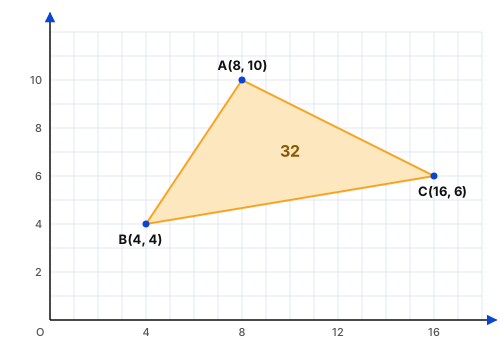
A triangle has vertices at A(8, 10), B(4, 4) and C(16, 6). What is its area?
एक त्रिभुज के शीर्ष A(8, 10), B(4, 4) और C(16, 6) हैं। उसका क्षेत्रफल क्या है?
  1. A32 square units32 वर्ग इकाई
  2. B36 square units36 वर्ग इकाई
  3. C14.5 square units14.5 वर्ग इकाई
  4. D35 square units35 वर्ग इकाई
Show answer

Concept: Area = 12|x1(y2−y3)+x2(y3−y1)+x3(y1−y2)|.

  1. 8(4−6)=−16; 4(6−10)=−16; 16(10−4)=96.
  2. Sum = 64.
  3. Area =642=32 sq units.

Trick: Shift origin to B(4, 4): A(4, 6), C(12, 2) ⇒ area =12|4×2−12×6|=12×64=32.

Answer: (A) 32 square units

अवधारणा: तीन शीर्ष दिए हों तो क्षेत्रफल = आधा × |सारणिक (shoelace) मान|।

हल:

  1. 8×(4−6)=−16, 4×(6−10)=−16, 16×(10−4)=96।
  2. इनका योग 64 है।
  3. आधा करने पर क्षेत्रफल = 32 वर्ग इकाई।

ट्रिक: मूल बिंदु B(4, 4) पर लाएँ: A(4, 6), C(12, 2) ⇒ 12|8−72|=32।

उत्तर: (A) 32 वर्ग इकाई

SSC CGLQuantitative AptitudeCoordinate geometry – area of triangleSSC CGL 2025 · 14 Oct Shift 1 →
Q4162.
The average of a certain number of quantities is 48. If 6 is added to each quantity, what will be the new average?
कुछ राशियों का औसत 48 है। यदि प्रत्येक राशि में 6 जोड़ दिया जाए, तो नया औसत क्या होगा?
  1. A39
  2. B54
  3. C41
  4. D52
Show answer

Concept: Adding a constant to every value adds the same constant to the average.

  1. New average = 48+6=54.
  2. The number of quantities does not matter.

Trick: Add/subtract/multiply/divide every term by k ⇒ do the same to the average.

Answer: (B) 54

अवधारणा: हर राशि में समान संख्या जोड़ें तो औसत में भी वही संख्या जुड़ती है।

हल:

  1. नया औसत = 48+6=54।
  2. राशियों की संख्या से फ़र्क नहीं पड़ता।

ट्रिक: हर पद पर +, −, ×, ÷ k करें तो औसत पर भी वही क्रिया होगी।

उत्तर: (B) 54

SSC CGLQuantitative AptitudeAverage – same number addedSSC CGL 2025 · 14 Oct Shift 1 →
Q4163.
A wholesaler sells a packet of tea to a retailer at a profit of 20%. The retailer then marks up the price by 35% and offers a discount of 16.67% to the customer. If the customer pays ₹864, find the cost price of the packet for the wholesaler.
एक थोक विक्रेता चाय का पैकेट फुटकर विक्रेता को 20% लाभ पर बेचता है। फुटकर विक्रेता मूल्य 35% बढ़ाकर अंकित करता है और ग्राहक को 16.67% छूट देता है। यदि ग्राहक ₹864 देता है, तो थोक विक्रेता के लिए पैकेट का क्रय मूल्य ज्ञात कीजिए।
  1. A₹600
  2. B₹400
  3. C₹640
  4. D₹750
Show answer

Concept: Multiply the successive factors: profit 20%=65, markup 35%=2720, discount 16.67%=56.

  1. Final price = CP×65×2720×56=CP×2720.
  2. 2720×CP=864.
  3. CP=864×2027= ₹640.

Trick: 65 and 56 cancel each other – only the 35% markup survives: CP=8641.35.

Answer: (C) ₹640

अवधारणा: क्रमागत गुणकों को गुणा करें: लाभ 20%=65, बढ़ोतरी 35%=2720, छूट 16.67%=56।

हल:

  1. अंतिम मूल्य = CP×65×2720×56=CP×2720।
  2. 2720×CP=864।
  3. CP=864×2027= ₹640।

ट्रिक: 65 और 56 कट जाते हैं – केवल 35% बचता है: CP=8641.35।

उत्तर: (C) ₹640

SSC CGLQuantitative AptitudeProfit, markup and discount chainSSC CGL 2025 · 14 Oct Shift 1 →
Q4164.
A group of 7 students went on a trip and spent ₹2,500 in total. If one of them spent ₹700 while the rest spent equally, what was the average spending of the other 6 students?
7 विद्यार्थियों के एक समूह ने यात्रा पर कुल ₹2,500 खर्च किए। यदि उनमें से एक ने ₹700 खर्च किए और शेष ने बराबर-बराबर, तो अन्य 6 विद्यार्थियों का औसत खर्च क्या था?
  1. A₹300
  2. B₹360
  3. C₹500
  4. D₹240
Show answer

Concept: Average = total of the group ÷ number in the group.

  1. Spent by other six = 2500−700= ₹1800.
  2. Average = 1800÷6= ₹300.

Trick: Use only the six people's total; the 7 is a distractor.

Answer: (A) ₹300

अवधारणा: औसत = समूह का योग ÷ सदस्यों की संख्या।

हल:

  1. बाकी छह का खर्च = 2500−700= ₹1800।
  2. औसत = 1800÷6= ₹300।

ट्रिक: केवल छह लोगों का योग लें; 7 संख्या भ्रमित करने के लिए है।

उत्तर: (A) ₹300

SSC CGLQuantitative AptitudeAverage – excluding one memberSSC CGL 2025 · 14 Oct Shift 1 →
Q4165.
In a quadrilateral ABCD, angles A, B and C are in the ratio 5 : 4 : 5. If angle D = 80°, what is angle B?
चतुर्भुज ABCD में कोण A, B और C 5 : 4 : 5 के अनुपात में हैं। यदि कोण D = 80° है, तो कोण B क्या होगा?
  1. A80°
  2. B72°
  3. C45°
  4. D120°
Show answer

Concept: Sum of the angles of a quadrilateral = 360°.

  1. A+B+C=360∘−80∘=280∘.
  2. Ratio 5 : 4 : 5 ⇒ 14 parts = 280° ⇒ 1 part = 20°.
  3. ∠B=4×20∘=80∘.

Trick: Subtract the known angle first, then split 280 in 14 parts.

Answer: (A) 80°

अवधारणा: चतुर्भुज के कोणों का योग = 360°।

हल:

  1. A+B+C=360∘−80∘=280∘।
  2. 5 : 4 : 5 ⇒ 14 भाग = 280° ⇒ 1 भाग = 20°।
  3. ∠B=4×20∘=80∘।

ट्रिक: पहले ज्ञात कोण घटाएँ, फिर 280 को 14 भागों में बाँटें।

उत्तर: (A) 80°

SSC CGLQuantitative AptitudeQuadrilateral – angle sumSSC CGL 2025 · 14 Oct Shift 1 →
Q4166.
A distributor marks a batch of 280 identical mobile chargers at 60% above the cost price and offers a 20% discount to retailers. A retailer purchases all the chargers and spends ₹15,360. What is the cost price per charger for the wholesaler?
एक वितरक 280 एक जैसे मोबाइल चार्जर क्रय मूल्य से 60% ऊपर अंकित करता है और फुटकर विक्रेताओं को 20% छूट देता है। एक फुटकर विक्रेता सभी चार्जर ₹15,360 में खरीदता है। थोक विक्रेता के लिए प्रति चार्जर क्रय मूल्य क्या है?
  1. A₹42.85
  2. B₹57.75
  3. C₹56.65
  4. D₹55.55
Show answer

Concept: SP=CP×(1+markup)×(1−discount).

  1. SP factor = 1.6×0.8=1.28.
  2. Total CP = 15360÷1.28= ₹12,000.
  3. Per charger = 12000÷280≈ ₹42.86 (listed as ₹42.85).

Trick: 60% up and 20% down = net +28% (60−20−60×20100).

Answer: (A) ₹42.85

अवधारणा: विक्रय मूल्य = क्रय मूल्य × (1 + बढ़ोतरी) × (1 − छूट)।

हल:

  1. गुणक = 1.6×0.8=1.28।
  2. कुल CP = 15360÷1.28= ₹12,000।
  3. प्रति चार्जर = 12000÷280≈ ₹42.85।

ट्रिक: 60% बढ़ोतरी और 20% छूट = शुद्ध +28% (60−20−12)।

उत्तर: (A) ₹42.85

SSC CGLQuantitative AptitudeMarkup and discount – CP per itemSSC CGL 2025 · 14 Oct Shift 1 →
Q4167.
Three numbers are in the ratio 4 : 5 : 7. If their average is 480, what is the difference between the largest and the smallest number?
तीन संख्याएँ 4 : 5 : 7 के अनुपात में हैं। यदि उनका औसत 480 है, तो सबसे बड़ी और सबसे छोटी संख्या का अंतर क्या है?
  1. A270
  2. B300
  3. C240
  4. D250
Show answer

Concept: Sum = average × count; then split the sum in the ratio.

  1. Sum = 480×3=1440.
  2. 16 parts = 1440 ⇒ 1 part = 90.
  3. Largest − smallest = (7−4)×90=270.

Trick: Find only the needed difference: 3 parts × 90 = 270.

Answer: (A) 270

अवधारणा: योग = औसत × संख्या; फिर योग को अनुपात में बाँटें।

हल:

  1. योग = 480×3=1440।
  2. 16 भाग = 1440 ⇒ 1 भाग = 90।
  3. अंतर = (7−4)×90=270।

ट्रिक: सीधे अंतर वाले 3 भाग × 90 = 270।

उत्तर: (A) 270

SSC CGLQuantitative AptitudeRatio and averageSSC CGL 2025 · 14 Oct Shift 1 →
Q4168.
A 136-litre container of pure milk undergoes a process in which 17 litres is removed and replaced with water. The process is carried out 3 times in all. Approximately how much of the original milk remains?
136 लीटर शुद्ध दूध वाले पात्र में से 17 लीटर निकालकर उतना पानी मिलाया जाता है। यह क्रिया कुल तीन बार की जाती है। मूल दूध लगभग कितना शेष रहेगा?
  1. A17343512 litres17343512 लीटर
  2. B1743512 litres1743512 लीटर
  3. C817100 litres817100 लीटर
  4. D91764 litres91764 लीटर
Show answer

Concept: Milk left = initial ×(1−removedtotal)n.

  1. Fraction kept each time = 1−17136=1−18=78.
  2. Milk left = 136×(78)3=136×343512.
  3. =46648512=91764 L (≈ 91.1 L).

Trick: 136=17×8, so 136×343512=17×34364 – cancel 8 first.

Answer: (D) 91764 litres

अवधारणा: शेष दूध=प्रारंभिक×(1−निकालाकुल)n।

हल:

  1. हर बार बचा भाग = 1−17136=78।
  2. शेष दूध = 136×(78)3=136×343512।
  3. =91764 लीटर (≈ 91.1 L)।

ट्रिक: 136=17×8, अतः पहले 8 काटें: 17×34364।

उत्तर: (D) 91764 लीटर

SSC CGLQuantitative AptitudeRepeated replacement – milk and waterSSC CGL 2025 · 14 Oct Shift 1 →
Q4169.
If secx − tanx = 13, then what is the value of secx + tanx?
यदि secx − tanx = 13 है, तो secx + tanx का मान क्या है?
  1. A9
  2. B3
  3. C4
  4. D1
Show answer

Concept: sec2x−tan2x=1⇒(secx−tanx)(secx+tanx)=1.

  1. Given secx−tanx=13.
  2. secx+tanx=1÷13=3.

Trick: sec + tan and sec − tan are always reciprocals – just flip the given value.

Answer: (B) 3

अवधारणा: sec2x−tan2x=1⇒(secx−tanx)(secx+tanx)=1।

हल:

  1. दिया है secx−tanx=13।
  2. secx+tanx=1÷13=3।

ट्रिक: sec + tan और sec − tan हमेशा एक-दूसरे के व्युत्क्रम – बस मान उलट दें।

उत्तर: (B) 3

SSC CGLQuantitative AptitudeTrigonometric identity – sec and tanSSC CGL 2025 · 14 Oct Shift 1 →
Q4170.
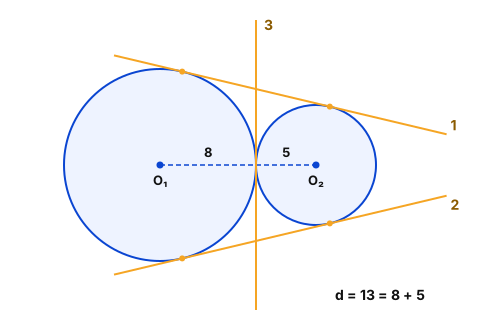
Two circles of radii 8 cm and 5 cm are such that the distance between their centres is 13 cm. How many common tangents can be drawn?
8 cm और 5 cm त्रिज्या वाले दो वृत्तों के केंद्रों के बीच की दूरी 13 cm है। कितनी उभयनिष्ठ स्पर्श रेखाएँ खींची जा सकती हैं?
  1. A0
  2. B1
  3. C2
  4. D3
Show answer

Concept: Compare distance between centres d with r₁ + r₂ and |r₁ − r₂|.

  1. r₁ + r₂ = 8 + 5 = 13 = d.
  2. So the circles touch externally.
  3. Common tangents = 2 direct + 1 at the point of contact = 3.

Trick: d > r₁+r₂ → 4; d = r₁+r₂ → 3; between → 2; d = |r₁−r₂| → 1; inside → 0.

Answer: (D) 3

अवधारणा: केंद्रों की दूरी d की तुलना r₁ + r₂ और |r₁ − r₂| से करें।

हल:

  1. r₁ + r₂ = 8 + 5 = 13 = d।
  2. अतः वृत्त बाहर से स्पर्श करते हैं।
  3. उभयनिष्ठ स्पर्श रेखाएँ = 2 सीधी + 1 स्पर्श बिंदु पर = 3।

ट्रिक: d > r₁+r₂ → 4; d = r₁+r₂ → 3; बीच में → 2; d = |r₁−r₂| → 1; अंदर → 0।

उत्तर: (D) 3

SSC CGLQuantitative AptitudeCommon tangents of two circlesSSC CGL 2025 · 14 Oct Shift 1 →
Q4171.
What is 3π2 radians in degrees?
3π2 रेडियन डिग्री में कितने होंगे?
  1. A180°
  2. B360°
  3. C270°
  4. D150°
Show answer

Concept: π radians =180∘, so degrees = radians ×180π.

  1. 3π2×180π=3×90.
  2. =270∘.

Trick: Put π=180∘ directly: 3×1802=270∘.

Answer: (C) 270°

अवधारणा: π रेडियन =180∘, अतः डिग्री = रेडियन ×180π।

हल:

  1. 3π2×180π=3×90।
  2. =270∘।

ट्रिक: सीधे π=180∘ रखें: 3×1802=270∘।

उत्तर: (C) 270°

SSC CGLQuantitative AptitudeRadian to degreeSSC CGL 2025 · 14 Oct Shift 1 →
Q4172.
If P = ₹2,400, R = 37.5% and T = 2 years, find the simple interest.
यदि P = ₹2,400, R = 37.5% और T = 2 वर्ष है, तो साधारण ब्याज ज्ञात कीजिए।
  1. A₹1,000
  2. B₹1,200
  3. C₹1,800
  4. D₹2,000
Show answer

Concept: SI=P×R×T100.

  1. SI=2400×37.5×2100.
  2. =24×75= ₹1800.

Trick: R×T=75%, and 75%=34: 34×2400=1800.

Answer: (C) ₹1,800

अवधारणा: साधारण ब्याज = P×R×T100।

हल:

  1. SI=2400×37.5×2100।
  2. =24×75= ₹1800।

ट्रिक: कुल दर = 37.5×2=75%=34; 34×2400=1800।

उत्तर: (C) ₹1,800

SSC CGLQuantitative AptitudeSimple interestSSC CGL 2025 · 14 Oct Shift 1 →
Q4173.
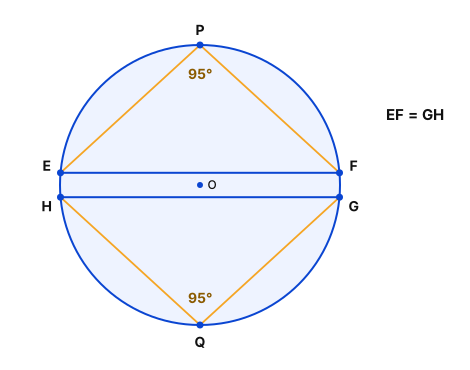
In a circle, the chords EF and GH are equal. The angle subtended by EF at the circumference is 95°. What is the angle subtended by GH at the circumference?
एक वृत्त में जीवाएँ EF और GH बराबर हैं। EF परिधि पर 95° का कोण बनाती है। GH परिधि पर कितना कोण बनाएगी?
  1. A95°
  2. B47.5°
  3. C120°
  4. D85°
Show answer

Concept: Equal chords subtend equal angles at the centre, and hence equal angles at the circumference (same side).

  1. EF = GH ⇒ their central angles are equal.
  2. Inscribed angle = half the central angle ⇒ equal too.
  3. Angle by GH = 95°.

Yaad rakhein: Equal chords are also equidistant from the centre.

Answer: (A) 95°

अवधारणा: समान जीवाएँ केंद्र पर समान कोण बनाती हैं, इसलिए परिधि पर भी समान कोण बनाती हैं।

हल:

  1. EF = GH ⇒ केंद्रीय कोण बराबर।
  2. परिधि कोण = केंद्रीय कोण का आधा ⇒ ये भी बराबर।
  3. GH द्वारा कोण = 95°।

याद रखें: समान जीवाएँ केंद्र से समान दूरी पर भी होती हैं।

उत्तर: (A) 95°

SSC CGLQuantitative AptitudeCircle – equal chordsSSC CGL 2025 · 14 Oct Shift 1 →
Q4174.
The number of students in two sections A and B having different heights is shown in the table below.
Height 1.35 m — A: 7, B: 6
Height 1.40 m — A: 9, B: 8
Height 1.45 m — A: 10, B: 12
Height 1.50 m — A: 13, B: 11
Height 1.55 m — A: 3, B: 2
Height 1.60 m — A: 12, B: 6
Height 1.65 m — A: 1, B: 4
What is the ratio of the total number of students in Section A whose height is less than 1.50 m to the total number of students in Section B whose height is more than 1.50 m?
दो वर्गों A और B में विभिन्न ऊँचाई वाले विद्यार्थियों की संख्या नीचे दी गई है।
ऊँचाई 1.35 m — A: 7, B: 6
ऊँचाई 1.40 m — A: 9, B: 8
ऊँचाई 1.45 m — A: 10, B: 12
ऊँचाई 1.50 m — A: 13, B: 11
ऊँचाई 1.55 m — A: 3, B: 2
ऊँचाई 1.60 m — A: 12, B: 6
ऊँचाई 1.65 m — A: 1, B: 4
वर्ग A में 1.50 m से कम ऊँचाई वाले विद्यार्थियों की कुल संख्या और वर्ग B में 1.50 m से अधिक ऊँचाई वाले विद्यार्थियों की कुल संख्या का अनुपात क्या है?
  1. A15 : 16
  2. B13 : 6
  3. C13 : 5
  4. D17 : 13
Show answer

Concept: Pick exactly the rows the condition asks for ('less than' and 'more than' exclude 1.50 m itself).

  1. Section A rows 1.35, 1.40, 1.45 m give 26 students (7, 9, 10).
  2. Section B rows 1.55, 1.60, 1.65 m give 12 students (2, 6, 4).
  3. 26 : 12, divide by 2 ⇒ 13 : 6.

Trick: Don't include the 1.50 m row in either count – that is the usual trap.

Answer: (B) 13 : 6

अवधारणा: शर्त के अनुसार सही पंक्तियाँ चुनें ('कम' और 'अधिक' में 1.50 m शामिल नहीं)।

हल:

  1. सेक्शन A की 1.35, 1.40, 1.45 m वाली पंक्तियाँ: 26 छात्र (7, 9, 10)।
  2. सेक्शन B की 1.55, 1.60, 1.65 m वाली पंक्तियाँ: 12 छात्र (2, 6, 4)।
  3. 26 : 12 को 2 से भाग देने पर 13 : 6।

ट्रिक: 1.50 m वाली पंक्ति किसी गिनती में न जोड़ें – यही जाल है।

उत्तर: (B) 13 : 6

SSC CGLQuantitative AptitudeData interpretation – tableSSC CGL 2025 · 14 Oct Shift 1 →
Q4175.
Which of these lines is parallel to 3x − 2y = 7?
इनमें से कौन-सी रेखा 3x − 2y = 7 के समांतर है?
  1. A3x + 2y = 7
  2. B4x + y = 15
  3. C3x − 2y = 11
  4. Dx + 5y = 10
Show answer

Concept: ax+by=c has slope −ab; parallel lines have equal slopes.

  1. Given line: slope =−3−2=32.
  2. 3x−2y=11 has the same a and b ⇒ slope 32 ⇒ parallel.
  3. Others: −32, −4, −15 – not equal.

Trick: Parallel line = same x and y part, only the constant changes: 3x−2y=k.

Answer: (C) 3x − 2y = 11

अवधारणा: ax+by=c की ढाल −ab होती है; समांतर रेखाओं की ढाल बराबर होती है।

हल:

  1. दी गई रेखा की ढाल =32।
  2. 3x−2y=11 में a, b वही ⇒ ढाल 32 ⇒ समांतर।
  3. बाकी की ढाल: −32, −4, −15।

ट्रिक: समांतर रेखा = x, y वाला भाग वही, केवल अचर बदलता है: 3x−2y=k।

उत्तर: (C) 3x − 2y = 11

SSC CGLQuantitative AptitudeParallel lines – slopeSSC CGL 2025 · 14 Oct Shift 1 →
Q4176.
Select the correct indirect/direct form of the given sentence.
He explained, "I have finished all my tasks for the day."
  1. AHe explained that he had finished all his tasks for the day.
  2. BHe explained that he has finished all his tasks for the day.
  3. CHe explained that he finished all his tasks for the day.
  4. DHe explained that I had finished all his tasks for the day.
Show answer

Concept: Past reporting verb ⇒ shift tenses one step back and change pronouns to match the speaker.

  1. 'have finished' (present perfect) → 'had finished' (past perfect).
  2. I → he, my → his; the comma and quotes become 'that'.
  3. Correct: He explained that he had finished all his tasks for the day.

Trick: Backshift ladder: is/am → was, has/have → had, did/V2 → had + V3.

Answer: (A) He explained that he had finished all his tasks for the day.

अवधारणा: Reporting verb past में हो तो tense एक कदम पीछे जाता है और pronoun वक्ता के अनुसार बदलते हैं।

हल:

  1. 'have finished' (present perfect) → 'had finished' (past perfect)।
  2. I → he, my → his; उद्धरण चिह्न हटकर 'that' आता है।
  3. सही: He explained that he had finished all his tasks for the day.

ट्रिक: Backshift क्रम: is/am → was, has/have → had, V2 → had + V3।

उत्तर: (A) He explained that he had finished all his tasks for the day.

SSC CGLEnglish ComprehensionNarration – present perfect to past perfectSSC CGL 2025 · 14 Oct Shift 1 →
Q4177.
Select the most appropriate option to fill in the blank.
Although the proposal appeared promising at first, further analysis revealed it to be ____ in logic.
  1. Aimpeccable
  2. Bfallacious
  3. Cpragmatic
  4. Dcoherent
Show answer

Concept: 'Although' sets up a contrast: the blank must be the opposite of 'promising'.

  1. Fallacious = based on false reasoning, logically unsound.
  2. Impeccable and coherent are positive; pragmatic (practical) doesn't describe logic going wrong.

Trick: Contrast markers (although, but, yet, however) ⇒ choose the word with opposite tone; three positive options eliminate themselves.

Answer: (B) fallacious

अवधारणा: 'Although' विरोध दिखाता है: रिक्त स्थान 'promising' का उल्टा (नकारात्मक) होगा।

हल:

  1. Fallacious = गलत तर्क पर आधारित, भ्रामक।
  2. Impeccable, coherent सकारात्मक हैं; pragmatic (व्यावहारिक) तर्क की गलती नहीं दर्शाता।

ट्रिक: although/but/yet दिखे तो उलटे भाव वाला शब्द चुनें।

उत्तर: (B) fallacious

SSC CGLEnglish ComprehensionFill in the blank – contrast clueSSC CGL 2025 · 14 Oct Shift 1 →
Q4178.
Sentences of a paragraph are given below in jumbled order. Arrange the sentences in the correct order to form a meaningful and coherent paragraph.
1. Regular reflection on one's experiences helps solidify these lessons.
2. Personal growth is an ongoing journey that often stems from embracing new challenges.
3. Every setback, rather than being a failure, can be viewed as an opportunity to learn.
4. It is through these experiences that individuals gain resilience and deeper understanding.
  1. A2-3-4-1
  2. B3-2-1-4
  3. C2-1-3-4
  4. D4-1-2-3
Show answer

Concept: Start with the general idea, then examples, then the result, then the closing advice.

  1. 2 introduces the topic: growth comes from challenges.
  2. 3 gives the view of setbacks as chances to learn; 4 ('these experiences') shows the gain – resilience.
  3. 1 ('these lessons') wraps up with reflection.

Trick: Sentences starting with 'It' or 'these' can't open; only 2 can start ⇒ options with 2 first: 2-3-4-1 or 2-1-3-4; 1 needs 'lessons' first ⇒ 2-3-4-1.

Answer: (A) 2-3-4-1

अवधारणा: पहले सामान्य विचार, फिर उदाहरण, फिर परिणाम, अंत में निष्कर्ष।

हल:

  1. 2 विषय बताता है: विकास चुनौतियों से आता है।
  2. 3 असफलता को सीखने का अवसर बताता है; 4 ('these experiences') लाभ – दृढ़ता।
  3. 1 ('these lessons') चिंतन के साथ समापन करता है।

ट्रिक: 'It'/'these' से शुरू वाक्य पहला नहीं हो सकता; केवल 2 पहला है, और 1 को 'lessons' का ज़िक्र पहले चाहिए ⇒ 2-3-4-1।

उत्तर: (A) 2-3-4-1

SSC CGLEnglish ComprehensionPara jumble – personal growthSSC CGL 2025 · 14 Oct Shift 1 →
Q4179.
Select the most appropriate option to fill in the blank.
Not until the auditors had submitted their exhaustive report ____ the full extent of procedural lapses become evident.
  1. Adid
  2. Bhad
  3. Cwas
  4. Dhas
Show answer

Concept: A negative adverbial at the start (Not until, Never, Hardly…) makes the main clause take question order: auxiliary + subject + verb.

  1. Main clause verb 'become' is in base form ⇒ needs 'did'.
  2. Structure: did + the full extent… + become evident.

Trick: Base verb after the blank ⇒ use do/does/did; the story is in the past ⇒ did.

Answer: (A) did

अवधारणा: वाक्य की शुरुआत में नकारात्मक शब्द (Not until, Never, Hardly) हो तो मुख्य उपवाक्य में प्रश्नवाचक क्रम आता है: सहायक क्रिया + कर्ता + क्रिया।

हल:

  1. मुख्य क्रिया 'become' मूल रूप में है ⇒ 'did' चाहिए।
  2. संरचना: did + the full extent… + become evident।

ट्रिक: रिक्त स्थान के बाद मूल क्रिया हो तो do/does/did लगाएँ।

उत्तर: (A) did

SSC CGLEnglish ComprehensionInversion after 'Not until'SSC CGL 2025 · 14 Oct Shift 1 →
Q4180.
Select the option which contains the most appropriate HOMONYM of the word given in bold/underline.
The garden was full of fragrant rose bushes.
  1. AShe rose early to watch the sunrise.
  2. BA single red rose lay on the table.
  3. CHe gifted her a bouquet of white roses.
  4. DThe rose plant needs regular pruning.
Show answer

Concept: Homonyms: same spelling/sound, different meaning.

  1. In the given sentence 'rose' = a flower (noun).
  2. (A) 'rose' = past tense of 'rise' (got up) – a different meaning.
  3. (B), (C), (D) all use 'rose' as the flower.

Trick: Look for the option where the word changes its part of speech – here noun → verb.

Answer: (A) She rose early to watch the sunrise.

अवधारणा: Homonym: एक जैसी वर्तनी/उच्चारण, पर अलग अर्थ।

हल:

  1. दिए गए वाक्य में 'rose' = गुलाब का फूल (संज्ञा)।
  2. (A) में 'rose' = 'rise' का past (उठी) – अलग अर्थ।
  3. (B), (C), (D) में फूल वाला अर्थ ही है।

ट्रिक: वह विकल्प खोजें जहाँ शब्द का part of speech बदल जाए – यहाँ noun → verb।

उत्तर: (A) She rose early to watch the sunrise.

SSC CGLEnglish ComprehensionHomonyms – roseSSC CGL 2025 · 14 Oct Shift 1 →