Question bank

Q&A: practice questions with answers

Search questions on any topic. Filter by exam category, exam, subject and topic, try the question, then open the answer and explanation.

Courses – airGurukul

4,800 questions found.

Q561.
A shopkeeper sells two shirts at ₹600 each. On one he gains 20% and on the other he loses 20%. What is his net gain or loss?
एक दुकानदार दो कमीज़ें ₹600 प्रत्येक में बेचता है। एक पर 20% लाभ और दूसरी पर 20% हानि होती है। उसे कुल कितना लाभ या हानि हुई?
  1. A₹50 loss₹50 हानि
  2. B₹75 gain₹75 लाभ
  3. C₹40 gain₹40 लाभ
  4. D₹80 loss₹80 हानि
Show answer

Concept: Equal SP with equal % gain and loss always gives a net loss.

  1. CP1=600×100120= ₹500; CP2=600×10080= ₹750.
  2. Total CP 1250 vs total SP 1200 ⇒ loss ₹50.

Trick: Loss% = x2100=4% of total CP. Total SP 1200 = 96% of CP ⇒ CP 1250, loss ₹50.

Answer: (A) ₹50 loss

अवधारणा: समान विक्रय मूल्य पर बराबर % लाभ-हानि हो तो हमेशा कुल हानि होती है।

हल:

  1. CP1=600×100120= ₹500; CP2=600×10080= ₹750.
  2. कुल CP 1250, कुल SP 1200 ⇒ हानि ₹50.

ट्रिक: हानि% = x2100=4%। 1200 = CP का 96% ⇒ CP = 1250, हानि ₹50.

उत्तर: (A) ₹50 हानि
SSC CGLQuantitative AptitudeProfit & loss – same SP, ±x%SSC CGL 2025 · 25 Sep Shift 1 →
Q562.
If the selling price of an article is 85% of its marked price and the cost price is 75% of the marked price, what is the profit percentage?
यदि किसी वस्तु का विक्रय मूल्य उसके अंकित मूल्य का 85% और क्रय मूल्य अंकित मूल्य का 75% है, तो लाभ प्रतिशत क्या है?
  1. A1417%
  2. B1313%
  3. C1623%
  4. D1323%
Show answer

Concept: Express SP and CP on the same base (MP = 100).

  1. SP = 85, CP = 75 ⇒ profit = 10.
  2. Profit% = 1075×100=403=1313%.

Trick: 1075=215; and 115≈6.67%, so 215=13.33%=1313%.

Answer: (B) 1313%

अवधारणा: SP और CP को एक ही आधार (MP = 100) पर लें।

हल:

  1. SP = 85, CP = 75 ⇒ लाभ = 10.
  2. लाभ% = 1075×100=403=1313%.

ट्रिक: 1075=215; 115≈6.67% ⇒ 215=1313%.

उत्तर: (B) 1313%

SSC CGLQuantitative AptitudeProfit % from marked priceSSC CGL 2025 · 25 Sep Shift 1 →
Q563.
If the average of eight numbers is 60 and the average of the first five numbers is 51, what is the average of the last three numbers?
यदि आठ संख्याओं का औसत 60 और पहली पाँच का औसत 51 है, तो अंतिम तीन संख्याओं का औसत क्या है?
  1. A80
  2. B65
  3. C95
  4. D75
Show answer

Concept: Sum = average × count.

  1. All 8 sum to 480; first 5 sum to 255.
  2. Last 3 sum = 225 ⇒ average = 75.

Trick: Deviation method: first five are 9 below 60 each ⇒ −45; spread over 3 numbers = +15 ⇒ 60 + 15 = 75.

Answer: (D) 75

अवधारणा: योग = औसत × संख्या।

हल:

  1. 8 संख्याओं का योग 480, पहली 5 का 255.
  2. अंतिम 3 का योग 225 ⇒ औसत 75.

ट्रिक: विचलन विधि: पहली पाँच 60 से 9-9 कम ⇒ −45; यह कमी 3 संख्याएँ पूरी करें = +15 ⇒ 75.

उत्तर: (D) 75

SSC CGLQuantitative AptitudeAverage – remaining numbersSSC CGL 2025 · 25 Sep Shift 1 →
Q564.
A prism has a base perimeter of 20 cm and height 8 cm. If its total surface area is 200 cm², what is the area of both bases combined?
एक प्रिज़्म के आधार का परिमाप 20 cm और ऊँचाई 8 cm है। यदि उसका कुल पृष्ठीय क्षेत्रफल 200 cm² है, तो दोनों आधारों का कुल क्षेत्रफल क्या है?
  1. A52 cm²
  2. B46 cm²
  3. C40 cm²
  4. D62 cm²
Show answer

Concept: TSA of prism = lateral area + 2 × base area; lateral area = base perimeter × height.

  1. Lateral area = 20×8=160cm2.
  2. Two bases = 200−160=40cm2.

Trick: The question asks for both bases together – don't halve 40 (20 would be one base).

Answer: (C) 40 cm²

अवधारणा: प्रिज़्म का TSA = पार्श्व क्षेत्रफल + 2 × आधार; पार्श्व = आधार परिमाप × ऊँचाई।

हल:

  1. पार्श्व क्षेत्रफल = 20×8=160cm2.
  2. दोनों आधार = 200−160=40cm2.

ट्रिक: प्रश्न दोनों आधारों का कुल पूछ रहा है – 40 को आधा न करें।

उत्तर: (C) 40 cm²

SSC CGLQuantitative AptitudePrism – surface areaSSC CGL 2025 · 25 Sep Shift 1 →
Q565.
A bookshop advertises: "Buy 3 books and get the 4th at 40% discount." If the marked price of each book is ₹500 and all books are priced the same, what is the effective percentage discount on the total purchase?
एक पुस्तक-दुकान का विज्ञापन है: "3 पुस्तकें खरीदिए और चौथी पर 40% छूट पाइए।" यदि प्रत्येक पुस्तक का अंकित मूल्य ₹500 है, तो कुल खरीद पर प्रभावी छूट प्रतिशत क्या होगा?
  1. A10%
  2. B12%
  3. C18%
  4. D25%
Show answer

Concept: Effective discount = total discount ÷ total MP.

  1. Four books MP = ₹2,000.
  2. Only the 4th gets 40% off ⇒ discount = 40% of 500 = ₹200.
  3. Effective = 2002000=10%.

Trick: Same price items: 40% on 1 of 4 items = 404=10%.

Answer: (A) 10%

अवधारणा: प्रभावी छूट = कुल छूट ÷ कुल अंकित मूल्य।

हल:

  1. 4 किताबों का MP = ₹2,000.
  2. केवल चौथी पर 40% छूट = ₹200.
  3. प्रभावी छूट = 2002000=10%.

ट्रिक: समान कीमत: 4 में से 1 पर 40% ⇒ 404=10%.

उत्तर: (A) 10%

SSC CGLQuantitative AptitudeDiscount – offer on a setSSC CGL 2025 · 25 Sep Shift 1 →
Q566.
An investor tracks 6 stocks. Five of them have an average return of 7%. If the overall average return is 10%, what was the return on the sixth stock?
एक निवेशक 6 शेयरों पर नज़र रखता है। उनमें से पाँच का औसत प्रतिफल 7% है। यदि कुल औसत प्रतिफल 10% है, तो छठे शेयर का प्रतिफल क्या था?
  1. A18%
  2. B25%
  3. C20%
  4. D11%
Show answer

Concept: Missing value = new total − known total.

  1. Six-stock total = 6×10=60.
  2. Five-stock total = 5×7=35 ⇒ 6th = 25%.

Trick: Each of five is 3 below 10 ⇒ deficit 15; 6th = 10+15=25%.

Answer: (B) 25%

अवधारणा: लुप्त मान = कुल योग − ज्ञात योग।

हल:

  1. 6 शेयरों का योग = 6×10=60.
  2. 5 का योग = 5×7=35 ⇒ छठा = 25%.

ट्रिक: पाँचों 10 से 3-3 कम ⇒ कमी 15; छठा = 10+15=25%.

उत्तर: (B) 25%

SSC CGLQuantitative AptitudeAverage – missing valueSSC CGL 2025 · 25 Sep Shift 1 →
Q567.
If tanA − cotA = 45, find tan²A + cot²A − 2 tanA cotA.
यदि tanA − cotA = 45 है, तो tan²A + cot²A − 2 tanA cotA ज्ञात कीजिए।
  1. A6625
  2. B45
  3. C1716
  4. D1625
Show answer

Concept: a2+b2−2ab=(a−b)2.

  1. tan2A+cot2A−2tanAcotA=(tanA−cotA)2.
  2. =(45)2=1625.

Trick: Spot the pattern a2+b2−2ab – just square the given difference; no need to find A.

Answer: (D) 1625

अवधारणा: a2+b2−2ab=(a−b)2।

  1. tan2A+cot2A−2tanAcotA=(tanA−cotA)2।
  2. =(45)2=1625।

ट्रिक: a2+b2−2ab का रूप पहचानें – दिए गए अंतर का वर्ग कर दें, A निकालने की ज़रूरत नहीं।

उत्तर: (D) 1625

SSC CGLQuantitative AptitudeTrigonometry – (a − b)² identitySSC CGL 2025 · 25 Sep Shift 1 →
Q568.
If cos 2A = 0 (0° < A < 90°), then what is the value of sec A?
यदि cos 2A = 0 (0° < A < 90°) है, तो sec A का मान क्या है?
  1. A2
  2. B4
  3. C2
  4. D3
Show answer

Concept: Double-angle identity rearranged: cos2A=1+cos2A2.

  1. Put cos2A=0: cos2A=12 ⇒ cosA=12 (A is acute).
  2. secA=1cosA=2. (Indeed 2A=90∘⇒A=45∘.)

Trick: cos2A=0 with A acute means A=45∘, so secA=sec45∘=2.

Answer: (C) 2

अवधारणा: द्विकोण सूत्र का रूप: cos2A=1+cos2A2।

  1. cos2A=0 रखें: cos2A=12 ⇒ cosA=12 (A न्यूनकोण)।
  2. secA=1cosA=2 (2A=90∘⇒A=45∘)।

ट्रिक: A न्यूनकोण और cos2A=0⇒A=45∘, अतः secA=2।

उत्तर: (C) 2

SSC CGLQuantitative AptitudeTrigonometry – double angleSSC CGL 2025 · 25 Sep Shift 1 →
Q569.
An angle of 2π3 radians represents what percentage of a full circle?
2π3 रेडियन का कोण पूरे वृत्त का कितने प्रतिशत होता है?
  1. A33.33%
  2. B50%
  3. C43.33%
  4. D35%
Show answer

Concept: Full circle = 2π rad =360∘.

  1. (2π3)÷2π=13.
  2. 13×100=33.33%.

Trick: 2π3 rad =120∘, and 120360=13.

Answer: (A) 33.33%

अवधारणा: पूरा वृत्त = 2π रेडियन =360∘.

हल:

  1. (2π3)÷2π=13.
  2. 13×100=33.33%.

ट्रिक: 2π3 रेडियन =120∘; 120360=13.

उत्तर: (A) 33.33%

SSC CGLQuantitative AptitudeRadian measure – part of circleSSC CGL 2025 · 25 Sep Shift 1 →
Q570.
If cosec x = sec(4x − 40°), find x.
यदि cosec x = sec(4x − 40°) है, तो x ज्ञात कीजिए।
  1. A45°
  2. B26°
  3. C30°
  4. D60°
Show answer

Concept: If cosec P = sec Q, then P + Q = 90°.

  1. x + (4x − 40°) = 90°.
  2. 5x = 130° ⇒ x = 26°.

Trick: Option check: x = 26° ⇒ 4x − 40 = 64°, and 26 + 64 = 90 ✓.

Answer: (B) 26°

अवधारणा: यदि cosec P = sec Q, तो P + Q = 90°.

हल:

  1. x + (4x − 40°) = 90°.
  2. 5x = 130° ⇒ x = 26°.

ट्रिक: जाँच: x = 26° ⇒ 4x − 40 = 64°; 26 + 64 = 90 ✓.

उत्तर: (B) 26°

SSC CGLQuantitative AptitudeTrigonometry – complementary anglesSSC CGL 2025 · 25 Sep Shift 1 →
Q571.
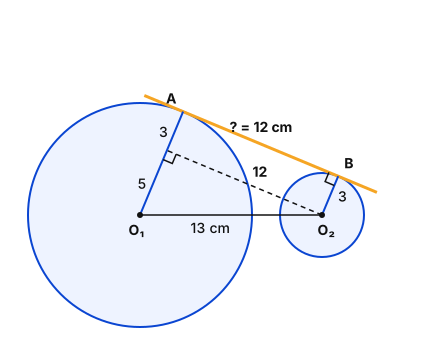
If two circles of radius 8 cm and 3 cm have their centres 13 cm apart, what is the length of the direct common tangent?
यदि 8 cm और 3 cm त्रिज्या वाले दो वृत्तों के केंद्रों के बीच की दूरी 13 cm है, तो सीधी उभयनिष्ठ स्पर्श रेखा की लंबाई क्या है?
  1. A124 cm
  2. B114 cm
  3. C78 cm
  4. D12 cm
Show answer

Concept: Direct common tangent = d2−(r1−r2)2.

  1. d=13, r1−r2=5.
  2. 169−25=144=12 cm.

Trick: 5-12-13 is a Pythagorean triplet – with 13 and 5, the answer is 12 at sight. (Transverse uses r1+r2.)

Answer: (D) 12 cm

अवधारणा: सीधी उभयनिष्ठ स्पर्श रेखा = d2−(r1−r2)2.

हल:

  1. d=13, r1−r2=5.
  2. 169−25=144=12 cm.

ट्रिक: 5-12-13 पाइथागोरस त्रिक है – 13 और 5 देखते ही उत्तर 12. (अनुप्रस्थ में r1+r2 लेते हैं।)

उत्तर: (D) 12 cm

SSC CGLQuantitative AptitudeCircles – direct common tangentSSC CGL 2025 · 25 Sep Shift 1 →
Q572.
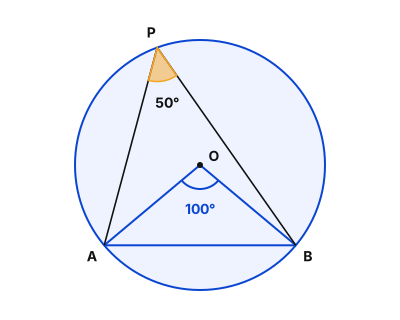
A chord separates a circle into two segments. If the angle formed by the chord at the centre is 100°, what is the angle formed at a point located in the major segment?
एक जीवा वृत्त को दो खंडों में बाँटती है। यदि जीवा केंद्र पर 100° का कोण बनाती है, तो दीर्घ खंड में स्थित बिंदु पर वह कितना कोण बनाएगी?
  1. A90°
  2. B75°
  3. C50°
  4. D120°
Show answer

Concept: Angle at the centre = 2 × angle at the circumference (same arc).

  1. Chord makes 100° at centre.
  2. Point in major segment: 100° ÷ 2 = 50°.

Trick: Minor segment angle would be 180° − 50° = 130° (cyclic quadrilateral). Major segment ⇒ the acute one.

Answer: (C) 50°

अवधारणा: केंद्र पर कोण = परिधि पर कोण का दोगुना (एक ही चाप)।

हल:

  1. जीवा केंद्र पर 100° बनाती है।
  2. दीर्घ खंड के बिंदु पर: 100° ÷ 2 = 50°.

ट्रिक: लघु खंड में कोण = 180° − 50° = 130°। दीर्घ खंड ⇒ न्यून कोण।

उत्तर: (C) 50°

SSC CGLQuantitative AptitudeCircle – angle in major segmentSSC CGL 2025 · 25 Sep Shift 1 →
Q573.
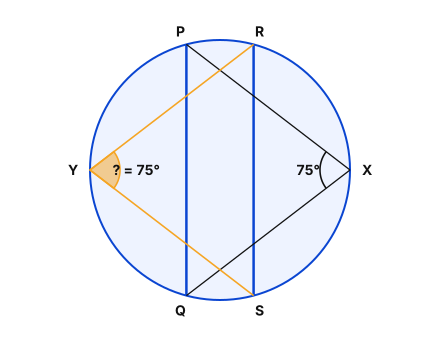
In a circle, the chords PQ and RS are equal. The angle subtended by PQ at the circumference is 75°. What is the angle subtended by RS at the circumference?
एक वृत्त में जीवाएँ PQ और RS बराबर हैं। PQ परिधि पर 75° का कोण बनाती है। RS परिधि पर कितना कोण बनाएगी?
  1. A75°
  2. B37.5°
  3. C120°
  4. D95°
Show answer

Concept: Equal chords subtend equal angles at the centre, hence at the circumference too.

  1. PQ = RS ⇒ equal central angles.
  2. Each circumference angle is half the central angle ⇒ RS also subtends 75°.

Trick: No calculation needed – 'equal chords ⇒ equal angles' gives the same 75°.

Answer: (A) 75°

अवधारणा: बराबर जीवाएँ केंद्र पर और परिधि पर बराबर कोण बनाती हैं।

हल:

  1. PQ = RS ⇒ केंद्रीय कोण बराबर।
  2. परिधि का कोण केंद्रीय कोण का आधा ⇒ RS भी 75° बनाएगी।

ट्रिक: गणना की ज़रूरत नहीं – 'बराबर जीवा ⇒ बराबर कोण'।

उत्तर: (A) 75°

SSC CGLQuantitative AptitudeCircle – equal chordsSSC CGL 2025 · 25 Sep Shift 1 →
Q574.
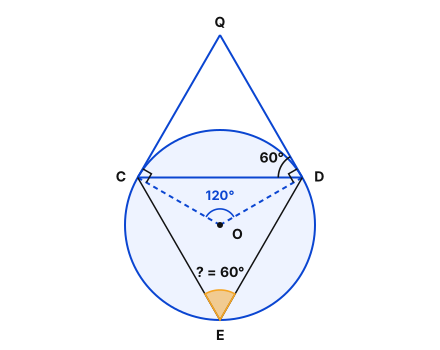
A chord CD is drawn in a circle with centre O. The tangent at C and the tangent at D meet at a point Q. If ∠CDQ = 60°, what is the angle subtended by the chord CD at the circumference of the circle?
केंद्र O वाले एक वृत्त में जीवा CD खींची गई है। C और D पर खींची गई स्पर्श रेखाएँ बिंदु Q पर मिलती हैं। यदि ∠CDQ = 60° है, तो जीवा CD परिधि पर कितना कोण बनाएगी?
  1. A30°
  2. B60°
  3. C90°
  4. D120°
Show answer

Concept: Tangents from an external point are equal; use the tangent–chord angle.

  1. QC = QD ⇒ ∠QCD = ∠QDC = 60° ⇒ ∠CQD = 60°.
  2. ∠COD = 180° − 60° = 120° (quadrilateral OCQD has two 90° angles).
  3. Angle at circumference = 120° ÷ 2 = 60°.

Trick: Alternate segment theorem: angle between tangent and chord (60°) equals the angle the chord makes in the other segment – answer directly 60°.

Answer: (B) 60°

अवधारणा: बाहरी बिंदु से स्पर्श रेखाएँ बराबर; स्पर्श रेखा–जीवा कोण का उपयोग करें।

हल:

  1. QC = QD ⇒ ∠QCD = ∠QDC = 60° ⇒ ∠CQD = 60°.
  2. ∠COD = 180° − 60° = 120° (OCQD में दो कोण 90°)।
  3. परिधि पर कोण = 120° ÷ 2 = 60°.

ट्रिक: एकांतर खंड प्रमेय: स्पर्श रेखा–जीवा कोण (60°) = दूसरे खंड में जीवा का कोण – सीधे 60°.

उत्तर: (B) 60°

SSC CGLQuantitative AptitudeCircle – tangents and chordSSC CGL 2025 · 25 Sep Shift 1 →
Q575.
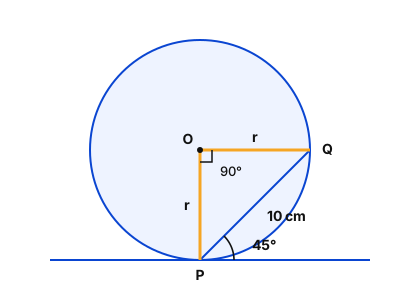
A line is tangent to a circle at point P. If a chord PQ has a length of 10 cm and makes an angle of 45° with the tangent, what is the radius of the circle?
एक रेखा वृत्त को बिंदु P पर स्पर्श करती है। यदि जीवा PQ की लंबाई 10 cm है और वह स्पर्श रेखा से 45° का कोण बनाती है, तो वृत्त की त्रिज्या क्या है?
  1. A44 cm
  2. B33 cm
  3. C53 cm
  4. D52 cm
Show answer

Concept: Angle between tangent and chord = half the central angle of that chord.

  1. Tangent–chord angle 45° ⇒ ∠POQ=90∘.
  2. Triangle POQ is right-isosceles with OP=OQ=r⇒PQ=r2.
  3. r=102=52 cm.

Trick: Central angle 90° ⇒ chord = radius ×2 (like the diagonal of a square).

Answer: (D) 52 cm

अवधारणा: स्पर्श रेखा–जीवा कोण = जीवा के केंद्रीय कोण का आधा।

हल:

  1. कोण 45° ⇒ ∠POQ=90∘.
  2. त्रिभुज POQ समकोण समद्विबाहु, OP=OQ=r⇒PQ=r2.
  3. r=102=52 cm.

ट्रिक: केंद्रीय कोण 90° ⇒ जीवा = त्रिज्या ×2 (वर्ग के विकर्ण जैसा)।

उत्तर: (D) 52 cm

SSC CGLQuantitative AptitudeCircle – tangent–chord angle and radiusSSC CGL 2025 · 25 Sep Shift 1 →
Q576.
Select the most appropriate option to substitute the underline/Bold segment in the given sentence.
If I was a bird, I would fly to distant lands.
  1. Ais
  2. Bwere
  3. Cam
  4. Dbeen
Show answer

Concept: Unreal/imaginary 'if' clauses use 'were' with every subject.

  1. Being a bird is impossible ⇒ hypothetical condition.
  2. Pattern: If + subject + were …, subject + would + V1.
  3. So the clause becomes If I were a bird…

Trick: See 'would' in the main clause + an impossible wish ⇒ fill 'were' (If I were you / As if he were …).

Answer: (B) were

अवधारणा: काल्पनिक 'if' वाक्यों में हर subject के साथ 'were' आता है।

हल:

  1. पक्षी बनना असंभव है ⇒ काल्पनिक शर्त।
  2. ढाँचा: If + subject + were …, subject + would + V1.
  3. सही रूप: If I were a bird…

ट्रिक: Main clause में 'would' और असंभव इच्छा दिखे ⇒ 'were' (If I were you, As if he were …)।

उत्तर: (B) were

SSC CGLEnglish ComprehensionSubjunctive mood – If I wereSSC CGL 2025 · 25 Sep Shift 1 →
Q577.
Select the correct indirect/direct form of the given sentence.
She told her friend that she had visited that place.
  1. AShe told her friend, "I have visited this place."
  2. BShe said to her friend, "I visit this place."
  3. CShe told her friend, "I had visited that place."
  4. DShe said to her friend, "She visited that place."
Show answer

Concept: Undo the changes of reported speech.

  1. Past perfect 'had visited' goes back to present perfect 'have visited'.
  2. 'she' (speaker) → 'I'; 'that place' → 'this place'.
  3. Direct: She told her friend, "I have visited this place."

Trick: In direct speech, the quote uses the speaker's own words – look for 'I' and 'this'; that removes (C) and (D) at once.

Answer: (A) She told her friend, "I have visited this place."

अवधारणा: Reported speech के बदलाव उल्टे करें।

हल:

  1. Past perfect 'had visited' → present perfect 'have visited'.
  2. 'she' (वक्ता) → 'I'; 'that place' → 'this place'.
  3. Direct: She told her friend, "I have visited this place."

ट्रिक: Direct speech में वक्ता के अपने शब्द – 'I' और 'this' खोजें; (C), (D) तुरंत बाहर।

उत्तर: (A) She told her friend, "I have visited this place."

SSC CGLEnglish ComprehensionNarration – indirect to directSSC CGL 2025 · 25 Sep Shift 1 →
Q578.
Select the most appropriate antonym of the given word: ALACRITY
  1. AEagerness
  2. BApathy
  3. CPromptness
  4. DGlee
Show answer

Concept: Alacrity = quick, cheerful willingness.

  1. Opposite needed: lack of interest/energy = Apathy.
  2. Eagerness, Promptness, Glee are close in meaning (synonym-type), not opposites.

Trick: Three options share one 'mood' (eager, prompt, glad) – the odd one with the opposite mood is the antonym.

Answer: (B) Apathy

अवधारणा: Alacrity = तत्परता, उत्साहपूर्ण तैयारी।

हल:

  1. विलोम चाहिए: उदासीनता = Apathy.
  2. Eagerness, Promptness, Glee लगभग समानार्थी हैं।

ट्रिक: तीन विकल्प एक ही भाव (उत्साह) के हों तो अलग भाव वाला ही विलोम है।

उत्तर: (B) Apathy

SSC CGLEnglish ComprehensionAntonym – AlacritySSC CGL 2025 · 25 Sep Shift 1 →
Q579.
Select the most appropriate meaning of the given idiom:
To throw dust in one's eyes
  1. ATo clean someone's eyes with dust
  2. BTo ignore someone’s presence
  3. CTo confuse or mislead someone deliberately
  4. DTo cause minor irritation
Show answer

Concept: Idioms carry a figurative meaning, not the literal one.

  1. To throw dust in someone's eyes = to deceive or mislead them on purpose.
  2. Example: The thief threw dust in the guard's eyes by posing as a delivery man.

Yaad rakhein: Hindi equivalent: 'आँखों में धूल झोंकना'. Similar idiom: 'pull the wool over someone's eyes'.

Answer: (C) To confuse or mislead someone deliberately

अवधारणा: मुहावरे का अर्थ लाक्षणिक होता है, शाब्दिक नहीं।

हल:

  1. To throw dust in someone's eyes = जानबूझकर धोखा देना/भ्रमित करना।
  2. (A) शाब्दिक अर्थ है – गलत।

याद रखें: हिंदी में ठीक यही मुहावरा है: 'आँखों में धूल झोंकना'। समान: 'pull the wool over someone's eyes'।

उत्तर: (C) To confuse or mislead someone deliberately

SSC CGLEnglish ComprehensionIdiom – throw dust in one's eyesSSC CGL 2025 · 25 Sep Shift 1 →
Q580.
Select the option that can be used as a one-word substitute for the given group of words.
A person who chooses to live a simple life, often for religious or spiritual reasons, abstaining from worldly pleasures.
  1. AHedonist
  2. BSybarite
  3. CAscetic
  4. DLibertine
Show answer

Concept: Match the definition word by word.

  1. Ascetic = one who lives simply and gives up worldly pleasures, usually for spiritual reasons.
  2. Hedonist / Sybarite = pleasure-lover; Libertine = one without moral restraint – all opposite in spirit.

Yaad rakhein: Pleasure-seeker words (hedonist, sybarite, epicure) vs self-denial words (ascetic, anchorite, hermit) often appear as a pair in SSC.

Answer: (C) Ascetic

अवधारणा: परिभाषा को शब्द से मिलाएँ।

हल:

  1. Ascetic = तपस्वी, जो आध्यात्मिक कारण से सांसारिक सुख त्याग दे।
  2. Hedonist / Sybarite = भोगविलासी; Libertine = नैतिक बंधन न मानने वाला।

याद रखें: भोग वाले शब्द (hedonist, sybarite, epicure) बनाम त्याग वाले शब्द (ascetic, anchorite, hermit) – SSC में अक्सर साथ आते हैं।

उत्तर: (C) Ascetic

SSC CGLEnglish ComprehensionOne-word substitution – AsceticSSC CGL 2025 · 25 Sep Shift 1 →