Q761.A man made a 20% profit on his investment. If he invested ₹10,000 and reinvested the profit, what would his net worth be after the second year at the same rate of return?
एक व्यक्ति को अपने निवेश पर 20% लाभ हुआ। यदि उसने ₹10,000 निवेश किए और लाभ को फिर से लगा दिया, तो उसी दर पर दूसरे वर्ष के अंत में उसकी कुल राशि कितनी होगी?
- A₹16,000
- B₹16,050
- C₹14,400
- D₹14,150
Show answer
Concept: Reinvesting the profit makes it compound growth: .
- After year 1: ₹12,000.
- After year 2: ₹14,400.
Trick: 20% twice = ⇒ ₹14,400.
Answer: (C) ₹14,400
अवधारणा: लाभ का पुनर्निवेश = चक्रवृद्धि: ।
- पहले वर्ष बाद: ₹12,000।
- दूसरे वर्ष बाद: ₹14,400।
ट्रिक: दो बार 20% = ⇒ ₹14,400।
उत्तर: (C) ₹14,400
Q762.A vendor offers a 10% discount on the marked price and sells a packet of salty biscuits for ₹180. If the profit earned on this sale is 50%, find the cost price.
एक विक्रेता अंकित मूल्य पर 10% छूट देकर नमकीन बिस्किट का पैकेट ₹180 में बेचता है। यदि इस बिक्री पर 50% लाभ हुआ, तो क्रय मूल्य ज्ञात कीजिए।
- A₹136
- B₹120
- C₹130
- D₹110
Show answer
Concept: . The discount is already included in SP.
- SP = ₹180 (after discount).
- CP = ₹120.
Trick: 50% profit ⇒ of . The 10% discount is extra data here.
Answer: (B) ₹120
अवधारणा: । छूट पहले ही SP में शामिल है।
- SP = ₹180 (छूट के बाद)।
- CP = ₹120।
ट्रिक: 50% लाभ ⇒ का । 10% छूट यहाँ अनावश्यक आँकड़ा है।
उत्तर: (B) ₹120
Q763.The average monthly salary of 10 employees in a company's IT department is ₹45,000. If two new employees join, taking the total to 12, and the average becomes ₹46,500, what is the average salary of the two new employees?
एक कंपनी के आईटी विभाग में 10 कर्मचारियों का औसत मासिक वेतन ₹45,000 है। दो नए कर्मचारी जुड़ने पर संख्या 12 हो जाती है और औसत ₹46,500 हो जाता है। दोनों नए कर्मचारियों का औसत वेतन क्या है?
- A₹50,000
- B₹54,000
- C₹57,000
- D₹52,000
Show answer
Concept: Sum = average × number; new members' sum = new total − old total.
- Rise in average = ₹1,500.
- This rise for all 12 people = ₹18,000, brought in by the two newcomers above the old ₹45,000 each.
- Newcomers' average = ₹54,000.
Trick: Check by totals: ; .
Answer: (B) ₹54,000
अवधारणा: योग = औसत × संख्या; नए सदस्यों का योग = नया योग − पुराना योग।
- पुराना योग = 4,50,000।
- नया योग = ।
- दो नए = 1,08,000 ⇒ औसत ₹54,000।
ट्रिक: विचलन विधि: 12 लोगों का औसत 1,500 बढ़ा = 18,000; नया औसत = ₹54,000।
उत्तर: (B) ₹54,000
Q764.A triangular storage prism has a base in the shape of a right triangle whose side lengths are in the ratio 3 : 4 : 5. If the perimeter of the base is 54 cm and the height of the prism is 8 cm, find the lateral surface area of the prism.
एक त्रिभुजाकार प्रिज़्म का आधार समकोण त्रिभुज है जिसकी भुजाएँ 3 : 4 : 5 के अनुपात में हैं। यदि आधार का परिमाप 54 cm और प्रिज़्म की ऊँचाई 8 cm है, तो प्रिज़्म का पार्श्व पृष्ठीय क्षेत्रफल ज्ञात कीजिए।
- A360 cm²
- B300 cm²
- C480 cm²
- D432 cm²
Show answer
Concept: Lateral surface area of any prism = perimeter of base × height.
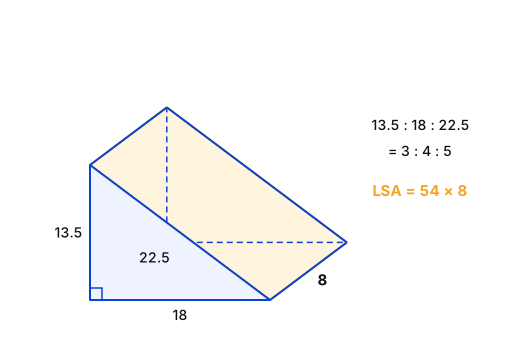
- Base perimeter = 54 cm (sides 13.5, 18, 22.5 – not needed).
- LSA = .
Trick: The 3 : 4 : 5 ratio is a distractor for LSA; it is needed only for total surface area (base area).
Answer: (D) 432 cm²
अवधारणा: किसी भी प्रिज़्म का पार्श्व पृष्ठ = आधार का परिमाप × ऊँचाई।
- आधार परिमाप = 54 cm।
- LSA = ।
ट्रिक: 3 : 4 : 5 अनुपात केवल संपूर्ण पृष्ठ (आधार क्षेत्रफल) के लिए चाहिए, LSA के लिए नहीं।
उत्तर: (D) 432 cm²
Q765.The average marks of 12 students is 85. When one student is removed, the average of the remaining 11 becomes 82. What were the marks of the removed student?
12 विद्यार्थियों का औसत अंक 85 है। एक विद्यार्थी हटाने पर शेष 11 का औसत 82 हो जाता है। हटाए गए विद्यार्थी के अंक कितने थे?
- A115
- B118
- C120
- D110
Show answer
Concept: Removed value = old total − new total.
- .
- .
- Removed = .
Trick: Removed marks = old avg + (drop in avg × remaining) = .
Answer: (B) 118
अवधारणा: हटाया गया मान = पुराना योग − नया योग।
- ।
- ।
- हटाया = 118।
ट्रिक: हटाए गए अंक = पुराना औसत + (औसत में कमी × शेष संख्या) = ।
उत्तर: (B) 118
Q766.A distributor marks a batch of 220 identical mobile chargers at 45% above cost price and offers a 15% discount to retailers. A retailer buys all the chargers and spends ₹14,790. What is the cost price per charger for the wholesaler?
एक वितरक 220 एक जैसे मोबाइल चार्जर को क्रय मूल्य से 45% ऊपर अंकित करता है और फुटकर विक्रेताओं को 15% छूट देता है। एक फुटकर विक्रेता सभी चार्जर ₹14,790 में खरीदता है। थोक विक्रेता के लिए प्रति चार्जर क्रय मूल्य क्या है?
- A₹54.5
- B₹57.5
- C₹56.5
- D₹55.5
Show answer
Concept: SP = .
- Factor = .
- Total CP = ₹12,000.
- Per charger = ₹54.5.
Trick: Net % = , so SP = 123.25% of CP.
Answer: (A) ₹54.5
अवधारणा: विक्रय मूल्य = CP × (1 + मार्कअप) × (1 − छूट)।
- गुणक = ।
- कुल CP = ₹12,000।
- प्रति चार्जर = ₹54.5।
ट्रिक: शुद्ध % = ; SP = CP का 123.25%।
उत्तर: (A) ₹54.5
Q767.If cotA = , then what is the value of cosecA?
यदि cotA = है, तो cosecA का मान क्या है?
- A
- B
- C
- D1
Show answer
Concept: .
- .
- .
- .
Trick: 3-4-5 triangle: = , so = .
Answer: (C)
अवधारणा: ।
- ।
- ।
- ।
ट्रिक: 3-4-5 त्रिभुज: = , अतः = ।
उत्तर: (C)
Q768.If 1 + cot²θ = cosec²θ, then what is the value of 3cosec²30° − 3cot²30°?
यदि 1 + cot²θ = cosec²θ है, तो 3cosec²30° − 3cot²30° का मान क्या है?
- A5
- B1
- C3
- D6
Show answer
Concept: for every .
- .
- .
Trick: Verify: , .
Answer: (C) 3
अवधारणा: हर के लिए ।
- ।
- ।
ट्रिक: जाँच: , ।
उत्तर: (C) 3
Q769.A sector of a circle has a radius of 20 cm and a central angle of radians. What is the area of the sector?
एक त्रिज्यखंड की त्रिज्या 20 cm और केंद्रीय कोण रेडियन है। त्रिज्यखंड का क्षेत्रफल क्या है?
- A141.4π cm²
- B171.4π cm²
- C145.5π cm²
- D175.8π cm²
Show answer
Concept: Sector area = ( in radians).
- .
- .
Trick: : , remainder 3 ⇒ 171.4.
Answer: (B) 171.4π cm²
अवधारणा: त्रिज्यखंड का क्षेत्रफल = ( रेडियन में)।
- ।
- ।
ट्रिक: : , शेष 3 ⇒ 171.4।
उत्तर: (B) 171.4π cm²
Q770.If sec(90° − θ) = y and θ is an acute angle, then what is the value of sinθ in terms of y?
यदि sec(90° − θ) = y है और θ न्यून कोण है, तो sinθ का मान y के पदों में क्या होगा?
- Ay
- B
- C
- DUndefinedअपरिभाषित
Show answer
Concept: .
- .
- .
Trick: Co-function pairs: sin↔cos, tan↔cot, sec↔cosec swap when is used.
Answer: (C)
अवधारणा: ।
- ।
- ।
ट्रिक: पर जोड़े आपस में बदलते हैं: sin↔cos, tan↔cot, sec↔cosec।
उत्तर: (C)
Q771.The radii of two circles are 8 cm and 3 cm. The centres of the two circles are 12 cm apart. What is the length of a transverse common tangent?
दो वृत्तों की त्रिज्याएँ 8 cm और 3 cm हैं। उनके केंद्रों के बीच की दूरी 12 cm है। तिर्यक उभयनिष्ठ स्पर्श रेखा की लंबाई क्या है?
- A cm
- B cm
- C cm
- D cm
Show answer
Concept: Transverse (direct-cross) tangent = .
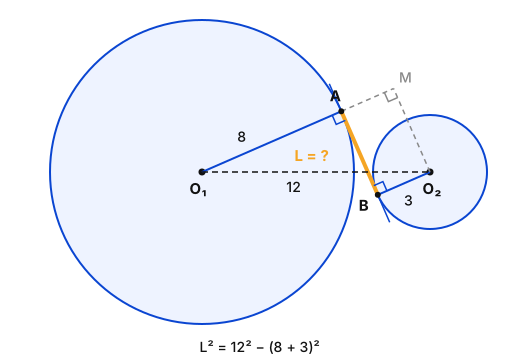
- , .
- cm.
Trick: Transverse uses , direct uses – 'cross = sum'.
Answer: (C) cm
अवधारणा: अनुप्रस्थ स्पर्शरेखा = ।
- , ।
- cm।
ट्रिक: अनुप्रस्थ में , सीधी में – 'क्रॉस = योग'।
उत्तर: (C) cm
Q772.In a circle, a chord AB subtends an angle of 40° at point C on the circumference. What angle does it subtend at point D on the circumference, on the same side as C?
एक वृत्त में जीवा AB, परिधि पर स्थित बिंदु C पर 40° का कोण बनाती है। C वाली ही ओर स्थित बिंदु D पर वह कितना कोण बनाएगी?
- A40°
- B80°
- C140°
- D150°
Show answer
Concept: Angles subtended by a chord in the same segment are equal.
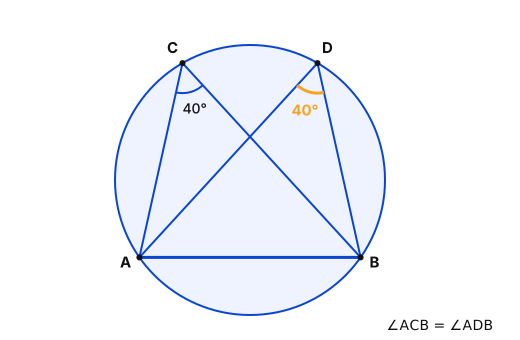
- C and D are on the same side of AB ⇒ same segment.
- ∠ADB = ∠ACB = 40°.
Trick: Opposite side would give the supplement (180° − 40° = 140°) – that is the trap option.
Answer: (A) 40°
अवधारणा: एक ही वृत्तखंड में जीवा द्वारा बने कोण बराबर होते हैं।
- C और D, AB के एक ही ओर ⇒ एक ही वृत्तखंड।
- ∠ADB = ∠ACB = 40°।
ट्रिक: विपरीत ओर का बिंदु 180° − 40° = 140° देता – यही भ्रामक विकल्प है।
उत्तर: (A) 40°
Q773.A chord of length 24 cm is drawn in a circle of radius 13 cm. What is the distance of the chord from the centre of the circle?
13 cm त्रिज्या वाले वृत्त में 24 cm लंबी जीवा खींची गई है। केंद्र से जीवा की दूरी क्या है?
- A5 cm
- B10 cm
- C8 cm
- D11 cm
Show answer
Concept: Perpendicular from centre bisects the chord: .
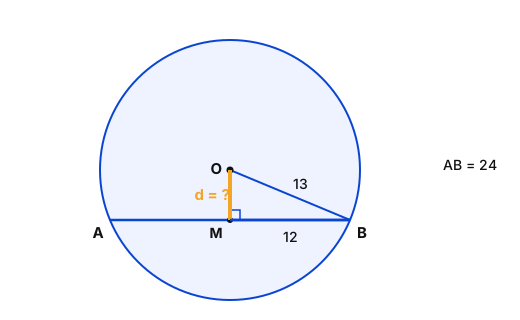
- Half chord = 12.
- cm.
Trick: 5-12-13 is a Pythagorean triplet – answer at sight.
Answer: (A) 5 cm
अवधारणा: केंद्र से लंब जीवा को समद्विभाजित करता है: ।
- आधी जीवा = 12।
- cm।
ट्रिक: 5-12-13 पाइथागोरस त्रिक है – उत्तर तुरंत।
उत्तर: (A) 5 cm
Q774.In a circle, the chord PQ subtends an angle of 100° at the centre O. What is the measure of the angle PRQ subtended by the same chord PQ at a point R on the remaining part of the circle?
एक वृत्त में जीवा PQ केंद्र O पर 100° का कोण बनाती है। वही जीवा PQ, वृत्त के शेष भाग पर स्थित बिंदु R पर कितना कोण ∠PRQ बनाएगी?
- A50°
- B60°
- C90°
- D120°
Show answer
Concept: Angle at centre = 2 × angle at the circumference (on the major arc).
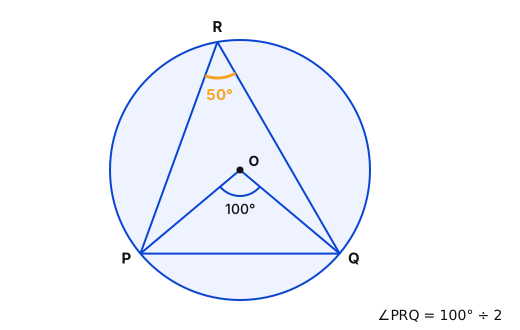
- ∠PRQ = 100° ÷ 2 = 50°.
Trick: If R were on the minor arc, the angle would be 180° − 50° = 130° – not in options, confirming 50°.
Answer: (A) 50°
अवधारणा: केंद्र पर कोण = परिधि के शेष भाग पर कोण का दोगुना।
- ∠PRQ = 100° ÷ 2 = 50°।
ट्रिक: R लघु चाप पर होता तो 180° − 50° = 130° होता – विकल्पों में नहीं, अतः 50°।
उत्तर: (A) 50°
Q775.A line is drawn from a point P, 15 cm away from the centre O of a circle of radius 12 cm. If this line is a tangent to the circle, what is the length of the tangent from P to the point of contact?
12 cm त्रिज्या वाले वृत्त के केंद्र O से 15 cm दूर स्थित बिंदु P से एक रेखा खींची गई है। यदि यह रेखा वृत्त की स्पर्श रेखा है, तो P से स्पर्श बिंदु तक उसकी लंबाई क्या है?
- A3 cm
- B9 cm
- C12 cm
- D10 cm
Show answer
Concept: Radius tangent ⇒ .
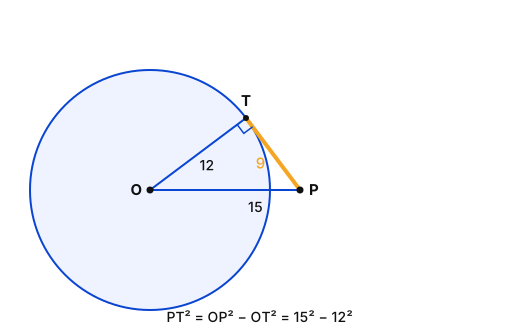
- Tangent = .
- cm.
Trick: 9-12-15 = 3 × (3-4-5) triplet – answer at sight.
Answer: (B) 9 cm
अवधारणा: त्रिज्या स्पर्शरेखा ⇒ स्पर्शरेखा² ।
- ।
- cm।
ट्रिक: 9-12-15 = 3 × (3-4-5) त्रिक – उत्तर तुरंत।
उत्तर: (B) 9 cm
Directions (Qs. 76-80): In the following passage some words have been deleted. Read the passage carefully and select the most appropriate option to fill in each blank.
To treat gender as ontologically prior or naturally originary is to misunderstand its position as a (76) ____ — a semiotic and performative formation whose apparent stability is produced only through continual repetition across spatial, legal and psychic structures. In this framework, embodiment is not simply experienced but actively mediated, shaped by interpretive regimes that legitimize certain bodies while casting others as abject, deviant or structurally unintelligible. The state, working alongside biomedical epistemes and juridico-political grammars, engages in a necropolitical management of life itself, wherein recognition is not inherent but (77) ____ , distributed through historically contingent and politically malleable matrices of intelligibility. This arrangement positions gender as a matter of discursive legibility rather than biological inevitability. Resistance, when articulated within these same grammars, can inadvertently reinforce the structures it aims to challenge. Consequently, the radical imperative is not merely to broaden the scope of recognition, but to pursue a (78) ____ of recognition’s ontological foundations. This move requires rejecting the liberal dialectics of inclusion and exclusion and revealing their constitutive foreclosure of alterity. Such a politics demands the (79) ____ of normativity as the organizing principle of embodiment. Only through this dismantling can a post-identitarian ethics of becoming emerge — one that favours contingency over coherence, opacity over transparency and relational indeterminacy over categorical fixity. Within this schema, freedom is not recuperative but (80) ____ — a break from taxonomic legibility and a refusal of the logocentric demand to be fully known.
Q776.Select the most appropriate option to fill in blank number (76).
- Apraxis-field
- Bontotheological mirror
- Cdiffident
- Dnomos
Show answer
Concept: The blank is a noun explained right after the dash: 'a semiotic and performative formation' made by repetition.
- Gender is described as produced through repeated practice, not as natural.
- 'Praxis-field' = an area formed by practice/action – fits 'performative formation'.
- 'Diffident' (shy) is an adjective – grammatically impossible after 'a'; 'nomos' (law/norm) and 'ontotheological mirror' do not match 'performative'.
Trick: In cloze tests, read the phrase after a dash or colon – it usually defines the missing word.
Answer: (A) praxis-field
अवधारणा: रिक्त स्थान एक संज्ञा है, जिसकी व्याख्या डैश के बाद दी है: 'a semiotic and performative formation' जो दोहराव से बनता है।
- Gender को स्वाभाविक नहीं, बार-बार के अभ्यास (performance) से बना बताया गया है।
- 'Praxis-field' = अभ्यास/क्रिया से बना क्षेत्र – 'performative formation' से मेल।
- 'Diffident' (संकोची) विशेषण है – 'a' के बाद संज्ञा चाहिए; 'nomos' और 'ontotheological mirror' 'performative' से मेल नहीं खाते।
ट्रिक: क्लोज़ टेस्ट में डैश या कोलन के बाद वाला भाग पढ़ें – वहीं प्रायः रिक्त शब्द की परिभाषा होती है।
उत्तर: (A) praxis-field
Directions (Qs. 76-80): In the following passage some words have been deleted. Read the passage carefully and select the most appropriate option to fill in each blank.
To treat gender as ontologically prior or naturally originary is to misunderstand its position as a (76) ____ — a semiotic and performative formation whose apparent stability is produced only through continual repetition across spatial, legal and psychic structures. In this framework, embodiment is not simply experienced but actively mediated, shaped by interpretive regimes that legitimize certain bodies while casting others as abject, deviant or structurally unintelligible. The state, working alongside biomedical epistemes and juridico-political grammars, engages in a necropolitical management of life itself, wherein recognition is not inherent but (77) ____ , distributed through historically contingent and politically malleable matrices of intelligibility. This arrangement positions gender as a matter of discursive legibility rather than biological inevitability. Resistance, when articulated within these same grammars, can inadvertently reinforce the structures it aims to challenge. Consequently, the radical imperative is not merely to broaden the scope of recognition, but to pursue a (78) ____ of recognition’s ontological foundations. This move requires rejecting the liberal dialectics of inclusion and exclusion and revealing their constitutive foreclosure of alterity. Such a politics demands the (79) ____ of normativity as the organizing principle of embodiment. Only through this dismantling can a post-identitarian ethics of becoming emerge — one that favours contingency over coherence, opacity over transparency and relational indeterminacy over categorical fixity. Within this schema, freedom is not recuperative but (80) ____ — a break from taxonomic legibility and a refusal of the logocentric demand to be fully known.
Q777.Select the most appropriate option to fill in blank number (77).
- Aconditionality
- Bsuccour
- Cpresumption
- Dirrevocability
Show answer
Concept: 'Not X but ___' needs the opposite idea of 'inherent' (natural, built-in).
- Recognition is 'distributed' through changing, political matrices – i.e. given only on certain conditions.
- 'Conditionality' = depending on conditions ✓.
- 'Irrevocability' (cannot be withdrawn) and 'presumption' contradict 'contingent and malleable'; 'succour' (help) is off-topic.
Trick: 'Not … but …' structure: the second word is the opposite of the first – inherent ↔ conditional.
Answer: (A) conditionality
अवधारणा: 'Not X but ___' में 'inherent' (स्वाभाविक, अंतर्निहित) का विपरीत भाव चाहिए।
- Recognition बदलती राजनीतिक व्यवस्थाओं से 'बाँटी' जाती है – यानी शर्तों पर मिलती है।
- 'Conditionality' = शर्तों पर निर्भरता ✓।
- 'Irrevocability' (वापस न लिया जा सके) और 'presumption' 'contingent, malleable' के विपरीत हैं; 'succour' (सहायता) असंबंधित।
ट्रिक: 'Not … but …' संरचना में दूसरा शब्द पहले का उल्टा होता है – inherent ↔ conditional।
उत्तर: (A) conditionality
Directions (Qs. 76-80): In the following passage some words have been deleted. Read the passage carefully and select the most appropriate option to fill in each blank.
To treat gender as ontologically prior or naturally originary is to misunderstand its position as a (76) ____ — a semiotic and performative formation whose apparent stability is produced only through continual repetition across spatial, legal and psychic structures. In this framework, embodiment is not simply experienced but actively mediated, shaped by interpretive regimes that legitimize certain bodies while casting others as abject, deviant or structurally unintelligible. The state, working alongside biomedical epistemes and juridico-political grammars, engages in a necropolitical management of life itself, wherein recognition is not inherent but (77) ____ , distributed through historically contingent and politically malleable matrices of intelligibility. This arrangement positions gender as a matter of discursive legibility rather than biological inevitability. Resistance, when articulated within these same grammars, can inadvertently reinforce the structures it aims to challenge. Consequently, the radical imperative is not merely to broaden the scope of recognition, but to pursue a (78) ____ of recognition’s ontological foundations. This move requires rejecting the liberal dialectics of inclusion and exclusion and revealing their constitutive foreclosure of alterity. Such a politics demands the (79) ____ of normativity as the organizing principle of embodiment. Only through this dismantling can a post-identitarian ethics of becoming emerge — one that favours contingency over coherence, opacity over transparency and relational indeterminacy over categorical fixity. Within this schema, freedom is not recuperative but (80) ____ — a break from taxonomic legibility and a refusal of the logocentric demand to be fully known.
Q778.Select the most appropriate option to fill in blank number (78).
- Areiteration
- Bdestitution
- Cemancipation
- Dinterpolation
Show answer
Concept: 'Not merely to broaden … but to pursue a ___ of the foundations' asks for a deeper, freeing move.
- The author wants to escape the very basis of recognition, not just enlarge it.
- 'Emancipation' = setting free from control ✓.
- 'Reiteration' (repeating) would strengthen the old base; 'interpolation' (inserting) is too mild.
Trick: 'Not merely … but …' signals a stronger step than the first – choose the most radical-positive word.
Answer: (C) emancipation
अवधारणा: 'Not merely to broaden … but to pursue a ___' में केवल विस्तार नहीं, गहरी मुक्ति का भाव चाहिए।
- लेखक recognition की नींव से ही मुक्त होना चाहता है, उसे केवल बड़ा करना नहीं।
- 'Emancipation' = नियंत्रण से मुक्ति ✓।
- 'Reiteration' (दोहराना) पुरानी नींव को मज़बूत करेगा; 'interpolation' (बीच में जोड़ना) कमज़ोर अर्थ।
ट्रिक: 'Not merely … but …' संकेत देता है कि दूसरा कदम पहले से अधिक प्रबल होगा।
उत्तर: (C) emancipation
Directions (Qs. 76-80): In the following passage some words have been deleted. Read the passage carefully and select the most appropriate option to fill in each blank.
To treat gender as ontologically prior or naturally originary is to misunderstand its position as a (76) ____ — a semiotic and performative formation whose apparent stability is produced only through continual repetition across spatial, legal and psychic structures. In this framework, embodiment is not simply experienced but actively mediated, shaped by interpretive regimes that legitimize certain bodies while casting others as abject, deviant or structurally unintelligible. The state, working alongside biomedical epistemes and juridico-political grammars, engages in a necropolitical management of life itself, wherein recognition is not inherent but (77) ____ , distributed through historically contingent and politically malleable matrices of intelligibility. This arrangement positions gender as a matter of discursive legibility rather than biological inevitability. Resistance, when articulated within these same grammars, can inadvertently reinforce the structures it aims to challenge. Consequently, the radical imperative is not merely to broaden the scope of recognition, but to pursue a (78) ____ of recognition’s ontological foundations. This move requires rejecting the liberal dialectics of inclusion and exclusion and revealing their constitutive foreclosure of alterity. Such a politics demands the (79) ____ of normativity as the organizing principle of embodiment. Only through this dismantling can a post-identitarian ethics of becoming emerge — one that favours contingency over coherence, opacity over transparency and relational indeterminacy over categorical fixity. Within this schema, freedom is not recuperative but (80) ____ — a break from taxonomic legibility and a refusal of the logocentric demand to be fully known.
Q779.Select the most appropriate option to fill in blank number (79).
- Aablation
- Bconcretization
- Cimmanence
- Dretrieval
Show answer
Concept: The next sentence calls it 'this dismantling', so the blank must mean removing.
- 'Ablation' = surgical removal, cutting away ✓.
- 'Concretization' (making solid) and 'retrieval' (getting back) keep normativity; 'immanence' (being present within) does not mean removal.
Trick: Look at the following sentence for a pronoun-summary ('this dismantling') – it names the blank's meaning.
Answer: (A) ablation
अवधारणा: अगले वाक्य में 'this dismantling' (यह विघटन) लिखा है, अतः रिक्त शब्द का अर्थ 'हटाना' होना चाहिए।
- 'Ablation' = काटकर हटाना ✓।
- 'Concretization' (ठोस बनाना), 'retrieval' (वापस पाना) – normativity बनी रहती; 'immanence' (भीतर विद्यमान) का अर्थ हटाना नहीं।
ट्रिक: अगले वाक्य का 'this …' वाला सार शब्द रिक्त का अर्थ बता देता है।
उत्तर: (A) ablation
Directions (Qs. 76-80): In the following passage some words have been deleted. Read the passage carefully and select the most appropriate option to fill in each blank.
To treat gender as ontologically prior or naturally originary is to misunderstand its position as a (76) ____ — a semiotic and performative formation whose apparent stability is produced only through continual repetition across spatial, legal and psychic structures. In this framework, embodiment is not simply experienced but actively mediated, shaped by interpretive regimes that legitimize certain bodies while casting others as abject, deviant or structurally unintelligible. The state, working alongside biomedical epistemes and juridico-political grammars, engages in a necropolitical management of life itself, wherein recognition is not inherent but (77) ____ , distributed through historically contingent and politically malleable matrices of intelligibility. This arrangement positions gender as a matter of discursive legibility rather than biological inevitability. Resistance, when articulated within these same grammars, can inadvertently reinforce the structures it aims to challenge. Consequently, the radical imperative is not merely to broaden the scope of recognition, but to pursue a (78) ____ of recognition’s ontological foundations. This move requires rejecting the liberal dialectics of inclusion and exclusion and revealing their constitutive foreclosure of alterity. Such a politics demands the (79) ____ of normativity as the organizing principle of embodiment. Only through this dismantling can a post-identitarian ethics of becoming emerge — one that favours contingency over coherence, opacity over transparency and relational indeterminacy over categorical fixity. Within this schema, freedom is not recuperative but (80) ____ — a break from taxonomic legibility and a refusal of the logocentric demand to be fully known.
Q780.Select the most appropriate option to fill in blank number (80).
- Arecuperative
- Bapophatic
- Cregulatory
- Dvalorized
Show answer
Concept: Freedom here is 'a break' and 'a refusal' – defined by what it rejects.
- 'Apophatic' = describing something through negation (what it is not) ✓.
- 'Recuperative' is already denied ('not recuperative'); 'regulatory' and 'valorized' imply control/approval, opposite of refusal.
Trick: 'Not A but ___' – the answer cannot be A itself, so (A) is eliminated at once.
Answer: (B) apophatic
अवधारणा: यहाँ स्वतंत्रता को 'break' और 'refusal' कहा गया है – यानी जो वह नकारती है, उससे परिभाषित।
- 'Apophatic' = निषेध द्वारा वर्णन (क्या नहीं है) ✓।
- 'Recuperative' को वाक्य स्वयं नकारता है; 'regulatory', 'valorized' नियंत्रण/स्वीकृति दर्शाते हैं, अस्वीकार नहीं।
ट्रिक: 'Not A but ___' में उत्तर A नहीं हो सकता – (A) तुरंत हटता है।
उत्तर: (B) apophatic

