Question bank

Q&A: practice questions with answers

Search questions on any topic. Filter by exam category, exam, subject and topic, try the question, then open the answer and explanation.

Courses – airGurukul

4,800 questions found.

Q961.
A seller offers a combo deal: "Buy 4 shirts for the price of 3". If each shirt costs him ₹1,500, what is the effective loss percentage?
एक विक्रेता ऑफ़र देता है: "4 कमीज़ें 3 की कीमत में"। यदि प्रत्येक कमीज़ उसे ₹1,500 की पड़ती है, तो प्रभावी हानि प्रतिशत क्या है?
  1. A20%
  2. B25%
  3. C30%
  4. D3313%
Show answer

Concept: Loss % = (goods given freetotal goods given)×100.

  1. Gives 4 shirts, gets money for 3 ⇒ 1 shirt free.
  2. Loss % = 14×100=25%.
  3. (₹6,000 cost vs ₹4,500 received ⇒ loss ₹1,500 = 25%.)

Trick: 'Buy x, get y free' ⇒ discount/loss % = yx+y×100; here 14.

Answer: (B) 25%

अवधारणा: हानि % = (मुफ़्त वस्तुएँ ÷ कुल दी गई वस्तुएँ) × 100.

  1. 4 कमीज़ें दीं, पैसे 3 के मिले ⇒ 1 मुफ़्त।
  2. हानि % = 14×100=25%.
  3. (लागत ₹6,000, मिले ₹4,500 ⇒ हानि ₹1,500.)

ट्रिक: 'x खरीदो, y मुफ़्त' ⇒ yx+y×100.

उत्तर: (B) 25%

SSC CGLQuantitative AptitudeProfit & loss – buy 4 pay for 3SSC CGL 2025 · 23 Sep Shift 3 →
Q962.
The price of a product is decreased by y% and then increased by y%. The final price becomes 10% less than the original. What is the value of y (approximately)?
किसी उत्पाद का मूल्य पहले y% घटाया जाता है और फिर y% बढ़ाया जाता है। अंतिम मूल्य मूल से 10% कम हो जाता है। y का मान (लगभग) क्या है?
  1. A31.6
  2. B20.6
  3. C25.6
  4. D29.6
Show answer

Concept: A y% fall followed by a y% rise always gives a net loss of y2100%.

  1. Net loss = 10% ⇒ y2100=10.
  2. y2=1000⇒y=1000≈31.6.

Trick: Use the shortcut: net %=−y2100; then 1000≈31.62 (since 31.62≈998.6).

Answer: (A) 31.6

अवधारणा: y% घटाकर फिर y% बढ़ाने पर हमेशा y2100% की शुद्ध कमी होती है।

  1. कमी = 10% ⇒ y2100=10.
  2. y2=1000⇒y≈31.6.

ट्रिक: शॉर्टकट: शुद्ध % =−y2100; 1000≈31.62.

उत्तर: (A) 31.6

SSC CGLQuantitative AptitudePercentage – equal fall then riseSSC CGL 2025 · 23 Sep Shift 3 →
Q963.
The average of 6 different numbers is 120. If the smallest number is 18, what is the average of the remaining five numbers?
6 भिन्न संख्याओं का औसत 120 है। यदि सबसे छोटी संख्या 18 है, तो शेष पाँच संख्याओं का औसत क्या है?
  1. A127.5
  2. B140.4
  3. C125.5
  4. D124.5
Show answer

Concept: Total = average × count.

  1. Total of 6 = 6×120=720.
  2. Remaining 5 = 720−18=702.
  3. Average = 7025=140.4.

Trick: Removed number is 102 below the mean; that deficit spread over 5 = 20.4 ⇒ 120+20.4=140.4.

Answer: (B) 140.4

अवधारणा: योग = औसत × संख्या।

  1. 6 का योग = 720.
  2. शेष 5 का योग = 720−18=702.
  3. औसत = 7025=140.4.

ट्रिक: 18 औसत से 102 कम है; 1025=20.4 ⇒ 120+20.4=140.4.

उत्तर: (B) 140.4

SSC CGLQuantitative AptitudeAverage – removing one numberSSC CGL 2025 · 23 Sep Shift 3 →
Q964.
A prism with a parallelogram base has base area 160 cm² and height 24 cm. If its lateral surface area is 768 cm², what is the perimeter of the base?
समांतर चतुर्भुज आधार वाले एक प्रिज़्म का आधार क्षेत्रफल 160 cm² और ऊँचाई 24 cm है। यदि उसका पार्श्व पृष्ठीय क्षेत्रफल 768 cm² है, तो आधार का परिमाप क्या है?
  1. A26 cm
  2. B22 cm
  3. C36 cm
  4. D32 cm
Show answer

Concept: Lateral surface area of any prism = perimeter of base × height.

  1. 768 = perimeter × 24.
  2. Perimeter = 76824=32 cm.
  3. (Base area 160 cm2 is not needed.)

Trick: Ignore extra data – LSA links only perimeter and height.

Answer: (D) 32 cm

अवधारणा: किसी भी प्रिज़्म का पार्श्व पृष्ठ = आधार का परिमाप × ऊँचाई।

  1. 768 = परिमाप × 24.
  2. परिमाप = 32 cm.
  3. (आधार क्षेत्रफल 160 की ज़रूरत नहीं।)

ट्रिक: अतिरिक्त आँकड़े छोड़ दें – LSA में केवल परिमाप और ऊँचाई।

उत्तर: (D) 32 cm

SSC CGLQuantitative AptitudeMensuration – lateral surface of a prismSSC CGL 2025 · 23 Sep Shift 3 →
Q965.
The average score of 50 students in a test is 136. The top 5 scorers had an average of 160 and the lowest 5 had an average of 100. What is the average of the remaining 40 students?
एक परीक्षा में 50 विद्यार्थियों का औसत अंक 136 है। शीर्ष 5 का औसत 160 और सबसे निचले 5 का औसत 100 रहा। शेष 40 विद्यार्थियों का औसत क्या है?
  1. A158
  2. B137.5
  3. C117
  4. D216
Show answer

Concept: Total of the rest = overall total − totals of the removed groups.

  1. All 50: 50×136=6800.
  2. Top 5: 800; bottom 5: 500.
  3. Rest 40: 6800−1300=5500 ⇒ average =550040=137.5.

Trick: Deviation method: top adds 5×24=+120, bottom 5×(−36)=−180; net −60 must be offset by 40 ⇒ +1.5 ⇒ 137.5.

Answer: (B) 137.5

अवधारणा: शेष का योग = कुल योग − हटाए गए समूहों का योग।

  1. 50 का योग = 6800.
  2. ऊपर के 5 = 800; नीचे के 5 = 500.
  3. शेष 40 = 5500 ⇒ औसत 137.5.

ट्रिक: विचलन: +120 और −180 = −60; 40 पर बाँटें ⇒ +1.5 ⇒ 137.5.

उत्तर: (B) 137.5

SSC CGLQuantitative AptitudeAverage – middle groupSSC CGL 2025 · 23 Sep Shift 3 →
Q966.
A wholesaler offers a bulk order deal where a 20% discount is applied to orders above ₹10,000, and a 5% additional seasonal discount is available. What is the effective price paid for an order worth ₹50,000?
एक थोक विक्रेता ₹10,000 से अधिक के ऑर्डर पर 20% छूट देता है और उसके बाद 5% अतिरिक्त मौसमी छूट भी उपलब्ध है। ₹50,000 के ऑर्डर पर प्रभावी भुगतान कितना होगा?
  1. A₹34,100
  2. B₹25,500
  3. C₹30,000
  4. D₹38,000
Show answer

Concept: Successive discounts multiply: price ×(1−d1)×(1−d2).

  1. After 20%: 50,000×0.8= ₹40,000.
  2. After 5%: 40,000×0.95= ₹38,000.

Trick: Equivalent single discount = 20+5−20×5100=24% ⇒ 76% of 50,000 = ₹38,000.

Answer: (D) ₹38,000

अवधारणा: क्रमागत छूट गुणा होती है: मूल्य ×(1−d1)×(1−d2).

  1. 20% के बाद: ₹40,000.
  2. 5% के बाद: 40,000×0.95= ₹38,000.

ट्रिक: समतुल्य छूट = 20+5−1=24% ⇒ 50,000 का 76% = ₹38,000.

उत्तर: (D) ₹38,000

SSC CGLQuantitative AptitudeDiscount – successive discountsSSC CGL 2025 · 23 Sep Shift 3 →
Q967.
If cosA = x, then what is the value of cotA in terms of x?
यदि cosA = x है, तो cotA का मान x के पदों में क्या होगा?
  1. Ax1−x²
  2. B1−x²x²
  3. C2x
  4. D2x²
Show answer

Concept: cotA=cosAsinA and sinA=1−cos2A.

  1. sinA=1−x2.
  2. cotA=x1−x2.

Trick: Draw a right triangle: base = x, hypotenuse = 1 ⇒ perpendicular =1−x2; cot=baseperpendicular.

Answer: (A) x1−x²

अवधारणा: cotA=cosAsinA, और sinA=1−cos2A.

  1. sinA=1−x2.
  2. cotA=x1−x2.

ट्रिक: समकोण त्रिभुज: आधार = x, कर्ण = 1 ⇒ लंब =1−x2; cot = आधार/लंब।

उत्तर: (A) x1−x²

SSC CGLQuantitative AptitudeTrigonometry – cot in terms of cosSSC CGL 2025 · 23 Sep Shift 3 →
Q968.
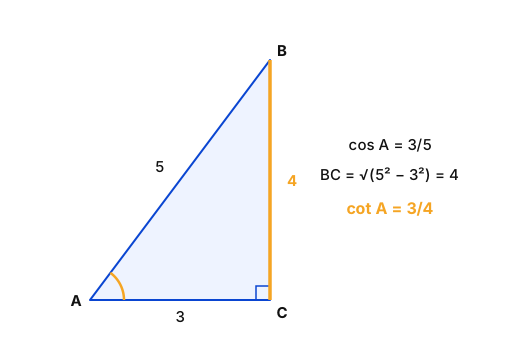
If cosA = 35 and A lies in the 1st quadrant, what is the value of cotA?
यदि cosA = 35 है और A पहले चतुर्थांश में है, तो cotA का मान क्या है?
  1. A−34
  2. B34
  3. C45
  4. D73
Show answer

Concept: cos=basehypotenuse; complete the right triangle.

  1. cosA=35 ⇒ base 3, hypotenuse 5 ⇒ perpendicular 4.
  2. cotA=baseperpendicular=34 (positive in Quadrant I).

Trick: Spot the triplet 3-4-5 – no calculation needed.

Answer: (B) 34

अवधारणा: cos = आधार/कर्ण; समकोण त्रिभुज पूरा करें।

  1. cosA=35 ⇒ आधार 3, कर्ण 5 ⇒ लंब 4.
  2. cotA= आधार/लंब =34 (प्रथम चतुर्थांश में धनात्मक)।

ट्रिक: त्रिक 3-4-5 पहचानें – गणना की ज़रूरत नहीं।

उत्तर: (B) 34

SSC CGLQuantitative AptitudeTrigonometry – using the 3-4-5 triangleSSC CGL 2025 · 23 Sep Shift 3 →
Q969.
The angle of a sector is π4 radians and the radius of the circle is 16 cm. What is the area of the sector?
एक त्रिज्यखंड का कोण π4 रेडियन है और वृत्त की त्रिज्या 16 cm है। त्रिज्यखंड का क्षेत्रफल क्या है?
  1. A6π cm²
  2. B22π cm²
  3. C32π cm²
  4. D28π cm²
Show answer

Concept: Sector area = 12r2θ (θ in radians).

  1. =12×162×π4.
  2. =12×256×π4=32πcm2.

Trick: π4=45∘=18 of the circle ⇒ πr28=256π8=32π.

Answer: (C) 32π cm²

अवधारणा: त्रिज्यखंड का क्षेत्रफल = 12r2θ (θ रेडियन में)।

  1. =12×256×π4.
  2. =32πcm2.

ट्रिक: π4=45∘= वृत्त का 18 ⇒ 256π8=32π.

उत्तर: (C) 32π cm²

SSC CGLQuantitative AptitudeCircle – area of a sector (radians)SSC CGL 2025 · 23 Sep Shift 3 →
Q970.
If tan x = cot(2x − 10°), find the value of x.
यदि tan x = cot(2x − 10°) है, तो x का मान ज्ञात कीजिए।
  1. A50°
  2. B25.52°
  3. C40°
  4. D33.33°
Show answer

Concept: If tanA=cotB (acute angles), then A+B=90∘.

  1. x+(2x−10∘)=90∘.
  2. 3x=100∘⇒x=1003≈33.33∘.

Yaad rakhein: Same rule for sinA=cosB and secA=cscB: A+B=90∘.

Answer: (D) 33.33°

अवधारणा: यदि tanA=cotB (न्यून कोण), तो A+B=90∘.

  1. x+2x−10∘=90∘.
  2. 3x=100∘⇒x≈33.33∘.

याद रखें: sinA=cosB, secA=cscB में भी A+B=90∘.

उत्तर: (D) 33.33°

SSC CGLQuantitative AptitudeTrigonometry – tan A = cot BSSC CGL 2025 · 23 Sep Shift 3 →
Q971.
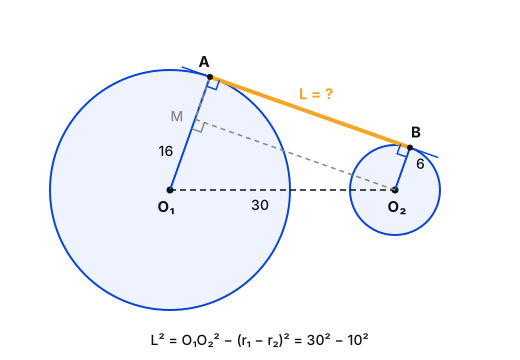
Two circles have radii of 16 cm and 6 cm. The distance between their centres is 30 cm. What is the length of a direct common tangent?
दो वृत्तों की त्रिज्याएँ 16 cm और 6 cm हैं। उनके केंद्रों के बीच की दूरी 30 cm है। सीधी उभयनिष्ठ स्पर्श रेखा की लंबाई क्या है?
  1. A20 cm
  2. B22 cm
  3. C202 cm
  4. D122 cm
Show answer

Concept: Direct common tangent = d2−(r1−r2)2.

  1. d = 30, r1−r2=10 ⇒ length =302−102=900−100.
  2. =800=400×2=202 cm.

Yaad rakhein: Transverse common tangent uses (r1+r2): d2−(r1+r2)2.

Answer: (C) 202 cm

अवधारणा: प्रत्यक्ष उभयनिष्ठ स्पर्श रेखा = d2−(r1−r2)2.

  1. =900−100=800.
  2. =202 cm.

याद रखें: अनुप्रस्थ स्पर्श रेखा में (r1+r2) लगता है।

उत्तर: (C) 202 cm

SSC CGLQuantitative AptitudeCircles – direct common tangentSSC CGL 2025 · 23 Sep Shift 3 →
Q972.
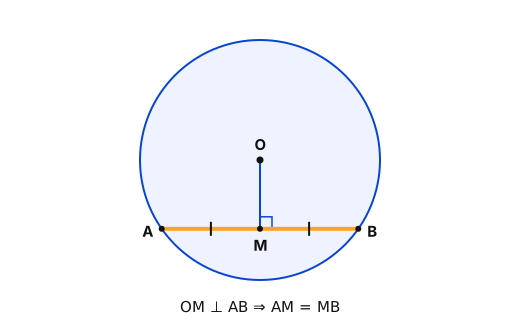
A line drawn from the centre of a circle is perpendicular to a chord. What does it do to the chord?
वृत्त के केंद्र से खींची गई रेखा किसी जीवा पर लंब है। वह जीवा के साथ क्या करती है?
  1. ADivides the chord into two equal partsजीवा को दो बराबर भागों में बाँट देती है
  2. BDoubles the length of the chordजीवा की लंबाई दोगुनी कर देती है
  3. CMakes the chord tangent to the circleजीवा को वृत्त की स्पर्श रेखा बना देती है
  4. DReduces the chord length to halfजीवा की लंबाई आधी कर देती है
Show answer

Concept: The perpendicular from the centre to a chord bisects the chord.

  1. Join the centre to both ends: two right triangles with equal hypotenuse (radius) and common side ⇒ congruent (RHS).
  2. So the foot of the perpendicular is the mid-point – the chord is split into two equal parts.

Yaad rakhein: Converse: the line from the centre to the mid-point of a chord is perpendicular to it.

Answer: (A) Divides the chord into two equal parts

अवधारणा: केंद्र से जीवा पर डाला गया लंब जीवा को समद्विभाजित करता है।

  1. केंद्र को जीवा के सिरों से मिलाएँ: दो समकोण त्रिभुज RHS से सर्वांगसम।
  2. अतः लंब का पाद जीवा का मध्य बिंदु है।

याद रखें: विलोम: केंद्र को जीवा के मध्य बिंदु से मिलाने वाली रेखा जीवा पर लंब होती है।

उत्तर: (A) जीवा को दो बराबर भागों में बाँट देती है

SSC CGLQuantitative AptitudeCircle theorem – perpendicular to a chordSSC CGL 2025 · 23 Sep Shift 3 →
Q973.
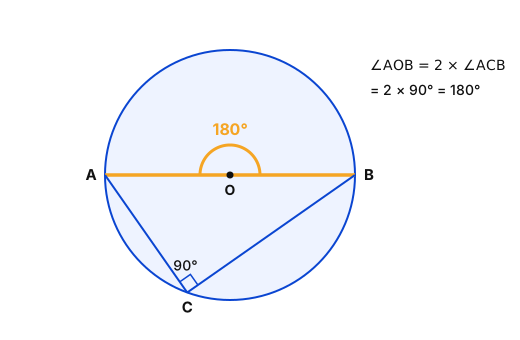
A chord divides a circle into two arcs. The angle subtended by the major arc at the circumference is 90°. What is the central angle subtended by the major arc?
एक जीवा वृत्त को दो चापों में बाँटती है। दीर्घ चाप द्वारा परिधि पर बनाया गया कोण 90° है। दीर्घ चाप द्वारा केंद्र पर बनाया गया कोण क्या होगा?
  1. A180°
  2. B110°
  3. C270°
  4. D150°
Show answer

Concept: An arc subtends at the centre twice the angle it subtends on the circle.

  1. Angle on the circle = 90°.
  2. Central angle = 2×90∘=180∘.

Yaad rakhein: An angle of 90° on the circle means the chord is a diameter (angle in a semicircle).

Answer: (A) 180°

अवधारणा: चाप द्वारा केंद्र पर बना कोण, परिधि पर बने कोण का दोगुना होता है।

  1. परिधि पर कोण = 90°.
  2. केंद्र पर = 2×90∘=180∘.

याद रखें: परिधि पर 90° का अर्थ – जीवा व्यास है (अर्धवृत्त का कोण)।

उत्तर: (A) 180°

SSC CGLQuantitative AptitudeCircle theorem – centre angle = 2 × circumference angleSSC CGL 2025 · 23 Sep Shift 3 →
Q974.
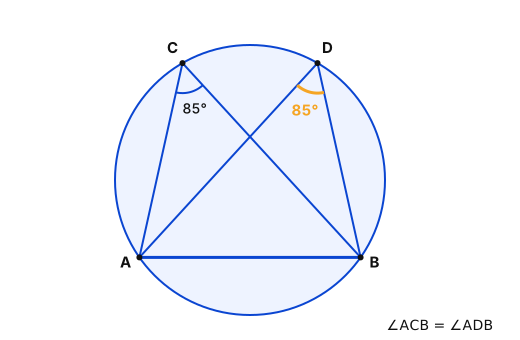
In a circle, chord AB subtends an angle of 85° at a point C on the circle. What is the angle subtended by the same chord AB at another point D on the same arc as C?
एक वृत्त में जीवा AB, वृत्त पर स्थित बिंदु C पर 85° का कोण बनाती है। वही जीवा AB, C वाले चाप पर स्थित किसी अन्य बिंदु D पर कितना कोण बनाएगी?
  1. A55°
  2. B50°
  3. C85°
  4. D40°
Show answer

Concept: Angles made by the same chord at points of the same arc are equal.

  1. C and D are on the same arc w.r.t. chord AB.
  2. ∠ADB = ∠ACB = 85°.

Yaad rakhein: On the opposite arc the angle would be 180° − 85° = 95° (cyclic quadrilateral).

Answer: (C) 85°

अवधारणा: एक ही जीवा द्वारा एक ही चाप के बिंदुओं पर बने कोण बराबर होते हैं।

  1. C और D, जीवा AB के सापेक्ष एक ही चाप पर हैं।
  2. ∠ADB = ∠ACB = 85°.

याद रखें: विपरीत चाप पर कोण 180° − 85° = 95° होता।

उत्तर: (C) 85°

SSC CGLQuantitative AptitudeCircle theorem – angles in the same segmentSSC CGL 2025 · 23 Sep Shift 3 →
Q975.
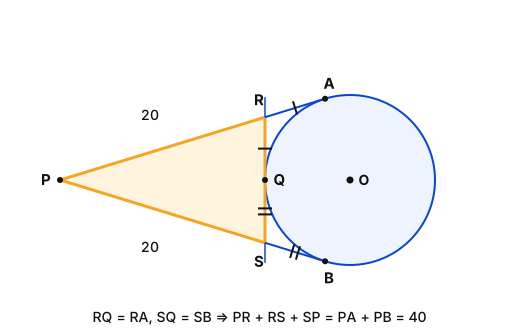
From an outside point P, two tangents PA and PB are drawn to a circle. A third tangent to the circle at a point Q intersects PA and PB at R and S respectively. If PA = 20 cm, what is the perimeter of △PRS?
बाहरी बिंदु P से एक वृत्त पर दो स्पर्श रेखाएँ PA और PB खींची गई हैं। बिंदु Q पर खींची गई तीसरी स्पर्श रेखा PA और PB को क्रमशः R और S पर काटती है। यदि PA = 20 cm है, तो △PRS का परिमाप क्या है?
  1. A40 cm
  2. B25 cm
  3. C20 cm
  4. D10 cm
Show answer

Concept: Tangents from one external point are equal in length.

  1. RQ = RA and SQ = SB.
  2. Perimeter PRS = PR + RQ + QS + SP = (PR + RA) + (PS + SB) = PA + PB.
  3. PA = PB = 20 ⇒ perimeter = 40 cm.

Trick: Perimeter of such a triangle is always 2 × PA – memorise it.

Answer: (A) 40 cm

अवधारणा: बाहरी बिंदु से खींची गई स्पर्श रेखाएँ बराबर होती हैं।

  1. RQ = RA और SQ = SB.
  2. परिमाप = (PR + RA) + (PS + SB) = PA + PB.
  3. = 20 + 20 = 40 cm.

ट्रिक: ऐसे त्रिभुज का परिमाप हमेशा 2 × PA होता है।

उत्तर: (A) 40 cm

SSC CGLQuantitative AptitudeTangents – perimeter of triangle cut by a tangentSSC CGL 2025 · 23 Sep Shift 3 →
Q976.
Select the correct spelling.
  1. Athermodinamick
  2. Btharmadynamic
  3. Cthermodynnamic
  4. Dthermodynamic
Show answer

Concept: Compound word: thermo (heat) + dynamic (power/motion).

  1. Write 'thermo' + 'dynamic' with no change: thermodynamic.
  2. (A) has 'dinamick', (B) 'thar…', (C) double 'nn' – all wrong.

Trick: Split long words into known roots (thermo-meter, dynam-ite) and join them unchanged.

Answer: (D) thermodynamic

अवधारणा: यह संयुक्त शब्द है: thermo (ऊष्मा) + dynamic (गति/शक्ति)।

  1. दोनों भाग बिना बदलाव जोड़ें: thermodynamic.
  2. (A) में 'dinamick', (B) में 'thar', (C) में दो 'n' – गलत।

ट्रिक: लंबे शब्दों को जाने-पहचाने मूल भागों में तोड़कर लिखें।

उत्तर: (D) thermodynamic

SSC CGLEnglish ComprehensionSpelling – thermodynamicSSC CGL 2025 · 23 Sep Shift 3 →
Q977.
Select the most appropriate synonym of the given word:
Uncontrollable
  1. AIrrepressible
  2. BForgettable
  3. CUnbearable
  4. DPreventable
Show answer

Concept: Uncontrollable = cannot be held back or checked.

  1. Irrepressible = impossible to restrain (e.g. irrepressible laughter) ⇒ same meaning.
  2. Forgettable = not memorable; Unbearable = too painful to tolerate; Preventable = can be stopped.

Trick: Prefix 'ir-' (= not) + 'repress' (hold down) ⇒ 'cannot be held down' = uncontrollable.

Answer: (A) Irrepressible

अवधारणा: Uncontrollable = जिसे रोका या काबू न किया जा सके।

  1. Irrepressible = जिसे दबाया न जा सके ⇒ समान अर्थ।
  2. Forgettable = भूलने योग्य; Unbearable = असहनीय; Preventable = रोका जा सकने वाला।

ट्रिक: ir- (नहीं) + repress (दबाना) ⇒ 'जो दबे नहीं'।

उत्तर: (A) Irrepressible

SSC CGLEnglish ComprehensionSynonym – UncontrollableSSC CGL 2025 · 23 Sep Shift 3 →
Q978.
Select the option that can be used as a one-word substitute for the given group of words:
'A system of government by one person with absolute power'.
  1. AOligarchy
  2. BDemocracy
  3. CAutocracy
  4. DPlutocracy
    Cloze Test
Show answer

Concept: '-cracy' = rule; the prefix tells who rules.

  1. auto (self/one) + cracy ⇒ Autocracy: rule by one person with total power.
  2. Oligarchy – a few; Plutocracy – the rich; Democracy – the people.

Trick: Remember prefixes: auto = one/self, oligo = few, pluto = wealth, demo = people.

Answer: (C) Autocracy

अवधारणा: '-cracy' = शासन; उपसर्ग बताता है कि शासन किसका है।

  1. auto (स्वयं/एक) ⇒ Autocracy: एक व्यक्ति का निरंकुश शासन।
  2. Oligarchy – कुछ लोगों का; Plutocracy – धनिकों का; Democracy – जनता का।

ट्रिक: उपसर्ग: auto = एक, oligo = कुछ, pluto = धन, demo = जनता।

उत्तर: (C) Autocracy

SSC CGLEnglish ComprehensionOne-word substitution – AutocracySSC CGL 2025 · 23 Sep Shift 3 →
Directions (Qs. 79-83): In the following passage some words have been deleted. Read the passage carefully and select the most appropriate option to fill in each blank.

The quest for global equity in the Anthropocene is better understood not as a problem of fair allocation, but as a performance shaped by deep ontological misunderstanding. The Global North frequently promotes technocratic interventions as universally relevant, yet these measures are grounded in implicit claims of historical advancement and civilizational (79) ____ . What is framed as climate finance often operates less as altruism and more as a mechanism that consolidates surveillance, control and dependency. Knowledge systems from the Global South, instead of being approached as autonomous frameworks, are routinely filtered through instrumental notions of "capacity building," a concept whose very origins disclose a colonial (80) ____ . Such frameworks presuppose that particular communities must be rendered "fit" for modernity, thereby sustaining an uneven pedagogical relationship that is misrepresented as support. At the same time, dominant visions of the planet are increasingly shaped through narratives of urgency and crisis. The repeated invocation of "tipping points" and "irreversible loss" produces an atmosphere of ethical alarm that paradoxically legitimizes ecological (81) ____ , substituting transformative systemic change with narrowly technical interventions. Mechanisms such as carbon offsets, biodiversity credits and the broader architecture of green financialization do not function as structural correctives; rather, they signal a persistent unwillingness to confront anthropocentric capitalism itself. In this context, dissent rarely operates as a disruptive force and is more often absorbed through strategic (82) ____ , where symbolic responsiveness conceals policy inertia. Civil society is incorporated rather than silenced. Subaltern expression is catalogued rather than empowered. Therefore, advancing ecological justice cannot be reduced to calls for inclusion alone. It demands a sustained interrogation of the ontological assumptions that govern who is included and on what terms. In the absence of such critique, the promise of planetary stewardship risks remaining an elaborate (83) ____ — visually compelling, yet fundamentally devoid of material transformation.
Q979.
Select the most appropriate option to fill in blank number (79).
  1. Ainferiority
  2. Bpreeminence
  3. Chegemony
  4. Dintelligibility
Show answer

Concept: The blank pairs with 'historical advancement' – a claim of being superior.

  1. The North claims it is ahead ⇒ it claims civilizational preeminence (superiority, being foremost).
  2. 'Inferiority' reverses the idea; 'intelligibility' (clarity) and 'hegemony' (domination of others) do not fit 'claims of … advancement and ___' as naturally.

Trick: Words joined by 'and' carry the same tone: advancement (+) and ___ (+) ⇒ a superiority word.

Answer: (B) preeminence

अवधारणा: रिक्त स्थान 'historical advancement' के साथ जुड़ा है – श्रेष्ठता का दावा।

  1. उत्तर (Global North) स्वयं को आगे मानता है ⇒ civilizational preeminence (श्रेष्ठता)।
  2. 'inferiority' उल्टा अर्थ; 'intelligibility' (स्पष्टता) असंगत।

ट्रिक: 'and' से जुड़े शब्द एक ही भाव के होते हैं: advancement (+) ⇒ ___ (+)।

उत्तर: (B) preeminence

SSC CGLEnglish ComprehensionCloze test – preeminenceSSC CGL 2025 · 23 Sep Shift 3 →
Directions (Qs. 79-83): In the following passage some words have been deleted. Read the passage carefully and select the most appropriate option to fill in each blank.

The quest for global equity in the Anthropocene is better understood not as a problem of fair allocation, but as a performance shaped by deep ontological misunderstanding. The Global North frequently promotes technocratic interventions as universally relevant, yet these measures are grounded in implicit claims of historical advancement and civilizational (79) ____ . What is framed as climate finance often operates less as altruism and more as a mechanism that consolidates surveillance, control and dependency. Knowledge systems from the Global South, instead of being approached as autonomous frameworks, are routinely filtered through instrumental notions of "capacity building," a concept whose very origins disclose a colonial (80) ____ . Such frameworks presuppose that particular communities must be rendered "fit" for modernity, thereby sustaining an uneven pedagogical relationship that is misrepresented as support. At the same time, dominant visions of the planet are increasingly shaped through narratives of urgency and crisis. The repeated invocation of "tipping points" and "irreversible loss" produces an atmosphere of ethical alarm that paradoxically legitimizes ecological (81) ____ , substituting transformative systemic change with narrowly technical interventions. Mechanisms such as carbon offsets, biodiversity credits and the broader architecture of green financialization do not function as structural correctives; rather, they signal a persistent unwillingness to confront anthropocentric capitalism itself. In this context, dissent rarely operates as a disruptive force and is more often absorbed through strategic (82) ____ , where symbolic responsiveness conceals policy inertia. Civil society is incorporated rather than silenced. Subaltern expression is catalogued rather than empowered. Therefore, advancing ecological justice cannot be reduced to calls for inclusion alone. It demands a sustained interrogation of the ontological assumptions that govern who is included and on what terms. In the absence of such critique, the promise of planetary stewardship risks remaining an elaborate (83) ____ — visually compelling, yet fundamentally devoid of material transformation.
Q980.
Select the most appropriate option to fill in blank number (80).
  1. Agenealogy
  2. Bimperative
  3. Cresidue
  4. Dparable
Show answer

Concept: The clue is 'whose very origins disclose…' – the blank must mean line of origin.

  1. Genealogy = history of descent/origin of something ⇒ 'a colonial genealogy' = it comes from colonial roots.
  2. Imperative (necessity), residue (leftover), parable (moral story) don't express origin.

Trick: Match the blank to the nearby keyword: 'origins' ↔ genealogy.

Answer: (A) genealogy

अवधारणा: संकेत: 'whose very origins disclose…' – रिक्त शब्द का अर्थ 'उत्पत्ति की परंपरा' होना चाहिए।

  1. Genealogy = वंश/उत्पत्ति का इतिहास ⇒ इसकी जड़ें औपनिवेशिक हैं।
  2. Imperative (अनिवार्यता), residue (अवशेष), parable (नीति-कथा) – अर्थ नहीं बैठता।

ट्रिक: पास के मुख्य शब्द 'origins' से मिलाएँ ⇒ genealogy.

उत्तर: (A) genealogy

SSC CGLEnglish ComprehensionCloze test – genealogySSC CGL 2025 · 23 Sep Shift 3 →