Question bank

Q&A: practice questions with answers

Search questions on any topic. Filter by exam category, exam, subject and topic, try the question, then open the answer and explanation.

Courses – airGurukul

4,800 questions found.

Q1361.
A triangular field has sides in the ratio 3 : 5 : 7 and a perimeter of 90 m. What is the area of the field?
एक त्रिभुजाकार खेत की भुजाएँ 3 : 5 : 7 के अनुपात में हैं और परिमाप 90 m है। खेत का क्षेत्रफल क्या है?
  1. A196 m²
  2. B234 m²
  3. C186 m²
  4. D182 m²
Show answer

Concept: Area = s(s−a)(s−b)(s−c), s = half perimeter.

  1. 15x=90→x=6 → sides 18, 30, 42 m; s=45.
  2. s−a=27,s−b=15,s−c=3.
  3. Area = 45×27×15×3=54675=1353≈233.8≈234 m².

Trick: Sides 3 : 5 : 7 make a triangle with a 120∘ angle, so area = 12×18×30×sin120∘=1353.

Answer: (B) 234 m²

अवधारणा: क्षेत्रफल = s(s−a)(s−b)(s−c), s = अर्ध परिमाप।

  1. 15x=90→x=6 → भुजाएँ 18, 30, 42 मी; s=45।
  2. s−a=27,s−b=15,s−c=3।
  3. क्षेत्रफल = 45×27×15×3=54675=1353≈234 मी²।

ट्रिक: 3 : 5 : 7 भुजाओं वाले त्रिभुज में एक कोण 120∘ होता है: क्षेत्रफल = 12×18×30×sin120∘=1353।

उत्तर: (B) 234 m²

SSC CGLQuantitative AptitudeMensuration – Heron's formulaSSC CGL 2025 · 22 Sep Shift 2 →
Q1362.
The value of a machine depreciates 10% in the first year, 20% in the second year and 33.33% in the third year. If the initial value was ₹20,000, what is its value at the end of 3 years?
एक मशीन का मूल्य पहले वर्ष 10%, दूसरे वर्ष 20% और तीसरे वर्ष 33.33% घटता है। यदि आरंभिक मूल्य ₹20,000 था, तो 3 वर्ष बाद उसका मूल्य क्या होगा?
  1. A₹9,200
  2. B₹9,700
  3. C₹9,500
  4. D₹9,600
Show answer

Concept: Multiply the original value by each remaining fraction.

  1. 10%↓→910;20%↓→45;3313%↓→23.
  2. 20,000×910=18,000→×45=14,400→×23=9,600.

Trick: Convert odd percentages to fractions: 3313%=13, so the value keeps 23.

Answer: (D) ₹9,600

अवधारणा: मूल मूल्य को हर बार बची हुई भिन्न से गुणा करें।

  1. 10% घटा → 910; 20% घटा → 45; 3313% घटा → 23।
  2. 20,000×910=18,000→×45=14,400→×23=9,600।

ट्रिक: 3313%=13 याद रखें; मूल्य का 23 बचता है।

उत्तर: (D) ₹9,600

SSC CGLQuantitative AptitudePercentage – successive depreciationSSC CGL 2025 · 22 Sep Shift 2 →
Q1363.
An electronics dealer marks an item 50% above cost and offers a festival discount of 20%, plus a cashback of ₹200 on the final selling price. If he still makes a 15% profit, what is the cost price?
एक इलेक्ट्रॉनिक्स विक्रेता वस्तु को लागत से 50% अधिक अंकित करता है, 20% त्योहारी छूट देता है और अंतिम विक्रय मूल्य पर ₹200 कैशबैक भी देता है। फिर भी उसे 15% लाभ होता है। क्रय मूल्य क्या है?
  1. A₹4,300
  2. B₹4,000
  3. C₹4,100
  4. D₹4,200
Show answer

Concept: Final SP = MP × (1 − discount) − cashback = CP × 1.15.

  1. Let CP = x → MP = 1.5x → after 20% off = 1.2x.
  2. 1.2x − 200 = 1.15x → 0.05x = 200.
  3. x = ₹4,000.

Trick: Verify option: CP 4,000 → MP 6,000 → 4,800 → 4,600 = 115% of 4,000 ✓.

Answer: (B) ₹4,000

अवधारणा: अंतिम SP = MP × (1 − छूट) − कैशबैक = CP × 1.15।

  1. CP = x → MP = 1.5x → 20% छूट के बाद 1.2x।
  2. 1.2x − 200 = 1.15x → 0.05x = 200।
  3. x = ₹4,000।

ट्रिक: विकल्प से जाँचें: CP 4,000 → MP 6,000 → 4,800 → 4,600 = 4,000 का 115% ✓।

उत्तर: (B) ₹4,000

SSC CGLQuantitative AptitudeProfit & loss – markup, discount and cashbackSSC CGL 2025 · 22 Sep Shift 2 →
Q1364.
Ravi can do a job in the same amount of time as Sonu and Monu together. If Ravi and Sonu together can do it in 12 days and Monu alone can do it in 48 days, in how many days can Sonu do it alone?
रवि किसी काम को उतने ही समय में करता है जितने में सोनू और मोनू साथ मिलकर। यदि रवि और सोनू साथ में उसे 12 दिनों में करते हैं और मोनू अकेला 48 दिनों में, तो सोनू अकेला उसे कितने दिनों में करेगा?
  1. A16 days16 दिन
  2. B30 days30 दिन
  3. C24 days24 दिन
  4. D32 days32 दिन
Show answer

Concept: Take total work as LCM of the days and work with daily units.

  1. Total = 48 units; R+S=4/day, M=1/day.
  2. R=S+M→S+M+S=4→2S=3→S=1.5/day.
  3. Sonu alone = 48÷1.5=32 days.

Trick: Replace R by (S+M): 2S+M=112→2S=112−148=348→S=132.

Answer: (D) 32 days

अवधारणा: कुल कार्य = दिनों का LCM लें और प्रतिदिन इकाइयों में हल करें।

  1. कुल = 48 इकाई; R+S=4/दिन, M=1/दिन।
  2. R=S+M→S+M+S=4→2S=3→S=1.5/दिन।
  3. सोनू अकेला = 48÷1.5=32 दिन।

ट्रिक: R की जगह (S+M) रखें: 2S+M=112→2S=348→S=132।

उत्तर: (D) 32 दिन

SSC CGLQuantitative AptitudeTime and work – efficiency methodSSC CGL 2025 · 22 Sep Shift 2 →
Q1365.
A storage box is in the shape of a right rectangular prism with internal dimensions 60 cm × 50 cm × 40 cm. How many litres can it hold?
एक भंडारण बॉक्स लंब आयताकार प्रिज़्म के आकार का है जिसकी भीतरी विमाएँ 60 cm × 50 cm × 40 cm हैं। उसमें कितने लीटर आ सकते हैं?
  1. A150
  2. B120
  3. C140
  4. D170
Show answer

Concept: Volume of cuboid = l×b×h; 1 litre = 1000 cm³.

  1. V=60×50×40=1,20,000 cm³.
  2. Litres = 1,20,000÷1000=120.

Trick: Convert to decimetres first (1 dm³ = 1 L): 6×5×4=120 L.

Answer: (B) 120

अवधारणा: घनाभ का आयतन = l×b×h; 1 लीटर = 1000 सेमी³।

  1. V=60×50×40=1,20,000 सेमी³।
  2. लीटर = 1,20,000÷1000=120।

ट्रिक: पहले डेसीमीटर में बदलें (1 dm³ = 1 L): 6×5×4=120 L।

उत्तर: (B) 120

SSC CGLQuantitative AptitudeMensuration – volume in litresSSC CGL 2025 · 22 Sep Shift 2 →
Q1366.
A trader bought 5 varieties of rice whose weights are in the ratio 3 : 4 : 5 : 6 : 7. Their respective prices per kg are ₹42, ₹45, ₹47, ₹48 and ₹50. What is the average cost per kg of the mixture?
एक व्यापारी ने पाँच किस्म के चावल खरीदे जिनके भार 3 : 4 : 5 : 6 : 7 के अनुपात में हैं। उनके क्रमशः मूल्य ₹42, ₹45, ₹47, ₹48 और ₹50 प्रति किग्रा हैं। मिश्रण की औसत लागत प्रति किग्रा क्या है?
  1. A₹47.1
  2. B₹44.1
  3. C₹44.8
  4. D₹46.3
Show answer

Concept: Average price = Σ(weight × price) ÷ Σweights.

  1. Σ(w×p)=126+180+235+288+350=1179.
  2. Σw=3+4+5+6+7=25.
  3. Average = 1179÷25= ₹47.16 ≈ ₹47.1.

Trick: Heavier weights go to costlier rice, so the average must exceed the simple mean (₹46.4) – only ₹47.1 fits.

Answer: (A) ₹47.1

अवधारणा: औसत मूल्य = Σ(भार × मूल्य) ÷ Σभार।

  1. Σ(w×p)=126+180+235+288+350=1179।
  2. Σw=3+4+5+6+7=25।
  3. औसत = 1179÷25= ₹47.16 ≈ ₹47.1।

ट्रिक: अधिक भार महँगे चावल का है, अतः औसत साधारण माध्य (₹46.4) से अधिक होगा – केवल ₹47.1।

उत्तर: (A) ₹47.1

SSC CGLQuantitative AptitudeMixture – weighted average priceSSC CGL 2025 · 22 Sep Shift 2 →
Q1367.
An alloy contains gold and silver in the ratio 5 : 3. A second alloy contains gold and silver in the ratio 3 : 1. What quantity of the first alloy must be added to 40 kg of the second alloy to form a new alloy containing gold and silver in the ratio 4 : 2?
एक मिश्रधातु में सोना और चाँदी 5 : 3 के अनुपात में हैं। दूसरी में 3 : 1 के अनुपात में। 40 kg दूसरी मिश्रधातु में पहली की कितनी मात्रा मिलाई जाए कि नई मिश्रधातु में सोना और चाँदी 4 : 2 के अनुपात में हों?
  1. A20 kg
  2. B60 kg
  3. C80 kg
  4. D40 kg
Show answer

Concept: Apply alligation on the fraction of gold.

  1. Gold fractions: 1st = 58, 2nd = 34, target = 46=23.
  2. 1st : 2nd = (34−23):(23−58)=112:124=2:1.
  3. 1st alloy = 2×40=80 kg.

Trick: Check: 80 kg → 50 gold + 30 silver; 40 kg → 30 + 10; total 80 : 40 = 2 : 1 ✓.

Answer: (C) 80 kg

अवधारणा: सोने के भाग पर एलीगेशन लगाएँ।

  1. सोने का भाग: पहली = 58, दूसरी = 34, लक्ष्य = 46=23।
  2. पहली : दूसरी = (34−23):(23−58)=112:124=2:1।
  3. पहली मिश्रधातु = 2×40=80 किग्रा।

ट्रिक: जाँच: 80 किग्रा → 50 सोना + 30 चाँदी; 40 किग्रा → 30 + 10; कुल 80 : 40 = 2 : 1 ✓।

उत्तर: (C) 80 kg

SSC CGLQuantitative AptitudeAlligation – mixing two alloysSSC CGL 2025 · 22 Sep Shift 2 →
Q1368.
If sinA = 35, find the value of (15sinA + 20cosA)² + (5sinA + 10cosA)².
यदि sinA = 35 है, तो (15sinA + 20cosA)² + (5sinA + 10cosA)² का मान ज्ञात कीजिए।
  1. A746
  2. B625
  3. C713
  4. D734
Show answer

Concept: sinA=35→cosA=45 (3-4-5 triplet).

  1. 15×35+20×45=9+16=25.
  2. 5×35+10×45=3+8=11.
  3. 252+112=625+121=746.

Trick: The answer is 625 + something positive, so 625 itself is out; unit digit 5+1=6 → 746.

Answer: (A) 746

अवधारणा: sinA=35→cosA=45 (3-4-5 त्रिक)।

  1. 15×35+20×45=9+16=25।
  2. 5×35+10×45=3+8=11।
  3. 252+112=625+121=746।

ट्रिक: उत्तर 625 + धनात्मक संख्या है, अतः 625 नहीं; इकाई अंक 5+1=6 → 746।

उत्तर: (A) 746

SSC CGLQuantitative AptitudeTrigonometry – value from a tripletSSC CGL 2025 · 22 Sep Shift 2 →
Q1369.
If sinβ = cosβ, then find sin³β + cos³β.
यदि sinβ = cosβ है, तो sin³β + cos³β ज्ञात कीजिए।
  1. A22
  2. B35
  3. C32
  4. D53
Show answer

Concept: sinβ=cosβ⇒tanβ=1⇒β=45∘.

  1. sin45∘=cos45∘=12.
  2. (12)3=122 for each.
  3. Sum = 222=12=22.

Trick: Use (a3+b3)=(a+b)(1−ab) with a+b=2, ab=12: 2×12=22.

Answer: (A) 22

अवधारणा: sinβ=cosβ⇒tanβ=1⇒β=45∘।

  1. sin45∘=cos45∘=12।
  2. हर एक का घन = 122।
  3. योग = 222=12=22।

ट्रिक: (a3+b3)=(a+b)(1−ab), जहाँ a+b=2, ab=12: 2×12=22।

उत्तर: (A) 22

SSC CGLQuantitative AptitudeTrigonometry – sinβ = cosβSSC CGL 2025 · 22 Sep Shift 2 →
Q1370.
Are these lines y = 3x + 2 and y = −13x + 5 perpendicular?
क्या रेखाएँ y = 3x + 2 और y = −13x + 5 परस्पर लंब हैं?
  1. AYesहाँ
  2. BNoनहीं
  3. COnly if they intersect at the originकेवल तभी जब वे मूल बिंदु पर मिलें
  4. DCannot be determinedज्ञात नहीं किया जा सकता
Show answer

Concept: Lines are perpendicular when m1×m2=−1.

  1. y=3x+2→m1=3.
  2. y=−(13)x+5→m2=−13.
  3. 3×(−13)=−1 → perpendicular.

Trick: Slopes that are negative reciprocals (3 and −13) always give perpendicular lines; the intercepts do not matter.

Answer: (A) Yes

अवधारणा: दो रेखाएँ लंब होती हैं जब m1×m2=−1।

  1. y=3x+2→m1=3।
  2. y=−(13)x+5→m2=−13।
  3. 3×(−13)=−1 → लंब।

ट्रिक: ढलान एक-दूसरे के ऋणात्मक व्युत्क्रम (3 और −13) हों तो रेखाएँ लंब होती हैं; अंतःखंड का कोई असर नहीं।

उत्तर: (A) हाँ

SSC CGLQuantitative AptitudeCoordinate geometry – perpendicular linesSSC CGL 2025 · 22 Sep Shift 2 →
Q1371.
If tan2θ = cot(3θ + 10°), then what is the value of θ?
यदि tan2θ = cot(3θ + 10°) है, तो θ का मान क्या है?
  1. A30°
  2. B25°
  3. C16°
  4. D18°
Show answer

Concept: If tan A = cot B, then A + B = 90°.

  1. 2θ + 3θ + 10° = 90°.
  2. 5θ = 80° → θ = 16°.

Trick: Just add the two angles and equate to 90° – one-line answer.

Answer: (C) 16°

अवधारणा: यदि tan A = cot B, तो A + B = 90°।

  1. 2θ + 3θ + 10° = 90°।
  2. 5θ = 80° → θ = 16°।

ट्रिक: दोनों कोणों का योग 90° रखें – एक पंक्ति में उत्तर।

उत्तर: (C) 16°

SSC CGLQuantitative AptitudeTrigonometry – complementary anglesSSC CGL 2025 · 22 Sep Shift 2 →
Q1372.
Two angles are supplementary. The measure of one angle is 30° less than twice the measure of the other. What is the measure of the larger angle?
दो कोण संपूरक हैं। एक कोण दूसरे के दोगुने से 30° कम है। बड़े कोण की माप क्या है?
  1. A110°
  2. B125°
  3. C170°
  4. D105°
Show answer

Concept: Supplementary angles add up to 180∘.

  1. Let smaller = x, other = 2x−30∘.
  2. x+2x−30∘=180∘→3x=210∘→x=70∘.
  3. Larger = 2×70∘−30∘=110∘.

Trick: Check options: 110∘+70∘=180∘ and 2×70−30=110 ✓.

Answer: (A) 110°

अवधारणा: संपूरक कोणों का योग 180∘ होता है।

  1. छोटा = x, दूसरा = 2x−30∘।
  2. x+2x−30∘=180∘→3x=210∘→x=70∘।
  3. बड़ा = 2×70∘−30∘=110∘।

ट्रिक: विकल्प जाँचें: 110∘+70∘=180∘ और 2×70−30=110 ✓।

उत्तर: (A) 110°

SSC CGLQuantitative AptitudeGeometry – supplementary anglesSSC CGL 2025 · 22 Sep Shift 2 →
Q1373.
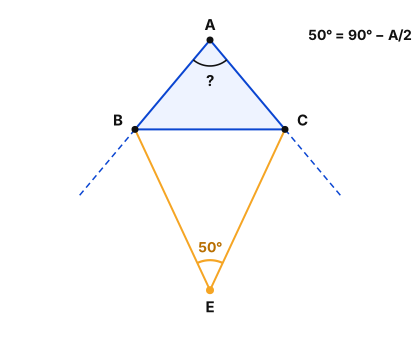
In a triangle ABC, the exterior angle bisectors of ∠B and ∠C meet at point E (the excentre opposite A). If ∠BEC = 50°, what is the measure of ∠A?
त्रिभुज ABC में ∠B और ∠C के बाह्य कोण-समद्विभाजक बिंदु E (A के सम्मुख बहिष्केंद्र) पर मिलते हैं। यदि ∠BEC = 50° है, तो ∠A की माप क्या है?
  1. A110°
  2. B100°
  3. C80°
  4. D70°
Show answer

Concept: Angle at the excentre opposite A: ∠BEC=90∘−∠A2.

  1. 50∘=90∘−∠A2.
  2. ∠A2=40∘→∠A=80∘.

Trick: Incentre: 90∘+A2; excentre (external bisectors of B, C): 90∘−A2.

Answer: (C) 80°

अवधारणा: A के सम्मुख बहिःकेंद्र पर: ∠BEC=90∘−∠A2।

  1. 50∘=90∘−∠A2।
  2. ∠A2=40∘→∠A=80∘।

ट्रिक: अंतःकेंद्र: 90∘+A2; बहिःकेंद्र (B, C के बाह्य समद्विभाजक): 90∘−A2।

उत्तर: (C) 80°

SSC CGLQuantitative AptitudeGeometry – excentre angleSSC CGL 2025 · 22 Sep Shift 2 →
Q1374.
Simplify: (5 + 3)²
सरल कीजिए: (5 + 3)²
  1. A8 + 215
  2. B8 − 215
  3. C3 + 215
  4. D3 − 215
Show answer

Concept: The question is (5+3)2; square each term and add twice their product.

  1. Squares of the terms: 5 and 3, total 8.
  2. Twice the product: 25×3=215.
  3. Result = 8+215.

Trick: Sum of squares gives 8 and a '+' sign stays for (a+b)2 – only option (A).

Answer: (A) 8 + 215

अवधारणा: प्रश्न (5+3)2 है; (a+b)2=a2+b2+2ab लगाएँ।

  1. (5)2+(3)2=5+3=8।
  2. 2×5×3=215।
  3. परिणाम = 8+215।

ट्रिक: वर्गों का योग 8 और (a+b)2 में चिह्न '+' – केवल (A)।

उत्तर: (A) 8 + 215

SSC CGLQuantitative AptitudeSurds – square of a sumSSC CGL 2025 · 22 Sep Shift 2 →
Q1375.
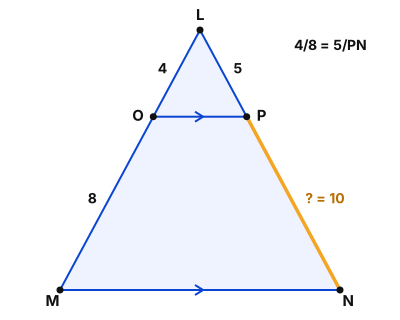
In triangle LMN, a line segment OP is drawn parallel to the side MN, with O on LM and P on LN. If LO = 4 cm, LM = 12 cm and LP = 5 cm, find the length of PN.
त्रिभुज LMN में भुजा MN के समांतर एक रेखाखंड OP खींचा गया है, जहाँ O, LM पर और P, LN पर है। यदि LO = 4 cm, LM = 12 cm और LP = 5 cm है, तो PN की लंबाई ज्ञात कीजिए।
  1. A11 cm
  2. B12 cm
  3. C15 cm
  4. D10 cm
Show answer

Concept: If OP∥MN, then LOOM=LPPN.

  1. OM=12−4=8 cm.
  2. 48=5PN→PN=10 cm.

Trick: LO is 13 of LM, so LP is 13 of LN: LN=15,PN=15−5=10.

Answer: (D) 10 cm

अवधारणा: यदि OP∥MN, तो LOOM=LPPN।

  1. OM=12−4=8 सेमी।
  2. 48=5PN→PN=10 सेमी।

ट्रिक: LO, LM का 13 है, तो LP भी LN का 13: LN=15,PN=15−5=10।

उत्तर: (D) 10 cm

SSC CGLQuantitative AptitudeGeometry – Basic Proportionality TheoremSSC CGL 2025 · 22 Sep Shift 2 →
Q1376.
The following sentence has been divided into parts. One of them contains an error. Select the part that contains the error from the given options.
The strict rules of the library don't let students (1)/ to take more than two books (2)/ out at a time, which is often (3)/ inconvenient for researchers. (4)
  1. A(1)
  2. B(2)
  3. C(3)
  4. D(4)
Show answer

Concept: Causative 'let' is followed by object + base verb, without 'to'.

  1. Part (2) reads 'to take' after 'let students' – wrong.
  2. Drop 'to' in part (2): let students take … books out.

Trick: Let, make, have, help (optional) + object + V1: 'let him go', 'made me laugh'. But 'allow' takes 'to': allow students to take.

Answer: (B) (2)

अवधारणा: Causative 'let' के बाद object + मूल क्रिया (V1) आती है, 'to' नहीं।

  1. भाग (2) में 'let students' के बाद 'to take' गलत है।
  2. सही: '…don't let students take more than two books out at a time…'।

ट्रिक: let, make, have + object + V1 (बिना to); पर 'allow' के साथ 'to' लगता है: allow students to take।

उत्तर: (B) (2)

SSC CGLEnglish ComprehensionError spotting – let + bare infinitiveSSC CGL 2025 · 22 Sep Shift 2 →
Q1377.
Select the option that expresses the given sentence in the Active/Passive voice.
The damaged server is about to be repaired by the technician.
  1. AThe technician is to be repaired about the damaged server.
  2. BThe damaged server is about repairing the technician.
  3. CThe technician is about to repair the damaged server.
  4. DThe damaged server will be repaired by the technician.
Show answer

Concept: 'is about to be + V3' (passive) becomes 'is about to + V1' (active), keeping the same time sense.

  1. Doer 'the technician' becomes the subject.
  2. is about to be repaired → is about to repair.
  3. (D) changes 'about to' (immediate future) into simple future – wrong.

Trick: In voice change, keep the tense frame unchanged – only swap subject/object and the verb form.

Answer: (C) The technician is about to repair the damaged server.

अवधारणा: 'is about to be + V3' (कर्मवाच्य) → 'is about to + V1' (कर्तृवाच्य); समय का भाव वही रहता है।

  1. कर्ता 'the technician' कर्ता (subject) बनेगा।
  2. is about to be repaired → is about to repair।
  3. (D) में 'about to' को साधारण भविष्य में बदल दिया – गलत।

ट्रिक: वाच्य बदलते समय काल का ढाँचा न बदलें – केवल कर्ता/कर्म और क्रिया-रूप बदलें।

उत्तर: (C) The technician is about to repair the damaged server.

SSC CGLEnglish ComprehensionVoice – passive to active (about to)SSC CGL 2025 · 22 Sep Shift 2 →
Q1378.
Select the correct spelling of a word meaning 'A legal judgment that a person is declared not guilty of a crime'.
  1. AAcquittal
  2. BAccquitall
  3. CAcqutal
  4. DAquittall
Show answer

Concept: Acquittal = formal court decision that the accused is not guilty.

  1. Spelling: a-c-q-u-i-t-t-a-l (cq, then double t).
  2. Others wrongly double 'c' or 'l', or drop letters.

Trick: Acquit → acquitted / acquittal: the final 't' doubles before a suffix starting with a vowel or 'al' (like 'commit → committal').

Answer: (A) Acquittal

अवधारणा: Acquittal = अदालत का निर्णय कि अभियुक्त दोषी नहीं है (दोषमुक्ति)।

  1. वर्तनी: a-c-q-u-i-t-t-a-l (cq, फिर दो t)।
  2. बाकी विकल्पों में c या l दोहरा है या अक्षर छूटे हैं।

ट्रिक: acquit → acquittal; 'commit → committal' की तरह अंतिम t दोहरा होता है।

उत्तर: (A) Acquittal

SSC CGLEnglish ComprehensionSpelling – AcquittalSSC CGL 2025 · 22 Sep Shift 2 →
Q1379.
Select the most appropriate antonym of the given word.
Modest
  1. AOstentatious
  2. BUnpretentious
  3. CHumble
  4. DConservative
Show answer

Concept: Modest = humble, not showing off one's abilities or wealth.

  1. Ostentatious = showy, done to impress others – opposite of modest.
  2. Unpretentious and humble are synonyms; conservative means traditional/cautious.

Trick: Two options (humble, unpretentious) mean the same as the word – eliminate them first.

Answer: (A) Ostentatious

अवधारणा: Modest = विनम्र, अपनी योग्यता या धन का दिखावा न करने वाला।

  1. Ostentatious = दिखावटी, दूसरों को प्रभावित करने के लिए – modest का विलोम।
  2. Unpretentious और humble समानार्थी हैं; conservative = परंपरावादी/सतर्क।

ट्रिक: दो विकल्प (humble, unpretentious) समानार्थी हैं – पहले उन्हें हटा दें।

उत्तर: (A) Ostentatious

SSC CGLEnglish ComprehensionAntonym – ModestSSC CGL 2025 · 22 Sep Shift 2 →
Q1380.
Select the correct spelling.
  1. AIncongruous
  2. BIncongreos
  3. CInccongrus
  4. DInkongreuous
Show answer

Concept: Incongruous = not fitting in; out of place.

  1. Correct form: in + congruous → i-n-c-o-n-g-r-u-o-u-s.
  2. Ends in '-uous' (like ingenuous, strenuous); single c.

Trick: Opposite 'congruous' (in agreement) is the base – just add 'in'. Noun: incongruity.

Answer: (A) Incongruous

अवधारणा: Incongruous = बेमेल, असंगत।

  1. सही रूप: in + congruous → i-n-c-o-n-g-r-u-o-u-s।
  2. अंत '-uous' (जैसे strenuous); c एक ही बार।

ट्रिक: मूल शब्द 'congruous' (मेल खाता) में 'in' जोड़ें; संज्ञा: incongruity।

उत्तर: (A) Incongruous

SSC CGLEnglish ComprehensionSpelling – IncongruousSSC CGL 2025 · 22 Sep Shift 2 →