Question bank

Q&A: practice questions with answers

Search questions on any topic. Filter by exam category, exam, subject and topic, try the question, then open the answer and explanation.

Courses – airGurukul

4,800 questions found.

Q1401.
Choose the address that is the same as the one given below.
Sample Address: No. 38, Orchid Residency, Lajpat Nagar, New Delhi, Delhi - 700084
नीचे दिए गए पते के समान पता चुनिए।
नमूना पता: No. 38, Orchid Residency, Lajpat Nagar, New Delhi, Delhi - 700084
  1. ANo. 38, Orchid Residency, Lajpat Nagar, New Delhi, Delhi - 700084
  2. B38, Orchid Residency, Lajpat Nagar, New Delhi, Delhi - 700084
  3. CNo. 38, Orchid Residncy, Lajpat Nagar, New Delhi, Delhi - 700084
  4. DNo. 38, Orchid Residency, Lajpat Nagar, New Delhi, Delhi - 600084
Show answer

Concept: Compare every part (prefix, spelling, PIN) of each option with the sample.

  1. Option B has lost the word “No.” before 38.
  2. Option C spells the building as “Residncy” (missing e).
  3. Option D shows PIN 600084, the sample has 700084.
  4. Option A agrees in every part.

Trick: Check the numbers (house no., PIN) first, then the long words – most changes hide there.

Answer: (A) No. 38, Orchid Residency, Lajpat Nagar, New Delhi, Delhi - 700084

अवधारणा: हर विकल्प के प्रत्येक भाग (No., स्पेलिंग, पिन) को मूल पते से मिलाएँ।

हल:

  1. B में 38 से पहले “No.” गायब है।
  2. C में “Residncy” – एक अक्षर (e) छूटा है।
  3. D में पिन 600084 है, मूल में 700084।
  4. केवल A पूरी तरह एक जैसा है।

ट्रिक: पहले अंक (मकान नं., पिन) जाँचें, फिर लंबे शब्द – बदलाव अक्सर वहीं होते हैं।

उत्तर: (A) No. 38, Orchid Residency, Lajpat Nagar, New Delhi, Delhi - 700084
SSC CGLGeneral Intelligence & ReasoningAddress matching – spot the differenceSSC CGL 2025 · 22 Sep Shift 1 →
Q1402.
A statement is given followed by two conclusions. Find which conclusion is TRUE based on the given statement.
Statement: D < B ≤ T = E ≥ O; G ≥ E < S; T ≥ B
Conclusions:
I. B ≤ O
II. D < G
एक कथन और उसके बाद दो निष्कर्ष दिए गए हैं। बताइए कौन-सा निष्कर्ष सत्य है।
कथन: D < B ≤ T = E ≥ O; G ≥ E < S; T ≥ B
निष्कर्ष:
I. B ≤ O
II. D < G
  1. AEither I or IIया तो I या II
  2. BNeither I nor IIन I न II
  3. COnly Iकेवल I
  4. DOnly IIकेवल II
Show answer

Concept: Two terms can be compared only when the signs between them point the same way.

  1. Conclusion I: B ≤ T = E ≥ O → signs ≤ and ≥ face opposite ways, so no relation. I is false.
  2. Conclusion II: D < B ≤ T = E and G ≥ E, i.e. E ≤ G.
  3. So D < B ≤ E ≤ G → D < G. II is true.

Trick: If one strict sign (<) appears in a same-direction chain, the result is strict.

Answer: (D) Only II

अवधारणा: दो पदों की तुलना तभी होती है जब बीच के सभी चिह्न एक ही दिशा में हों।

हल:

  1. I: B ≤ T = E ≥ O – चिह्न उल्टी दिशा में, इसलिए संबंध तय नहीं। I गलत।
  2. II: D < B ≤ T = E तथा G ≥ E अर्थात E ≤ G।
  3. D < B ≤ E ≤ G ⇒ D < G, II सही।

ट्रिक: एक ही दिशा की श्रृंखला में एक भी < हो तो परिणाम सख्त (<) होगा।

उत्तर: (D) केवल II

SSC CGLGeneral Intelligence & ReasoningInequality – chain through a common termSSC CGL 2025 · 22 Sep Shift 1 →
Q1403.
Read the given statement and conclusions carefully. Decide which of the given conclusions is/are definitely true from the statement.
Statement: P = Q ≥ R ≤ S > T < U
Conclusions:
I. Q > U
II. R ≤ P
दिए गए कथन और निष्कर्षों को ध्यानपूर्वक पढ़िए तथा बताइए कौन-सा निष्कर्ष निश्चित रूप से सत्य है।
कथन: P = Q ≥ R ≤ S > T < U
निष्कर्ष:
I. Q > U
II. R ≤ P
  1. AOnly conclusion II is trueकेवल निष्कर्ष II सत्य है
  2. BNeither conclusion I nor II is trueन निष्कर्ष I न II सत्य है
  3. CBoth conclusions I and II are trueनिष्कर्ष I और II दोनों सत्य हैं
  4. DOnly conclusion I is trueकेवल निष्कर्ष I सत्य है
Show answer

Concept: A conclusion holds only if the path between the two terms has signs in one direction.

  1. II: P = Q ≥ R → P ≥ R, i.e. R ≤ P. True.
  2. I: Q ≥ R ≤ S > T < U – the direction flips at R and at T.
  3. No fixed relation between Q and U, so I is false.

Trick: Look for a “valley” (≥ … ≤) or “peak” (≤ … ≥) in the path – it breaks the comparison.

Answer: (A) Only conclusion II is true

अवधारणा: निष्कर्ष तभी सही है जब दोनों पदों के बीच चिह्न एक ही दिशा में हों।

हल:

  1. II: P = Q ≥ R ⇒ R ≤ P, सही।
  2. I: Q ≥ R ≤ S > T < U – R और T पर दिशा बदलती है।
  3. Q और U की तुलना संभव नहीं, I गलत।

ट्रिक: रास्ते में ≥ के बाद ≤ (या उल्टा) आए तो तुलना टूट जाती है।

उत्तर: (A) केवल निष्कर्ष II सत्य है

SSC CGLGeneral Intelligence & ReasoningInequality – direct and broken chainsSSC CGL 2025 · 22 Sep Shift 1 →
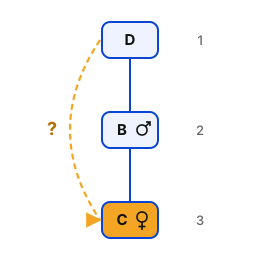
Q1404.
C is the daughter of B. B is the son of D. How is D related to C?
C, B की पुत्री है। B, D का पुत्र है। D का C से क्या संबंध है?
  1. AFatherपिता
  2. BMotherमाता
  3. CGrandparentदादा/दादी
  4. DUncleचाचा
Show answer

Concept: Count the generation gap between the two people.

  1. D → B (son): one generation down.
  2. B → C (daughter): another generation down.
  3. D is two generations above C, so D is C’s grandparent (gender of D not given).

Trick: Parent of a parent = grandparent; when gender is unknown choose the neutral word.

Answer: (C) Grandparent

अवधारणा: दोनों व्यक्तियों के बीच पीढ़ियों का अंतर गिनें।

हल:

  1. B, D का पुत्र है – एक पीढ़ी नीचे।
  2. C, B की पुत्री है – एक और पीढ़ी नीचे।
  3. D, C से दो पीढ़ी ऊपर है – D, C का दादा/दादी (grandparent) है; D का लिंग नहीं दिया।

ट्रिक: माता-पिता के माता-पिता = grandparent; लिंग न पता हो तो उदासीन शब्द चुनें।

उत्तर: (C) दादा/दादी

SSC CGLGeneral Intelligence & ReasoningBlood relation – generationsSSC CGL 2025 · 22 Sep Shift 1 →
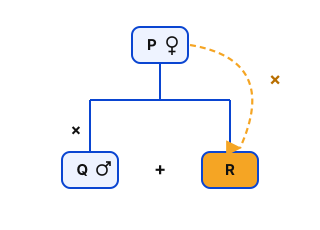
Q1405.
P − Q means P is the sister of Q; P × Q means P is the mother of Q; P ÷ Q means P is the father of Q; P + Q means P is the brother of Q.
What is the relation in P × Q + R?
P − Q का अर्थ है P, Q की बहन है; P × Q का अर्थ है P, Q की माता है; P ÷ Q का अर्थ है P, Q का पिता है; P + Q का अर्थ है P, Q का भाई है।
P × Q + R में क्या संबंध है?
  1. AP is the mother of RP, R की माता है
  2. BQ is the father of RQ, R का पिता है
  3. CR is the mother of QR, Q की माता है
  4. DQ is the brother of PQ, P का भाई है
Show answer

Concept: Decode each symbol and join the relations.

  1. “×” between P and Q: Q is P’s child, P being female.
  2. “+” between Q and R: Q is a male sibling of R.
  3. Siblings share parents, so R is also P’s child → P is R’s mother.

Trick: A sibling of my child is also my child – so the parent passes to every sibling.

Answer: (A) P is the mother of R

अवधारणा: हर चिह्न का अर्थ लिखकर संबंध जोड़ें।

हल:

  1. P × Q ⇒ P, Q की माँ है।
  2. Q + R ⇒ Q, R का भाई है, यानी दोनों भाई-बहन।
  3. इसलिए P, R की भी माँ है।

ट्रिक: भाई-बहनों के माता-पिता समान होते हैं।

उत्तर: (A) P, R की माता है

SSC CGLGeneral Intelligence & ReasoningCoded blood relationSSC CGL 2025 · 22 Sep Shift 1 →
Q1406.
Read the statement and identify the action that follows.
Statement: Cases of waterborne diseases have significantly increased in the city during the last six months.
Course of Action:
1. The municipal corporation should take immediate steps to ensure clean drinking water supply.
2. People should be advised to boil water before drinking.
कथन पढ़कर अनुसरण करने वाली कार्यवाही पहचानिए।
कथन: पिछले छह माह में शहर में जलजनित रोगों के मामले काफ़ी बढ़ गए हैं।
कार्यवाही:
1. नगर निगम स्वच्छ पेयजल आपूर्ति सुनिश्चित करने हेतु तुरंत कदम उठाए।
2. लोगों को पानी उबालकर पीने की सलाह दी जाए।
  1. ABoth followदोनों अनुसरण करती हैं
  2. BOnly 1 followsकेवल 1 अनुसरण करती है
  3. COnly 2 followsकेवल 2 अनुसरण करती है
  4. DNeither followsकोई नहीं
Show answer

Concept: A valid action should solve or reduce the stated problem practically.

  1. Problem: rise in waterborne diseases.
  2. Action 1 removes the cause (unsafe water) – follows.
  3. Action 2 is an immediate safety step for people – follows.
  4. Both work together, so both follow.

Trick: Long-term fix + short-term precaution for the same problem → usually both follow.

Answer: (A) Both follow

अवधारणा: सही कार्यवाही वह है जो समस्या को व्यावहारिक रूप से दूर करे या घटाए।

हल:

  1. समस्या: जलजनित रोग बढ़े हैं।
  2. कार्य 1: साफ़ पानी की आपूर्ति – जड़ पर प्रहार, उचित।
  3. कार्य 2: पानी उबालकर पीना – तुरंत बचाव, उचित।
  4. दोनों साथ चल सकते हैं।

ट्रिक: स्थायी उपाय + तात्कालिक सावधानी – दोनों आमतौर पर अनुसरण करते हैं।

उत्तर: (A) दोनों अनुसरण करती हैं

SSC CGLGeneral Intelligence & ReasoningCourse of action – public healthSSC CGL 2025 · 22 Sep Shift 1 →
Q1407.
Find the odd one out:
असंगत चुनिए:
  1. Ax5#
  2. By6#
  3. Cz7#
  4. Dw8#
Show answer

Concept: Letter position and number should move together.

  1. x(24)→5, y(25)→6, z(26)→7: next letter, next number.
  2. Number = position − 19 in each: 24−19=5, 25−19=6, 26−19=7.
  3. w(23)→8 breaks it (23−19 = 4, not 8).

Trick: Find one fixed difference between letter value and number; the item that misses it is odd.

Answer: (D) w8#

अवधारणा: अक्षर का स्थान और संख्या साथ-साथ बढ़ने चाहिए।

हल:

  1. x(24)→5, y(25)→6, z(26)→7।
  2. हर में संख्या = स्थान − 19।
  3. w(23) के लिए 4 होना चाहिए, पर 8 है – विषम।

ट्रिक: अक्षर-मान और संख्या का स्थिर अंतर खोजें; जो न माने वह विषम।

उत्तर: (D) w8#

SSC CGLGeneral Intelligence & ReasoningOdd one out – letter-number linkSSC CGL 2025 · 22 Sep Shift 1 →
Q1408.
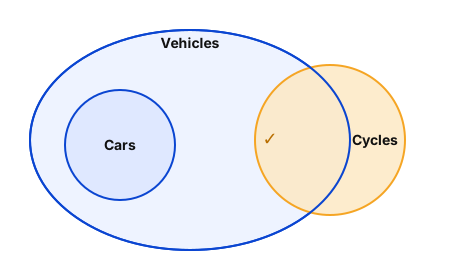
Read the following statements carefully and identify the conclusion that follows.
Statements:
All cars are vehicles.
Some vehicles are cycles.
No cycle is a car.
Conclusions:
I. Some cycles are cars.
II. Some vehicles are not cars.
निम्न कथनों को ध्यानपूर्वक पढ़कर अनुसरण करने वाला निष्कर्ष पहचानिए।
कथन:
सभी कारें वाहन हैं।
कुछ वाहन साइकिल हैं।
कोई साइकिल कार नहीं है।
निष्कर्ष:
I. कुछ साइकिलें कार हैं।
II. कुछ वाहन कार नहीं हैं।
  1. AOnly I followsकेवल I अनुसरण करता है
  2. BOnly II followsकेवल II अनुसरण करता है
  3. CBoth I and II followI और II दोनों अनुसरण करते हैं
  4. DNeither I nor II followsन I न II अनुसरण करता है
Show answer

Concept: “Some A are B” + “No B is C” ⇒ “Some A are not C”.

  1. I says some cycles are cars, but the statement says no cycle is a car – I is false.
  2. Some vehicles are cycles, and those cycles are not cars.
  3. So some vehicles are not cars – II follows.

Trick: A conclusion that contradicts a given “No” statement can never follow.

Answer: (B) Only II follows

अवधारणा: “कुछ A, B हैं” + “कोई B, C नहीं” ⇒ “कुछ A, C नहीं हैं”।

हल:

  1. I कहता है कुछ साइकिल कार हैं – कथन “कोई साइकिल कार नहीं” के विपरीत, I गलत।
  2. कुछ वाहन साइकिल हैं और वे कार नहीं हैं।
  3. अतः कुछ वाहन कार नहीं हैं – II सही।

ट्रिक: “कोई नहीं” कथन का खंडन करने वाला निष्कर्ष कभी सही नहीं होता।

उत्तर: (B) केवल II अनुसरण करता है

SSC CGLGeneral Intelligence & ReasoningSyllogism – some + noSSC CGL 2025 · 22 Sep Shift 1 →
Q1409.
What comes next?
X, U, Q, L, ?
आगे क्या आएगा?
X, U, Q, L, ?
  1. AF
  2. BG
  3. CH
  4. DI
Show answer

Concept: Convert letters to positions and study the differences.

  1. X=24, U=21, Q=17, L=12.
  2. Gaps: −3, −4, −5 → next −6.
  3. 12 − 6 = 6 → F.

Trick: Remember EJOTY = 5, 10, 15, 20, 25 to convert letters fast.

Answer: (A) F

अवधारणा: अक्षरों को स्थान-मान में बदलकर अंतर देखें।

हल:

  1. X=24, U=21, Q=17, L=12।
  2. अंतर: −3, −4, −5 ⇒ अगला −6।
  3. 12 − 6 = 6 ⇒ F।

ट्रिक: EJOTY = 5, 10, 15, 20, 25 याद रखें – अक्षर-मान तुरंत मिलेगा।

उत्तर: (A) F

SSC CGLGeneral Intelligence & ReasoningLetter series – increasing backward gapsSSC CGL 2025 · 22 Sep Shift 1 →
Q1410.
Select the word that can be formed using the letters of the given word.
COMBATING
दिए गए शब्द के अक्षरों से बनने वाला शब्द चुनिए।
COMBATING
  1. ADAY
  2. BHOUSE
  3. CCOAT
  4. DNOTE
Show answer

Concept: Every letter of the new word must be present in the given word.

  1. Letters available: C, O, M, B, A, T, I, N, G.
  2. DAY – no D, Y; HOUSE – no H, U, S, E; NOTE – no E.
  3. COAT – C, O, A, T all present.

Trick: Check a rare letter in each option first (D, H, E) – eliminates quickly.

Answer: (C) COAT

अवधारणा: नए शब्द का हर अक्षर दिए गए शब्द में होना चाहिए।

हल:

  1. उपलब्ध अक्षर: C, O, M, B, A, T, I, N, G।
  2. DAY में D, Y नहीं; HOUSE में H, U, S, E नहीं; NOTE में E नहीं।
  3. COAT के C, O, A, T सब मौजूद।

ट्रिक: हर विकल्प का कोई एक अनुपस्थित अक्षर ढूँढें – तेज़ी से हटेंगे।

उत्तर: (C) COAT

SSC CGLGeneral Intelligence & ReasoningWord formation from given lettersSSC CGL 2025 · 22 Sep Shift 1 →
Q1411.
Fill in the missing letter based on an alphabetical pattern.
C, E, G, I, ?
वर्णमाला पैटर्न के आधार पर लुप्त अक्षर भरिए।
C, E, G, I, ?
  1. AM
  2. BK
  3. CH
  4. DJ
Show answer

Concept: Each letter skips one letter (+2).

  1. C(3), E(5), G(7), I(9).
  2. Next: 9 + 2 = 11 → K.

Trick: Odd positions 3, 5, 7, 9, 11 – the series is just odd-numbered letters.

Answer: (B) K

अवधारणा: हर बार एक अक्षर छोड़कर (+2) आगे।

हल:

  1. C(3), E(5), G(7), I(9)।
  2. अगला 9 + 2 = 11 ⇒ K।

ट्रिक: ये सब विषम स्थान वाले अक्षर हैं – 3, 5, 7, 9, 11।

उत्तर: (B) K

SSC CGLGeneral Intelligence & ReasoningLetter series – +2 patternSSC CGL 2025 · 22 Sep Shift 1 →
Q1412.
In a certain code, SLANO is written as TMBOP. How is SPEED written in that code?
एक कूट में SLANO को TMBOP लिखा जाता है। उसी कूट में SPEED कैसे लिखा जाएगा?
  1. ATQFFE
  2. BTSQJO
  3. CTSBOJ
  4. DURBJO
Show answer

Concept: Find the shift from the example and apply it to the new word.

  1. S→T, L→M, A→B, N→O, O→P: each letter +1.
  2. SPEED: S→T, P→Q, E→F, E→F, D→E.
  3. Code = TQFFE.

Trick: Both E’s must give the same letter – only TQFFE has a doubled middle letter.

Answer: (A) TQFFE

अवधारणा: उदाहरण से खिसकाव ज्ञात कर नए शब्द पर लगाएँ।

हल:

  1. S→T, L→M, A→B, N→O, O→P – हर अक्षर +1।
  2. SPEED: S→T, P→Q, E→F, E→F, D→E।
  3. कोड = TQFFE।

ट्रिक: SPEED में दो E हैं, कोड में भी दो समान अक्षर होंगे – केवल TQFFE।

उत्तर: (A) TQFFE

SSC CGLGeneral Intelligence & ReasoningLetter coding – +1 shiftSSC CGL 2025 · 22 Sep Shift 1 →
Q1413.
Find the odd one out from the given alternatives.
दिए गए विकल्पों में से असंगत चुनिए।
  1. AClassical Languagesशास्त्रीय भाषाएँ
  2. BHindiहिंदी
  3. CSanskritसंस्कृत
  4. DMarathiमराठी
Show answer

Concept: Three options are individual items; one is the group name.

  1. Hindi, Sanskrit, Marathi – each is a single language.
  2. “Classical Languages” is a category (a group of languages), not one language.

Yaad rakhein: Sanskrit is one of India’s notified classical languages; Marathi got the status in 2024.

Answer: (A) Classical Languages

अवधारणा: तीन विकल्प अलग-अलग सदस्य हैं, एक पूरे वर्ग का नाम है।

हल:

  1. हिंदी, संस्कृत, मराठी – प्रत्येक एक भाषा है।
  2. “शास्त्रीय भाषाएँ” एक वर्ग है, अकेली भाषा नहीं।

याद रखें: संस्कृत भारत की अधिसूचित शास्त्रीय भाषा है; मराठी को 2024 में यह दर्जा मिला।

उत्तर: (A) शास्त्रीय भाषाएँ

SSC CGLGeneral Intelligence & ReasoningOdd one out – class vs membersSSC CGL 2025 · 22 Sep Shift 1 →
Q1414.
What comes next?
ZY, XW, VU, TS, RQ, ?
आगे क्या आएगा?
ZY, XW, VU, TS, RQ, ?
  1. APO
  2. BPQ
  3. CPR
  4. DQP
Show answer

Concept: The alphabet is read backwards two letters at a time.

  1. Z Y | X W | V U | T S | R Q – continuous reverse alphabet.
  2. Next two letters after Q going back: P, O.
  3. Answer pair: PO.

Trick: Write the alphabet backwards and simply cut it into pairs.

Answer: (A) PO

अवधारणा: वर्णमाला उल्टी दिशा में दो-दो अक्षरों में लिखी गई है।

हल:

  1. ZY, XW, VU, TS, RQ – लगातार उल्टी वर्णमाला।
  2. Q के बाद पीछे की ओर P, O।
  3. अगला युग्म PO।

ट्रिक: उल्टी वर्णमाला लिखकर दो-दो में बाँट दें।

उत्तर: (A) PO

SSC CGLGeneral Intelligence & ReasoningLetter-pair series – reverse pairsSSC CGL 2025 · 22 Sep Shift 1 →
Q1415.
The sum of three consecutive even numbers is 60. What is the largest of these three numbers?
तीन क्रमागत सम संख्याओं का योग 60 है। इनमें सबसे बड़ी संख्या कौन-सी है?
  1. A22
  2. B24
  3. C26
  4. D28
Show answer

Concept: For 3 consecutive evens, the middle one = sum ÷ 3.

  1. Middle number = 60÷3=20.
  2. Numbers: 18, 20, 22.
  3. Largest = 22.

Trick: Middle = average; largest = middle + 2.

Answer: (A) 22

अवधारणा: तीन क्रमागत सम संख्याओं में बीच वाली = योग ÷ 3।

हल:

  1. बीच की संख्या = 60÷3=20।
  2. संख्याएँ: 18, 20, 22।
  3. सबसे बड़ी = 22।

ट्रिक: बीच वाली = औसत; सबसे बड़ी = बीच वाली + 2।

उत्तर: (A) 22

SSC CGLGeneral Intelligence & ReasoningConsecutive even numbers – sumSSC CGL 2025 · 22 Sep Shift 1 →
Q1416.
Eligibility Criteria:
Should have passed Graduation with a minimum of 55% marks. Must have a minimum typing speed of 45 WPM. Should have completed a Diploma in Computer Applications (DCA). Age should be between 21 and 30 years only.
Case: Amit has completed his Graduation with 62% marks, types at 50 WPM, holds a DCA certificate and is 26 years old.
पात्रता मानदंड:
स्नातक कम से कम 55% अंकों के साथ उत्तीर्ण हो। टाइपिंग गति कम से कम 45 WPM हो। कंप्यूटर एप्लीकेशंस में डिप्लोमा (DCA) पूरा हो। आयु 21 से 30 वर्ष के बीच हो।
मामला: अमित ने 62% अंकों के साथ स्नातक किया है, 50 WPM की गति से टाइप करता है, उसके पास DCA प्रमाणपत्र है और उसकी आयु 26 वर्ष है।
  1. AEligibleपात्र
  2. BNot eligible due to ageआयु के कारण अपात्र
  3. CNot eligible due to typing speedटाइपिंग गति के कारण अपात्र
  4. DNot eligible due to missing certificationप्रमाणपत्र न होने के कारण अपात्र
Show answer

Concept: Tick every condition; one failure makes the candidate ineligible.

  1. Graduation 62% (need ≥ 55%) ✓
  2. Typing 50 WPM (need ≥ 45) ✓
  3. DCA held ✓; age 26 (21–30) ✓
  4. All four met → eligible.

Trick: Make a quick ✓/✗ column for each condition – no need to reread the case.

Answer: (A) Eligible

अवधारणा: हर शर्त जाँचें; एक भी अधूरी हो तो अपात्र।

हल:

  1. स्नातक 62% (≥ 55% चाहिए) ✓
  2. टाइपिंग 50 WPM (≥ 45) ✓
  3. DCA है ✓; आयु 26 (21–30) ✓
  4. सभी शर्तें पूरी – पात्र।

ट्रिक: हर शर्त के आगे ✓/✗ लगाते जाएँ।

उत्तर: (A) पात्र

SSC CGLGeneral Intelligence & ReasoningEligibility criteria checkSSC CGL 2025 · 22 Sep Shift 1 →
Q1417.
If 'A' denotes '+', 'B' denotes '×', 'C' denotes '−' and 'D' denotes '÷', what is the value of the following expression?
6 B 2 A 4 C 3 D 1 = ?
यदि 'A' का अर्थ '+', 'B' का अर्थ '×', 'C' का अर्थ '−' और 'D' का अर्थ '÷' है, तो निम्न व्यंजक का मान क्या है?
6 B 2 A 4 C 3 D 1 = ?
  1. A18
  2. B13
  3. C15
  4. D12
Show answer

Concept: Replace letters by signs, then use BODMAS.

  1. 6 B 2 A 4 C 3 D 1 → 6×2+4−3÷1.
  2. × and ÷ first: 12+4−3.
  3. = 13.

Trick: Write the decoded sign above each letter before solving – avoids mix-ups.

Answer: (B) 13

अवधारणा: अक्षरों के स्थान पर चिह्न रखकर BODMAS लगाएँ।

हल:

  1. 6×2+4−3÷1।
  2. पहले × और ÷: 12+4−3।
  3. = 13।

ट्रिक: हर अक्षर के ऊपर उसका चिह्न लिख लें, फिर हल करें।

उत्तर: (B) 13

SSC CGLGeneral Intelligence & ReasoningLetter-coded operators – BODMASSSC CGL 2025 · 22 Sep Shift 1 →
Q1418.
If the signs are interchanged as follows: '+' means '×', '−' means '÷', '×' means '+' and '÷' means '−', choose the correct equation from the options below.
यदि चिह्न इस प्रकार बदले जाएँ: '+' = '×', '−' = '÷', '×' = '+' और '÷' = '−', तो नीचे दिए विकल्पों में से सही समीकरण चुनिए।
  1. A8 + 2 × 3 = 19
  2. B15 + 3 − 6 = 10
  3. C12 ÷ 6 + 3 = 5
  4. D10 − 2 + 3 = 12
Show answer

Concept: Change the signs as told and evaluate each option.

  1. A: 8 + 2 × 3 → 8×2+3=16+3=19 ✓
  2. B: 15×3÷6=7.5 ✗; C: 12−6×3=−6 ✗
  3. D: 10÷2×3=15 ✗
  4. Only A balances.

Trick: Start with the option having the fewest operations – often settles quickly.

Answer: (A) 8 + 2 × 3 = 19

अवधारणा: बताए अनुसार चिह्न बदलकर हर विकल्प हल करें।

हल:

  1. A: 8×2+3=19 ✓
  2. B: 15×3÷6=7.5 ✗; C: 12−6×3=−6 ✗
  3. D: 10÷2×3=15 ✗
  4. केवल A सही।

ट्रिक: कम चिह्न वाले विकल्प से शुरू करें – जल्दी निपटता है।

उत्तर: (A) 8 + 2 × 3 = 19

SSC CGLGeneral Intelligence & ReasoningSign interchange – find correct equationSSC CGL 2025 · 22 Sep Shift 1 →
Q1419.
Shyam, who is suffering from an infectious disease, is admitted to a hospital. As a healthcare worker, what would be your first step?
संक्रामक रोग से पीड़ित श्याम को अस्पताल में भर्ती किया जाता है। एक स्वास्थ्यकर्मी के रूप में आपका पहला कदम क्या होगा?
  1. AImmediately isolate Shyam and inform the doctor on duty.श्याम को तुरंत अलग करें और ड्यूटी डॉक्टर को सूचित करें।
  2. BAsk Shyam to sit in the waiting area with other patients.श्याम को अन्य रोगियों के साथ प्रतीक्षा क्षेत्र में बैठने को कहें।
  3. CHave Shyam fill out the forms to complete the admission process.श्याम से भर्ती प्रक्रिया के फ़ॉर्म भरवाएँ।
  4. DInform Shyam's family about the situation.श्याम के परिवार को स्थिति की सूचना दें।
Show answer

Concept: First priority with an infectious patient is to stop the spread.

  1. Isolation keeps other patients and staff safe; the doctor must know at once.
  2. Waiting area (B) spreads infection.
  3. Forms (C) and family call (D) can come after safety.

Trick: In “first step” questions choose the option that prevents harm immediately.

Answer: (A) Immediately isolate Shyam and inform the doctor on duty.

अवधारणा: संक्रामक रोगी के साथ पहला काम संक्रमण फैलने से रोकना है।

हल:

  1. अलग रखना (isolation) दूसरों को बचाता है; डॉक्टर को तुरंत बताना ज़रूरी।
  2. प्रतीक्षा कक्ष (B) में बैठाना संक्रमण फैलाएगा।
  3. फ़ॉर्म (C) और परिवार को सूचना (D) बाद में।

ट्रिक: “पहला कदम” वाले प्रश्न में तुरंत नुकसान रोकने वाला विकल्प चुनें।

उत्तर: (A) श्याम को तुरंत अलग करें और ड्यूटी डॉक्टर को सूचित करें।

SSC CGLGeneral Intelligence & ReasoningSituational judgement – infection controlSSC CGL 2025 · 22 Sep Shift 1 →
Q1420.
Given below is an equation which has to be solved by following the interchange, i.e. '+' becomes '−' and '−' becomes '+', '×' becomes '÷' and '÷' becomes '×'.
Then what is the value of 100 ÷ 4 + 30 − 50 × 10?
नीचे दिया समीकरण इस परिवर्तन के अनुसार हल कीजिए: '+' बने '−' और '−' बने '+', '×' बने '÷' और '÷' बने '×'।
तो 100 ÷ 4 + 30 − 50 × 10 का मान क्या है?
  1. A334
  2. B330
  3. C475
  4. D375
Show answer

Concept: Swap + ↔ − and × ↔ ÷, then apply BODMAS.

  1. 100 ÷ 4 + 30 − 50 × 10 → 100×4−30+50÷10.
  2. = 400−30+5.
  3. = 375.

Trick: Unit digit check: 400−30+5 ends in 5 → only 475 or 375; 400−25=375.

Answer: (D) 375

अवधारणा: + ↔ − और × ↔ ÷ बदलकर BODMAS लगाएँ।

हल:

  1. 100×4−30+50÷10।
  2. = 400−30+5।
  3. = 375।

ट्रिक: इकाई अंक 5 आएगा – 475 या 375; 400−25=375।

उत्तर: (D) 375

SSC CGLGeneral Intelligence & ReasoningSign interchange – evaluateSSC CGL 2025 · 22 Sep Shift 1 →