Question bank

Q&A: practice questions with answers

Search questions on any topic. Filter by exam category, exam, subject and topic, try the question, then open the answer and explanation.

Courses – airGurukul

4,800 questions found.

Q1461.
Amit buys a set of 3 identical watches at a total cost of ₹3,500. He sells them at ₹1,600, ₹1,700 and ₹1,500 respectively. What is the overall profit or loss?
अमित ₹3,500 की कुल लागत पर 3 एक जैसी घड़ियाँ खरीदता है। वह उन्हें क्रमशः ₹1,600, ₹1,700 और ₹1,500 में बेचता है। कुल लाभ या हानि क्या है?
  1. A₹1,100 loss₹1,100 हानि
  2. B₹1,300 profit₹1,300 लाभ
  3. C₹1,600 profit₹1,600 लाभ
  4. D₹1,600 loss₹1,600 हानि
Show answer

Concept: Overall profit = total SP − total CP.

  1. Total SP = 1,600+1,700+1,500= ₹4,800.
  2. Total CP = ₹3,500.
  3. Profit = 4,800−3,500= ₹1,300.

Trick: Average SP = 1,600 (middle value) → 3×1,600=4,800 instantly.

Answer: (B) ₹1,300 profit

अवधारणा: कुल लाभ = कुल विक्रय मूल्य − कुल क्रय मूल्य।

हल:

  1. कुल SP = ₹4,800।
  2. कुल CP = ₹3,500।
  3. लाभ = ₹1,300।

ट्रिक: SP का औसत 1,600 ⇒ 3×1,600=4,800।

उत्तर: (B) ₹1,300 लाभ

SSC CGLQuantitative AptitudeProfit & loss – overall resultSSC CGL 2025 · 22 Sep Shift 1 →
Q1462.
25 men can do a piece of work in 5 days. Find the time required by 10 men to do two times the work.
25 आदमी एक कार्य 5 दिनों में करते हैं। 10 आदमी उससे दोगुना कार्य कितने दिनों में करेंगे?
  1. A20 days20 दिन
  2. B25 days25 दिन
  3. C30 days30 दिन
  4. D36 days36 दिन
Show answer

Concept: M1D1W1=M2D2W2.

  1. 25×51=10×D2.
  2. 125=5D⇒D=25 days.

Trick: Total man-days = 125 for one work; double work = 250; 250÷10=25.

Answer: (B) 25 days

अवधारणा: M1D1W1=M2D2W2।

हल:

  1. 25×51=10×D2।
  2. 125=5D⇒D=25 दिन।

ट्रिक: एक काम = 125 मानव-दिवस; दोगुना = 250; 250÷10=25।

उत्तर: (B) 25 दिन

SSC CGLQuantitative AptitudeWork – men, days and workSSC CGL 2025 · 22 Sep Shift 1 →
Q1463.
Saveena and Tejasvini together can do a piece of work in 15 days. Tejasvini alone can do it in 20 days. In how many days can Saveena alone do it?
सवीना और तेजस्विनी मिलकर एक कार्य 15 दिनों में करती हैं। तेजस्विनी अकेली उसे 20 दिनों में करती है। सवीना अकेली उसे कितने दिनों में करेगी?
  1. A60
  2. B62
  3. C40
  4. D50
Show answer

Concept: One-day work of A = (A + B)’s one-day work − B’s one-day work.

  1. Saveena’s 1 day = 115−120.
  2. =4−360=160.
  3. She alone takes 60 days.

Trick: Alone time = a×bb−a=15×2020−15=60.

Answer: (A) 60

अवधारणा: A का एक दिन का काम = (A + B) का − B का।

हल:

  1. सवीना का 1 दिन = 115−120।
  2. =160।
  3. अकेले 60 दिन।

ट्रिक: अकेले समय = 15×2020−15=60।

उत्तर: (A) 60

SSC CGLQuantitative AptitudeWork – one person’s time aloneSSC CGL 2025 · 22 Sep Shift 1 →
Q1464.
The average salary of 20 workers in a factory is ₹48,000. If the salary of a supervisor is added, the average rises to ₹49,500. What is the supervisor's salary?
एक कारखाने के 20 श्रमिकों का औसत वेतन ₹48,000 है। पर्यवेक्षक का वेतन जोड़ने पर औसत ₹49,500 हो जाता है। पर्यवेक्षक का वेतन क्या है?
  1. A₹64,000
  2. B₹74,000
  3. C₹79,500
  4. D₹89,500
Show answer

Concept: New value = new average + (old count × rise in average).

  1. Rise in average = 49,500−48,000= ₹1,500.
  2. Supervisor = 49,500+20×1,500.
  3. =49,500+30,000= ₹79,500.

Trick: He must cover the new average for himself and give ₹1,500 extra to each of 20 workers.

Answer: (C) ₹79,500

अवधारणा: नया मान = नया औसत + (पुरानी संख्या × औसत में वृद्धि)।

हल:

  1. औसत में वृद्धि = ₹1,500।
  2. सुपरवाइज़र = 49,500+20×1,500।
  3. = ₹79,500।

ट्रिक: वह अपना औसत भी देता है और 20 लोगों को ₹1,500 अतिरिक्त।

उत्तर: (C) ₹79,500

SSC CGLQuantitative AptitudeAverage – new member’s valueSSC CGL 2025 · 22 Sep Shift 1 →
Q1465.
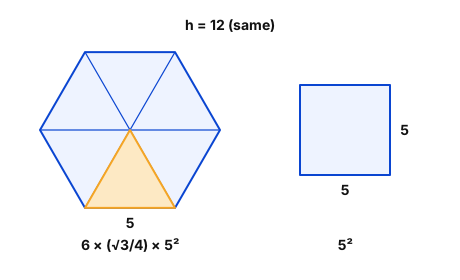
Two right prisms have the same height of 12 cm. One has a regular hexagonal base with side 5 cm and the other a square base with side 5 cm. What is the ratio of their volumes?
दो लंब प्रिज़्म की ऊँचाई समान 12 cm है। एक का आधार 5 cm भुजा वाला सम षट्भुज है और दूसरे का 5 cm भुजा वाला वर्ग। उनके आयतनों का अनुपात क्या है?
  1. A3 : 1
  2. B33 : 2
  3. C33 : 5
  4. D3 : 23
Show answer

Concept: Volume of a prism = base area × height; equal heights ⇒ compare bases.

  1. Regular hexagon area = (332)a2; square area = a2.
  2. Ratio = (332)a2:a2=33:2.

Trick: Hexagon = 6 equilateral triangles: 6×(34)a2=(332)a2.

Answer: (B) 33 : 2

अवधारणा: प्रिज़्म का आयतन = आधार क्षेत्रफल × ऊँचाई; ऊँचाई बराबर ⇒ केवल आधार तुलना।

हल:

  1. षट्भुज = (332)a2; वर्ग = a2।
  2. अनुपात = 33:2।

ट्रिक: षट्भुज = 6 समबाहु त्रिभुज = 6×(34)a2।

उत्तर: (B) 33 : 2

SSC CGLQuantitative AptitudeMensuration – prism volumesSSC CGL 2025 · 22 Sep Shift 1 →
Q1466.
A 32-litre mixture of milk and water contains milk and water in the ratio 3 : 5. How much water must be added to make the ratio 3 : 6?
32 लीटर दूध-पानी के मिश्रण में दूध और पानी 3 : 5 के अनुपात में हैं। अनुपात 3 : 6 करने के लिए कितना पानी मिलाना होगा?
  1. A3 L
  2. B4 L
  3. C5 L
  4. D7.5 L
Show answer

Concept: Milk stays the same; only water changes.

  1. Milk = 38×32=12 L, water = 20 L.
  2. For 3 : 6, water = 2 × milk = 24 L.
  3. Water to add = 24−20=4 L.

Trick: Milk part is 3 in both ratios, so 1 extra part of water = 328=4 L.

Answer: (B) 4 L

अवधारणा: दूध नहीं बदलता, केवल पानी बढ़ता है।

हल:

  1. दूध = 12 L, पानी = 20 L।
  2. 3 : 6 के लिए पानी = 24 L।
  3. मिलाना = 4 L।

ट्रिक: दोनों अनुपात में दूध 3 भाग ⇒ 1 भाग पानी = 4 L।

उत्तर: (B) 4 L

SSC CGLQuantitative AptitudeMixture – adding waterSSC CGL 2025 · 22 Sep Shift 1 →
Q1467.
If sinA = 941 and A lies in the 2nd quadrant, then find the value of sinA × secA.
यदि sinA = 941 है और A दूसरे चतुर्थांश में है, तो sinA × secA का मान ज्ञात कीजिए।
  1. A940
  2. B−940
  3. C4140
  4. D−4140
Show answer

Concept: sinA×secA=sinAcosA=tanA; in Q2 only sin (and cosec) are positive.

  1. sinA=941 → triplet (9, 40, 41), so |cosA|=4041.
  2. In Q2 cosA=−4041.
  3. tanA=9−40=−940.

Trick: sin×sec=tan; tan is negative in Q2 – keep only negative options.

Answer: (B) −940

अवधारणा: sinA×secA=tanA; द्वितीय चतुर्थांश में केवल sin (और cosec) धनात्मक।

हल:

  1. sinA=941 ⇒ (9, 40, 41) ⇒ |cosA|=4041।
  2. Q2 में cosA=−4041।
  3. tanA=−940।

ट्रिक: sin×sec=tan, और Q2 में tan ऋणात्मक।

उत्तर: (B) −940

SSC CGLQuantitative AptitudeTrigonometry – sign in 2nd quadrantSSC CGL 2025 · 22 Sep Shift 1 →
Q1468.
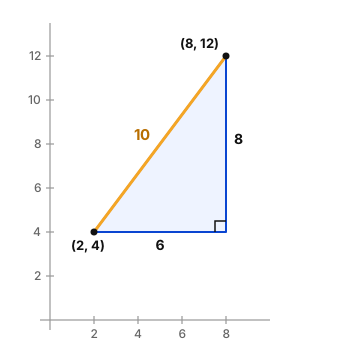
What is the length of the segment joining (2, 4) and (8, 12)?
(2, 4) और (8, 12) को जोड़ने वाले रेखाखंड की लंबाई क्या है?
  1. A10
  2. B12
  3. C14
  4. D13
Show answer

Concept: d=(x2−x1)2+(y2−y1)2.

  1. Δx=6, Δy=8.
  2. d=36+64=100=10.

Trick: 6, 8 → 10 is the 3-4-5 triplet doubled.

Answer: (A) 10

अवधारणा: d=(x2−x1)2+(y2−y1)2।

हल:

  1. Δx=6, Δy=8।
  2. d=100=10।

ट्रिक: 6, 8, 10 = (3, 4, 5) × 2।

उत्तर: (A) 10

SSC CGLQuantitative AptitudeCoordinate geometry – distanceSSC CGL 2025 · 22 Sep Shift 1 →
Q1469.
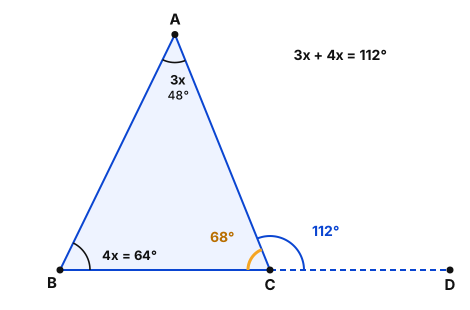
In a triangle ABC, side BC is extended to a point D. The exterior angle at C is 112°. The interior angles at A and B are in the ratio 3 : 4. What is the measure of the largest interior angle of the triangle?
त्रिभुज ABC में भुजा BC को बिंदु D तक बढ़ाया गया है। C पर बाह्य कोण 112° है। A और B के अंतःकोण 3 : 4 के अनुपात में हैं। त्रिभुज का सबसे बड़ा अंतःकोण कितना है?
  1. A60°
  2. B68°
  3. C105°
  4. D15°
Show answer

Concept: Exterior angle = sum of the two opposite interior angles.

  1. ∠A + ∠B = 112°, ratio 3 : 4 → 7 parts = 112° → 1 part = 16°.
  2. ∠A = 48°, ∠B = 64°.
  3. ∠C = 180° − 112° = 68° → largest.

Trick: Interior angle at C = 180° − exterior angle; compare it with the bigger of A, B.

Answer: (B) 68°

अवधारणा: बाह्य कोण = दोनों सम्मुख अंतः कोणों का योग।

हल:

  1. ∠A + ∠B = 112°, 7 भाग = 112° ⇒ 1 भाग = 16°।
  2. ∠A = 48°, ∠B = 64°।
  3. ∠C = 68° – सबसे बड़ा।

ट्रिक: ∠C = 180° − बाह्य कोण।

उत्तर: (B) 68°

SSC CGLQuantitative AptitudeTriangles – exterior angleSSC CGL 2025 · 22 Sep Shift 1 →
Q1470.
Two triangles △ABC and △DEF are congruent, written as △ABC ≅ △DEF. If ∠A = 40°, what is the measure of ∠D?
दो त्रिभुज △ABC और △DEF सर्वांगसम हैं, जिसे △ABC ≅ △DEF लिखा जाता है। यदि ∠A = 40° है, तो ∠D की माप क्या है?
  1. A40°
  2. B50°
  3. C60°
  4. D130°
Show answer

Concept: In △ABC ≅ △DEF the letters match in order: A↔D, B↔E, C↔F.

  1. ∠A corresponds to ∠D.
  2. Corresponding parts of congruent triangles are equal (CPCT).
  3. ∠D = 40°.

Trick: Read the congruence statement letter by letter – position gives the pair.

Answer: (A) 40°

अवधारणा: △ABC ≅ △DEF में अक्षर क्रम से मिलते हैं: A↔D, B↔E, C↔F।

हल:

  1. ∠A का संगत ∠D है।
  2. सर्वांगसम त्रिभुजों के संगत भाग बराबर (CPCT)।
  3. ∠D = 40°।

ट्रिक: सर्वांगसमता कथन में स्थान से जोड़ी पहचानें।

उत्तर: (A) 40°

SSC CGLQuantitative AptitudeCongruent triangles – corresponding anglesSSC CGL 2025 · 22 Sep Shift 1 →
Q1471.
Given x + 1x = 9, determine the value of 2xx²−1.
यदि x + 1x = 9 है, तो 2xx²−1 का मान ज्ञात कीजिए।
  1. A27777
  2. B27177
  3. C72171
  4. D96677
Show answer

Concept: (x−1x)2=(x+1x)2−4.

  1. (x−1x)2=81−4=77⇒x−1x=77 (taking the positive root).
  2. 2xx2−1: divide top and bottom by x → 2x−1x.
  3. =277=27777.

Trick: Any 2xx2−1 form = 2x−1x – just divide by x.

Answer: (A) 27777

अवधारणा: (x−1x)2=(x+1x)2−4।

हल:

  1. (x−1x)2=81−4=77⇒x−1x=77।
  2. अंश-हर को x से भाग: 2x−1x।
  3. =277=27777।

ट्रिक: 2xx2−1=2x−1x – बस x से भाग दें।

उत्तर: (A) 27777

SSC CGLQuantitative AptitudeAlgebra – x − 1/x from x + 1/xSSC CGL 2025 · 22 Sep Shift 1 →
Q1472.
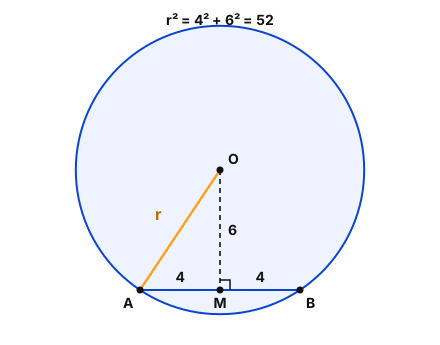
A chord of length 8 cm is at a distance of 6 cm away from the centre of a circle. What is the approximate radius of the circle?
8 cm लंबी एक जीवा वृत्त के केंद्र से 6 cm दूर है। वृत्त की अनुमानित त्रिज्या क्या है?
  1. A10 cm
  2. B14 cm
  3. C7 cm
  4. D25 cm
Show answer

Concept: The perpendicular from the centre bisects the chord: r2 = (half-chord)2 + d2.

  1. Half-chord = 4 cm, d = 6 cm.
  2. r=16+36=52≈7.2 cm.
  3. Nearest option: 7 cm.

Trick: 49=7 and 64=8, so 52 lies just above 7.

Answer: (C) 7 cm

अवधारणा: केंद्र से लंब जीवा को समद्विभाजित करता है: r2 = (आधी जीवा)2 + d2।

हल:

  1. आधी जीवा = 4, d = 6।
  2. r=52≈7.2 cm।
  3. निकटतम विकल्प 7 cm।

ट्रिक: 49=7, 64=8 ⇒ 52 थोड़ा 7 से अधिक।

उत्तर: (C) 7 cm

SSC CGLQuantitative AptitudeCircle – radius from chord and distanceSSC CGL 2025 · 22 Sep Shift 1 →
Q1473.
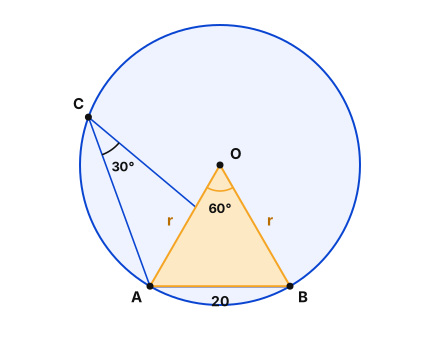
A chord AB of a circle has a length of 20 cm. The angle subtended by the chord at a point C on the major arc is 30°. Find the radius of the circle.
किसी वृत्त की जीवा AB की लंबाई 20 cm है। दीर्घ चाप पर स्थित बिंदु C पर यह जीवा 30° का कोण बनाती है। वृत्त की त्रिज्या ज्ञात कीजिए।
  1. A17 cm
  2. B20 cm
  3. C12 cm
  4. D18 cm
Show answer

Concept: Angle at the centre = 2 × angle at the circumference; chord = 2r sin(inscribed angle).

  1. Angle at C = 30∘ ⇒ ∠AOB=2×30∘=60∘.
  2. OA=OB=r and ∠AOB=60∘ ⇒ △AOB is equilateral.
  3. So r=AB=20 cm. (Check: 2rsin30∘=r=20.)

Trick: Central angle 60∘ ⇒ radius = chord (equilateral △).

Answer: (B) 20 cm

अवधारणा: केंद्र पर कोण = परिधि पर कोण का दोगुना; जीवा = 2r sin(परिधि कोण)।

  1. C पर कोण 30∘ ⇒ ∠AOB=60∘।
  2. OA=OB=r और ∠AOB=60∘ ⇒ △AOB समबाहु।
  3. अतः r=AB=20 cm।

ट्रिक: केंद्र पर 60∘ ⇒ त्रिज्या = जीवा।

उत्तर: (B) 20 cm

SSC CGLQuantitative AptitudeCircle – chord, inscribed angle and radiusSSC CGL 2025 · 22 Sep Shift 1 →
Q1474.
If tanA = xy and A ∈ (0, π2), then what is sinA in terms of x and y?
यदि tanA = xy और A ∈ (0, π2) है, तो sinA का मान x और y के पदों में क्या होगा?
  1. Ax²−y²x
  2. Byx²+y²
  3. Cxx²+y²
  4. Dx²+y²y
Show answer

Concept: tanA = perpendicular/base; sinA = perpendicular/hypotenuse.

  1. Perpendicular = x, base = y.
  2. Hypotenuse = x2+y2.
  3. sinA=xx2+y2 (positive in the 1st quadrant).

Trick: Put x=3, y=4: sinA=35; only xx2+y2 gives 35.

Answer: (C) xx²+y²

अवधारणा: tanA = लंब/आधार; sinA = लंब/कर्ण।

हल:

  1. लंब = x, आधार = y।
  2. कर्ण = x2+y2।
  3. sinA=xx2+y2।

ट्रिक: x=3, y=4 रखें: sinA=35 – केवल यही विकल्प मेल खाता है।

उत्तर: (C) xx²+y²

SSC CGLQuantitative AptitudeTrigonometry – sin from tanSSC CGL 2025 · 22 Sep Shift 1 →
Q1475.
You earn ₹157.5 in 10.5 hours. Find your hourly wage as a fraction.
आप 10.5 घंटे में ₹157.5 कमाते हैं। अपनी प्रति घंटा मज़दूरी भिन्न के रूप में ज्ञात कीजिए।
  1. A151
  2. B121
  3. C154
  4. D174
Show answer

Concept: Hourly wage = total pay ÷ hours.

  1. 157.5÷10.5=1575÷105.
  2. = 15 → ₹15 per hour = 151.

Trick: 10.5×15=157.5 – check by multiplying.

Answer: (A) 151

अवधारणा: प्रति घंटा मज़दूरी = कुल कमाई ÷ घंटे।

हल:

  1. 157.5÷10.5=1575÷105।
  2. = 15 ⇒ 151।

ट्रिक: जाँच: 10.5×15=157.5।

उत्तर: (A) 151

SSC CGLQuantitative AptitudeUnitary method – rate per hourSSC CGL 2025 · 22 Sep Shift 1 →
Q1476.
Select the most appropriate meaning of the given idiom.
His careless remark cooked his goose.
  1. AHelp someone succeed
  2. BRuin someone's plans or chances
  3. CSave someone from difficulty
  4. DMock someone
Show answer

Concept: “Cook someone’s goose” = spoil a person’s chances or plans for good.

  1. His careless remark damaged his own prospects.
  2. A (help succeed) and C (save) are the opposite; D (mock) is a different idea.

Trick: A cooked goose cannot fly again – the chance is gone.

Answer: (B) Ruin someone's plans or chances

अवधारणा: “Cook someone’s goose” = किसी की योजना या अवसर बिगाड़ देना।

हल:

  1. उसकी लापरवाह टिप्पणी ने उसका अपना मौका बिगाड़ दिया।
  2. A और C उल्टे अर्थ; D (मज़ाक उड़ाना) अलग बात।

ट्रिक: पका हुआ हंस उड़ नहीं सकता – यानी मौका खत्म।

उत्तर: (B) Ruin someone's plans or chances

SSC CGLEnglish ComprehensionIdiom – cook one’s gooseSSC CGL 2025 · 22 Sep Shift 1 →
Q1477.
Select the correct spelling to fill in the blank.
The music had a strong, regular beat and felt very ____.
  1. ARythmic
  2. BRhythmic
  3. CRhythimic
  4. DRhytmic
Show answer

Concept: Adjective from “rhythm” = rhythm + ic.

  1. Rhythm is spelt R-H-Y-T-H-M (two h’s).
  2. Add -ic → R-H-Y-T-H-M-I-C.
  3. Rythmic and Rhytmic drop an h; Rhythimic adds an i.

Trick: Mnemonic for rhythm: “Rhythm Helps Your Two Hips Move”.

Answer: (B) Rhythmic

अवधारणा: “rhythm” से विशेषण = rhythm + ic।

हल:

  1. rhythm में दो h हैं: R-H-Y-T-H-M।
  2. -ic जोड़ें ⇒ rhythmic।
  3. बाकी विकल्पों में h छूटा या i अतिरिक्त है।

ट्रिक: Rhythm Helps Your Two Hips Move – स्पेलिंग याद।

उत्तर: (B) Rhythmic

SSC CGLEnglish ComprehensionSpelling – rhythmicSSC CGL 2025 · 22 Sep Shift 1 →
Q1478.
Sentences of a paragraph are given below in jumbled order. Arrange the sentences in the correct order to form a meaningful and coherent paragraph.
1. This light is then converted into electrical signals by the retina.
2. The brain interprets these signals, creating the images we see.
3. The human eye works by capturing light from the surrounding environment.
4. The lens of the eye focuses this incoming light.
  1. A1-2-3-4
  2. B2-1-4-3
  3. C3-4-1-2
  4. D4-3-2-1
Show answer

Concept: Follow the natural process from start to finish.

  1. 3 introduces the topic (eye captures light).
  2. 4: the lens focuses “this incoming light”.
  3. 1: the retina converts “this light” into signals.
  4. 2: the brain interprets “these signals”. Order: 3-4-1-2.

Trick: Words like “this”, “these” point back – they cannot open a paragraph.

Answer: (C) 3-4-1-2

अवधारणा: प्रक्रिया को शुरुआत से अंत तक क्रम में रखें।

हल:

  1. 3 – विषय का परिचय (आँख प्रकाश ग्रहण करती है)।
  2. 4 – लेंस “this incoming light” को फोकस करता है।
  3. 1 – रेटिना संकेत बनाता है; 2 – मस्तिष्क “these signals” समझता है।
  4. क्रम: 3-4-1-2।

ट्रिक: “this/these” वाले वाक्य पिछली बात से जुड़ते हैं – शुरुआत नहीं कर सकते।

उत्तर: (C) 3-4-1-2

SSC CGLEnglish ComprehensionPara jumble – how the eye seesSSC CGL 2025 · 22 Sep Shift 1 →
Q1479.
Sentences of a paragraph are given below in jumbled order. Arrange the sentences in the correct order to form a meaningful and coherent paragraph.
1. This process is known as the water cycle.
2. Water from oceans, lakes, and rivers evaporates into the atmosphere.
3. It then cools and condenses to form clouds.
4. Eventually, the water returns to Earth as precipitation.
  1. A4-1-2-3
  2. B1-2-3-4
  3. C2-3-4-1
  4. D3-4-1-2
Show answer

Concept: Arrange the steps of the process, then the summary line.

  1. 2: evaporation – the start.
  2. 3: “It then cools…” – condensation.
  3. 4: “Eventually” – precipitation.
  4. 1 gives the label for everything above, so it goes last. Order: 2-3-4-1.

Trick: “This process is known as” sums up – it comes after the process is described.

Answer: (C) 2-3-4-1

अवधारणा: प्रक्रिया के चरण क्रम से, फिर सारांश वाक्य।

हल:

  1. 2 – वाष्पीकरण, शुरुआत।
  2. 3 – “It then cools” – संघनन।
  3. 4 – “Eventually” – वर्षा।
  4. 1 – “This process…” – पूरे चक्र का नाम। क्रम: 2-3-4-1।

ट्रिक: “This process is known as” हमेशा वर्णन के बाद आता है।

उत्तर: (C) 2-3-4-1

SSC CGLEnglish ComprehensionPara jumble – water cycleSSC CGL 2025 · 22 Sep Shift 1 →
Q1480.
Select the correct spelling.
  1. AIncontrovertible
  2. BIncontrovartible
  3. CIncontrovertibel
  4. DIncontrovurtibel
Show answer

Concept: in + controvert (to dispute) + ible = “impossible to dispute”.

  1. Root “controvert” has -vert (as in convert, invert).
  2. Ending is -ible, not -ibel.
  3. Correct: Incontrovertible.

Trick: Think “convert” inside it: in-contro-VERT-ible.

Answer: (A) Incontrovertible

अवधारणा: in + controvert (विवाद करना) + ible = जिस पर विवाद न हो सके।

हल:

  1. मूल शब्द controvert में -vert है (convert, invert की तरह)।
  2. अंत -ible, -ibel नहीं।
  3. सही: Incontrovertible।

ट्रिक: बीच में “VERT” याद रखें: in-contro-VERT-ible।

उत्तर: (A) Incontrovertible

SSC CGLEnglish ComprehensionSpelling – incontrovertibleSSC CGL 2025 · 22 Sep Shift 1 →