Question bank

Q&A: practice questions with answers

Search questions on any topic. Filter by exam category, exam, subject and topic, try the question, then open the answer and explanation.

Courses – airGurukul

5,000 questions found.

Q2321.
Rearrange the following sentence parts to form a meaningful and grammatically correct paragraph:
P. In search of the rare orchid, she carefully explored the greenhouse and examined the plants.
Q. She gently removed the flower from its pot to inspect its petals and leaves.
R. She placed the orchid in a special humid chamber to preserve its delicate fragrance.
S. As a satisfying result of her efforts, she displayed the beautiful orchid in a glass vase.
  1. AP, Q, R, S
  2. BQ, P, R, S
  3. CR, Q, P, S
  4. DS, Q, R, P
Show answer

Concept: Follow the natural sequence: search → inspect → preserve → display.

  1. P opens with the purpose: 'In search of the rare orchid…'.
  2. Q: she takes the flower out to inspect it.
  3. R: places it in a humid chamber to preserve it.
  4. S: 'As a … result of her efforts' – clearly the ending.

Trick: 'In search of' opens, 'As a result' closes → P…S; only option A fits.

Answer: (A) P, Q, R, S

अवधारणा: स्वाभाविक क्रम: खोज → जाँच → संरक्षण → प्रदर्शन।

  1. P उद्देश्य से शुरू करता है: 'In search of the rare orchid…'।
  2. Q: फूल निकालकर पंखुड़ियाँ जाँचती है।
  3. R: उसे नमी वाले कक्ष में सुरक्षित रखती है।
  4. S: 'As a … result of her efforts' – स्पष्ट रूप से अंत।

ट्रिक: 'In search of' शुरुआत, 'As a result' अंत → P…S; केवल A।

उत्तर: (A) P, Q, R, S
SSC CHSLEnglish LanguagePara jumble – orchidSSC CHSL 2025 · 22 Nov Shift 1 →
Q2322.
Rearrange the following sentences to form a meaningful and grammatically correct paragraph:
P. He steered the kayak towards the river bend when he noticed a strong current approaching.
Q. In search of the best rapids, he paddled his kayak further into the flowing water.
R. He leaned forward carefully, adjusting his balance while navigating the swift water.
S. He glided through the rapids to the calm pool, enjoying a thrilling ride.
  1. AS, P, Q, R
  2. BR, P, Q, S
  3. CQ, P, R, S
  4. DS, P, R, Q
Show answer

Concept: Order the action from start to finish of the ride.

  1. Q starts: 'In search of the best rapids' he paddles further.
  2. P: he notices a strong current and steers.
  3. R: he leans forward, balancing in the swift water.
  4. S: he glides to the calm pool – the end.

Trick: Opening sentence names the purpose; the calm, 'enjoying' line ends it → Q…S.

Answer: (C) Q, P, R, S

अवधारणा: सवारी की शुरुआत से अंत तक का क्रम लगाएँ।

  1. Q शुरुआत: 'In search of the best rapids' – आगे बढ़ता है।
  2. P: तेज़ धारा देखकर नाव मोड़ता है।
  3. R: आगे झुककर संतुलन बनाता है।
  4. S: शांत तालाब में पहुँचकर आनंद – अंत।

ट्रिक: उद्देश्य वाला वाक्य पहले, शांत/आनंद वाला अंत में → Q…S।

उत्तर: (C) Q, P, R, S

SSC CHSLEnglish LanguagePara jumble – kayakSSC CHSL 2025 · 22 Nov Shift 1 →
Q2323.
What is the antonym of "unlike"?
  1. ADivergent
  2. BSplit
  3. CUnrelated
  4. DIdentical
Show answer

Concept: Unlike = not similar, different.

  1. Opposite = exactly the same → identical.
  2. Divergent and unrelated are closer to 'unlike' (synonyms); split = divide.

Trick: Two options mean the same as the word → both out; pick the true opposite.

Answer: (D) Identical

अवधारणा: Unlike = असमान, भिन्न।

  1. विलोम = पूरी तरह एक जैसा → identical।
  2. Divergent और unrelated 'unlike' के समानार्थी जैसे हैं; split = बाँटना।

ट्रिक: जो विकल्प प्रश्न-शब्द के समान अर्थ दें, उन्हें पहले हटाएँ।

उत्तर: (D) Identical

SSC CHSLEnglish LanguageAntonym – unlikeSSC CHSL 2025 · 22 Nov Shift 1 →
Q2324.
Select the correct pair of words to complete the following sentence.
The cold wind ____ across the cliff, loosening dust and leaves, while ____ clung stubbornly to the ancient rocks.
  1. Ablue, likens
  2. Bblew, likens
  3. Cblue, lichens
  4. Dblew, lichens
Show answer

Concept: Choose words by their role: blank 1 = verb, blank 2 = noun subject.

  1. Wind '___ across' → past of blow = blew (blue is a colour).
  2. '___ clung to the rocks' → noun: lichens = small plant-like growths on rocks/trees (likens = compares).

Trick: Decide part of speech first; it removes the sound-alike trap.

Answer: (D) blew, lichens

अवधारणा: शब्द का कार्य देखें: पहला खाली स्थान = क्रिया, दूसरा = संज्ञा कर्ता।

  1. हवा '___ across' → blow का भूतकाल blew (blue = नीला रंग)।
  2. '___ clung to the rocks' → संज्ञा lichens = चट्टानों पर उगने वाले शैवाल-कवक की परत (likens = तुलना करता है)।

ट्रिक: पहले शब्द-भेद (part of speech) तय करें, फिर समान ध्वनि वाले शब्द का जाल नहीं फँसाएगा।

उत्तर: (D) blew, lichens

SSC CHSLEnglish LanguageHomophones – blew, lichensSSC CHSL 2025 · 22 Nov Shift 1 →
Q2325.
Select the correctly spelt word.
  1. Amischeif
  2. Bmonogamus
  3. CPrecedore
  4. Dcommemorate
Show answer

Concept: Pick the only correctly spelt word.

  1. commemorate (double m, then -memorate) = to honour the memory of. ✔
  2. mischeif → mischief; monogamus → monogamous; Precedore → procedure.

Trick: Com + memor(y) + ate → 'commemorate' = to keep in memory.

Answer: (D) commemorate

अवधारणा: एकमात्र सही वर्तनी वाला शब्द चुनें।

  1. commemorate (दो m, फिर -memorate) = किसी की स्मृति में सम्मान करना। ✔
  2. mischeif → mischief; monogamus → monogamous; Precedore → procedure।

ट्रिक: Com + memor(y) + ate → स्मृति (memory) से जुड़ा शब्द।

उत्तर: (D) commemorate

SSC CHSLEnglish LanguageSpelling – commemorateSSC CHSL 2025 · 22 Nov Shift 1 →
Q2326.
A contractor hired workers to complete a job in 30 days. After 10 days, 10 workers quit, causing a 5 -day delay. How many workers were hired initially?
एक ठेकेदार ने किसी कार्य को 30 दिनों में पूरा करने के लिए श्रमिकों को नियुक्त किया। 10 दिन बाद 10 श्रमिकों ने कार्य छोड़ दिया, जिससे 5 दिन का विलम्ब हो गया। प्रारम्भ में कितने श्रमिक नियुक्त किए गए थे?
  1. A30
  2. B36
  3. C40
  4. D50
Show answer

Concept: Total work in man-days stays the same however the workforce changes.

  1. Let workers = x. Total work = 30x man-days.
  2. First 10 days done: 10x. Left: 20x.
  3. Remaining days with delay = 20+5=25, done by (x − 10) men → 25(x−10)=20x.
  4. 25x−250=20x⇒5x=250⇒x=50.

Trick: Options test: x = 50 → left work 20×50=1000; 40 men×25 days=1000 ✔.

Answer: (D) 50

अवधारणा: श्रमिक कितने भी बदलें, कुल काम (man-days) वही रहता है।

  1. मान लें श्रमिक = x। कुल काम = 30x man-days।
  2. पहले 10 दिन में हुआ: 10x। बचा: 20x।
  3. देरी सहित बचे दिन = 20+5=25, (x − 10) श्रमिकों द्वारा → 25(x−10)=20x।
  4. 25x−250=20x⇒5x=250⇒x=50।

ट्रिक: विकल्प जाँचें: x = 50 → बचा काम 1000; 40×25=1000 ✔।

उत्तर: (D) 50

SSC CHSLGeneral IntelligenceTime & work – workers leaving midwaySSC CHSL 2025 · 22 Nov Shift 1 →
Q2327.
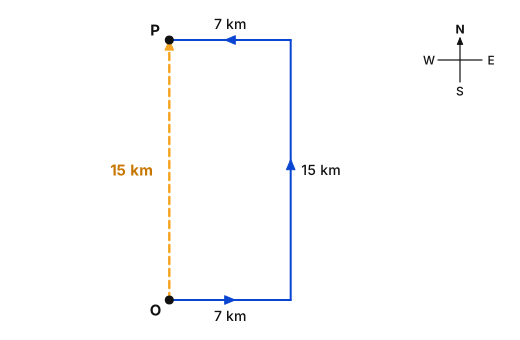
A person walks 7 km east, then 15 km north, and finally 7 km west. In which direction is he from his starting point ?
एक व्यक्ति 7 km पूर्व की ओर चलता है, फिर 15 km उत्तर की ओर और अन्त में 7 km पश्चिम की ओर चलता है। वह अपने प्रारम्भिक बिन्दु से किस दिशा में है?
  1. AEastपूर्व
  2. BWestपश्चिम
  3. CNorthउत्तर
  4. DSouthदक्षिण
Show answer

Concept: Equal and opposite moves cancel each other.

  1. 7 km East and 7 km West cancel → net East-West = 0.
  2. Only 15 km North remains → he is due North of the start.

Trick: Cancel opposite pairs first; whatever is left gives the direction instantly.

Answer: (C) North

अवधारणा: बराबर और विपरीत दिशा की चालें एक-दूसरे को रद्द कर देती हैं।

  1. 7 km पूर्व और 7 km पश्चिम रद्द → पूर्व-पश्चिम में शुद्ध दूरी 0।
  2. केवल 15 km उत्तर बचा → वह आरंभ बिंदु से ठीक उत्तर में है।

ट्रिक: पहले विपरीत जोड़े काटें, जो बचे वही दिशा।

उत्तर: (C) उत्तर

SSC CHSLGeneral IntelligenceDirection – final positionSSC CHSL 2025 · 22 Nov Shift 1 →
Q2328.
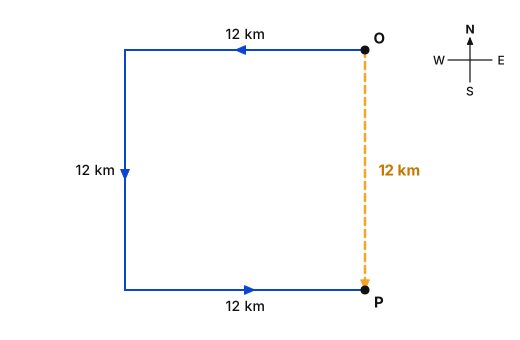
A person walks 12 km west, then 12 km south, and finally 12 km east. How far is he from his starting point ?
एक व्यक्ति 12 km पश्चिम की ओर चलता है, फिर 12 km दक्षिण की ओर और अन्त में 12 km पूर्व की ओर चलता है। वह अपने प्रारम्भिक बिन्दु से कितनी दूर है?
  1. A12 km
  2. B10 km
  3. C15 km
  4. D11 km
Show answer

Concept: Shortest distance = net displacement after cancelling opposite moves.

  1. 12 km West and 12 km East cancel each other.
  2. Net movement = 12 km South → distance = 12 km.

Trick: Three sides of a square (W, S, E) always leave you one side-length away.

Answer: (A) 12 km

अवधारणा: न्यूनतम दूरी = विपरीत चालें काटने के बाद बचा विस्थापन।

  1. 12 km पश्चिम और 12 km पूर्व एक-दूसरे को काटते हैं।
  2. शुद्ध चाल = 12 km दक्षिण → दूरी = 12 km।

ट्रिक: वर्ग की तीन भुजाओं पर चलने पर आप एक भुजा की दूरी पर ही रहते हैं।

उत्तर: (A) 12 km

SSC CHSLGeneral IntelligenceDirection – distance from startSSC CHSL 2025 · 22 Nov Shift 1 →
Q2329.
Select the related word from the given alternatives.
Mirror : Reflection :: Book : ?
दिए गए विकल्पों में से सम्बन्धित शब्द चुनिए।
दर्पण : प्रतिबिम्ब :: पुस्तक : ?
  1. AWordsशब्द
  2. BAuthorलेखक
  3. CKnowledgeज्ञान
  4. DPageपृष्ठ
Show answer

Concept: First word is an object; second is what it provides to the user.

  1. A mirror gives a reflection.
  2. A book gives knowledge.
  3. Words/Page are parts of a book; Author is its creator – different relation.

Trick: Make a sentence: 'A ___ gives us ___' – it filters part/maker options.

Answer: (C) Knowledge

अवधारणा: पहला शब्द वस्तु है; दूसरा वह जो वह उपयोगकर्ता को देती है।

  1. दर्पण से प्रतिबिंब मिलता है।
  2. पुस्तक से ज्ञान मिलता है।
  3. Words/Page पुस्तक के भाग हैं, Author निर्माता – संबंध अलग है।

ट्रिक: वाक्य बनाएँ: '___ हमें ___ देता है' – भाग/निर्माता वाले विकल्प हट जाते हैं।

उत्तर: (C) ज्ञान

SSC CHSLGeneral IntelligenceAnalogy – object : what it givesSSC CHSL 2025 · 22 Nov Shift 1 →
Q2330.
Pick the correct options from the given alternatives
27 : 53 :: 32 : ?
दिए गए विकल्पों में से सही विकल्प चुनिए।
27 : 53 :: 32 : ?
  1. A64
  2. B65
  3. C63
  4. D66
Show answer

Concept: Find the operation turning the first number into the second.

  1. 27×2=54, 54−1=53 → rule: 2n−1.
  2. 32×2−1=64−1=63.

Trick: Second number ≈ double the first? Check ±1 – the most common SSC pattern.

Answer: (C) 63

अवधारणा: पहली संख्या से दूसरी बनाने का नियम खोजें।

  1. 27×2=54, 54−1=53 → नियम: 2n−1।
  2. 32×2−1=64−1=63।

ट्रिक: दूसरी संख्या लगभग दुगुनी हो तो ±1 जाँचें।

उत्तर: (C) 63

SSC CHSLGeneral IntelligenceNumber analogy – 2n − 1SSC CHSL 2025 · 22 Nov Shift 1 →
Q2331.
Pick the correct options from the given alternatives
GERMANY : YNAMREG :: BRAZIL : ?
दिए गए विकल्पों में से सही विकल्प चुनिए।
GERMANY : YNAMREG :: BRAZIL : ?
  1. ALIZARB
  2. BLIZARZ
  3. CLIRZAB
  4. DLZIRAB
Show answer

Concept: The code writes the word backwards.

  1. GERMANY read from the end = YNAMREG.
  2. BRAZIL read from the end = L-I-Z-A-R-B = LIZARB.

Trick: First letter of the code = last letter of the word: only A starts with L and ends with B correctly.

Answer: (A) LIZARB

अवधारणा: कोड में शब्द को उल्टा लिखा गया है।

  1. GERMANY को अंत से पढ़ें = YNAMREG।
  2. BRAZIL को अंत से पढ़ें = LIZARB।

ट्रिक: कोड का पहला अक्षर = शब्द का अंतिम अक्षर; पूरा उल्टा केवल A में।

उत्तर: (A) LIZARB

SSC CHSLGeneral IntelligenceLetter analogy – reverse orderSSC CHSL 2025 · 22 Nov Shift 1 →
Q2332.
- Select the correct options from the given alternatives 20, 120, 240, 380,
- दिए गए विकल्पों में से सही विकल्प चुनिए 20, 120, 240, 380,
  1. A540
  2. B550
  3. C520
  4. D500
Show answer

Concept: Differences increase by a fixed amount.

  1. Differences: 100, 120, 140 (rising by 20).
  2. Next difference = 160 → 380 + 160 = 540.

Trick: If first differences aren't equal, take differences of differences.

Answer: (A) 540

अवधारणा: अंतर हर बार एक निश्चित मात्रा से बढ़ते हैं।

  1. अंतर: 100, 120, 140 (हर बार +20)।
  2. अगला अंतर = 160 → 380 + 160 = 540।

ट्रिक: पहले अंतर बराबर न हों तो अंतरों का अंतर निकालें।

उत्तर: (A) 540

SSC CHSLGeneral IntelligenceNumber series – second differencesSSC CHSL 2025 · 22 Nov Shift 1 →
Q2333.
Pick the correct options from below.
47, 63, ?, 107, 135
नीचे दिए गए विकल्पों में से सही विकल्प चुनिए।
47, 63, ?, 107, 135
  1. A90
  2. B80
  3. C73
  4. D83
Show answer

Concept: Differences form an arithmetic pattern (+4).

  1. Known gaps: 63 − 47 = 16 and 135 − 107 = 28.
  2. Pattern 16, 20, 24, 28 → ? = 63 + 20 = 83.
  3. Check: 83 + 24 = 107 ✔.

Trick: Two known differences 16 and 28 with two gaps between → step = (28 − 16) ÷ 3 = 4.

Answer: (D) 83

अवधारणा: अंतर समान्तर क्रम (+4) में हैं।

  1. ज्ञात अंतर: 63 − 47 = 16 और 135 − 107 = 28।
  2. क्रम 16, 20, 24, 28 → ? = 63 + 20 = 83।
  3. जाँच: 83 + 24 = 107 ✔।

ट्रिक: 16 से 28 तक तीन कदम → हर कदम (28 − 16) ÷ 3 = 4।

उत्तर: (D) 83

SSC CHSLGeneral IntelligenceNumber series – missing middle termSSC CHSL 2025 · 22 Nov Shift 1 →
Q2334.
What comes next in the following series?
C2, X3, D5, W7, ?
निम्नलिखित शृंखला में आगे क्या आएगा?
C2, X3, D5, W7, ?
  1. AE11
  2. BV11
  3. CE9
  4. DV9
Show answer

Concept: Split letters and numbers into separate patterns.

  1. Alternate letters: C, D, E (forward) and X, W (backward). 5th term is in the forward set → E.
  2. Numbers 2, 3, 5, 7 = consecutive primes → next 11.
  3. Term = E11.

Trick: Only two options have E; prime after 7 is 11, not 9 → E11.

Answer: (A) E11

अवधारणा: अक्षर और संख्या की श्रृंखला अलग-अलग देखें।

  1. एकांतर अक्षर: C, D, E (आगे) और X, W (पीछे)। 5वाँ पद आगे वाले समूह में → E।
  2. संख्याएँ 2, 3, 5, 7 = क्रमागत अभाज्य → अगली 11।
  3. पद = E11।

ट्रिक: 7 के बाद अभाज्य संख्या 11 है, 9 नहीं → E11।

उत्तर: (A) E11

SSC CHSLGeneral IntelligenceAlphanumeric seriesSSC CHSL 2025 · 22 Nov Shift 1 →
Q2335.
Carefully examine the Reference Statement. Then, identify the single option among the four alternatives (a, b, c, d) that is an EXACT AND COMPLETE REPLICATION of the Reference Statement. Pay exceptionally close attention to every character, number, symbol, space, and punctuation mark.
Reference: Washington: July 4th, 1776.
संदर्भ कथन का ध्यानपूर्वक परीक्षण कीजिए। इसके पश्चात् चार विकल्पों (a, b, c, d) में से उस एक विकल्प को पहचानिए जो संदर्भ कथन की पूर्णतः यथावत् एवं सम्पूर्ण प्रतिकृति है। प्रत्येक अक्षर, अंक, चिह्न, रिक्त स्थान तथा विराम-चिह्न पर अत्यन्त सावधानी से ध्यान दीजिए।
संदर्भ: Washington: July 4th, 1776.
  1. AWashington: July 4.th, 1776.
  2. BWashington: July 4th, 1776.
  3. CWashingtan: July 4th, 1776.
  4. DWashington: July 4th, 1767.
Show answer

Concept: Compare character by character: letters, digits, punctuation.

  1. (A) has an extra dot '4.th' ✗.
  2. (C) 'Washingtan' ✗; (D) year 1767 ✗.
  3. (B) matches 'Washington: July 4th, 1776.' exactly ✔.

Trick: Check the risky spots first – spelling of names, digits of years, and dots.

Answer: (B) Washington: July 4th, 1776.

अवधारणा: अक्षर, अंक और विराम चिह्न – सब एक-एक करके मिलाएँ।

  1. (A) में '4.th' अतिरिक्त बिंदु ✗।
  2. (C) 'Washingtan' ✗; (D) वर्ष 1767 ✗।
  3. (B) संदर्भ से पूरी तरह मेल खाता है ✔।

ट्रिक: पहले जोखिम वाले स्थान देखें – नाम की वर्तनी, वर्ष के अंक, बिंदु।

उत्तर: (B) Washington: July 4th, 1776.

SSC CHSLGeneral IntelligenceExact matching – text replicationSSC CHSL 2025 · 22 Nov Shift 1 →
Q2336.
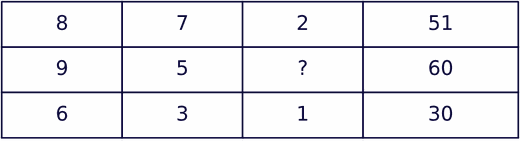
In the following question, select the number which can be placed at the sign of question mark (?) from the given alternatives.
निम्नलिखित प्रश्न में, दिए गए विकल्पों में से वह संख्या चुनिए जिसे प्रश्नवाचक चिह्न (?) के स्थान पर रखा जा सकता है।
  1. A115
  2. B110
  3. C105
  4. D111
Show answer

Concept: In each row, the last number comes from the first three by one fixed rule.

  1. First row: product of 5, 3, 4 is 60; adding 5 gives 65 ✔.
  2. Second row: product of 3, 7, 8 is 168; adding 5 gives 173 ✔.
  3. Third row: product of 7, 5, 3 is 105; so ? = 110.

Trick: When the result is much larger than the inputs, try multiplication first, then adjust by a constant.

Answer: (B) 110

अवधारणा: हर पंक्ति में पहली तीन संख्याओं से अंतिम संख्या एक ही नियम से बनती है।

  1. पहली पंक्ति: 5, 3, 4 का गुणनफल 60; उसमें 5 जोड़ें तो 65 ✔।
  2. दूसरी पंक्ति: 3, 7, 8 का गुणनफल 168; 5 जोड़ें तो 173 ✔।
  3. तीसरी पंक्ति: 7, 5, 3 का गुणनफल 105; अतः ? = 110।

ट्रिक: परिणाम बहुत बड़ा हो तो पहले गुणा आज़माएँ, फिर स्थिरांक जोड़ें/घटाएँ।

उत्तर: (B) 110

SSC CHSLGeneral IntelligenceNumber grid – product + 5SSC CHSL 2025 · 22 Nov Shift 1 →
Q2337.
In the following question, select the number which can be placed at the sign of question mark (?) from the given alternatives.
figure
निम्नलिखित प्रश्न में, दिए गए विकल्पों में से वह संख्या चुनिए जिसे प्रश्नवाचक चिह्न (?) के स्थान पर रखा जा सकता है।
figure
  1. A3
  2. B4
  3. C6
  4. D5
Show answer

Concept: Last column = 3 × (sum of first three numbers).

  1. First row: sum of 8, 7, 2 is 17, and thrice 17 is 51 ✔.
  2. Last row: sum of 6, 3, 1 is 10, and thrice 10 is 30 ✔.
  3. Middle row: one-third of 60 is 20, so 14 + ? = 20 → ? = 6.

Trick: All results (51, 60, 30) are multiples of 3 – divide by 3 and look for the sum.

Answer: (C) 6

अवधारणा: अंतिम स्तंभ = 3 × (पहली तीन संख्याओं का योग)।

  1. पहली पंक्ति: 8, 7, 2 का योग 17, उसका तिगुना 51 ✔।
  2. अंतिम पंक्ति: 6, 3, 1 का योग 10, तिगुना 30 ✔।
  3. बीच की पंक्ति: 60 का एक-तिहाई 20, अतः 14 + ? = 20 → ? = 6।

ट्रिक: 51, 60, 30 सब 3 के गुणज – 3 से भाग देकर योग देखें।

उत्तर: (C) 6

SSC CHSLGeneral IntelligenceNumber grid – (sum) × 3SSC CHSL 2025 · 22 Nov Shift 1 →
Q2338.
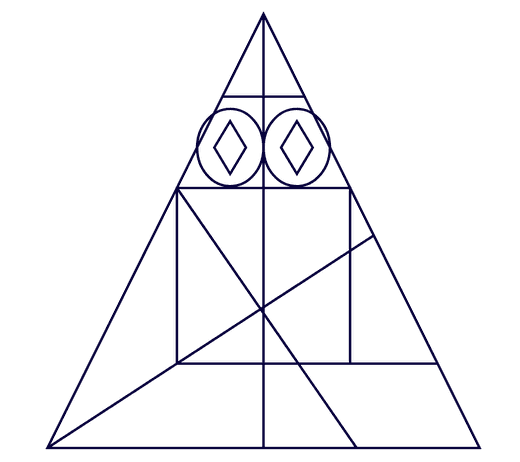
Find the number of triangles in the following figure.
figure
निम्नलिखित आकृति में त्रिभुजों की संख्या ज्ञात कीजिए।
figure
  1. A32
  2. B33
  3. C30
  4. D31
Show answer

Concept: Count systematically so no triangle is missed or repeated; curves (ovals, diamonds) form no triangles.

  1. Ignore the two ovals and the diamonds inside them – only straight lines matter.
  2. Count triangles having the top vertex first (big triangle split by the vertical median and the horizontal cross-lines).
  3. Then count those formed by the two slanting lines inside and around the square, and the bottom strip.
  4. Adding all groups gives 30 triangles.

Trick: Fix one vertex at a time (top apex, bottom-left corner, then inner crossing points) and tick off each triangle as you count.

Answer: (C) 30

अवधारणा: क्रमबद्ध तरीके से गिनें ताकि कोई त्रिभुज छूटे या दोहराया न जाए; अंडाकार और हीरे (वक्र/बंद आकृतियाँ) त्रिभुज नहीं बनाते।

  1. दोनों अंडाकार और उनके भीतर के हीरों को छोड़ दें – केवल सीधी रेखाएँ गिनें।
  2. पहले शीर्ष बिंदु वाले त्रिभुज गिनें (ऊर्ध्व माध्यिका और क्षैतिज रेखाओं से बने)।
  3. फिर वर्ग के भीतर/आसपास की दो तिरछी रेखाओं और नीचे की पट्टी से बने त्रिभुज।
  4. सभी समूह जोड़ने पर कुल 30 त्रिभुज।

ट्रिक: एक-एक शीर्ष तय करके गिनें (ऊपरी शीर्ष, नीचे बायाँ कोना, फिर भीतरी कटान बिंदु) और गिनते समय निशान लगाते जाएँ।

उत्तर: (C) 30

SSC CHSLGeneral IntelligenceCounting triangles – complex figureSSC CHSL 2025 · 22 Nov Shift 1 →
Q2339.
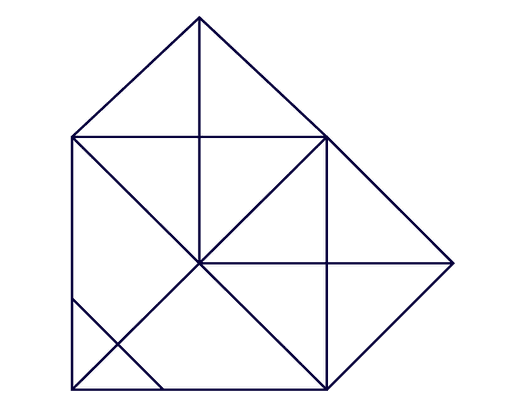
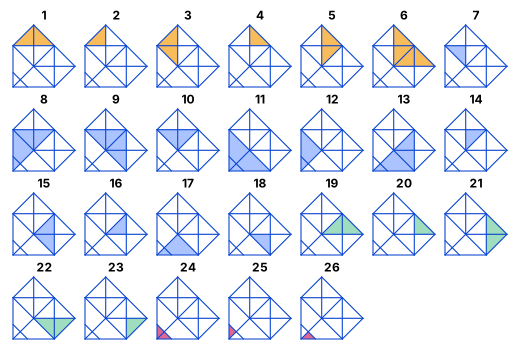
How many triangles are there in the following figure?
figure
निम्नलिखित आकृति में कितने त्रिभुज हैं?
figure
  1. A24
  2. B19
  3. C26
  4. D22
Show answer

Concept: Split the figure into regions and count each group once.

  1. Inside the big square (both diagonals + half-lines from centre): 12 triangles.
  2. Using the top apex: 6 triangles.
  3. Using the right-hand vertex (no apex): 5 triangles.
  4. Small cut in the bottom-left corner: 3 triangles. Total = 12 + 6 + 5 + 3 = 26.

Trick: A square with both diagonals alone gives 8 – extra half-lines inside it add more; count them as a separate group.

Answer: (C) 26

अवधारणा: आकृति को भागों में बाँटकर हर समूह को एक बार गिनें।

  1. बड़े वर्ग के भीतर (दोनों विकर्ण + केंद्र से निकली अर्ध-रेखाएँ): 12 त्रिभुज।
  2. ऊपरी शीर्ष को लेकर: 6 त्रिभुज।
  3. दाएँ शीर्ष को लेकर (ऊपरी शीर्ष छोड़कर): 5 त्रिभुज।
  4. नीचे-बाएँ कोने की छोटी रेखा: 3 त्रिभुज। कुल = 12 + 6 + 5 + 3 = 26।

ट्रिक: केवल दोनों विकर्णों वाला वर्ग = 8 त्रिभुज; भीतर की अतिरिक्त रेखाओं वाले त्रिभुज अलग गिनें।

उत्तर: (C) 26

SSC CHSLGeneral IntelligenceCounting triangles – square with attachmentsSSC CHSL 2025 · 22 Nov Shift 1 →
Q2340.
A started walking straight from a point P. He turned 6 times right during his journey. Finally, he is facing towards east. In which direction he started walking from P? (He took no left turn)
A ने बिन्दु P से सीधे चलना प्रारम्भ किया। अपनी यात्रा के दौरान वह 6 बार दाईं ओर मुड़ा। अन्ततः उसका मुख पूर्व दिशा की ओर है। उसने P से किस दिशा में चलना प्रारम्भ किया था? (उसने कोई भी मोड़ बाईं ओर नहीं लिया)
  1. ANorthउत्तर
  2. BSouthदक्षिण
  3. CEastपूर्व
  4. DWestपश्चिम
Show answer

Concept: Every 4 right turns = 360° = no change in direction.

  1. 6 right turns = 4 + 2 → net effect = 2 right turns = 180° (about-turn).
  2. Final direction East is opposite to the starting direction.
  3. Opposite of East = West → he started towards West.

Trick: Divide the number of turns by 4 and use only the remainder.

Answer: (D) West

अवधारणा: हर 4 दाएँ मोड़ = 360° = दिशा में कोई बदलाव नहीं।

  1. 6 दाएँ मोड़ = 4 + 2 → प्रभावी 2 दाएँ मोड़ = 180° (उलटी दिशा)।
  2. अंतिम दिशा पूर्व, आरंभिक दिशा का विपरीत है।
  3. पूर्व का विपरीत = पश्चिम → वह पश्चिम की ओर चला था।

ट्रिक: मोड़ों की संख्या को 4 से भाग दें, केवल शेषफल का प्रयोग करें।

उत्तर: (D) पश्चिम

SSC CHSLGeneral IntelligenceDirection – multiple right turnsSSC CHSL 2025 · 22 Nov Shift 1 →