Question bank

Q&A: practice questions with answers

Search questions on any topic. Filter by exam category, exam, subject and topic, try the question, then open the answer and explanation.

Courses – airGurukul

5,000 questions found.

Q2361.
Find the remainder on dividing (4x3+3x2−12x+1) by (3x−6).
(4x3+3x2−12x+1) को (3x−6) से भाग देने पर शेषफल ज्ञात कीजिए।
  1. A21
  2. B32
  3. C30
  4. D22
Show answer

Concept: Remainder on dividing f(x) by (ax−b) = f(ba).

  1. 3x−6=0⇒x=2.
  2. f(2)=4·8+3·4−24+1=32+12−24+1=21.

Trick: The factor 3 in (3x−6) does not change the remainder – only the root x=2 matters.

Answer: (A) 21

अवधारणा: f(x) को (ax−b) से भाग देने पर शेषफल = f(ba)।

  1. 3x−6=0⇒x=2।
  2. f(2)=4·8+3·4−24+1=32+12−24+1=21।

ट्रिक: (3x−6) का 3 शेषफल नहीं बदलता – केवल मूल x=2 देखें।

उत्तर: (A) 21

SSC CHSLQuantitative AptitudeRemainder theoremSSC CHSL 2025 · 22 Nov Shift 1 →
Q2362.
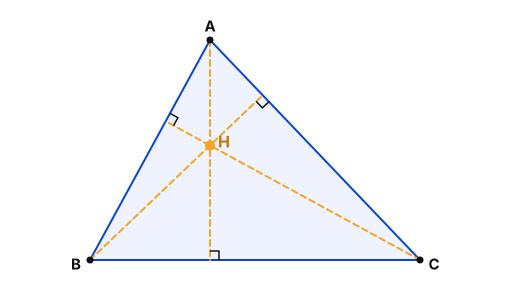
The point at which the altitudes of a triangle meet is called
किसी त्रिभुज के शीर्षलंब जिस बिंदु पर मिलते हैं, उसे कहते हैं
  1. ACentroidकेंद्रक (Centroid)
  2. BCircumcenterपरिकेंद्र (Circumcenter)
  3. COrthocenterलंबकेंद्र (Orthocenter)
  4. DIncenterअंतःकेंद्र (Incenter)
Show answer

Concept: Each triangle centre is the meeting point of a particular set of lines.

  1. Altitudes (perpendiculars from vertices) meet at the orthocentre.
  2. Medians → centroid; perpendicular bisectors → circumcentre; angle bisectors → incentre.

Yaad rakhein: Mnemonic: Altitude–Ortho, Median–Centroid, Bisector of angle–Incentre, Perp. bisector–Circumcentre.

Answer: (C) Orthocenter

अवधारणा: त्रिभुज का हर केंद्र किसी खास रेखा-समूह का मिलन बिंदु है।

  1. शीर्षलंब (शीर्ष से सामने की भुजा पर लंब) लंबकेंद्र (orthocentre) पर मिलते हैं।
  2. माध्यिकाएँ → केन्द्रक; लंब समद्विभाजक → परिकेंद्र; कोण समद्विभाजक → अंतःकेंद्र।

याद रखें: Altitude–Ortho, Median–Centroid, कोण-Bisector–Incentre, Perpendicular bisector–Circumcentre।

उत्तर: (C) लंबकेंद्र (Orthocenter)

SSC CHSLQuantitative AptitudeCentres of a triangle – orthocentreSSC CHSL 2025 · 22 Nov Shift 1 →
Q2363.
If sin⁡x(1−cos⁡x)+sin⁡x(1+cos⁡x)=4,0, <x<90∘, then find the value of (sin⁡x+ cos⁡x ).
यदि sin⁡x(1−cos⁡x)+sin⁡x(1+cos⁡x)=4,0, <x<90∘, तो (sin⁡x+ cos⁡x ) का मान ज्ञात कीजिए।
  1. A3+12
  2. B23+12
  3. C3−12
  4. D23−12
Show answer

Concept: Combine the fractions using 1−cos2x=sin2x.

  1. Sum = sinx[(1+cosx)+(1−cosx)]1−cos2x=2sinxsin2x=2sinx.
  2. 2sinx=4⇒sinx=12⇒x=30∘.
  3. sinx+cosx=12+32=3+12.

Trick: Remember: sinx1−cosx+sinx1+cosx=2cscx directly.

Answer: (A) 3+12

अवधारणा: भिन्नों को जोड़ें और 1−cos2x=sin2x का प्रयोग करें।

  1. योग = sinx[(1+cosx)+(1−cosx)]1−cos2x=2sinxsin2x=2sinx।
  2. 2sinx=4⇒sinx=12⇒x=30∘।
  3. sinx+cosx=12+32=3+12।

ट्रिक: सीधा याद रखें: sinx1−cosx+sinx1+cosx=2cscx।

उत्तर: (A) 3+12

SSC CHSLQuantitative AptitudeTrigonometric identity – value of sin x + cos xSSC CHSL 2025 · 22 Nov Shift 1 →
Q2364.
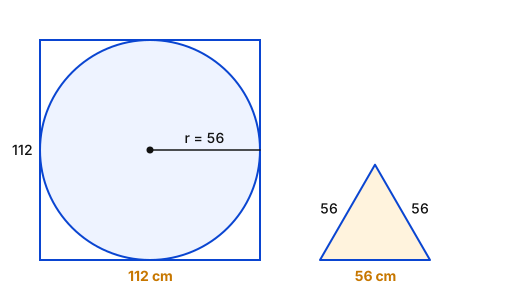
The area of a circle is 9856cm2. The circle is inscribed in a square, and the side of the square is twice the side of an equilateral triangle. Find the sum of the perimeters of the square and the triangle.
एक वृत्त का क्षेत्रफल 9856cm2 है। यह वृत्त एक वर्ग के अंतर्गत बनाया गया है तथा वर्ग की भुजा एक समबाहु त्रिभुज की भुजा की दोगुनी है। वर्ग तथा त्रिभुज के परिमापों का योग ज्ञात कीजिए।
  1. A616 cm
  2. B716 cm
  3. C516 cm
  4. D800 cm
Show answer

Concept: For a circle inside a square, side of square = diameter.

  1. πr2=9856⇒r2=9856×722=3136⇒r=56 cm.
  2. Square side = 112 cm → perimeter 448 cm.
  3. Triangle side = 1122=56 cm → perimeter 168 cm.
  4. Sum = 448+168=616 cm.

Trick: Perimeters: 4×112+3×56=56×(8+3)=56×11=616.

Answer: (A) 616 cm

अवधारणा: वर्ग के अंदर बने वृत्त में, वर्ग की भुजा = व्यास।

  1. πr2=9856⇒r2=9856×722=3136⇒r=56 cm।
  2. वर्ग की भुजा = 112 cm → परिमाप 448 cm।
  3. त्रिभुज की भुजा = 56 cm → परिमाप 168 cm।
  4. योग = 448+168=616 cm।

ट्रिक: 4×112+3×56=56×11=616 – एक ही गुणा।

उत्तर: (A) 616 cm

SSC CHSLQuantitative AptitudeCircle inscribed in square – perimetersSSC CHSL 2025 · 22 Nov Shift 1 →
Q2365.
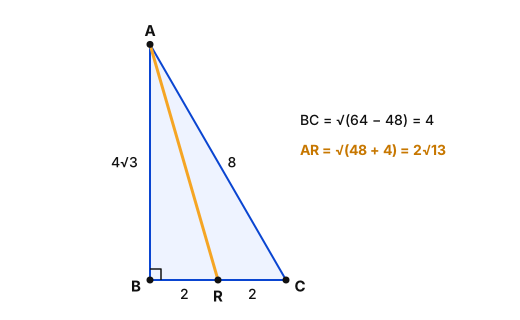
In a right-angled triangle ABC, with a right angle at B,R is the mid-point of side BC,AB=43cm and AC=8cm. Find the length of AR .
एक समकोण त्रिभुज ABC में, B,R पर समकोण है, R भुजा BC,AB=43cm का मध्य-बिंदु है तथा AC=8cm है। AR की लंबाई ज्ञात कीजिए।
  1. A5cm
  2. B3cm
  3. C213cm
  4. D3 cm
Show answer

Concept: Use Pythagoras twice: first for BC, then for AR in ΔABR.

  1. BC2=AC2−AB2=64−48=16⇒BC=4 cm.
  2. R is the midpoint → BR=2 cm.
  3. AR2=AB2+BR2=48+4=52⇒AR=52=213 cm.

Trick: 52 lies between 7 and 8, and 213≈7.2 – the only option in that range.

Answer: (C) 213cm

अवधारणा: पाइथागोरस दो बार: पहले BC, फिर ΔABR में AR।

  1. BC2=AC2−AB2=64−48=16⇒BC=4 cm।
  2. R मध्य बिंदु → BR=2 cm।
  3. AR2=AB2+BR2=48+4=52⇒AR=213 cm।

ट्रिक: 52 का मान 7 और 8 के बीच; 213≈7.2 – केवल यही विकल्प।

उत्तर: (C) 213cm

SSC CHSLQuantitative AptitudePythagoras – median to a legSSC CHSL 2025 · 22 Nov Shift 1 →
Q2366.
If the surface area of a sphere is increased by 69%, by what percentage does the volume of the sphere increase?
यदि किसी गोले का पृष्ठीय क्षेत्रफल 69% बढ़ा दिया जाए, तो गोले का आयतन कितने प्रतिशत बढ़ जाएगा?
  1. A119.7%
  2. B109.7%
  3. C66.3%
  4. D20.5%
Show answer

Concept: Surface area ∝r2, volume ∝r3.

  1. Area ratio 169 : 100 → radius ratio 13 : 10.
  2. Volume ratio = 133:103 = 2197 : 1000.
  3. Increase = 11971000×100=119.7%.

Trick: +69% area = (1.3)2 → radius +30%; volume = (1.3)3=2.197 → +119.7%.

Answer: (A) 119.7%

अवधारणा: पृष्ठीय क्षेत्रफल ∝r2, आयतन ∝r3।

  1. क्षेत्रफल अनुपात 169 : 100 → त्रिज्या अनुपात 13 : 10।
  2. आयतन अनुपात = 133:103 = 2197 : 1000।
  3. वृद्धि = 11971000×100=119.7%।

ट्रिक: +69% = (1.3)2 → त्रिज्या +30%; आयतन (1.3)3=2.197 → +119.7%।

उत्तर: (A) 119.7%

SSC CHSLQuantitative AptitudeSphere – % change in volume from areaSSC CHSL 2025 · 22 Nov Shift 1 →
Q2367.
A and B invested Rs. 70,000 and Rs. 80,000 , respectively. If the profit at the end of the year is Rs. 3,00,000, what is B's share?
A तथा B ने क्रमशः Rs. 70,000 तथा Rs. 80,000 निवेश किए। यदि वर्ष के अंत में लाभ Rs. 3,00,000 है, तो B का हिस्सा कितना है?
  1. ARs. 160,000
  2. BRs. 170,000
  3. CRs. 180,000
  4. DRs. 190,000
Show answer

Concept: Same time period → profit is shared in the ratio of investments.

  1. Ratio A : B = 70000 : 80000 = 7 : 8 (total 15 parts).
  2. 1 part = 300000÷15= ₹20,000.
  3. B's share = 8×20000= ₹1,60,000.

Trick: Find one part first (total ÷ sum of ratio), then multiply.

Answer: (A) Rs. 160,000

अवधारणा: समान अवधि → लाभ निवेश के अनुपात में बँटता है।

  1. अनुपात A : B = 70000 : 80000 = 7 : 8 (कुल 15 भाग)।
  2. 1 भाग = 300000÷15= ₹20,000।
  3. B का हिस्सा = 8×20000= ₹1,60,000।

ट्रिक: पहले एक भाग निकालें (कुल ÷ अनुपात योग), फिर गुणा करें।

उत्तर: (A) Rs. 160,000

SSC CHSLQuantitative AptitudePartnership – share in profitSSC CHSL 2025 · 22 Nov Shift 1 →
Q2368.
Simplify the expression: sin⁡x.sec⁡xtan⁡x
व्यंजक को सरल कीजिए: sin⁡x.sec⁡xtan⁡x
  1. Atan⁡x
  2. B1
  3. Csin⁡x
  4. Dsec⁡x
Show answer

Concept: Convert everything to sin and cos.

  1. sinx·secx=sinxcosx=tanx.
  2. tanx÷tanx=1.

Trick: Spot that sinx·secx is itself tanx – answer in one look.

Answer: (B) 1

अवधारणा: सब कुछ sin और cos में बदलें।

  1. sinx·secx=sinxcosx=tanx।
  2. tanx÷tanx=1।

ट्रिक: sinx·secx स्वयं tanx है – एक नज़र में उत्तर।

उत्तर: (B) 1

SSC CHSLQuantitative AptitudeTrigonometric simplificationSSC CHSL 2025 · 22 Nov Shift 1 →
Q2369.
What is the value of sin⁡(30∘)×cos⁡(30∘) ?
sin⁡(30∘)×cos⁡(30∘) का मान क्या है?
  1. A24
  2. B34
  3. C2
  4. D1
Show answer

Concept: sin30∘=12, cos30∘=32.

  1. Product = 12×32=34.

Trick: sinθcosθ=12sin2θ⇒12sin60∘=12×32=34.

Answer: (B) 34

अवधारणा: sin30∘=12, cos30∘=32।

  1. गुणनफल = 12×32=34।

ट्रिक: sinθcosθ=12sin2θ⇒12×sin60∘=34।

उत्तर: (B) 34

SSC CHSLQuantitative AptitudeStandard trigonometric valuesSSC CHSL 2025 · 22 Nov Shift 1 →
Q2370.
26 mango trees, 39 apple trees, and 52 trees have to be planted in rows such that each row contains the same number of trees of the same variety only. The maximum number of trees in a row may be planted in is:
26 आम के पेड़, 39 सेब के पेड़ तथा 52 पेड़ पंक्तियों में इस प्रकार लगाए जाने हैं कि प्रत्येक पंक्ति में केवल एक ही किस्म के समान संख्या में पेड़ हों। एक पंक्ति में अधिकतम कितने पेड़ लगाए जा सकते हैं:
  1. A12
  2. B13
  3. C11
  4. D14
Show answer

Concept: Largest equal group that divides every quantity = HCF.

  1. 26=2×13, 39=3×13, 52=4×13.
  2. Common factor = 13 → HCF = 13 trees per row.

Trick: 'Maximum in each group, equal groups' → HCF; 'minimum common multiple' → LCM.

Answer: (B) 13

अवधारणा: हर संख्या को पूरा बाँटने वाला सबसे बड़ा समान समूह = HCF।

  1. 26=2×13, 39=3×13, 52=4×13।
  2. सर्वनिष्ठ गुणनखंड 13 → HCF = 13 पेड़ प्रति पंक्ति।

ट्रिक: 'हर समूह में अधिकतम, बराबर समूह' → HCF; 'न्यूनतम सर्वनिष्ठ' → LCM।

उत्तर: (B) 13

SSC CHSLQuantitative AptitudeHCF – maximum trees per rowSSC CHSL 2025 · 22 Nov Shift 1 →
Q2371.
In a class of a certain number of students, if a student weighing 60 kg joins, the average weight increases by 2 kg . If another student weighing 60 kg joins, the average increases by 3.5 kg over the original average. What was the original average weight of the class?
किसी कक्षा में विद्यार्थियों की एक निश्चित संख्या है। यदि 60 kg भार वाला एक विद्यार्थी उसमें सम्मिलित हो जाता है, तो औसत भार 2 kg बढ़ जाता है। यदि 60 kg भार वाला एक और विद्यार्थी सम्मिलित हो जाता है, तो औसत मूल औसत से 3.5 kg बढ़ जाता है। कक्षा का मूल औसत भार क्या था?
  1. A46 kg
  2. B50 kg
  3. C52 kg
  4. D54 kg
Show answer

Concept: New average=(old total+new weight)÷new count; form two equations.

  1. Let n students, average A. First joining: nA+60=(n+1)(A+2)⇒A+2n=58.
  2. Second joining: nA+120=(n+2)(A+3.5)⇒2A+3.5n=113.
  3. From the first, A=58−2n; substitute: 116−4n+3.5n=113⇒n=6, A=46 kg.
  4. Check: 3367=48(=46+2), 3968=49.5(=46+3.5) ✔

Trick: Newcomer's weight = old average+rise×new count: 60=A+2(n+1).

Answer: (A) 46 kg

अवधारणा: नया औसत=(पुराना योग+नया भार)÷नई संख्या; दो समीकरण बनाएँ।

  1. मान लें n छात्र, औसत A। पहला छात्र: nA+60=(n+1)(A+2)⇒A+2n=58।
  2. दूसरा छात्र: nA+120=(n+2)(A+3.5)⇒2A+3.5n=113।
  3. पहले से A=58−2n; रखने पर 116−4n+3.5n=113⇒n=6, A=46 kg।
  4. जाँच: 3367=48(=46+2), 3968=49.5(=46+3.5) ✔

ट्रिक: नए सदस्य का भार = पुराना औसत+वृद्धि×नई संख्या: 60=A+2(n+1)।

उत्तर: (A) 46 kg

SSC CHSLQuantitative AptitudeAverage – new members joiningSSC CHSL 2025 · 22 Nov Shift 1 →
Q2372.
A can do a work in 12 days, B in 16 days, and C in 24 days. If all three work together for 2 days and then A leaves, in how many more days will the remaining work be finished?
A एक कार्य को 12 दिनों में, B 16 दिनों में तथा C 24 दिनों में कर सकता है। यदि तीनों मिलकर 2 दिन कार्य करते हैं और उसके बाद A कार्य छोड़ देता है, तो शेष कार्य कितने और दिनों में पूरा होगा?
  1. A6 days6 दिन
  2. B3 days3 दिन
  3. C8 days8 दिन
  4. D5 days5 दिन
Show answer

Concept: Total work = LCM; subtract work done, divide the rest by remaining efficiency.

  1. LCM(12,16,24)=48 units; A = 4, B = 3, C = 2 units/day.
  2. 2 days together: 9×2=18 units → 30 units left.
  3. B + C = 5 units/day → 30÷5=6 days.

Trick: Choose LCM as total work – every efficiency becomes a whole number.

Answer: (A) 6 days

अवधारणा: कुल कार्य = LCM; किया काम घटाएँ, बचे को शेष क्षमता से भाग दें।

  1. LCM(12,16,24)=48 इकाई; A = 4, B = 3, C = 2 इकाई/दिन।
  2. 2 दिन साथ: 9×2=18 इकाई → 30 इकाई शेष।
  3. B + C = 5 इकाई/दिन → 30÷5=6 दिन।

ट्रिक: कुल कार्य LCM लें – सभी क्षमताएँ पूर्ण संख्या बन जाती हैं।

उत्तर: (A) 6 दिन

SSC CHSLQuantitative AptitudeTime & work – one worker leavesSSC CHSL 2025 · 22 Nov Shift 1 →
Q2373.
A sum of ₹50,000 is borrowed for 5 years at a certain rate of interest. If the total interest paid at the end of 5 years is ₹ 25,000 , what is the rate of interest?
₹50,000 की राशि 5 वर्षों के लिए एक निश्चित ब्याज दर पर उधार ली जाती है। यदि 5 वर्ष के अंत में चुकाया गया कुल ब्याज ₹ 25,000 है, तो ब्याज की दर क्या है?
  1. A20%
  2. B15%
  3. C12%
  4. D10%
Show answer

Concept: R=SI×100P×T.

  1. R=25000×10050000×5.
  2. =2500000÷250000=10% p.a.

Trick: Interest is half the principal in 5 years → 50%÷5=10% per year.

Answer: (D) 10%

अवधारणा: R=SI×100P×T।

  1. R=25000×10050000×5।
  2. =2500000÷250000=10% वार्षिक।

ट्रिक: 5 वर्ष में ब्याज = मूलधन का आधा (50%) → 50÷5=10% प्रति वर्ष।

उत्तर: (D) 10%

SSC CHSLQuantitative AptitudeSimple interest – rateSSC CHSL 2025 · 22 Nov Shift 1 →
Q2374.
If cot⁡θ=1, find sin2⁡θ.
यदि cot⁡θ=1, तो sin2⁡θ ज्ञात कीजिए।
  1. A34
  2. B56
  3. C12
  4. D67
Show answer

Concept: cotθ=1 means θ=45∘.

  1. θ=45∘⇒sinθ=12.
  2. sin2θ=12.

Trick: Identity way: csc2θ=1+cot2θ=2⇒sin2θ=12.

Answer: (C) 12

अवधारणा: cotθ=1 यानी θ=45∘।

  1. θ=45∘⇒sinθ=12।
  2. sin2θ=12।

ट्रिक: सर्वसमिका से: csc2θ=1+cot2θ=2⇒sin2θ=12।

उत्तर: (C) 12

SSC CHSLQuantitative AptitudeTrigonometric ratios – cot θ = 1SSC CHSL 2025 · 22 Nov Shift 1 →
Q2375.
If cot⁡A=3, find cosecA and secA.
यदि cot⁡A=3, तो cosecA तथा secA ज्ञात कीजिए।
  1. AcosecA=2,sec⁡A=32
  2. BcosecA=12,sec⁡A=12
  3. CcosecA=2,sec⁡A=2
  4. DcosecA=2,sec⁡A=23
Show answer

Concept: cotA=baseperpendicular; build a right triangle.

  1. Take base = 3, perpendicular = 1 → hypotenuse = 3+1=2.
  2. cscA=21=2.
  3. secA=23.

Trick: cotA=3⇒A=30∘; csc30∘=2, sec30∘=23.

Answer: (D) cosecA=2,sec⁡A=23

अवधारणा: cotA=आधारलंब; समकोण त्रिभुज बनाएँ।

  1. आधार = 3, लंब = 1 → कर्ण = 3+1=2।
  2. cscA=21=2।
  3. secA=23।

ट्रिक: cotA=3⇒A=30∘; csc30∘=2, sec30∘=23।

उत्तर: (D) cosecA=2,sec⁡A=23

SSC CHSLQuantitative AptitudeTrigonometric ratios – cot A = √3SSC CHSL 2025 · 22 Nov Shift 1 →
Q2376.
Which tribal group held significant influence in the Punjab region during the 13th and 14th centuries?
13वीं तथा 14वीं शताब्दी के दौरान पंजाब क्षेत्र में किस जनजातीय समूह का महत्वपूर्ण प्रभाव था?
  1. AThe KhokharKhokhar जनजाति
  2. BThe MundaMunda जनजाति
  3. CThe OraonOraon जनजाति
  4. DThe BaigaBaiga जनजाति
Show answer

Concept: Identify the tribe tied to medieval Punjab.

  1. The Khokhars were a martial tribe of the Punjab (Salt Range–Jhelum area) who often rebelled against the Delhi Sultans in the 13th–14th centuries.
  2. Munda and Oraon are tribes of the Chhotanagpur region (Jharkhand); Baiga live in central India (MP/Chhattisgarh).

Yaad rakhein: Jasrat Khokhar troubled the Sayyid rulers in the 15th century – the Khokhars stayed a Punjab power for long.

Answer: (A) The Khokhar

अवधारणा: मध्यकालीन पंजाब से जुड़ी जनजाति पहचानें।

  1. खोखर पंजाब (नमक पर्वतमाला–झेलम क्षेत्र) की योद्धा जनजाति थी, जिसने 13वीं–14वीं सदी में दिल्ली सल्तनत का बार-बार विरोध किया।
  2. मुंडा और उरांव छोटानागपुर (झारखंड) की जनजातियाँ हैं; बैगा मध्य भारत (MP/छत्तीसगढ़) में।

याद रखें: जसरथ खोखर ने 15वीं सदी में सैयद शासकों को चुनौती दी थी।

उत्तर: (A) Khokhar जनजाति

SSC CHSLGeneral AwarenessMedieval Punjab – Khokhar tribeSSC CHSL 2025 · 22 Nov Shift 1 →
Q2377.
Consider the following statements about Emperor Akbar's military campaigns:
I. The conquest of Ranthambore took place in the year 1569 .
II. Akbar's Gujarat campaign was carried out in 1572.
Which of the statements given above is/are correct?
सम्राट Akbar के सैन्य अभियानों के विषय में निम्नलिखित कथनों पर विचार कीजिए:
I. रणथंभौर की विजय वर्ष 1569 में हुई थी।
II. Akbar का गुजरात अभियान 1572 में चलाया गया था।
उपर्युक्त कथनों में से कौन-सा/से सही है/हैं?
  1. AStatement I aloneकेवल कथन I
  2. BStatement II aloneकेवल कथन II
  3. CBoth I and III तथा II दोनों
  4. DNeither statement is correctकोई भी कथन सही नहीं है
Show answer

Concept: Check each conquest year against Akbar's chronology.

  1. I – Ranthambore fort was taken from Surjan Hada in 1569 (after Chittor, 1568). Correct.
  2. II – Gujarat campaign began in 1572; Surat fell in 1573. Correct.

Yaad rakhein: Sequence: Chittor 1568 → Ranthambore & Kalinjar 1569 → Gujarat 1572–73 → Bengal 1576.

Answer: (C) Both I and II

अवधारणा: हर कथन का वर्ष अकबर के कालक्रम से मिलाएँ।

  1. I – रणथंभौर दुर्ग 1569 में सुरजन हाड़ा से जीता गया (चित्तौड़ 1568 के बाद)। सही।
  2. II – गुजरात अभियान 1572 में शुरू हुआ; सूरत 1573 में जीता। सही।

याद रखें: क्रम: चित्तौड़ 1568 → रणथंभौर व कालिंजर 1569 → गुजरात 1572–73 → बंगाल 1576।

उत्तर: (C) I तथा II दोनों

SSC CHSLGeneral AwarenessAkbar's conquests – datesSSC CHSL 2025 · 22 Nov Shift 1 →
Q2378.
Which Indian actress became the first from India to receive an international award at the 1963 Moscow International Film Festival ?
1963 के Moscow International Film Festival में अंतर्राष्ट्रीय पुरस्कार प्राप्त करने वाली भारत की पहली अभिनेत्री कौन बनीं?
  1. AMeena Kumari
  2. BSuchitra Sen
  3. CSharmila Tagore
  4. DWaheeda Rehman
Show answer

Concept: Moscow Film Festival 1963 – Best Actress honour.

  1. Suchitra Sen won the Best Actress (Silver Prize) at Moscow in 1963 for the Bengali film Saat Paake Bandha.
  2. She was the first Indian actress to win an international film award.

Yaad rakhein: Suchitra Sen also played the lead in Gulzar's Aandhi (1975).

Answer: (B) Suchitra Sen

अवधारणा: 1963 मॉस्को फ़िल्म महोत्सव – सर्वश्रेष्ठ अभिनेत्री सम्मान।

  1. सुचित्रा सेन को बंगाली फ़िल्म सात पाके बांधा के लिए 1963 में मॉस्को में सर्वश्रेष्ठ अभिनेत्री पुरस्कार मिला।
  2. वे अंतरराष्ट्रीय फ़िल्म पुरस्कार जीतने वाली पहली भारतीय अभिनेत्री बनीं।

याद रखें: सुचित्रा सेन ने गुलज़ार की फ़िल्म आँधी (1975) में मुख्य भूमिका निभाई।

उत्तर: (B) Suchitra Sen

SSC CHSLGeneral AwarenessFirst Indian actress with an international awardSSC CHSL 2025 · 22 Nov Shift 1 →
Q2379.
Who was the first Indian to receive the Nobel Prize ?
नोबेल पुरस्कार प्राप्त करने वाले पहले भारतीय कौन थे?
  1. AHargobind Khorana
  2. BRabindranath Tagore
  3. CC. V. Raman
  4. DVenkatraman Ramakrishnan
Show answer

Concept: Compare the years of the Indian-linked Nobel prizes.

  1. Rabindranath Tagore – Literature, 1913 (Gitanjali) – first Indian and first Asian Nobel laureate.
  2. C. V. Raman – Physics 1930; H. G. Khorana – Medicine 1968; V. Ramakrishnan – Chemistry 2009.

Yaad rakhein: 1913 → 1930 → 1968 → 2009: the earliest year wins.

Answer: (B) Rabindranath Tagore

अवधारणा: भारत से जुड़े नोबेल पुरस्कारों के वर्ष मिलाएँ।

  1. रवीन्द्रनाथ टैगोर – साहित्य, 1913 (गीतांजलि) – पहले भारतीय और पहले एशियाई नोबेल विजेता।
  2. सी. वी. रमन – भौतिकी 1930; हरगोविंद खुराना – चिकित्सा 1968; वेंकटरमन रामकृष्णन – रसायन 2009।

याद रखें: 1913 → 1930 → 1968 → 2009: सबसे पहला वर्ष = टैगोर।

उत्तर: (B) Rabindranath Tagore

SSC CHSLGeneral AwarenessFirst Indian Nobel laureateSSC CHSL 2025 · 22 Nov Shift 1 →
Q2380.
Swavalambini, launched in March 2025, is an initiative focused on which area ?
मार्च 2025 में आरंभ किया गया Swavalambini किस क्षेत्र पर केंद्रित पहल है?
  1. ASkill Development for Youthयुवाओं के लिए कौशल विकास
  2. BWomen Entrepreneurship Programmeमहिला उद्यमिता कार्यक्रम
  3. CRural Health Awarenessग्रामीण स्वास्थ्य जागरूकता
  4. DDigital Literacy Driveडिजिटल साक्षरता अभियान
Show answer

Concept: Match the scheme name with its focus area.

  1. Swavalambini ('self-reliant woman') is a women entrepreneurship programme of the Ministry of Skill Development & Entrepreneurship, launched in March 2025.
  2. It began with women students of higher-education institutes in the North-East, offering training and mentorship to start ventures.

Trick: Name clue: 'Swavalambi' = self-reliant; the '-ini' ending points to women.

Answer: (B) Women Entrepreneurship Programme

अवधारणा: योजना के नाम को उसके क्षेत्र से मिलाएँ।

  1. स्वावलंबिनी कौशल विकास एवं उद्यमिता मंत्रालय का महिला उद्यमिता कार्यक्रम है, जो मार्च 2025 में शुरू हुआ।
  2. इसकी शुरुआत पूर्वोत्तर के उच्च शिक्षा संस्थानों की छात्राओं से हुई – प्रशिक्षण व मार्गदर्शन देकर उद्यम शुरू कराने हेतु।

ट्रिक: नाम से संकेत: 'स्वावलंबी' = आत्मनिर्भर; '-इनी' = महिला।

उत्तर: (B) महिला उद्यमिता कार्यक्रम

SSC CHSLGeneral AwarenessSwavalambini scheme (2025)SSC CHSL 2025 · 22 Nov Shift 1 →