Question bank

Q&A: practice questions with answers

Search questions on any topic. Filter by exam category, exam, subject and topic, try the question, then open the answer and explanation.

Courses – airGurukul

5,000 questions found.

Q2541.
Carefully examine the Reference Statement. Then, identify the single option among the four alternatives (a, b, c, d) that is an EXACT AND COMPLETE REPLICATION of the Reference Statement. Pay exceptionally close attention to every character, number, symbol, space, and punctuation mark.
Reference: Kanpur. Aug. 15th, 2027 (Sunday).
संदर्भ कथन का ध्यानपूर्वक परीक्षण कीजिए। तत्पश्चात् चार विकल्पों (a, b, c, d) में से उस एक विकल्प की पहचान कीजिए जो संदर्भ कथन की पूर्णतः यथावत् प्रतिकृति है। प्रत्येक अक्षर, अंक, चिह्न, रिक्त स्थान तथा विराम-चिह्न पर अत्यंत सावधानीपूर्वक ध्यान दीजिए।
संदर्भ: Kanpur. Aug. 15th, 2027 (Sunday).
  1. AKanpur. Aug 15th, 2027 (Sunday).
  2. BKanpur. Aug. 15th, 2027 (Sunday).
  3. CKanpur. Aug. 15th, 2027 (Sunady).
  4. DKanpur, Aug. 15th, 2027 (Sunday).
Show answer

Concept: Match every letter, space and punctuation with the reference.

  1. (A) 'Aug' lacks the full stop.
  2. (C) 'Sunady' – letters swapped.
  3. (D) comma after Kanpur instead of full stop.
  4. (B) matches fully.

Trick: Check the tricky spots first – abbreviations, commas/stops and short words like day names.

Answer: (B) Kanpur. Aug. 15th, 2027 (Sunday).

अवधारणा: हर अक्षर, स्पेस और विराम-चिह्न का मिलान करें।

हल:

  1. (A) 'Aug' के बाद पूर्ण विराम नहीं।
  2. (C) 'Sunady' – अक्षर उलटे।
  3. (D) Kanpur के बाद comma है।
  4. (B) पूरी तरह मेल खाता है।

ट्रिक: पहले संक्षिप्त शब्द, विराम-चिह्न और दिन के नाम जाँचें।

उत्तर: (B) Kanpur. Aug. 15th, 2027 (Sunday).
SSC CHSLGeneral IntelligenceExact replication – text matchingSSC CHSL 2025 · 21 Nov Shift 2 →
Q2542.
Carefully examine the Reference Statement. Then, identify the single option among the four alternatives (a, b, c, d) that is an EXACT AND COMPLETE REPLICATION of the Reference Statement. Pay exceptionally close attention to every character, number, symbol, space, and punctuation mark.
Reference: Cairo, Egypt. 23 July 1952.
संदर्भ कथन का ध्यानपूर्वक परीक्षण कीजिए। तत्पश्चात् चार विकल्पों (a, b, c, d) में से उस एक विकल्प की पहचान कीजिए जो संदर्भ कथन की पूर्णतः यथावत् प्रतिकृति है। प्रत्येक अक्षर, अंक, चिह्न, रिक्त स्थान तथा विराम-चिह्न पर अत्यंत सावधानीपूर्वक ध्यान दीजिए।
संदर्भ: Cairo, Egypt. 23 July 1952.
  1. ACairo, Egypt. 23 July 1952.
  2. BCairo, Egypt: 23 July 1952.
  3. CCairro, Egypt. 23 July 1952.
  4. DCairo, Egypt. 23 Jully 1952.
Show answer

Concept: Compare each option symbol by symbol with the reference.

  1. (B) colon after Egypt – wrong.
  2. (C) 'Cairro' – extra r.
  3. (D) 'Jully' – extra l.
  4. (A) identical to the reference.

Trick: Scan for doubled letters and changed punctuation – the commonest traps.

Answer: (A) Cairo, Egypt. 23 July 1952.

अवधारणा: हर विकल्प को चिह्न-दर-चिह्न मिलाएँ।

हल:

  1. (B) Egypt के बाद colon – गलत।
  2. (C) 'Cairro' – एक r ज़्यादा।
  3. (D) 'Jully' – एक l ज़्यादा।
  4. (A) बिल्कुल समान।

ट्रिक: दोहरे अक्षर और बदले विराम-चिह्न सबसे आम जाल हैं।

उत्तर: (A) Cairo, Egypt. 23 July 1952.

SSC CHSLGeneral IntelligenceExact replication – text matchingSSC CHSL 2025 · 21 Nov Shift 2 →
Q2543.
Choose the related word from the given alternatives.
Steering Wheel : Car :: ?: Bicycle
दिए गए विकल्पों में से संबंधित शब्द चुनिए।
Steering Wheel : Car :: ?: Bicycle
  1. APedalपैडल
  2. BHandlebarहैंडलबार
  3. CChainचेन
  4. DSeatसीट
Show answer

Concept: Steering wheel controls the direction of a car; find the part that steers a bicycle.

  1. Bicycle is steered by the handlebar.
  2. Pedal/chain move the cycle forward; seat supports the rider.

Trick: Ask 'what do you hold to turn?' – car: steering wheel, bike: handlebar.

Answer: (B) Handlebar

अवधारणा: Steering wheel कार की दिशा बदलता है; साइकिल में यह काम कौन करता है?

हल:

  1. साइकिल की दिशा handlebar से बदलती है।
  2. Pedal/chain आगे बढ़ाते हैं; seat पर सवार बैठता है।

ट्रिक: 'मोड़ने के लिए क्या पकड़ते हैं?' – कार: steering, साइकिल: handlebar।

उत्तर: (B) हैंडलबार

SSC CHSLGeneral IntelligenceAnalogy – steering partSSC CHSL 2025 · 21 Nov Shift 2 →
Q2544.
Find the next number in the sequence.
3, 6, 12, 15, 30, 33, ?
अनुक्रम में अगली संख्या ज्ञात कीजिए।
3, 6, 12, 15, 30, 33, ?
  1. A60
  2. B63
  3. C66
  4. D69
Show answer

Concept: Look for two operations used alternately.

  1. 3 +3 = 6, ×2 = 12, +3 = 15, ×2 = 30, +3 = 33.
  2. Next step is ×2: 33×2=66.

Trick: Alternate pattern: note which operation came last (+3), so the next is the other one (×2).

Answer: (C) 66

अवधारणा: दो संक्रियाएँ बारी-बारी से प्रयोग हो रही हैं।

हल:

  1. 3 +3 = 6, ×2 = 12, +3 = 15, ×2 = 30, +3 = 33।
  2. अगला ×2: 33×2=66।

ट्रिक: अंतिम संक्रिया +3 थी, तो अगली ×2 होगी।

उत्तर: (C) 66

SSC CHSLGeneral IntelligenceNumber series – alternate +3, ×2SSC CHSL 2025 · 21 Nov Shift 2 →
Q2545.
Find the next number in the sequence.
80, 20, 5, 1.25, ?
अनुक्रम में अगली संख्या ज्ञात कीजिए।
80, 20, 5, 1.25, ?
  1. A0.3215
  2. B0.3125
  3. C0.3025
  4. D0.3155
Show answer

Concept: Each term is a fixed fraction of the previous one.

  1. 80 → 20 → 5 → 1.25: each term is one-quarter of the one before.
  2. 1.25÷4=0.3125.

Trick: 1.25÷4=516, and 116=0.0625 → 5×0.0625=0.3125.

Answer: (B) 0.3125

अवधारणा: हर पद पिछले पद का एक निश्चित भाग है।

हल:

  1. 80÷4=20, 20÷4=5, 5÷4=1.25।
  2. 1.25÷4=0.3125।

ट्रिक: 1.25÷4=516; 116=0.0625 → 5×0.0625=0.3125।

उत्तर: (B) 0.3125

SSC CHSLGeneral IntelligenceNumber series – ÷4SSC CHSL 2025 · 21 Nov Shift 2 →
Q2546.
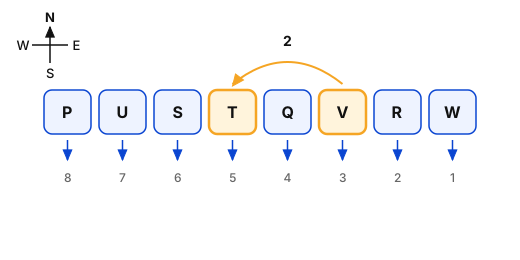
8 girls P, Q, R, S, T, U, V, and W are sitting in a row facing South (not necessarily in the same order). P and W are at the extreme ends of the row. T and U are immediate neighbours of S. R is fourth to the left of S.U is to the immediate left of P. V is not the immediate neighbour of T. Who is sitting second to the right of V ?
8 लड़कियाँ P, Q, R, S, T, U, V और W एक पंक्ति में दक्षिण की ओर मुख करके बैठी हैं (आवश्यक नहीं कि इसी क्रम में)। P और W पंक्ति के अंतिम छोरों पर हैं। T और U, S के निकटतम पड़ोसी हैं। R, S.U के बाईं ओर चौथे स्थान पर है, जो P के तत्काल बाईं ओर है। V, T का निकटतम पड़ोसी नहीं है। V के दाईं ओर दूसरे स्थान पर कौन बैठी है?
  1. AS
  2. BU
  3. CQ
  4. DT
Show answer

Concept: They face South; label seats 1–8 starting at the end that is on the girls' left.

  1. U is immediately left of P → P can't be at seat 1 → P = 8, U = 7, W = 1.
  2. S is between T and U → S = 6, T = 5.
  3. R is 4th left of S → R = 2.
  4. Seats 3, 4: V can't be next to T → V = 3, Q = 4.
  5. Second right of V (3) = seat 5 = T.

Trick: Order: W R V Q T S U P (from their left). For South-facing rows, 'their right' is your left on paper – fix it once and stick to it.

Answer: (D) T

अवधारणा: दक्षिण की ओर मुख है; सीटें लड़कियों के अपने बाएँ से दाएँ 1–8 मानें।

हल:

  1. U, P के ठीक बाएँ → P = 8, U = 7, W = 1।
  2. S के दोनों ओर T और U → S = 6, T = 5।
  3. R, S से चौथा बाएँ → R = 2।
  4. सीट 3, 4: V, T के पास नहीं → V = 3, Q = 4।
  5. V (3) से दूसरा दाएँ = सीट 5 = T।

ट्रिक: क्रम: W R V Q T S U P। दक्षिणमुखी पंक्ति में उनका दायाँ कागज़ पर आपका बायाँ होता है – एक बार तय करें।

उत्तर: (D) T

SSC CHSLGeneral IntelligenceLinear seating – facing SouthSSC CHSL 2025 · 21 Nov Shift 2 →
Q2547.
Rahul started walking straight from his school to his house. During his journey, he turned 15 times left and 14 times right. He is finally walking towards the West to reach his house. In which direction did he start walking?
राहुल अपने विद्यालय से अपने घर की ओर सीधा चलना आरंभ करता है। अपनी यात्रा के दौरान वह 15 बार बाएँ और 14 बार दाएँ मुड़ता है। अंत में वह अपने घर पहुँचने के लिए पश्चिम की ओर चल रहा है। उसने किस दिशा में चलना आरंभ किया था?
  1. ASouthदक्षिण
  2. BNorthउत्तर
  3. CEastपूर्व
  4. DWestपश्चिम
Show answer

Concept: One left and one right cancel; only the net turns matter.

  1. Net = 15 left − 14 right = 1 left turn.
  2. Start → (turn left) → West, so start was the direction whose left is West.
  3. Left of North is West → he started towards North.

Trick: Work backwards: undo the final left turn by turning right from West → North.

Answer: (B) North

अवधारणा: एक बायाँ और एक दायाँ मोड़ एक-दूसरे को काट देते हैं।

हल:

  1. शुद्ध = 15 बाएँ − 14 दाएँ = 1 बायाँ मोड़।
  2. प्रारंभिक दिशा से बाएँ मुड़कर पश्चिम मिला।
  3. उत्तर की ओर मुख हो तो बायाँ = पश्चिम → शुरुआत उत्तर से।

ट्रिक: उल्टा चलें: पश्चिम से एक दायाँ मोड़ = उत्तर।

उत्तर: (B) उत्तर

SSC CHSLGeneral IntelligenceDirection – net turnsSSC CHSL 2025 · 21 Nov Shift 2 →
Q2548.
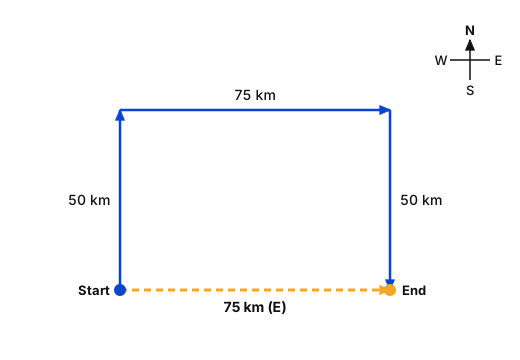
M walks 50 km towards the North. He turns right and walks 75 km. He again turns right and walks 50 km. How far (in km) and in which direction is he now from the starting point?
M उत्तर की ओर 50 km चलता है। वह दाएँ मुड़कर 75 km चलता है। वह पुनः दाएँ मुड़कर 50 km चलता है। अब वह प्रारंभिक बिंदु से कितनी दूर (km में) तथा किस दिशा में है?
  1. A75 , West75 , पश्चिम
  2. B50, East50, पूर्व
  3. C75 , East75 , पूर्व
  4. D50, West50, पश्चिम
Show answer

Concept: Track the facing direction after each turn and cancel opposite moves.

  1. North 50 km → right turn = East 75 km → right turn = South 50 km.
  2. North 50 and South 50 cancel.
  3. Left: 75 km East.

Trick: Two right turns = U-turn, so the 1st and 3rd legs (both 50) cancel – the middle leg is the answer.

Answer: (C) 75 , East

अवधारणा: हर मोड़ के बाद दिशा देखें और विपरीत चालें काटें।

हल:

  1. उत्तर 50 km → दाएँ = पूर्व 75 km → दाएँ = दक्षिण 50 km।
  2. उत्तर 50 और दक्षिण 50 कट गए।
  3. बचा 75 km पूर्व।

ट्रिक: दो दाएँ मोड़ = U-turn; पहला और तीसरा भाग कट जाते हैं, बीच वाला ही उत्तर।

उत्तर: (C) 75 , पूर्व

SSC CHSLGeneral IntelligenceDirection – distance and directionSSC CHSL 2025 · 21 Nov Shift 2 →
Q2549.
Assuming that the data given in the statement are definitely true, which of the following conclusions can be logically deducted?
Statement: All applicants who have a master's degree are shortlisted for the job.
Fact: Suman was shortlisted for the job. Which conclusion is valid?
यह मानते हुए कि कथन में दी गई जानकारी निश्चित रूप से सत्य है, निम्नलिखित में से कौन-सा निष्कर्ष तार्किक रूप से निकाला जा सकता है?
कथन: वे सभी आवेदक जिनके पास स्नातकोत्तर उपाधि है, नौकरी के लिए शॉर्टलिस्ट कर लिए जाते हैं।
तथ्य: सुमन को नौकरी के लिए शॉर्टलिस्ट किया गया था। कौन-सा निष्कर्ष वैध है?
  1. ASuman has a master's degree.सुमन के पास स्नातकोत्तर उपाधि है।
  2. BSuman might have a master's degree.सुमन के पास स्नातकोत्तर उपाधि हो सकती है।
  3. COnly applicants with a master's degree are shortlisted.केवल स्नातकोत्तर उपाधि वाले आवेदक ही शॉर्टलिस्ट किए जाते हैं।
  4. DSuman is the only applicant shortlisted.सुमन ही एकमात्र शॉर्टलिस्ट किया गया आवेदक है।
Show answer

Concept: 'All A are B' does not mean 'All B are A'.

  1. Master's holders ⊂ shortlisted group; others may also be shortlisted.
  2. Suman is shortlisted → she may or may not have the degree.
  3. So only 'might have' is valid; (A), (C), (D) claim too much.

Trick: From B back to A you can only say 'possible' – never 'definite'.

Answer: (B) Suman might have a master's degree.

अवधारणा: 'All A are B' का अर्थ 'All B are A' नहीं होता।

हल:

  1. मास्टर डिग्री वाले, चयनित समूह का हिस्सा हैं; दूसरे भी चयनित हो सकते हैं।
  2. सुमन चयनित है → डिग्री हो भी सकती है, नहीं भी।
  3. इसलिए केवल 'might have' सही; बाकी अधिक दावा करते हैं।

ट्रिक: B से A की ओर केवल 'संभव' कह सकते हैं, 'निश्चित' नहीं।

उत्तर: (B) सुमन के पास स्नातकोत्तर उपाधि हो सकती है।

SSC CHSLGeneral IntelligenceStatement and conclusion – 'All' is one-waySSC CHSL 2025 · 21 Nov Shift 2 →
Q2550.
By interchanging the given two numbers (not digits), which of the following equations will NOT be correct? 5 and 10 l. 10×2+5−20÷4=15 ll. 5+10÷2×4=25
दी गई दो संख्याओं (अंकों को नहीं) को परस्पर बदलने पर, निम्नलिखित में से कौन-सा समीकरण सही नहीं होगा? 5 तथा 10 l. 10×2+5−20÷4=15 ll. 5+10÷2×4=25
  1. AOnly Iकेवल I
  2. BOnly IIकेवल II
  3. CBoth I and III और II दोनों
  4. DNeither I nor IIन तो I और न ही II
Show answer

Concept: Swap 5 and 10 everywhere, then solve using BODMAS.

  1. I: 5×2+10−20÷4=10+10−5=15 ✓ (correct).
  2. II: 10+5÷2×4=10+2.5×4=10+10=20≠25 ✗.
  3. So only II is not correct.

Trick: Do ÷ and × left to right before + and −; don't do 2×4 first in II.

Answer: (B) Only II

अवधारणा: 5 और 10 को हर जगह आपस में बदलें, फिर BODMAS से हल करें।

हल:

  1. I: 5×2+10−20÷4=10+10−5=15 ✓
  2. II: 10+5÷2×4=10+2.5×4=20≠25 ✗
  3. केवल II गलत है।

ट्रिक: ÷ और × बाएँ से दाएँ पहले करें; II में 2×4 पहले न करें।

उत्तर: (B) केवल II

SSC CHSLGeneral IntelligenceInterchange of numbers – BODMASSSC CHSL 2025 · 21 Nov Shift 2 →
Q2551.
The average of 12 numbers is 35 . If one number is excluded, the average becomes 33. Find the excluded number.
12 संख्याओं का औसत 35 है। यदि एक संख्या हटा दी जाए, तो औसत 33 हो जाता है। हटाई गई संख्या ज्ञात कीजिए।
  1. A55
  2. B57
  3. C59
  4. D61
Show answer

Concept: Sum = average × count.

  1. Sum of 12 = 12×35=420.
  2. Sum of 11 = 11×33=363.
  3. Removed = 420−363=57.

Trick: Removed = new avg + (old count × drop) = 33+12×2=57.

Answer: (B) 57

अवधारणा: योग = औसत × संख्या।

हल:

  1. 12 संख्याओं का योग = 12×35=420।
  2. 11 संख्याओं का योग = 11×33=363।
  3. हटाई गई = 420−363=57।

ट्रिक: हटाई गई = नया औसत + (पुरानी संख्या × कमी) = 33+12×2=57।

उत्तर: (B) 57

SSC CHSLQuantitative AptitudeAverage – removed numberSSC CHSL 2025 · 21 Nov Shift 2 →
Q2552.
If 35=5.916, find the value of 75.
यदि 35=5.916, तो 75 का मान ज्ञात कीजिए।
  1. A1.1832
  2. B1.2832
  3. C1.0832
  4. D1.1916
Show answer

Concept: Make the denominator a perfect square so the given root appears.

  1. 75=7×55×5=355.
  2. =5.916÷5=1.1832.

Trick: ab=abb – always multiply inside by the denominator.

Answer: (A) 1.1832

अवधारणा: हर (denominator) को पूर्ण वर्ग बनाएँ ताकि दिया गया 35 आ जाए।

हल:

  1. 75=7×55×5=355।
  2. =5.916÷5=1.1832।

ट्रिक: ab=abb – अंदर हर से गुणा करें।

उत्तर: (A) 1.1832

SSC CHSLQuantitative AptitudeSurds – √(7/5) using √35SSC CHSL 2025 · 21 Nov Shift 2 →
Q2553.
If x=(3+2)(3−2),y=(3−2)(3+2).
find the value of (x2+y2).
यदि x=(3+2)(3−2),y=(3−2)(3+2)।
तो (x2+y2) का मान ज्ञात कीजिए।
  1. A96
  2. B98
  3. C100
  4. D102
Show answer

Concept: x=3+23−2, y = its reciprocal, so xy=1; use x2+y2=(x+y)2−2xy.

  1. x=(3+2)23−2=5+26.
  2. y=5−26 → x+y=10, xy=1.
  3. x2+y2=102−2×1=98.

Trick: When y=1x: x2+y2=(x+y)2−2. With x+y=2(a+b)a−b=2×51=10→100−2=98.

Answer: (B) 98

अवधारणा: x=3+23−2 और y उसका व्युत्क्रम है, इसलिए xy=1; सूत्र x2+y2=(x+y)2−2xy।

हल:

  1. x=(3+2)23−2=5+26।
  2. y=5−26 → x+y=10, xy=1।
  3. x2+y2=100−2=98।

ट्रिक: y=1x हो तो x2+y2=(x+y)2−2=100−2=98।

उत्तर: (B) 98

SSC CHSLQuantitative AptitudeRationalisation – x² + y²SSC CHSL 2025 · 21 Nov Shift 2 →
Q2554.
P,Q, and R invest money in a business in the ratio 3:5:7. If the total profit at the end of the year is ₹45,000, find Q's share.
P,Q, तथा R एक व्यवसाय में 3:5:7 के अनुपात में धन निवेश करते हैं। यदि वर्ष के अंत में कुल लाभ ₹45,000 है, तो Q का हिस्सा ज्ञात कीजिए।
  1. A₹9,000
  2. B₹15,000
  3. C₹21,000
  4. D₹12,000
Show answer

Concept: Profit is divided in the ratio of investment (same time).

  1. Total parts = 3+5+7=15.
  2. 1 part = 45000÷15= ₹3,000.
  3. Q=5×3000= ₹15,000.

Trick: Q's 5 parts out of 15 = 13 of profit → 450003= 15,000.

Answer: (B) ₹15,000

अवधारणा: समान समय हो तो लाभ निवेश के अनुपात में बँटता है।

हल:

  1. कुल भाग = 3+5+7=15।
  2. 1 भाग = 45000÷15= ₹3,000।
  3. Q=5×3000= ₹15,000।

ट्रिक: 515=13 → 45000 का 13= 15,000।

उत्तर: (B) ₹15,000

SSC CHSLQuantitative AptitudePartnership – share from ratioSSC CHSL 2025 · 21 Nov Shift 2 →
Q2555.
X, Y, and Z invest money in the ratio 4:5:6. If the total profit is ₹60,000, find X's share.
X, Y तथा Z, 4:5:6 के अनुपात में धन निवेश करते हैं। यदि कुल लाभ ₹60,000 है, तो X का हिस्सा ज्ञात कीजिए।
  1. A₹16,000
  2. B₹20,000
  3. C₹24,000
  4. D₹18,000
Show answer

Concept: Divide the profit in the investment ratio 4 : 5 : 6.

  1. Total parts = 15.
  2. 1 part = 60000÷15= ₹4,000.
  3. X=4×4000= ₹16,000.

Trick: X gets 415; 6000015=4000 is a quick mental step → ×4.

Answer: (A) ₹16,000

अवधारणा: लाभ को 4 : 5 : 6 में बाँटें।

हल:

  1. कुल भाग = 15।
  2. 1 भाग = 60000÷15= ₹4,000।
  3. X=4×4000= ₹16,000।

ट्रिक: X का हिस्सा 415; 6000015=4000 → ×4।

उत्तर: (A) ₹16,000

SSC CHSLQuantitative AptitudePartnership – share from ratioSSC CHSL 2025 · 21 Nov Shift 2 →
Q2556.
If P:Q=3:4 and Q:R=5:6, then what is P:Q:R ?
यदि P:Q=3:4 तथा Q:R=5:6, तो P:Q:R क्या है?
  1. A15:20:24
  2. B3 : 4 : 6
  3. C15 : 20 : 22
  4. D12 : 20 : 24
Show answer

Concept: Make the common term Q equal in both ratios.

  1. P : Q = 3 : 4 → ×5 → 15 : 20.
  2. Q : R = 5 : 6 → ×4 → 20 : 24.
  3. P : Q : R = 15 : 20 : 24.

Trick: Cross method: P=3×5, Q=4×5, R=4×6 → 15 : 20 : 24.

Answer: (A) 15:20:24

अवधारणा: उभयनिष्ठ पद Q को दोनों अनुपातों में बराबर करें।

हल:

  1. P : Q = 3 : 4 → ×5 → 15 : 20।
  2. Q : R = 5 : 6 → ×4 → 20 : 24।
  3. P : Q : R = 15 : 20 : 24।

ट्रिक: सीधा तरीका: P=3×5, Q=4×5, R=4×6।

उत्तर: (A) 15:20:24

SSC CHSLQuantitative AptitudeRatio – combining P:Q and Q:RSSC CHSL 2025 · 21 Nov Shift 2 →
Q2557.
If the average of 11,14,x, and 23 is 18 , find the value of x.
यदि 11,14,x तथा 23 का औसत 18 है, तो x का मान ज्ञात कीजिए।
  1. A22
  2. B20
  3. C24
  4. D26
Show answer

Concept: Sum = average × number of terms.

  1. Total = 18×4=72.
  2. 11+14+23=48.
  3. x=72−48=24.

Trick: Deviation method: 11 (−7), 14 (−4), 23 (+5) → net −6, so x=18+6=24.

Answer: (C) 24

अवधारणा: योग = औसत × पदों की संख्या।

हल:

  1. कुल = 18×4=72।
  2. 11+14+23=48।
  3. x=72−48=24।

ट्रिक: विचलन विधि: −7, −4, +5 = −6 → x=18+6=24।

उत्तर: (C) 24

SSC CHSLQuantitative AptitudeAverage – missing valueSSC CHSL 2025 · 21 Nov Shift 2 →
Q2558.
The average of four numbers is 30 . The average of the first and second is 25 , and that of the third and fourth is 35 . What is the second number if the first is 20?
चार संख्याओं का औसत 30 है। पहली तथा दूसरी संख्या का औसत 25 है और तीसरी तथा चौथी संख्या का औसत 35 है। यदि पहली संख्या 20 है, तो दूसरी संख्या क्या है?
  1. A25
  2. B28
  3. C30
  4. D32
Show answer

Concept: Convert each average into a sum.

  1. First + second = 2×25=50.
  2. First = 20 → second = 50−20=30.
  3. (Check: 3rd + 4th = 70, total 120=4×30 ✓)

Trick: Only the pair containing the asked number matters – ignore the rest.

Answer: (C) 30

अवधारणा: हर औसत को योग में बदलें।

हल:

  1. पहली + दूसरी = 2×25=50।
  2. पहली = 20 → दूसरी = 50−20=30।
  3. (जाँच: 50+70=120=4×30 ✓)

ट्रिक: केवल उसी जोड़ी का उपयोग करें जिसमें पूछी गई संख्या है।

उत्तर: (C) 30

SSC CHSLQuantitative AptitudeAverage – grouped numbersSSC CHSL 2025 · 21 Nov Shift 2 →
Q2559.
A student scored 84 marks in a test. If this was 70% of the total, what were the maximum marks?
एक विद्यार्थी ने एक परीक्षा में 84 अंक प्राप्त किए। यदि यह कुल अंकों का 70% था, तो अधिकतम अंक कितने थे?
  1. A110
  2. B120
  3. C130
  4. D140
Show answer

Concept: If 70% = 84, find 100%.

  1. 1% = 84÷70=1.2.
  2. 100% = 1.2×100=120.

Trick: 70% → 84 means 7 → 8.4, so 10 → 12; scale ×10 → 120.

Answer: (B) 120

अवधारणा: 70% = 84 है, तो 100% कितना?

हल:

  1. 1% = 84÷70=1.2।
  2. 100% = 120।

ट्रिक: 7 → 8.4, तो 10 → 12; ×10 → 120।

उत्तर: (B) 120

SSC CHSLQuantitative AptitudePercentage – finding the totalSSC CHSL 2025 · 21 Nov Shift 2 →
Q2560.
A shopkeeper buys an article for Rs. 400 and sells it for Rs. 500. What is the profit percentage?
एक दुकानदार एक वस्तु Rs. 400 में खरीदता है और उसे Rs. 500 में बेचता है। लाभ प्रतिशत क्या है?
  1. A20%
  2. B22.5%
  3. C25%
  4. D30%
Show answer

Concept: Profit%=ProfitCP×100.

  1. Profit = 500−400= ₹100.
  2. Profit%=100400×100=25%.

Trick: 100 on 400 = 14=25%. Always divide by CP, not SP (100500=20% is the trap).

Answer: (C) 25%

अवधारणा: लाभ%=लाभक्रय मूल्य×100।

हल:

  1. लाभ = 500−400= ₹100।
  2. लाभ%=100400×100=25%।

ट्रिक: हमेशा CP से भाग दें; SP से भाग (20%) जाल है।

उत्तर: (C) 25%

SSC CHSLQuantitative AptitudeProfit percentageSSC CHSL 2025 · 21 Nov Shift 2 →