Question bank

Q&A: practice questions with answers

Search questions on any topic. Filter by exam category, exam, subject and topic, try the question, then open the answer and explanation.

Courses – airGurukul

5,000 questions found.

Q2741.
Two figures given on the left side of (: ) are related with some logic/rule/relation. Select the missing figure on the right side of (:) from the given alternatives based on the same logic/rule/relation.

figure
(: ) के बाईं ओर दी गई दो आकृतियाँ किसी तर्क/नियम/संबंध से संबंधित हैं। उसी तर्क/नियम/संबंध के आधार पर दिए गए विकल्पों में से (:) के दाईं ओर की लुप्त आकृति का चयन कीजिए।
figure
  1. Afigure
  2. Bfigure
  3. Cfigure
  4. Dfigure
Show answer

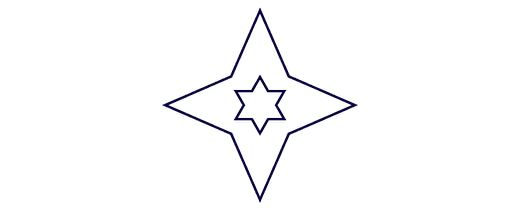
Concept: The outer and inner shapes exchange positions.

  1. Given third figure: six-pointed star outside, five-pointed star inside.
  2. After the swap: five-pointed star outside, six-pointed star inside.
  3. Only option C shows this.

Trick: Focus only on the outer boundary of each option – it must be the five-pointed star.

Answer: (C) Option C

अवधारणा: बाहरी और भीतरी आकृतियाँ स्थान बदलती हैं।

हल:

  1. तीसरी आकृति: बाहर छह-कोणीय तारा, अंदर पाँच-कोणीय तारा।
  2. अदला-बदली के बाद: बाहर पाँच-कोणीय, अंदर छह-कोणीय।
  3. केवल विकल्प C में यही है।

ट्रिक: हर विकल्प में केवल बाहरी आकृति देखें – पाँच-कोणीय तारा होना चाहिए।

उत्तर: (C) Option C
SSC CHSLGeneral IntelligenceFigure analogy – inner/outer swapSSC CHSL 2025 · 20 Nov Shift 3 →
Q2742.
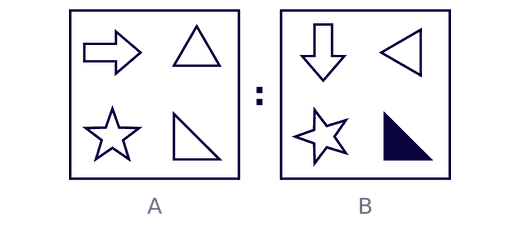
Two figures given on the left side of (:) are related with some logic/rule/relation. Select the missing figure on the right side of (:) from the given alternatives based on the same logic/rule/relation.
figure
figure
(:) के बाईं ओर दी गई दो आकृतियाँ किसी तर्क/नियम/संबंध से संबंधित हैं। उसी तर्क/नियम/संबंध के आधार पर दिए गए विकल्पों में से (:) के दाईं ओर की लुप्त आकृति का चयन कीजिए।
figure
figure
  1. Afigure
  2. Bfigure
  3. Cfigure
  4. Dfigure
Show answer

Concept: Each element turns 90° clockwise in its own place; the bottom-right element also gets shaded.

  1. In A→B: arrow right → down, triangle tips onto its side, star tilts, right triangle turns and is filled.
  2. Apply to C: up arrow → right arrow; every other shape turns 90° clockwise.
  3. Bottom-right shape becomes shaded – matches option D.

Trick: Track one easy element (the arrow) first – it shows the direction of rotation and removes wrong options quickly.

Answer: (D) Option D

अवधारणा: हर आकृति अपनी जगह पर 90° दक्षिणावर्त घूमती है; नीचे-दाईं आकृति छायांकित भी होती है।

हल:

  1. A→B में: तीर दाएँ → नीचे, त्रिभुज करवट लेता है, तारा झुकता है, समकोण त्रिभुज घूमकर भर जाता है।
  2. C पर लागू करें: ऊपर का तीर → दाएँ; बाकी आकृतियाँ भी 90° दक्षिणावर्त।
  3. नीचे-दाईं आकृति छायांकित – विकल्प D से मेल।

ट्रिक: पहले तीर जैसी आसान आकृति देखें – घूमने की दिशा पता चलती है और गलत विकल्प हटते हैं।

उत्तर: (D) Option D

SSC CHSLGeneral IntelligenceFigure analogy – 90° rotation and shadingSSC CHSL 2025 · 20 Nov Shift 3 →
Q2743.
Two figures given on the left side of (::) are related with some logic / rule /relation. Select the missing figure on the right side of (:) from the given alternatives based on the same logic / rule/relation.
figure
(::) के बाईं ओर दी गई दो आकृतियाँ किसी तर्क/नियम/संबंध से संबंधित हैं। उसी तर्क/नियम/संबंध के आधार पर दिए गए विकल्पों में से (:) के दाईं ओर की लुप्त आकृति का चयन कीजिए।
figure
  1. A
  2. B
  3. C
  4. D
Show answer

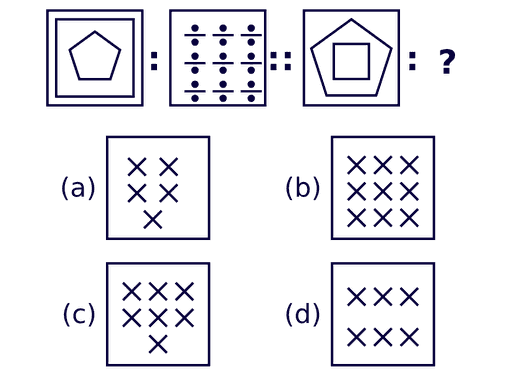
Concept: Number of symbols in the 2nd figure = total sides of the shapes inside the frame of the 1st.

  1. First: square (4) + pentagon (5) = 9 → 9 symbols (3 × 3).
  2. Third: pentagon (5) + square (4) = 9.
  3. So the answer needs 9 crosses: option B (3 rows of 3).

Trick: Just count the crosses: A = 5, C = 7, D = 6, B = 9.

Answer: (B) Option B

अवधारणा: दूसरी आकृति में चिह्नों की संख्या = पहली आकृति के फ्रेम के अंदर की आकृतियों की कुल भुजाएँ।

हल:

  1. पहली: वर्ग (4) + पंचभुज (5) = 9 → 9 चिह्न (3 × 3)।
  2. तीसरी: पंचभुज (5) + वर्ग (4) = 9।
  3. अतः 9 क्रॉस चाहिए: विकल्प B (3 पंक्तियाँ × 3)।

ट्रिक: बस क्रॉस गिनें: A = 5, C = 7, D = 6, B = 9।

उत्तर: (B) Option B

SSC CHSLGeneral IntelligenceFigure analogy – sides counted as symbolsSSC CHSL 2025 · 20 Nov Shift 3 →
Q2744.
In the following figure series, select the figure which can be placed at the sign of question mark (?) from the given alternatives.
figure
निम्नलिखित आकृति-शृंखला में, दिए गए विकल्पों में से उस आकृति का चयन कीजिए जिसे प्रश्नवाचक चिह्न (?) के स्थान पर रखा जा सकता है।
figure
  1. Afigure
  2. Bfigure
  3. Cfigure
  4. Dfigure
Show answer

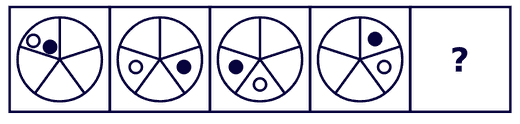
Concept: Track each mark separately in the 5-sector circle.

  1. Shaded dot: moves 2 sectors clockwise each step.
  2. Hollow circle: moves 1 sector anticlockwise each step.
  3. From figure 4: shaded dot upper-right → bottom; hollow circle right → upper-right.
  4. Option B shows this.

Trick: Follow one mark at a time; when two marks move, they usually move in opposite directions or by different steps.

Answer: (B) Option B

अवधारणा: 5 खंडों वाले वृत्त में हर चिह्न को अलग-अलग देखें।

हल:

  1. भरा बिंदु: हर बार 2 खंड दक्षिणावर्त।
  2. खाली वृत्त: हर बार 1 खंड वामावर्त।
  3. चौथी आकृति से: भरा बिंदु ऊपर-दाएँ → नीचे; खाली वृत्त दाएँ → ऊपर-दाएँ।
  4. विकल्प B में यही है।

ट्रिक: एक समय में एक ही चिह्न देखें; दो चिह्न प्रायः अलग दिशा या अलग कदमों से चलते हैं।

उत्तर: (B) Option B

SSC CHSLGeneral IntelligenceFigure series – moving dots in sectorsSSC CHSL 2025 · 20 Nov Shift 3 →
Q2745.
In the following question, four number pairs are given. In each pair the number on left side of (⋅) is related to the number of the right side of (-) with some Logic/Rule/Relation. Three pairs are similar on the basis of same Logic/Rule/Relation. Select the odd one out from the given alternatives.
(NOTE: Operations should be performed on the whole numbers, without breaking down the number into its constituent digits. E.g. 13 - Operations on 13 such as adding /subtracting /multiplying etc. to 13 can be performed. Breaking down 13 into 1 and 3 and then performing mathematical operations on 1 and 3 is not allowed)
निम्नलिखित प्रश्न में, चार संख्या-युग्म दिए गए हैं। प्रत्येक युग्म में (⋅) के बाईं ओर की संख्या किसी तर्क/नियम/संबंध द्वारा (-) के दाईं ओर की संख्या से संबंधित है। तीन युग्म समान तर्क/नियम/संबंध के आधार पर एक जैसे हैं। दिए गए विकल्पों में से विषम युग्म का चयन कीजिए।
(नोट: संक्रियाएँ पूर्ण संख्याओं पर की जानी चाहिए, संख्या को उसके अंकों में तोड़े बिना। उदाहरण के लिए 13 - 13 पर जोड़ना/घटाना/गुणा करना आदि संक्रियाएँ की जा सकती हैं। 13 को 1 और 3 में तोड़कर 1 और 3 पर गणितीय संक्रियाएँ करने की अनुमति नहीं है।)
  1. A14-256
  2. B12-196
  3. C16-324
  4. D18-420
Show answer

Concept: Right number = (left number+2)2.

  1. 14 → 162=256 ✓; 12 → 142=196 ✓; 16 → 182=324 ✓.
  2. 18 → 202=400, but given 420 ✗.

Trick: Perfect squares end in 0, 1, 4, 5, 6, 9; 420 is not a square at all – it stands out instantly.

Answer: (D) 18-420

अवधारणा: दाईं संख्या = (बाईं संख्या+2)2।

हल:

  1. 14 → 162=256 ✓; 12 → 142=196 ✓; 16 → 182=324 ✓।
  2. 18 → 202=400, पर दिया है 420 ✗।

ट्रिक: 256, 196, 324 पूर्ण वर्ग हैं; 420 पूर्ण वर्ग नहीं है – तुरंत अलग।

उत्तर: (D) 18-420

SSC CHSLGeneral IntelligenceOdd pair – (n + 2)²SSC CHSL 2025 · 20 Nov Shift 3 →
Q2746.
In a certain coded language 'SPPU' is coded as 'NJKO' and 'GBOT' is coded as 'BVJN'. How will 'KBNT' be coded in the same code language?
एक निश्चित कूट भाषा में 'SPPU' को 'NJKO' के रूप में तथा 'GBOT' को 'BVJN' के रूप में कूटबद्ध किया जाता है। उसी कूट भाषा में 'KBNT' को किस प्रकार कूटबद्ध किया जाएगा?
  1. AHTJL
  2. BDTHN
  3. CGTGN
  4. DFVIN
Show answer

Concept: Find the shift of each letter position.

  1. SPPU → NJKO: S−5, P−6, P−5, U−6.
  2. GBOT → BVJN: same −5, −6, −5, −6 (B−6 wraps to V).
  3. Apply to KBNT: K→F (back 5), B→V (back 6), N→I (back 5), T→N (back 6) → FVIN.

Trick: Second letter B−6 = V; only option D has V in second place.

Answer: (D) FVIN

अवधारणा: हर स्थान के अक्षर का खिसकाव निकालें।

हल:

  1. SPPU → NJKO: S−5, P−6, P−5, U−6।
  2. GBOT → BVJN: वही −5, −6, −5, −6 (B−6 घूमकर V)।
  3. KBNT पर लागू: K→F (5 पीछे), B→V (6 पीछे), N→I (5 पीछे), T→N (6 पीछे) → FVIN।

ट्रिक: दूसरा अक्षर B−6 = V; केवल विकल्प D में दूसरे स्थान पर V है।

उत्तर: (D) FVIN

SSC CHSLGeneral IntelligenceCoding – alternate −5, −6 shiftSSC CHSL 2025 · 20 Nov Shift 3 →
Q2747.
In a certain code language, 'bring the light' is coded as 'db eb nq', 'light bring happiness' is coded as 'eb mj no', 'happiness produced joy' is coded as 'mj qp ub'. How will 'bring happiness' be coded in that code language ?
एक निश्चित कूट भाषा में, 'bring the light' को 'db eb nq', 'light bring happiness' को 'eb mj no' तथा 'happiness produced joy' को 'mj qp ub' के रूप में कूटबद्ध किया जाता है। उसी कूट भाषा में 'bring happiness' को किस प्रकार कूटबद्ध किया जाएगा?
  1. Aeb ub
  2. Bmj eb
  3. Cmj no
  4. Deb qp
Show answer

Concept: A word appearing in two sentences has the code common to both.

  1. (ii) & (iii): common word 'happiness', common code 'mj'.
  2. 'bring' is in (i) and (ii); the only code present in both is 'eb' → bring = eb.
  3. 'bring happiness' = eb + mj.

Trick: Find 'happiness' = mj first; then only options with both mj and eb survive – B.

Answer: (B) mj eb

अवधारणा: जो शब्द दो वाक्यों में आए, उसका कोड भी दोनों में सामान्य होगा।

हल:

  1. (ii) और (iii): सामान्य शब्द 'happiness', सामान्य कोड 'mj'।
  2. 'bring' (i) और (ii) दोनों में है; दोनों में सामान्य कोड केवल 'eb' → bring = eb।
  3. 'bring happiness' = eb + mj।

ट्रिक: पहले happiness = mj निकालें; mj और eb दोनों वाला विकल्प – B।

उत्तर: (B) mj eb

SSC CHSLGeneral IntelligenceCoding – common word, common codeSSC CHSL 2025 · 20 Nov Shift 3 →
Q2748.
In a certain code language, 'apple is very sweet' is coded as 'kp lm qr st', 'sweet fruit is mango' is coded as 'qr mn Im xy', 'very mango fruit apple' is coded as 'kp st xy mn', 'fruit very is tasty' is coded as 'mn st Im ab'. How will 'very sweet fruit' be coded in that code language ?
एक निश्चित कूट भाषा में, 'apple is very sweet' को 'kp lm qr st', 'sweet fruit is mango' को 'qr mn Im xy', 'very mango fruit apple' को 'kp st xy mn' तथा 'fruit very is tasty' को 'mn st Im ab' के रूप में कूटबद्ध किया जाता है। उसी कूट भाषा में 'very sweet fruit' को किस प्रकार कूटबद्ध किया जाएगा?
  1. Akp qr mn
  2. Bst Im mn
  3. Cqr mn st
  4. Dkp Im qr
Show answer

Concept: Compare pairs of sentences to fix codes one by one.

  1. 'very' occurs in (i), (iii), (iv); 'st' is in all three → very = st.
  2. (i) & (iii) share apple, very → kp, st → apple = kp. (i) & (iv) share is → lm.
  3. Left in (i): sweet = qr.
  4. 'fruit' in (ii), (iii), (iv); common code 'mn' → fruit = mn.
  5. very sweet fruit = st qr mn → order-free match: qr mn st.

Trick: Code order is not fixed; just check the set {st, qr, mn} in the options.

Answer: (C) qr mn st

अवधारणा: वाक्यों के जोड़ों की तुलना से एक-एक कोड तय करें।

हल:

  1. 'very' (i), (iii), (iv) में; 'st' तीनों में → very = st।
  2. (i) व (iii) में apple, very → apple = kp; (i) व (iv) से is = lm।
  3. (i) में बचा: sweet = qr।
  4. 'fruit' (ii), (iii), (iv) में; सामान्य कोड 'mn' → fruit = mn।
  5. very sweet fruit = {st, qr, mn} → qr mn st।

ट्रिक: कोड का क्रम तय नहीं; बस विकल्पों में {st, qr, mn} समूह देखें।

उत्तर: (C) qr mn st

SSC CHSLGeneral IntelligenceCoding – four-sentence word codesSSC CHSL 2025 · 20 Nov Shift 3 →
Q2749.
A word has been given in the question. This word CAN be formed by using the letters of the word given in one of the alternatives only. Select that alternative.
LIGHT
प्रश्न में एक शब्द दिया गया है। यह शब्द केवल एक विकल्प में दिए गए शब्द के अक्षरों का प्रयोग करके बनाया जा सकता है। उस विकल्प का चयन कीजिए।
LIGHT
  1. ALITHOTOMY
  2. BHOLLOWING
  3. CLIGHTER
  4. DHOLOGRAPH
Show answer

Concept: All letters of LIGHT (L, I, G, H, T) must be present in the option.

  1. LITHOTOMY: no G. HOLLOWING: no T. HOLOGRAPH: no I, no T.
  2. LIGHTER contains L, I, G, H, T.

Trick: Check the rare letters first (G and T) – they eliminate three options in seconds.

Answer: (C) LIGHTER

अवधारणा: LIGHT के सभी अक्षर (L, I, G, H, T) विकल्प में होने चाहिए।

हल:

  1. LITHOTOMY: G नहीं। HOLLOWING: T नहीं। HOLOGRAPH: I और T नहीं।
  2. LIGHTER में L, I, G, H, T सब हैं।

ट्रिक: पहले कम आने वाले अक्षर (G, T) जाँचें – तीन विकल्प तुरंत हटते हैं।

उत्तर: (C) LIGHTER

SSC CHSLGeneral IntelligenceWord formation – LIGHTSSC CHSL 2025 · 20 Nov Shift 3 →
Q2750.
Select the option that is related to the fifth letter cluster in the same way as the second letter cluster is related to the first letter cluster and fourth letter cluster is related to third letter cluster.
QPSU : VTQR :: GXOE : FPYH :: HCSJ : ?
उस विकल्प का चयन कीजिए जो पाँचवें अक्षर-समूह से उसी प्रकार संबंधित है, जिस प्रकार दूसरा अक्षर-समूह पहले अक्षर-समूह से तथा चौथा अक्षर-समूह तीसरे अक्षर-समूह से संबंधित है।
QPSU : VTQR :: GXOE : FPYH :: HCSJ : ?
  1. AKSEJ
  2. BKTDI
  3. CLSEI
  4. DLTEJ
Show answer

Concept: Reverse the cluster, then move each letter one step forward.

  1. QPSU → reverse USPQ → +1 → VTQR ✓.
  2. GXOE → reverse EOXG → +1 → FPYH ✓.
  3. HCSJ → reverse JSCH → +1 → KTDI.

Trick: Last letter of answer = first letter + 1: H + 1 = I; only options B and C end in I, and second letter S+1 = T leaves B.

Answer: (B) KTDI

अवधारणा: क्लस्टर को उलटा लिखें, फिर हर अक्षर +1।

हल:

  1. QPSU → उलटा USPQ → +1 → VTQR ✓।
  2. GXOE → उलटा EOXG → +1 → FPYH ✓।
  3. HCSJ → उलटा JSCH → +1 → KTDI।

ट्रिक: उत्तर का अंतिम अक्षर = पहला अक्षर + 1: H+1 = I; B, C बचे, दूसरा अक्षर S+1 = T → B।

उत्तर: (B) KTDI

SSC CHSLGeneral IntelligenceLetter analogy – reverse and +1SSC CHSL 2025 · 20 Nov Shift 3 →
Q2751.
If the square of 27 is 729 , then find the square of 175 .
यदि 27 का वर्ग 729 है, तो 175 का वर्ग ज्ञात कीजिए।
  1. A30625
  2. B34625
  3. C35625
  4. D36625
Show answer

Concept: For n5, (n5)2=n×(n+1) followed by 25.

  1. 175 → n=17, n+1=18.
  2. 17×18=306.
  3. Write 25 after it → 1752=30625.

Trick: Units digit of the square must be 25 and 1752<1802=32400 → only 30625 fits.

Answer: (A) 30625

अवधारणा: 5 पर समाप्त संख्या n5 का वर्ग = n×(n+1) के बाद 25।

हल:

  1. 175 → n=17, n+1=18।
  2. 17×18=306।
  3. पीछे 25 लगाएँ → 1752=30625।

ट्रिक: 1752<1802=32400 – इससे छोटा विकल्प केवल 30625 है।

उत्तर: (A) 30625

SSC CHSLQuantitative AptitudeSquares – number ending in 5SSC CHSL 2025 · 20 Nov Shift 3 →
Q2752.
Find the value of cos⁡45∘sin⁡45∘+ cot⁡60∘cosec30∘+sec⁡30∘tan⁡45∘.
cos⁡45∘sin⁡45∘+ cot⁡60∘cosec30∘+sec⁡30∘tan⁡45∘ का मान ज्ञात कीजिए।
  1. A(12+34)
  2. B(12+43)
  3. C(12+23)
  4. D(1+43)
Show answer

Concept: Substitute standard trigonometric values.

  1. cos45∘×sin45∘=(12)(12)=12.
  2. cot60∘×csc30∘=13×2=23.
  3. sec30∘×tan45∘=23×1=23.
  4. Sum = 12+43.

Trick: Notice the last two terms are both 23 – just double it.

Answer: (B) (12+43)

अवधारणा: मानक त्रिकोणमितीय मान रखें।

हल:

  1. cos45∘×sin45∘=(12)(12)=12।
  2. cot60∘×csc30∘=13×2=23।
  3. sec30∘×tan45∘=23×1=23।
  4. योग = 12+43।

ट्रिक: अंतिम दोनों पद 23 हैं – सीधे दोगुना करें।

उत्तर: (B) (12+43)

SSC CHSLQuantitative AptitudeTrigonometric values – standard anglesSSC CHSL 2025 · 20 Nov Shift 3 →
Q2753.
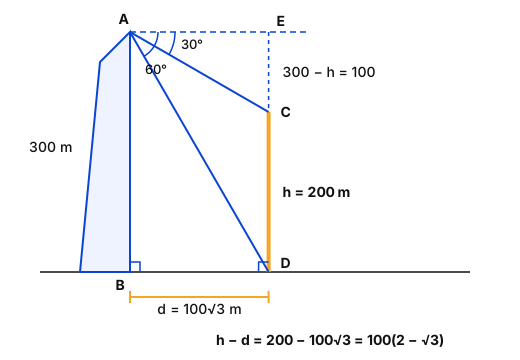
From the top of a hill 300 metres high, the angles of depression of the top and bottom of a pole are 30° and 60°, respectively. The difference (in metres) between the height of the pole and its distance from the hill is:
300 मीटर ऊँची एक पहाड़ी के शिखर से एक खंभे के शीर्ष तथा तल के अवनमन कोण क्रमशः 30° और 60° हैं। खंभे की ऊँचाई तथा पहाड़ी से उसकी दूरी के बीच का अंतर (मीटर में) कितना है?
  1. A150(2−3)
  2. B150(3−1)
  3. C100(3−1)
  4. D100(2−3)
Show answer

Concept: Use tan in the right triangles formed from the hilltop.

  1. Foot of pole at 60°: tan60∘=300d→d=3003=1003 m.
  2. Top of pole at 30°: tan30∘=300−hd→300−h=1003×13=100→h=200 m.
  3. h−d=200−1003=100(2−3) m.

Trick: With 60° and 30° from the same point, the vertical drops are in ratio 3 : 1 → 300−h=100 directly.

Answer: (D) 100(2−3)

अवधारणा: पहाड़ी की चोटी से बने समकोण त्रिभुजों में tan लगाएँ।

हल:

  1. खंभे का आधार 60° पर: tan60∘=300d→d=1003 m।
  2. खंभे का शीर्ष 30° पर: tan30∘=300−hd→300−h=100→h=200 m।
  3. h−d=200−1003=100(2−3) m।

ट्रिक: एक ही बिंदु से 60° और 30° हों तो ऊर्ध्व गिरावट 3 : 1 के अनुपात में → 300−h=100।

उत्तर: (D) 100(2−3)

SSC CHSLQuantitative AptitudeHeights and distances – angles of depressionSSC CHSL 2025 · 20 Nov Shift 3 →
Q2754.
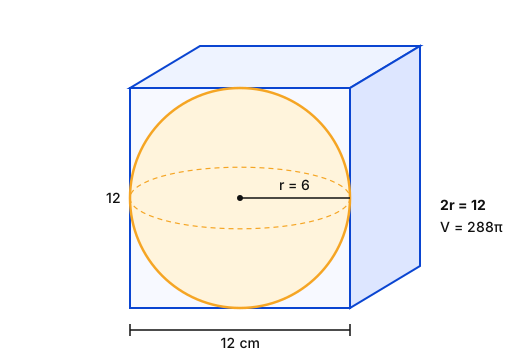
A cube-shaped container with a side length of 12 cm is filled with water. A solid metal sphere with a radius of 6 cm is then submerged into the container. How much water, in cubic centimeters, will overflow ?
12 सेमी भुजा वाला एक घनाकार पात्र पानी से भरा हुआ है। फिर 6 सेमी त्रिज्या वाला एक ठोस धातु का गोला उस पात्र में डुबोया जाता है। कितना पानी (घन सेंटीमीटर में) बाहर बह जाएगा?
  1. A288π
  2. B1728−288π
  3. C36π
  4. D144−36π
Show answer

Concept: Water overflow = volume of the solid immersed.

  1. Sphere diameter = 12 cm = cube side, so it fits fully.
  2. Volume = 43πr3=43π×216=288πcm3.

Trick: Don't subtract from the cube volume – overflow equals the sphere's volume itself.

Answer: (A) 288π

अवधारणा: बाहर निकला पानी = डुबोई गई ठोस वस्तु का आयतन।

हल:

  1. गोले का व्यास = 12 cm = घन की भुजा, अतः पूरा अंदर आ जाता है।
  2. आयतन = 43πr3=43π×216=288πcm3।

ट्रिक: घन के आयतन से घटाना नहीं है – बहा पानी = गोले का आयतन।

उत्तर: (A) 288π

SSC CHSLQuantitative AptitudeMensuration – sphere in a full cubeSSC CHSL 2025 · 20 Nov Shift 3 →
Q2755.
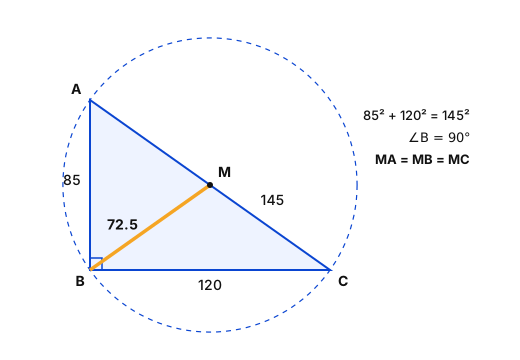
In triangle ABC, side lengths are AB =85cm,BC=120cm, and CA=145cm. Let M be the midpoint of side CA . Find the length of BM.
त्रिभुज ABC में भुजाओं की लंबाइयाँ AB =85cm,BC=120cm, तथा CA=145cm हैं। माना कि M भुजा CA का मध्य-बिंदु है। BM की लंबाई ज्ञात कीजिए।
  1. A53.5 cm53.5 सेमी
  2. B72.5 cm72.5 सेमी
  3. C66.5 cm66.5 सेमी
  4. D89.2 cm89.2 सेमी
Show answer

Concept: In a right triangle the median to the hypotenuse = half the hypotenuse.

  1. Check: 852+1202=7225+14400=21625=1452 → right angle at B.
  2. M is the midpoint of hypotenuse CA.
  3. BM=1452=72.5 cm.

Trick: 85 : 120 : 145 = 17 : 24 : 29 (×5) – a known triplet, so spot the right angle instantly.

Answer: (B) 72.5 cm

अवधारणा: समकोण त्रिभुज में कर्ण पर माध्यिका = कर्ण का आधा।

हल:

  1. जाँच: 852+1202=7225+14400=21625=1452 → B पर समकोण।
  2. M कर्ण CA का मध्य-बिंदु है।
  3. BM=1452=72.5 cm।

ट्रिक: 85 : 120 : 145 = 17 : 24 : 29 (×5) – पहचाना हुआ त्रिक, समकोण तुरंत दिखता है।

उत्तर: (B) 72.5 सेमी

SSC CHSLQuantitative AptitudeRight triangle – median to hypotenuseSSC CHSL 2025 · 20 Nov Shift 3 →
Q2756.
What is the degree measure of −4π3 radians ?
−4π3 रेडियन का डिग्री माप क्या है?
  1. A-240°0'0"
  2. B200°0'0'
  3. C-180°0'0*
  4. D-100°0'0"
Show answer

Concept: Degrees=radians×180∘π.

  1. −4π3×180∘π=−4×60∘=−240∘.
  2. Written as −240∘0′0′′.

Trick: π3=60∘; so 4π3=4×60∘ and keep the minus sign.

Answer: (A) -240°0'0"

अवधारणा: डिग्री=रेडियन×180∘π।

हल:

  1. −4π3×180∘π=−4×60∘=−240∘।
  2. अर्थात −240∘0′0′′।

ट्रिक: π3=60∘; अतः 4π3=4×60∘, ऋण चिह्न बना रहेगा।

उत्तर: (A) -240°0'0"

SSC CHSLQuantitative AptitudeRadian to degree conversionSSC CHSL 2025 · 20 Nov Shift 3 →
Q2757.
Which of the following set can never form the sides of a triangle ?
निम्नलिखित में से कौन-सा समुच्चय कभी भी किसी त्रिभुज की भुजाएँ नहीं बना सकता?
  1. A2 cm, 4 cm, 5 cm2 सेमी, 4 सेमी, 5 सेमी
  2. B6 cm, 6 cm, 6 cm6 सेमी, 6 सेमी, 6 सेमी
  3. C7cm,3cm,2cm
  4. D11cm,6cm,8cm
Show answer

Concept: Sum of the two smaller sides must exceed the largest side.

  1. A: 2 + 4 = 6 > 5 ✓; B: 6 + 6 > 6 ✓; D: 6 + 8 = 14 > 11 ✓.
  2. C: 3 + 2 = 5 < 7 ✗ – cannot form a triangle.

Trick: Only test the two smallest sides against the largest – one check per option.

Answer: (C) 7cm,3cm,2cm

अवधारणा: त्रिभुज तभी बनेगा जब छोटी दो भुजाएँ मिलकर तीसरी (सबसे लंबी) से बड़ी हों।

हल:

  1. A: 2 + 4 = 6 > 5 ✓; B: 6 + 6 > 6 ✓; D: 6 + 8 = 14 > 11 ✓।
  2. C: 3 + 2 = 5 < 7 ✗ – त्रिभुज नहीं बनेगा।

ट्रिक: केवल दो छोटी भुजाओं का योग सबसे बड़ी से मिलाएँ – हर विकल्प में एक ही जाँच।

उत्तर: (C) 7cm,3cm,2cm

SSC CHSLQuantitative AptitudeTriangle inequalitySSC CHSL 2025 · 20 Nov Shift 3 →
Q2758.
How many diagonals does a regular heptagon have ?
एक सम सप्तभुज में कितने विकर्ण होते हैं?
  1. A7
  2. B14
  3. C10
  4. D18
Show answer

Concept: Diagonals of an n-gon = n(n−3)2.

  1. Heptagon: n=7.
  2. 7×(7−3)2=282=14.

Trick: Alternative: nC2−n=21−7=14 (all joining lines minus sides).

Answer: (B) 14

अवधारणा: n भुजाओं वाले बहुभुज के विकर्ण = n(n−3)2।

हल:

  1. सप्तभुज: n=7।
  2. 7×(7−3)2=282=14।

ट्रिक: दूसरा तरीका: 7C2−7=21−7=14 (सभी रेखाएँ − भुजाएँ)।

उत्तर: (B) 14

SSC CHSLQuantitative AptitudePolygon – number of diagonalsSSC CHSL 2025 · 20 Nov Shift 3 →
Q2759.
At a specific rate of simple interest, a sum of money becomes ₹20,500 after four years and ₹21,800 after six. Calculate the simple interest rate at 10% annually for five years on the same amount.
साधारण ब्याज की एक निश्चित दर पर, कोई धनराशि चार वर्ष बाद ₹20,500 तथा छह वर्ष बाद ₹21,800 हो जाती है। उसी धनराशि पर 10% वार्षिक की दर से पाँच वर्ष का साधारण ब्याज ज्ञात कीजिए।
  1. A₹9,540
  2. B₹7,140
  3. C₹8,950
  4. D₹8,440
Show answer

Concept: Under SI, the amount grows by a fixed interest each year.

  1. 2 years' SI = 21800−20500= ₹1300 → 1 year = ₹650.
  2. 4 years' SI = ₹2600 → P=20500−2600= ₹17,900.
  3. SI at 10% for 5 years = 17900×10×5100= ₹8,950.

Trick: 10% for 5 years = 50% of P → half of 17,900 = ₹8,950.

Answer: (C) ₹8,950

अवधारणा: साधारण ब्याज में हर साल बराबर ब्याज जुड़ता है।

हल:

  1. 2 वर्ष का ब्याज = 21800−20500= ₹1300 → 1 वर्ष = ₹650।
  2. 4 वर्ष का ब्याज = ₹2600 → P=20500−2600= ₹17,900।
  3. 10% पर 5 वर्ष का SI = 17900×10×5100= ₹8,950।

ट्रिक: 10% × 5 वर्ष = P का 50% → 17,900 का आधा = ₹8,950।

उत्तर: (C) ₹8,950

SSC CHSLQuantitative AptitudeSimple interest – principal from two amountsSSC CHSL 2025 · 20 Nov Shift 3 →
Q2760.
A specific amount of principal is invested by an individual. The annual simple interest rate is 7% for the first two years, 10% for the following four, and 12% for the remaining time. The total interest earned after nine years is ₹8,100. How much was invested initially?
एक व्यक्ति द्वारा एक निश्चित मूलधन निवेश किया जाता है। वार्षिक साधारण ब्याज की दर पहले दो वर्षों के लिए 7%, अगले चार वर्षों के लिए 10% तथा शेष अवधि के लिए 12% है। नौ वर्षों बाद अर्जित कुल ब्याज ₹8,100 है। आरंभ में कितनी धनराशि निवेश की गई थी?
  1. A₹9,500
  2. B₹8,000
  3. C₹9,000
  4. D₹9,800
Show answer

Concept: Total SI% = sum of (rate × years) for each period.

  1. Periods: 2 yrs @7%, 4 yrs @10%, 3 yrs @12%.
  2. Total % = 14 + 40 + 36 = 90% of P.
  3. 90% of P = ₹8100 → P = ₹9,000.

Trick: Add 'rate × time' blocks first; one division gives the principal.

Answer: (C) ₹9,000

अवधारणा: कुल SI% = हर अवधि के (दर × वर्ष) का योग।

हल:

  1. अवधियाँ: 2 वर्ष @7%, 4 वर्ष @10%, 3 वर्ष @12%।
  2. कुल % = 14 + 40 + 36 = P का 90%।
  3. P का 90% = ₹8100 → P = ₹9,000।

ट्रिक: पहले 'दर × समय' जोड़ें; एक ही भाग से मूलधन मिल जाता है।

उत्तर: (C) ₹9,000

SSC CHSLQuantitative AptitudeSimple interest – changing ratesSSC CHSL 2025 · 20 Nov Shift 3 →