Question bank

Q&A: practice questions with answers

Search questions on any topic. Filter by exam category, exam, subject and topic, try the question, then open the answer and explanation.

Courses – airGurukul

5,000 questions found.

Q3241.
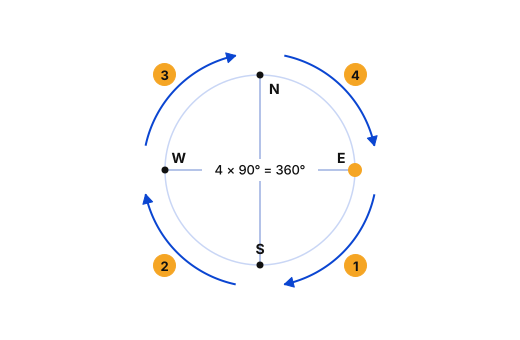
A started walking straight towards East. After taking how many right turns during her journey she will be finally facing towards east? (she took only right turns during her journey)
A ने पूर्व दिशा की ओर सीधे चलना आरंभ किया। अपनी यात्रा के दौरान कितने दाएँ मोड़ लेने के बाद वह अंततः पूर्व दिशा की ओर मुख किए हुए होगी? (उसने अपनी यात्रा के दौरान केवल दाएँ मोड़ ही लिए)
  1. A4
  2. B3
  3. C5
  4. D6
Show answer

Concept: One right turn = 90∘ clockwise; 360∘ brings back the start.

  1. East → South → West → North → East.
  2. That is 4 turns = 4×90∘=360∘.

Trick: To face the starting direction again with one-way turns: 4 turns (or a multiple of 4).

Answer: (A) 4

अवधारणा: एक right turn = 90∘ घड़ी की दिशा में; 360∘ पर वापस वही दिशा।

हल:

  1. पूर्व → दक्षिण → पश्चिम → उत्तर → पूर्व।
  2. 4×90∘=360∘।

ट्रिक: एक ही ओर मुड़कर वापस उसी दिशा = 4 (या 4 का गुणज) मोड़।

उत्तर: (A) 4
SSC CHSLGeneral IntelligenceDirection – number of right turnsSSC CHSL 2025 · 19 Nov Shift 1 →
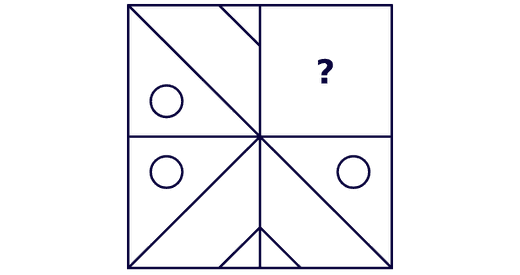
Q3242.
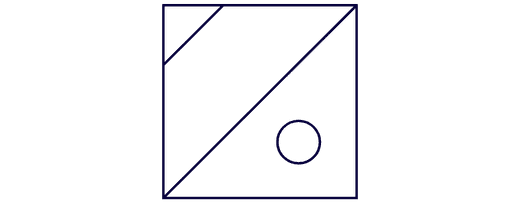
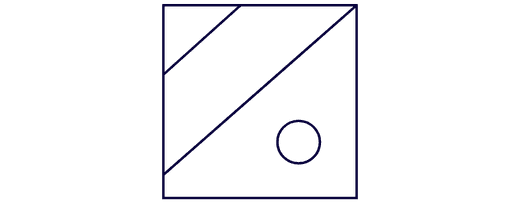
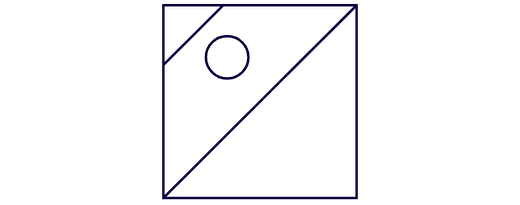
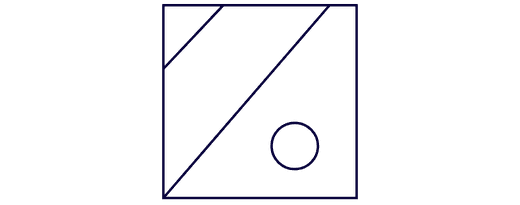
Which option figure will complete the pattern in the question figure? (Rotation is not allowed)
figure
कौन-सी विकल्प आकृति प्रश्न आकृति के पैटर्न को पूरा करेगी? (घुमाने की अनुमति नहीं है)
figure
  1. Afigure
  2. Bfigure
  3. Cfigure
  4. Dfigure
Show answer

Concept: The square's quarters are mirror images about the middle lines.

  1. Bottom-left = top-left flipped vertically; bottom-right = bottom-left flipped sideways.
  2. So top-right = top-left flipped sideways: long line to the corner, small cut line at the top centre, circle on the outer side.
  3. Option (A) shows exactly this.

Trick: Read the missing quarter from its neighbour across the vertical axis (left ↔ right).

Answer: (A)

अवधारणा: चारों भाग मध्य रेखाओं के सापेक्ष दर्पण प्रतिबिंब हैं।

हल:

  1. नीचे-बायाँ = ऊपर-बायाँ का उल्टा (ऊपर-नीचे); नीचे-दायाँ = नीचे-बायाँ का बाएँ-दाएँ प्रतिबिंब।
  2. अतः ऊपर-दायाँ = ऊपर-बायाँ का बाएँ-दाएँ प्रतिबिंब।
  3. विकल्प (A) यही है।

ट्रिक: लुप्त भाग को उसके बगल वाले भाग का दर्पण मानें।

उत्तर: (A)

SSC CHSLGeneral IntelligencePattern completion – mirror symmetrySSC CHSL 2025 · 19 Nov Shift 1 →
Q3243.
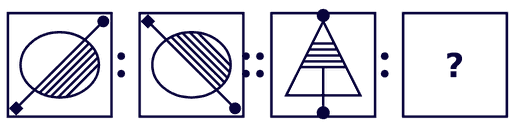
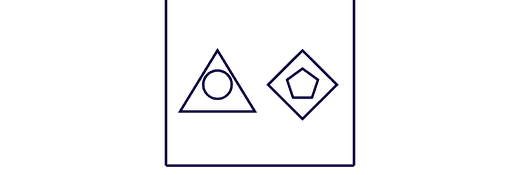
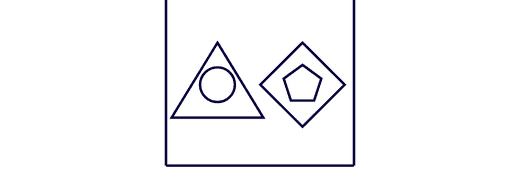
Select the option that is related to third figure in the same way as the second figure is related to the first figure.
figure
उस विकल्प का चयन कीजिए जो तीसरी आकृति से उसी प्रकार संबंधित है, जिस प्रकार दूसरी आकृति पहली आकृति से संबंधित है।
figure
  1. Afigure
  2. Bfigure
  3. Cfigure
  4. Dfigure
Show answer

Concept: Fig 2 is Fig 1 flipped top-to-bottom (water image).

  1. Dot and diamond swap top/bottom; left-right unchanged; shading moves to the other half.
  2. Flip Fig 3 the same way: triangle points down, stalk with dot goes up, stripes move to the lower part.
  3. Option (B) matches.

Trick: Water image: only up–down changes, left–right stays put.

Answer: (B)

अवधारणा: दूसरी आकृति पहली का जल प्रतिबिंब (ऊपर-नीचे उलटी) है।

हल:

  1. बिंदु और हीरा ऊपर-नीचे बदले; बाएँ-दाएँ वही।
  2. तीसरी आकृति को भी उलटें: त्रिभुज नीचे की ओर, डंडी व बिंदु ऊपर, धारियाँ नीचे।
  3. विकल्प (B) मेल खाता है।

ट्रिक: जल प्रतिबिंब में केवल ऊपर-नीचे बदलता है, बाएँ-दाएँ नहीं।

उत्तर: (B)

SSC CHSLGeneral IntelligenceFigure analogy – water imageSSC CHSL 2025 · 19 Nov Shift 1 →
Q3244.
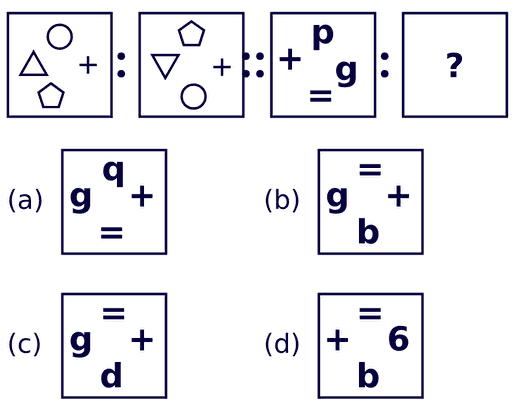
Two figures given on the left side of (:) are related with some logic/rule/relation. Select the missing figure on the right side of (:) from the given alternatives based on the same logic/rule/relation.
figure
(:) के बाईं ओर दी गई दो आकृतियाँ किसी तर्क/नियम/संबंध से संबंधित हैं। उसी तर्क/नियम/संबंध के आधार पर दिए गए विकल्पों में से (:) के दाईं ओर की लुप्त आकृति का चयन कीजिए।
figure
  1. A
  2. B
  3. C
  4. D
Show answer

Concept: First pair: top and bottom elements interchange – a water image.

  1. Circle (top) ↔ pentagon (bottom); triangle flips; sides stay.
  2. In Fig 3: '=' goes to the top, '+' stays left, 'p' at top becomes 'b' at bottom, 'g' on right becomes '6'.
  3. Option (D) shows this.

Trick: In water image p ↔ b, g ↔ 6 type flips happen – look for them.

Answer: (D)

अवधारणा: पहले जोड़े में ऊपर-नीचे के तत्व बदल गए – जल प्रतिबिंब।

हल:

  1. वृत्त (ऊपर) ↔ पंचभुज (नीचे); त्रिभुज उलटा; बाएँ-दाएँ वही।
  2. तीसरी आकृति: '=' ऊपर, '+' बाएँ ही, ऊपर का 'p' नीचे 'b', दाएँ का 'g' → '6'।
  3. विकल्प (D) यही है।

ट्रिक: जल प्रतिबिंब में p ↔ b, g ↔ 6 जैसा उलटाव होता है।

उत्तर: (D)

SSC CHSLGeneral IntelligenceFigure analogy – water imageSSC CHSL 2025 · 19 Nov Shift 1 →
Q3245.
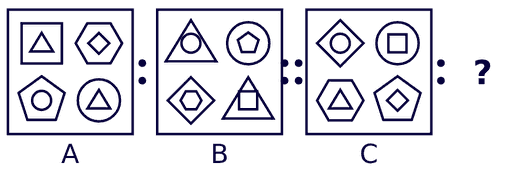
Select the option which is related to figure C as is the relation of figure B to figure A.
figure
उस विकल्प का चयन कीजिए जो आकृति $C$ से उसी प्रकार संबंधित है, जिस प्रकार आकृति $B$ का आकृति A से संबंध है।
figure
  1. Afigure
  2. Bfigure
  3. Cfigure
  4. Dfigure
Show answer

Concept: Each pair swaps inner and outer shapes and moves to the diagonally opposite cell.

  1. A → B: triangle-in-square becomes square-in-triangle, shifted diagonally.
  2. Apply to C: top-left gets pentagon-in-diamond, top-right hexagon-in-triangle.
  3. Bottom-left: circle-in-square; bottom-right: diamond-in-circle → option (A).

Trick: Check one cell only (e.g. top-left) – it usually leaves just one option.

Answer: (A)

अवधारणा: हर जोड़ी में अंदर-बाहर की आकृति बदलती है और विकर्ण के उल्टे खाने में जाती है।

हल:

  1. A → B: वर्ग में त्रिभुज → त्रिभुज में वर्ग, विकर्ण पार।
  2. C पर लागू: ऊपर-बाएँ = हीरे में पंचभुज, ऊपर-दाएँ = त्रिभुज में षट्भुज।
  3. नीचे-बाएँ = वर्ग में वृत्त, नीचे-दाएँ = वृत्त में हीरा → (A)।

ट्रिक: केवल एक खाना (जैसे ऊपर-बायाँ) जाँचें – अक्सर एक ही विकल्प बचता है।

उत्तर: (A)

SSC CHSLGeneral IntelligenceFigure analogy – inner/outer swapSSC CHSL 2025 · 19 Nov Shift 1 →
Q3246.
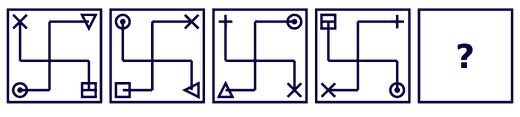
In the following question, select the figure which can be placed at the sign of question mark (?) from the given alternatives.
figure
निम्नलिखित प्रश्न में, दिए गए विकल्पों में से उस आकृति का चयन कीजिए जिसे प्रश्नवाचक चिह्न (?) के स्थान पर रखा जा सकता है।
figure
  1. Afigure
  2. Bfigure
  3. Cfigure
  4. Dfigure
Show answer

Concept: Frame stays; the end-marks shift one corner clockwise each step.

  1. Ringed dot: bottom-left → top-left → top-right → bottom-right → next bottom-left.
  2. Plus: top-left → top-right → next bottom-right.
  3. Only (D) has ringed dot at bottom-left and plus at bottom-right.

Trick: Track one symbol at a time; two symbols are enough to fix the answer.

Answer: (D)

अवधारणा: ढाँचा वही; सिरों के चिह्न हर बार एक कोना घड़ी की दिशा में खिसकते हैं।

हल:

  1. घेरे वाला बिंदु: नीचे-बाएँ → ऊपर-बाएँ → ऊपर-दाएँ → नीचे-दाएँ → अगला नीचे-बाएँ।
  2. प्लस: ऊपर-बाएँ → ऊपर-दाएँ → अगला नीचे-दाएँ।
  3. केवल (D) में दोनों सही स्थान पर।

ट्रिक: एक-एक चिह्न ट्रैक करें; दो चिह्न से उत्तर तय।

उत्तर: (D)

SSC CHSLGeneral IntelligenceFigure series – clockwise movementSSC CHSL 2025 · 19 Nov Shift 1 →
Q3247.
In a certain coded language 'CSJP' is coded as 'GWNT' and 'ESBC' is coded as 'IWFG'. How will 'BUPQ' be coded in the same language?
एक निश्चित कूट भाषा में 'CSJP' को 'GWNT' लिखा जाता है और 'ESBC' को 'IWFG' लिखा जाता है। उसी भाषा में 'BUPQ' को किस प्रकार लिखा जाएगा?
  1. ADXUV
  2. BCWSS
  3. CFVQS
  4. DFYTU
Show answer

Concept: Each letter shifts by the same value.

  1. C→G, S→W, J→N, P→T: +4 each (E→I, B→F confirm).
  2. BUPQ, each moved four ahead: B→F, U→Y, P→T, Q→U.

Trick: Check just the first letter: B+4 = F leaves (C) and (D); U+4 = Y → (D).

Answer: (D) FYTU

अवधारणा: हर अक्षर में एक समान बदलाव।

हल:

  1. C→G, S→W, J→N, P→T: हर एक +4।
  2. BUPQ: B→F, U→Y, P→T, Q→U।

ट्रिक: पहला अक्षर B+4 = F → (C), (D) बचे; U+4 = Y → (D)।

उत्तर: (D) FYTU

SSC CHSLGeneral IntelligenceCoding – constant +4SSC CHSL 2025 · 19 Nov Shift 1 →
Q3248.
In a certain coded language 'HONEY' is coded as 'CYIIT' and 'DIRTY' is coded as 'YNMCT'. How will 'MONEY' be coded in the same code language?
एक निश्चित कूट भाषा में 'HONEY' को 'CYIIT' लिखा जाता है और 'DIRTY' को 'YNMCT' लिखा जाता है। उसी कूट भाषा में 'MONEY' को किस प्रकार लिखा जाएगा?
  1. AXINYL
  2. BHYIIT
  3. CHYTIT
  4. DXYIIT
Show answer

Concept: Same letters in the same positions get the same code.

  1. HONEY → CYIIT; MONEY differs only in the first letter, so 'ONEY' → 'YIIT'.
  2. First letter rule: H(8) → C(3) and D(4) → Y(25): −5.
  3. M(13) − 5 = H(8) → HYIIT.

Trick: Compare words with common parts – copy that part of the code directly.

Answer: (B) HYIIT

अवधारणा: एक जैसे अक्षर, एक जैसी जगह → एक जैसा कोड।

हल:

  1. HONEY → CYIIT; MONEY में केवल पहला अक्षर अलग, अतः 'ONEY' → 'YIIT'।
  2. पहला अक्षर: H→C, D→Y: −5।
  3. M − 5 = H → HYIIT।

ट्रिक: समान भाग का कोड सीधे उतार लें – केवल नया अक्षर हल करें।

उत्तर: (B) HYIIT

SSC CHSLGeneral IntelligenceCoding – common lettersSSC CHSL 2025 · 19 Nov Shift 1 →
Q3249.
In a certain coded language 'GHTMIK' is coded as 'PMPYLJ' and 'NEATLY' is coded as 'DPWFIQ'. How will 'DACBYP' be coded in the same code language?
एक निश्चित कूट भाषा में 'GHTMIK' को 'PMPYLJ' लिखा जाता है और 'NEATLY' को 'DPWFIQ' लिखा जाता है। उसी कूट भाषा में 'DACBYP' को किस प्रकार लिखा जाएगा?
  1. AJROENH
  2. BUCHEEG
  3. CUCEHEG
  4. DLSOFMG
Show answer

Concept: Reverse the word, then add +5, +4, +3, +5, +4, +3.

  1. GHTMIK reversed = KIMTHG → +5,+4,+3,+5,+4,+3 → PMPYLJ ✓
  2. DACBYP reversed = PYBCAD.
  3. P→U (+5), Y→C (+4), B→E (+3), C→H (+5), A→E (+4), D→G (+3) → UCEHEG.

Trick: When no direct pattern appears, try reversing the word first.

Answer: (C) UCEHEG

अवधारणा: शब्द उलटें, फिर +5, +4, +3, +5, +4, +3 जोड़ें।

हल:

  1. GHTMIK उलटा = KIMTHG → PMPYLJ ✓
  2. DACBYP उलटा = PYBCAD।
  3. P→U, Y→C, B→E, C→H, A→E, D→G → UCEHEG।

ट्रिक: सीधा पैटर्न न दिखे तो पहले शब्द उलटा करके देखें।

उत्तर: (C) UCEHEG

SSC CHSLGeneral IntelligenceCoding – reverse + (+5, +4, +3)SSC CHSL 2025 · 19 Nov Shift 1 →
Q3250.
A word has been given in the question. This word CAN be formed by using the letters of the word given in one of the alternatives only. Select that alternative.
SHOES
प्रश्न में एक शब्द दिया गया है। यह शब्द केवल एक विकल्प में दिए गए शब्द के अक्षरों का प्रयोग करके ही बनाया जा सकता है। उस विकल्प का चयन कीजिए।
SHOES
  1. ASCHOOL
  2. BSCHOOLERS
  3. CSTATEMENT
  4. DBATSMAN
Show answer

Concept: Every letter of SHOES, with its count, must be present.

  1. SHOES needs S×2, H, O, E.
  2. SCHOOL – one S, no E; STATEMENT and BATSMAN – no H, no O.
  3. SCHOOLERS has S×2, H, O, E ✓

Trick: Check the repeated letter (S twice) first – it removes most options.

Answer: (B) SCHOOLERS

अवधारणा: SHOES के हर अक्षर की गिनती सहित उपलब्धता देखें।

हल:

  1. ज़रूरत: S दो बार, H, O, E।
  2. SCHOOL – एक S, E नहीं; STATEMENT, BATSMAN – H, O नहीं।
  3. SCHOOLERS में सब मौजूद ✓

ट्रिक: दोहराए अक्षर (दो S) पहले जाँचें – अधिकतर विकल्प हट जाते हैं।

उत्तर: (B) SCHOOLERS

SSC CHSLGeneral IntelligenceWord formationSSC CHSL 2025 · 19 Nov Shift 1 →
Q3251.
Which is a mixed recurring decimal?
मिश्रित आवर्ती दशमलव कौन-सा है?
  1. A0.75
  2. B0.3333…$0.3333…$
  3. C0.272727…$0.272727…$
  4. D2.1454545…$2.1454545…$
Show answer

Concept: Mixed recurring: some decimal digits do not repeat, then a block repeats.

  1. 0.75 – terminating.
  2. 0.333… and 0.2727… – repetition starts right after the point (pure recurring).
  3. 2.1454545… – '1' does not repeat, then '45' repeats → mixed recurring.

Trick: Pure = bar starts at first decimal place; Mixed = bar starts later.

Answer: (D) 2.1454545…

अवधारणा: मिश्रित आवर्ती: दशमलव के बाद कुछ अंक नहीं दोहराते, फिर कोई समूह दोहराता है।

हल:

  1. 0.75 – सांत दशमलव।
  2. 0.333…, 0.2727… – दोहराव तुरंत शुरू (शुद्ध आवर्ती)।
  3. 2.1454545… – '1' नहीं दोहराता, फिर '45' दोहराता है → मिश्रित आवर्ती।

ट्रिक: शुद्ध = बार पहले अंक से; मिश्रित = बार बाद में शुरू।

उत्तर: (D) $2.1454545…$

SSC CHSLQuantitative AptitudeDecimals – mixed recurringSSC CHSL 2025 · 19 Nov Shift 1 →
Q3252.
A TV is sold at a discount of 20%. If a man buys it for Rs. 6500 , what is the marked price?
एक टीवी $20%$ की छूट पर बेचा जाता है। यदि एक व्यक्ति उसे 6500 रुपये में खरीदता है, तो अंकित मूल्य क्या है?
  1. A8125
  2. B10000
  3. C8000
  4. D8225
Show answer

Concept: After d% discount, SP = (100−d)% of MP.

  1. SP = 80% of MP = 6500.
  2. MP = 6500×10080=6500×54=8125.

Trick: 20% off → MP = SP×54 (add one-fourth of SP: 6500+1625).

Answer: (A) 8125

अवधारणा: d% छूट के बाद SP = MP का (100−d)%।

हल:

  1. MP का 80% = 6500।
  2. MP = 6500×10080=8125।

ट्रिक: 20% छूट → MP = SP×54, यानी 6500+1625=8125।

उत्तर: (A) 8125

SSC CHSLQuantitative AptitudeDiscount – marked price from SPSSC CHSL 2025 · 19 Nov Shift 1 →
Q3253.
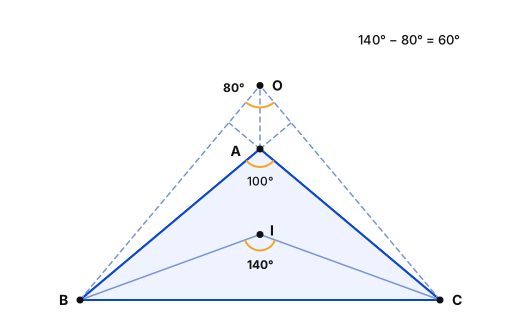
In triangle ABC, the orthocenter O and the incenter I. If ∠BIC−∠BOC=60∘, what is ∠A ?
त्रिभुज $ABC$ में, लंबकेंद्र $O$ तथा अंतःकेंद्र I है। यदि $∠BIC-∠BOC={60}^{∘}$ है, तो $∠A$ क्या है?
  1. A100°
  2. B90°
  3. C110°
  4. D120°
Show answer

Concept: ∠BIC=90∘+A2 (incentre); ∠BOC=180∘−A (orthocentre).

  1. (90∘+A2)−(180∘−A)=60∘.
  2. 3A2−90∘=60∘→3A2=150∘.
  3. A=100∘.

Trick: Remember the pair: Incentre 90+A2, Excentre 90−A2, Orthocentre 180−A, Circumcentre 2A.

Answer: (A) 100°

अवधारणा: ∠BIC=90∘+A2 (अंतःकेंद्र); ∠BOC=180∘−A (लंबकेंद्र)।

हल:

  1. (90∘+A2)−(180∘−A)=60∘।
  2. 3A2−90∘=60∘→3A2=150∘।
  3. A=100∘।

ट्रिक: अंतःकेंद्र 90+A2, बाह्यकेंद्र 90−A2, लंबकेंद्र 180−A, परिकेंद्र 2A।

उत्तर: (A) 100°

SSC CHSLQuantitative AptitudeTriangle centres – incentre & orthocentre anglesSSC CHSL 2025 · 19 Nov Shift 1 →
Q3254.
If cot⁡θ=512,0∘<θ<90∘, then find the value of:
((1+sin⁡θ)cos⁡θ)−((1−sin⁡θ)cos⁡θ).
यदि cot⁡θ=512,0∘&lt;θ&lt;90∘ है, तो निम्नलिखित का मान ज्ञात कीजिए:
[(1+sin⁡θ)cos⁡θ]−[(1−sin⁡θ)cos⁡θ].
  1. A125$\frac{12}{5}$
  2. B245$\frac{24}{5}$
  3. C−245$\frac{-24}{5}$
  4. D135$\frac{13}{5}$
Show answer

Concept: cotθ=512⇒tanθ=125. The two brackets have the same denominator cosθ.

  1. 1+sinθcosθ−1−sinθcosθ=(1+sinθ)−(1−sinθ)cosθ=2sinθcosθ=2tanθ.
  2. 2tanθ=2×125=245.

Trick: Same denominators → subtract numerators: (1+s)−(1−s)=2s, so the answer is just 2tanθ.

Answer: (B) 245

अवधारणा: cotθ=512⇒tanθ=125। दोनों कोष्ठकों का हर cosθ समान है।

  1. 1+sinθcosθ−1−sinθcosθ=(1+sinθ)−(1−sinθ)cosθ=2sinθcosθ=2tanθ।
  2. 2tanθ=2×125=245।

ट्रिक: हर समान हो तो अंश घटाएँ: (1+s)−(1−s)=2s, अतः उत्तर = 2tanθ।

उत्तर: (B) $\frac{24}{5}$

SSC CHSLQuantitative AptitudeTrigonometry – ratios from cot θSSC CHSL 2025 · 19 Nov Shift 1 →
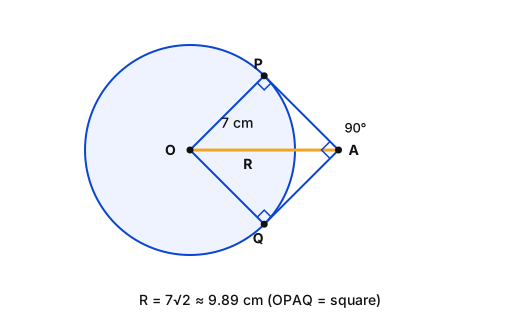
Q3255.
Two tangents are drawn from a point A outside a circle of radius 7 cm . The angle between the tangents is 90∘, and the distance from A to the center of the circle is Rcm. Find the value of R.
7 cm त्रिज्या वाले एक वृत्त के बाहर स्थित बिंदु A से दो स्पर्श रेखाएँ खींची जाती हैं। स्पर्श रेखाओं के बीच का कोण ${90}^{∘}$ है, तथा $A$ से वृत्त के केंद्र की दूरी $R cm$ है। $R$ का मान ज्ञात कीजिए।
  1. A6.30 cm
  2. B7.32 cm
  3. C9.89 cm
  4. D62cm$6\sqrt{2} cm$
Show answer

Concept: Line from external point to centre bisects the angle between tangents; radius ⊥ tangent.

  1. Half angle = 45∘; in right △: sin45∘=rR.
  2. R=7sin45∘=72.
  3. 7×1.414≈9.89 cm.

Trick: Tangents at 90∘ → the figure is a square: R=diagonal=r2.

Answer: (C) 9.89 cm

अवधारणा: बाहरी बिंदु–केंद्र रेखा स्पर्शरेखाओं के बीच के कोण को समद्विभाजित करती है; त्रिज्या ⊥ स्पर्शरेखा।

हल:

  1. आधा कोण = 45∘; sin45∘=rR।
  2. R=72।
  3. 7×1.414≈9.89 cm।

ट्रिक: स्पर्शरेखाओं के बीच 90∘ → वर्ग बनता है: R=विकर्ण=r2।

उत्तर: (C) 9.89 cm

SSC CHSLQuantitative AptitudeTangents – distance of external pointSSC CHSL 2025 · 19 Nov Shift 1 →
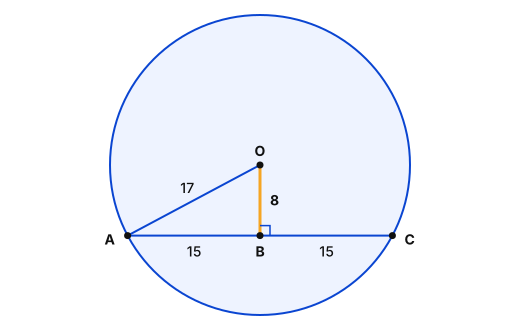
Q3256.
In a circle with center O,AC is a chord. OB is perpendicular to AC at point B. If OA=17cm and AC=30cm, what is the length of OB ?
केंद्र $O$ वाले एक वृत्त में $AC$ एक जीवा है। OB बिंदु $B$ पर AC के लंबवत है। यदि $OA=17 cm$ और $AC=30 cm$ है, तो $OB$ की लंबाई क्या है?
  1. A9 cm
  2. B8 cm
  3. C5 cm
  4. D10 cm
Show answer

Concept: Perpendicular from centre bisects the chord.

  1. AB = 302=15 cm.
  2. OB2=172−152=289−225=64.
  3. OB = 8 cm.

Trick: Triplet 8-15-17: see 15 and 17 → other side 8.

Answer: (B) 8 cm

अवधारणा: केंद्र से जीवा पर लंब जीवा को समद्विभाजित करता है।

हल:

  1. AB = 302=15 cm।
  2. OB2=172−152=64।
  3. OB = 8 cm।

ट्रिक: त्रिक 8-15-17: 15 और 17 दिखे तो तीसरी भुजा 8।

उत्तर: (B) 8 cm

SSC CHSLQuantitative AptitudeCircle – perpendicular from centre to chordSSC CHSL 2025 · 19 Nov Shift 1 →
Q3257.
The perimeter of a rectangle is 14 2cm, while the area of the rectangle is 18cm2. Find the difference between the length and the breadth of the given rectangle.
एक आयत का परिमाप 14 $\sqrt{2} cm$ है, जबकि उस आयत का क्षेत्रफल $18{ cm}^{2}$ है। दिए गए आयत की लंबाई तथा चौड़ाई का अंतर ज्ञात कीजिए।
  1. A33cm$3\sqrt{3} cm$
  2. B46cm$\sqrt{46} cm$
  3. C26cm$\sqrt{26} cm$
  4. D3cm$\sqrt{3} cm$
Show answer

Concept: (l−b)2=(l+b)2−4lb.

  1. l+b=1422=72→(l+b)2=98.
  2. 4lb=4×18=72.
  3. (l−b)2=98−72=26→l−b=26 cm.

Trick: Never find l and b separately – use the identity directly.

Answer: (C) 26cm

अवधारणा: (l−b)2=(l+b)2−4lb।

हल:

  1. l+b=72→(l+b)2=98।
  2. 4lb=72।
  3. (l−b)2=26→l−b=26 cm।

ट्रिक: l, b अलग से न निकालें – सीधा सूत्र लगाएँ।

उत्तर: (C) $\sqrt{26} cm$

SSC CHSLQuantitative AptitudeRectangle – difference of sidesSSC CHSL 2025 · 19 Nov Shift 1 →
Q3258.
The floor of a building consists of 500 rhombus-shaped tiles. If the lengths of the diagonals of each tile are 15cm and 18 cm , respectively, then find the cost of polishing the floor at a rate of Rs. 20 per m2.
किसी भवन के फर्श में 500 समचतुर्भुज आकार की टाइलें लगी हैं। यदि प्रत्येक टाइल के विकर्णों की लंबाइयाँ क्रमशः 15cm तथा 18 cm हैं, तो 20 रुपये प्रति ${m}^{2}$ की दर से फर्श की पॉलिश कराने की लागत ज्ञात कीजिए।
  1. ARs. 135
  2. BRs. 150
  3. CRs. 130
  4. DRs. 125
Show answer

Concept: Area of rhombus = 12×d1×d2; 1m2=10000cm2.

  1. One tile = 12×15×18=135cm2.
  2. 500 tiles = 67500cm2=6.75m2.
  3. Cost = 6.75×20= ₹135.

Trick: 500×2010000=1, so cost in ₹ = area of one tile in cm² = 135.

Answer: (A) Rs. 135

अवधारणा: समचतुर्भुज का क्षेत्रफल = 12×d1×d2; 1m2=10000cm2।

हल:

  1. एक टाइल = 12×15×18=135cm2।
  2. 500 टाइलें = 67500cm2=6.75m2।
  3. खर्च = 6.75×20= ₹135।

ट्रिक: 500×2010000=1 → खर्च = एक टाइल का क्षेत्रफल = 135।

उत्तर: (A) Rs. 135

SSC CHSLQuantitative AptitudeRhombus – area and polishing costSSC CHSL 2025 · 19 Nov Shift 1 →
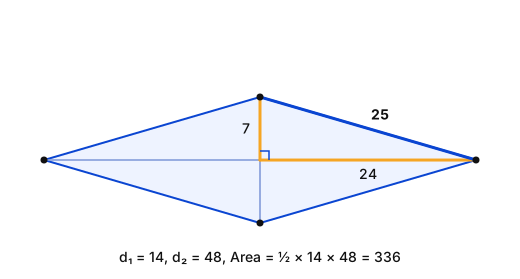
Q3259.
In a rhombus, the diagonals are in the ratio 7:24. If the side of the rhombus is 25 cm , determine the exact lengths of both diagonals and the area.
एक समचतुर्भुज में विकर्ण $7:24$ के अनुपात में हैं। यदि समचतुर्भुज की भुजा 25 cm है, तो दोनों विकर्णों की यथार्थ लंबाइयाँ तथा क्षेत्रफल ज्ञात कीजिए।
  1. A12 cm and 26cm,220cm212 cm तथा $26 cm,220{ cm}^{2}$
  2. B14 cm and 48cm,336cm214 cm तथा $48 cm,336{ cm}^{2}$
  3. C16 cm and 30cm,240cm216 cm तथा $30 cm,240{ cm}^{2}$
  4. DCan't be determinedज्ञात नहीं किया जा सकता
Show answer

Concept: Diagonals bisect at 90∘: side2=(d12)2+(d22)2.

  1. Half-diagonals 7k2 and 24k2 → 7-24-25 triplet scaled: 25k2=25→k=2.
  2. Diagonals = 14 cm and 48 cm.
  3. Area = 12×14×48=336cm2.

Trick: 7 : 24 : 25 triplet – half-diagonals are 7 and 24, so diagonals 14 and 48.

Answer: (B) 14 cm and 48cm,336cm2

अवधारणा: विकर्ण समकोण पर समद्विभाजित: भुजा2=(d12)2+(d22)2।

हल:

  1. आधे विकर्ण 7k2, 24k2→25k2=25→k=2।
  2. विकर्ण = 14 cm और 48 cm।
  3. क्षेत्रफल = 12×14×48=336cm2।

ट्रिक: त्रिक 7-24-25: भुजा 25 → आधे विकर्ण 7 व 24 → विकर्ण 14 व 48।

उत्तर: (B) 14 cm तथा $48 cm,336{ cm}^{2}$

SSC CHSLQuantitative AptitudeRhombus – diagonals from sideSSC CHSL 2025 · 19 Nov Shift 1 →
Q3260.
In a partnership, P and Q invest in the ratio 5:7. If the total profit is Rs. 1,20,000, how much profit does P get?
एक साझेदारी में P तथा Q $5:7$ के अनुपात में निवेश करते हैं। यदि कुल लाभ $1,20,000$ रुपये है, तो P को कितना लाभ मिलेगा?
  1. ARs. 40,000
  2. BRs. 50,000
  3. CRs. 62,780
  4. DRs. 48,889
Show answer

Concept: Equal time → profit in ratio of investment.

  1. Total parts = 5+7=12.
  2. 1 part = 1,20,000÷12=10,000.
  3. P = 5×10,000= ₹50,000.

Trick: Share must be a multiple of 10,000 here – only ₹50,000 fits.

Answer: (B) Rs. 50,000

अवधारणा: समय बराबर → लाभ निवेश के अनुपात में।

हल:

  1. कुल भाग = 12।
  2. 1 भाग = 1,20,000÷12=10,000।
  3. P = 5×10,000= ₹50,000।

ट्रिक: हिस्सा 10,000 का गुणज होगा – केवल ₹50,000 फिट।

उत्तर: (B) Rs. 50,000

SSC CHSLQuantitative AptitudePartnership – profit shareSSC CHSL 2025 · 19 Nov Shift 1 →