Directions (Qs. 20-24): Read the following passage carefully and answer the questions that follow.
The history of written communication has been a fascinating progression from ancient inscriptions to digital typography. Early civilizations depended on labor-intensive methods like clay tablets and papyrus scrolls, which, while durable, restricted the spread of knowledge to a privileged few. The invention of the movable type printing press in the 15th century, introduced by Johannes Gutenberg, marked a revolutionary epoch, enabling the mass production of books through mechanical reproduction. This breakthrough was eventually followed by lithography, which utilized chemical processes to print images and text with greater speed, though often requiring bulky equipment. The 20th century saw the emergence of phototypesetting, valued for its precision and flexibility. However, the most profound shift occurred with the arrival of digital publishing. Digital technologies merged high-speed output with relatively low costs, transforming personal, educational, and professional document creation.
Contemporary advancements have moved beyond static text. Interactive digital platforms integrate with global networks, facilitating real-time editing, multimedia embedding, and collaborative writing. These innovations not only democratize information access but also reshape how narratives are constructed and consumed.
From the scratch of a reed stylus to the instant update of a cloud-based document, writing has matured into a synthesis of art, technology, and connectivity-an essential element of modern society.
Q3321.Identify the tense in "writing has matured into a synthesis of art, technology, and connectivity".
- APresent perfect
- BPast perfect
- CPresent continuous
- DSimple present
Show answer
Concept: has/have + V3 = present perfect.
- Verb: 'has matured' = has + V3.
- Past perfect needs 'had matured'; present continuous 'is maturing'; simple present 'matures'.
Trick: has/have + V3 → present perfect; had + V3 → past perfect.
Answer: (A) Present perfect
अवधारणा: has/have + V3 = present perfect tense।
- क्रिया: 'has matured' = has + V3।
- past perfect में 'had', present continuous में 'is maturing' होता।
ट्रिक: has/have + V3 → present perfect; had + V3 → past perfect।
उत्तर: (A) Present perfect
Directions (Qs. 20-24): Read the following passage carefully and answer the questions that follow.
The history of written communication has been a fascinating progression from ancient inscriptions to digital typography. Early civilizations depended on labor-intensive methods like clay tablets and papyrus scrolls, which, while durable, restricted the spread of knowledge to a privileged few. The invention of the movable type printing press in the 15th century, introduced by Johannes Gutenberg, marked a revolutionary epoch, enabling the mass production of books through mechanical reproduction. This breakthrough was eventually followed by lithography, which utilized chemical processes to print images and text with greater speed, though often requiring bulky equipment. The 20th century saw the emergence of phototypesetting, valued for its precision and flexibility. However, the most profound shift occurred with the arrival of digital publishing. Digital technologies merged high-speed output with relatively low costs, transforming personal, educational, and professional document creation.
Contemporary advancements have moved beyond static text. Interactive digital platforms integrate with global networks, facilitating real-time editing, multimedia embedding, and collaborative writing. These innovations not only democratize information access but also reshape how narratives are constructed and consumed.
From the scratch of a reed stylus to the instant update of a cloud-based document, writing has matured into a synthesis of art, technology, and connectivity-an essential element of modern society.
Q3322.The word "epoch" most nearly means:
- ADisaster
- BEra
- CMachine
- DDecline
Show answer
Concept: Epoch = a notable period of time in history.
- Passage: the printing press began 'a revolutionary epoch' – a new age.
- Era = a long, distinct period – same meaning.
- Disaster, Machine, Decline do not mean a period.
Yaad rakhein: Epoch-making = so important that it starts a new age.
Answer: (B) Era
अवधारणा: Epoch = इतिहास का कोई विशेष काल/युग।
- गद्यांश: printing press से 'a revolutionary epoch' – नया युग शुरू हुआ।
- Era = युग – समान अर्थ।
याद रखें: Epoch-making = युगांतरकारी (नया युग शुरू करने वाला)।
उत्तर: (B) Era
Directions (Qs. 20-24): Read the following passage carefully and answer the questions that follow.
The history of written communication has been a fascinating progression from ancient inscriptions to digital typography. Early civilizations depended on labor-intensive methods like clay tablets and papyrus scrolls, which, while durable, restricted the spread of knowledge to a privileged few. The invention of the movable type printing press in the 15th century, introduced by Johannes Gutenberg, marked a revolutionary epoch, enabling the mass production of books through mechanical reproduction. This breakthrough was eventually followed by lithography, which utilized chemical processes to print images and text with greater speed, though often requiring bulky equipment. The 20th century saw the emergence of phototypesetting, valued for its precision and flexibility. However, the most profound shift occurred with the arrival of digital publishing. Digital technologies merged high-speed output with relatively low costs, transforming personal, educational, and professional document creation.
Contemporary advancements have moved beyond static text. Interactive digital platforms integrate with global networks, facilitating real-time editing, multimedia embedding, and collaborative writing. These innovations not only democratize information access but also reshape how narratives are constructed and consumed.
From the scratch of a reed stylus to the instant update of a cloud-based document, writing has matured into a synthesis of art, technology, and connectivity-an essential element of modern society.
Q3323.The word 'democratize" in the passage means:
- ATo restrict strictly
- BTo make accessible to everyone
- CTo vote efficiently
- DTo print slowly
Show answer
Concept: Democratize = make something available to all people.
- Earlier, knowledge was limited to 'a privileged few'.
- Digital platforms 'democratize information access' → open it to everyone.
- Option A is the opposite; C and D are unrelated.
Trick: Demo = people – so the meaning must involve 'everyone'.
Answer: (B) To make accessible to everyone
अवधारणा: Democratize = किसी चीज़ को सभी के लिए सुलभ बनाना।
- पहले ज्ञान केवल 'privileged few' तक सीमित था।
- Digital platforms ने सूचना सबके लिए खोल दी।
ट्रिक: Demo = लोग; इसलिए अर्थ में 'सभी लोग' होना चाहिए।
उत्तर: (B) To make accessible to everyone
Directions (Qs. 20-24): Read the following passage carefully and answer the questions that follow.
The history of written communication has been a fascinating progression from ancient inscriptions to digital typography. Early civilizations depended on labor-intensive methods like clay tablets and papyrus scrolls, which, while durable, restricted the spread of knowledge to a privileged few. The invention of the movable type printing press in the 15th century, introduced by Johannes Gutenberg, marked a revolutionary epoch, enabling the mass production of books through mechanical reproduction. This breakthrough was eventually followed by lithography, which utilized chemical processes to print images and text with greater speed, though often requiring bulky equipment. The 20th century saw the emergence of phototypesetting, valued for its precision and flexibility. However, the most profound shift occurred with the arrival of digital publishing. Digital technologies merged high-speed output with relatively low costs, transforming personal, educational, and professional document creation.
Contemporary advancements have moved beyond static text. Interactive digital platforms integrate with global networks, facilitating real-time editing, multimedia embedding, and collaborative writing. These innovations not only democratize information access but also reshape how narratives are constructed and consumed.
From the scratch of a reed stylus to the instant update of a cloud-based document, writing has matured into a synthesis of art, technology, and connectivity-an essential element of modern society.
Q3324.According to the passage, which innovation merged high-speed output with relatively low costs?
- AClay tablets
- BMovable type press
- CLithography
- DDigital publishing
Show answer
Concept: Detail questions are answered from the exact line in the passage.
- The passage credits digital technologies with combining fast output and low cost.
- It comes right after the mention of the arrival of digital publishing.
- Clay tablets were slow; lithography needed bulky equipment.
Trick: Scan for the key words 'high-speed' and 'low costs' – the nearby noun is the answer.
Answer: (D) Digital publishing
अवधारणा: तथ्य वाले प्रश्न का उत्तर गद्यांश की सही पंक्ति से मिलता है।
- गद्यांश के अनुसार तेज़ उत्पादन और कम लागत को digital तकनीक ने साथ जोड़ा।
- यह digital publishing के आगमन के तुरंत बाद लिखा है।
ट्रिक: 'high-speed' और 'low costs' शब्द खोजें – पास का नाम ही उत्तर है।
उत्तर: (D) Digital publishing
Q3325.Which of the following pairs of homonyms can be used to fill in the blanks most suitably?
The reporter tried to a response regarding the activities allegedly carried out by the firm.
- Aillicit, elicit
- Belicit, illicit
- Cimminent, eminent
- Deminent, imminent
Show answer
Concept: Elicit (verb) = draw out; illicit (adjective) = illegal.
- Blank 1 after 'tried to' needs a verb → elicit a response.
- Blank 2 before 'activities' needs an adjective → illicit activities.
- Eminent (famous) / imminent (about to happen) do not fit.
Trick: Elicit = Extract; Illicit = Illegal.
Answer: (B) elicit, illicit
अवधारणा: Elicit (verb) = निकलवाना/प्राप्त करना; illicit (adjective) = अवैध।
- 'tried to' के बाद verb चाहिए → elicit a response।
- 'activities' से पहले adjective चाहिए → illicit activities।
- eminent (प्रसिद्ध) / imminent (निकट आने वाला) अर्थ में नहीं बैठते।
ट्रिक: Elicit = Extract (निकालना); Illicit = Illegal (अवैध)।
उत्तर: (B) elicit, illicit
Q3326.Find the odd one out:
9, 16, 25, 36, 41, 49
विषम को पहचानिए:
9, 16, 25, 36, 41, 49
- A25
- B36
- C41
- D49
Show answer
Concept: Most numbers in the list are perfect squares; find the one that is not.
- , , , , .
- 41 lies between 36 () and 49 () – not a square.
Trick: A perfect square never ends in 2, 3, 7 or 8 – but when the last digit doesn't help, just check squares 1–10 from memory.
Answer: (C) 41
अवधारणा: सूची की अधिकतर संख्याएँ पूर्ण वर्ग हैं; जो नहीं है वही विषम है।
- , , , , ।
- 41, 36 और 49 के बीच है – पूर्ण वर्ग नहीं।
ट्रिक: 1 से 10 तक के वर्ग याद रखें – 41 उनमें नहीं आता।
उत्तर: (C) 41
Q3327.Pipe P can fill a tank in 16 hours, and pipe Q can empty the same tank in 20 hours. If both pipes are opened simultaneously, in how many hours will the tank be full?
पाइप P एक टंकी को 16 घंटे में भर सकता है, और पाइप Q उसी टंकी को 20 घंटे में खाली कर सकता है। यदि दोनों पाइप एक साथ खोले जाएँ, तो टंकी कितने घंटे में भर जाएगी?
- A40 hours40 घंटे
- B56 hours56 घंटे
- C80 hours80 घंटे
- D74 hours74 घंटे
Show answer
Concept: Net rate = filling rate − emptying rate.
- Tank = LCM(16, 20) = 80 units.
- P fills units/hr; Q empties units/hr.
- Net = unit/hr → time = hours.
Trick: Time = hours.
Answer: (C) 80 hours
अवधारणा: शुद्ध दर = भरने की दर − खाली करने की दर।
- टंकी = LCM(16, 20) = 80 इकाई।
- P = 5 इकाई/घंटा भरता है, Q = 4 इकाई/घंटा खाली करता है।
- शुद्ध = 1 इकाई/घंटा → घंटे।
ट्रिक: समय = घंटे।
उत्तर: (C) 80 घंटे
Q3328.If and , what is the value of ?
यदि और , तो का मान क्या है?
- A11
- B13
- C9
- D8
Show answer
Concept: Put the given values of x and y and simplify.
- ; .
- .
Trick: , then just add 7 → 8.
Answer: (D) 8
अवधारणा: x और y के दिए मान रखकर सरल करें।
- , ।
- ।
ट्रिक: ; उसमें 7 जोड़ें → 8।
उत्तर: (D) 8
Q3329.A shopkeeper bought an item for ₹600 and sold it for ₹950. What is the profit percentage?
एक दुकानदार ने एक वस्तु ₹600 में खरीदी और उसे ₹950 में बेच दिया। लाभ प्रतिशत क्या है?
- A58.33 %
- B50.33 %
- C48.33 %
- D68.33 %
Show answer
Concept: .
- Profit = ₹350.
- Profit % = .
Trick: ; and , so .
Answer: (A) 58.33 %
अवधारणा: ।
- लाभ = ₹350।
- लाभ % = ।
ट्रिक: ; , अतः ।
उत्तर: (A) 58.33 %
Q3330.In a royal garden, decorative lamps follow this pattern: Row 1 has 5 lamps, Row 2 has 9 lamps, Row 3 has 13 lamps, with each row having 4 more lamps than the previous row. If this pattern continues for 8 rows, how many lamps are in the 8th row ?
एक शाही उद्यान में सजावटी दीपक इस पैटर्न का अनुसरण करते हैं: पंक्ति 1 में 5 दीपक हैं, पंक्ति 2 में 9 दीपक हैं, पंक्ति 3 में 13 दीपक हैं, तथा प्रत्येक पंक्ति में पिछली पंक्ति से 4 दीपक अधिक हैं। यदि यह पैटर्न 8 पंक्तियों तक जारी रहता है, तो 8वीं पंक्ति में कितने दीपक होंगे?
- A32
- B35
- C37
- D33
Show answer
Concept: nth term of an AP = .
- , , .
- .
Trick: Row n = → row 8 = .
Answer: (D) 33
अवधारणा: समांतर श्रेणी का nवाँ पद = ।
- , , ।
- ।
ट्रिक: पंक्ति n में दीपक = → ।
उत्तर: (D) 33
Q3331.A mixture contains milk and water in the ratio . If there are 40 liters of milk, what is the total quantity of the mixture?
एक मिश्रण में दूध और पानी का अनुपात है। यदि उसमें 40 लीटर दूध है, तो मिश्रण की कुल मात्रा कितनी है?
- A62 liters62 लीटर
- B66 liters66 लीटर
- C64 liters64 लीटर
- D68 liters68 लीटर
Show answer
Concept: If one part of a ratio is known, find one unit and scale up.
- Milk : Water = 5 : 3; 5 units = 40 L → 1 unit = 8 L.
- Total = 8 units = L.
Trick: Total = L.
Answer: (C) 64 liters
अवधारणा: अनुपात का एक भाग ज्ञात हो तो 1 इकाई निकालें, फिर कुल।
- 5 इकाई = 40 लीटर → 1 इकाई = 8 लीटर।
- कुल = 8 इकाई = 64 लीटर।
ट्रिक: कुल = लीटर।
उत्तर: (C) 64 लीटर
Q3332.A and B together can complete a work in 14 days. If A alone can complete the work in 16 days, how many days will B alone take to complete the work ?
A और B मिलकर एक कार्य को 14 दिनों में पूरा कर सकते हैं। यदि A अकेला उसी कार्य को 16 दिनों में पूरा कर सकता है, तो B अकेला उस कार्य को पूरा करने में कितने दिन लेगा?
- A125 days125 दिन
- B120 days120 दिन
- C115 days115 दिन
- D112 days112 दिन
Show answer
Concept: B's rate = (A + B)'s rate − A's rate.
- Work = LCM(14, 16) = 112 units.
- A + B = /day; A = /day.
- B = 1 unit/day → 112 days.
Trick: B = days.
Answer: (D) 112 days
अवधारणा: B की दर = (A + B) की दर − A की दर।
- कार्य = LCM(14, 16) = 112 इकाई।
- A + B = 8 इकाई/दिन, A = 7 इकाई/दिन।
- B = 1 इकाई/दिन → 112 दिन।
ट्रिक: B = दिन।
उत्तर: (D) 112 दिन
Q3333.A man starts walking from point and walks 8 km east, then 7 km south, and finally 8 km west. How far is he from point A ?
एक व्यक्ति बिंदु से चलना प्रारंभ करता है और 8 km पूर्व की ओर चलता है, फिर 7 km दक्षिण की ओर, और अंत में 8 km पश्चिम की ओर चलता है। वह बिंदु A से कितनी दूर है?
- A6 km
- B5 km
- C7 km
- D8 km
Show answer
Concept: Equal and opposite movements cancel out.
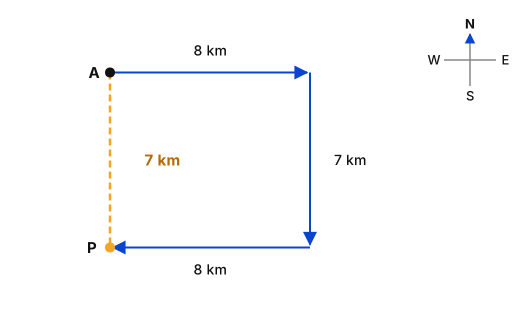
- 8 km East and 8 km West cancel.
- Only 7 km South remains → distance = 7 km.
Trick: Net E–W = 8 − 8 = 0, net N–S = 7 → answer 7 km.
Answer: (C) 7 km
अवधारणा: बराबर और विपरीत चालें एक-दूसरे को निरस्त कर देती हैं।
- 8 km पूर्व और 8 km पश्चिम निरस्त।
- सिर्फ 7 km दक्षिण बचता है → दूरी = 7 km।
ट्रिक: पूर्व-पश्चिम = 0, उत्तर-दक्षिण = 7 → 7 km।
उत्तर: (C) 7 km
Q3334.A person walks 15 km east, then 8 km north, and finally 15 km west. How far is he from his starting point?
एक व्यक्ति 15 km पूर्व की ओर चलता है, फिर 8 km उत्तर की ओर, और अंत में 15 km पश्चिम की ओर चलता है। वह अपने प्रारंभिक बिंदु से कितनी दूर है?
- A9 km
- B4 km
- C11 km
- D8 km
Show answer
Concept: Distance from start depends only on net movement in each direction.
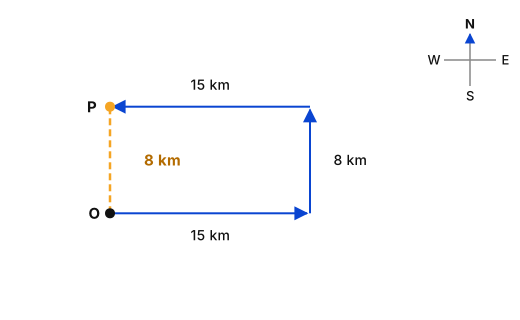
- 15 km East − 15 km West = 0.
- 8 km North remains → he is 8 km from start.
Trick: When the first and last legs are equal and opposite, the answer is the middle leg.
Answer: (D) 8 km
अवधारणा: प्रारंभ से दूरी हर दिशा की शुद्ध चाल पर निर्भर है।
- 15 km पूर्व − 15 km पश्चिम = 0।
- 8 km उत्तर बचा → दूरी 8 km।
ट्रिक: पहली और आखिरी चाल बराबर-विपरीत हों तो बीच वाली चाल ही उत्तर है।
उत्तर: (D) 8 km
Q3335.Few of the letters are given followed by a question mark (?) these letters are following a specific pattern you have to give the correct option which can replace question mark.
Find the next letter: G, K, P, V, ?
कुछ अक्षर दिए गए हैं जिनके बाद एक प्रश्नवाचक चिह्न (?) है, ये अक्षर एक विशिष्ट पैटर्न का अनुसरण कर रहे हैं, आपको वह सही विकल्प चुनना है जो प्रश्नवाचक चिह्न के स्थान पर आ सके।
अगला अक्षर ज्ञात कीजिए: G, K, P, V, ?
- AD
- BC
- CE
- DG
Show answer
Concept: Convert letters to positions and study the gaps.
- G(7), K(11), P(16), V(22): gaps +4, +5, +6.
- Next gap +7: 22 + 7 = 29 → 29 − 26 = 3 = C.
Trick: After Z, subtract 26 to wrap around.
Answer: (B) C
अवधारणा: अक्षरों को स्थान-संख्या में बदलकर अंतर देखें।
- G(7), K(11), P(16), V(22): अंतर +4, +5, +6।
- अगला +7: 22 + 7 = 29 → 29 − 26 = 3 = C।
ट्रिक: Z के बाद 26 घटाकर फिर से A से गिनें।
उत्तर: (B) C
Q3336.For each given equation, identify the correct interchange (of signs or numbers) from the options that makes the equation true.
दिए गए प्रत्येक समीकरण के लिए, विकल्पों में से वह सही अदला-बदली (चिह्नों या संख्याओं की) पहचानिए जो समीकरण को सत्य बनाती है।
- AInterchange 7 and 47 और 4 को आपस में बदलिए
- BInterchange - and +- और + को आपस में बदलिए
- CInterchange 8 and 78 और 7 को आपस में बदलिए
- DInterchange 4 and 84 और 8 को आपस में बदलिए
Show answer
Concept: Try each interchange and evaluate using BODMAS.
- Given: .
- Swap 8 and 7: ✔.
Trick: Need +6; making the product larger (, +5) and subtracting 1 less fits exactly.
Answer: (C) Interchange 8 and 7
अवधारणा: हर विकल्प के अनुसार अदला-बदली करके BODMAS से जाँचें।
- अभी: ।
- 8 और 7 बदलें: ✔।
ट्रिक: 6 और चाहिए – गुणनफल बढ़ाने वाला विकल्प पहले जाँचें।
उत्तर: (C) 8 और 7 को आपस में बदलिए
Q3337.Which one of the following numbers is not a palindromic number ?
निम्नलिखित में से कौन-सी संख्या पैलिंड्रोमिक संख्या नहीं है?
- A1881
- B15451
- C4983
- D13331
Show answer
Concept: A palindrome reads the same forwards and backwards.
- 1881, 15451, 13331 – same when reversed.
- 4983 reversed = 3894 – different.
Trick: Just compare first and last digits: 4 ≠ 3 → not a palindrome.
Answer: (C) 4983
अवधारणा: पैलिंड्रोम संख्या आगे और पीछे से एक जैसी पढ़ी जाती है।
- 1881, 15451, 13331 – उलटने पर वही।
- 4983 उलटने पर 3894 – अलग।
ट्रिक: पहला और आखिरी अंक मिलाएँ: 4 ≠ 3 → पैलिंड्रोम नहीं।
उत्तर: (C) 4983
Q3338.Which of the following options will replace the question mark (?) in the given series?
A4, D8, G16, J32, ?
निम्नलिखित में से कौन-सा विकल्प दी गई शृंखला में प्रश्नवाचक चिह्न (?) के स्थान पर आएगा?
A4, D8, G16, J32, ?
- AQ54
- BM64
- CK36
- DJ45
Show answer
Concept: Treat the letter part and the number part separately.
- Letters A, D, G, J: +3 each → M.
- Numbers 4, 8, 16, 32: ×2 → 64.
- Next term = M64.
Trick: Only one option has both letter M and a doubled number – pick it at once.
Answer: (B) M64
अवधारणा: अक्षर और संख्या को अलग-अलग देखें।
- A, D, G, J: +3 → M।
- 4, 8, 16, 32: ×2 → 64।
- अगला पद = M64।
ट्रिक: अक्षर M वाला विकल्प केवल एक है – तुरंत चुनें।
उत्तर: (B) M64
Q3339.Which of the following options will replace the question mark (?) in the given series?
V1, U8, T27, S64, ?
निम्नलिखित में से कौन-सा विकल्प दी गई शृंखला में प्रश्नवाचक चिह्न (?) के स्थान पर आएगा?
V1, U8, T27, S64, ?
- AR125
- BV49
- CU216
- DR121
Show answer
Concept: Letters and numbers follow separate patterns.
- V, U, T, S: one step back → R.
- 1, 8, 27, 64 = .
- Next term = R125.
Yaad rakhein: Cubes 1–10: 1, 8, 27, 64, 125, 216, 343, 512, 729, 1000.
Answer: (A) R125
अवधारणा: अक्षर और संख्या अलग नियम पर चलते हैं।
- V, U, T, S: एक पीछे → R।
- 1, 8, 27, 64 = से ।
- अगला पद = R125।
याद रखें: 1 से 10 तक के घन याद रखें: 1, 8, 27, 64, 125, 216 ...
उत्तर: (A) R125
Q3340.What should come next in the following series?
B3, D6, F12, H24, J48, ?
निम्नलिखित शृंखला में आगे क्या आना चाहिए?
B3, D6, F12, H24, J48, ?
- AK92
- BK78
- CJ90
- DL96
Show answer
Concept: Split into letter pattern and number pattern.
- B, D, F, H, J: +2 → L.
- 3, 6, 12, 24, 48: ×2 → 96.
- Next term = L96.
Trick: Letter after J by +2 is L – only option D has L.
Answer: (D) L96
अवधारणा: अक्षर और संख्या का पैटर्न अलग-अलग देखें।
- B, D, F, H, J: +2 → L।
- 3, 6, 12, 24, 48: ×2 → 96।
- अगला पद = L96।
ट्रिक: J के बाद +2 = L – केवल विकल्प D में L है।
उत्तर: (D) L96

