Directions (Qs. 20-24): Read the following passage carefully and answer the questions that follow.
India's engagement with the cosmos is deeply rooted in its scientific heritage, for the study of astronomy originally known as "jyotisha" flourished on the subcontinent centuries ago. Initially established to foster indigenous space technology, the Indian Space Research Organisation (ISRO) evolved through determined self-reliance before propelling itself skyward, ultimately becoming a global space giant.
In the modern era, India's reputation on the celestial stage began with the successful launch of Aryabhata in the late 20th century. ISRO's unique operational philosophy, combining frugal engineering with technological precision, earned it the admiration of space agencies worldwide and inspired a nation of scientists. This success catalysed government support for exploration, leading to an increase in satellite launches, lunar missions, and interplanetary probes across the solar system.
The 21st century has witnessed the execution of landmark missions such as Chandrayaan-3 and Mangalyaan, whose triumphs in deep space have positioned India as a dominant force in cost-effective space travel. Private sector participation has further accelerated technological innovation, allowing startups to collaborate with seasoned scientists, thus honing their technical ingenuity from an early stage.
Today, India stands not merely as a participant in space exploration but as a pioneering leader shaping its direction. This progression from ancient observation to modern execution underscores the nation's soaring ambition in the cosmic arena.
Q3521.Identify the voice in "Initially established to foster indigenous space technology".
- AActive voice
- BPassive voice
- CMiddle voice
- DCausative voice
Show answer
Concept: A past participle (V3) phrase describing what was done to the subject is passive.
- 'established' (V3) describes ISRO.
- Full form: ISRO was established to foster space technology.
- ISRO receives the action → passive.
Trick: Add 'was/were' before the V3 — if it makes sense, the phrase is passive.
Answer: (B) Passive voice
अवधारणा: जो V3 phrase बताए कि subject के साथ क्या किया गया, वह passive होता है।
- 'established' (V3) ISRO के बारे में है।
- पूरा रूप: ISRO was established to foster space technology।
- ISRO पर क्रिया हुई → passive।
ट्रिक: V3 से पहले 'was/were' जोड़कर देखें — अर्थ बने तो passive।
उत्तर: (B) Passive voice
Directions (Qs. 20-24): Read the following passage carefully and answer the questions that follow.
India's engagement with the cosmos is deeply rooted in its scientific heritage, for the study of astronomy originally known as "jyotisha" flourished on the subcontinent centuries ago. Initially established to foster indigenous space technology, the Indian Space Research Organisation (ISRO) evolved through determined self-reliance before propelling itself skyward, ultimately becoming a global space giant.
In the modern era, India's reputation on the celestial stage began with the successful launch of Aryabhata in the late 20th century. ISRO's unique operational philosophy, combining frugal engineering with technological precision, earned it the admiration of space agencies worldwide and inspired a nation of scientists. This success catalysed government support for exploration, leading to an increase in satellite launches, lunar missions, and interplanetary probes across the solar system.
The 21st century has witnessed the execution of landmark missions such as Chandrayaan-3 and Mangalyaan, whose triumphs in deep space have positioned India as a dominant force in cost-effective space travel. Private sector participation has further accelerated technological innovation, allowing startups to collaborate with seasoned scientists, thus honing their technical ingenuity from an early stage.
Today, India stands not merely as a participant in space exploration but as a pioneering leader shaping its direction. This progression from ancient observation to modern execution underscores the nation's soaring ambition in the cosmic arena.
Q3522.The word "frugal" most nearly means:
- AExtravagant and wasteful
- BEconomical and thrifty
- CComplex and difficult
- DWeak and fragile
Show answer
Concept: Frugal = using money/resources carefully, avoiding waste.
- Passage links 'frugal engineering' with 'cost-effective' missions.
- So frugal = economical and thrifty.
- 'Extravagant and wasteful' is the exact opposite.
Trick: Look for a clue word nearby — 'cost-effective' points straight to economical.
Answer: (B) Economical and thrifty
अवधारणा: Frugal = मितव्ययी, पैसे/संसाधन सोच-समझकर खर्च करने वाला।
- Passage में 'frugal engineering' को 'cost-effective' मिशनों से जोड़ा गया है।
- अतः frugal = economical and thrifty।
- 'Extravagant and wasteful' बिल्कुल उल्टा अर्थ है।
ट्रिक: पास का संकेत-शब्द देखें — 'cost-effective' सीधे 'economical' बताता है।
उत्तर: (B) Economical and thrifty
Directions (Qs. 20-24): Read the following passage carefully and answer the questions that follow.
India's engagement with the cosmos is deeply rooted in its scientific heritage, for the study of astronomy originally known as "jyotisha" flourished on the subcontinent centuries ago. Initially established to foster indigenous space technology, the Indian Space Research Organisation (ISRO) evolved through determined self-reliance before propelling itself skyward, ultimately becoming a global space giant.
In the modern era, India's reputation on the celestial stage began with the successful launch of Aryabhata in the late 20th century. ISRO's unique operational philosophy, combining frugal engineering with technological precision, earned it the admiration of space agencies worldwide and inspired a nation of scientists. This success catalysed government support for exploration, leading to an increase in satellite launches, lunar missions, and interplanetary probes across the solar system.
The 21st century has witnessed the execution of landmark missions such as Chandrayaan-3 and Mangalyaan, whose triumphs in deep space have positioned India as a dominant force in cost-effective space travel. Private sector participation has further accelerated technological innovation, allowing startups to collaborate with seasoned scientists, thus honing their technical ingenuity from an early stage.
Today, India stands not merely as a participant in space exploration but as a pioneering leader shaping its direction. This progression from ancient observation to modern execution underscores the nation's soaring ambition in the cosmic arena.
Q3523.The word "ingenuity" means:
- ACleverness and inventiveness
- BPhysical endurance
- CHonest behavior
- DA type of engine
Show answer
Concept: Ingenuity = cleverness in inventing or solving problems.
- Passage: startups hone their 'technical ingenuity' with scientists → inventive skill.
- Endurance, honesty and engine are unrelated meanings.
Yaad rakhein: Ingenious = clever/inventive; ingenuous = innocent, simple — don't mix them up.
Answer: (A) Cleverness and inventiveness
अवधारणा: Ingenuity = नई चीज़ें बनाने/समस्या सुलझाने की चतुराई (आविष्कार-कुशलता)।
- Passage: startups वैज्ञानिकों के साथ अपनी 'technical ingenuity' निखारते हैं → आविष्कार की कुशलता।
- सहनशक्ति, ईमानदारी, इंजन — इनसे कोई संबंध नहीं।
याद रखें: Ingenious = चतुर/आविष्कारी; ingenuous = भोला-भाला — इन्हें न मिलाएँ।
उत्तर: (A) Cleverness and inventiveness
Directions (Qs. 20-24): Read the following passage carefully and answer the questions that follow.
India's engagement with the cosmos is deeply rooted in its scientific heritage, for the study of astronomy originally known as "jyotisha" flourished on the subcontinent centuries ago. Initially established to foster indigenous space technology, the Indian Space Research Organisation (ISRO) evolved through determined self-reliance before propelling itself skyward, ultimately becoming a global space giant.
In the modern era, India's reputation on the celestial stage began with the successful launch of Aryabhata in the late 20th century. ISRO's unique operational philosophy, combining frugal engineering with technological precision, earned it the admiration of space agencies worldwide and inspired a nation of scientists. This success catalysed government support for exploration, leading to an increase in satellite launches, lunar missions, and interplanetary probes across the solar system.
The 21st century has witnessed the execution of landmark missions such as Chandrayaan-3 and Mangalyaan, whose triumphs in deep space have positioned India as a dominant force in cost-effective space travel. Private sector participation has further accelerated technological innovation, allowing startups to collaborate with seasoned scientists, thus honing their technical ingenuity from an early stage.
Today, India stands not merely as a participant in space exploration but as a pioneering leader shaping its direction. This progression from ancient observation to modern execution underscores the nation's soaring ambition in the cosmic arena.
Q3524.According to the passage, what factor has further accelerated technological innovation in recent years ?
- AThe discovery of ancient texts
- BPrivate sector participation
- CA decrease in government funding
- DThe launch of Aryabhata
Show answer
Concept: Fact-based RC: find the line that answers the question directly.
- Paragraph 3: 'Private sector participation has further accelerated technological innovation'.
- Aryabhata and ancient texts are historical points; reduced funding is never mentioned.
Trick: Search the passage for the question's key words 'further accelerated' — the answer sits right before them.
Answer: (B) Private sector participation
अवधारणा: तथ्य वाले प्रश्न: passage में वही पंक्ति खोजें जो सीधा उत्तर दे।
- तीसरा पैराग्राफ़: 'Private sector participation has further accelerated technological innovation'।
- आर्यभट और प्राचीन ग्रंथ ऐतिहासिक बातें हैं; funding घटने का ज़िक्र ही नहीं।
ट्रिक: प्रश्न के शब्द 'further accelerated' passage में ढूँढें — उत्तर ठीक उनसे पहले है।
उत्तर: (B) Private sector participation
Q3525.Which of the following pairs of homonyms can be used to fill in the blanks most suitably ?
The steep down the mountain path was treacherous, yet there was not a single word of among the group.
- Adissent, descent
- Bdescent, dissent
- Cdescent, descent
- Ddissent, dissent
Show answer
Concept: Descent = a downward slope/going down; Dissent = disagreement.
- Blank 1: 'steep ___ down the mountain path' → descent.
- Blank 2: 'not a single word of ___' → objection → dissent.
- Order: descent, dissent.
Trick: descent goes down (like descend); dissent = disagree.
Answer: (B) descent, dissent
अवधारणा: Descent = ढलान/नीचे उतरना; Dissent = असहमति।
- पहला blank: 'steep ___ down the mountain path' → descent।
- दूसरा blank: 'not a single word of ___' → विरोध → dissent।
- क्रम: descent, dissent।
ट्रिक: descent ↔ descend (नीचे उतरना); dissent ↔ disagree (असहमति)।
उत्तर: (B) descent, dissent
Q3526.Two numbers differ by 20. If their product is increased by the square of their difference, the result is 1200 . Find the larger number.
दो संख्याओं का अंतर 20 है। यदि उनके गुणनफल में उनके अंतर का वर्ग जोड़ दिया जाए, तो परिणाम 1200 प्राप्त होता है। बड़ी संख्या ज्ञात कीजिए।
- A28
- B34
- C40
- D46
Show answer
Concept: Use .
- Difference = 20, so .
- → .
- → .
- Larger = = 40 (smaller = 20).
Trick: Test options: and ✓ — done in 5 seconds.
Answer: (C) 40
अवधारणा: सूत्र: ।
- अंतर = 20, अतः ।
- → ।
- → ।
- बड़ी संख्या = = 40 (छोटी = 20)।
ट्रिक: विकल्प जाँचें: और ✓।
उत्तर: (C) 40
Q3527.The average score of 5 students in a test is 82. If the scores of four students are , and 80 , what is the score of the fifth student?
एक परीक्षा में 5 विद्यार्थियों का औसत प्राप्तांक 82 है। यदि चार विद्यार्थियों के प्राप्तांक , तथा 80 हैं, तो पाँचवें विद्यार्थी का प्राप्तांक क्या है?
- A68
- B90
- C85
- D80
Show answer
Concept: .
- Total of 5 = .
- Known four = .
- Fifth = = 80.
Trick: Deviation method: from 82 → ; fifth must be .
Answer: (D) 80
अवधारणा: ।
- 5 का योग = ।
- चार का योग = ।
- पाँचवाँ = = 80।
ट्रिक: विचलन विधि: 82 से → ; अतः पाँचवाँ = ।
उत्तर: (D) 80
Q3528.P, Q, and R started a business by investing ₹5000, ₹3000, and ₹2000 respectively. If the total profit at the end of the year was ₹2000, what is Q's share of the profit ?
P, Q और R ने क्रमशः ₹5000, ₹3000 और ₹2000 निवेश करके एक व्यवसाय आरंभ किया। यदि वर्ष के अंत में कुल लाभ ₹2000 था, तो लाभ में Q का हिस्सा क्या है?
- A₹500
- B₹600
- C₹700
- D₹1000
Show answer
Concept: Same time period → profit is shared in the ratio of investments.
- (total 10 parts).
- 1 part = = ₹200.
- = ₹600.
Trick: Q invested 3000 out of 10000 = 30%; 30% of ₹2000 = ₹600.
Answer: (B) ₹600
अवधारणा: समय बराबर हो तो लाभ निवेश के अनुपात में बँटता है।
- (कुल 10 भाग)।
- 1 भाग = = ₹200।
- = ₹600।
ट्रिक: Q का निवेश 10000 में 3000 = 30%; ₹2000 का 30% = ₹600।
उत्तर: (B) ₹600
Q3529.What is the average of the following numbers: ?
निम्नलिखित संख्याओं का औसत क्या है: ?
- A24.2
- B25.4
- C29.2
- D27.2
Show answer
Concept: .
- Sum = .
- Average = = 29.2.
Trick: Dividing by 5 = multiply by 2 then ÷ 10: → 29.2.
Answer: (C) 29.2
अवधारणा: ।
- योग = ।
- औसत = = 29.2।
ट्रिक: 5 से भाग = 2 से गुणा करके 10 से भाग: → 29.2।
उत्तर: (C) 29.2
Q3530.If a car travels 220 km in 5 hours, what is its average speed in km/hr ?
यदि कोई कार 5 घंटे में 220 km की दूरी तय करती है, तो उसकी औसत चाल km/hr में क्या है?
- A
- B
- C
- D48 km/hr
Show answer
Concept: .
- Speed = = 44 km/hr.
Trick: (double and drop a zero).
Answer: (C)
अवधारणा: ।
- चाल = = 44 km/hr।
ट्रिक: (दोगुना करो, एक शून्य हटाओ)।
उत्तर: (C)
Q3531.If a number is increased by 20% and then decreased by , what is the net change ?
यदि किसी संख्या को 20% बढ़ाया जाए और फिर घटाया जाए, तो शुद्ध परिवर्तन क्या होगा?
- A4% increase4% वृद्धि
- B4% decrease4% कमी
- CNo changeकोई परिवर्तन नहीं
- D decrease कमी
Show answer
Concept: Net change for +a% then −b% = .
- Start with 100 → +20% → 120.
- → 96.
- Change = → 4% decrease.
Trick: Same % up then same % down always gives a loss of = .
Answer: (B) 4% decrease
अवधारणा: +a% फिर −b% का शुद्ध परिवर्तन = ।
- 100 से शुरू → +20% → 120।
- घटाया → 96।
- परिवर्तन = → 4% कमी।
ट्रिक: बराबर % बढ़ाकर फिर घटाने पर हमेशा की कमी = ।
उत्तर: (B) 4% कमी
Q3532.During Diwali, Mira decorates 60 candles in a row. The red candle is 20th from the left and 41st from the right. The blue candle is 15th from the left and 46th from the right. How many candles are there between the red and blue candles ?
दिवाली के अवसर पर मीरा 60 मोमबत्तियाँ एक पंक्ति में सजाती है। लाल मोमबत्ती बाएँ से 20वीं और दाएँ से 41वीं है। नीली मोमबत्ती बाएँ से 15वीं और दाएँ से 46वीं है। लाल और नीली मोमबत्तियों के बीच कितनी मोमबत्तियाँ हैं?
- A4
- B3
- CThis arrangement is impossibleयह व्यवस्था असंभव है
- D1
Show answer
Concept: Left rank + Right rank = Total + 1; items between = difference of same-side ranks − 1.
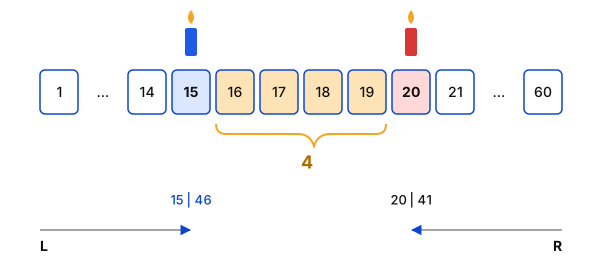
- Red: 20 + 41 = 61 = 60 + 1 ✓; Blue: 15 + 46 = 61 ✓ → arrangement is valid.
- From left: Red 20th, Blue 15th.
- Between = 20 − 15 − 1 = 4 (positions 16–19).
Trick: Always first check L + R = N + 1 — that kills the 'impossible' option at once.
Answer: (A) 4
अवधारणा: बाएँ से स्थान + दाएँ से स्थान = कुल + 1; बीच की वस्तुएँ = एक ही ओर के स्थानों का अंतर − 1।
- लाल: 20 + 41 = 61 = 60 + 1 ✓; नीली: 15 + 46 = 61 ✓ → व्यवस्था संभव।
- बाएँ से: लाल 20वीं, नीली 15वीं।
- बीच में = 20 − 15 − 1 = 4 (स्थान 16 से 19)।
ट्रिक: पहले L + R = N + 1 जाँचें — इससे 'impossible' विकल्प तुरंत हटता है।
उत्तर: (A) 4
Q3533.A shop offers a 20% discount on the marked price of an item. If the selling price is ₹800, what is the marked price ?
एक दुकान किसी वस्तु के अंकित मूल्य पर 20% की छूट देती है। यदि विक्रय मूल्य ₹800 है, तो अंकित मूल्य क्या है?
- A₹1100
- B₹1000
- C₹950
- D₹1250
Show answer
Concept: .
- 20% off → SP = 80% of MP.
- = ₹1000.
- Check: ✓.
Trick: 20% discount ↔ multiply SP by to get MP.
Answer: (B) ₹1000
अवधारणा: ।
- 20% छूट → SP = MP का 80%।
- = ₹1000।
- जाँच: ✓।
ट्रिक: 20% छूट हो तो ।
उत्तर: (B) ₹1000
Q3534.A person walks 18 km west, then 24 km north, and finally 18 km east. In which direction is he from his starting point ?
एक व्यक्ति 18 km पश्चिम की ओर चलता है, फिर 24 km उत्तर की ओर, और अंत में 18 km पूर्व की ओर चलता है। वह अपने प्रारंभिक बिंदु से किस दिशा में है?
- ANorthउत्तर
- BSouthदक्षिण
- CEastपूर्व
- DWestपश्चिम
Show answer
Concept: Equal walks in opposite directions cancel each other.
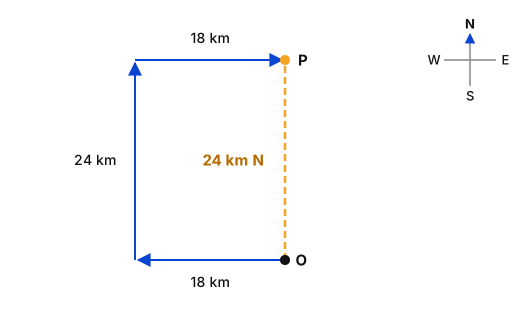
- 18 km West and 18 km East cancel out.
- Only 24 km North remains.
- He is 24 km North of the start.
Trick: Strike off equal opposite moves; whatever is left is the answer direction.
Answer: (A) North
अवधारणा: विपरीत दिशाओं में बराबर दूरी एक-दूसरे को रद्द कर देती है।
- 18 km पश्चिम और 18 km पूर्व रद्द हो गए।
- केवल 24 km उत्तर बचा।
- वह आरंभ से 24 km उत्तर में है।
ट्रिक: बराबर-विपरीत चालें काट दें; जो बचे वही दिशा।
उत्तर: (A) उत्तर
Q3535.A person walks 16 km north, then 18 km west, and finally 16 km South . In which direction is he from his starting point ?
एक व्यक्ति 16 km उत्तर की ओर चलता है, फिर 18 km पश्चिम की ओर, और अंत में 16 km दक्षिण की ओर चलता है। वह अपने प्रारंभिक बिंदु से किस दिशा में है?
- ANorthउत्तर
- BSouthदक्षिण
- CEastपूर्व
- DWestपश्चिम
Show answer
Concept: Cancel equal and opposite movements.
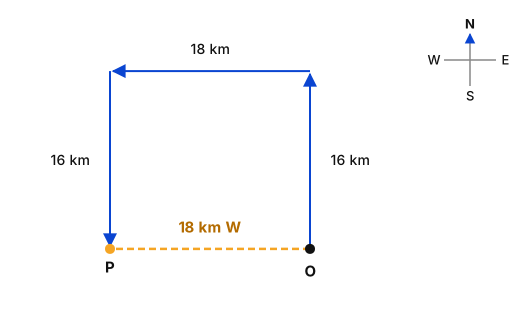
- 16 km North and 16 km South cancel.
- Remaining: 18 km West.
- Final position: West of the start.
Trick: N–S pair cancels, so only the E–W leg decides the direction.
Answer: (D) West
अवधारणा: बराबर और विपरीत चालें रद्द करें।
- 16 km उत्तर और 16 km दक्षिण रद्द।
- बचा: 18 km पश्चिम।
- अंतिम स्थिति: आरंभ से पश्चिम।
ट्रिक: उत्तर–दक्षिण जोड़ी कटी, तो केवल पूर्व–पश्चिम वाली चाल दिशा तय करती है।
उत्तर: (D) पश्चिम
Q3536.Few of the letters are given followed by a question mark (?) these letters are following a specific pattern you have to give the correct option which can replace question mark.
Complete the sequence: F, C, Z, W, ?
कुछ अक्षर दिए गए हैं जिनके बाद एक प्रश्नवाचक चिह्न (?) है; ये अक्षर एक विशिष्ट पैटर्न का अनुसरण कर रहे हैं। आपको वह सही विकल्प चुनना है जो प्रश्नवाचक चिह्न के स्थान पर आ सके।
शृंखला पूर्ण कीजिए: F, C, Z, W, ?
- AM
- BN
- CT
- DQ
Show answer
Concept: Find the gap between letter positions (A = 1 … Z = 26).
- F(6) → C(3) → Z(26) → W(23): each −3 (after A it wraps to Z).
- Next: 23 − 3 = 20 = T.
Trick: Use EJOTY: T = 20 instantly.
Answer: (C) T
अवधारणा: अक्षरों के स्थानांक का अंतर देखें (A = 1 … Z = 26)।
- F(6) → C(3) → Z(26) → W(23): हर बार −3 (A के बाद फिर Z से)।
- अगला: 23 − 3 = 20 = T।
ट्रिक: EJOTY याद रखें: T = 20।
उत्तर: (C) T
Q3537.What will come in place of the question mark (?) in the following number series?
55, 89, 144, 233, 377 , ?
निम्नलिखित संख्या शृंखला में प्रश्नवाचक चिह्न (?) के स्थान पर क्या आएगा?
55, 89, 144, 233, 377 , ?
- A560
- B610
- C577
- D630
Show answer
Concept: Each term = sum of the previous two.
- 55 + 89 = 144; 89 + 144 = 233; 144 + 233 = 377.
- Next = 233 + 377 = 610.
Yaad rakhein: Fibonacci terms: 1, 1, 2, 3, 5, 8, 13, 21, 34, 55, 89, 144, 233, 377, 610 — ratio approaches 1.618.
Answer: (B) 610
अवधारणा: हर पद = पिछले दो पदों का योग।
- 55 + 89 = 144; 89 + 144 = 233; 144 + 233 = 377।
- अगला = 233 + 377 = 610।
याद रखें: फिबोनाची: 1, 1, 2, 3, 5, 8, 13, 21, 34, 55, 89, 144, 233, 377, 610।
उत्तर: (B) 610
Q3538.Identify the missing number in the following number sequence.
22, 18, 44, 36, 132, 108, ?, 432
निम्नलिखित संख्या अनुक्रम में लुप्त संख्या ज्ञात कीजिए।
22, 18, 44, 36, 132, 108, ?, 432
- A528
- B436
- C480
- D580
Show answer
Concept: Split the series into odd-place and even-place terms.
- Even places: 18 → 36 → 108 → 432 (×2, ×3, ×4).
- Odd places: 22 → 44 → 132 → ? (×2, ×3, ×4).
- ? = = 528.
Trick: Each odd-place term pairs with the next one: , , — so ? = .
Answer: (A) 528
अवधारणा: श्रृंखला को विषम और सम स्थानों में बाँटें।
- सम स्थान: 18 → 36 → 108 → 432 (×2, ×3, ×4)।
- विषम स्थान: 22 → 44 → 132 → ? (×2, ×3, ×4)।
- ? = = 528।
ट्रिक: 8 पदों वाली श्रृंखला में अक्सर दो अलग श्रृंखलाएँ छिपी होती हैं — अलग करके देखें।
उत्तर: (A) 528
Q3539.Which one of the following number pairs is not divisible by both 11 and 17 ?
निम्नलिखित में से कौन-सा संख्या-युग्म 11 और 17 दोनों से विभाज्य नहीं है?
- A
- B
- C
- D
Show answer
Concept: Divisible by both 11 and 17 ⇔ divisible by .
- , , , → all fine.
- → not a multiple of 17.
- So pair (198, 374) fails.
Trick: Odd-even digit test for 11 works on all; then just check which number is not in the 187-table.
Answer: (D)
अवधारणा: 11 और 17 दोनों से विभाज्य ⇔ से विभाज्य।
- , , , → सब सही।
- → 17 का गुणज नहीं।
- अतः जोड़ी (198, 374) शर्त पूरी नहीं करती।
ट्रिक: 187 का पहाड़ा देखें — जो संख्या उसमें न हो वही उत्तर।
उत्तर: (D)
Q3540.Complete the following series from the given options.
k_Imml_mk_mmk_lkkl_m
दिए गए विकल्पों में से निम्नलिखित शृंखला को पूर्ण कीजिए।
k_Imml_mk_mmk_lkkl_m
- AI, k, m, k, k
- Bk, l, m, k, k
- Ck, l, k, l, m
- Dk, m, m, k, l
Show answer
Concept: Fill blanks so the string forms repeating/shifting blocks.
- String: k_lmml_mk_mmk_lkkl_m (20 letters) → 4 blocks of 5.
- With k, l, k, l, m: kklmm | llmkk | mmkll | kklmm.
- Each block shifts k→l→m→k; last block repeats the first ✓.
Trick: Try options blank by blank: 1st blank must make 'kk' start; eliminate quickly.
Answer: (C) k, l, k, l, m
अवधारणा: रिक्त स्थान ऐसे भरें कि बराबर समूह बनें।
- श्रृंखला: k_lmml_mk_mmk_lkkl_m (20 अक्षर) → 5-5 के 4 समूह।
- k, l, k, l, m भरने पर: kklmm | llmkk | mmkll | kklmm।
- हर समूह में k→l→m→k बदलाव; अंतिम समूह पहले जैसा ✓।
ट्रिक: कुल अक्षर गिनें (20) और 4 या 5 के समूह बनाकर पैटर्न देखें।
उत्तर: (C) k, l, k, l, m

