Question bank

Q&A: practice questions with answers

Search questions on any topic. Filter by exam category, exam, subject and topic, try the question, then open the answer and explanation.

Courses – airGurukul

5,000 questions found.

Q3641.
Complete the given series of letter clusters.
CEGI, GIKM, KMOQ, ?
अक्षर-समूहों की दी गई शृंखला को पूर्ण कीजिए।
CEGI, GIKM, KMOQ, ?
  1. AORQT
  2. BONPR
  3. COQSU
  4. DOQRU
Show answer

Concept: Each cluster shifts by a fixed number of places.

  1. CEGI → GIKM → KMOQ: every letter moves +4.
  2. KMOQ + 4 → O, Q, S, U.
  3. Next = OQSU.

Trick: The last two letters of a cluster open the next one (CEGI → GI.., GIKM → KM..): so after KMOQ comes OQ.. → keep +2 → OQSU.

Answer: (C) OQSU

अवधारणा: हर समूह निश्चित स्थान आगे खिसकता है।

हल:

  1. CEGI → GIKM → KMOQ: हर अक्षर +4।
  2. KMOQ + 4 → O, Q, S, U।
  3. अगला = OQSU।

ट्रिक: समूह के अंदर अंतर +2 है; O से शुरू करके +2, +2, +2 → OQSU।

उत्तर: (C) OQSU
SSC CHSLGeneral IntelligenceLetter cluster series (+4)SSC CHSL 2025 · 17 Nov Shift 3 →
Q3642.
If % means *add both numbers and multiply by 3 ", and $ means "subtract second from first and square the result", then find: 8 $ 6 % 2
यदि % का अर्थ है "दोनों संख्याओं को जोड़ें और 3 से गुणा करें", तथा $ का अर्थ है "पहली संख्या में से दूसरी को घटाएँ और परिणाम का वर्ग करें", तो ज्ञात कीजिए: 8 $ 6 % 2
  1. A12
  2. B18
  3. C14
  4. D16
Show answer

Concept: Apply the defined meanings of the symbols, left to right.

  1. 8 $ 6 =(8−6)2=22=4.
  2. 4 % 2 =(4+2)×3=18.
  3. Value = 18.

Trick: Answer must be a multiple of 3 (last step ×3): only 12 and 18 – and 12 would need sum 4, impossible here.

Answer: (B) 18

अवधारणा: प्रतीकों के दिए गए अर्थ बाएँ से दाएँ लगाएँ।

हल:

  1. 8 $ 6 =(8−6)2=22=4।
  2. 4 % 2 =(4+2)×3=18।
  3. मान = 18।

ट्रिक: अंतिम चरण ×3 है, अतः उत्तर 3 का गुणज होगा – 12 या 18; जोड़ 6 है तो 18।

उत्तर: (B) 18

SSC CHSLGeneral IntelligenceSymbol operationsSSC CHSL 2025 · 17 Nov Shift 3 →
Q3643.
Which of the following shows a correlation, not causation?
निम्नलिखित में से कौन-सा सहसंबंध (correlation) दर्शाता है, कारणता (causation) नहीं?
  1. AStudents who sit in the front rows score higher marks.जो विद्यार्थी अगली पंक्तियों में बैठते हैं, वे अधिक अंक प्राप्त करते हैं।
  2. BDrinking contaminated water causes cholera.दूषित जल पीने से हैजा होता है।
  3. CLack of insulin causes diabetes.इंसुलिन की कमी से मधुमेह होता है।
  4. DBacteria cause food poisoning.बैक्टीरिया से खाद्य विषाक्तता होती है।
Show answer

Concept: Causation: one thing produces the other. Correlation: two things simply occur together.

  1. Contaminated water → cholera, insulin deficiency → diabetes, bacteria → food poisoning: proven causes.
  2. Front-row seating and higher marks only go together; sincere students tend to sit in front – the seat does not create marks.
  3. So (A) shows only correlation.

Trick: The options using "causes" state causation; the one without a cause word is usually the correlation.

Answer: (A) Students who sit in the front rows score higher marks.

अवधारणा: कारणता: एक घटना दूसरी को पैदा करती है। सहसंबंध: दोनों बस साथ-साथ दिखती हैं।

हल:

  1. दूषित जल → हैजा, इंसुलिन की कमी → मधुमेह, बैक्टीरिया → खाद्य विषाक्तता: सिद्ध कारण।
  2. आगे बैठना और ज़्यादा अंक साथ दिखते हैं; मेहनती छात्र आगे बैठते हैं – सीट से अंक नहीं बढ़ते।
  3. अतः (A) केवल सहसंबंध है।

ट्रिक: जिन विकल्पों में "causes/होता है" है वे कारणता हैं; बाकी वाला सहसंबंध।

उत्तर: (A) जो विद्यार्थी अगली पंक्तियों में बैठते हैं, वे अधिक अंक प्राप्त करते हैं।

SSC CHSLGeneral IntelligenceCorrelation vs causationSSC CHSL 2025 · 17 Nov Shift 3 →
Q3644.
A series is given with one term missing. Select the correct alternative from the given ones that will complete the series.
BSF, EPI, ____ KJO, NGR
एक शृंखला दी गई है जिसमें एक पद लुप्त है। दिए गए विकल्पों में से वह सही विकल्प चुनिए जो शृंखला को पूर्ण करेगा।
BSF, EPI, ____ KJO, NGR
  1. AHML
  2. BHNL
  3. CHAZ
  4. DGHN
Show answer

Concept: Track each letter position separately.

  1. 1st: B, E, _, K, N (+3) → H.
  2. 2nd: S, P, _, J, G (−3) → M.
  3. 3rd: F, I, _, O, R (+3) → L → HML.

Trick: Only (A) and (B) start with H; middle letter must be P − 3 = M → HML.

Answer: (A) HML

अवधारणा: हर स्थान के अक्षर को अलग से देखें।

हल:

  1. पहला: B, E, _, K, N (+3) → H।
  2. दूसरा: S, P, _, J, G (−3) → M।
  3. तीसरा: F, I, _, O, R (+3) → L → HML।

ट्रिक: केवल (A), (B) H से शुरू; बीच का अक्षर P − 3 = M → HML।

उत्तर: (A) HML

SSC CHSLGeneral IntelligenceMissing letter clusterSSC CHSL 2025 · 17 Nov Shift 3 →
Q3645.
A series is given with one wrong term from the given series.
NVK, JRG, FNC, BJY, XFW
एक शृंखला दी गई है जिसमें से एक पद गलत है।
NVK, JRG, FNC, BJY, XFW
  1. AFNC
  2. BXFW
  3. CJRG
  4. DBJY
Show answer

Concept: Check each position's rule; the term that breaks it is wrong.

  1. 1st: N, J, F, B, X (−4, wrapping B → X) ✓.
  2. 2nd: V, R, N, J, F (−4) ✓.
  3. 3rd: K, G, C, Y, ? → Y − 4 = U, but given W → XFW is wrong (should be XFU).

Trick: Backward wrap: B − 4 → (A, Z, Y) X; Y − 4 → U.

Answer: (B) XFW

अवधारणा: हर स्थान का नियम जाँचें; जो पद नियम तोड़े वही गलत।

हल:

  1. पहला: N, J, F, B, X (−4, B के बाद Z की ओर घूमकर X) ✓।
  2. दूसरा: V, R, N, J, F (−4) ✓।
  3. तीसरा: K, G, C, Y, ? → Y − 4 = U, पर W दिया है → XFW गलत (XFU होना चाहिए)।

ट्रिक: पीछे घूमना: B − 4 → X; Y − 4 → U।

उत्तर: (B) XFW

SSC CHSLGeneral IntelligenceWrong term in letter seriesSSC CHSL 2025 · 17 Nov Shift 3 →
Q3646.
A series is given with one term missing. Select the correct alternative from the given ones that will complete the series.
HYV, JUB, ?, NMN , PIT
एक शृंखला दी गई है जिसमें एक पद लुप्त है। दिए गए विकल्पों में से वह सही विकल्प चुनिए जो शृंखला को पूर्ण करेगा।
HYV, JUB, ?, NMN , PIT
  1. ALQH
  2. BGHK
  3. CGOL
  4. DLPG
Show answer

Concept: Different positions follow different steps.

  1. 1st: H, J, _, N, P (+2) → L.
  2. 2nd: Y, U, _, M, I (−4) → Q.
  3. 3rd: V, B, _, N, T (+6, V → B wraps past Z) → H → LQH.

Trick: Only (A) and (D) start with L; 2nd letter U − 4 = Q → LQH.

Answer: (A) LQH

अवधारणा: अलग-अलग स्थान अलग-अलग अंतर से चलते हैं।

हल:

  1. पहला: H, J, _, N, P (+2) → L।
  2. दूसरा: Y, U, _, M, I (−4) → Q।
  3. तीसरा: V, B, _, N, T (+6, V से Z पार कर B) → H → LQH।

ट्रिक: केवल (A), (D) L से शुरू; दूसरा अक्षर U − 4 = Q → LQH।

उत्तर: (A) LQH

SSC CHSLGeneral IntelligenceMissing letter clusterSSC CHSL 2025 · 17 Nov Shift 3 →
Q3647.
A series is given with one term missing. Select the correct alternative from the given ones that will complete the series.
GPQ, KLM, ?, SDE, WZA
एक शृंखला दी गई है जिसमें एक पद लुप्त है। दिए गए विकल्पों में से वह सही विकल्प चुनिए जो शृंखला को पूर्ण करेगा।
GPQ, KLM, ?, SDE, WZA
  1. AHOJ
  2. BJCl
  3. COHI
  4. DOGJ
Show answer

Concept: Find the step for each of the three positions.

  1. 1st: G, K, _, S, W (+4) → O.
  2. 2nd: P, L, _, D, Z (−4) → H.
  3. 3rd: Q, M, _, E, A (−4) → I → OHI.

Trick: In KLM and SDE the last two letters are consecutive; so the missing one also ends in consecutive letters: H, I → OHI.

Answer: (C) OHI

अवधारणा: तीनों स्थानों का अंतर अलग से निकालें।

हल:

  1. पहला: G, K, _, S, W (+4) → O।
  2. दूसरा: P, L, _, D, Z (−4) → H।
  3. तीसरा: Q, M, _, E, A (−4) → I → OHI।

ट्रिक: KLM, SDE में अंतिम दो अक्षर लगातार हैं; अतः लुप्त पद भी ऐसा होगा: H, I → OHI।

उत्तर: (C) OHI

SSC CHSLGeneral IntelligenceMissing letter clusterSSC CHSL 2025 · 17 Nov Shift 3 →
Q3648.
A series is given with one wrong term. Select the wrong term from the given series.
DMR, FOT, BKP, HQW, ZIN
एक शृंखला दी गई है जिसमें एक पद गलत है। दी गई शृंखला में से गलत पद चुनिए।
DMR, FOT, BKP, HQW, ZIN
  1. AFOT
  2. BHQW
  3. CZIN
  4. DBKP
Show answer

Concept: Here the rule works inside each cluster: 1st +9 = 2nd, 2nd +5 = 3rd.

  1. DMR: 4+9=13 (M), 13+5=18 (R) ✓; FOT ✓; BKP ✓.
  2. ZIN: Z+9 → I (wrap), I+5 → N ✓.
  3. HQW: H+9 = Q ✓ but Q(17)+5 = 22 = V, not W → HQW is wrong.

Trick: First and last letters differ by 14 in every correct term (D→R, F→T); H→W is 15 – odd one out.

Answer: (B) HQW

अवधारणा: यहाँ नियम हर समूह के भीतर है: पहला +9 = दूसरा, दूसरा +5 = तीसरा।

हल:

  1. DMR: 4+9=13 (M), 13+5=18 (R) ✓; FOT ✓; BKP ✓।
  2. ZIN: Z+9 → I (घूमकर), I+5 → N ✓।
  3. HQW: H+9 = Q ✓, पर Q(17)+5 = 22 = V, W नहीं → HQW गलत।

ट्रिक: सही पदों में पहले और आखिरी अक्षर का अंतर 14 है (D→R, F→T); H→W में 15 – यही गलत।

उत्तर: (B) HQW

SSC CHSLGeneral IntelligenceWrong term – internal patternSSC CHSL 2025 · 17 Nov Shift 3 →
Q3649.
Which of the following words can be formed using the letters only once?
ADMINISTRATION
Word I: RATION
Word II: DOMINANT
Word III: TRANSMIT
निम्नलिखित में से कौन-से शब्द दिए गए शब्द के अक्षरों का केवल एक-एक बार प्रयोग करके बनाए जा सकते हैं?
ADMINISTRATION
शब्द I: RATION
शब्द II: DOMINANT
शब्द III: TRANSMIT
  1. AOnly word I can be formed using the letters only onceकेवल शब्द I को अक्षरों का केवल एक बार प्रयोग करके बनाया जा सकता है
  2. BOnly word I and II can be formed using the letters only onceकेवल शब्द I और II को अक्षरों का केवल एक बार प्रयोग करके बनाया जा सकता है
  3. COnly words I and III can be formed using the letters only onceकेवल शब्द I और III को अक्षरों का केवल एक बार प्रयोग करके बनाया जा सकता है
  4. DAll the words can be formed using the letters only once.सभी शब्दों को अक्षरों का केवल एक बार प्रयोग करके बनाया जा सकता है।
Show answer

Concept: A word can be formed only if each letter is available as many times as needed.

  1. ADMINISTRATION has A2, D1, M1, I3, N2, S1, T2, R1, O1.
  2. RATION – all once ✓; DOMINANT needs N×2 ✓; TRANSMIT needs T×2 ✓.
  3. All three can be formed.

Trick: Check only the repeated letters of each word (N in DOMINANT, T in TRANSMIT) – that is where it usually fails.

Answer: (D) All the words can be formed using the letters only once.

अवधारणा: शब्द तभी बनेगा जब हर अक्षर ज़रूरत जितनी बार उपलब्ध हो।

हल:

  1. ADMINISTRATION में: A2, D1, M1, I3, N2, S1, T2, R1, O1।
  2. RATION – सब एक बार ✓; DOMINANT में N×2 ✓; TRANSMIT में T×2 ✓।
  3. तीनों शब्द बन सकते हैं।

ट्रिक: केवल दोहराए गए अक्षर जाँचें (DOMINANT में N, TRANSMIT में T) – गलती वहीं होती है।

उत्तर: (D) सभी शब्दों को अक्षरों का केवल एक बार प्रयोग करके बनाया जा सकता है।

SSC CHSLGeneral IntelligenceWord formation from lettersSSC CHSL 2025 · 17 Nov Shift 3 →
Q3650.
Identify the pattern in the following sequence.
2, 6, 15, 40, 89, 210
What is the next number in the sequence?
निम्नलिखित अनुक्रम में पैटर्न पहचानिए।
2, 6, 15, 40, 89, 210
अनुक्रम में अगली संख्या क्या है?
  1. A414
  2. B356
  3. C379
  4. D489
Show answer

Concept: Look at the differences of consecutive terms.

  1. Differences: 4, 9, 25, 49, 121 = 22,32,52,72,112.
  2. Next prime is 13 → 132=169.
  3. 210+169= 379.

Trick: Differences that are perfect squares but skip 42, 62 → think of prime squares.

Answer: (C) 379

अवधारणा: लगातार पदों का अंतर देखें।

हल:

  1. अंतर: 4, 9, 25, 49, 121 = 22,32,52,72,112।
  2. अगली अभाज्य 13 → 132=169।
  3. 210+169= 379।

ट्रिक: अंतर पूर्ण वर्ग हैं पर 42, 62 छूटे हैं → अभाज्य संख्याओं के वर्ग।

उत्तर: (C) 379

SSC CHSLGeneral IntelligenceNumber series – squares of primesSSC CHSL 2025 · 17 Nov Shift 3 →
Q3651.
The average marks of 20 students in a mathematics test were 55. Later, it was discovered that one student's marks were wrongly recorded as 40 instead of 70. After correction, the average increases. A new student then joins the group whose marks are 20% more than the corrected average. What is the final average of the group?
किसी गणित परीक्षा में 20 विद्यार्थियों के औसत अंक 55 थे। बाद में पता चला कि एक विद्यार्थी के अंक 70 के स्थान पर गलती से 40 दर्ज कर दिए गए थे। संशोधन के बाद औसत बढ़ जाता है। फिर एक नया विद्यार्थी समूह में सम्मिलित होता है जिसके अंक संशोधित औसत से 20% अधिक हैं। समूह का अंतिम औसत क्या है?
  1. A57.10
  2. B57.04
  3. C57.20
  4. D56.15
Show answer

Concept: Work with totals: total = average × count.

  1. Old total = 20×55=1100; correction adds 70−40=30 → 1130.
  2. Corrected average = 1130÷20=56.5; new student = 56.5×1.2=67.8.
  3. Final average = (1130+67.8)÷21=1197.8÷21≈ 57.04.

Trick: Newcomer is 67.8−56.5=11.3 above average → average rises by 11.321≈0.54 → 56.5+0.54=57.04.

Answer: (B) 57.04

अवधारणा: कुल योग पर काम करें: योग = औसत × संख्या।

हल:

  1. पुराना योग = 20×55=1100; संशोधन से 70−40=30 जुड़ा → 1130।
  2. संशोधित औसत = 1130÷20=56.5; नया छात्र = 56.5×1.2=67.8।
  3. अंतिम औसत = (1130+67.8)÷21=1197.8÷21≈ 57.04।

ट्रिक: नया छात्र औसत से 11.3 अधिक → औसत 11.321≈0.54 बढ़ेगा → 56.5+0.54=57.04।

उत्तर: (B) 57.04

SSC CHSLQuantitative AptitudeAverage – correction and new entrySSC CHSL 2025 · 17 Nov Shift 3 →
Q3652.
Ram invests 32% of his income in mutual funds, 28% in fixed deposits, and the rest in recurring deposits. After 2 years, the mutual funds grow by 25%, fixed deposits by 10%, and recurring deposits by 20%. If his total income is ₹ 1,80,000, what is the total percentage return on his entire investment portfolio after 2 years?
राम अपनी आय का 32% म्यूचुअल फंड में, 28% सावधि जमा (fixed deposit) में तथा शेष आवर्ती जमा (recurring deposit) में निवेश करता है। 2 वर्ष बाद म्यूचुअल फंड 25% बढ़ जाता है, सावधि जमा 10% बढ़ जाती है तथा आवर्ती जमा 20% बढ़ जाती है। यदि उसकी कुल आय ₹ 1,80,000 है, तो 2 वर्ष बाद उसके सम्पूर्ण निवेश पर कुल प्रतिशत प्रतिफल क्या है?
  1. A18.8%
  2. B15.25%
  3. C14.85%
  4. D18%
Show answer

Concept: Overall return % = weighted average of the separate returns (weights = share invested).

  1. Shares: MF 32%, FD 28%, RD 100−60=40%.
  2. Return = 0.32×25+0.28×10+0.40×20=8+2.8+8= 18.8%.
  3. (In rupees: gain ₹33,840 on ₹1,80,000 = 18.8%.)

Trick: The income figure is not needed – percentage weights alone give the answer.

Answer: (A) 18.8%

अवधारणा: कुल प्रतिफल % = अलग-अलग प्रतिफलों का भारित औसत (भार = निवेश का हिस्सा)।

हल:

  1. हिस्से: MF 32%, FD 28%, RD 100−60=40%।
  2. प्रतिफल = 0.32×25+0.28×10+0.40×20=8+2.8+8= 18.8%।
  3. (रुपयों में: ₹1,80,000 पर लाभ ₹33,840 = 18.8%)

ट्रिक: आय की राशि की ज़रूरत ही नहीं – केवल प्रतिशत भार से उत्तर मिल जाता है।

उत्तर: (A) 18.8%

SSC CHSLQuantitative AptitudePercentage – weighted returnSSC CHSL 2025 · 17 Nov Shift 3 →
Q3653.
The price of a television is increased by 25% and then a discount of 20% is offered on the new price. If the final price becomes ₹84,000, what was the original price?
एक टेलीविजन के मूल्य में 25% की वृद्धि की जाती है और फिर नए मूल्य पर 20% की छूट दी जाती है। यदि अंतिम मूल्य ₹84,000 हो जाता है, तो मूल मूल्य क्या था?
  1. A₹72,000
  2. B₹60,000
  3. C₹54,200
  4. D₹84,000
Show answer

Concept: Net effect of +a% then −b% = a−b−ab100.

  1. +25% then −20%: 25−20−25×20100=0% net change.
  2. So final price = original price.
  3. Original = ₹84,000.

Trick: +25%=×54 and −20%=×45 – they cancel exactly.

Answer: (D) ₹84,000

अवधारणा: +a% फिर −b% का शुद्ध प्रभाव = a−b−ab100।

हल:

  1. +25% फिर −20%: 25−20−500100=0% परिवर्तन।
  2. अतः अंतिम मूल्य = मूल मूल्य।
  3. मूल मूल्य = ₹84,000।

ट्रिक: +25%=×54 और −20%=×45 – दोनों एक-दूसरे को काट देते हैं।

उत्तर: (D) ₹84,000

SSC CHSLQuantitative AptitudeSuccessive percentage changeSSC CHSL 2025 · 17 Nov Shift 3 →
Q3654.
A number has 3 in its unit place; then its square can be:
किसी संख्या के इकाई स्थान पर 3 है; तो उसका वर्ग हो सकता है:
  1. A129
  2. B169
  3. C189
  4. D149
Show answer

Concept: A number ending in 3 has a square ending in 9, and the option must also be a perfect square.

  1. All options end in 9, so check which is a perfect square.
  2. 122=144, 132=169, 142=196 → only 169 is a square.
  3. 169=132, and 13 ends in 3 ✓.

Yaad rakhein: Squares end only in 0, 1, 4, 5, 6, 9; a number ending in 3 or 7 gives a square ending in 9.

Answer: (B) 169

अवधारणा: 3 पर ख़त्म होने वाली संख्या का वर्ग 9 पर ख़त्म होता है; साथ ही विकल्प पूर्ण वर्ग होना चाहिए।

हल:

  1. सभी विकल्प 9 पर ख़त्म, अतः पूर्ण वर्ग जाँचें।
  2. 122=144, 132=169, 142=196 → केवल 169 पूर्ण वर्ग।
  3. 169=132, और 13 का इकाई अंक 3 ✓।

याद रखें: वर्ग का इकाई अंक केवल 0, 1, 4, 5, 6, 9 होता है; 3 या 7 वाली संख्या का वर्ग 9 पर ख़त्म।

उत्तर: (B) 169

SSC CHSLQuantitative AptitudeSquares – unit digitSSC CHSL 2025 · 17 Nov Shift 3 →
Q3655.
Find the square root of 3025 .
3025 का वर्गमूल ज्ञात कीजिए।
  1. A35
  2. B45
  3. C55
  4. D65
Show answer

Concept: A square ending in 25 has a root ending in 5.

  1. Unit digit of root = 5.
  2. Remaining part 30 lies between 52=25 and 62=36 → tens digit 5.
  3. 3025= 55 (check: 55×55=3025).

Trick: For n52: n×(n+1) followed by 25 → 5×6=30 → 3025, so root = 55.

Answer: (C) 55

अवधारणा: 25 पर ख़त्म होने वाले वर्ग का मूल 5 पर ख़त्म होता है।

हल:

  1. मूल का इकाई अंक = 5।
  2. शेष 30, 52=25 और 62=36 के बीच → दहाई अंक 5।
  3. 3025= 55 (जाँच: 55×55=3025)।

ट्रिक: n52=n×(n+1) के बाद 25 → 5×6=30 → 3025, अतः मूल 55।

उत्तर: (C) 55

SSC CHSLQuantitative AptitudeSquare rootSSC CHSL 2025 · 17 Nov Shift 3 →
Q3656.
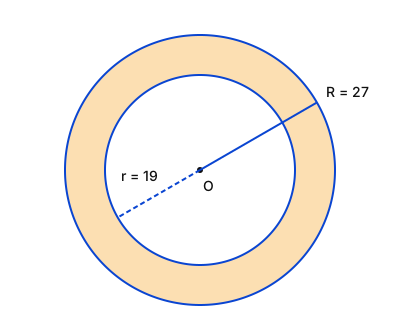
A circular pipe has an external diameter of 54 cm and an internal diameter of 38 cm . Find the area of the cross-section of the pipe.
एक वृत्ताकार पाइप का बाह्य व्यास 54 cm तथा आंतरिक व्यास 38 cm है। पाइप के अनुप्रस्थ काट का क्षेत्रफल ज्ञात कीजिए।
  1. A1367.57cm2
  2. B1170.85cm2
  3. C1399.80cm2
  4. D1156.57cm2
Show answer

Concept: Cross-section of a pipe = π(R2−r2)=π(R+r)(R−r).

  1. R=542=27cm, r=382=19cm.
  2. R2−r2=(27+19)(27−19)=46×8=368.
  3. Area = 227×368=80967≈ 1156.57 cm².

Trick: Use (R+r)(R−r) – no need to square 27 and 19.

Answer: (D) 1156.57cm2

अवधारणा: पाइप का अनुप्रस्थ काट = π(R2−r2)=π(R+r)(R−r)।

हल:

  1. R=542=27cm, r=382=19cm।
  2. R2−r2=(27+19)(27−19)=46×8=368।
  3. क्षेत्रफल = 227×368=80967≈ 1156.57 cm²।

ट्रिक: (R+r)(R−r) लगाएँ – 27 और 19 का वर्ग करने की ज़रूरत नहीं।

उत्तर: (D) 1156.57cm2

SSC CHSLQuantitative AptitudeMensuration – area of a ringSSC CHSL 2025 · 17 Nov Shift 3 →
Q3657.
If (216x3−343y3)÷(6x−7y)=Ax2− By2+Cxy, then find the value of ( 2A+B− C).
यदि (216x3−343y3)÷(6x−7y)=Ax2− By2+Cxy है, तो ( 2A+B− C) का मान ज्ञात कीजिए।
  1. A-19
  2. B-17
  3. C-22
  4. D-18
Show answer

Concept: a3−b3=(a−b)(a2+ab+b2).

  1. 216x3−343y3=(6x)3−(7y)3 → quotient = 36x2+42xy+49y2.
  2. Match with Ax2−By2+Cxy: A=36, −B=49⇒B=−49, C=42.
  3. 2A+B−C=72−49−42= −19.

Trick: Watch the sign: the "−B" in the given form makes B negative.

Answer: (A) -19

अवधारणा: a3−b3=(a−b)(a2+ab+b2)।

हल:

  1. 216x3−343y3=(6x)3−(7y)3 → भागफल = 36x2+42xy+49y2।
  2. Ax2−By2+Cxy से मिलाएँ: A=36, −B=49⇒B=−49, C=42।
  3. 2A+B−C=72−49−42= −19।

ट्रिक: चिह्न पर ध्यान दें: दिए रूप में "−B" है, इसलिए B ऋणात्मक है।

उत्तर: (A) -19

SSC CHSLQuantitative AptitudeAlgebra – difference of cubesSSC CHSL 2025 · 17 Nov Shift 3 →
Q3658.
If x2+y2+z2=2(4x+5y+3z)−50, then find the value of 2(x+y)−3z.
यदि x2+y2+z2=2(4x+5y+3z)−50 है, तो 2(x+y)−3z का मान ज्ञात कीजिए।
  1. A11
  2. B18
  3. C10
  4. D9
Show answer

Concept: If a sum of real squares is 0, each square is 0.

  1. x2−8x+y2−10y+z2−6z+50=0.
  2. 50=16+25+9→(x−4)2+(y−5)2+(z−3)2=0⇒x=4, y=5, z=3.
  3. 2(4+5)−3×3=18−9= 9.

Trick: Values = half the coefficients inside the bracket: 2(4x+5y+3z) → x=4, y=5, z=3 directly.

Answer: (D) 9

अवधारणा: वास्तविक वर्गों का योग 0 हो तो हर वर्ग 0 होता है।

हल:

  1. x2−8x+y2−10y+z2−6z+50=0।
  2. 50=16+25+9→(x−4)2+(y−5)2+(z−3)2=0⇒x=4, y=5, z=3।
  3. 2(4+5)−3×3=18−9= 9।

ट्रिक: 2(4x+5y+3z) में कोष्ठक के गुणांक ही मान हैं: x=4, y=5, z=3।

उत्तर: (D) 9

SSC CHSLQuantitative AptitudeAlgebra – sum of squares equals zeroSSC CHSL 2025 · 17 Nov Shift 3 →
Q3659.
A right circular cone has a base circumference of 22 cm and a slant height of 7 cm . Find its curved surface area.
एक लंब वृत्तीय शंकु के आधार की परिधि 22 cm तथा तिर्यक ऊँचाई 7 cm है। इसका वक्र पृष्ठीय क्षेत्रफल ज्ञात कीजिए।
  1. A78cm2
  2. B77cm2
  3. C66cm2
  4. D68cm2
Show answer

Concept: CSA of cone = πrl=12×(base circumference)×l.

  1. 2πr=22→πr=11.
  2. CSA = πr×l=11×7= 77 cm².

Trick: No need to find r: CSA = circumference×slant height2=22×72=77.

Answer: (B) 77cm2

अवधारणा: शंकु का वक्र पृष्ठ = πrl=12×(आधार परिधि)×l।

हल:

  1. 2πr=22→πr=11।
  2. वक्र पृष्ठ = πr×l=11×7= 77 cm²।

ट्रिक: r निकालने की ज़रूरत नहीं: परिधि×तिर्यक ऊँचाई2=22×72=77।

उत्तर: (B) 77cm2

SSC CHSLQuantitative AptitudeCone – curved surface areaSSC CHSL 2025 · 17 Nov Shift 3 →
Q3660.
If sin⁡A=513, and A is acute, find the value of cosec2A−cot2⁡A.
यदि sin⁡A=513 है और A एक न्यून कोण है, तो cosec2A−cot2⁡A का मान ज्ञात कीजिए।
  1. A-2
  2. B-3
  3. C0
  4. D1
Show answer

Concept: csc2A−cot2A=1 for every valid angle.

  1. From 1+cot2A=csc2A → csc2A−cot2A=1.
  2. Check: sinA=513→cscA=135, cotA=125→16925−14425=2525=1.
  3. Value = 1.

Trick: The given value of sinA is a distractor – the identity is always 1.

Answer: (D) 1

अवधारणा: csc2A−cot2A=1 (हर मान्य कोण के लिए)।

हल:

  1. 1+cot2A=csc2A → csc2A−cot2A=1।
  2. जाँच: sinA=513→cscA=135, cotA=125→16925−14425=1।
  3. मान = 1।

ट्रिक: sinA का मान केवल भटकाने के लिए है – सर्वसमिका का मान सदा 1।

उत्तर: (D) 1

SSC CHSLQuantitative AptitudeTrigonometric identitySSC CHSL 2025 · 17 Nov Shift 3 →