Question bank

Q&A: practice questions with answers

Search questions on any topic. Filter by exam category, exam, subject and topic, try the question, then open the answer and explanation.

Courses – airGurukul

5,000 questions found.

Q3941.
Complete the following series from the given options.
P_TP_S_CT_RSPC_PR_P_T_RS
दिए गए विकल्पों में से निम्नलिखित शृंखला को पूर्ण कीजिए।
P_TP_S_CT_RSPC_PR_P_T_RS
  1. ACSPCRPTP
  2. BCRPCS PPT
  3. CCCPPPRST
  4. DCRPPTSCP
Show answer

Concept: 24 places → try equal blocks; a 6-letter block PCTPRS repeats.

  1. PCTPRS | PCTPRS | PCTPRS | PCTPRS
  2. Blanks in order: C R P P T S C P → CRPPTSCP.

Trick: Count total letters + blanks, then try block sizes that divide it (4, 6, 8) – the visible letters confirm the block.

Answer: (D) CRPPTSCP

अवधारणा: 24 स्थान → बराबर खंड बनाएँ; 6 अक्षरों का खंड PCTPRS दोहराता है।

  1. PCTPRS | PCTPRS | PCTPRS | PCTPRS
  2. रिक्त स्थान क्रम से: CRPPTSCP

ट्रिक: कुल स्थान गिनें और उसके भाजक (4, 6, 8) वाले खंड आज़माएँ – दिखते अक्षर खंड की पुष्टि करते हैं।

उत्तर: (D) CRPPTSCP
SSC CHSLGeneral IntelligenceLetter series – repeating blockSSC CHSL 2025 · 15 Nov Shift 3 →
Q3942.
What comes next in the following series?
P0, Q1, R4, S9, T16, U25, ?
निम्नलिखित शृंखला में आगे क्या आएगा?
P0, Q1, R4, S9, T16, U25, ?
  1. AV49
  2. BV25
  3. CV30
  4. DV36
Show answer

Concept: Letter part and number part follow separate rules.

  1. Letters: P, Q, R, S, T, U → next V.
  2. Numbers: 0, 1, 4, 9, 16, 25 = 02, 12, … → next 62=36.
  3. Term = V36.

Trick: All options start with V, so only the number matters: next square after 25 is 36.

Answer: (D) V36

अवधारणा: अक्षर भाग और संख्या भाग अलग नियम से चलते हैं।

  1. अक्षर: P, Q, R, S, T, U → अगला V
  2. संख्या: 0, 1, 4, 9, 16, 25 = 02, 12, … → अगला 62=36
  3. पद = V36

ट्रिक: सभी विकल्प V से शुरू – केवल संख्या देखें: 25 के बाद अगला वर्ग 36।

उत्तर: (D) V36

SSC CHSLGeneral IntelligenceAlphanumeric series – letters and squaresSSC CHSL 2025 · 15 Nov Shift 3 →
Q3943.
What comes next in the following series?
G1, H1, I1.5, J3, K3. 5, L10.5, ?
निम्नलिखित शृंखला में आगे क्या आएगा?
G1, H1, I1.5, J3, K3. 5, L10.5, ?
  1. AM12
  2. BM11.5
  3. CM11
  4. DM12.5
Show answer

Concept: Numbers use ×1, +0.5, ×2, +0.5, ×3, +0.5 …

  1. 1×1=1 → +0.5=1.5 → ×2=3 → +0.5=3.5 → ×3=10.5.
  2. Next step is +0.5 → 11; letter after L = M.
  3. Term = M11.

Trick: If numbers jump then barely move, suspect two alternating operations.

Answer: (C) M11

अवधारणा: संख्याएँ ×1, +0.5, ×2, +0.5, ×3, +0.5 … के क्रम में बदलती हैं।

  1. 1×1=1 → +0.5=1.5 → ×2=3 → +0.5=3.5 → ×3=10.5
  2. अगला चरण +0.5 → 11; L के बाद M
  3. पद = M11

ट्रिक: संख्या कभी तेज़ उछले और कभी थोड़ा बढ़े, तो दो बदलती संक्रियाएँ होती हैं।

उत्तर: (C) M11

SSC CHSLGeneral IntelligenceAlphanumeric series – alternate operationsSSC CHSL 2025 · 15 Nov Shift 3 →
Q3944.
If: +→−,−→×,×→+,/→/ Then evaluate: 96/(12+4)×(6−2)+10= ?
यदि: +→−,−→×,×→+,/→/ तो मान ज्ञात कीजिए: 96/(12+4)×(6−2)+10= ?
  1. A16
  2. B15
  3. C14
  4. D12
Show answer

Concept: Swap every sign first (+ → −, − → ×, × → +, / → /), then solve by BODMAS.

  1. 96/(12+4)×(6−2)+10 → 96÷(12−4)+(6×2)−10
  2. =96÷8+12−10
  3. =12+12−10= 14

Trick: Rewrite the whole expression with new signs on paper before calculating – mixing old and new signs is the usual mistake.

Answer: (C) 14

अवधारणा: पहले सभी चिह्न बदलें (+ → −, − → ×, × → +, / → /), फिर BODMAS लगाएँ।

  1. 96/(12+4)×(6−2)+10 → 96÷(12−4)+(6×2)−10
  2. =96÷8+12−10
  3. =12+12−10= 14

ट्रिक: गणना से पहले पूरा व्यंजक नए चिह्नों के साथ दोबारा लिखें – पुराने-नए चिह्न मिलाना आम गलती है।

उत्तर: (C) 14

SSC CHSLGeneral IntelligenceSymbol substitution – BODMASSSC CHSL 2025 · 15 Nov Shift 3 →
Q3945.
If: +→x,−→+,x→+,/→ - Then evaluate: [(6+3)×(18−6)]/(20−5)= ?
यदि: +→x,−→+,x→+,/→ - तो मान ज्ञात कीजिए: [(6+3)×(18−6)]/(20−5)= ?
  1. A15
  2. B16
  3. C17
  4. D18
Show answer

Concept: Replace signs as given (+ → ×, − → +, × → +, / → −), then simplify.

  1. [(6×3)+(18+6)]−(20+5)
  2. =[18+24]−25
  3. =42−25= 17

Trick: Brackets stay where they are – only the signs change.

Answer: (C) 17

अवधारणा: दिए अनुसार चिह्न बदलें (+ → ×, − → +, × → +, / → −), फिर हल करें।

  1. [(6×3)+(18+6)]−(20+5)
  2. =[18+24]−25
  3. =42−25= 17

ट्रिक: कोष्ठक अपनी जगह रहते हैं – केवल चिह्न बदलते हैं।

उत्तर: (C) 17

SSC CHSLGeneral IntelligenceSymbol substitution – bracketsSSC CHSL 2025 · 15 Nov Shift 3 →
Q3946.
In the word DAUGHTER (in both forward and backward directions), how many pairs of letters are there such that the number of letters between them in the word is the same as the number of letters between them in the English alphabet?
शब्द DAUGHTER में (आगे तथा पीछे दोनों दिशाओं में) अक्षरों के ऐसे कितने युग्म हैं, जिनमें से प्रत्येक में उनके बीच उतने ही अक्षर हैं जितने अंग्रेज़ी वर्णमाला में उनके बीच आते हैं?
  1. AFourचार
  2. Bfiveपाँच
  3. CTwoदो
  4. DThreeतीन
Show answer

Concept: Gap in the word must equal gap in the alphabet (either direction).

  1. Alphabet positions: D4 A1 U21 G7 H8 T20 E5 R18.
  2. Forward: D–G (3 = 3), D–H (4 = 4), G–H (1 = 1).
  3. Backward: T–R (word gap 2, alphabet R←T gap 2).
  4. Total = 4.

Trick: Write the alphabet rank under each letter; a pair works when |position difference| = |rank difference|.

Answer: (A) Four

अवधारणा: शब्द में दूरी = वर्णमाला में दूरी (आगे या पीछे किसी भी दिशा में)।

  1. वर्णमाला क्रम: D4 A1 U21 G7 H8 T20 E5 R18
  2. आगे की दिशा: D–G (3 = 3), D–H (4 = 4), G–H (1 = 1)
  3. पीछे की दिशा: T–R (दोनों में दूरी 2)
  4. कुल = 4

ट्रिक: हर अक्षर के नीचे उसका वर्णमाला क्रम लिखें; जहाँ स्थान का अंतर = क्रम का अंतर, वही युग्म है।

उत्तर: (A) चार

SSC CHSLGeneral IntelligenceLetter pairs – DAUGHTERSSC CHSL 2025 · 15 Nov Shift 3 →
Q3947.
From the given alternative words, select the word that cannot be formed using letters of the given word only once. PARALLELOGRAM
दिए गए वैकल्पिक शब्दों में से उस शब्द का चयन कीजिए, जिसे दिए गए शब्द के अक्षरों का केवल एक बार प्रयोग करके नहीं बनाया जा सकता। PARALLELOGRAM
  1. AROLE
  2. BLARGE
  3. CLEAP
  4. DALERT
Show answer

Concept: A word can be formed only if every letter (with count) is in the given word.

  1. Letters: P, A×3, R×2, L×3, E, O, G, M.
  2. ROLE, LARGE, LEAP – all letters available.
  3. ALERT needs T – not present ✗

Trick: First scan options for a letter missing altogether (here T) – the fastest elimination.

Answer: (D) ALERT

अवधारणा: शब्द तभी बनेगा जब उसका हर अक्षर (गिनती सहित) दिए शब्द में हो।

  1. अक्षर: P, A×3, R×2, L×3, E, O, G, M
  2. ROLE, LARGE, LEAP – सब अक्षर मौजूद।
  3. ALERT में T चाहिए – जो नहीं है ✗

ट्रिक: पहले देखें कि किस विकल्प में ऐसा अक्षर है जो दिए शब्द में है ही नहीं (यहाँ T)।

उत्तर: (D) ALERT

SSC CHSLGeneral IntelligenceWord formation – PARALLELOGRAMSSC CHSL 2025 · 15 Nov Shift 3 →
Q3948.
How many letter pairs are there in the word 'CLUSTERS' which has as many letters in both the forward as well as the backward direction) as there are between them in the English alphabetical series?
शब्द 'CLUSTERS' में अक्षरों के ऐसे कितने युग्म हैं, जिनमें आगे तथा पीछे दोनों दिशाओं में उनके बीच उतने ही अक्षर हैं जितने अंग्रेज़ी वर्णमाला क्रम में उनके बीच आते हैं?
  1. ATwoदो
  2. BOneएक
  3. CZeroशून्य
  4. DThreeतीन
Show answer

Concept: Count pairs whose gap in the word equals their gap in the alphabet.

  1. Ranks: C3 L12 U21 S19 T20 E5 R18 S19.
  2. S–T (adjacent, 19→20) ✓; R–S (adjacent, 18→19) ✓.
  3. T–R: word gap 2, alphabet gap 2 (T→S→R backward) ✓
  4. Total = 3.

Trick: Start with adjacent letters that are also alphabet neighbours, then check gaps of 2, 3 … – most pairs fail fast.

Answer: (D) Three

अवधारणा: ऐसे युग्म गिनें जिनकी शब्द में दूरी = वर्णमाला में दूरी।

  1. क्रम: C3 L12 U21 S19 T20 E5 R18 S19
  2. S–T (सटे हुए, 19→20) ✓; R–S (18→19) ✓
  3. T–R: शब्द में दूरी 2, वर्णमाला में भी 2 (पीछे की ओर) ✓
  4. कुल = 3

ट्रिक: पहले सटे हुए अक्षर देखें जो वर्णमाला में भी पड़ोसी हों, फिर 2, 3 की दूरी जाँचें।

उत्तर: (D) तीन

SSC CHSLGeneral IntelligenceLetter pairs – CLUSTERSSSC CHSL 2025 · 15 Nov Shift 3 →
Q3949.
Identify the next number.
7, 14, 42, 168, ?
अगली संख्या ज्ञात कीजिए।
7, 14, 42, 168, ?
  1. A840
  2. B850
  3. C860
  4. D830
Show answer

Concept: Fast growth → check ratios.

  1. 7×2=14, ×3=42, ×4=168.
  2. Next ×5 → 168×5= 840.

Trick: These are 7×1!, 7×2!, 7×3!, 7×4!, so next = 7×5!=7×120=840.

Answer: (A) 840

अवधारणा: तेज़ी से बढ़ती श्रृंखला → अनुपात देखें।

  1. 7×2=14, ×3=42, ×4=168
  2. अगला ×5 → 168×5= 840

ट्रिक: ये 7×1!, 7×2!, 7×3!, 7×4! हैं, अगला = 7×5!=840।

उत्तर: (A) 840

SSC CHSLGeneral IntelligenceNumber series – increasing multiplierSSC CHSL 2025 · 15 Nov Shift 3 →
Q3950.
What comes next in the sequence? 2, 5, 11, 17, 23, 31, 41, ?
इस अनुक्रम में आगे क्या आएगा? 2, 5, 11, 17, 23, 31, 41, ?
  1. A43
  2. B47
  3. C45
  4. D46
Show answer

Concept: All terms are primes; check which primes are skipped.

  1. Skipped primes: 3, 7, 13, 19, 29, 37 – each lies between two terms.
  2. Every alternate prime is taken → after 41 skip 43 → 47.

Trick: If differences look random, test whether every term is prime – a very common SSC pattern.

Answer: (B) 47

अवधारणा: सभी पद अभाज्य हैं; देखें कौन-से अभाज्य छोड़े गए।

  1. छोड़े गए अभाज्य: 3, 7, 13, 19, 29, 37 – हर दो पदों के बीच एक।
  2. एक छोड़कर एक अभाज्य → 41 के बाद 43 छोड़ें → 47

ट्रिक: अंतर बेतरतीब लगें तो जाँचें कि क्या सभी पद अभाज्य हैं – SSC का आम पैटर्न।

उत्तर: (B) 47

SSC CHSLGeneral IntelligenceSeries – alternate prime numbersSSC CHSL 2025 · 15 Nov Shift 3 →
Q3951.
Which of the following is true ?
निम्नलिखित में से कौन-सा कथन सत्य है?
  1. AAll real numbers are either rational or irrationalसभी वास्तविक संख्याएँ या तो परिमेय होती हैं या अपरिमेय
  2. BAll rational numbers are irrationalसभी परिमेय संख्याएँ अपरिमेय होती हैं
  3. CNo real number is rationalकोई भी वास्तविक संख्या परिमेय नहीं होती
  4. DAll integers are irrationalसभी पूर्णांक अपरिमेय होते हैं
Show answer

Concept: Real numbers = rational numbers ∪ irrational numbers (no overlap).

  1. So every real number is either rational or irrational ✓
  2. (B) false – rationals can be written as pq, irrationals cannot.
  3. (C) false – 12, 5 are real and rational; (D) false – every integer n=n1 is rational.

Yaad rakhein: Natural ⊂ Whole ⊂ Integer ⊂ Rational ⊂ Real; irrational numbers (2, π) sit outside the rationals but inside the reals.

Answer: (A) All real numbers are either rational or irrational

अवधारणा: वास्तविक संख्याएँ = परिमेय ∪ अपरिमेय (दोनों में कोई साझा संख्या नहीं)।

  1. अतः हर वास्तविक संख्या या तो परिमेय है या अपरिमेय ✓
  2. (B) गलत – परिमेय को pq लिख सकते हैं, अपरिमेय को नहीं।
  3. (C) गलत – 12, 5 वास्तविक भी हैं और परिमेय भी; (D) गलत – हर पूर्णांक n=n1 परिमेय है।

याद रखें: प्राकृत ⊂ पूर्ण ⊂ पूर्णांक ⊂ परिमेय ⊂ वास्तविक; अपरिमेय (2, π) परिमेय से बाहर पर वास्तविक के अंदर हैं।

उत्तर: (A) सभी वास्तविक संख्याएँ या तो परिमेय होती हैं या अपरिमेय

SSC CHSLQuantitative AptitudeNumber system – real numbersSSC CHSL 2025 · 15 Nov Shift 3 →
Q3952.
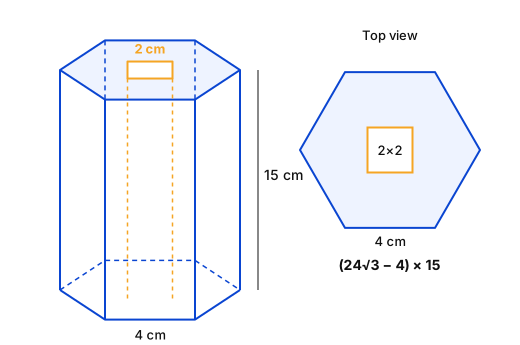
A solid right prism has a base that is a regular hexagon of side 4 cm . The height of the prism is 15 cm . A square cavity of side 2 cm is carved vertically through the center of the prism from top to bottom. Calculate the volume of the material remaining in the prism.
(Use 3=1.732 )
एक ठोस लंब प्रिज़्म का आधार 4 cm भुजा वाला एक सम षट्भुज है। प्रिज़्म की ऊँचाई 15 cm है। प्रिज़्म के केंद्र से होकर ऊपर से नीचे तक 2 cm भुजा वाली एक वर्गाकार गुहा काटी गई है। प्रिज़्म में शेष बचे पदार्थ का आयतन ज्ञात कीजिए।
(3=1.732 का प्रयोग कीजिए)
  1. A563.5cm3
  2. B623.5cm3
  3. C548.2cm3
  4. D585.6cm3
Show answer

Concept: Remaining volume = prism volume − cavity volume.

  1. Hexagon area = 332×42=243=24×1.732=41.568cm2.
  2. Prism volume = 41.568×15=623.52cm3.
  3. Cavity = 2×2×15=60cm3.
  4. Remaining = 623.52−60= 563.52≈563.5cm3.

Trick: Since the cavity runs the full height: (base area−hole area)×h=(41.568−4)×15=563.5 in one step.

Answer: (A) 563.5cm3

अवधारणा: बचा आयतन = प्रिज़्म का आयतन − खोखले भाग का आयतन।

  1. षट्भुज क्षेत्रफल = 332×42=243=24×1.732=41.568cm2
  2. प्रिज़्म आयतन = 41.568×15=623.52cm3
  3. खोखला भाग = 2×2×15=60cm3
  4. बचा = 623.52−60= 563.52≈563.5cm3

ट्रिक: छेद पूरी ऊँचाई में है: (आधार क्षेत्रफल−छेद क्षेत्रफल)×h=(41.568−4)×15=563.5।

उत्तर: (A) 563.5cm3

SSC CHSLQuantitative AptitudeMensuration – hexagonal prism with cavitySSC CHSL 2025 · 15 Nov Shift 3 →
Q3953.
A glass manufacturer produces transparent right prism blocks with a square base of side 12 cm and height 30 cm . If the selling price is ₹ 0.80 per cm3 and the cost price is ₹0.50 per cm3, what is the total profit earned on selling 20 such prisms?
एक काँच निर्माता 12 cm भुजा वाले वर्गाकार आधार तथा 30 cm ऊँचाई वाले पारदर्शी लंब प्रिज़्म खंड बनाता है। यदि विक्रय मूल्य ₹0.80 प्रति cm3 है और क्रय मूल्य ₹0.50 प्रति cm3 है, तो ऐसे 20 प्रिज़्म बेचने पर कुल कितना लाभ होगा?
  1. A₹15400
  2. B₹16000
  3. C₹18500
  4. D₹25920
Show answer

Concept: Profit=volume×(SP−CP per cm3)×number of pieces.

  1. Volume of one prism = 12×12×30=4320cm3.
  2. Profit per cm³ = 0.80−0.50= ₹0.30.
  3. Total = 4320×0.30×20=4320×6= ₹25920.

Trick: Combine the small numbers first: 0.30×20=6, then 4320×6=25920.

Answer: (D) ₹25920

अवधारणा: लाभ=आयतन×(प्रति cm3 विक्रय मूल्य−क्रय मूल्य)×नगों की संख्या।

  1. एक प्रिज़्म का आयतन = 12×12×30=4320cm3
  2. प्रति cm³ लाभ = 0.80−0.50= ₹0.30
  3. कुल = 4320×0.30×20=4320×6= ₹25920

ट्रिक: पहले छोटी संख्याएँ मिलाएँ: 0.30×20=6, फिर 4320×6=25920।

उत्तर: (D) ₹25920

SSC CHSLQuantitative AptitudeVolume and profit – square prismSSC CHSL 2025 · 15 Nov Shift 3 →
Q3954.
A and B invest ₹40,000 and ₹30,000 respectively. After 8 months, A withdraws all of his capital. At the end of the year, what is their profit-sharing?
A और B क्रमशः ₹40,000 और ₹30,000 निवेश करते हैं। 8 महीने बाद A अपनी संपूर्ण पूँजी निकाल लेता है। वर्ष के अंत में उनका लाभ-विभाजन क्या होगा?
  1. A9:8
  2. B8 : 7
  3. C7:8
  4. D8 : 9
Show answer

Concept: Profit ratio = capital × months each capital stayed.

  1. A: 40000×8=3,20,000.
  2. B: 30000×12=3,60,000.
  3. Ratio = 32 : 36 = 8 : 9.

Trick: Cancel common zeros first: 4×8:3×12=32:36=8:9.

Answer: (D) 8 : 9

अवधारणा: लाभ का अनुपात = पूँजी × जितने महीने पूँजी लगी रही।

  1. A: 40000×8=3,20,000
  2. B: 30000×12=3,60,000
  3. अनुपात = 32 : 36 = 8 : 9

ट्रिक: पहले शून्य हटाएँ: 4×8:3×12=32:36=8:9।

उत्तर: (D) 8 : 9

SSC CHSLQuantitative AptitudePartnership – withdrawal of capitalSSC CHSL 2025 · 15 Nov Shift 3 →
Q3955.
A started a business with ₹50,000. B joined after 6 months with ₹20,000. At the end of the year, what is their profit-sharing ratio?
A ने ₹50,000 से एक व्यवसाय आरंभ किया। B, 6 महीने बाद ₹20,000 के साथ इसमें सम्मिलित हुआ। वर्ष के अंत में उनका लाभ-विभाजन अनुपात क्या होगा?
  1. A5:1
  2. B5:2
  3. C2:5
  4. D5:3
Show answer

Concept: Multiply each capital by the months it was invested.

  1. A: 50000×12=6,00,000.
  2. B joins after 6 months → 20000×6=1,20,000.
  3. Ratio = 6 : 1.2 = 5 : 1.

Trick: In thousands: 50×12:20×6=600:120=5:1.

Answer: (A) 5:1

अवधारणा: हर पूँजी को उतने महीनों से गुणा करें जितने वह लगी रही।

  1. A: 50000×12=6,00,000
  2. B 6 महीने बाद जुड़ा → 20000×6=1,20,000
  3. अनुपात = 600 : 120 = 5 : 1

ट्रिक: हज़ार में सोचें: 50×12:20×6=600:120=5:1।

उत्तर: (A) 5:1

SSC CHSLQuantitative AptitudePartnership – partner joins laterSSC CHSL 2025 · 15 Nov Shift 3 →
Q3956.
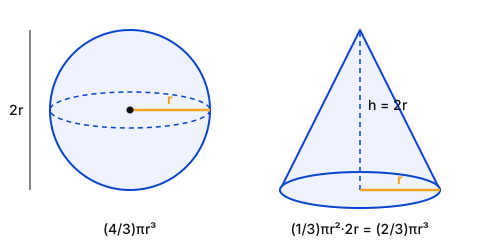
A sphere and a cone have the same base radius and the same height. What is the ratio of their volumes (sphere : cone) ?
एक गोले और एक शंकु के आधार की त्रिज्या तथा ऊँचाई समान हैं। उनके आयतनों का अनुपात (गोला : शंकु) क्या है?
  1. A1 : 3
  2. B1 : 2
  3. C2 : 1
  4. D3 : 1
Show answer

Concept: Height of a sphere = its diameter = 2r, so the cone also has h=2r.

  1. Sphere = 43πr3.
  2. Cone = 13πr2×2r=23πr3.
  3. Ratio = 43:23= 2 : 1.

Trick: Same r and h=2r: cone : sphere : cylinder = 1 : 2 : 3 (Archimedes' ratio).

Answer: (C) 2 : 1

अवधारणा: गोले की ऊँचाई = व्यास = 2r, इसलिए शंकु की ऊँचाई भी 2r।

  1. गोला = 43πr3
  2. शंकु = 13πr2×2r=23πr3
  3. अनुपात = 43:23= 2 : 1

ट्रिक: समान r और h=2r पर शंकु : गोला : बेलन = 1 : 2 : 3 (आर्किमिडीज़ का अनुपात)।

उत्तर: (C) 2 : 1

SSC CHSLQuantitative AptitudeVolume ratio – sphere and coneSSC CHSL 2025 · 15 Nov Shift 3 →
Q3957.
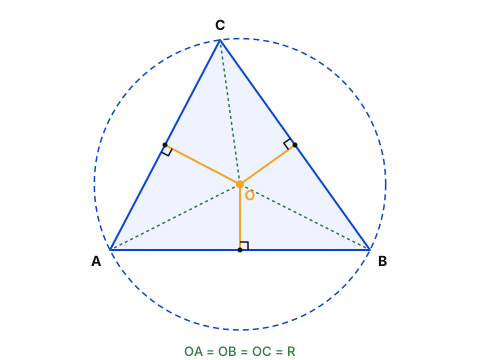
The point of intersection of the perpendicular bisectors of the three sides of a triangle is called:
किसी त्रिभुज की तीनों भुजाओं के लंब समद्विभाजकों का प्रतिच्छेद बिंदु कहलाता है:
  1. AIncenterअंतःकेंद्र
  2. BCircumcenterपरिकेंद्र
  3. CCentroidकेंद्रक
  4. DOrthocenterलंबकेंद्र
Show answer

Concept: Perpendicular bisectors meet at the point equidistant from all three vertices.

  1. That point is the centre of the circle through A, B, C → circumcentre.
  2. Incentre – angle bisectors; centroid – medians; orthocentre – altitudes.

Trick: Pairs: Bisector of Angle → Incentre; Perpendicular bisector → Circumcentre; Median → Centroid; Altitude → Orthocentre.

Answer: (B) Circumcenter

अवधारणा: भुजाओं के लंब समद्विभाजक उस बिंदु पर मिलते हैं जो तीनों शीर्षों से समान दूरी पर है।

  1. वह बिंदु A, B, C से होकर जाने वाले वृत्त का केंद्र है → परिकेंद्र
  2. अंतःकेंद्र – कोण समद्विभाजक; केंद्रक – माध्यिकाएँ; लंबकेंद्र – शीर्षलंब।

ट्रिक: कोण समद्विभाजक → अंतःकेंद्र; लंब समद्विभाजक → परिकेंद्र; माध्यिका → केंद्रक; शीर्षलंब → लंबकेंद्र।

उत्तर: (B) परिकेंद्र

SSC CHSLQuantitative AptitudeTriangle centres – circumcentreSSC CHSL 2025 · 15 Nov Shift 3 →
Q3958.
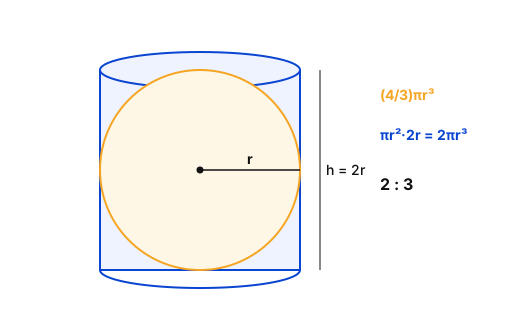
If a sphere is inscribed in a cylinder with the same radius and height, what is the ratio of the volume of the sphere to the volume of the cylinder?
यदि किसी बेलन में समान त्रिज्या और ऊँचाई वाला एक गोला अंतर्निहित है, तो गोले के आयतन और बेलन के आयतन का अनुपात क्या होगा?
  1. A2:3
  2. B1:2
  3. C3 : 2
  4. D1 : 3
Show answer

Concept: A sphere fitting exactly in a cylinder gives cylinder radius r and height 2r.

  1. Sphere = 43πr3.
  2. Cylinder = πr2×2r=2πr3.
  3. Ratio = 43:2= 2 : 3.

Trick: Use the 1 : 2 : 3 rule (cone : sphere : cylinder) → sphere : cylinder = 2 : 3 instantly.

Answer: (A) 2:3

अवधारणा: बेलन में ठीक फिट गोला → बेलन की त्रिज्या r और ऊँचाई 2r।

  1. गोला = 43πr3
  2. बेलन = πr2×2r=2πr3
  3. अनुपात = 43:2= 2 : 3

ट्रिक: 1 : 2 : 3 नियम (शंकु : गोला : बेलन) से सीधे गोला : बेलन = 2 : 3।

उत्तर: (A) 2:3

SSC CHSLQuantitative AptitudeVolume ratio – sphere in a cylinderSSC CHSL 2025 · 15 Nov Shift 3 →
Q3959.
If ' x ' =7cos⁡A+24sin⁡A and ' y ' = 7sin⁡A−24cos⁡A, then find the value of 2(x2+y2).
यदि ' x ' =7cos⁡A+24sin⁡A और ' y ' = 7sin⁡A−24cos⁡A है, तो 2(x2+y2) का मान ज्ञात कीजिए।
  1. A1250
  2. B1150
  3. C1350
  4. D1160
Show answer

Concept: (acosA+bsinA)2+(asinA−bcosA)2=a2+b2.

  1. Cross terms ±2·7·24sinAcosA cancel on adding.
  2. x2+y2=72+242=49+576=625.
  3. 2(x2+y2)=2×625= 1250.

Trick: Put A=0∘: x=7, y=−24 → x2+y2=49+576=625 – answer in seconds.

Answer: (A) 1250

अवधारणा: (acosA+bsinA)2+(asinA−bcosA)2=a2+b2

  1. जोड़ने पर ±2·7·24sinAcosA वाले पद कट जाते हैं।
  2. x2+y2=72+242=49+576=625
  3. 2(x2+y2)=2×625= 1250

ट्रिक: A=0∘ रखें: x=7, y=−24 → x2+y2=625 – तुरंत उत्तर।

उत्तर: (A) 1250

SSC CHSLQuantitative AptitudeTrigonometry – sum of squares identitySSC CHSL 2025 · 15 Nov Shift 3 →
Q3960.
The ratio of the two angles of a triangle is 1:3, respectively. If the third angle of the triangle is 50% more than the sum of the given two angles of the triangle, then find the largest angle of the triangle.
किसी त्रिभुज के दो कोणों का अनुपात क्रमशः 1:3 है। यदि त्रिभुज का तीसरा कोण दिए गए इन दोनों कोणों के योग से 50% अधिक है, तो त्रिभुज का सबसे बड़ा कोण ज्ञात कीजिए।
  1. A108°
  2. B110*
  3. C120*
  4. D100°
Show answer

Concept: Angle sum of a triangle = 180°.

  1. Two angles = x and 3x, sum = 4x.
  2. Third = 4x+50% of 4x=6x.
  3. 10x=180∘→x=18∘; angles 18∘, 54∘, 108∘.
  4. Largest = 108°.

Trick: Third angle is 1.5×(sum of other two), so it takes 1.52.5=35 of 180∘=108∘.

Answer: (A) 108°

अवधारणा: त्रिभुज के कोणों का योग = 180°।

  1. दो कोण = x और 3x, योग = 4x
  2. तीसरा = 4x+4x का 50%=6x
  3. 10x=180∘→x=18∘; कोण 18∘, 54∘, 108∘
  4. सबसे बड़ा = 108°

ट्रिक: तीसरा कोण = 1.5×(बाकी दो का योग), यानी 180∘ का 35=108∘।

उत्तर: (A) 108°

SSC CHSLQuantitative AptitudeTriangle – angles in ratioSSC CHSL 2025 · 15 Nov Shift 3 →