Question bank

Q&A: practice questions with answers

Search questions on any topic. Filter by exam category, exam, subject and topic, try the question, then open the answer and explanation.

Courses – airGurukul

5,000 questions found.

Q4141.
Some letters are missing from the series. From the given alternative choose the best option which follow the pattern of the series.
b__hj_d_h_b_f_j
शृंखला में से कुछ अक्षर लुप्त हैं। दिए गए विकल्पों में से उस सर्वोत्तम विकल्प का चयन कीजिए जो शृंखला के प्रतिरूप का अनुसरण करता हो।
b__hj_d_h_b_f_j
  1. Adfhbeff
  2. Bdfhfhdf
  3. Cdfbfjdh
  4. Ddbfdhjh
Show answer

Concept: Split the 15 places into three blocks of 5 and find the common unit.

  1. Blocks: b__hj / _d_h_ / b_f_j → each = b d f h j (alternate letters).
  2. Block 1 needs d, f; block 2 needs b, f, j; block 3 needs d, h.
  3. Order: d f b f j d h.

Trick: First two blanks must be d, f (between b and h) – this alone removes (D); check the third letter 'b' to pick (C).

Answer: (C) dfbfjdh

अवधारणा: 15 स्थानों को 5-5 के तीन खंडों में बाँटकर साझा इकाई खोजें।

हल:

  1. खंड: b__hj / _d_h_ / b_f_j → हर खंड = b d f h j (एक-एक छोड़कर अक्षर)।
  2. खंड 1 में d, f; खंड 2 में b, f, j; खंड 3 में d, h।
  3. क्रम: d f b f j d h।

ट्रिक: पहले दो रिक्त d, f होंगे (b और h के बीच) – फिर तीसरा अक्षर 'b' देखकर (C) चुनें।

उत्तर: (C) dfbfjdh
SSC CHSLGeneral IntelligenceMissing letters – repeating unit bdfhjSSC CHSL 2025 · 15 Nov Shift 1 →
Q4142.
If: +→x,−→+,x→:+→+ Then evaluate:
(15+2)+6−(5÷4)+4=?
यदि: +→x,−→+,x→:+→+ तो निम्नलिखित का मान ज्ञात कीजिए:
(15+2)+6−(5÷4)+4=?
  1. A80
  2. B66
  3. C46
  4. D86
Show answer

Concept: Replace each sign as given, then simplify using BODMAS.

  1. + → ×, − → ÷, × → −, ÷ → +.
  2. (15+2)+6−(5÷4)+4→(15×2)×6÷(5+4)×4.
  3. =30×6÷9×4=180÷9×4=20×4=80.

Trick: Rewrite the whole expression first on paper; never swap signs in your head while calculating.

Answer: (A) 80

अवधारणा: दिए अनुसार चिह्न बदलें, फिर BODMAS से सरल करें।

हल:

  1. + → ×, − → ÷, × → −, ÷ → +।
  2. (15+2)+6−(5÷4)+4→(15×2)×6÷(5+4)×4।
  3. =30×6÷9×4=180÷9×4=20×4=80।

ट्रिक: पहले पूरा व्यंजक नए चिह्नों के साथ लिख लें; गणना करते समय मन में चिह्न न बदलें।

उत्तर: (A) 80

SSC CHSLGeneral IntelligenceSign substitution with BODMASSSC CHSL 2025 · 15 Nov Shift 1 →
Q4143.
If: +→−,−→×,×→/,/→+ Then evaluate: {(30−5)×5+2}4= ?
यदि: +→−,−→×,×→/,/→+ तो मान ज्ञात कीजिए: {(30−5)×5+2}4= ?
  1. A2
  2. B8
  3. C7
  4. D4
Show answer

Concept: Swap the signs inside the numerator; the fraction bar stays a division by 4.

  1. + → −, − → ×, × → ÷.
  2. (30−5)×5+2→(30×5)÷5−2.
  3. =150÷5−2=30−2=28.
  4. 284=7.

Trick: (30×5)÷5 simply gives back 30 – cancel ×5 and ÷5 at sight.

Answer: (C) 7

अवधारणा: अंश (numerator) के चिह्न बदलें; भिन्न की रेखा 4 से भाग ही रहेगी।

हल:

  1. + → −, − → ×, × → ÷।
  2. (30−5)×5+2→(30×5)÷5−2।
  3. =150÷5−2=30−2=28।
  4. 284=7।

ट्रिक: (30×5)÷5=30 – ×5 और ÷5 को सीधे काट दें।

उत्तर: (C) 7

SSC CHSLGeneral IntelligenceSign substitution – fraction expressionSSC CHSL 2025 · 15 Nov Shift 1 →
Q4144.
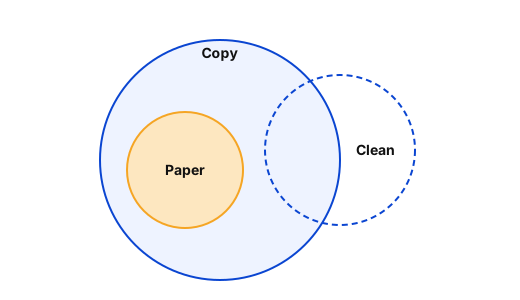
If all papers are copy and some copies are clean, which of the following must be true?
यदि सभी कागज़ कॉपी हैं और कुछ कॉपियाँ स्वच्छ हैं, तो निम्नलिखित में से कौन-सा कथन अनिवार्य रूप से सत्य होगा?
  1. ASome papers are clean.कुछ कागज़ स्वच्छ हैं।
  2. BAll clean things are copies.सभी स्वच्छ वस्तुएँ कॉपियाँ हैं।
  3. CSome copy are papers.कुछ कॉपियाँ कागज़ हैं।
  4. DAll copies are clean things.सभी कॉपियाँ स्वच्छ वस्तुएँ हैं।
Show answer

Concept: 'All A are B' always gives 'Some B are A' (conversion).

  1. All papers are copy → Some copies are papers ✔ (definite).
  2. Some copies are clean – the clean part may lie outside papers → 'Some papers are clean' is only possible.
  3. 'All clean are copies' and 'All copies are clean' are never stated.

Trick: From 'All', 'Some' in reverse is always safe; 'Some + Some' or 'All + Some' links between different terms rarely give certainty.

Answer: (C) Some copy are papers.

अवधारणा: 'All A are B' से हमेशा 'Some B are A' निकलता है (conversion)।

हल:

  1. All papers are copy → Some copies are papers ✔ (निश्चित)।
  2. Some copies are clean – clean वाला हिस्सा papers से बाहर भी हो सकता है → 'Some papers are clean' केवल संभव है।
  3. 'All clean are copies' व 'All copies are clean' कहीं नहीं दिया।

ट्रिक: 'All' का उल्टा 'Some' हमेशा सुरक्षित निष्कर्ष है।

उत्तर: (C) कुछ कॉपियाँ कागज़ हैं।

SSC CHSLGeneral IntelligenceSyllogism – definite conclusionSSC CHSL 2025 · 15 Nov Shift 1 →
Q4145.
Choose the related word from the given alternatives
String : ? :: Mouse : Computer
दिए गए विकल्पों में से संबंधित शब्द चुनिए।
String : ? :: Mouse : Computer
  1. ATelevision
  2. BGuitar
  3. CRefrigerator
  4. DWashing Machine
Show answer

Concept: Mouse is a part (accessory) of a computer; find the item of which a string is a part.

  1. String → part of a Guitar.
  2. Television, refrigerator, washing machine have no strings.

Trick: Make a sentence: 'A ___ is a part of ___' – it must work for both pairs.

Answer: (B) Guitar

अवधारणा: Mouse कंप्यूटर का एक भाग है; वह वस्तु खोजें जिसका भाग string (तार) है।

हल:

  1. String → Guitar का भाग।
  2. Television, refrigerator, washing machine में तार नहीं होते।

ट्रिक: वाक्य बनाएँ: '___, ___ का भाग है' – दोनों युग्मों पर लागू होना चाहिए।

उत्तर: (B) Guitar

SSC CHSLGeneral IntelligenceAnalogy – part and wholeSSC CHSL 2025 · 15 Nov Shift 1 →
Q4146.
In a certain code language, 'apple mango banana' is written as 'rt, km, hp', 'banana orange grape' is written as 'hp, qw, ns' 'apple grape lemon' is written as 'rt, ns, vx'. How is 'orange' written in that language?
एक निश्चित कूट भाषा में 'apple mango banana' को 'rt, km, hp' लिखा जाता है, 'banana orange grape' को 'hp, qw, ns' लिखा जाता है तथा 'apple grape lemon' को 'rt, ns, vx' लिखा जाता है। उसी भाषा में 'orange' को किस प्रकार लिखा जाएगा?
  1. Art
  2. Bqw
  3. Ckm
  4. Dvx
Show answer

Concept: A word common to two sentences has the code common to them.

  1. S1 & S2: banana ↔ hp.
  2. S1 & S3: apple ↔ rt; S2 & S3: grape ↔ ns.
  3. S2 = banana, orange, grape ↔ hp, qw, ns → orange = qw.

Trick: Orange appears only in S2 – remove the codes of its known neighbours from S2 and the leftover is the answer.

Answer: (B) qw

अवधारणा: दो वाक्यों में साझा शब्द का कोड भी उन्हीं में साझा होता है।

हल:

  1. S1 और S2: banana ↔ hp।
  2. S1 और S3: apple ↔ rt; S2 और S3: grape ↔ ns।
  3. S2 = banana, orange, grape ↔ hp, qw, ns → orange = qw।

ट्रिक: Orange केवल S2 में है – S2 से ज्ञात शब्दों के कोड हटाएँ, बचा कोड उत्तर है।

उत्तर: (B) qw

SSC CHSLGeneral IntelligenceCoding-decoding – word codesSSC CHSL 2025 · 15 Nov Shift 1 →
Q4147.
Three of the following words are alike in some manner and hence form a group. Which word does NOT belong to that group?
(The words must be considered as meaningful English words and must not be grouped based on the number of letters/number of consonants/vowels in the word).
निम्नलिखित में से तीन शब्द किसी न किसी प्रकार से एक समान हैं और इस प्रकार एक समूह बनाते हैं। कौन-सा शब्द उस समूह से संबंधित नहीं है?
(शब्दों को अर्थपूर्ण अंग्रेज़ी शब्द माना जाए तथा उन्हें शब्द में अक्षरों की संख्या/व्यंजनों या स्वरों की संख्या के आधार पर समूहबद्ध न किया जाए।)
  1. APunjab
  2. BHaryana
  3. CRajasthan
  4. DAndaman & Nicobar
Show answer

Concept: Group by administrative status in India.

  1. Punjab, Haryana, Rajasthan → States with elected governments.
  2. Andaman & Nicobar Islands → Union Territory run by a Lieutenant Governor.

Yaad rakhein: The capital is Sri Vijaya Puram (earlier Port Blair) – renamed in 2024.

Answer: (D) Andaman & Nicobar

अवधारणा: देखें कि कौन State है और कौन UT।

हल:

  1. Punjab, Haryana, Rajasthan → निर्वाचित सरकार वाले राज्य।
  2. Andaman & Nicobar → UT, जिसका प्रशासन Lt. Governor चलाते हैं।

याद रखें: अंडमान-निकोबार की राजधानी श्री विजय पुरम (पहले पोर्ट ब्लेयर) है – 2024 में नाम बदला गया।

उत्तर: (D) Andaman & Nicobar

SSC CHSLGeneral IntelligenceOdd one out – States vs Union TerritorySSC CHSL 2025 · 15 Nov Shift 1 →
Q4148.
When all the alphabets of 'DEVELOPMENT' are arranged in the reverse alphabetical order from left to right, then which alphabet is 5th to the right of the 11th alphabet from the right end of the new word formed ?
जब 'DEVELOPMENT' के सभी अक्षरों को बाएँ से दाएँ विपरीत वर्णानुक्रम में व्यवस्थित किया जाता है, तो इस प्रकार बने नए शब्द के दाएँ छोर से 11वें अक्षर के दाईं ओर 5वाँ अक्षर कौन-सा होगा?
  1. AD
  2. BM
  3. CE
  4. DL
Show answer

Concept: Arrange letters Z→A, then convert right-end position to left-end position.

  1. DEVELOPMENT has 11 letters: D, E×3, L, M, N, O, P, T, V.
  2. Z→A order: VTPONMLEEED.
  3. 11th from right = 1st from left = V; 5th to its right = M.

Trick: In an n-letter word, kth from right = (n − k + 1)th from left; then 1 + 5 = 6th from left = M.

Answer: (B) M

अवधारणा: अक्षरों को Z→A क्रम में लगाएँ, फिर दाएँ से स्थिति को बाएँ से स्थिति में बदलें।

हल:

  1. शब्द में 11 अक्षर: D, E×3, L, M, N, O, P, T, V।
  2. Z→A क्रम: VTPONMLEEED।
  3. दाएँ से 11वाँ = बाएँ से 1ला = V; उसके दाएँ 5वाँ = M।

ट्रिक: n अक्षरों में दाएँ से kवाँ = बाएँ से (n − k + 1)वाँ; फिर 1 + 5 = बाएँ से 6ठा = M।

उत्तर: (B) M

SSC CHSLGeneral IntelligenceLetter arrangement – positionSSC CHSL 2025 · 15 Nov Shift 1 →
Q4149.
Find the next number.
3, 9, 45, 315, ?
अगली संख्या ज्ञात कीजिए।
3, 9, 45, 315, ?
  1. A3435
  2. B2455
  3. C3465
  4. D3365
Show answer

Concept: Fast-growing terms → check multiplication factors.

  1. 3×3=9, ×5=45, ×7=315.
  2. Next multiplier 11: 315×11=3465.

Trick: ×11 rule: 315 × 11 → 3 | 3+1 | 1+5 | 5 = 3465. Also, the answer must end in 5 and be divisible by 315 – only 3465 works.

Answer: (C) 3465

अवधारणा: तेज़ी से बढ़ते पद → गुणक जाँचें।

हल:

  1. 3×3=9, ×5=45, ×7=315।
  2. अगला गुणक 11: 315×11=3465।

ट्रिक: ×11 का नियम: 315 → 3 | 3+1 | 1+5 | 5 = 3465।

उत्तर: (C) 3465

SSC CHSLGeneral IntelligenceNumber series – prime multipliersSSC CHSL 2025 · 15 Nov Shift 1 →
Q4150.
Identify the pattern in the following sequence.
89, 289, 689, 1289, 2089,
What is the next number in the sequence?
निम्नलिखित अनुक्रम में प्रतिरूप की पहचान कीजिए।
89, 289, 689, 1289, 2089,
इस अनुक्रम में अगली संख्या कौन-सी है?
  1. A3089
  2. B3099
  3. C3689
  4. D3589
Show answer

Concept: Take first differences; if they rise uniformly, extend them.

  1. Differences: 200, 400, 600, 800 → +200 each.
  2. Next difference 1000 → 2089 + 1000 = 3089.

Trick: Every term ends in 89 and the differences are round hundreds – only 3089 adds a clean 1000.

Answer: (A) 3089

अवधारणा: पहले अंतर निकालें; यदि वे समान रूप से बढ़ें तो आगे बढ़ाएँ।

हल:

  1. अंतर: 200, 400, 600, 800 → हर बार +200।
  2. अगला अंतर 1000 → 2089 + 1000 = 3089।

ट्रिक: हर पद 89 पर खत्म होता है और अंतर सैकड़ों में हैं – केवल 3089 ठीक 1000 जोड़ता है।

उत्तर: (A) 3089

SSC CHSLGeneral IntelligenceNumber series – differences in APSSC CHSL 2025 · 15 Nov Shift 1 →
Q4151.
Which one of the following statements is FALSE ?
निम्नलिखित में से कौन-सा कथन असत्य है?
  1. AEvery whole number is an integerप्रत्येक पूर्ण संख्या एक पूर्णांक है
  2. BEvery integer is a rational numberप्रत्येक पूर्णांक एक परिमेय संख्या है
  3. CBoth rational and irrational numbers are real numbersपरिमेय और अपरिमेय दोनों संख्याएँ वास्तविक संख्याएँ हैं
  4. DEvery rational number is an irrational numberप्रत्येक परिमेय संख्या एक अपरिमेय संख्या है
Show answer

Concept: Rational and irrational numbers are two separate (disjoint) sets that together make the real numbers.

  1. Whole numbers {0,1,2,…}⊂ integers → (A) true.
  2. Any integer n=n1 → rational → (B) true.
  3. Real=rational∪irrational → (C) true.
  4. A number cannot be both rational and irrational → (D) false.

Trick: Chain to remember: Natural⊂Whole⊂Integer⊂Rational⊂Real; Irrational sits beside Rational, never inside it.

Answer: (D) Every rational number is an irrational number

अवधारणा: Rational व irrational – दोनों अलग-अलग समूह हैं; इन दोनों का मेल real numbers कहलाता है।

हल:

  1. Whole numbers {0,1,2,…} – ये integers का हिस्सा हैं → (A) ठीक।
  2. Integer n=n1 लिखा जा सकता है → rational → (B) ठीक।
  3. Real=rational∪irrational → (C) ठीक।
  4. जो rational है वह irrational कभी नहीं हो सकता → (D) गलत।

ट्रिक: क्रम: Natural⊂Whole⊂Integer⊂Rational⊂Real; Irrational इस श्रृंखला के बगल में है, अंदर नहीं।

उत्तर: (D) प्रत्येक परिमेय संख्या एक अपरिमेय संख्या है

SSC CHSLQuantitative AptitudeNumber system – classification of numbersSSC CHSL 2025 · 15 Nov Shift 1 →
Q4152.
The decimal expansion of an irrational number is:
किसी अपरिमेय संख्या का दशमलव प्रसार होता है:
  1. ATerminatingसांत
  2. BRepeatingआवर्ती
  3. CNon-terminating and non-repeatingअसांत और अनावर्ती
  4. DTerminating and repeatingसांत और आवर्ती
Show answer

Concept: Terminating or recurring decimal ⇔ rational; otherwise irrational.

  1. Irrational numbers cannot be written as pq.
  2. So their decimals never end and never repeat a block, e.g. 2=1.41421…, π=3.14159…

Trick: If the decimal 'stops' or 'loops', it is rational – an irrational number does neither.

Answer: (C) Non-terminating and non-repeating

अवधारणा: सांत या आवर्ती दशमलव ⇔ परिमेय; बाकी सब अपरिमेय।

हल:

  1. अपरिमेय संख्या को pq रूप में नहीं लिखा जा सकता।
  2. इसलिए उसका दशमलव न खत्म होता है, न दोहराता है, जैसे 2=1.41421…, π=3.14159…

ट्रिक: दशमलव 'रुके' या 'दोहराए' तो परिमेय – अपरिमेय दोनों में से कुछ नहीं करता।

उत्तर: (C) असांत और अनावर्ती

SSC CHSLQuantitative AptitudeDecimal expansion of irrational numbersSSC CHSL 2025 · 15 Nov Shift 1 →
Q4153.
A dealer bought two electronic items. On the first item, he gained 20%, and on the second item, he lost 10%. The cost price of the first item was 50% more than that of the second. If the overall profit from both items was ₹200, find the cost price of each item.
एक विक्रेता ने दो इलेक्ट्रॉनिक वस्तुएँ खरीदीं। पहली वस्तु पर उसे 20% का लाभ हुआ तथा दूसरी वस्तु पर 10% की हानि हुई। पहली वस्तु का क्रय मूल्य दूसरी वस्तु के क्रय मूल्य से 50% अधिक था। यदि दोनों वस्तुओं से कुल लाभ ₹200 था, तो प्रत्येक वस्तु का क्रय मूल्य ज्ञात कीजिए।
  1. A₹1,200 and ₹800₹1,200 और ₹800
  2. B₹1,000 and ₹700₹1,000 और ₹700
  3. C₹900 and ₹600₹900 और ₹600
  4. D₹1,500 and ₹1,000₹1,500 और ₹1,000
Show answer

Concept: Net profit = profit on one − loss on the other, using a variable for cost price.

  1. CP of 2nd = x, CP of 1st = 1.5x.
  2. Gain = 20% of 1.5x = 0.3x; loss = 10% of x = 0.1x.
  3. Net = 0.2x = 200 → x = 1000.
  4. CPs: ₹1,500 and ₹1,000.

Trick: Option test: first must be 1.5 × second – only (C) and (D) qualify; (D): 300 − 100 = 200 ✔.

Answer: (D) ₹1,500 and ₹1,000

अवधारणा: कुल लाभ = एक पर लाभ − दूसरी पर हानि; क्रय मूल्य को चर मानें।

हल:

  1. दूसरी का CP = x, पहली का CP = 1.5x।
  2. लाभ = 1.5x का 20% = 0.3x; हानि = x का 10% = 0.1x।
  3. कुल = 0.2x = 200 → x = 1000।
  4. CP: ₹1,500 और ₹1,000।

ट्रिक: विकल्प जाँच: पहला = 1.5 × दूसरा – केवल (C), (D); (D) में 300 − 100 = 200 ✔।

उत्तर: (D) ₹1,500 और ₹1,000

SSC CHSLQuantitative AptitudeProfit and loss – two articlesSSC CHSL 2025 · 15 Nov Shift 1 →
Q4154.
A dealer buys a batch of 30 electric kettles at ₹500 each. He sells 20 of them at 20% profit and the remaining 10 at 10% loss. Find the overall profit or loss percentage.
एक विक्रेता 30 इलेक्ट्रिक केतलियों का एक समूह ₹500 प्रति केतली की दर से खरीदता है। वह उनमें से 20 केतलियाँ 20% लाभ पर तथा शेष 10 केतलियाँ 10% हानि पर बेचता है। कुल लाभ या हानि प्रतिशत ज्ञात कीजिए।
  1. A8% Profit8% लाभ
  2. B6% Profit6% लाभ
  3. C10% Profit10% लाभ
  4. D5% Loss5% हानि
Show answer

Concept: Overall % = weighted average of the individual profit/loss % (weights = cost).

  1. Total CP = 30×500= ₹15,000.
  2. 20 kettles (₹10,000) at +20% → +₹2,000; 10 kettles (₹5,000) at −10% → −₹500.
  3. Net profit = ₹1,500 → 150015000×100=10%.

Trick: Weighted average: 2×20+1×(−10)3=303=10% profit.

Answer: (C) 10% Profit

अवधारणा: कुल % = अलग-अलग लाभ/हानि % का भारित औसत (भार = लागत)।

हल:

  1. कुल CP = 30×500= ₹15,000।
  2. 20 केतली (₹10,000) पर +20% → +₹2,000; 10 केतली (₹5,000) पर −10% → −₹500।
  3. शुद्ध लाभ = ₹1,500 → 150015000×100=10%।

ट्रिक: भारित औसत: 2×20+1×(−10)3=10% लाभ।

उत्तर: (C) 10% लाभ

SSC CHSLQuantitative AptitudeOverall profit percentageSSC CHSL 2025 · 15 Nov Shift 1 →
Q4155.
15 plates, each of Rs. 320, are sold at Rs. 4000. What is the percentage of the discount given?
प्रत्येक Rs. 320 मूल्य की 15 प्लेटें Rs. 4000 में बेची जाती हैं। दी गई छूट का प्रतिशत कितना है?
  1. A33.33%
  2. B20%
  3. C13.5%
  4. D16.67%
Show answer

Concept: Discount %=discountmarked price×100.

  1. Marked price = 15×320= ₹4,800.
  2. Discount = 4800−4000= ₹800.
  3. 8004800×100=16×100=16.67%.

Trick: Per plate: 400015≈266.67, i.e. ₹53.33 off ₹320 =16→16.67%.

Answer: (D) 16.67%

अवधारणा: छूट %=छूटअंकित मूल्य×100।

हल:

  1. अंकित मूल्य = 15×320= ₹4,800।
  2. छूट = 4800−4000= ₹800।
  3. 8004800×100=16×100=16.67%।

ट्रिक: 16=16.67% याद रखें – 8004800 सीधे 16 है।

उत्तर: (D) 16.67%

SSC CHSLQuantitative AptitudeDiscount percentageSSC CHSL 2025 · 15 Nov Shift 1 →
Q4156.
A mobile was bought for ₹12000. Its price was marked up by 30%. Thereafter, it was sold at a discount of 20% on the marked price. What was the percentage profit on the transaction?
एक मोबाइल ₹12000 में खरीदा गया। उसका मूल्य 30% बढ़ाकर अंकित किया गया। तत्पश्चात उसे अंकित मूल्य पर 20% की छूट देकर बेच दिया गया। इस सौदे में लाभ प्रतिशत कितना था?
  1. A5%
  2. B2%
  3. C4%
  4. D3%
Show answer

Concept: Successive change: net % = a+b+ab100.

  1. Mark-up +30%, discount −20%.
  2. Net = 30−20+30×(−20)100=10−6=4%.
  3. Check: MP = 15,600; SP = 12,480; profit = 480 = 4% of 12,000.

Trick: Use a+b+ab100 – the CP of ₹12,000 is not even needed.

Answer: (C) 4%

अवधारणा: क्रमिक परिवर्तन: शुद्ध % = a+b+ab100।

हल:

  1. मार्क-अप +30%, छूट −20%।
  2. शुद्ध = 30−20+30×(−20)100=10−6=4%।
  3. जाँच: MP = 15,600; SP = 12,480; लाभ = 480 = 12,000 का 4%।

ट्रिक: a+b+ab100 सूत्र से – ₹12,000 की ज़रूरत ही नहीं पड़ती।

उत्तर: (C) 4%

SSC CHSLQuantitative AptitudeMark-up and discount – net profit %SSC CHSL 2025 · 15 Nov Shift 1 →
Q4157.
A teacher calculated the average marks of 20 students in a test as 65 . Later, she found that the marks of one student were wrongly entered as 45 instead of 85 . After correcting the error, what is the correct average mark of the class?
एक शिक्षिका ने एक परीक्षा में 20 विद्यार्थियों के औसत अंक 65 निकाले। बाद में उसे ज्ञात हुआ कि एक विद्यार्थी के अंक 85 के स्थान पर गलती से 45 दर्ज कर दिए गए थे। त्रुटि सुधारने के बाद कक्षा का सही औसत अंक क्या है?
  1. A63
  2. B67
  3. C68
  4. D62
Show answer

Concept: Change in average=correct value−wrong valuenumber of items.

  1. Error = 85−45=40 (too little).
  2. Average rises by 4020=2.
  3. New average = 65+2=67.

Trick: Never recompute the full total – just spread the error over 20 students.

Answer: (B) 67

अवधारणा: औसत में बदलाव=सही मान−गलत मानसंख्या।

हल:

  1. अंतर = 85−45=40 (कम लिखा गया)।
  2. औसत में वृद्धि = 4020=2।
  3. नया औसत = 65+2=67।

ट्रिक: पूरा योग दोबारा न निकालें – बस अंतर को 20 छात्रों में बाँट दें।

उत्तर: (B) 67

SSC CHSLQuantitative AptitudeAverage – correcting a wrong entrySSC CHSL 2025 · 15 Nov Shift 1 →
Q4158.
A student scored 25% more marks in History than in English. If the average of his marks in both subjects is 81 , what are his marks in English ?
एक विद्यार्थी ने इतिहास में अंग्रेज़ी की तुलना में 25% अधिक अंक प्राप्त किए। यदि दोनों विषयों में उसके अंकों का औसत 81 है, तो अंग्रेज़ी में उसके अंक कितने हैं?
  1. A72
  2. B54
  3. C90
  4. D64
Show answer

Concept: Use ratio: 25% more means History : English = 5 : 4.

  1. Total = 2×81=162.
  2. English : History = 4 : 5 → 9 parts = 162 → 1 part = 18.
  3. English = 4×18=72 (History = 90).

Trick: 25%=14 → ratio 4 : 5 directly; total 162÷9=18.

Answer: (A) 72

अवधारणा: अनुपात का प्रयोग: 25% अधिक यानी History : English = 5 : 4।

हल:

  1. कुल = 2×81=162।
  2. English : History = 4 : 5 → 9 भाग = 162 → 1 भाग = 18।
  3. English = 4×18=72 (History = 90)।

ट्रिक: 25%=14 → सीधे 4 : 5 अनुपात; 162÷9=18।

उत्तर: (A) 72

SSC CHSLQuantitative AptitudeAverage with percentage relationSSC CHSL 2025 · 15 Nov Shift 1 →
Q4159.
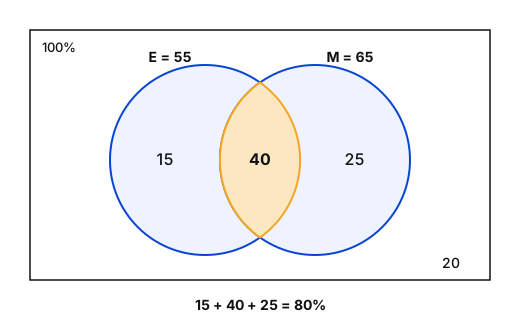
A school conducted a scholarship test where 55% of the students passed in English,65% passed in Math, and 40% passed in both subjects.What is the percentage of students who passed in at least one subject ?
एक विद्यालय ने एक छात्रवृत्ति परीक्षा आयोजित की, जिसमें 55% विद्यार्थी अंग्रेज़ी में, 65% विद्यार्थी गणित में तथा 40% विद्यार्थी दोनों विषयों में उत्तीर्ण हुए। कम से कम एक विषय में उत्तीर्ण होने वाले विद्यार्थियों का प्रतिशत कितना है?
  1. A80%
  2. B75%
  3. C90%
  4. D85%
Show answer

Concept: n(A ∪ B) = n(A) + n(B) − n(A ∩ B).

  1. At least one = 55 + 65 − 40.
  2. = 80%.

Yaad rakhein: Failed in both = 100 − 80 = 20% – a common follow-up question.

Answer: (A) 80%

अवधारणा: n(A ∪ B) = n(A) + n(B) − n(A ∩ B)।

हल:

  1. कम से कम एक में पास = 55 + 65 − 40।
  2. = 80%।

याद रखें: दोनों में फेल = 100 − 80 = 20% – यह भी अक्सर पूछा जाता है।

उत्तर: (A) 80%

SSC CHSLQuantitative AptitudePercentage – passed in at least one subjectSSC CHSL 2025 · 15 Nov Shift 1 →
Q4160.
P and Q invest ₹20,000 and ₹30,000 respectively. After 5 months, R joins with ₹40,000. What will be the ratio of their profits at the end of the year ?
P और Q क्रमशः ₹20,000 तथा ₹30,000 का निवेश करते हैं। 5 माह बाद R ₹40,000 के साथ सम्मिलित होता है। वर्ष के अंत में उनके लाभों का अनुपात क्या होगा?
  1. A5 : 6 : 7
  2. B6 : 7 : 5
  3. C7 : 9 : 6
  4. D6 : 9 : 7
Show answer

Concept: Profit ratio = capital × months.

  1. P: 20×12=240; Q: 30×12=360 (in thousands).
  2. R joins after 5 months → 7 months: 40×7=280.
  3. 240 : 360 : 280 = 6 : 9 : 7.

Trick: Drop the zeros and divide by a common factor early: 2×12:3×12:4×7 = 24 : 36 : 28 → ÷4.

Answer: (D) 6 : 9 : 7

अवधारणा: लाभ का अनुपात = पूँजी × महीने।

हल:

  1. P: 20×12=240; Q: 30×12=360 (हज़ार में)।
  2. R 5 महीने बाद आया → 7 महीने: 40×7=280।
  3. 240 : 360 : 280 = 6 : 9 : 7।

ट्रिक: शून्य हटाकर गुणा करें: 24 : 36 : 28 → 4 से भाग।

उत्तर: (D) 6 : 9 : 7

SSC CHSLQuantitative AptitudePartnership – different time periodsSSC CHSL 2025 · 15 Nov Shift 1 →