Question bank

Q&A: practice questions with answers

Search questions on any topic. Filter by exam category, exam, subject and topic, try the question, then open the answer and explanation.

Courses – airGurukul

5,000 questions found.

Directions (Qs. 18-22): Read the following passage carefully and answer the questions that follow.

Over the last decade, there has been a significant increase in housing costs across urban and suburban areas. Multiple elements add to this climb, including urbanization, low interest rates, rising material costs, and limited land availability. However, numerous property analysts claim that the present frenzy regarding property values is not solely grounded in economic logic but is partially fueled by the fear of missing out and aggressive marketing.

In many societies, homeownership carries social and personal prestige, particularly for growing families. This personal desire frequently results in rushed bidding wars whenever there is a slight dip in inventory, further driving the prices higher. Furthermore, with news outlets continuously broadcasting stories about soaring rents, the sense of competition or instability tends to trigger hasty purchases.

Although real estate is historically viewed as a "tangible asset" for building

wealth, advisors suggest prudence. Simply chasing the boom can lead to debt burdens that do not fit with future plans. A steady strategy, backed by financial assessment and professional counsel, is more advantageous than responding to fleeting spikes.
Q421.
What is the meaning of "tangible asset" as used in the passage?
  1. AA risky gamble
  2. BA debt that never ends
  3. CA physical item of value used to build wealth
  4. DA temporary rental
Show answer

Concept: Break the phrase into its words.

  1. Tangible = that can be touched, physical.
  2. Asset = something valuable owned.
  3. Passage calls real estate a tangible asset 'for building wealth' → a physical item of value.

Trick: Tangible ~ touch (Latin 'tangere'); real estate (house/land) is literally touchable.

Answer: (C) A physical item of value used to build wealth

अवधारणा: वाक्यांश को शब्दों में तोड़ें।

  1. Tangible = मूर्त, जिसे छुआ जा सके।
  2. Asset = मूल्यवान संपत्ति।
  3. गद्यांश में मकान/ज़मीन को धन बढ़ाने वाली मूर्त संपत्ति कहा गया है।

ट्रिक: Tangible ≈ touch; मकान-ज़मीन भौतिक रूप से छू सकते हैं।

उत्तर: (C) A physical item of value used to build wealth
SSC CHSLEnglish LanguagePhrase meaning – tangible assetSSC CHSL 2025 · 29 Nov Shift 2 →
Directions (Qs. 18-22): Read the following passage carefully and answer the questions that follow.

Over the last decade, there has been a significant increase in housing costs across urban and suburban areas. Multiple elements add to this climb, including urbanization, low interest rates, rising material costs, and limited land availability. However, numerous property analysts claim that the present frenzy regarding property values is not solely grounded in economic logic but is partially fueled by the fear of missing out and aggressive marketing.

In many societies, homeownership carries social and personal prestige, particularly for growing families. This personal desire frequently results in rushed bidding wars whenever there is a slight dip in inventory, further driving the prices higher. Furthermore, with news outlets continuously broadcasting stories about soaring rents, the sense of competition or instability tends to trigger hasty purchases.

Although real estate is historically viewed as a "tangible asset" for building

wealth, advisors suggest prudence. Simply chasing the boom can lead to debt burdens that do not fit with future plans. A steady strategy, backed by financial assessment and professional counsel, is more advantageous than responding to fleeting spikes.
Q422.
According to the passage, what is one reason behind the rise in housing prices besides economic factors?
  1. AA decrease in population growth
  2. BPersonal desire for social prestige
  3. CExcessive government regulations
  4. DA lack of interest in buying homes
Show answer

Concept: Separate economic and non-economic causes in the passage.

  1. Economic: urbanization, low interest rates, material costs, land shortage.
  2. Non-economic: homeownership gives social and personal prestige, leading to bidding wars.

Trick: Options (A), (C), (D) are never mentioned – eliminate quickly.

Answer: (B) Personal desire for social prestige

अवधारणा: आर्थिक और गैर-आर्थिक कारण अलग करें।

  1. आर्थिक: शहरीकरण, कम ब्याज दर, सामग्री लागत, भूमि की कमी।
  2. गैर-आर्थिक: घर का मालिक होना सामाजिक प्रतिष्ठा देता है → बोली की होड़।

ट्रिक: (A), (C), (D) गद्यांश में हैं ही नहीं – तुरंत हटाएँ।

उत्तर: (B) Personal desire for social prestige

SSC CHSLEnglish LanguageRC – non-economic causeSSC CHSL 2025 · 29 Nov Shift 2 →
Q423.
Rearrange the following sentence parts to form a meaningful and grammatically correct paragraph:
P. He plugged the router into the power source and connected it to the broadband line.
Q. He completed the on-screen instructions to set up the internet connection securely.
R. He linked all his digital devices to the newly established network.
S. He checked the internet speed to ensure the connection was stable and efficient.
  1. AS, Q, P, R
  2. BP, Q, R, S
  3. CQ, P, S, R
  4. DQ, R, P, S
Show answer

Concept: Arrange steps in the order they actually happen.

  1. P – plug in and connect router (first physical step).
  2. Q – follow on-screen setup.
  3. R – connect devices to the new network.
  4. S – test speed (final check).

Trick: Process sentences: hardware → setup → use → test. P first leaves only (B).

Answer: (B) P, Q, R, S

अवधारणा: काम का स्वाभाविक क्रम लगाएँ।

  1. P – router को बिजली व broadband से जोड़ना।
  2. Q – स्क्रीन निर्देश पूरे करना।
  3. R – डिवाइस नेटवर्क से जोड़ना।
  4. S – स्पीड जाँचना (अंतिम)।

ट्रिक: P से शुरू होने वाला एक ही विकल्प (B) है।

उत्तर: (B) P, Q, R, S

SSC CHSLEnglish LanguagePara jumble – router setupSSC CHSL 2025 · 29 Nov Shift 2 →
Q424.
Rearrange the following sentences to form a meaningful and grammatically correct paragraph:
P. In 1896, the discovery of gold in the Yukon sparked a massive wave of migration.
Q. Adventurers from many countries rushed in hopes of gaining quick wealth.
R. Only a small number of these fortune-seekers actually became rich.
S. As a result of this movement, several towns and settlements developed rapidly.
  1. AS, Q, R, P
  2. BP, Q, S, R
  3. CQ, P, R, S
  4. DR, Q, P, S
Show answer

Concept: Event → reaction → result → conclusion.

  1. P introduces the event (1896 gold discovery).
  2. Q – people rush in.
  3. S – 'As a result of this movement' → towns grow.
  4. R – 'these fortune-seekers' → only a few got rich (closing).

Trick: The opener has the date and the subject; 'this movement' and 'these' refer back.

Answer: (B) P, Q, S, R

अवधारणा: घटना → प्रतिक्रिया → परिणाम → निष्कर्ष।

  1. P – 1896 में सोने की खोज (शुरुआत)।
  2. Q – लोग दौड़ पड़े।
  3. S – 'As a result of this movement' → बस्तियाँ बनीं।
  4. R – 'these fortune-seekers' → कुछ ही अमीर बने।

ट्रिक: तारीख व मुख्य घटना वाला वाक्य पहला; 'this/these' पीछे के वाक्य से जुड़ते हैं।

उत्तर: (B) P, Q, S, R

SSC CHSLEnglish LanguagePara jumble – gold rushSSC CHSL 2025 · 29 Nov Shift 2 →
Q425.
What is the antonym of "Preventable" ?
  1. AAvoidable
  2. BIneluctable
  3. CImprobable
  4. DEscapable
Show answer

Concept: Opposite of 'can be stopped' is 'cannot be avoided'.

  1. Preventable = that can be avoided.
  2. Ineluctable = impossible to avoid, inevitable.
  3. Avoidable, Escapable are synonyms; Improbable = unlikely.

Trick: Two options mean the same as the word – drop both; the 'in-' negative word is the opposite.

Answer: (B) Ineluctable

अवधारणा: 'रोका जा सके' का उल्टा 'टाला न जा सके'।

  1. Preventable = जिसे रोका जा सके।
  2. Ineluctable = अपरिहार्य, जिससे बचा न जा सके।
  3. Avoidable, Escapable समानार्थी हैं; Improbable = असंभावित।

ट्रिक: दो विकल्प समानार्थी हैं – हटाएँ; 'in-' वाला शब्द उल्टा है।

उत्तर: (B) Ineluctable

SSC CHSLEnglish LanguageAntonym – preventableSSC CHSL 2025 · 29 Nov Shift 2 →
Q426.
A series is given with one term missing. Select the correct alternative from the given ones that will complete the series.
5, 9, 17, 33,65, ?, 257
एक शृंखला दी गई है जिसमें एक पद लुप्त है। दिए गए विकल्पों में से वह सही विकल्प चुनिए जो शृंखला को पूर्ण करेगा।
5, 9, 17, 33,65, ?, 257
  1. A122
  2. B129
  3. C124
  4. D126
Show answer

Concept: Each term = previous×2−1.

  1. 5 → 9 → 17 → 33 → 65: each is double minus 1 (e.g. 33×2=66, 66−1=65).
  2. Missing term = 65×2−1= 129.
  3. Check: 129×2−1=257 ✓

Trick: Differences 4, 8, 16, 32 double → next difference 64; 65+64=129.

Answer: (B) 129

अवधारणा: हर पद = पिछला×2−1।

  1. 5, 9, 17, 33, 65 – हर बार दुगना करके 1 घटाया (33×2=66→65)।
  2. अगला पद = 65×2−1= 129।
  3. जाँच: 129×2−1=257 ✓

ट्रिक: अंतर 4, 8, 16, 32 दुगने होते हैं → अगला अंतर 64; 65+64=129।

उत्तर: (B) 129

SSC CHSLGeneral IntelligenceSeries – ×2 − 1SSC CHSL 2025 · 29 Nov Shift 2 →
Q427.
If 25!30=−25 and 8!24=−80, then what is the value of 4!16 ?
यदि 25!30=−25 तथा 8!24=−80 है, तो 4!16 का मान क्या होगा ?
  1. A-60
  2. B-95
  3. C-90
  4. D-85
Show answer

Concept: Find one rule that fits both given examples.

  1. 25 ! 30: difference = −5, and −5×5=−25 ✓
  2. 8 ! 24: difference = −16, and −16×5=−80 ✓
  3. 4 ! 16: (4−16)×5=−12×5= −60.

Trick: Result ÷ difference is the same (5) in both examples – that fixed multiplier is the rule.

Answer: (A) -60

अवधारणा: दोनों उदाहरणों पर लागू एक नियम खोजें।

  1. 25 ! 30: अंतर −5, −5×5=−25 ✓
  2. 8 ! 24: अंतर −16, −16×5=−80 ✓
  3. 4 ! 16 = (4−16)×5=−12×5= −60।

ट्रिक: परिणाम ÷ अंतर दोनों में 5 है – यही गुणक नियम है।

उत्तर: (A) -60

SSC CHSLGeneral IntelligenceCoded operation – (a − b) × 5SSC CHSL 2025 · 29 Nov Shift 2 →
Q428.
If 15$7=420 and 30$18=2160, then what is the value of 50$20 ?
यदि 15$7=420 तथा 30$18=2160 है, तो 50$20 का मान क्या होगा ?
  1. A4520
  2. B4512
  3. C4000
  4. D4508
Show answer

Concept: Compare the result with the product of the two numbers.

  1. 15×7=105; 420÷105=4.
  2. 30×18=540; 2160÷540=4.
  3. 50 $ 20 =50×20×4= 4000.

Trick: Answer must be a multiple of 1000 (50×20=1000) → only 4000.

Answer: (C) 4000

अवधारणा: परिणाम की तुलना दोनों संख्याओं के गुणनफल से करें।

  1. 15×7=105; 420÷105=4।
  2. 30×18=540; 2160÷540=4।
  3. 50 $ 20 =50×20×4= 4000।

ट्रिक: 50×20=1000, इसलिए उत्तर 1000 का गुणज होगा → केवल 4000।

उत्तर: (C) 4000

SSC CHSLGeneral IntelligenceCoded operation – product × 4SSC CHSL 2025 · 29 Nov Shift 2 →
Q429.
Find the next element that replace the ? Logically
8, 19, 41, 85, ?
वह अगला पद ज्ञात कीजिए जो तार्किक रूप से ? के स्थान पर आएगा
8, 19, 41, 85, ?
  1. A128
  2. B173
  3. C132
  4. D131
Show answer

Concept: Each term = previous×2+3.

  1. 8 → 19 → 41 → 85 (e.g. 41×2=82, +3=85).
  2. Next = 85×2+3=170+3= 173.

Trick: Gaps 11, 22, 44 double → next gap 88; 85+88=173.

Answer: (B) 173

अवधारणा: हर पद = पिछला×2+3।

  1. 8, 19, 41, 85 (41×2=82, +3=85)।
  2. अगला = 85×2+3= 173।

ट्रिक: अंतर 11, 22, 44 → अगला 88; 85+88=173।

उत्तर: (B) 173

SSC CHSLGeneral IntelligenceSeries – ×2 + 3SSC CHSL 2025 · 29 Nov Shift 2 →
Q430.
Find the next element that replace the ? Logically
20, 84, 340, 1364, ?
वह अगला पद ज्ञात कीजिए जो तार्किक रूप से ? के स्थान पर आएगा
20, 84, 340, 1364, ?
  1. A5908
  2. B5460
  3. C5900
  4. D5890
Show answer

Concept: Each term = previous×4+4.

  1. 20 → 84 → 340 → 1364: multiply by 4, then add 4 (e.g. 340×4=1360, +4).
  2. Next = 1364×4+4=5456+4= 5460.

Trick: Ratio ≈ 4 each time: 1364×4=5456, and the option just above it is 5460.

Answer: (B) 5460

अवधारणा: हर पद = पिछला×4+4।

  1. 20 → 84 → 340 → 1364 (हर बार ×4 फिर +4)।
  2. अगला = 1364×4+4=5456+4= 5460।

ट्रिक: 1364×4≈5456, इसके ठीक पास वाला विकल्प 5460 ही है।

उत्तर: (B) 5460

SSC CHSLGeneral IntelligenceSeries – ×4 + 4SSC CHSL 2025 · 29 Nov Shift 2 →
Q431.
Which of the following will come next to the series ?
A, B, D, H, ?
निम्नलिखित में से कौन-सा शृंखला में आगे आएगा ?
A, B, D, H, ?
  1. AX
  2. BP
  3. CU
  4. DM
Show answer

Concept: Convert letters to alphabet positions.

  1. A = 1, B = 2, D = 4, H = 8 → positions double.
  2. Next position = 16 → P.

Trick: EJOTY positions: E5, J10, O15, T20 – so 16 is just after O = P.

Answer: (B) P

अवधारणा: अक्षरों को वर्णमाला क्रमांक में बदलें।

  1. A = 1, B = 2, D = 4, H = 8 → हर बार दुगना।
  2. अगला = 16 → P।

ट्रिक: EJOTY: E5, J10, O15, T20 – O(15) के बाद 16 = P।

उत्तर: (B) P

SSC CHSLGeneral IntelligenceLetter series – doubling positionsSSC CHSL 2025 · 29 Nov Shift 2 →
Q432.
Five people A, B, C, D, and E have different heights. C is taller than only two people. E is the tallest. B is taller than D but shorter than E. How many people are taller than C but shorter than the tallest person?
पाँच व्यक्तियों A, B, C, D तथा E की लंबाइयाँ भिन्न-भिन्न हैं। C केवल दो व्यक्तियों से लंबा है। E सबसे लंबा है। B, D से लंबा है परन्तु E से छोटा है। कितने व्यक्ति C से लंबे हैं परन्तु सबसे लंबे व्यक्ति से छोटे हैं?
  1. A1
  2. B2
  3. C3
  4. D0
Show answer

Concept: Place people from tallest to shortest.

  1. E is tallest → 1st.
  2. C taller than only two → C is 3rd.
  3. So exactly one person (A or B) is 2nd – between E and C.

Trick: Taller than only 2 of 5 → rank 3; between rank 1 and rank 3 sits just one place.

Answer: (A) 1

अवधारणा: सबसे लंबे से छोटे तक क्रम बनाएं।

  1. E सबसे लंबा → पहला।
  2. C केवल दो से लंबा → C तीसरा।
  3. इसलिए E और C के बीच सिर्फ एक व्यक्ति (दूसरा स्थान) है।

ट्रिक: 5 में केवल 2 से लंबा = तीसरा स्थान; 1 और 3 के बीच एक ही स्थान।

उत्तर: (A) 1

SSC CHSLGeneral IntelligenceRanking – heightsSSC CHSL 2025 · 29 Nov Shift 2 →
Q433.
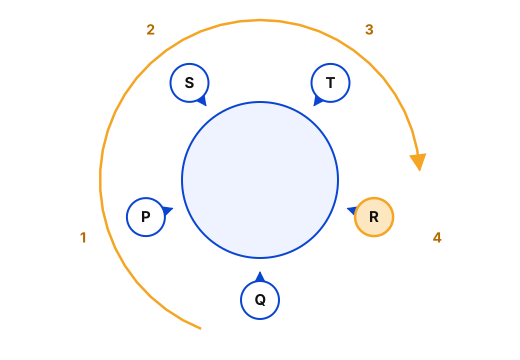
5 persons P, Q, R, S and T are sitting around a circular table facing towards the centre (not necessarily in the same order). R is not an immediate neighbour of S or P.Q is sitting second to the left of T. P is sitting second to the left of R. Who is sitting fourth to the left of Q?
5 व्यक्ति P, Q, R, S तथा T एक वृत्ताकार मेज़ के चारों ओर केंद्र की ओर मुख करके बैठे हैं (आवश्यक नहीं कि इसी क्रम में)। R, S का निकटतम पड़ोसी नहीं है अथवा P.Q, T के बाईं ओर दूसरे स्थान पर बैठा है। P, R के बाईं ओर दूसरे स्थान पर बैठा है। Q के बाईं ओर चौथे स्थान पर कौन बैठा है?
  1. AQ
  2. BP
  3. CR
  4. DS
Show answer

Concept: Facing centre: moving left = moving clockwise.

  1. Fix T; Q sits 2 places to T's left.
  2. P is 2nd left of R and R must not touch P or S → only fit: R just left of T, then Q, P, S.
  3. Order (clockwise): T, R, Q, P, S. Four places left of Q: P, S, T, R.

Trick: In a circle of 5, 4th to the left = 1st to the right. Q's right neighbour is R.

Answer: (C) R

अवधारणा: केंद्र की ओर मुख – बाएँ = घड़ी की दिशा।

  1. T रखें; Q उसके बाएँ दूसरे स्थान पर।
  2. P, R के बाएँ दूसरा और R का पड़ोसी P/S नहीं → R, T के ठीक बाएँ।
  3. क्रम: T, R, Q, P, S। Q से बाएँ चार स्थान: P, S, T, R।

ट्रिक: 5 लोगों में बाएँ चौथा = दाएँ पहला। Q के दाएँ R है।

उत्तर: (C) R

SSC CHSLGeneral IntelligenceCircular seating – facing centreSSC CHSL 2025 · 29 Nov Shift 2 →
Q434.
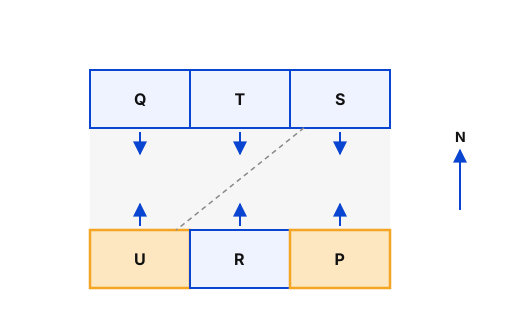
There are 6 flats on a floor in two rows (three in each row opposite to each other). Flats of one row are facing north. Flats of other row are facing south. These flats are alloted to P, Q, R, S, T and U. S and U get diagonally opposite flats. U's flat is next to R's flat. R gets a north facing flat. The direction in which the flats of Q and T are facing is same. Q's flat is not next to S. Which of the following pair represents people having a north facing flat ?
एक मंज़िल पर दो पंक्तियों में 6 फ्लैट हैं (प्रत्येक पंक्ति में तीन, एक-दूसरे के सामने)। एक पंक्ति के फ्लैट उत्तर की ओर मुख किए हुए हैं। दूसरी पंक्ति के फ्लैट दक्षिण की ओर मुख किए हुए हैं। ये फ्लैट P, Q, R, S, T तथा U को आवंटित किए गए हैं। S तथा U को विकर्णतः आमने-सामने वाले फ्लैट मिलते हैं। U का फ्लैट R के फ्लैट के बगल में है। R को उत्तर की ओर मुख वाला फ्लैट मिलता है। Q तथा T के फ्लैट जिस दिशा की ओर मुख किए हुए हैं, वह समान है। Q का फ्लैट S के बगल में नहीं है। निम्नलिखित में से कौन-सा युग्म उत्तर की ओर मुख वाले फ्लैट रखने वाले व्यक्तियों को दर्शाता है ?
  1. AQT
  2. BUT
  3. CUP
  4. DQS
Show answer

Concept: Fill rows using the fixed clues first.

  1. R faces north; U is next to R → U also north.
  2. Q and T face the same way → they must take the south row (north has only one seat left).
  3. S is diagonal to U → S is in the other (south) row. Left over for north: P.

Trick: North row = R, U, P. Options with Q, T or S are out at once.

Answer: (C) UP

अवधारणा: पक्की शर्तों से पंक्तियाँ भरें।

  1. R उत्तरमुखी; U उसके बगल में → U भी उत्तर।
  2. Q और T एक ही दिशा → दक्षिण पंक्ति (उत्तर में एक ही जगह बची)।
  3. S, U के विकर्ण → दक्षिण में। उत्तर में बचा P।

ट्रिक: उत्तर पंक्ति = R, U, P। Q, T, S वाले विकल्प तुरंत बाहर।

उत्तर: (C) UP

SSC CHSLGeneral IntelligenceFlats – north/south rowsSSC CHSL 2025 · 29 Nov Shift 2 →
Q435.
Select the option that is related to the fourth number in the same way as the first number is related to the second number and fifth number is related to sixth number.
(NOTE: Operations should be performed on the whole numbers, without breaking down the numbers into its constituent digits. E.g. 13 - Operations on 13 such as adding /subtracting /multiplying etc. to 13 can be performed. Breaking down 13 into 1 and 3 and then performing mathematical operations on 1 and 3 is not allowed)
2511 : 3461 :: ? : 4874 :: 7674 : 8624
उस विकल्प का चयन कीजिए जो चौथी संख्या से उसी प्रकार संबंधित है, जिस प्रकार पहली संख्या दूसरी संख्या से तथा पाँचवीं संख्या छठी संख्या से संबंधित है।
(नोट: संक्रियाएँ पूर्ण संख्याओं पर की जानी चाहिए, संख्याओं को उनके अंकों में तोड़े बिना। उदा. 13 - 13 पर जोड़ना/घटाना/गुणा करना आदि जैसी संक्रियाएँ की जा सकती हैं। 13 को 1 तथा 3 में तोड़कर फिर 1 तथा 3 पर गणितीय संक्रियाएँ करना अनुमत नहीं है)
2511 : 3461 :: ? : 4874 :: 7674 : 8624
  1. A3035
  2. B3047
  3. C3924
  4. D3076
Show answer

Concept: Find the constant link in the complete pairs.

  1. 3461 − 2511 = 950; 8624 − 7674 = 950.
  2. So second = first + 950.
  3. ? = 4874 − 950 = 3924.

Trick: Unit digit: 4874 − 950 ends in 4 – only 3924 ends in 4.

Answer: (C) 3924

अवधारणा: पूर्ण युग्मों में स्थिर संबंध खोजें।

  1. 3461 − 2511 = 950; 8624 − 7674 = 950।
  2. दूसरी = पहली + 950।
  3. ? = 4874 − 950 = 3924।

ट्रिक: इकाई अंक: 4874 − 950 का अंतिम अंक 4 – केवल 3924।

उत्तर: (C) 3924

SSC CHSLGeneral IntelligenceNumber analogy – +950SSC CHSL 2025 · 29 Nov Shift 2 →
Q436.
Select the option that is related to the fifth number in the same way as the second number is related to the first number and fourth number is related to third number.
(NOTE: Operations should be performed on the whole numbers, without breaking down the numbers into its constituent digits. E.g. 13 - Operations on 13 such as adding /subtracting /multiplying etc. to 13 can be performed. Breaking down 13 into 1 and 3 and then performing mathematical operations on 1 and 3 is not allowed)
3480 : 577 :: 4206 : 698 : 2160 : ?
उस विकल्प का चयन कीजिए जो पाँचवीं संख्या से उसी प्रकार संबंधित है, जिस प्रकार दूसरी संख्या पहली संख्या से तथा चौथी संख्या तीसरी संख्या से संबंधित है।
(नोट: संक्रियाएँ पूर्ण संख्याओं पर की जानी चाहिए, संख्याओं को उनके अंकों में तोड़े बिना। उदा. 13 - 13 पर जोड़ना/घटाना/गुणा करना आदि जैसी संक्रियाएँ की जा सकती हैं। 13 को 1 तथा 3 में तोड़कर फिर 1 तथा 3 पर गणितीय संक्रियाएँ करना अनुमत नहीं है)
3480 : 577 :: 4206 : 698 : 2160 : ?
  1. A357
  2. B360
  3. C354
  4. D352
Show answer

Concept: Second number is about one-sixth of the first.

  1. 3480÷6=580 → 580−3=577 ✓
  2. 4206÷6=701 → 701−3=698 ✓
  3. 2160÷6=360 → 360−3= 357.

Trick: Ratio test: 3480577≈6 tells you to divide by 6 first, then fix the small gap.

Answer: (A) 357

अवधारणा: दूसरी संख्या पहली की लगभग छठवाँ भाग है।

  1. 3480÷6=580, 580−3=577 ✓
  2. 4206÷6=701, 701−3=698 ✓
  3. 2160÷6=360, 360−3= 357।

ट्रिक: अनुपात ≈ 6 देखकर पहले 6 से भाग दें, फिर छोटा अंतर ठीक करें।

उत्तर: (A) 357

SSC CHSLGeneral IntelligenceNumber analogy – ÷6 − 3SSC CHSL 2025 · 29 Nov Shift 2 →
Q437.
By interchanging the given two signs which of the following equation will NOT be correct?
 and ÷
l. 50+10−5÷15×2=22
li. 20+40÷38−19×3=63
दिए गए दो चिह्नों को आपस में बदलने पर निम्नलिखित में से कौन-सा समीकरण सही नहीं होगा?
तथा ÷
l. 50+10−5÷15×2=22
li. 20+40÷38−19×3=63
  1. AOnly Iकेवल I
  2. BOnly IIकेवल II
  3. CBoth I and III तथा II दोनों
  4. DNeither I nor IIन तो I और न ही II
Show answer

Concept: Swap the two signs, then apply BODMAS.

  1. I: 50+10÷5−15×2=50+2−30=22 ✓ (correct).
  2. II: 20+40−38÷19×3=60−6=54≠63 ✗.
  3. So the equation that is NOT correct is only II.

Trick: Do ÷ and × first; additions last – quick mental check.

Answer: (B) Only II

अवधारणा: दोनों चिह्न बदलें, फिर BODMAS लगाएँ।

  1. I: 50+10÷5−15×2=50+2−30=22 ✓
  2. II: 20+40−38÷19×3=60−6=54≠63 ✗
  3. अतः केवल II सही नहीं है।

ट्रिक: पहले ÷ और ×, अंत में जोड़-घटाव।

उत्तर: (B) केवल II

SSC CHSLGeneral IntelligenceSign interchange (− and ÷)SSC CHSL 2025 · 29 Nov Shift 2 →
Q438.
Select the correct combination of mathematical signs to replace (*) signs sequentially and to balance the given equation.
250∗5∗3∗50∗20=180
(*) चिह्नों को क्रमानुसार प्रतिस्थापित करने तथा दिए गए समीकरण को संतुलित करने के लिए गणितीय चिह्नों के सही संयोजन का चयन कीजिए।
250∗5∗3∗50∗20=180
  1. A×,÷,+
  2. B,+÷,x1−
  3. C÷,×,+,−
  4. D,x1÷,+
Show answer

Concept: Insert signs in order and solve with BODMAS.

  1. With ÷, ×, +, −: 250÷5×3+50−20.
  2. 250÷5=50; 50×3=150.
  3. 150+50−20= 180 ✓

Trick: 250 must shrink to near 180 – start by trying '÷' in the first place.

Answer: (C) ÷,×,+,−

अवधारणा: चिह्न क्रम से रखें और BODMAS से हल करें।

  1. ÷, ×, +, − रखने पर: 250÷5×3+50−20।
  2. 250÷5=50; 50×3=150।
  3. 150+50−20= 180 ✓

ट्रिक: 250 को 180 के पास लाने के लिए पहले स्थान पर '÷' आज़माएँ।

उत्तर: (C) ÷,×,+,−

SSC CHSLGeneral IntelligenceSigns to balance equationSSC CHSL 2025 · 29 Nov Shift 2 →
Q439.
In the following question, select the odd letter-number cluster from the given alternatives.
(NOTE: Operations should be performed on the whole numbers, without breaking down the number into its constituent digits. E.g. 13 - Operations on 13 such as adding /subtracting /multiplying etc. to 13 can be performed. Breaking down 13 into 1 and 3 and then performing mathematical operations on 1 and 3 is not allowed)
निम्नलिखित प्रश्न में, दिए गए विकल्पों में से विषम अक्षर-संख्या समूह का चयन कीजिए।
(नोट: संक्रियाएँ पूर्ण संख्याओं पर की जानी चाहिए, संख्या को उसके अंकों में तोड़े बिना। उदा. 13 - 13 पर जोड़ना/घटाना/गुणा करना आदि जैसी संक्रियाएँ की जा सकती हैं। 13 को 1 तथा 3 में तोड़कर फिर 1 तथा 3 पर गणितीय संक्रियाएँ करना अनुमत नहीं है)
  1. ASDTR61
  2. BQTVS78
  3. CGTRD49
  4. DTFRE50
Show answer

Concept: Number = sum of the letters' alphabet positions.

  1. SDTR: 19 + 4 + 20 + 18 = 61 ✓; QTVS: 17 + 20 + 22 + 19 = 78 ✓
  2. GTRD: 7 + 20 + 18 + 4 = 49 ✓
  3. TFRE: 20 + 6 + 18 + 5 = 49, but shows 50 ✗

Trick: Remember EJOTY (5, 10, 15, 20, 25) to get positions fast.

Answer: (D) TFRE50

अवधारणा: संख्या = अक्षरों के क्रमांकों का योग।

  1. SDTR = 61 ✓, QTVS = 78 ✓, GTRD = 49 ✓
  2. TFRE: 20 + 6 + 18 + 5 = 49, पर दिया 50 ✗

ट्रिक: EJOTY (5, 10, 15, 20, 25) से क्रमांक जल्दी निकालें।

उत्तर: (D) TFRE50

SSC CHSLGeneral IntelligenceOdd cluster – letter sumSSC CHSL 2025 · 29 Nov Shift 2 →
Q440.
In the following question, four letter-number pairs are given. The letter-number on the left side of ( - ) is related to the letter-number on the right side of (⋅) with some Logic / Rule /Relation. Three pairs are similar on the basis of same Logic/Rule/Relation. Select the odd one out from the given alternatives.
(NOTE: Operations should be performed on the whole numbers, without breaking down the number into its constituent digits. E.g. 13 - Operations on 13 such as adding /subtracting /multiplying etc. to 13 can be performed. Breaking down 13 into 1 and 3 and then performing mathematical operations on 1 and 3 is not allowed)
निम्नलिखित प्रश्न में, चार अक्षर-संख्या युग्म दिए गए हैं। ( - ) के बाईं ओर की अक्षर-संख्या, (⋅) के दाईं ओर की अक्षर-संख्या से किसी तर्क/नियम/संबंध द्वारा संबंधित है। तीन युग्म समान तर्क/नियम/संबंध पर आधारित हैं। दिए गए विकल्पों में से विषम युग्म का चयन कीजिए।
(नोट: संक्रियाएँ पूर्ण संख्याओं पर की जानी चाहिए, संख्या को उसके अंकों में तोड़े बिना। उदा. 13 - 13 पर जोड़ना/घटाना/गुणा करना आदि जैसी संक्रियाएँ की जा सकती हैं। 13 को 1 तथा 3 में तोड़कर फिर 1 तथा 3 पर गणितीय संक्रियाएँ करना अनुमत नहीं है)
  1. AWE240 - BK610
  2. BMQ310 - RW680
  3. CTL420 - YR770
  4. DCI370 - HO740
Show answer

Concept: Check letter shifts and number difference in each pair.

  1. All pairs: 1st letter +5, 2nd letter +6.
  2. Number gap: 610 − 240, 680 − 310, 740 − 370 all = 370.
  3. TL420 → YR770: gap = 350 ✗

Trick: Letters all match here, so test only the numbers – saves time.

Answer: (C) TL420 - YR770

अवधारणा: हर युग्म में अक्षर-खिसकाव और संख्या-अंतर देखें।

  1. सभी में पहला अक्षर +5, दूसरा +6।
  2. अंतर: 610 − 240, 680 − 310, 740 − 370 = 370।
  3. TL420 → YR770: अंतर 350 ✗

ट्रिक: अक्षर सब में समान हैं, केवल संख्याएँ जाँचें।

उत्तर: (C) TL420 - YR770

SSC CHSLGeneral IntelligenceOdd pair – letter shift & number gapSSC CHSL 2025 · 29 Nov Shift 2 →