Question bank

Q&A: practice questions with answers

Search questions on any topic. Filter by exam category, exam, subject and topic, try the question, then open the answer and explanation.

Courses – airGurukul

5,000 questions found.

Q541.
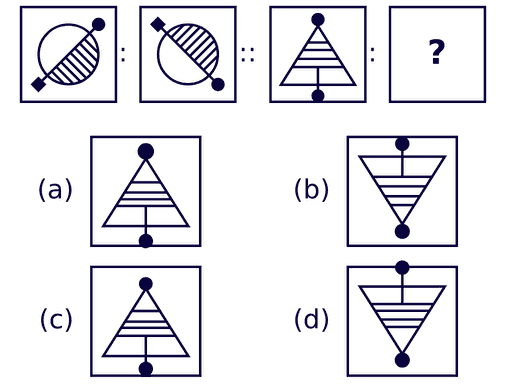
Two figures given on the left side of (::) are related with some logic/rule/relation. Select the missing figure on the right side of (:) from the given alternatives based on the same logic/rule/relation.
figure
(::) के बाईं ओर दी गई दो आकृतियाँ किसी तर्क/नियम/संबंध से संबंधित हैं। उसी तर्क/नियम/संबंध के आधार पर दिए गए विकल्पों में से (:) के दाईं ओर की लुप्त आकृति का चयन कीजिए।
figure
  1. A
  2. B
  3. C
  4. D
Show answer

Concept: The second figure is the first flipped about a horizontal line (top ↔ bottom).

  1. In pair 1, the parts at the top go to the bottom and vice versa; left-right positions stay the same.
  2. Flip the third figure the same way: the upright triangle becomes inverted, its top dot goes to the bottom vertex and the stem with the other dot now points upward.
  3. This matches option (B).

Trick: In a top-bottom flip, nothing moves sideways — reject options where elements shift left or right.

Answer: (B) Option (B)

अवधारणा: दूसरी आकृति, पहली को क्षैतिज रेखा के सापेक्ष पलटने (ऊपर ↔ नीचे) से बनी है।

  1. जोड़ा 1 में ऊपर के भाग नीचे और नीचे के ऊपर चले गए; बाएँ-दाएँ स्थिति वही रही।
  2. तीसरी आकृति को भी ऐसे पलटें: सीधा त्रिभुज उल्टा, ऊपर का बिंदु नीचे के शीर्ष पर और दूसरी डंडी ऊपर की ओर।
  3. यह विकल्प (B) से मेल खाता है।

ट्रिक: ऊपर-नीचे पलटने में कोई भाग बाएँ-दाएँ नहीं खिसकता — ऐसे विकल्प हटा दें।

उत्तर: (B) विकल्प (B)
SSC CHSLGeneral IntelligenceFigure analogy – water image (flip)SSC CHSL 2025 · 29 Nov Shift 1 →
Q542.
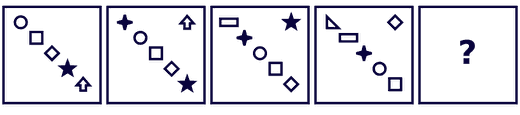
In the following figure series, select the figure which can be placed at the sign of question mark (?) from the given alternatives.
figure
निम्नलिखित आकृति-शृंखला में, दिए गए विकल्पों में से उस आकृति का चयन कीजिए जिसे प्रश्नवाचक चिह्न (?) के स्थान पर रखा जा सकता है।
figure
  1. A________ (b) ____ O
  2. B____ O____ (d) ____口
  3. C____
  4. D____口
Show answer

Concept: Track how the row of shapes on the diagonal shifts from one figure to the next.

  1. Each step, the five diagonal shapes slide one place towards the bottom-right.
  2. The shape that falls off the end goes to the top-right corner; a new shape enters at the top-left.
  3. Figure 4: triangle, bar, 4-point star, circle, square on the diagonal → in figure 5 the square leaves to the corner and the rest shift down → option (D).

Trick: Only the corner shape needs checking: it is always the last shape of the previous diagonal — here the square (口).

Answer: (D) ____口

अवधारणा: तिरछी रेखा पर रखी आकृतियाँ हर चरण में कैसे खिसकती हैं, यह देखें।

  1. हर चरण में पाँचों आकृतियाँ एक स्थान नीचे-दाएँ खिसकती हैं।
  2. अंत से निकली आकृति ऊपर-दाएँ कोने में जाती है; ऊपर-बाएँ नई आकृति आती है।
  3. आकृति 4: त्रिभुज, डंडी, 4-कोनी तारा, वृत्त, वर्ग → आकृति 5 में वर्ग कोने में जाएगा और बाकी नीचे खिसकेंगी → विकल्प (D)।

ट्रिक: केवल कोने वाली आकृति जाँचें: वह पिछली आकृति की अंतिम आकृति (यहाँ वर्ग 口) होती है।

उत्तर: (D) ____口

SSC CHSLGeneral IntelligenceFigure series – sliding chainSSC CHSL 2025 · 29 Nov Shift 1 →
Q543.
After interchanging the given two signs, what will be the value of the given equation?
 and ÷
40+20×15−5÷5= ?
दिए गए दो चिह्नों को आपस में बदलने पर, दिए गए समीकरण का मान क्या होगा?
और ÷
40+20×15−5÷5= ?
  1. A85
  2. B90
  3. C100
  4. D95
Show answer

Concept: Swap the two given signs (− and ÷) everywhere, then solve by BODMAS.

  1. 40+20×15−5÷5 → 40+20×15÷5−5.
  2. 20×15÷5=300÷5=60.
  3. 40+60−5 = 95.

Trick: Rewrite the whole expression after swapping before calculating — most errors come from swapping only one sign.

Answer: (D) 95

अवधारणा: दिए गए दोनों चिह्न (− और ÷) हर जगह आपस में बदलें, फिर BODMAS से हल करें।

  1. 40+20×15−5÷5 → 40+20×15÷5−5।
  2. 20×15÷5=300÷5=60।
  3. 40+60−5 = 95।

ट्रिक: गणना से पहले पूरा व्यंजक बदलकर लिखें — गलती अक्सर एक ही चिह्न बदलने से होती है।

उत्तर: (D) 95

SSC CHSLGeneral IntelligenceSign interchange – BODMASSSC CHSL 2025 · 29 Nov Shift 1 →
Q544.
Select the correct combination of mathematical signs to replace (*) signs sequentially and to balance the given equation.
24∗4∗30∗6∗7=94
(*) चिह्नों को क्रमानुसार प्रतिस्थापित करने तथा दिए गए समीकरण को संतुलित करने के लिए गणितीय चिह्नों के सही संयोजन का चयन कीजिए।
24∗4∗30∗6∗7=94
  1. A×,+,÷,
  2. B+,+,,x
  3. C×,+,+
  4. D,+÷,×,−
Show answer

Concept: Insert the signs in order and evaluate with BODMAS.

  1. Using ×, +, ÷, −: 24×4+30÷6−7.
  2. 24×4=96; 30÷6=5.
  3. 96+5−7 = 94 ✓.

Trick: 94 is close to 24×4=96, so the first sign is likely ×; then you need +5−7, i.e. 30÷6.

Answer: (A) ×,+,÷,

अवधारणा: चिह्नों को क्रम से रखें और BODMAS से जाँचें।

  1. ×, +, ÷, − लगाने पर: 24×4+30÷6−7।
  2. 24×4=96; 30÷6=5।
  3. 96+5−7 = 94 ✓।

ट्रिक: 94, 24×4=96 के पास है — पहला चिह्न × लगेगा; फिर +5−7 चाहिए यानी 30÷6।

उत्तर: (A) ×,+,÷,

SSC CHSLGeneral IntelligenceBalancing an equation with signsSSC CHSL 2025 · 29 Nov Shift 1 →
Q545.
In the following question, four letter-number pairs are given. The letter-number on the left side of (−) is related to the letter-number on the right side of (-) with some Logic/Rule/Relation. Three pairs are similar on the basis of same Logic/Rule/Relation. Select the odd one out from the given alternatives.
(NOTE: Operations should be performed on the whole numbers, without breaking down the number into its constituent digits. E.g. 13 - Operations on 13 such as adding /subtracting /multiplying etc. to 13 can be performed. Breaking down 13 into 1 and 3 and then performing mathematical operations on 1 and 3 is not allowed)
निम्नलिखित प्रश्न में चार अक्षर-संख्या युग्म दिए गए हैं। (−) के बाईं ओर की अक्षर-संख्या, (-) के दाईं ओर की अक्षर-संख्या से किसी तर्क/नियम/संबंध द्वारा संबंधित है। तीन युग्म उसी तर्क/नियम/संबंध के आधार पर समान हैं। दिए गए विकल्पों में से विषम युग्म का चयन कीजिए।
(नोट: संक्रियाएँ पूर्ण संख्याओं पर की जानी चाहिए, संख्या को उसके अंकों में विभाजित किए बिना। उदाहरण के लिए 13 - 13 पर की जाने वाली संक्रियाएँ जैसे 13 में जोड़ना/घटाना/गुणा करना आदि की जा सकती हैं। 13 को 1 और 3 में विभाजित करके 1 और 3 पर गणितीय संक्रियाएँ करने की अनुमति नहीं है।)
  1. ATB287 - SZ581
  2. BQL320 - PJ604
  3. CFC231 - EA525
  4. DUH410 - TF704
Show answer

Concept: Check letters and numbers separately; the pair that breaks either rule is odd.

  1. Letters: 1st letter −1, 2nd letter −2 in all pairs (T→S, B→Z; Q→P, L→J …).
  2. Numbers: 287 + 294 = 581; 231 + 294 = 525; 410 + 294 = 704.
  3. But 320 + 294 = 614 ≠ 604 → QL320 – PJ604 is odd.

Trick: If the letters agree everywhere, go straight to the numbers — just compare the difference in each pair.

Answer: (B) QL320 - PJ604

अवधारणा: अक्षर और संख्या अलग-अलग जाँचें; जो युग्म किसी नियम को तोड़े वही विषम।

  1. अक्षर: सभी में पहला अक्षर −1, दूसरा −2 (T→S, B→Z; Q→P, L→J …)।
  2. संख्या: 287 + 294 = 581; 231 + 294 = 525; 410 + 294 = 704।
  3. पर 320 + 294 = 614 ≠ 604 → QL320 – PJ604 विषम।

ट्रिक: अक्षर सब में समान हों तो सीधे संख्याओं का अंतर देखें।

उत्तर: (B) QL320 - PJ604

SSC CHSLGeneral IntelligenceOdd one out – letter-number pairsSSC CHSL 2025 · 29 Nov Shift 1 →
Q546.
In the following question, four letter-number pairs are given. The letter-number on the left side of (-) is related to the letter-number on the right side of (-) with some Logic/Rule/Relation. Three pairs are similar on the basis of same Logic/Rule/Relation. Select the odd one out from the given alternatives.
(NOTE: Operations should be performed on the whole numbers, without breaking down the number into its constituent digits. E.g. 13 - Operations on 13 such as adding /subtracting /multiplying etc. to 13 can be performed. Breaking down 13 into 1 and 3 and then performing mathematical operations on 1 and 3 is not allowed)
निम्नलिखित प्रश्न में चार अक्षर-संख्या युग्म दिए गए हैं। (-) के बाईं ओर की अक्षर-संख्या, (-) के दाईं ओर की अक्षर-संख्या से किसी तर्क/नियम/संबंध द्वारा संबंधित है। तीन युग्म उसी तर्क/नियम/संबंध के आधार पर समान हैं। दिए गए विकल्पों में से विषम युग्म का चयन कीजिए।
(नोट: संक्रियाएँ पूर्ण संख्याओं पर की जानी चाहिए, संख्या को उसके अंकों में विभाजित किए बिना। उदाहरण के लिए 13 - 13 पर की जाने वाली संक्रियाएँ जैसे 13 में जोड़ना/घटाना/गुणा करना आदि की जा सकती हैं। 13 को 1 और 3 में विभाजित करके 1 और 3 पर गणितीय संक्रियाएँ करने की अनुमति नहीं है।)
  1. ARC206-OW617
  2. BLA194 - IU581
  3. CKS187 - HM560
  4. DER313 - BN939
Show answer

Concept: Find the common letter shift and number rule from the majority.

  1. Letters: 1st letter −3, 2nd letter −6 (R→O, C→W; L→I, A→U; K→H, S→M).
  2. Numbers: × 3 − 1: 206 → 617, 194 → 581, 187 → 560.
  3. ER313 – BN939: R→N is only −4, and 313×3−1=938≠939 → odd.

Trick: Backward shift past A: count C, B, A, Z, Y, X, W — or use C(3)−6+26=23 = W.

Answer: (D) ER313 - BN939

अवधारणा: बहुमत से अक्षरों का खिसकाव और संख्या का नियम निकालें।

  1. अक्षर: पहला −3, दूसरा −6 (R→O, C→W; L→I, A→U; K→H, S→M)।
  2. संख्या: × 3 − 1: 206 → 617, 194 → 581, 187 → 560।
  3. ER313 – BN939: R→N केवल −4, और 313×3−1=938≠939 → विषम।

ट्रिक: A से पीछे जाना हो तो 26 जोड़ें: C(3)−6+26=23 = W।

उत्तर: (D) ER313 - BN939

SSC CHSLGeneral IntelligenceOdd one out – letter-number pairsSSC CHSL 2025 · 29 Nov Shift 1 →
Q547.
In the following question, four number pairs are given. In each pair the number on left side of (-) is related to the number of the right side of (-) with some Logic/Rule/Relation. Three pairs are similar on the basis of same Logic/Rule/Relation. Select the odd one out from the given alternatives.
(NOTE: Operations should be performed on the whole numbers, without breaking down the number into its constituent digits. E.g.13- Operations on 13 such as adding /subtracting /multiplying etc. to 13 can be performed. Breaking down 13 into 1 and 3 and then performing mathematical operations on 1 and 3 is not allowed)
निम्नलिखित प्रश्न में चार संख्या युग्म दिए गए हैं। प्रत्येक युग्म में (-) के बाईं ओर की संख्या, (-) के दाईं ओर की संख्या से किसी तर्क/नियम/संबंध द्वारा संबंधित है। तीन युग्म उसी तर्क/नियम/संबंध के आधार पर समान हैं। दिए गए विकल्पों में से विषम युग्म का चयन कीजिए।
(नोट: संक्रियाएँ पूर्ण संख्याओं पर की जानी चाहिए, संख्या को उसके अंकों में विभाजित किए बिना। उदाहरण के लिए 13 - 13 पर की जाने वाली संक्रियाएँ जैसे 13 में जोड़ना/घटाना/गुणा करना आदि की जा सकती हैं। 13 को 1 और 3 में विभाजित करके 1 और 3 पर गणितीय संक्रियाएँ करने की अनुमति नहीं है।)
  1. A2652-663
  2. B1548-387
  3. C2376-594
  4. D1981-492
Show answer

Concept: Second number=first number÷4.

  1. 2652÷4=663 ✓; 1548÷4=387 ✓; 2376÷4=594 ✓.
  2. 1981 is odd, so not divisible by 4 → 1981 – 492 is the odd pair.

Trick: Divisibility by 4: last two digits must be divisible by 4 — 52, 48, 76 yes; 81 no.

Answer: (D) 1981-492

अवधारणा: दूसरी संख्या=पहली संख्या÷4।

  1. 2652÷4=663 ✓; 1548÷4=387 ✓; 2376÷4=594 ✓।
  2. 1981 विषम संख्या है, 4 से विभाज्य नहीं → 1981 – 492 विषम युग्म।

ट्रिक: 4 से विभाज्यता: अंतिम दो अंक 4 से विभाज्य — 52, 48, 76 हाँ; 81 नहीं।

उत्तर: (D) 1981-492

SSC CHSLGeneral IntelligenceOdd one out – number pairsSSC CHSL 2025 · 29 Nov Shift 1 →
Q548.
In the following question, in each alternative a group of numbers is given. The numbers of each group are related to the numbers of the same group by some Logic/Rule/Relation. Select that group of numbers in which numbers are not related by that same Logic/Rule/Relation.
(NOTE: Operations should be performed on the whole numbers, without breaking down the number into its constituent digits. E.g. 13 - Operations on 13 such as adding /subtracting /multiplying etc. to 13 can be performed. Breaking down 13 into 1 and 3 and then performing mathematical operations on 1 and 3 is not allowed)
निम्नलिखित प्रश्न में, प्रत्येक विकल्प में संख्याओं का एक समूह दिया गया है। प्रत्येक समूह की संख्याएँ उसी समूह की संख्याओं से किसी तर्क/नियम/संबंध द्वारा संबंधित हैं। उस संख्या समूह का चयन कीजिए जिसमें संख्याएँ उसी तर्क/नियम/संबंध द्वारा संबंधित नहीं हैं।
(नोट: संक्रियाएँ पूर्ण संख्याओं पर की जानी चाहिए, संख्या को उसके अंकों में विभाजित किए बिना। उदाहरण के लिए 13 - 13 पर की जाने वाली संक्रियाएँ जैसे 13 में जोड़ना/घटाना/गुणा करना आदि की जा सकती हैं। 13 को 1 और 3 में विभाजित करके 1 और 3 पर गणितीय संक्रियाएँ करने की अनुमति नहीं है।)
  1. A(48, 96, 120)
  2. B(66, 132, 170)
  3. C(90,180,225)
  4. D(72, 144, 180)
Show answer

Concept: In each group: 2nd=2×1st and 3rd=2.5×1st (ratio 2 : 4 : 5).

  1. 48 → 96, 120 ✓; 90 → 180, 225 ✓; 72 → 144, 180 ✓.
  2. 66 → 132 ✓ but 66×2.5=165, not 170 → odd group.

Trick: 3rd ÷ 2nd should be 54=1.25: 170÷132 is not 1.25 (165 would be).

Answer: (B) (66, 132, 170)

अवधारणा: हर समूह में: दूसरी=2×पहली, तीसरी=2.5×पहली (अनुपात 2 : 4 : 5)।

  1. 48 → 96, 120 ✓; 90 → 180, 225 ✓; 72 → 144, 180 ✓।
  2. 66 → 132 ✓ पर 66×2.5=165, 170 नहीं → विषम समूह।

ट्रिक: तीसरी ÷ दूसरी = 54 होना चाहिए; 132×54=165≠170।

उत्तर: (B) (66, 132, 170)

SSC CHSLGeneral IntelligenceOdd group – ratio 2 : 4 : 5SSC CHSL 2025 · 29 Nov Shift 1 →
Q549.
Select the option that is related to the fifth letter-number cluster in the same way as the second letter-number cluster is related to the first letter-number cluster and fourth letter-number cluster is related to third letter-number cluster.(NOTE: Operations should be performed on the whole numbers, without breaking down the numbers into its constituent digits. E.g.13- Operations on 13 such as adding /subtracting /multiplying etc. to 13 can be performed. Breaking down 13 into 1 and 3 and then performing mathematical operations on 1 and 3 is not allowed) BM112 : AN562 :: CS280 : BT730 :: GX96 : ?
उस विकल्प का चयन कीजिए जो पाँचवें अक्षर-संख्या समूह से उसी प्रकार संबंधित है, जिस प्रकार दूसरा अक्षर-संख्या समूह पहले अक्षर-संख्या समूह से तथा चौथा अक्षर-संख्या समूह तीसरे अक्षर-संख्या समूह से संबंधित है। (नोट: संक्रियाएँ पूर्ण संख्याओं पर की जानी चाहिए, संख्याओं को उनके अंकों में विभाजित किए बिना। उदाहरण के लिए 13 - 13 पर की जाने वाली संक्रियाएँ जैसे 13 में जोड़ना/घटाना/गुणा करना आदि की जा सकती हैं। 13 को 1 और 3 में विभाजित करके 1 और 3 पर गणितीय संक्रियाएँ करने की अनुमति नहीं है।) BM112 : AN562 :: CS280 : BT730 :: GX96 : ?
  1. AEZ538
  2. BEY546
  3. CFY546
  4. DFZ538
Show answer

Concept: Apply the same letter shift and number operation to the third cluster.

  1. Letters: 1st −1, 2nd +1 (B→A, M→N; C→B, S→T).
  2. Numbers: 112 + 450 = 562; 280 + 450 = 730.
  3. GX96 → G−1 = F, X+1 = Y, 96 + 450 = 546 → FY546.

Trick: Letters alone settle it: G→F, X→Y gives 'FY' — only one option starts with FY.

Answer: (C) FY546

अवधारणा: वही अक्षर-खिसकाव और संख्या-संक्रिया तीसरे समूह पर लगाएँ।

  1. अक्षर: पहला −1, दूसरा +1 (B→A, M→N; C→B, S→T)।
  2. संख्या: 112 + 450 = 562; 280 + 450 = 730।
  3. GX96 → F, Y; 96 + 450 = 546 → FY546।

ट्रिक: केवल अक्षर देखें: G→F, X→Y = 'FY' — एक ही विकल्प FY से शुरू होता है।

उत्तर: (C) FY546

SSC CHSLGeneral IntelligenceLetter-number analogySSC CHSL 2025 · 29 Nov Shift 1 →
Q550.
Select the option that is related to the fifth letter-number cluster in the same way as the second letter-number cluster is related to the first letter-number cluster and fourth letter-number cluster is related to third letter-number cluster.
(NOTE: Operations should be performed on the whole numbers, without breaking down the numbers into its constituent digits. E.g. 13 - Operations on 13 such as adding /subtracting /multiplying etc. to 13 can be performed. Breaking down 13 into 1 and 3 and then performing mathematical operations on 1 and 3 is not allowed)
PQ8 : JK66 :: G019 : Al363 :: BX13 : ?
उस विकल्प का चयन कीजिए जो पाँचवें अक्षर-संख्या समूह से उसी प्रकार संबंधित है, जिस प्रकार दूसरा अक्षर-संख्या समूह पहले अक्षर-संख्या समूह से तथा चौथा अक्षर-संख्या समूह तीसरे अक्षर-संख्या समूह से संबंधित है।
(नोट: संक्रियाएँ पूर्ण संख्याओं पर की जानी चाहिए, संख्याओं को उनके अंकों में विभाजित किए बिना। उदाहरण के लिए 13 - 13 पर की जाने वाली संक्रियाएँ जैसे 13 में जोड़ना/घटाना/गुणा करना आदि की जा सकती हैं। 13 को 1 और 3 में विभाजित करके 1 और 3 पर गणितीय संक्रियाएँ करने की अनुमति नहीं है।)
PQ8 : JK66 :: G019 : Al363 :: BX13 : ?
  1. AVR173
  2. BVS173
  3. CVS171
  4. DVR171
Show answer

Concept: Find the letter shift and number rule from the first two pairs.

  1. Letters: both −6 (P→J, Q→K; G→A, O→I).
  2. Numbers: 82+2=66; 192+2=361+2=363.
  3. BX13 → B−6 = V, X−6 = R; 132+2=169+2=171 → VR171.

Trick: Moving back past A, add 26: B(2)−6+26=22 = V.

Answer: (D) VR171

अवधारणा: पहले दो युग्मों से अक्षर-खिसकाव और संख्या नियम निकालें।

  1. अक्षर: दोनों −6 (P→J, Q→K; G→A, O→I)।
  2. संख्या: 82+2=66; 192+2=361+2=363।
  3. BX13 → V, R; 132+2=169+2=171 → VR171।

ट्रिक: A से पीछे जाने पर 26 जोड़ें: B(2)−6+26=22 = V।

उत्तर: (D) VR171

SSC CHSLGeneral IntelligenceLetter-number analogy – square + 2SSC CHSL 2025 · 29 Nov Shift 1 →
Q551.
If an article is sold for Rs. 105 at a loss of 30%, what was its cost price?
यदि कोई वस्तु 30% की हानि पर Rs. 105 में बेची जाती है, तो उसका क्रय मूल्य कितना था?
  1. ARs. 140
  2. BRs. 150
  3. CRs. 120
  4. DRs. 135
Show answer

Concept: At a loss of L%, SP=(100−L)% of CP.

  1. 30% loss → SP=70% of CP.
  2. 70% of CP = ₹105 → CP=105×10070= ₹150.

Trick: 70% ↔ 105 means 10% ↔ 15, so 100% = 150 — done mentally.

Answer: (B) Rs. 150

अवधारणा: L% हानि पर SP=CP का (100−L)%।

  1. 30% हानि → SP=CP का 70%।
  2. CP का 70% = ₹105 → CP=105×10070= ₹150।

ट्रिक: 70% = 105 तो 10% = 15, अतः 100% = 150 — मन में हल।

उत्तर: (B) Rs. 150

SSC CHSLQuantitative AptitudeProfit & loss – CP from SP and loss %SSC CHSL 2025 · 29 Nov Shift 1 →
Q552.
A bus travels at 40 km/h. How long to cover 800 km ?
एक बस 40 km/h की चाल से चलती है। 800 km की दूरी तय करने में उसे कितना समय लगेगा?
  1. A24 hours
  2. B20hours
  3. C30 hours
  4. D34 hours
Show answer

Concept: Time=Distance÷Speed.

  1. Time=800÷40= 20 hours.

Trick: 40 km each hour → 800 has twenty 40s (40×20=800).

Answer: (B) 20hours

अवधारणा: समय=दूरी÷चाल।

  1. समय=800÷40= 20 घंटे।

ट्रिक: हर घंटे 40 km → 800 में 40 बीस बार (40×20=800)।

उत्तर: (B) 20hours

SSC CHSLQuantitative AptitudeSpeed, time & distance – basicSSC CHSL 2025 · 29 Nov Shift 1 →
Q553.
A alone can do work in 10 days, B alone in 20 days. They work together for 5 days, then A leaves. How many more days will B take to finish the remaining work?
A अकेले किसी कार्य को 10 दिन में तथा B अकेले उसी कार्य को 20 दिन में कर सकता है। वे 5 दिन तक साथ मिलकर कार्य करते हैं, इसके बाद A कार्य छोड़ देता है। शेष कार्य को पूरा करने में B को और कितने दिन लगेंगे?
  1. A10 days
  2. B3 days
  3. C5 days
  4. D8 days
Show answer

Concept: Take total work = LCM of the days; find work left after joint working.

  1. Total work = LCM(10,20)=20 units; A = 2 units/day, B = 1 unit/day.
  2. In 5 days together: (2+1)×5=15 units.
  3. Left = 20−15=5 units → B takes 5÷1 = 5 days.

Trick: Fraction method: together 5×(110+120)=34 done; B finishes 14×20=5 days.

Answer: (C) 5 days

अवधारणा: कुल कार्य = दिनों का LCM मानें; साथ काम के बाद बचा कार्य निकालें।

  1. कुल कार्य = LCM(10,20)=20 इकाई; A = 2 इकाई/दिन, B = 1 इकाई/दिन।
  2. 5 दिन साथ में: (2+1)×5=15 इकाई।
  3. शेष = 20−15=5 इकाई → B को 5÷1 = 5 दिन।

ट्रिक: भिन्न विधि: 5×(110+120)=34 काम; शेष 14×20=5 दिन।

उत्तर: (C) 5 days

SSC CHSLQuantitative AptitudeTime & work – one person leavesSSC CHSL 2025 · 29 Nov Shift 1 →
Q554.
A wall of size 8m×4m is to be covered with rectangular tiles of size 2 m ×1m. How many tiles are required to cover the wall completely?
8m×4m आकार की एक दीवार को 2 m ×1m आकार की आयताकार टाइलों से ढका जाना है। दीवार को पूरी तरह ढकने के लिए कितनी टाइलों की आवश्यकता होगी?
  1. A12
  2. B14
  3. C16
  4. D18
Show answer

Concept: Number of tiles=area of wall÷area of one tile.

  1. Wall = 8×4=32m2; tile = 2×1=2m2.
  2. Tiles = 32÷2 = 16.

Trick: Direct fit: 8÷2=4 tiles along length, 4÷1=4 along height → 4×4=16.

Answer: (C) 16

अवधारणा: टाइलों की संख्या=दीवार का क्षेत्रफल÷एक टाइल का क्षेत्रफल।

  1. दीवार = 8×4=32m2; टाइल = 2×1=2m2।
  2. टाइलें = 32÷2 = 16।

ट्रिक: लंबाई में 8÷2=4, ऊँचाई में 4÷1=4 → 4×4=16।

उत्तर: (C) 16

SSC CHSLQuantitative AptitudeMensuration – number of tilesSSC CHSL 2025 · 29 Nov Shift 1 →
Q555.
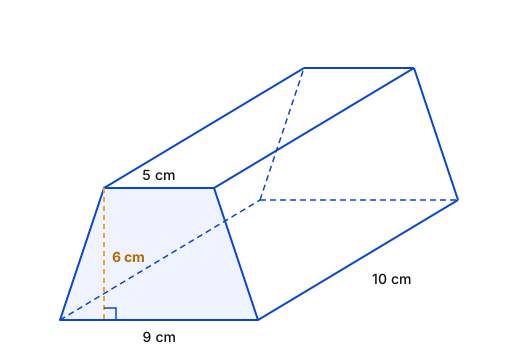
A right prism has a trapezoidal base with parallel sides 5 cm and 9 cm , height of the trapezium 6 cm , and height of the prism 10 cm . Find the volume of the prism.
एक लंब प्रिज़्म का आधार समलंब है जिसकी समांतर भुजाएँ 5 cm तथा 9 cm हैं, समलंब की ऊँचाई 6 cm है और प्रिज़्म की ऊँचाई 10 cm है। प्रिज़्म का आयतन ज्ञात कीजिए।
  1. A384cm3
  2. B456cm3
  3. C420cm3
  4. D386cm3
Show answer

Concept: Volume of a right prism=base area×height of prism.

  1. Trapezium area = 12×(5+9)×6=7×6=42cm2.
  2. Volume = 42×10 = 420 cm³.

Trick: Prism height is 10, so the answer must end in 0 — only 420 does.

Answer: (C) 420cm3

अवधारणा: लम्ब प्रिज़्म का आयतन=आधार का क्षेत्रफल×प्रिज़्म की ऊँचाई।

  1. समलंब का क्षेत्रफल = 12×(5+9)×6=7×6=42cm2।
  2. आयतन = 42×10 = 420 cm³।

ट्रिक: ऊँचाई 10 है, इसलिए उत्तर 0 पर खत्म होगा — केवल 420।

उत्तर: (C) 420cm3

SSC CHSLQuantitative AptitudeMensuration – volume of a trapezoidal prismSSC CHSL 2025 · 29 Nov Shift 1 →
Q556.
Which criteria are sufficient to prove the similarity of two triangles?
दो त्रिभुजों की समरूपता सिद्ध करने के लिए कौन-सी कसौटियाँ पर्याप्त हैं?
  1. AAA
  2. BSSS
  3. CSAS
  4. DAll of theseइनमें से सभी
Show answer

Concept: Triangles are similar if angles are equal and sides are in the same ratio.

  1. AA: two pairs of equal angles (third is then equal) → similar.
  2. SSS: all three side ratios equal → similar.
  3. SAS: one equal angle with the two including sides in proportion → similar. Each alone is enough.

Yaad rakhein: Don't confuse with congruence: for similarity, sides need only be proportional, not equal; RHS and ASA belong to congruence lists.

Answer: (D) All of these

अवधारणा: त्रिभुज समरूप होते हैं जब कोण बराबर हों और भुजाएँ समान अनुपात में हों।

  1. AA: दो कोण बराबर (तीसरा अपने-आप बराबर) → समरूप।
  2. SSS: तीनों भुजाओं का अनुपात समान → समरूप।
  3. SAS: एक कोण बराबर और उसे बनाने वाली दो भुजाएँ समानुपाती → समरूप। तीनों में से कोई भी पर्याप्त है।

याद रखें: सर्वांगसमता से न मिलाएँ: समरूपता में भुजाएँ केवल समानुपाती होनी चाहिए, बराबर नहीं।

उत्तर: (D) इनमें से सभी

SSC CHSLQuantitative AptitudeGeometry – similarity criteriaSSC CHSL 2025 · 29 Nov Shift 1 →
Q557.
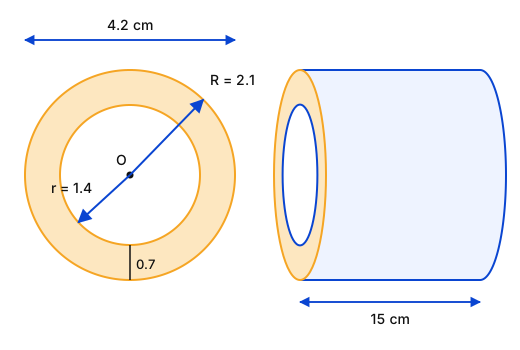
The outer diameter of a hollow cylindrical copper rod is 4.2 cm . The rod is 7 mm thick and 15 cm long. If 1 cubic cm of copper weighs 0.4 kg , find the total weight of the rod.
एक खोखली बेलनाकार ताँबे की छड़ का बाह्य व्यास 4.2 cm है। छड़ 7 mm मोटी तथा 15 cm लंबी है। यदि 1 घन cm ताँबे का भार 0.4 kg है, तो छड़ का कुल भार ज्ञात कीजिए।
  1. A46.2 kg
  2. B94.4 kg
  3. C68.1 kg
  4. D58.7 kg
Show answer

Concept: Volume of a hollow cylinder = π(R2−r2)h; weight=volume×weight per cm3.

  1. R=4.2÷2=2.1 cm; thickness 7 mm = 0.7 cm → r=1.4 cm.
  2. R2−r2=(2.1+1.4)(2.1−1.4)=3.5×0.7=2.45.
  3. Volume = 227×2.45×15=22×0.35×15=115.5 cm³.
  4. Weight = 115.5×0.4 = 46.2 kg.

Trick: Use R2−r2=(R+r)(R−r) — avoids squaring decimals.

Answer: (A) 46.2 kg

अवधारणा: खोखले बेलन का आयतन = π(R2−r2)h; भार=आयतन×प्रति cm3 भार।

  1. R=4.2÷2=2.1 cm; मोटाई 7 mm = 0.7 cm → r=1.4 cm।
  2. R2−r2=(2.1+1.4)(2.1−1.4)=3.5×0.7=2.45।
  3. आयतन = 227×2.45×15=22×0.35×15=115.5 cm³।
  4. भार = 115.5×0.4 = 46.2 kg।

ट्रिक: R2−r2=(R+r)(R−r) लगाएँ — दशमलव का वर्ग नहीं करना पड़ेगा।

उत्तर: (A) 46.2 kg

SSC CHSLQuantitative AptitudeMensuration – hollow cylinder weightSSC CHSL 2025 · 29 Nov Shift 1 →
Q558.
Find the value of :
(3+2)2−(3−2)2
निम्नलिखित का मान ज्ञात कीजिए :
(3+2)2−(3−2)2
  1. A47
  2. B83
  3. C23
  4. D52
Show answer

Concept: (a+b)2−(a−b)2=4ab.

  1. Here a=3,b=2.
  2. Value = 4×3×2 = 83.

Trick: Never expand both squares — the 4ab identity gives it in one line.

Answer: (B) 83

अवधारणा: (a+b)2−(a−b)2=4ab।

  1. यहाँ a=3,b=2।
  2. मान = 4×3×2 = 83।

ट्रिक: दोनों वर्ग खोलने की ज़रूरत नहीं — 4ab सूत्र से एक लाइन में उत्तर।

उत्तर: (B) 83

SSC CHSLQuantitative AptitudeAlgebra – (a+b)² − (a−b)²SSC CHSL 2025 · 29 Nov Shift 1 →
Q559.
P, Q, and R invested Rs. 60,000 , Rs.50,000, and Rs.40,000, respectively, in a business. If the total profit after 1 year is Rs.1,50,000, how much will Q receive?
P, Q तथा R ने एक व्यवसाय में क्रमशः Rs. 60,000, Rs.50,000 तथा Rs.40,000 का निवेश किया। यदि 1 वर्ष बाद कुल लाभ Rs.1,50,000 है, तो Q को कितना धन प्राप्त होगा?
  1. ARs. 50,000
  2. BRs. 55,000
  3. CRs. 60,000
  4. DRs. 65,000
Show answer

Concept: For the same period, profit is shared in the ratio of investments.

  1. Ratio = 60 : 50 : 40 (in thousands) = 6 : 5 : 4; sum = 15.
  2. Q = 515×1,50,000 = ₹50,000.

Trick: Q's share is 515=13 of profit → 1,50,000÷3=50,000.

Answer: (A) Rs. 50,000

अवधारणा: समान अवधि हो तो लाभ निवेश के अनुपात में बँटता है।

  1. अनुपात = 60 : 50 : 40 (हज़ार में) = 6 : 5 : 4; योग = 15।
  2. Q = 515×1,50,000 = ₹50,000।

ट्रिक: Q का हिस्सा 515=13 → 1,50,000÷3=50,000।

उत्तर: (A) Rs. 50,000

SSC CHSLQuantitative AptitudePartnership – equal timeSSC CHSL 2025 · 29 Nov Shift 1 →
Q560.
The sum of three numbers is 180. If the ratio of the first to the second is 3 : 4 and the ratio of the second to the third is 4:5, find the first number.
तीन संख्याओं का योग 180 है। यदि पहली और दूसरी संख्या का अनुपात 3 : 4 है तथा दूसरी और तीसरी संख्या का अनुपात 4:5 है, तो पहली संख्या ज्ञात कीजिए।
  1. A36
  2. B40
  3. C45
  4. D48
Show answer

Concept: Make the common term equal, then split the total in the combined ratio.

  1. 1st : 2nd = 3 : 4 and 2nd : 3rd = 4 : 5 → 3 : 4 : 5 (12 parts).
  2. 1 part = 180÷12=15.
  3. First number = 3×15= 45.

Trick: First number must be a multiple of 3 and 180×312=1804=45.

Answer: (C) 45

अवधारणा: साझा पद बराबर करें, फिर कुल को संयुक्त अनुपात में बाँटें।

  1. पहला : दूसरा = 3 : 4 और दूसरा : तीसरा = 4 : 5 → 3 : 4 : 5 (12 भाग)।
  2. 1 भाग = 180÷12=15।
  3. पहली संख्या = 3×15= 45।

ट्रिक: पहली संख्या = 180×312=1804=45।

उत्तर: (C) 45

SSC CHSLQuantitative AptitudeRatio – combining two ratiosSSC CHSL 2025 · 29 Nov Shift 1 →