Question bank

Q&A: practice questions with answers

Search questions on any topic. Filter by exam category, exam, subject and topic, try the question, then open the answer and explanation.

Courses – airGurukul

5,000 questions found.

Q641.
Two figures given on the left side of (:) are related with some logic/rule/relation. Select the missing figure on the right side of (:) from the given alternatives based on the same logic/rule/relation.
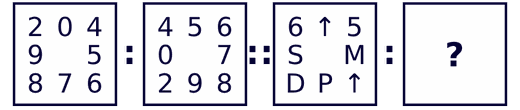
figure
(:) के बाईं ओर दी गई दो आकृतियाँ किसी तर्क/नियम/संबंध से संबंधित हैं। उसी तर्क/नियम/संबंध के आधार पर दिए गए विकल्पों में से (:) के दाईं ओर की लुप्त आकृति का चयन कीजिए।
figure
  1. Afigure
  2. Bfigure
  3. Cfigure
  4. Dfigure
Show answer

Concept: Read the 8 border cells clockwise from top-left and compare positions.

Solution:

  1. Fig 1 → Fig 2: every element shifts 2 places anticlockwise along the border.
  2. Fig 3 read clockwise: 6, ↑, 5, M, ↑, P, D, S.
  3. Shift by 2 anticlockwise → top row 5, M, ↑; bottom row 6, S, D – matches option B.

Trick: Track just one easy symbol (like 6): find where it lands, then confirm with one more element.

Answer: (B) Option B

अवधारणा: बाहरी 8 खानों को ऊपर-बाएँ से दक्षिणावर्त पढ़ें और स्थिति की तुलना करें।

हल:

  1. पहली से दूसरी आकृति: हर तत्व किनारे पर 2 स्थान वामावर्त खिसकता है।
  2. तीसरी आकृति: 6, ↑, 5, M, ↑, P, D, S।
  3. 2 स्थान वामावर्त → ऊपर 5, M, ↑; नीचे 6, S, D – विकल्प B।

ट्रिक: केवल एक आसान चिह्न (जैसे 6) को ट्रैक करें, फिर एक और से पुष्टि करें।

उत्तर: (B) विकल्प B
SSC CHSLGeneral IntelligenceFigure analogy – border elements shiftSSC CHSL 2025 · 28 Nov Shift 3 →
Q642.
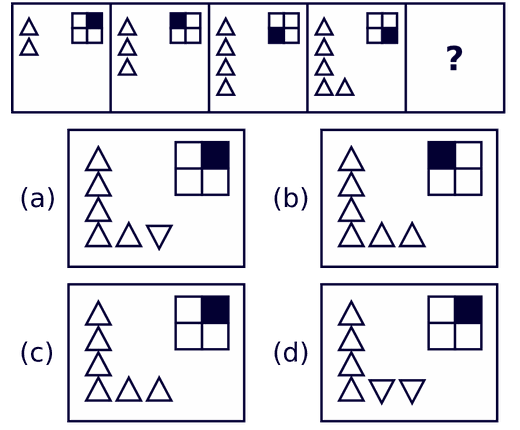
In the following figure series, select the figure which can be placed at the sign of question mark (?) from the given alternatives.
figure
निम्नलिखित आकृति शृंखला में, दिए गए विकल्पों में से उस आकृति का चयन कीजिए जिसे प्रश्नवाचक चिह्न (?) के स्थान पर रखा जा सकता है।
figure
  1. A
  2. B
  3. C
  4. D
Show answer

Concept: Track two changes separately: number of triangles and position of the shaded cell.

Solution:

  1. Triangles: 2, 3, 4, 5 → next = 6 (all pointing up).
  2. Shaded cell moves one corner anticlockwise each step: TR → TL → BL → BR → next TR.
  3. Figure with 6 triangles and top-right shaded = option C.

Trick: Split a figure series into independent parts – solve each, then match both.

Answer: (C) Option C

अवधारणा: दो बदलाव अलग-अलग देखें: त्रिभुजों की संख्या और छायांकित खाने की स्थिति।

हल:

  1. त्रिभुज: 2, 3, 4, 5 → अगला 6।
  2. छायांकित खाना हर बार एक कोना वामावर्त: ऊपर-दाएँ → ऊपर-बाएँ → नीचे-बाएँ → नीचे-दाएँ → फिर ऊपर-दाएँ।
  3. 6 त्रिभुज + ऊपर-दाएँ छायांकित = विकल्प C।

ट्रिक: श्रृंखला को अलग-अलग भागों में तोड़ें, फिर दोनों मिलाएँ।

उत्तर: (C) विकल्प C

SSC CHSLGeneral IntelligenceFigure series – count and rotationSSC CHSL 2025 · 28 Nov Shift 3 →
Q643.
If ' - means ' ÷ ', '+' means '×', '÷' means ' 4 ' and ' x ' means ' + ', then 56−8+4 ÷15×5= ?
यदि ' - का अर्थ ' ÷ ' है, '+' का अर्थ '×' है, '÷' का अर्थ ' 4 ' है और ' x ' का अर्थ ' + ' है, तो 56−8+4 ÷15×5= ?
  1. A20
  2. B16
  3. C18
  4. D22
Show answer

Concept: Replace signs first, then apply BODMAS. (Here '÷' stands for '−'.)

Solution:

  1. Swap: − → ÷, + → ×, ÷ → −, × → +.
  2. Converted: (56÷8)×4−15+5
  3. =7×4−10=28−10= 18.

Trick: Write the new expression on paper before calculating – most mistakes come from solving with old signs.

Answer: (C) 18

अवधारणा: पहले चिह्न बदलें, फिर BODMAS लगाएँ ('÷' का अर्थ '−' है)।

हल:

  1. बदला हुआ रूप: (56÷8)×4−15+5
  2. =7×4−10=28−10= 18।

ट्रिक: पहले नया व्यंजक लिख लें, तभी हल करें।

उत्तर: (C) 18

SSC CHSLGeneral IntelligenceSymbol substitution – BODMASSSC CHSL 2025 · 28 Nov Shift 3 →
Q644.
Select the correct combination of mathematical signs to replace (*) signs sequentially and to balance the given equation.
12∗4∗8∗2∗5=23
दिए गए समीकरण को संतुलित करने के लिए (*) चिह्नों को क्रमिक रूप से प्रतिस्थापित करने वाले गणितीय चिह्नों के सही संयोजन का चयन कीजिए।
12∗4∗8∗2∗5=23
  1. A÷,+,x,−
  2. B+,x,÷,−
  3. C,−×,+,+
  4. D×, - +,+
Show answer

Concept: Insert each option's signs in order and simplify with BODMAS.

Solution:

  1. Option B: 12+4×8÷2−5.
  2. 4×8÷2=16.
  3. 12+16−5 = 23 ✔

Trick: RHS 23 is small and odd → the last sign is likely '−5' or '+5'; test those options first.

Answer: (B) +,x,÷,−

अवधारणा: हर विकल्प के चिह्न क्रम से लगाकर BODMAS से हल करें।

हल:

  1. विकल्प B: 12+4×8÷2−5।
  2. 4×8÷2=16।
  3. 12+16−5 = 23 ✔

ट्रिक: अंतिम चिह्न से शुरुआत कर विकल्प जल्दी छाँटें।

उत्तर: (B) +,x,÷,−

SSC CHSLGeneral IntelligenceBalancing equation – sign combinationSSC CHSL 2025 · 28 Nov Shift 3 →
Q645.
In the following question, select the odd letter-number cluster from the given alternatives.
(NOTE: Operations should be performed on the whole numbers, without breaking down the number into its constituent digits. E.g. 13 - Operations on 13 such as adding /subtracting /multiplying etc. to 13 can be performed. Breaking down 13 into 1 and 3 and then performing mathematical operations on 1 and 3 is not allowed)
निम्नलिखित प्रश्न में, दिए गए विकल्पों में से विषम अक्षर-संख्या समूह का चयन कीजिए।
(नोट: संक्रियाएँ पूर्ण संख्याओं पर की जानी चाहिए, संख्या को उसके अंकों में विभाजित किए बिना। उदाहरण: 13 - 13 पर जोड़ने/घटाने/गुणा करने आदि जैसी संक्रियाएँ की जा सकती हैं। 13 को 1 और 3 में विभाजित करके 1 और 3 पर गणितीय संक्रियाएँ करने की अनुमति नहीं है।)
  1. AJKMN48
  2. BUVXY92
  3. CCDGH21
  4. DFGIJ32
Show answer

Concept: Number = sum of the alphabet positions of the four letters.

Solution:

  1. JKMN: 10 + 11 + 13 + 14 = 48 ✔; UVXY: 21 + 22 + 24 + 25 = 92 ✔
  2. FGIJ: 6 + 7 + 9 + 10 = 32 ✔
  3. CDGH: 3 + 4 + 7 + 8 = 22, but 21 is given ✘

Trick: Use EJOTY (5, 10, 15, 20, 25) to get letter positions instantly.

Answer: (C) CDGH21

अवधारणा: संख्या = चारों अक्षरों के स्थानीय मान का योग।

हल:

  1. JKMN = 48 ✔, UVXY = 92 ✔, FGIJ = 32 ✔
  2. CDGH: 3 + 4 + 7 + 8 = 22, पर दिया 21 ✘

ट्रिक: EJOTY (5, 10, 15, 20, 25) से अक्षरों का स्थान तुरंत निकालें।

उत्तर: (C) CDGH21

SSC CHSLGeneral IntelligenceOdd one – letter positions sumSSC CHSL 2025 · 28 Nov Shift 3 →
Q646.
In the following question, four letter-number pairs are given. The letter-number on the left side of ( - ) is related to the letter-number on the right side of ( - ) with some
Logic/Rule/Relation. Three pairs are similar on the basis of same Logic/Rule/Relation. Select the odd one out from the given alternatives.
(NOTE: Operations should be performed on the whole numbers, without breaking down the number into its constituent digits. E.g. 13 - Operations on 13 such as adding /subtracting /multiplying etc. to 13 can be performed. Breaking down 13 into 1 and 3 and then performing mathematical operations on 1 and 3 is not allowed)
निम्नलिखित प्रश्न में, चार अक्षर-संख्या युग्म दिए गए हैं। ( - ) के बाईं ओर की अक्षर-संख्या किसी तर्क/नियम/संबंध से ( - ) के दाईं ओर की अक्षर-संख्या से संबंधित है। तीन युग्म समान तर्क/नियम/संबंध के आधार पर एक जैसे हैं। दिए गए विकल्पों में से विषम युग्म का चयन कीजिए।
(नोट: संक्रियाएँ पूर्ण संख्याओं पर की जानी चाहिए, संख्या को उसके अंकों में विभाजित किए बिना। उदाहरण: 13 - 13 पर जोड़ने/घटाने/गुणा करने आदि जैसी संक्रियाएँ की जा सकती हैं। 13 को 1 और 3 में विभाजित करके 1 और 3 पर गणितीय संक्रियाएँ करने की अनुमति नहीं है।)
  1. ABC500 - DE350
  2. BIJ725 - KL575
  3. CFG890 - HI740
  4. DNO660 - PQ500
Show answer

Concept: Letters move +2 in all pairs, so compare the numbers.

Solution:

  1. 500 − 350 = 150; 725 − 575 = 150; 890 − 740 = 150.
  2. 660 − 500 = 160 ✘ – different.

Trick: When the letter rule is the same everywhere, the odd one hides in the numbers.

Answer: (D) NO660 - PQ500

अवधारणा: सभी युग्मों में अक्षर +2 खिसकते हैं, इसलिए संख्याओं की तुलना करें।

हल:

  1. 500 − 350, 725 − 575, 890 − 740 = 150 हर बार।
  2. 660 − 500 = 160 ✘।

ट्रिक: अक्षरों का नियम समान हो तो अंतर संख्याओं में ढूँढें।

उत्तर: (D) NO660 - PQ500

SSC CHSLGeneral IntelligenceOdd pair – letter shift and number fallSSC CHSL 2025 · 28 Nov Shift 3 →
Q647.
In the following question, four number pairs are given. In each pair the number on left side of ( - ) is related to the number of the right side of (-) with some Logic/Rule/Relation. Three pairs are similar on the basis of same Logic/Rule/Relation. Select the odd one out from the given alternatives.
(NOTE: Operations should be performed on the whole numbers, without breaking down the number into its constituent digits. E.g. 13 - Operations on 13 such as adding /subtracting /multiplying etc. to 13 can be performed. Breaking down 13 into 1 and 3 and then performing mathematical operations on 1 and 3 is not allowed)
निम्नलिखित प्रश्न में, चार संख्या युग्म दिए गए हैं। प्रत्येक युग्म में ( - ) के बाईं ओर की संख्या किसी तर्क/नियम/संबंध से (-) के दाईं ओर की संख्या से संबंधित है। तीन युग्म समान तर्क/नियम/संबंध के आधार पर एक जैसे हैं। दिए गए विकल्पों में से विषम युग्म का चयन कीजिए।
(नोट: संक्रियाएँ पूर्ण संख्याओं पर की जानी चाहिए, संख्या को उसके अंकों में विभाजित किए बिना। उदाहरण: 13 - 13 पर जोड़ने/घटाने/गुणा करने आदि जैसी संक्रियाएँ की जा सकती हैं। 13 को 1 और 3 में विभाजित करके 1 और 3 पर गणितीय संक्रियाएँ करने की अनुमति नहीं है।)
  1. A441-21
  2. B529-23
  3. C600-24
  4. D676-26
Show answer

Concept: Left number=(right number)2.

Solution:

  1. 212=441 ✔, 232=529 ✔, 262=676 ✔
  2. 242=576, not 600 ✘

Trick: 600 does not end in a square-ending pattern with a perfect root (600≈24.5) – spot it without calculating others.

Answer: (C) 600-24

अवधारणा: बाईं संख्या = दाईं संख्या का वर्ग।

हल:

  1. 212=441 ✔, 232=529 ✔, 262=676 ✔
  2. 242=576, 600 नहीं ✘

ट्रिक: 600≈24.5 – पूर्ण वर्ग नहीं, इसलिए सीधे विषम।

उत्तर: (C) 600-24

SSC CHSLGeneral IntelligenceOdd pair – perfect squaresSSC CHSL 2025 · 28 Nov Shift 3 →
Q648.
In the following question, in each alternative a group of numbers is given. The numbers of each group are related to the numbers of the same group by some Logic/Rule/Relation. Select that group of numbers in which numbers are not related by that same Logic/Rule/Relation.
(NOTE: Operations should be performed on the whole numbers, without breaking down the number into its constituent digits. E.g. 13 - Operations on 13 such as adding /subtracting /multiplying etc. to 13 can be performed. Breaking down 13 into 1 and 3 and then performing mathematical operations on 1 and 3 is not allowed)
निम्नलिखित प्रश्न में, प्रत्येक विकल्प में संख्याओं का एक समूह दिया गया है। प्रत्येक समूह की संख्याएँ उसी समूह की संख्याओं से किसी तर्क/नियम/संबंध द्वारा संबंधित हैं। उस संख्या समूह का चयन कीजिए जिसमें संख्याएँ उसी तर्क/नियम/संबंध से संबंधित नहीं हैं।
(नोट: संक्रियाएँ पूर्ण संख्याओं पर की जानी चाहिए, संख्या को उसके अंकों में विभाजित किए बिना। उदाहरण: 13 - 13 पर जोड़ने/घटाने/गुणा करने आदि जैसी संक्रियाएँ की जा सकती हैं। 13 को 1 और 3 में विभाजित करके 1 और 3 पर गणितीय संक्रियाएँ करने की अनुमति नहीं है।)
  1. A(142, 485, 7)
  2. B(215, 1215, 10)
  3. C(310,1641,11)
  4. D(180,2370,13)
Show answer

Concept: Middle=first+(third)3.

Solution:

  1. 142+343=485 ✔; 215+1000=1215 ✔; 310+1331=1641 ✔
  2. 180+133=180+2197=2377≠2370 ✘

Trick: Unit-digit check: 0+7 (133 ends in 7) = 7, but 2370 ends in 0 → odd one at once.

Answer: (D) (180,2370,13)

अवधारणा: बीच की संख्या = पहली संख्या + तीसरी का घन।

हल:

  1. 142+343=485 ✔; 215+1000=1215 ✔; 310+1331=1641 ✔
  2. 180+2197=2377≠2370 ✘

ट्रिक: इकाई अंक: 133 का अंतिम अंक 7, 180 + … का अंतिम अंक 7 होना चाहिए, पर 2370 में 0 है।

उत्तर: (D) (180,2370,13)

SSC CHSLGeneral IntelligenceOdd group – first + cube of thirdSSC CHSL 2025 · 28 Nov Shift 3 →
Q649.
Select the option that is related to the sixth letter-number cluster in the same way as the first letter-number cluster is related to the second letter-number cluster and third letter-number cluster is related to fourth letter-number cluster.
(NOTE: Operations should be performed on the whole numbers, without breaking down the number into its constituent digits. E.g. 13 - Operations on 13 such as adding /subtracting /multiplying etc. to 13 can be performed. Breaking down 13 into 1 and 3 and then performing mathematical operations on 1 and 3 is not allowed) PR500 : QQ250 :: BL120 : CK60 :: ? : DG200
उस विकल्प का चयन कीजिए जो छठे अक्षर-संख्या समूह से उसी प्रकार संबंधित है जिस प्रकार पहला अक्षर-संख्या समूह दूसरे अक्षर-संख्या समूह से तथा तीसरा अक्षर-संख्या समूह चौथे अक्षर-संख्या समूह से संबंधित है।
(नोट: संक्रियाएँ पूर्ण संख्याओं पर की जानी चाहिए, संख्या को उसके अंकों में विभाजित किए बिना। उदाहरण: 13 - 13 पर जोड़ने/घटाने/गुणा करने आदि जैसी संक्रियाएँ की जा सकती हैं। 13 को 1 और 3 में विभाजित करके 1 और 3 पर गणितीय संक्रियाएँ करने की अनुमति नहीं है।) PR500 : QQ250 :: BL120 : CK60 :: ? : DG200
  1. ACI400
  2. BCH400
  3. CDH400
  4. DCG200
Show answer

Concept: Rule: 1st letter +1, 2nd letter −1, number ÷ 2. The blank is the first term, so reverse it.

Solution:

  1. PR500 → QQ250 and BL120 → CK60 confirm the rule.
  2. Reverse from DG200: D − 1 = C, G + 1 = H, 200×2=400.
  3. Missing cluster = CH400.

Trick: When '?' is on the left, apply the opposite operations (+ ↔ −, × ↔ ÷).

Answer: (B) CH400

अवधारणा: नियम: पहला अक्षर +1, दूसरा −1, संख्या ÷ 2। '?' पहले पद में है, इसलिए उल्टा करें।

हल:

  1. PR500 → QQ250, BL120 → CK60 से नियम पक्का।
  2. DG200 से उल्टा: D − 1 = C, G + 1 = H, 200×2=400।
  3. उत्तर = CH400।

ट्रिक: '?' बाईं ओर हो तो उल्टी संक्रियाएँ लगाएँ।

उत्तर: (B) CH400

SSC CHSLGeneral IntelligenceLetter-number analogy – reverse workingSSC CHSL 2025 · 28 Nov Shift 3 →
Q650.
Select the option that is related to the fifth letter-number cluster in the same way as the second letter-number cluster is related to the first letter-number cluster and fourth letter-number cluster is related to third letter-number cluster.
(NOTE: Operations should be performed on the whole numbers, without breaking down the number into its constituent digits. E.g. 13 - Operations on 13 such as adding /subtracting /multiplying etc. to 13 can be performed. Breaking down 13 into 1 and 3 and then performing mathematical operations on 1 and 3 is not allowed)
RJ10 : VN105 :: DL12 : HP149 :: GK14 : ?
उस विकल्प का चयन कीजिए जो पाँचवें अक्षर-संख्या समूह से उसी प्रकार संबंधित है जिस प्रकार दूसरा अक्षर-संख्या समूह पहले अक्षर-संख्या समूह से तथा चौथा अक्षर-संख्या समूह तीसरे अक्षर-संख्या समूह से संबंधित है।
(नोट: संक्रियाएँ पूर्ण संख्याओं पर की जानी चाहिए, संख्या को उसके अंकों में विभाजित किए बिना। उदाहरण: 13 - 13 पर जोड़ने/घटाने/गुणा करने आदि जैसी संक्रियाएँ की जा सकती हैं। 13 को 1 और 3 में विभाजित करके 1 और 3 पर गणितीय संक्रियाएँ करने की अनुमति नहीं है।)
RJ10 : VN105 :: DL12 : HP149 :: GK14 : ?
  1. AKO201
  2. BKP201
  3. CKO199
  4. DL0205
Show answer

Concept: Letters move +4; number becomes (number)2+5.

Solution:

  1. RJ10 → VN105: R+4 = V, J+4 = N, 102+5=105 ✔; DL12 → HP149 ✔ (144 + 5).
  2. GK14 → G+4 = K, K+4 = O, 142+5=196+5=201.
  3. Answer = KO201.

Trick: Option letters decide quickly: K+4 = O removes KP and L0 options; 201 removes 199.

Answer: (A) KO201

अवधारणा: अक्षर +4 खिसकते हैं; संख्या = (संख्या)2+5।

हल:

  1. 102+5=105 ✔, 122+5=149 ✔।
  2. GK14 → K, O और 142+5=201।
  3. उत्तर = KO201।

ट्रिक: K + 4 = O से KP और L0 विकल्प तुरंत हटते हैं।

उत्तर: (A) KO201

SSC CHSLGeneral IntelligenceLetter-number analogy – +4 letters, n² + 5SSC CHSL 2025 · 28 Nov Shift 3 →
Q651.
A shopkeeper sells a product at Rs. 240 after losing 20%. What is the cost price?
एक दुकानदार 20% की हानि पर एक वस्तु Rs. 240 में बेचता है। क्रय मूल्य क्या है?
  1. ARs. 280
  2. BRs. 300
  3. CRs. 320
  4. DRs. 350
Show answer

Concept: At x% loss, SP=(100−x)% of CP.

Solution:

  1. 20% loss → SP=80% of CP=45 of CP.
  2. CP=240×54 = ₹300.

Trick: 20% loss means SP is 4 parts out of CP's 5 → 1 part = 240÷4=60, CP = 5×60=300.

Answer: (B) Rs. 300

अवधारणा: x% हानि पर SP=CP का (100−x)%।

हल:

  1. 20% हानि → SP=CP का 80%=45।
  2. CP=240×54 = ₹300।

ट्रिक: SP = 4 भाग, CP = 5 भाग → 1 भाग = 60, CP = 300।

उत्तर: (B) Rs. 300

SSC CHSLQuantitative AptitudeProfit & loss – CP from SP and loss %SSC CHSL 2025 · 28 Nov Shift 3 →
Q652.
A shopkeeper mixes 3 kg of rice at ₹60/kg with 2 kg of rice at ₹70/kg. What is the price per kg of the mixture?
एक दुकानदार ₹60/kg वाले 3 kg चावल को ₹70/kg वाले 2 kg चावल के साथ मिलाता है। मिश्रण का प्रति kg मूल्य क्या है?
  1. A₹62
  2. B₹64
  3. C₹65
  4. D₹66
Show answer

Concept: Mixture price=total cost÷total quantity.

Solution:

  1. Cost: 3×60+2×70=180+140 = ₹320.
  2. Quantity = 5 kg → 320÷5 = ₹64/kg.

Trick: Weighted average: 60+(25)×10=64 (base price + share of the extra ₹10).

Answer: (B) ₹64

अवधारणा: मिश्रण का मूल्य=कुल लागत÷कुल मात्रा।

हल:

  1. लागत: 180+140 = ₹320; मात्रा = 5 kg।
  2. 320÷5 = ₹64 प्रति kg।

ट्रिक: भारित औसत: 60+(25)×10=64।

उत्तर: (B) ₹64

SSC CHSLQuantitative AptitudeMixture – average price per kgSSC CHSL 2025 · 28 Nov Shift 3 →
Q653.
A car travels 240 km at 60km/h. Time taken?
एक कार 60km/h की चाल से 240 km चलती है। लिया गया समय कितना है?
  1. A3 hours3 घंटे
  2. B3.5 hours3.5 घंटे
  3. C4 hours4 घंटे
  4. D5 hours5 घंटे
Show answer

Concept: Time=Distance÷Speed.

Solution:

  1. 240÷60 = 4 hours.

Yaad rakhein: Units must match: km with km/h gives hours directly.

Answer: (C) 4 hours

अवधारणा: समय=दूरी÷चाल।

हल:

  1. 240÷60 = 4 घंटे।

याद रखें: km और km/h से उत्तर सीधे घंटों में आता है।

उत्तर: (C) 4 घंटे

SSC CHSLQuantitative AptitudeSpeed, time & distance – timeSSC CHSL 2025 · 28 Nov Shift 3 →
Q654.
P is twice as efficient as Q.P and Q together can complete a piece of work in 18 days. In how many days can P alone complete the work?
P, Q से दोगुना कार्यकुशल है। P और Q मिलकर एक कार्य 18 दिनों में पूरा कर सकते हैं। P अकेला उस कार्य को कितने दिनों में पूरा कर सकता है?
  1. A24 days24 दिन
  2. B27 days27 दिन
  3. C36 days36 दिन
  4. D54 days54 दिन
Show answer

Concept: Take efficiencies as units of work per day.

Solution:

  1. P : Q = 2 : 1 → together 3 units/day.
  2. Total work = 3×18=54 units.
  3. P alone = 54÷2 = 27 days.

Trick: P alone=together-days×(total efficiency÷P's efficiency)=18×32=27.

Answer: (B) 27 days

अवधारणा: दक्षता को प्रति दिन कार्य-इकाई मानें।

हल:

  1. P : Q = 2 : 1 → साथ में 3 इकाई/दिन।
  2. कुल कार्य = 3×18=54 इकाई।
  3. P अकेला = 54÷2 = 27 दिन।

ट्रिक: 18×32=27 – एक पंक्ति में।

उत्तर: (B) 27 दिन

SSC CHSLQuantitative AptitudeTime & work – efficiency ratioSSC CHSL 2025 · 28 Nov Shift 3 →
Q655.
What is the selling price if the marked price is Rs. 1200 and the discount is 15%?
यदि अंकित मूल्य Rs. 1200 है और छूट 15% है, तो विक्रय मूल्य क्या होगा?
  1. ARs. 1080
  2. BRs. 1020
  3. CRs. 1100
  4. DRs. 1050
Show answer

Concept: SP=MP×100−discount%100.

Solution:

  1. SP=1200×85100=12×85 = ₹1020.

Trick: 10% of 1200 = 120, 5% = 60 → discount 180 → 1200−180=1020.

Answer: (B) Rs. 1020

अवधारणा: SP=MP×100−छूट%100।

हल:

  1. SP=1200×85100 = ₹1020।

ट्रिक: 1200 का 10% = 120, 5% = 60 → छूट 180 → 1020।

उत्तर: (B) Rs. 1020

SSC CHSLQuantitative AptitudeDiscount – SP from MPSSC CHSL 2025 · 28 Nov Shift 3 →
Q656.
A solid metallic cuboid with dimensions 50cm×40cm×10cm is melted and recast into small solid cubes of side 2 cm each. How many such cubes can be formed?
50cm×40cm×10cm विमाओं वाले एक ठोस धात्विक घनाभ को पिघलाकर 2 cm भुजा वाले छोटे ठोस घनों में ढाला जाता है। ऐसे कितने घन बनाए जा सकते हैं?
  1. A2000
  2. B2500
  3. C3000
  4. D5000
Show answer

Concept: Volume stays the same on melting; number of cubes=big volume÷small volume.

Solution:

  1. Cuboid = 50×40×10=20,000cm3.
  2. One cube = 23=8cm3.
  3. Cubes = 20,000÷8 = 2500.

Trick: Divide each side by 2 directly: 25×20×5=2500.

Answer: (B) 2500

अवधारणा: पिघलाने पर आयतन नहीं बदलता; घनों की संख्या=बड़ा आयतन÷छोटा आयतन।

हल:

  1. घनाभ = 50×40×10=20,000cm3; एक घन = 8 cm³।
  2. संख्या = 20,000÷8 = 2500।

ट्रिक: हर भुजा को 2 से भाग दें: 25×20×5=2500।

उत्तर: (B) 2500

SSC CHSLQuantitative AptitudeMensuration – recasting cuboid into cubesSSC CHSL 2025 · 28 Nov Shift 3 →
Q657.
Two triangular garden plots are measured. It is found that the three sides of the first plot are exactly equal in length to the corresponding three sides of the second plot. Are these two plots congruent?
दो त्रिभुजाकार बगीचों की माप ली जाती है। यह पाया जाता है कि पहले भूखंड की तीनों भुजाएँ दूसरे भूखंड की संगत तीनों भुजाओं के ठीक बराबर हैं। क्या ये दोनों भूखंड सर्वांगसम हैं?
  1. AYes, by SSSहाँ, SSS द्वारा
  2. BNoनहीं
  3. CYes, by SASहाँ, SAS द्वारा
  4. DCannot sayकह नहीं सकते
Show answer

Concept: Two triangles with all three corresponding sides equal are congruent (SSS rule).

Solution:

  1. All three sides of plot 1 = the matching sides of plot 2 → SSS holds.
  2. SAS needs an included angle, which is not given.

Yaad rakhein: Valid congruence rules: SSS, SAS, ASA, AAS, RHS. AAA and SSA are NOT rules.

Answer: (A) Yes, by SSS

अवधारणा: जिन दो त्रिभुजों की तीनों संगत भुजाएँ बराबर हों, वे सर्वांगसम होते हैं (SSS)।

हल:

  1. दोनों भूखंडों की तीनों भुजाएँ बराबर → SSS लागू।
  2. SAS के लिए बीच का कोण चाहिए, जो दिया नहीं है।

याद रखें: मान्य नियम: SSS, SAS, ASA, AAS, RHS; AAA और SSA नियम नहीं हैं।

उत्तर: (A) हाँ, SSS द्वारा

SSC CHSLQuantitative AptitudeGeometry – SSS congruenceSSC CHSL 2025 · 28 Nov Shift 3 →
Q658.
A right prism has a volume of 2400 cm3 and a height of 30 cm. What is the area of its base?
एक लम्ब प्रिज्म का आयतन 2400 cm3 तथा ऊँचाई 30 cm है। इसके आधार का क्षेत्रफल क्या है?
  1. A60cm2
  2. B75cm2
  3. C80cm2
  4. D100cm2
Show answer

Concept: Volume of a right prism=base area×height.

Solution:

  1. Base area = 2400÷30 = 80 cm².

Yaad rakhein: Same formula works for every prism and cylinder: V=(area of base)×h.

Answer: (C) 80cm2

अवधारणा: लंब प्रिज्म का आयतन=आधार क्षेत्रफल×ऊँचाई।

हल:

  1. आधार क्षेत्रफल = 2400÷30 = 80 cm²।

याद रखें: यही सूत्र हर प्रिज्म और बेलन पर लागू: V=आधार×h।

उत्तर: (C) 80cm2

SSC CHSLQuantitative AptitudeMensuration – base area of prismSSC CHSL 2025 · 28 Nov Shift 3 →
Q659.
An 80-liter mixture contains milk and water in the ratio 3:1. If 10 liters of water is added to the mixture, what will be the new ratio of milk to water?
80 लीटर के एक मिश्रण में दूध और पानी 3:1 के अनुपात में हैं। यदि मिश्रण में 10 लीटर पानी मिला दिया जाए, तो दूध और पानी का नया अनुपात क्या होगा?
  1. A3 : 2
  2. B3 : 1
  3. C5 : 3
  4. D2 : 1
Show answer

Concept: Split the mixture by ratio; only water changes when water is added.

Solution:

  1. Milk = 34×80 = 60 L, water = 20 L.
  2. After adding 10 L water: water = 30 L.
  3. Milk : water = 60 : 30 = 2 : 1.

Trick: Milk stays fixed – just compare milk with new water.

Answer: (D) 2 : 1

अवधारणा: अनुपात से मात्रा बाँटें; पानी मिलाने पर केवल पानी बदलता है।

हल:

  1. दूध = 80 का 34 = 60 L, पानी = 20 L।
  2. 10 L पानी मिलाने पर पानी = 30 L।
  3. दूध : पानी = 60 : 30 = 2 : 1।

ट्रिक: दूध स्थिर रहता है – सिर्फ नए पानी से तुलना करें।

उत्तर: (D) 2 : 1

SSC CHSLQuantitative AptitudeMixture – adding water changes ratioSSC CHSL 2025 · 28 Nov Shift 3 →
Q660.
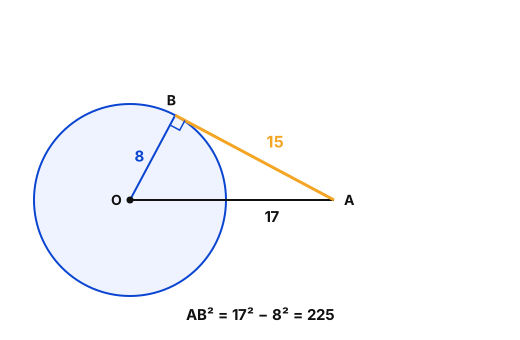
A circle has a radius of 8 cm. From an external point A , which is 17 cm away from the center of the circle, a tangent is drawn touching the circle at point B. What is the length of the tangent segment AB?
एक वृत्त की त्रिज्या 8 cm है। वृत्त के केंद्र से 17 cm दूर स्थित एक बाह्य बिंदु A से एक स्पर्श रेखा खींची जाती है जो वृत्त को बिंदु B पर स्पर्श करती है। स्पर्श रेखा खंड AB की लंबाई क्या है?
  1. A25 cm
  2. B9 cm
  3. C15 cm
  4. D12 cm
Show answer

Concept: Radius ⟂ tangent at the point of contact, so use Pythagoras.

Solution:

  1. AB2=OA2−OB2=172−82=289−64=225.
  2. AB=225 = 15 cm.

Trick: 8, 15, 17 is a Pythagorean triplet – answer is instant.

Answer: (C) 15 cm

अवधारणा: स्पर्श बिंदु पर त्रिज्या स्पर्शरेखा पर लंब होती है; पाइथागोरस लगाएँ।

हल:

  1. AB2=172−82=289−64=225।
  2. AB = 15 cm।

ट्रिक: 8, 15, 17 पाइथागोरस त्रिक है।

उत्तर: (C) 15 cm

SSC CHSLQuantitative AptitudeCircle – length of tangentSSC CHSL 2025 · 28 Nov Shift 3 →