Question bank

Q&A: practice questions with answers

Search questions on any topic. Filter by exam category, exam, subject and topic, try the question, then open the answer and explanation.

Courses – airGurukul

5,000 questions found.

Q841.
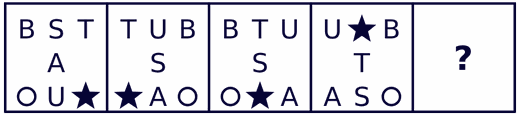
Two figures given on the left side of (::) are related with some logic/rule/relation. Select the missing figure on the right side of (:) from the given alternatives based on the same logic/rule/relation.
figure
(::) के बाईं ओर दी गई दो आकृतियाँ किसी तर्क/नियम/संबंध से संबंधित हैं। उसी तर्क/नियम/संबंध के आधार पर दिए गए विकल्पों में से (:) के दाईं ओर की लुप्त आकृति का चयन कीजिए।
figure
  1. Afigure
  2. Bfigure
  3. Cfigure
  4. Dfigure
Show answer

Concept: Two moves alternate between boxes: (i) row-ends swap with middle column shifting, (ii) each row slides one place right.

  1. Box 2 → Box 3 used the row-slide move; Box 3 → Box 4 used the swap move.
  2. So Box 4 → ? is a row-slide: top U,★,B → B,U,★; bottom A,S,○ → ○,A,S; centre T fixed.
  3. This matches option (B).

Trick: Track one symbol (e.g. B) across boxes – its path reveals the rule.

Answer: (B)

अवधारणा: दो प्रकार की चालें बारी-बारी से लगती हैं; अगली चाल = हर पंक्ति एक स्थान दाएँ खिसकना।

हल:

  1. बॉक्स 4 का ऊपर U,★,B → B,U,★; नीचे A,S,○ → ○,A,S; बीच में T वही।
  2. यह विकल्प (B) से मेल खाता है।

ट्रिक: किसी एक चिह्न (जैसे B) को हर बॉक्स में ट्रैक करें।

उत्तर: (B)
SSC CHSLGeneral IntelligenceFigure analogy – alternate movesSSC CHSL 2025 · 28 Nov Shift 1 →
Q842.
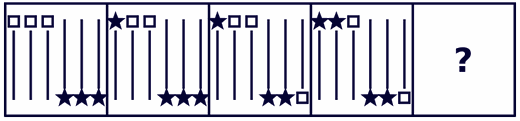
In the following figure series, select the figure which can be placed at the sign of question mark (?) from the given alternatives.
figure
निम्नलिखित आकृति शृंखला में, दिए गए विकल्पों में से उस आकृति का चयन कीजिए जिसे प्रश्नवाचक चिह्न (?) के स्थान पर रखा जा सकता है।
figure
  1. Afigure
  2. Bfigure
  3. Cfigure
  4. Dfigure
Show answer

Concept: One symbol changes per step, alternately at top (from left) and bottom (from right).

  1. 1→2: first top square → star; 2→3: last bottom star → square; 3→4: second top square → star.
  2. Next: second bottom star → square.
  3. Figure: top ★ ★ ■, bottom ★ ■ ■ – option (B).

Trick: Spot which position changed in each step; the pattern of positions predicts the next.

Answer: (B)

अवधारणा: हर चरण में एक चिह्न बदलता है – बारी-बारी ऊपर (बाएँ से) और नीचे (दाएँ से)।

हल:

  1. अगला बदलाव नीचे का दूसरा चिह्न: तारा → वर्ग।
  2. आकृति: ऊपर ★ ★ ■, नीचे ★ ■ ■ – विकल्प (B)।

ट्रिक: हर चरण में बदली स्थिति लिखें – अगला क्रम खुद दिख जाएगा।

उत्तर: (B)

SSC CHSLGeneral IntelligenceFigure series – alternating changesSSC CHSL 2025 · 28 Nov Shift 1 →
Q843.
If ' A ' means ' + ', ' B ' means ′÷ ', ' C ' means ' x ' and ' D ' means ' ⿻′, then 48 A 12 B 3 D5C2 = ?
यदि ' A ' का अर्थ ' + ' है, ' B ' का अर्थ ′÷ ' है, ' C ' का अर्थ ' x ' है और ' D ' का अर्थ ' ⿻′ है, तो 48 A 12 B 3 D5C2 = ?
  1. A42
  2. B45
  3. C44
  4. D40
Show answer

Concept: A = +, B = ÷, C = ×, D = −; then BODMAS.

  1. 48+12÷3−5×2
  2. =48+4−10=42.

Trick: Handle ÷ and × first, then +/− left to right.

Answer: (A) 42

अवधारणा: A = +, B = ÷, C = ×, D = −; फिर BODMAS।

हल:

  1. 48+12÷3−5×2
  2. =48+4−10=42।

ट्रिक: पहले ÷, ×, फिर +, −।

उत्तर: (A) 42

SSC CHSLGeneral IntelligenceCoded operations – BODMASSSC CHSL 2025 · 28 Nov Shift 1 →
Q844.
Select the correct combination of mathematical signs to replace (*) signs sequentially and to balance the given equation. 42∗18∗36∗3∗2=36
दिए गए समीकरण को संतुलित करने के लिए (*) चिह्नों के स्थान पर क्रमानुसार रखे जाने वाले गणितीय चिह्नों के सही संयोजन का चयन कीजिए। 42∗18∗36∗3∗2=36
  1. A,,,−++×
  2. B,,,+−+×
  3. Cx,+,−,+
  4. D,+×,÷,−
Show answer

Concept: Substitute each option's signs and solve with BODMAS.

  1. Option (B): 42+18−36÷3×2.
  2. 36÷3=12, 12×2=24.
  3. 60−24=36 ✔.

Trick: RHS 36 is close to 42+18=60 → look for '+' then '−' with a 24-making tail.

Answer: (B) ,,,+−+×

अवधारणा: हर विकल्प के चिह्न रखकर BODMAS से हल करें।

हल:

  1. (B): 42+18−36÷3×2।
  2. 36÷3×2=24।
  3. 60−24=36 ✔।

ट्रिक: 42+18=60, बचे भाग से 24 घटना चाहिए – यही संकेत है।

उत्तर: (B) ,,,+−+×

SSC CHSLGeneral IntelligenceBalancing equation – signsSSC CHSL 2025 · 28 Nov Shift 1 →
Q845.
In the following question, four letter-number pairs are given. The letter-number on the left side of (-) is related to the letter-number on the right side of (-) with some Logic/Rule/Relation. Three pairs are similar on the basis of same Logic/Rule/Relation. Select the odd one out from the given alternatives.
(NOTE: Operations should be performed on the whole numbers, without breaking down the number into its constituent digits. E.g. 13 - Operations on 13 such as adding /subtracting /multiplying etc. to 13 can be performed. Breaking down 13 into 1 and 3 and then performing mathematical operations on 1 and 3 is not allowed)
निम्नलिखित प्रश्न में, चार अक्षर-संख्या युग्म दिए गए हैं। (-) के बाईं ओर की अक्षर-संख्या, (-) के दाईं ओर की अक्षर-संख्या से किसी तर्क/नियम/संबंध द्वारा संबंधित है। तीन युग्म समान तर्क/नियम/संबंध के आधार पर एक-समान हैं। दिए गए विकल्पों में से असंगत युग्म का चयन कीजिए।
(नोट: संक्रियाएँ पूर्ण संख्याओं पर की जानी चाहिए, संख्या को उसके अंकों में विभाजित किए बिना। उदाहरण: 13 - 13 पर जोड़ने/घटाने/गुणा करने आदि जैसी संक्रियाएँ की जा सकती हैं। 13 को 1 और 3 में विभाजित करके 1 और 3 पर गणितीय संक्रियाएँ करने की अनुमति नहीं है।)
  1. ADY108 - EC216
  2. BES132 - FV264
  3. CBI244 - CL488
  4. DQV296 - RY592
Show answer

Concept: Number: ×2 in all; letters: first +1, second +3.

  1. ES→FV: S+3 = V; BI→CL: I+3 = L; QV→RY: V+3 = Y ✔.
  2. DY→EC: Y(25)+4 = C(3) – second letter moves +4 ✘.

Trick: When numbers agree everywhere, check letters with position values.

Answer: (A) DY108 - EC216

अवधारणा: संख्या: सभी में ×2; अक्षर: पहला +1, दूसरा +3।

हल:

  1. S+3 = V, I+3 = L, V+3 = Y ✔।
  2. DY→EC में Y(25) + 4 = C(3) ✘।

ट्रिक: संख्याएँ सब में समान नियम मानें तो अक्षर जाँचें।

उत्तर: (A) DY108 - EC216

SSC CHSLGeneral IntelligenceOdd pair – letters + numbersSSC CHSL 2025 · 28 Nov Shift 1 →
Q846.
In the following question, four letter-number pairs are given. The letter-number on the left side of (-) is related to the letter-number on the right side of (-) with some Logic/Rule/Relation. Three pairs are similar on the basis of same Logic/Rule/Relation. Select the odd one out from the given alternatives.
(NOTE: Operations should be performed on the whole numbers, without breaking down the number into its constituent digits. E.g. 13 - Operations on 13 such as adding /subtracting /multiplying etc. to 13 can be performed. Breaking down 13 into 1 and 3 and then performing mathematical operations on 1 and 3 is not allowed)
निम्नलिखित प्रश्न में, चार अक्षर-संख्या युग्म दिए गए हैं। (-) के बाईं ओर की अक्षर-संख्या, (-) के दाईं ओर की अक्षर-संख्या से किसी तर्क/नियम/संबंध द्वारा संबंधित है। तीन युग्म समान तर्क/नियम/संबंध के आधार पर एक-समान हैं। दिए गए विकल्पों में से असंगत युग्म का चयन कीजिए।
(नोट: संक्रियाएँ पूर्ण संख्याओं पर की जानी चाहिए, संख्या को उसके अंकों में विभाजित किए बिना। उदाहरण: 13 - 13 पर जोड़ने/घटाने/गुणा करने आदि जैसी संक्रियाएँ की जा सकती हैं। 13 को 1 और 3 में विभाजित करके 1 और 3 पर गणितीय संक्रियाएँ करने की अनुमति नहीं है।)
  1. ASQ120 - UW180
  2. BAX246 - CC369
  3. CBC122 - DH183
  4. DKV310 - MA465
Show answer

Concept: Number × 1.5 in all; letters: first +2, second +5.

  1. AX→CC: X(24)+5 = C; BC→DH: C+5 = H; KV→MA: V+5 = A ✔.
  2. SQ→UW: Q(17)+6 = W(23) ✘.

Trick: ×1.5 = add half: 120 + 60 = 180 – quick check.

Answer: (A) SQ120 - UW180

अवधारणा: संख्या × 1.5 सभी में; अक्षर: पहला +2, दूसरा +5।

हल:

  1. X+5 = C, C+5 = H, V+5 = A ✔।
  2. SQ→UW में Q + 6 = W ✘।

ट्रिक: ×1.5 = संख्या + उसका आधा।

उत्तर: (A) SQ120 - UW180

SSC CHSLGeneral IntelligenceOdd pair – letters + numbersSSC CHSL 2025 · 28 Nov Shift 1 →
Q847.
In the following question, in each alternative a group of numbers is given. The numbers of each group are related to the numbers of the same group by some Logic/Rule/Relation. Select that group of numbers in which numbers are not related by that same Logic/Rule/Relation.
(NOTE: Operations should be performed on the whole numbers, without breaking down the number into its constituent digits. E.g. 13 - Operations on 13 such as adding /subtracting /multiplying etc. to 13 can be performed. Breaking down 13 into 1 and 3 and then performing mathematical operations on 1 and 3 is not allowed)
निम्नलिखित प्रश्न में, प्रत्येक विकल्प में संख्याओं का एक समूह दिया गया है। प्रत्येक समूह की संख्याएँ उसी समूह की संख्याओं से किसी तर्क/नियम/संबंध द्वारा संबंधित हैं। संख्याओं के उस समूह का चयन कीजिए जिसमें संख्याएँ उसी तर्क/नियम/संबंध द्वारा संबंधित नहीं हैं।
(नोट: संक्रियाएँ पूर्ण संख्याओं पर की जानी चाहिए, संख्या को उसके अंकों में विभाजित किए बिना। उदाहरण: 13 - 13 पर जोड़ने/घटाने/गुणा करने आदि जैसी संक्रियाएँ की जा सकती हैं। 13 को 1 और 3 में विभाजित करके 1 और 3 पर गणितीय संक्रियाएँ करने की अनुमति नहीं है।)
  1. A(315, 285, 255)
  2. B(492, 462, 432)
  3. C(678,648,618)
  4. D(754, 724, 700)
Show answer

Concept: Each group falls by 30, then 30.

  1. 315, 285, 255; 492, 462, 432; 678, 648, 618 – all −30, −30.
  2. 754 − 724 = 30 but 724 − 700 = 24 ✘.

Trick: Check just the last gap of every group – the odd one shows up.

Answer: (D) (754, 724, 700)

अवधारणा: हर समूह में −30, −30 का अंतर है।

हल:

  1. पहले तीन समूहों में दोनों अंतर 30।
  2. (754, 724, 700) में दूसरा अंतर 24 ✘।

ट्रिक: हर समूह का अंतिम अंतर देखें।

उत्तर: (D) (754, 724, 700)

SSC CHSLGeneral IntelligenceOdd group – constant differenceSSC CHSL 2025 · 28 Nov Shift 1 →
Q848.
In the following question, in each alternative a group of numbers is given. The numbers of each group are related to the numbers of the same group by some Logic/Rule/Relation. Select that group of numbers in which numbers are not related by that same Logic/Rule/Relation.
(NOTE: Operations should be performed on the whole numbers, without breaking down the number into its constituent digits. E.g. 13 - Operations on 13 such as adding /subtracting /multiplying etc. to 13 can be performed. Breaking down 13 into 1 and 3 and then performing mathematical operations on 1 and 3 is not allowed)
निम्नलिखित प्रश्न में, प्रत्येक विकल्प में संख्याओं का एक समूह दिया गया है। प्रत्येक समूह की संख्याएँ उसी समूह की संख्याओं से किसी तर्क/नियम/संबंध द्वारा संबंधित हैं। संख्याओं के उस समूह का चयन कीजिए जिसमें संख्याएँ उसी तर्क/नियम/संबंध द्वारा संबंधित नहीं हैं।
(नोट: संक्रियाएँ पूर्ण संख्याओं पर की जानी चाहिए, संख्या को उसके अंकों में विभाजित किए बिना। उदाहरण: 13 - 13 पर जोड़ने/घटाने/गुणा करने आदि जैसी संक्रियाएँ की जा सकती हैं। 13 को 1 और 3 में विभाजित करके 1 और 3 पर गणितीय संक्रियाएँ करने की अनुमति नहीं है।)
  1. A(120, 243, 363)
  2. B(155, 313, 468)
  3. C(145, 292, 437)
  4. D(182, 367, 549)
Show answer

Concept: Second=2×first+3; third=first+second.

  1. 120→243→363; 155→313→468; 182→367→549 ✔.
  2. 145×2+3=293, not 292 ✘.

Trick: Quick check: third − first should equal second (437−145=292 ✔), so test the ×2+3 step.

Answer: (C) (145, 292, 437)

अवधारणा: दूसरी=2×पहली+3; तीसरी = पहली + दूसरी।

हल:

  1. तीन समूह नियम मानते हैं।
  2. 145×2+3=293, पर दी है 292 ✘।

ट्रिक: पहले योग वाला नियम, फिर ×2+3 जाँचें।

उत्तर: (C) (145, 292, 437)

SSC CHSLGeneral IntelligenceOdd group – 2a+3 and sumSSC CHSL 2025 · 28 Nov Shift 1 →
Q849.
Select the option that is related to the fifth letter-number cluster in the same way as the second letter-number cluster is related to the first letter-number cluster and fourth letter-number cluster is related to third letter-number cluster.
(NOTE: Operations should be performed on the whole numbers, without breaking down the numbers into its constituent digits. E.g. 13 - Operations on 13 such as adding /subtracting /multiplying etc. to 13 can be performed. Breaking down 13 into 1 and 3 and then performing mathematical operations on 1 and 3 is not allowed)
TC760: QZ550 :: BS1040: YP830:: GL840:?
उस विकल्प का चयन कीजिए जो पाँचवें अक्षर-संख्या समूह से उसी प्रकार संबंधित है, जिस प्रकार दूसरा अक्षर-संख्या समूह पहले अक्षर-संख्या समूह से संबंधित है तथा चौथा अक्षर-संख्या समूह तीसरे अक्षर-संख्या समूह से संबंधित है।
(नोट: संक्रियाएँ पूर्ण संख्याओं पर की जानी चाहिए, संख्या को उसके अंकों में विभाजित किए बिना। उदाहरण: 13 - 13 पर जोड़ने/घटाने/गुणा करने आदि जैसी संक्रियाएँ की जा सकती हैं। 13 को 1 और 3 में विभाजित करके 1 और 3 पर गणितीय संक्रियाएँ करने की अनुमति नहीं है।)
TC760: QZ550 :: BS1040: YP830:: GL840:?
  1. ADH610
  2. BDI590
  3. CDI630
  4. DCH630
Show answer

Concept: Both letters −3 (with wrap-around); number −210.

  1. T→Q, C→Z; B→Y, S→P ✔.
  2. GL → D I; 840 − 210 = 630.
  3. Answer: DI630.

Trick: Fix the number first (630) – leaves only (C) and (D); then G−3 = D, L−3 = I.

Answer: (C) DI630

अवधारणा: दोनों अक्षर −3; संख्या −210।

हल:

  1. G−3 = D, L−3 = I।
  2. 840 − 210 = 630 → DI630।

ट्रिक: पहले संख्या 630 से विकल्प छाँटें, फिर अक्षर मिलाएँ।

उत्तर: (C) DI630

SSC CHSLGeneral IntelligenceLetter-number analogySSC CHSL 2025 · 28 Nov Shift 1 →
Q850.
Select the option that is related to the fifth letter-number cluster in the same way as the second letter-number cluster is related to the first letter-number cluster and fourth letter-number cluster is related to third letter-number cluster.
(NOTE: Operations should be performed on the whole numbers, without breaking down the numbers into its constituent digits. E.g. 13 - Operations on 13 such as adding /subtracting /multiplying etc. to 13 can be performed. Breaking down 13 into 1 and 3 and then performing mathematical operations on 1 and 3 is not allowed)
MX72 : VK215 :: DB93 : ZB278 :: GY103 :?
उस विकल्प का चयन कीजिए जो पाँचवें अक्षर-संख्या समूह से उसी प्रकार संबंधित है, जिस प्रकार दूसरा अक्षर-संख्या समूह पहले अक्षर-संख्या समूह से संबंधित है तथा चौथा अक्षर-संख्या समूह तीसरे अक्षर-संख्या समूह से संबंधित है।
(नोट: संक्रियाएँ पूर्ण संख्याओं पर की जानी चाहिए, संख्या को उसके अंकों में विभाजित किए बिना। उदाहरण: 13 - 13 पर जोड़ने/घटाने/गुणा करने आदि जैसी संक्रियाएँ की जा सकती हैं। 13 को 1 और 3 में विभाजित करके 1 और 3 पर गणितीय संक्रियाएँ करने की अनुमति नहीं है।)
MX72 : VK215 :: DB93 : ZB278 :: GY103 :?
  1. AVE308
  2. BWE308
  3. CUE309
  4. DXE309
Show answer

Concept: Number: ×3 − 1. Letters: each −2, then the two letters swap places.

  1. 72×3−1=215; 93×3−1=278 ✔ → 103×3−1=308.
  2. MX: K, V → VK; DB: B, Z → ZB ✔.
  3. GY: E, W → WE.

Trick: Number 308 cuts options to (A) and (B); then check the first letter Y − 2 = W.

Answer: (B) WE308

अवधारणा: संख्या: ×3 − 1; अक्षर: दोनों −2, फिर स्थान बदलें।

हल:

  1. 103×3−1=308।
  2. G−2 = E, Y−2 = W → स्थान बदलकर WE।

ट्रिक: 308 से (A), (B) बचते हैं; Y − 2 = W से (B)।

उत्तर: (B) WE308

SSC CHSLGeneral IntelligenceLetter-number analogy – shift & swapSSC CHSL 2025 · 28 Nov Shift 1 →
Q851.
The average of 9 numbers is 83 . If the average of the first 4 is 89 and last 4 is 80 , what is the 5 th number ?
9 संख्याओं का औसत 83 है। यदि पहली 4 संख्याओं का औसत 89 है तथा अंतिम 4 संख्याओं का औसत 80 है, तो 5वीं संख्या क्या है?
  1. A95
  2. B71
  3. C80
  4. D73
Show answer

Concept: Sum=average×count; the middle number=total−(first group+last group).

  1. Total of 9=9×83=747.
  2. First 4=4×89=356; last 4=4×80=320.
  3. 5th=747−356−320=71.

Trick: Deviation method: first 4 give +6×4=+24, last 4 give −3×4=−12 → 5th=83−12=71.

Answer: (B) 71

अवधारणा: योग=औसत×संख्या; 5वीं=कुल−(पहली 4+अंतिम 4)।

हल:

  1. कुल=9×83=747।
  2. पहली 4 = 356, अंतिम 4 = 320।
  3. 5वीं=747−676=71।

ट्रिक: विचलन विधि: +24 और −12 → कुल +12 अधिक, अतः 5वीं=83−12=71।

उत्तर: (B) 71

SSC CHSLQuantitative AptitudeAverage – middle numberSSC CHSL 2025 · 28 Nov Shift 1 →
Q852.
If the price of a product increases by 50%, by what percent should the consumption be reduced to keep the expenditure same ?
यदि किसी उत्पाद के मूल्य में 50% की वृद्धि होती है, तो व्यय को समान बनाए रखने के लिए खपत में कितने प्रतिशत की कमी की जानी चाहिए?
  1. A20.5%
  2. B45%
  3. C21.33%
  4. D33.33%
Show answer

Concept: To keep expenditure fixed, cut in consumption=R100+R×100%.

  1. R=50⇒50150×100%=33.33%.

Trick: Fraction method: 50%=12 rise → consumption cut=12+1=13=33.33%.

Answer: (D) 33.33%

अवधारणा: खर्च समान रखने हेतु खपत में कमी=R100+R×100%।

हल:

  1. R=50⇒50150×100=33.33%।

ट्रिक: भिन्न विधि: 12 वृद्धि → कमी=12+1=13।

उत्तर: (D) 33.33%

SSC CHSLQuantitative AptitudePercentage – price rise vs consumptionSSC CHSL 2025 · 28 Nov Shift 1 →
Q853.
A 30% discount on an article brings the price to Rs. 700. What is the original price?
किसी वस्तु पर 30% की छूट देने पर उसका मूल्य ₹700 रह जाता है। उसका मूल मूल्य क्या है?
  1. ARs. 900₹900
  2. BRs. 1500₹1500
  3. CRs. 1250₹1250
  4. DRs. 1000₹1000
Show answer

Concept: After 30% discount, price paid = 70% of original.

  1. 70% of x=700⇒x=700×10070= ₹1000.

Trick: 70% ↔ 700 means 100% ↔ 1000 – just shift the zeros.

Answer: (D) Rs. 1000

अवधारणा: 30% छूट के बाद दिया गया मूल्य = मूल का 70%।

हल:

  1. x का 70%=700⇒x= ₹1000।

ट्रिक: 70% = 700 तो 100% = 1000।

उत्तर: (D) ₹1000

SSC CHSLQuantitative AptitudeDiscount – find marked priceSSC CHSL 2025 · 28 Nov Shift 1 →
Q854.
A solution contains 60% acid. How much water must be added to 88 liters of this solution to make acid 40% ?
एक विलयन में 60% अम्ल है। इस विलयन के 88 लीटर में कितना पानी मिलाया जाए कि अम्ल 40% हो जाए?
  1. A44 liters44 लीटर
  2. B40 liters40 लीटर
  3. C50 liters50 लीटर
  4. D55 liters55 लीटर
Show answer

Concept: When only water is added, the quantity of acid stays the same.

  1. Acid=60% of 88=52.8 L.
  2. For acid to be 40%: total=52.8÷0.4=132 L.
  3. Water to add=132−88= 44 L.

Trick: Water added=V×(old%−new%)÷new%=88×20÷40=44 L.

Answer: (A) 44 liters

अवधारणा: केवल पानी मिलाने पर अम्ल की मात्रा नहीं बदलती।

हल:

  1. अम्ल=88 का 60%=52.8 L।
  2. अम्ल 40% होने के लिए कुल=52.8÷0.4=132 L।
  3. मिलाया जाने वाला पानी=132−88= 44 L।

ट्रिक: मिलाया पानी=V×(पुराना%−नया%)÷नया%=88×20÷40=44 L।

उत्तर: (A) 44 लीटर

SSC CHSLQuantitative AptitudeMixture – adding waterSSC CHSL 2025 · 28 Nov Shift 1 →
Q855.
A can do a piece of work in 40 days and B in 60 days. They work together for 10 days. How much work is left ?
A किसी कार्य को 40 दिनों में तथा B उसी कार्य को 60 दिनों में कर सकता है। वे 10 दिनों तक एक साथ कार्य करते हैं। कितना कार्य शेष रह जाता है?
  1. A15
  2. B17
  3. C712
  4. D127
Show answer

Concept: Take total work = LCM of days.

  1. Total=LCM(40,60)=120 units; A=3, B=2 units/day.
  2. 10 days together = 5×10=50 units.
  3. Left=70120=712.

Trick: Direct: 10×(140+160)=10×5120=512 done → 712 left.

Answer: (C) 712

अवधारणा: कुल कार्य = दिनों का LCM।

हल:

  1. कुल = 120 इकाई; A=3, B=2 प्रतिदिन।
  2. 10 दिन में = 50 इकाई।
  3. शेष=70120=712।

ट्रिक: 10×(140+160)=512 पूरा → 712 शेष।

उत्तर: (C) 712

SSC CHSLQuantitative AptitudeTime & work – work leftSSC CHSL 2025 · 28 Nov Shift 1 →
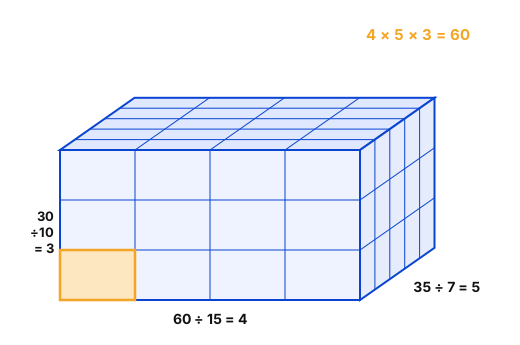
Q856.
How many cuboid boxes of size 15 cm×10cm×7cm can be packed into a carton of size 60cm×35cm×30cm without leaving any space ?
15 cm×10cm×7cm आकार के कितने घनाभाकार बक्से 60cm×35cm×30cm आकार के कार्टन में बिना कोई स्थान छोड़े रखे जा सकते हैं?
  1. A40
  2. B30
  3. C60
  4. D50
Show answer

Concept: Number of boxes=carton volume÷box volume (edges must divide exactly).

  1. 60÷15=4,35÷7=5,30÷10=3.
  2. Boxes=4×5×3=60.

Trick: Pair each carton edge with the box edge that divides it evenly.

Answer: (C) 60

अवधारणा: डिब्बों की संख्या=कार्टन का आयतन÷डिब्बे का आयतन।

हल:

  1. 60÷15=4,35÷7=5,30÷10=3।
  2. कुल=4×5×3=60।

ट्रिक: हर भुजा को उस भुजा से जोड़ें जिससे पूरा भाग जाए।

उत्तर: (C) 60

SSC CHSLQuantitative AptitudeMensuration – packing boxesSSC CHSL 2025 · 28 Nov Shift 1 →
Q857.
A triangular road sign has angles 40°, 80°, and 60°. Another similar sign has one angle 60∘. What are the other two?
एक त्रिभुजाकार सड़क-चिह्न के कोण 40°, 80° तथा 60° हैं। एक अन्य समरूप चिह्न का एक कोण 60∘ है। शेष दो कोण क्या हैं?
  1. A80° and 40°80° तथा 40°
  2. B65° and 45°65° तथा 45°
  3. C50° and 60°50° तथा 60°
  4. D80° and 80°80° तथा 80°
Show answer

Concept: Similar triangles have equal corresponding angles.

  1. Second sign has the same angles: 40°, 80°, 60°.
  2. Given 60°, the others are 80° and 40° (sum 180° ✔).

Trick: Similarity changes size, never angles.

Answer: (A) 80° and 40°

अवधारणा: समरूप त्रिभुजों के संगत कोण बराबर होते हैं।

हल:

  1. दूसरे चिह्न के कोण भी 40°, 80°, 60°।
  2. 60° दिया है, अतः बाकी 80° और 40°।

ट्रिक: समरूपता में आकार बदलता है, कोण नहीं।

उत्तर: (A) 80° तथा 40°

SSC CHSLQuantitative AptitudeSimilar triangles – anglesSSC CHSL 2025 · 28 Nov Shift 1 →
Q858.
An interior designer uses a regular hexagon shape for a tabletop. What is the measure of each interior angle ?
एक इंटीरियर डिज़ाइनर मेज़ के ऊपरी भाग के लिए सम षट्भुज आकृति का उपयोग करता है। इसके प्रत्येक अंतःकोण की माप क्या है?
  1. A80°
  2. B120°*120°
  3. C90°
  4. D180°
Show answer

Concept: Each exterior angle of a regular n-gon = 360°/n; interior = 180° − exterior.

  1. Hexagon: exterior = 360°/6 = 60°.
  2. Interior = 180° − 60° = 120°.

Trick: Exterior-angle route is faster than (n − 2) × 180°/n.

Answer: (B) 120°*

अवधारणा: समबहुभुज का बाह्य कोण = 360°/n; अंतः कोण = 180° − बाह्य।

हल:

  1. षट्भुज: बाह्य = 60°।
  2. अंतः = 120°।

ट्रिक: बाह्य कोण वाला तरीका सबसे तेज़ है।

उत्तर: (B) 120°

SSC CHSLQuantitative AptitudePolygon – interior angleSSC CHSL 2025 · 28 Nov Shift 1 →
Q859.
A trader bought 600 kg of rice, part at ₹20 per kg and the rest at ₹28 per kg. He sold all at ₹25 per kg and made a total profit of ₹1,400. If the quantity bought at ₹20 was twice that bought at ₹28, find the quantity bought at ₹28 per kg.
एक व्यापारी ने 600 kg चावल खरीदा — कुछ भाग ₹20 प्रति kg की दर से तथा शेष ₹28 प्रति kg की दर से। उसने सारा चावल ₹25 प्रति kg की दर से बेचा तथा कुल ₹1,400 का लाभ अर्जित किया। यदि ₹20 की दर से खरीदी गई मात्रा, ₹28 की दर से खरीदी गई मात्रा की दोगुनी थी, तो ₹28 प्रति kg की दर से खरीदी गई मात्रा ज्ञात कीजिए।
  1. A210 kg
  2. B230 kg
  3. C240 kg
  4. D200 kg
Show answer

Concept: Use the given ratio of quantities (2 : 1).

  1. ₹28 part =x, ₹20 part =2x⇒3x=600⇒x=200 kg.
  2. Check: CP=400×20+200×28=13,600; SP=600×25=15,000; profit = ₹1,400 ✔.

Trick: The ratio alone gives the answer; the profit only confirms it.

Answer: (D) 200 kg

अवधारणा: मात्राओं का अनुपात 2 : 1 सीधे प्रयोग करें।

हल:

  1. ₹28 वाला =x, ₹20 वाला =2x⇒3x=600⇒x=200 kg।
  2. जाँच: क्रय 13,600, विक्रय 15,000 → लाभ 1,400 ✔।

ट्रिक: केवल अनुपात से उत्तर मिल जाता है; लाभ से पुष्टि।

उत्तर: (D) 200 kg

SSC CHSLQuantitative AptitudeMixture – quantity at a priceSSC CHSL 2025 · 28 Nov Shift 1 →
Q860.
A pipe has a right prism shape with an equilateral triangle base of side 8 cm and length 30 cm . Find its water-holding capacity.
एक पाइप लंब प्रिज़्म के आकार का है, जिसका आधार 8 cm भुजा वाला समबाहु त्रिभुज है तथा जिसकी लंबाई 30 cm है। इसकी जल-धारण क्षमता ज्ञात कीजिए।
  1. A511.71cm3
  2. B615.36cm3
  3. C831.36cm3
  4. D978.21cm3
Show answer

Concept: Volume of prism=base area×length; equilateral triangle area=34a2.

  1. Base=34×64=163cm2.
  2. Volume=163×30=4803=480×1.732=831.36cm3.

Trick: 4803≈480×1.73≈830 → only 831.36 is close.

Answer: (C) 831.36cm3

अवधारणा: प्रिज़्म का आयतन=आधार क्षेत्रफल×लंबाई; समबाहु त्रिभुज=34a2।

हल:

  1. आधार=163cm2।
  2. आयतन=4803=831.36cm3।

ट्रिक: 480×1.73≈830 – सीधे निकटतम विकल्प।

उत्तर: (C) 831.36cm3

SSC CHSLQuantitative AptitudePrism – volumeSSC CHSL 2025 · 28 Nov Shift 1 →