Question bank

Q&A: practice questions with answers

Search questions on any topic. Filter by exam category, exam, subject and topic, try the question, then open the answer and explanation.

Courses – airGurukul

5,000 questions found.

Q941.
Length of 5 rectangles P,Q,R,S and T is compared. Length of no two rectangles is same. Length of Q is less than only two rectangles. Length of no rectangle is less than S . Length of R is not more than T but more than P . Length of which rectangle is maximum?
5 आयतों P,Q,R,S तथा T की लंबाई की तुलना की जाती है। किन्हीं दो आयतों की लंबाई समान नहीं है। Q की लंबाई केवल दो आयतों की लंबाई से कम है। किसी भी आयत की लंबाई S से कम नहीं है। R की लंबाई T से अधिक नहीं है, किंतु P से अधिक है। किस आयत की लंबाई अधिकतम है?
  1. AT
  2. BR
  3. CP
  4. DS
Show answer

Concept: Place fixed positions first, then fit the chain.
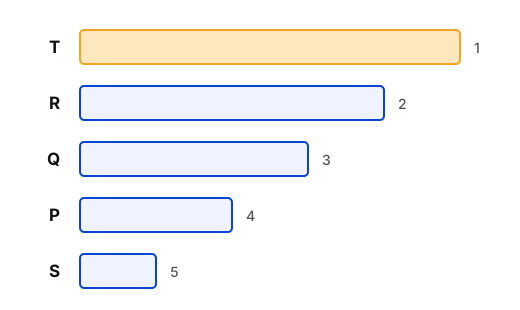
  1. Q has exactly two longer → Q is 3rd.
  2. No one shorter than S → S is 5th (shortest).
  3. T > R > P → T, R fill 1st & 2nd, P is 4th: T > R > Q > P > S → T longest.

Trick: R is 'not more than T' → R can't be top; S is lowest → only T remains for top.

Answer: (A) T

अवधारणा: पहले निश्चित स्थान रखें, फिर बाकी क्रम बैठाएँ।

  1. Q से केवल दो बड़े → Q तीसरा।
  2. S से छोटा कोई नहीं → S सबसे छोटा (5वाँ)।
  3. T > R > P → T > R > Q > P > S → सबसे लंबा T।

ट्रिक: R, T से बड़ा नहीं और S सबसे छोटा – शीर्ष पर केवल T बचता है।

उत्तर: (A) T
SSC CHSLGeneral IntelligenceOrdering – Length comparisonSSC CHSL 2025 · 27 Nov Shift 3 →
Q942.
Price of 6 toys P, Q, R, S, T, and U is compared. The price of no two toys is the same. The price of Q is the second highest. The price of T is less than R but mor. The price of U is less than S but more than P.
Which toy has the highest price?
6 खिलौनों P, Q, R, S, T तथा U के मूल्य की तुलना की जाती है। किन्हीं दो खिलौनों का मूल्य समान नहीं है। Q का मूल्य दूसरा सर्वाधिक है। T का मूल्य R से कम है, किंतु S से अधिक है। U का मूल्य S से कम है, किंतु P से अधिक है।
किस खिलौने का मूल्य सर्वाधिक है?
  1. AQ
  2. BR
  3. CS
  4. DT
Show answer

Concept: Join the clues into one chain and fit the fixed position.

  1. R > T > S and S > U > P → R > T > S > U > P.
  2. Q is 2nd highest → only one toy above Q.
  3. R is above T, S, U, P → R > Q > T > S > U > P → R highest.

Trick: Q is 2nd, so the answer can't be Q; R beats everyone in the chain → R.

Answer: (B) R

अवधारणा: संकेतों को एक श्रृंखला में जोड़ें और निश्चित स्थान बैठाएँ।

  1. R > T > S और S > U > P → R > T > S > U > P।
  2. Q दूसरा सबसे महँगा → उससे ऊपर केवल एक।
  3. R सबसे ऊपर → R > Q > T > S > U > P → R।

ट्रिक: Q दूसरे स्थान पर है, अतः उत्तर Q नहीं; श्रृंखला में R सबसे ऊपर।

उत्तर: (B) R

SSC CHSLGeneral IntelligenceOrdering – Price comparisonSSC CHSL 2025 · 27 Nov Shift 3 →
Q943.
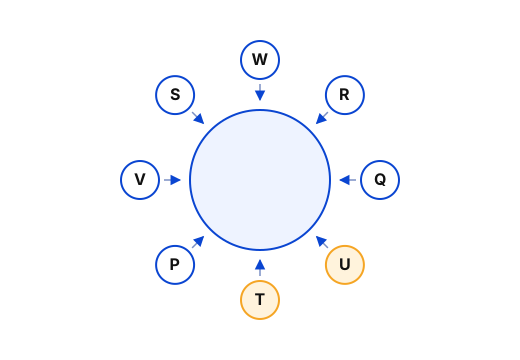
8 women P, Q, R, S, T, U, V and W are sitting around a circular table facing the centre (not necessarily in the same order). Q is second to the left of W.P is third to the left of Q . S is to the immediate right of W.U is fourth to the left of S,R is the immediate neighbour of W and Q . V is second to the right of W. Who is to the immediate right of T ?
8 महिलाएँ P, Q, R, S, T, U, V तथा W एक वृत्ताकार मेज़ के चारों ओर केंद्र की ओर मुख करके बैठी हैं (आवश्यक नहीं कि इसी क्रम में)। Q, W.P के बाईं ओर दूसरे स्थान पर है, जो Q के बाईं ओर तीसरे स्थान पर है। S, W.U के ठीक दाईं ओर है, जो S,R के बाईं ओर चौथे स्थान पर है, जो W तथा Q की निकटतम पड़ोसी है। V, W के दाईं ओर दूसरे स्थान पर है। T के ठीक दाईं ओर कौन है?
  1. AU
  2. BR
  3. CS
  4. DT
Show answer

Concept: Facing centre: left = clockwise, right = anticlockwise.

  1. Fix W; Q 2nd left of W, R between them; S immediate right of W; V 2nd right of W.
  2. P 3rd left of Q; U 4th left of S (opposite S); T takes the last seat.
  3. Clockwise: W, R, Q, U, T, P, V, S → right of T (anticlockwise) = U.

Trick: '4th to the left/right' in a circle of 8 is always the person sitting directly opposite.

Answer: (A) U

अवधारणा: केंद्र की ओर मुख: बायाँ = दक्षिणावर्त, दायाँ = वामावर्त।

  1. W तय करें; Q, W के बाएँ दूसरा, R दोनों के बीच; S, W के ठीक दाएँ; V, W के दाएँ दूसरा।
  2. P, Q के बाएँ तीसरा; U, S के बाएँ चौथा (ठीक सामने); T बची सीट पर।
  3. दक्षिणावर्त: W, R, Q, U, T, P, V, S → T के दाएँ = U।

ट्रिक: 8 लोगों के वृत्त में '4th left/right' हमेशा ठीक सामने वाला होता है।

उत्तर: (A) U

SSC CHSLGeneral IntelligenceCircular arrangement – Facing centreSSC CHSL 2025 · 27 Nov Shift 3 →
Q944.
If ' A ' means '+', ' B ' means '-', ' C ' means ' x ', and ' D ' means ' ÷ ', then 48 B 8 C 2 A 12 D 3= ?
यदि ' A ' का अर्थ '+' है, ' B ' का अर्थ '-' है, ' C ' का अर्थ ' x ' है तथा ' D ' का अर्थ ' ÷ ' है, तो 48 B 8 C 2 A 12 D 3= ?
  1. A28
  2. B36
  3. C20
  4. D16
Show answer

Concept: Replace letters with signs, then solve by BODMAS.

  1. 48−8×2+12÷3.
  2. =48−16+4.
  3. = 36.

Trick: Do ÷ and × first (16 and 4), then just 48−16+4.

Answer: (B) 36

अवधारणा: अक्षरों को चिह्नों से बदलें, फिर BODMAS से हल करें।

  1. 48−8×2+12÷3।
  2. =48−16+4।
  3. = 36।

ट्रिक: पहले ÷ और × (16 और 4), फिर 48−16+4।

उत्तर: (B) 36

SSC CHSLGeneral IntelligenceSymbol substitution – BODMASSSC CHSL 2025 · 27 Nov Shift 3 →
Q945.
Select the correct combination of mathematical signs to replace (*) signs sequentially and to balance the given equation.
18∗6∗54∗9∗12=114
दिए गए समीकरण को संतुलित करने के लिए (*) चिह्नों के स्थान पर क्रमानुसार रखे जाने वाले गणितीय चिह्नों का सही संयोजन चुनिए।
18∗6∗54∗9∗12=114
  1. A×,−,÷,+
  2. B÷,+,x,−
  3. C,−×,+,+
  4. D,+÷,−,×
Show answer

Concept: Insert each option's signs in order and simplify by BODMAS.

  1. Option A: 18×6−54÷9+12.
  2. =108−6+12.
  3. = 114 ✓ = RHS.

Trick: 114 is large – a '×' between 18 and 6 (108) is needed; start checking with that option.

Answer: (A) ×,−,÷,+

अवधारणा: हर विकल्प के चिह्न क्रम से रखें और BODMAS से हल करें।

  1. विकल्प A: 18×6−54÷9+12।
  2. =108−6+12।
  3. = 114 ✓।

ट्रिक: 114 बड़ी संख्या है – 18×6=108 चाहिए, उसी विकल्प से शुरुआत करें।

उत्तर: (A) ×,−,÷,+

SSC CHSLGeneral IntelligenceBalancing an equationSSC CHSL 2025 · 27 Nov Shift 3 →
Q946.
In the following question, four letter-number pairs are given. The letter-number on the left side of (−) is related to the letter-number on the right side of (-) with some Logic/Rule/Relation. Select the odd one out from the given alternatives.
(NOTE: Operations should be performed on the whole numbers, without breaking down the number into its constituent digits. E.g.13- Operations on 13 such as adding /subtracting /multiplying etc. to 13 can be performed. Breaking down 13 into 1 and 3 and then performing mathematical operations on 1 and 3 is not allowed)
निम्नलिखित प्रश्न में चार अक्षर-संख्या युग्म दिए गए हैं। (−) के बाईं ओर का अक्षर-संख्या किसी तर्क/नियम/संबंध के अनुसार (-) के दाईं ओर के अक्षर-संख्या से संबंधित है। दिए गए विकल्पों में से असंगत को चुनिए।
(नोट: संक्रियाएँ पूर्ण संख्याओं पर की जानी चाहिए, संख्या को उसके अंकों में तोड़े बिना। उदाहरण के लिए 13 — 13 पर जोड़ना/घटाना/गुणा करना आदि संक्रियाएँ की जा सकती हैं। 13 को 1 तथा 3 में तोड़कर 1 और 3 पर गणितीय संक्रियाएँ करना मान्य नहीं है।)
  1. AB156M - C3120
  2. BF204Q - G408S
  3. CH175R - I360T
  4. DD198N - E396P
Show answer

Concept: Right-side number=left-side number×2.

  1. 156×2=312 ✓; 204×2=408 ✓; 198×2=396 ✓.
  2. 175×2=350, but given 360 ✗.
  3. So H175R – I360T is odd.

Trick: Right number must be even and double – check the last digits: 175 → 350, not 360.

Answer: (C) H175R - I360T

अवधारणा: दाईं ओर की संख्या=बाईं ओर की संख्या×2।

  1. 156×2=312 ✓; 204×2=408 ✓; 198×2=396 ✓।
  2. 175×2=350, पर दिया 360 ✗।
  3. अतः H175R – I360T असंगत।

ट्रिक: 175 का दोगुना 350 – इकाई अंक 0 तो है, पर 360 नहीं।

उत्तर: (C) H175R - I360T

SSC CHSLGeneral IntelligenceOdd one out – Letter-number pairsSSC CHSL 2025 · 27 Nov Shift 3 →
Q947.
In a certain coded language 'GHOST' is coded as 'QOLDD' and 'BRAIN' is coded as 'KEXNY'. How will 'STORM' be coded in the same code language?
एक निश्चित कूट भाषा में 'GHOST' को 'QOLDD' तथा 'BRAIN' को 'KEXNY' लिखा जाता है। उसी कूट भाषा में 'STORM' को किस प्रकार लिखा जाएगा?
  1. AJKMPP
  2. BJNLPP
  3. CKMLPQ
  4. DINKPO
Show answer

Concept: Reverse the word, then shift letters −3, −4, −3, −4, −3.

  1. GHOST → TSOHG → Q O L D D ✓.
  2. STORM → MROTS.
  3. M−3 = J, R−4 = N, O−3 = L, T−4 = P, S−3 = P → JNLPP.

Trick: Last code letter comes from the first word letter: S − 3 = P; only options with 'P' at the end and J at the start → JNLPP.

Answer: (B) JNLPP

अवधारणा: शब्द को उलटें, फिर −3, −4, −3, −4, −3 खिसकाएँ।

  1. GHOST → TSOHG → QOLDD ✓।
  2. STORM → MROTS।
  3. M−3 = J, R−4 = N, O−3 = L, T−4 = P, S−3 = P → JNLPP।

ट्रिक: पहला कोड अक्षर M − 3 = J; दूसरा R − 4 = N – इतने से ही JNLPP तय।

उत्तर: (B) JNLPP

SSC CHSLGeneral IntelligenceCoding – Reverse and shiftSSC CHSL 2025 · 27 Nov Shift 3 →
Q948.
In a certain coded language 'MANTRA' is coded as 'QVXREE' and 'POTION' is coded as 'TSMXSR'. How will 'CAMERA' be coded in the same code language?
एक निश्चित कूट भाषा में 'MANTRA' को 'QVXREE' तथा 'POTION' को 'TSMXSR' लिखा जाता है। उसी कूट भाषा में 'CAMERA' को किस प्रकार लिखा जाएगा?
  1. AGUIPEE
  2. BGVIQEE
  3. CHWJRFF
  4. DGVIREE
Show answer

Concept: Keep first and last letters, reverse the middle four, then add +4 to every letter.

  1. MANTRA → M RTNA A → +4 → QVXREE ✓.
  2. CAMERA → C REMA A = CREMAA.
  3. +4: C→G, R→V, E→I, M→Q, A→E, A→E → GVIQEE.

Trick: First (C+4 = G) and last (A+4 = E) are fixed; then the 4th letter M+4 = Q decides between B and D.

Answer: (B) GVIQEE

अवधारणा: पहला-अंतिम अक्षर वहीं, बीच के चार उलटें, फिर हर अक्षर +4।

  1. MANTRA → M RTNA A → +4 → QVXREE ✓।
  2. CAMERA → CREMAA।
  3. +4: G V I Q E E → GVIQEE।

ट्रिक: M + 4 = Q (R नहीं) – इसी से B और D में फैसला।

उत्तर: (B) GVIQEE

SSC CHSLGeneral IntelligenceCoding – Middle reversal and +4SSC CHSL 2025 · 27 Nov Shift 3 →
Q949.
A series is given with one term missing. Select the correct alternative from the given ones that will complete the series.
TI278, SG246, ? , QC182, PA150
एक शृंखला दी गई है जिसमें एक पद लुप्त है। दिए गए विकल्पों में से वह सही विकल्प चुनिए जो शृंखला को पूर्ण करेगा।
TI278, SG246, ? , QC182, PA150
  1. ARE250
  2. BRE214
  3. CRE210
  4. DRE256
Show answer

Concept: Treat first letter, second letter and number as separate series.

  1. First letters: T, S, R, Q, P (−1).
  2. Second letters: I, G, E, C, A (−2).
  3. Numbers: 278, 246, 214, 182, 150 (−32) → RE214.

Trick: All options start with RE – just find the number: 246 − 32 = 214.

Answer: (B) RE214

अवधारणा: पहला अक्षर, दूसरा अक्षर और संख्या को अलग-अलग श्रृंखला मानें।

  1. पहले अक्षर: T, S, R, Q, P (−1)।
  2. दूसरे अक्षर: I, G, E, C, A (−2)।
  3. संख्या: 278, 246, 214, 182, 150 (−32)।

ट्रिक: सभी विकल्प RE से शुरू – केवल संख्या: 246 − 32 = 214।

उत्तर: (B) RE214

SSC CHSLGeneral IntelligenceAlphanumeric seriesSSC CHSL 2025 · 27 Nov Shift 3 →
Q950.
A series is given with one term wrong. Select that wrong term from the given alternatives.
DK12, KR60, RY300, YF1500, FM7600
एक शृंखला दी गई है जिसमें एक पद गलत है। दिए गए विकल्पों में से उस गलत पद को चुनिए।
DK12, KR60, RY300, YF1500, FM7600
  1. AKR60
  2. BYF1500
  3. CRY300
  4. DFM7600
Show answer

Concept: Letters move +7; numbers multiply by 5.

  1. Letters D→K→R→Y→F (+7 each, cyclic) – all fine.
  2. 12×5=60, × 5 = 300, × 5 = 1500.
  3. Next should be 1500×5=7500, but 7600 is given → FM7600 is wrong.

Trick: Any number × 5 ends in 0 or 5 and here must be 7500 – 7600 breaks the ×5 chain.

Answer: (D) FM7600

अवधारणा: अक्षर +7 चलते हैं; संख्याएँ × 5 होती हैं।

  1. अक्षर D→K→R→Y→F (हर बार +7) – सही।
  2. 12×5=60, × 5 = 300, × 5 = 1500।
  3. अगला 1500×5=7500 होना चाहिए, पर 7600 दिया → FM7600 गलत।

ट्रिक: 1500×5=7500 – मन में तुरंत, 7600 गलत।

उत्तर: (D) FM7600

SSC CHSLGeneral IntelligenceWrong term – Alphanumeric seriesSSC CHSL 2025 · 27 Nov Shift 3 →
Q951.
25% of a number is 35. What is 80% of that number?
किसी संख्या का 25% 35 है। उस संख्या का 80% कितना होगा?
  1. A100
  2. B112
  3. C122
  4. D132
Show answer

Concept: If p% of N is known, q% of N=known value×qp.

  1. 25%=35 → 100%=35×4=140.
  2. 80% of 140=0.8×140 = 112.

Trick: 80% is 8025=3.2 times 25% → 35×3.2=112 (no need to find the number).

Answer: (B) 112

अवधारणा: p% ज्ञात हो तो q%=ज्ञात मान×qp।

  1. 25%=35 → 100%=35×4=140।
  2. 140 का 80% = 112।

ट्रिक: 80% = 25% का 3.2 गुना → 35×3.2=112।

उत्तर: (B) 112

SSC CHSLQuantitative AptitudePercentage – Scaling a known partSSC CHSL 2025 · 27 Nov Shift 3 →
Q952.
On selling 15 articles, a trader gains the cost price of 5 articles. What is his profit percentage?
15 वस्तुएँ बेचने पर एक व्यापारी को 5 वस्तुओं के क्रय मूल्य के बराबर लाभ होता है। उसका लाभ प्रतिशत क्या है?
  1. A30.33%
  2. B33.33%
  3. C30%
  4. D21.25%
Show answer

Concept: Profit %=(articles' worth gained÷articles sold)×100.

  1. Let CP of 1 article = ₹1 → CP of 15 = ₹15.
  2. Profit = CP of 5 = ₹5.
  3. Profit%=515×100=33.33%.

Trick: GainSold=515=13=3313% straight away.

Answer: (B) 33.33%

अवधारणा: लाभ%=(जितनी वस्तुओं का लाभ÷बेची गई वस्तुएँ)×100।

  1. 1 वस्तु का CP = ₹1 → 15 का = ₹15।
  2. लाभ = 5 वस्तुओं का CP = ₹5।
  3. लाभ%=515×100=33.33%।

ट्रिक: 515=13=3313% – सीधे।

उत्तर: (B) 33.33%

SSC CHSLQuantitative AptitudeProfit % – Gain equal to CP of some articlesSSC CHSL 2025 · 27 Nov Shift 3 →
Q953.
A can complete a task in 12 days, while B can finish the same task in 18 days. They decide to work alternately, with A starting the work on the first day. How many days will it take for them to complete the entire task?
A किसी कार्य को 12 दिनों में पूरा कर सकता है, जबकि B उसी कार्य को 18 दिनों में समाप्त कर सकता है। वे एकांतर दिनों में कार्य करने का निर्णय लेते हैं, जिसमें पहले दिन A कार्य आरंभ करता है। संपूर्ण कार्य पूरा करने में उन्हें कितने दिन लगेंगे?
  1. A1123 days1123 दिन
  2. B1113 days1113 दिन
  3. C1413 days1413 दिन
  4. D1313 days1313 दिन
Show answer

Concept: Take total work = LCM; find work in one 2-day cycle.

  1. Work = LCM(12,18)=36 units; A = 3/day, B = 2/day.
  2. One cycle (A+B, 2 days) = 5 units → 7 cycles = 14 days = 35 units.
  3. Left 1 unit, day 15 is A's: 13 day → total = 14+13=1413 days.

Trick: Pick cycles so the leftover is less than one day of the starter (A) – here 35 units, leftover 1.

Answer: (C) 1413 days

अवधारणा: कुल कार्य = LCM; 2 दिन के एक चक्र का कार्य निकालें।

  1. कार्य = LCM(12,18)=36 इकाई; A = 3/दिन, B = 2/दिन।
  2. एक चक्र (2 दिन) = 5 इकाई → 7 चक्र = 14 दिन = 35 इकाई।
  3. बचा 1 इकाई, 15वाँ दिन A का: 13 दिन → कुल = 1413 दिन।

ट्रिक: इतने चक्र लें कि बचा कार्य, पहले काम करने वाले (A) के एक दिन से कम हो।

उत्तर: (C) 1413 दिन

SSC CHSLQuantitative AptitudeTime & work – Alternate daysSSC CHSL 2025 · 27 Nov Shift 3 →
Q954.
If a car reduces its speed by 8 km/h, it takes 1 hour more for a journey of 160 km . Find original speed.
यदि कोई कार अपनी चाल 8 km/h कम कर देती है, तो 160 km की यात्रा में उसे 1 घंटा अधिक लगता है। मूल चाल ज्ञात कीजिए।
  1. A32 km/h
  2. B40km/h
  3. C48 km/h
  4. D56km/h
Show answer

Concept: Distances−8−Distances=extra time.

  1. 160s−8−160s=1 → 1280=s(s−8).
  2. s2−8s−1280=0 → (s−40)(s+32)=0.
  3. s = 40 km/h.

Trick: Test options: 16040=4 h, 16032=5 h → difference 1 h ✓.

Answer: (B) 40km/h

अवधारणा: दूरीs−8−दूरीs=अतिरिक्त समय।

  1. 160s−8−160s=1 → s(s−8)=1280।
  2. s2−8s−1280=0 → (s−40)(s+32)=0।
  3. s = 40 km/h।

ट्रिक: विकल्प जाँचें: 16040=4 घंटे, 16032=5 घंटे → अंतर 1 घंटा ✓।

उत्तर: (B) 40km/h

SSC CHSLQuantitative AptitudeSpeed – Reduced speed, extra timeSSC CHSL 2025 · 27 Nov Shift 3 →
Q955.
A sum becomes ₹6000 in 5 years at 10% simple interest per annum. What is the original sum?
कोई धनराशि 10% वार्षिक साधारण ब्याज की दर से 5 वर्षों में ₹6000 हो जाती है। मूलधन कितना है?
  1. A₹3000
  2. B₹5000
  3. C₹4000
  4. D₹6000
Show answer

Concept: Amount=P(1+RT100).

  1. Total SI%=10×5=50%.
  2. Amount=150% of P=6000.
  3. P=6000×100150 = ₹4000.

Trick: 50% SI → A : P = 3 : 2 → P=6000×23 = 4000.

Answer: (C) ₹4000

अवधारणा: मिश्रधन=P(1+RT100)।

  1. कुल ब्याज%=10×5=50%।
  2. मिश्रधन=P का 150%=6000।
  3. P=6000×100150 = ₹4000।

ट्रिक: 50% ब्याज → मिश्रधन : मूलधन = 3 : 2 → P=6000×23।

उत्तर: (C) ₹4000

SSC CHSLQuantitative AptitudeSimple interest – Principal from amountSSC CHSL 2025 · 27 Nov Shift 3 →
Q956.
A tank shaped like a rectangular parallelepiped measures 4m×1.8m× 1.5 m . How many liters of water can it hold?
एक टंकी आयताकार समांतर षट्फलक के आकार की है, जिसकी माप 4m×1.8m× 1.5 m है। इसमें कितने लीटर पानी आ सकता है?
  1. A10000 L
  2. B11000 L
  3. C10800 L
  4. D10900 L
Show answer

Concept: Volume=l×b×h; 1m3=1000 litres.

  1. Volume=4×1.8×1.5=10.8 m³.
  2. Capacity=10.8×1000 = 10800 L.

Trick: 1.8×1.5=2.7; 2.7×4=10.8 → shift decimal three places.

Answer: (C) 10800 L

अवधारणा: आयतन=l×b×h; 1m3=1000 लीटर।

  1. आयतन=4×1.8×1.5=10.8 m³।
  2. धारिता=10.8×1000 = 10800 L।

ट्रिक: 1.8×1.5=2.7, × 4 = 10.8 → दशमलव तीन स्थान आगे।

उत्तर: (C) 10800 L

SSC CHSLQuantitative AptitudeMensuration – Cuboid capacitySSC CHSL 2025 · 27 Nov Shift 3 →
Q957.
An artist carves an ice sculpture in shape of a right triangular pyramid (base triangle: base 5 cm , height 12 cm , pyramid height 15 cm ). What is the volume of ice used?
एक कलाकार बर्फ की एक मूर्ति लंब त्रिभुजाकार पिरामिड के आकार में तराशता है (आधार त्रिभुज: आधार 5 cm, ऊँचाई 12 cm, पिरामिड की ऊँचाई 15 cm)। प्रयुक्त बर्फ का आयतन कितना है?
  1. A100cm3
  2. B150cm3
  3. C200cm3
  4. D300cm3
Show answer

Concept: Pyramid volume=13×base area×height.

  1. Base (right triangle) area = 12×5×12=30 cm².
  2. Volume=13×30×15 = 150 cm³.

Yaad rakhein: A pyramid holds exactly one-third of the prism with the same base and height (30×15=450 → 150).

Answer: (B) 150cm3

अवधारणा: पिरामिड का आयतन=13×आधार क्षेत्रफल×ऊँचाई।

  1. आधार (समकोण त्रिभुज) = 12×5×12=30 cm²।
  2. आयतन=13×30×15 = 150 cm³।

याद रखें: पिरामिड, उसी आधार-ऊँचाई वाले प्रिज़्म का 13 होता है (450 → 150)।

उत्तर: (B) 150cm3

SSC CHSLQuantitative AptitudeMensuration – Volume of pyramidSSC CHSL 2025 · 27 Nov Shift 3 →
Q958.
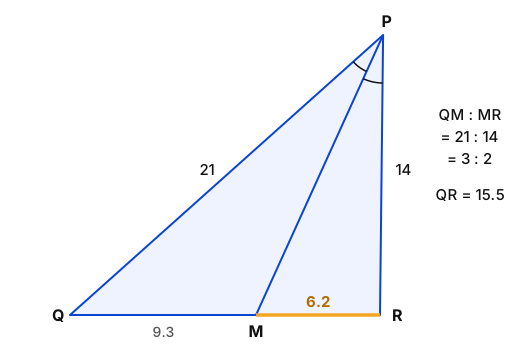
In triangle PQR,′M ' is a point on QR such that ∠RPM=∠QPM. If PQ=21,PR =14 and QR=15.5, then find the length of MR.
त्रिभुज PQR,′M ', QR पर एक ऐसा बिंदु है कि ∠RPM=∠QPM है। यदि PQ=21,PR =14 तथा QR=15.5 हो, तो MR की लंबाई ज्ञात कीजिए।
  1. A9.1 cm
  2. B6.2 cm
  3. C6.5 cm
  4. D9 cm
Show answer

Concept: Bisector of ∠P divides QR in the ratio PQ : PR.

  1. QM : MR = 21 : 14 = 3 : 2.
  2. MR=25×15.5 = 6.2 cm.

Trick: MR is next to the shorter side PR → it is the smaller part (below 7.75); only 6.2 and 6.5 qualify, ratio gives 6.2.

Answer: (B) 6.2 cm

अवधारणा: ∠P का समद्विभाजक QR को PQ : PR के अनुपात में बाँटता है।

  1. QM : MR = 21 : 14 = 3 : 2।
  2. MR=25×15.5 = 6.2 cm।

ट्रिक: MR छोटी भुजा PR की ओर है → छोटा भाग (7.75 से कम)।

उत्तर: (B) 6.2 cm

SSC CHSLQuantitative AptitudeTriangles – Angle bisector theoremSSC CHSL 2025 · 27 Nov Shift 3 →
Q959.
Out of 400 students, 40% failed the exam. Out of the remaining 40% passed the exam with distinction. Find the ratio of the students who passed the exam with distinction to the students who passed the exam without distinction.
400 विद्यार्थियों में से 40% परीक्षा में अनुत्तीर्ण हो गए। शेष में से 40% विद्यार्थी परीक्षा में विशेष योग्यता (distinction) के साथ उत्तीर्ण हुए। विशेष योग्यता के साथ उत्तीर्ण विद्यार्थियों तथा बिना विशेष योग्यता के उत्तीर्ण विद्यार्थियों का अनुपात ज्ञात कीजिए।
  1. A2 : 3
  2. B2 : 4
  3. C2 : 1
  4. D2 : 6
Show answer

Concept: Work in stages: failed → passed → distinction.

  1. Passed = 60% of 400 = 240.
  2. Distinction = 40% of 240 = 96; without = 144.
  3. 96 : 144 = 2 : 3.

Trick: Within the passed group it is 40% : 60% = 2 : 3 – the total 400 is not even needed.

Answer: (A) 2 : 3

अवधारणा: चरणों में: अनुत्तीर्ण → उत्तीर्ण → विशेष योग्यता।

  1. उत्तीर्ण = 400 का 60% = 240।
  2. Distinction = 240 का 40% = 96; बिना = 144।
  3. 96 : 144 = 2 : 3।

ट्रिक: उत्तीर्ण में 40% : 60% = 2 : 3 – 400 की ज़रूरत ही नहीं।

उत्तर: (A) 2 : 3

SSC CHSLQuantitative AptitudePercentage – Ratio of sub-groupsSSC CHSL 2025 · 27 Nov Shift 3 →
Q960.
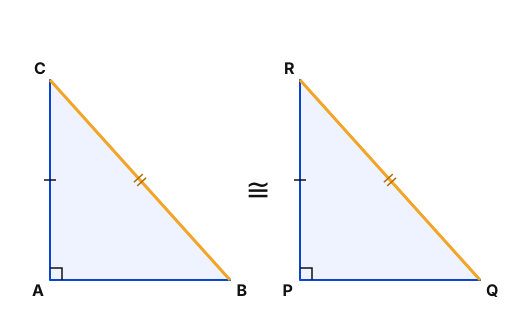
Assertion (A): If in two right-angled triangles the hypotenuse and one side are equal, then the triangles are congruent.
Reason (R): The RHS (Right angle-Hypotenuse-Side) congruence rule is applicable to right-angled triangles.
अभिकथन (A): यदि दो समकोण त्रिभुजों में कर्ण तथा एक भुजा बराबर हों, तो वे त्रिभुज सर्वांगसम होते हैं।
कारण (R): RHS (समकोण-कर्ण-भुजा) सर्वांगसमता नियम समकोण त्रिभुजों पर लागू होता है।
  1. ABoth A and R are true, and R is the correct explanation of AA और R दोनों सत्य हैं तथा R, A की सही व्याख्या है
  2. BBoth A and R are true, but R is not the correct explanation of AA और R दोनों सत्य हैं, किंतु R, A की सही व्याख्या नहीं है
  3. CA is true, but R is falseA सत्य है, किंतु R असत्य है
  4. DA is false, but R is trueA असत्य है, किंतु R सत्य है
Show answer

Concept: RHS: two right triangles with equal hypotenuse and one equal side are congruent.

  1. A states the RHS result → true.
  2. R names the RHS rule for right triangles → true.
  3. R is the very rule behind A → R explains A.

Yaad rakhein: Congruence rules: SSS, SAS, ASA, AAS, RHS – but not SSA or AAA.

Answer: (A) Both A and R are true, and R is the correct explanation of A

अवधारणा: RHS: कर्ण और एक भुजा बराबर हो तो दो समकोण त्रिभुज सर्वांगसम होते हैं।

  1. A, RHS का ही कथन है → सत्य।
  2. R, समकोण त्रिभुजों के लिए RHS नियम बताता है → सत्य।
  3. A इसी नियम से सिद्ध होता है → R सही व्याख्या।

याद रखें: सर्वांगसमता नियम: SSS, SAS, ASA, AAS, RHS – SSA और AAA नहीं।

उत्तर: (A) A और R दोनों सत्य हैं तथा R, A की सही व्याख्या है

SSC CHSLQuantitative AptitudeCongruence – RHS ruleSSC CHSL 2025 · 27 Nov Shift 3 →