Question bank

Q&A: practice questions with answers

Search questions on any topic. Filter by exam category, exam, subject and topic, try the question, then open the answer and explanation.

Courses – airGurukul

5,000 questions found.

Q1041.
8 boys S, T, U, V, W, X, Y and Z are sitting around a circular table facing towards the centre (not necessarily in the same order). Z is to the immediate right of S. Z is not the immediate neighbour of W or V. X is to the immediate left of T. Y is the immediate neighbour of W. U is the immediate neighbour of W and Z. Who is sitting second to the right of Z ?
8 लड़के S, T, U, V, W, X, Y तथा Z एक वृत्ताकार मेज़ के चारों ओर केंद्र की ओर मुख करके बैठे हैं (आवश्यक नहीं कि इसी क्रम में)। Z, S के ठीक दाईं ओर है। Z, W अथवा V का निकटतम पड़ोसी नहीं है। X, T के ठीक बाईं ओर है। Y, W का निकटतम पड़ोसी है। U, W तथा Z का निकटतम पड़ोसी है। Z के दाईं ओर दूसरे स्थान पर कौन बैठा है?
  1. AU
  2. BW
  3. CV
  4. DT
Show answer

Concept: Facing centre: right = anticlockwise, left = clockwise.
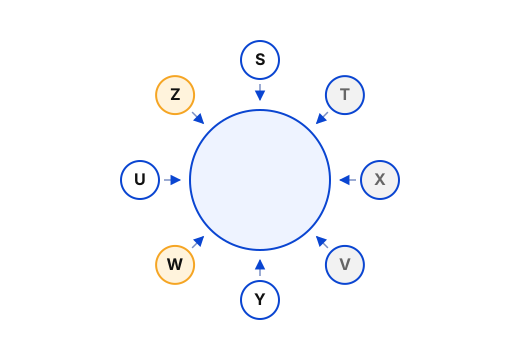
  1. U sits between W and Z, and Y is next to W → block Z–U–W–Y.
  2. Z is to the immediate right of S, so S is on Z's left and U must be on Z's right.
  3. Going right from Z: U (1st), W (2nd), Y (3rd); V, X, T fill the remaining seats (X to the left of T).

Trick: Build the blocks first (S–Z–U–W–Y and X–T), then read off the seats.

Answer: (B) W

अवधारणा: केंद्र की ओर मुख: दायाँ = वामावर्त, बायाँ = दक्षिणावर्त।

  1. U, W और Z के बीच है तथा Y, W के पास है → ब्लॉक Z–U–W–Y।
  2. Z, S के ठीक दाईं ओर है, अतः S, Z के बाईं ओर और U, Z के दाईं ओर।
  3. Z से दाएँ: U (पहला), W (दूसरा), Y (तीसरा); शेष स्थानों पर V, X, T (X, T के बाईं ओर)।

ट्रिक: पहले ब्लॉक बनाएँ (S–Z–U–W–Y और X–T), फिर स्थान पढ़ें।

उत्तर: (B) W
SSC CHSLGeneral IntelligenceCircular seating – facing centreSSC CHSL 2025 · 27 Nov Shift 2 →
Q1042.
Some conditional data is provided to you in form of statement you have to check which of the following statement are logically inference from given statement.
Statement : Employees who complete their projects before the deadline are given a bonus. Rahul completed his project this month before the deadline. What can we infer?
आपको कथन के रूप में कुछ सशर्त सूचना दी गई है। आपको यह जाँचना है कि निम्नलिखित में से कौन-सा कथन दिए गए कथन से तार्किक रूप से निष्कर्षित होता है।
कथन : जो कर्मचारी अपनी परियोजनाएँ समय-सीमा से पहले पूरी कर लेते हैं, उन्हें बोनस दिया जाता है। Rahul ने इस माह अपनी परियोजना समय-सीमा से पहले पूरी कर ली। हम क्या निष्कर्ष निकाल सकते हैं?
  1. ARahul received a bonus this monthRahul को इस माह बोनस मिला
  2. BRahul always completes work before the deadlineRahul सदैव समय-सीमा से पहले कार्य पूरा करता है
  3. CRahul needed extra leaveRahul को अतिरिक्त अवकाश की आवश्यकता थी
  4. DRahul is a hardworking employeeRahul एक परिश्रमी कर्मचारी है
Show answer

Concept: If the condition of a rule is met, its result must follow.

  1. Rule: finish before deadline → get bonus.
  2. Rahul finished before the deadline this month.
  3. So he got the bonus this month; habits/leave/nature are not stated.

Trick: Pick the option that only uses facts in the statement – 'always' and character judgements go beyond it.

Answer: (A) Rahul received a bonus this month

अवधारणा: नियम की शर्त पूरी हो तो उसका परिणाम निश्चित है।

  1. नियम: समय-सीमा से पहले काम → बोनस।
  2. Rahul ने इस माह समय से पहले काम पूरा किया।
  3. अतः उसे इस माह बोनस मिला; आदत/अवकाश/स्वभाव का उल्लेख नहीं।

ट्रिक: 'सदैव' या स्वभाव वाले विकल्प कथन से आगे जाते हैं – हटा दें।

उत्तर: (A) Rahul को इस माह बोनस मिला

SSC CHSLGeneral IntelligenceLogical inference – conditional ruleSSC CHSL 2025 · 27 Nov Shift 2 →
Q1043.
In this type of questions, question is provided with substitutes for various mathematical symbols, followed by a question involving calculation of an expression or choosing the correct/incorrect equation. You have to put the real signs in the given equation and then solve the questions as required. If '#' stands for '÷', '%' stands for '-', '$' stands for ' + ', ′∼ ' stands for ' × ', then find the value of: 12∼5∼7$3= ?
इस प्रकार के प्रश्नों में विभिन्न गणितीय चिह्नों के स्थान पर प्रतिस्थापित चिह्न दिए जाते हैं, तत्पश्चात् किसी व्यंजक का मान ज्ञात करने अथवा सही/गलत समीकरण चुनने से संबंधित प्रश्न पूछा जाता है। आपको दिए गए समीकरण में वास्तविक चिह्न रखकर प्रश्न को हल करना है। यदि '#' का अर्थ '÷' है, '%' का अर्थ '-' है, '$' का अर्थ ' + ' है, ′∼ ' का अर्थ ' × ' है, तो 12∼5∼7$3= का मान ज्ञात कीजिए?
  1. A424
  2. B423
  3. C421
  4. D422
Show answer

Concept: Replace symbols with real signs, then apply BODMAS.

  1. ∼ = ×, $ = + → 12×5×7+3.
  2. 12×5×7=420.
  3. 420+3=423.

Trick: Unit digit check: 2×5×7 ends in 0, +3 → ends in 3 → only 423.

Answer: (B) 423

अवधारणा: चिह्न बदलें, फिर BODMAS लगाएँ।

  1. ∼ = ×, $ = + → 12×5×7+3।
  2. 12×5×7=420।
  3. 420+3=423।

ट्रिक: इकाई अंक: 0+3=3 → केवल 423।

उत्तर: (B) 423

SSC CHSLGeneral IntelligenceSymbol substitution – BODMASSSC CHSL 2025 · 27 Nov Shift 2 →
Q1044.
After interchanging the given two signs, what will be the value of the given equation ?
× and -
18×8−24÷4+12= ?
दिए गए दो चिह्नों को आपस में बदलने पर दिए गए समीकरण का मान क्या होगा?
× तथा -
18×8−24÷4+12= ?
  1. A22
  2. B-20
  3. C-18
  4. D-14
Show answer

Concept: Swap the two signs everywhere, then use BODMAS.

  1. 18×8−24÷4+12→18−8×24÷4+12.
  2. 8×24÷4=8×6=48.
  3. 18−48+12=−18.

Trick: Do ÷ first (24÷4=6) to keep numbers small.

Answer: (C) -18

अवधारणा: दोनों चिह्न हर जगह बदलें, फिर BODMAS।

  1. 18×8−24÷4+12→18−8×24÷4+12।
  2. 8×24÷4=8×6=48।
  3. 18−48+12=−18।

ट्रिक: पहले भाग (24÷4=6) करें – संख्याएँ छोटी रहेंगी।

उत्तर: (C) -18

SSC CHSLGeneral IntelligenceSign interchange – × and −SSC CHSL 2025 · 27 Nov Shift 2 →
Q1045.
By interchanging the given two numbers (not digits) which of the following equation will NOT be correct?
4 and 6
l. 3×6+4−10÷2=13
II. 8×6+4−12÷3=18
दी गई दो संख्याओं (अंकों को नहीं) को आपस में बदलने पर निम्नलिखित में से कौन-सा समीकरण सही नहीं होगा?
4 तथा 6
l. 3×6+4−10÷2=13
II. 8×6+4−12÷3=18
  1. AOnly Iकेवल I
  2. BOnly IIकेवल II
  3. CBoth I and III तथा II दोनों
  4. DNeither I nor IIन तो I और न ही II
Show answer

Concept: Swap the numbers 4 and 6 (not digits inside 10, 12), then evaluate.

  1. I becomes 3×4+6−10÷2; 3×4 is 12 and 10÷2 is 5, so 12+6−5=13 ✓
  2. II becomes 8×4+6−12÷3; 8×4 is 32 and 12÷3 is 4, so total = 34, not 18 ✗
  3. So only II is not correct.

Trick: Quick estimate: in II, 8×4 alone is 32, already far above 18.

Answer: (B) Only II

अवधारणा: 4 और 6 संख्याएँ बदलें (10, 12 के अंक नहीं), फिर हल करें।

  1. I बनता है 3×4+6−10÷2; 3×4=12, 10÷2=5, तो 12+6−5=13 ✓
  2. II बनता है 8×4+6−12÷3; 8×4=32, 12÷3=4, कुल = 34, 18 नहीं ✗
  3. अतः केवल II गलत।

ट्रिक: II में केवल 8×4=32 ही 18 से बहुत बड़ा है।

उत्तर: (B) केवल II

SSC CHSLGeneral IntelligenceNumber interchange – checking equationsSSC CHSL 2025 · 27 Nov Shift 2 →
Q1046.
In a certain coded language 'CPET' is coded as 'IWKA' and 'TLJQ' is coded as 'ZSPX'. How will 'CPXM' be coded in the same code language?
एक निश्चित कूट भाषा में 'CPET' को 'IWKA' तथा 'TLJQ' को 'ZSPX' लिखा जाता है। उसी कूट भाषा में 'CPXM' को किस प्रकार लिखा जाएगा?
  1. AGXDU
  2. BIWDT
  3. CHWCS
  4. DHYCT
Show answer

Concept: Compare letter positions of word and code.

  1. C→I (+6), P→W (+7), E→K (+6), T→A (+7); TLJQ→ZSPX same.
  2. In CPXM, C and P give I and W (as in CPET); X is 24, add 6 → 30, minus 26 → 4th letter D; M is 13, add 7 → 20th letter T.
  3. Code = IWDT.

Trick: First two letters of CPXM equal CPET → code must start 'IW' → only option B.

Answer: (B) IWDT

अवधारणा: शब्द और कोड के अक्षरों की स्थिति-संख्या मिलाएँ।

  1. C→I (+6), P→W (+7), E→K (+6), T→A (+7); TLJQ में भी यही।
  2. CPXM में C, P से I, W (CPET जैसा); X = 24, +6 → 30, −26 → 4 = D; M = 13, +7 → 20 = T।
  3. कोड = IWDT।

ट्रिक: CPXM के पहले दो अक्षर CPET जैसे → कोड 'IW' से शुरू → केवल B।

उत्तर: (B) IWDT

SSC CHSLGeneral IntelligenceCoding – +6, +7 alternatingSSC CHSL 2025 · 27 Nov Shift 2 →
Q1047.
In a certain coded language 'RSNV' is coded as 'NNJQ' and 'GDHQ' is coded as 'CYDL'. How will 'ONRG' be coded in the same code language?
एक निश्चित कूट भाषा में 'RSNV' को 'NNJQ' तथा 'GDHQ' को 'CYDL' लिखा जाता है। उसी कूट भाषा में 'ONRG' को किस प्रकार लिखा जाएगा?
  1. AMHOC
  2. BKINB
  3. CLJOZ
  4. DIKPA
Show answer

Concept: Each letter moves back 4, then 5, alternately.

  1. R→N (−4), S→N (−5), N→J (−4), V→Q (−5); GDHQ→CYDL confirms.
  2. ONRG: O(15)−4 = K, N(14)−5 = I, R(18)−4 = N, G(7)−5 = B.
  3. Code = KINB.

Trick: Find only the first letter: O − 4 = K → only option B starts with K.

Answer: (B) KINB

अवधारणा: अक्षर बारी-बारी 4 और 5 पीछे जाते हैं।

  1. R→N (−4), S→N (−5), N→J (−4), V→Q (−5); GDHQ→CYDL से पुष्टि।
  2. ONRG: O−4 = K, N−5 = I, R−4 = N, G−5 = B।
  3. कोड = KINB।

ट्रिक: पहला अक्षर ही काफ़ी: O − 4 = K → केवल B।

उत्तर: (B) KINB

SSC CHSLGeneral IntelligenceCoding – −4, −5 alternatingSSC CHSL 2025 · 27 Nov Shift 2 →
Q1048.
Which following group of letters, when sequentially placed from left to right will complete the given series?
t_pp_kpptkp_tk_p
निम्नलिखित में से अक्षरों का कौन-सा समूह बाएँ से दाएँ क्रमानुसार रखने पर दी गई शृंखला को पूर्ण करेगा?
t_pp_kpptkp_tk_p
  1. Ak k t p
  2. Bktpp
  3. Ckttt
  4. Dkttp
Show answer

Concept: Split the 16-letter string into equal repeating blocks.

  1. Blocks of 4: t_pp | _kpp | tkp_ | tk_p.
  2. Each block = tkpp.
  3. Blanks in order: k, t, p, p.

Trick: Length 16 → try blocks of 4; fill one block fully and copy.

Answer: (B) ktpp

अवधारणा: 16 अक्षरों को बराबर दोहराते समूहों में बाँटें।

  1. 4-4 के समूह: t_pp | _kpp | tkp_ | tk_p।
  2. हर समूह = tkpp।
  3. रिक्त क्रम से: k, t, p, p।

ट्रिक: लंबाई 16 → 4 के समूह आज़माएँ; एक समूह पूरा करके दोहराएँ।

उत्तर: (B) ktpp

SSC CHSLGeneral IntelligenceMissing letters – repeating blockSSC CHSL 2025 · 27 Nov Shift 2 →
Q1049.
A series is given with one term missing. Select the correct alternative from the given ones that will complete the series.
OK34, JF136, EA544, ZV2176, ?
एक शृंखला दी गई है जिसमें एक पद लुप्त है। दिए गए विकल्पों में से वह सही विकल्प चुनिए जो शृंखला को पूर्ण करेगा।
OK34, JF136, EA544, ZV2176, ?
  1. AUR8934
  2. BTQ8604
  3. CUQ8704
  4. DTR8814
Show answer

Concept: Treat letters and numbers as separate series.

  1. Letters step back by 5: O→J→E→Z→U and K→F→A→V→Q.
  2. Numbers ×4: 34→136→544→2176→8704.
  3. Term = UQ8704.

Trick: Number part alone: 2176×4=8704 → only option C has it.

Answer: (C) UQ8704

अवधारणा: अक्षर और संख्या को अलग-अलग शृंखला मानें।

  1. अक्षर 5 पीछे: O→J→E→Z→U तथा K→F→A→V→Q।
  2. संख्या ×4: 34→136→544→2176→8704।
  3. पद = UQ8704।

ट्रिक: सिर्फ़ संख्या: 2176×4=8704 → केवल C।

उत्तर: (C) UQ8704

SSC CHSLGeneral IntelligenceAlphanumeric series – letters −5, number ×4SSC CHSL 2025 · 27 Nov Shift 2 →
Q1050.
A series is given with one term missing. Select the correct alternative from the given ones that will complete the series.
NX32, QT97, TP292, WL877, ?
एक शृंखला दी गई है जिसमें एक पद लुप्त है। दिए गए विकल्पों में से वह सही विकल्प चुनिए जो शृंखला को पूर्ण करेगा।
NX32, QT97, TP292, WL877, ?
  1. AYH2882
  2. BZH2632
  3. CZG2462
  4. DYG2742
Show answer

Concept: First letter, second letter and number each have their own rule.

  1. 1st letter +3: N→Q→T→W→Z.
  2. 2nd letter −4: X→T→P→L→H.
  3. Number ×3+1: 877×3+1=2632 → ZH2632.

Trick: Number check is enough: 877×3=2631, +1=2632 → option B.

Answer: (B) ZH2632

अवधारणा: पहला अक्षर, दूसरा अक्षर और संख्या – तीनों के अलग नियम।

  1. पहला अक्षर +3: N→Q→T→W→Z।
  2. दूसरा अक्षर −4: X→T→P→L→H।
  3. संख्या ×3+1: 877×3+1=2632 → ZH2632।

ट्रिक: सिर्फ़ संख्या: 877×3+1=2632 → विकल्प B।

उत्तर: (B) ZH2632

SSC CHSLGeneral IntelligenceAlphanumeric series – +3, −4, ×3+1SSC CHSL 2025 · 27 Nov Shift 2 →
Q1051.
What percent of 280 is 70 ?
280 का कितने प्रतिशत 70 है?
  1. A35%
  2. B40%
  3. C45%
  4. D25%
Show answer

Concept: Required %=partwhole×100.

  1. 70280=14.
  2. 14×100=25%.

Trick: 70 is exactly a quarter of 280 (70×4=280) → 25% without calculation.

Answer: (D) 25%

अवधारणा: अभीष्ट %=भागपूर्ण×100।

  1. 70280=14।
  2. 14×100=25%।

ट्रिक: 70×4=280, यानी 70 एक-चौथाई है → सीधे 25%।

उत्तर: (D) 25%

SSC CHSLQuantitative AptitudePercentage – what percentSSC CHSL 2025 · 27 Nov Shift 2 →
Q1052.
If profit earned is 20% of the selling price, what is the profit percentage on cost price?
यदि अर्जित लाभ विक्रय मूल्य का 20% है, तो क्रय मूल्य पर लाभ प्रतिशत कितना है?
  1. A25%
  2. B30%
  3. C33.33%
  4. D20%
Show answer

Concept: Profit % is always on CP; convert profit-on-SP to profit-on-CP.

  1. Let SP = ₹100 → profit = ₹20.
  2. CP=100−20= ₹80.
  3. Profit %=2080×100=25%.

Trick: Profit = 15 of SP → profitCP=15−1=14=25%.

Answer: (A) 25%

अवधारणा: लाभ % हमेशा क्रय मूल्य पर; विक्रय मूल्य वाले लाभ को क्रय मूल्य पर बदलें।

  1. मान लें SP = ₹100 → लाभ = ₹20।
  2. CP=100−20= ₹80।
  3. लाभ %=2080×100=25%।

ट्रिक: लाभ = SP का 15 → CP पर 15−1=14=25%।

उत्तर: (A) 25%

SSC CHSLQuantitative AptitudeProfit % – profit given on SPSSC CHSL 2025 · 27 Nov Shift 2 →
Q1053.
What will be the simple interest on Rs. 1500 at 4% per annum for 3 years ?
Rs. 1500 पर 4% वार्षिक दर से 3 वर्षों का साधारण ब्याज कितना होगा?
  1. ARs. 150.00
  2. BRs. 200.00
  3. CRs. 180.00
  4. DRs. 240.00
Show answer

Concept: SI=P×R×T100.

  1. Interest per year = 4% of 1500 = ₹60.
  2. For 3 years: 60×3= ₹180.

Trick: Total rate = 4×3=12%; 12% of 1500 = ₹180.

Answer: (C) Rs. 180.00

अवधारणा: साधारण ब्याज=P×R×T100।

  1. एक वर्ष का ब्याज = 1500 का 4% = ₹60।
  2. 3 वर्ष: 60×3= ₹180।

ट्रिक: कुल दर = 4×3=12%; 1500 का 12% = ₹180।

उत्तर: (C) Rs. 180.00

SSC CHSLQuantitative AptitudeSimple interest – basicSSC CHSL 2025 · 27 Nov Shift 2 →
Q1054.
An artist uses a regular octagon to make a frame. If the side is 15 cm , what's the total border length ?
एक कलाकार एक फ्रेम बनाने के लिए सम अष्टभुज का उपयोग करता है। यदि भुजा 15 cm है, तो किनारे (बॉर्डर) की कुल लंबाई कितनी होगी?
  1. A150 cm
  2. B120 cm
  3. C130 cm
  4. D140 cm
Show answer

Concept: Perimeter of a regular polygon = number of sides × side.

  1. Octagon has 8 equal sides.
  2. Border = 8×15=120cm.

Trick: 'Octa' = 8 (octopus has 8 arms).

Answer: (B) 120 cm

अवधारणा: सम बहुभुज का परिमाप = भुजाओं की संख्या × भुजा।

  1. अष्टभुज की 8 बराबर भुजाएँ।
  2. किनारा = 8×15=120cm।

ट्रिक: Octa = 8 (octopus की 8 भुजाएँ)।

उत्तर: (B) 120 cm

SSC CHSLQuantitative AptitudePerimeter – regular octagonSSC CHSL 2025 · 27 Nov Shift 2 →
Q1055.
If the curved surface area of a right circular cone is equal to twice the area of its base, find the slant height in terms of the radius.
यदि एक लंब वृत्तीय शंकु का वक्र पृष्ठीय क्षेत्रफल उसके आधार के क्षेत्रफल के दोगुने के बराबर है, तो तिर्यक ऊँचाई को त्रिज्या के पदों में ज्ञात कीजिए।
  1. Al=r
  2. Bl=3r
  3. Cl=2r
  4. Dl=5r
Show answer

Concept: CSA of cone = πrl; base area = πr2.

  1. πrl=2×πr2.
  2. Divide both sides by πr: l=2r.

Trick: CSA ÷ base area = lr always → ratio 2 means l=2r.

Answer: (C) l=2r

अवधारणा: शंकु का वक्र पृष्ठ = πrl; आधार = πr2।

  1. πrl=2×πr2।
  2. दोनों ओर πr से भाग: l=2r।

ट्रिक: वक्र पृष्ठ ÷ आधार = lr हमेशा → अनुपात 2 तो l=2r।

उत्तर: (C) l=2r

SSC CHSLQuantitative AptitudeCone – CSA vs base areaSSC CHSL 2025 · 27 Nov Shift 2 →
Q1056.
If the surface area of a hemisphere increases by 69%, by what approximate percent does the radius increase?
यदि एक अर्धगोले का पृष्ठीय क्षेत्रफल 69% बढ़ जाता है, तो त्रिज्या में लगभग कितने प्रतिशत की वृद्धि होती है?
  1. A10%
  2. B30%
  3. C20%
  4. D25%
Show answer

Concept: Surface area∝r2, so radius ratio=area ratio.

  1. New area : old area = 169 : 100.
  2. Radius ratio = 13 : 10.
  3. Increase = 310×100=30%.

Trick: Area +69% = 1.32−1 → radius +30%. (Also +21% area ↔ +10% radius, +44% ↔ +20%.)

Answer: (B) 30%

अवधारणा: पृष्ठीय क्षेत्रफल∝r2, इसलिए त्रिज्या अनुपात=क्षेत्रफल अनुपात।

  1. नया : पुराना क्षेत्रफल = 169 : 100।
  2. त्रिज्या अनुपात = 13 : 10।
  3. वृद्धि = 310×100=30%।

ट्रिक: +69% क्षेत्रफल = 1.32 → त्रिज्या +30%; (+21% ↔ +10%, +44% ↔ +20%)।

उत्तर: (B) 30%

SSC CHSLQuantitative AptitudeArea change → radius changeSSC CHSL 2025 · 27 Nov Shift 2 →
Q1057.
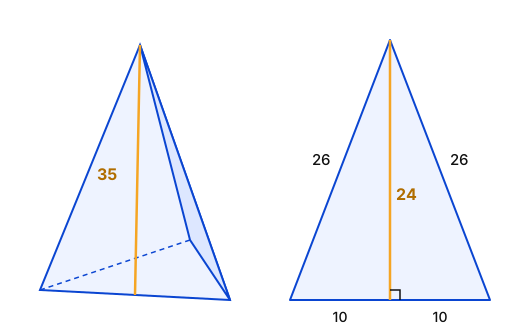
The base of a regular right pyramid is an isosceles triangle with equal sides of 26 cm and a base of 20 cm . The slant height of the pyramid is 35 cm . Find the total surface area of the pyramid.
एक सम लंब पिरामिड का आधार एक समद्विबाहु त्रिभुज है जिसकी बराबर भुजाएँ 26 cm तथा आधार 20 cm है। पिरामिड की तिर्यक ऊँचाई 35 cm है। पिरामिड का कुल पृष्ठीय क्षेत्रफल ज्ञात कीजिए।
  1. A1500cm2
  2. B1540cm2
  3. C1590cm2
  4. D1600cm2
Show answer

Concept: TSA=base area+12×base perimeter×slant height.

  1. Base altitude=262−102=576=24cm → base area=12×20×24=240cm2.
  2. Lateral area=12×(26+26+20)×35=36×35=1260cm2.
  3. TSA=240+1260=1500cm2.

Trick: 10-24-26 is the 5-12-13 triplet ×2 – altitude 24 instantly.

Answer: (A) 1500cm2

अवधारणा: कुल पृष्ठ=आधार क्षेत्रफल+12×आधार परिमाप×तिर्यक ऊँचाई।

  1. आधार की ऊँचाई=262−102=24cm → आधार=12×20×24=240cm2।
  2. पार्श्व=12×72×35=36×35=1260cm2।
  3. कुल=240+1260=1500cm2।

ट्रिक: 10-24-26 = 5-12-13 का दोगुना – ऊँचाई 24 तुरंत।

उत्तर: (A) 1500cm2

SSC CHSLQuantitative AptitudePyramid – total surface areaSSC CHSL 2025 · 27 Nov Shift 2 →
Q1058.
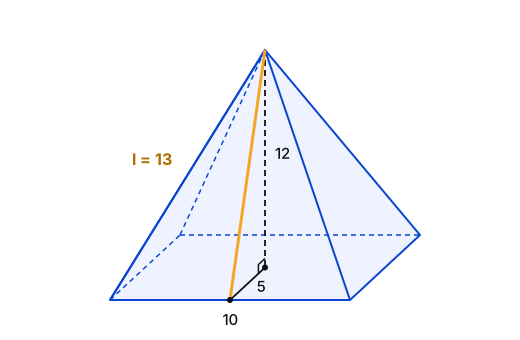
Two identical regular right pyramids, each with a square base of side 10 cm and a perpendicular height of 12 cm , are stacked one on top of the other such that their bases perfectly align. The top pyramid is inverted.Calculate the slant height of a single pyramid.
दो सर्वसम सम लंब पिरामिड, जिनमें से प्रत्येक का आधार 10 cm भुजा वाला वर्ग है तथा लंब ऊँचाई 12 cm है, एक-दूसरे के ऊपर इस प्रकार रखे गए हैं कि उनके आधार पूर्णतः मिल जाते हैं। ऊपर वाला पिरामिड उल्टा है। एक पिरामिड की तिर्यक ऊँचाई ज्ञात कीजिए।
  1. A5 cm
  2. B12 cm
  3. C10 cm
  4. D13 cm
Show answer

Concept: Slant height2=height2+(half side)2 for a square-base pyramid.

  1. Stacking is irrelevant – use one pyramid.
  2. Half side = 5 cm, height = 12 cm.
  3. l=144+25=169=13cm.

Trick: 5-12-13 triplet → 13 cm at a glance.

Answer: (D) 13 cm

अवधारणा: वर्ग आधार पिरामिड: तिर्यक ऊँचाई2=ऊँचाई2+(आधी भुजा)2।

  1. दो पिरामिड रखना अप्रासंगिक – एक ही लें।
  2. आधी भुजा = 5 cm, ऊँचाई = 12 cm।
  3. l=144+25=169=13cm।

ट्रिक: 5-12-13 त्रिक → तुरंत 13 cm।

उत्तर: (D) 13 cm

SSC CHSLQuantitative AptitudePyramid – slant heightSSC CHSL 2025 · 27 Nov Shift 2 →
Q1059.
If cot⁡θ=724, find cos⁡θ.
यदि cot⁡θ=724, तो cos⁡θ ज्ञात कीजिए।
  1. A257
  2. B725
  3. C2425
  4. D247
Show answer

Concept: cotθ=baseperpendicular; cosθ=basehypotenuse.

  1. cotθ=724 → base 7, perpendicular 24.
  2. Hypotenuse=49+576=625=25.
  3. cosθ=725.

Trick: 7-24-25 is a standard triplet; cos and cot share the same numerator (base).

Answer: (B) 725

अवधारणा: cotθ=आधारलंब; cosθ=आधारकर्ण।

  1. cotθ=724 → आधार 7, लंब 24।
  2. कर्ण=49+576=25।
  3. cosθ=725।

ट्रिक: 7-24-25 मानक त्रिक; cot और cos दोनों में ऊपर 'आधार' ही।

उत्तर: (B) 725

SSC CHSLQuantitative AptitudeTrigonometry – cos from cotSSC CHSL 2025 · 27 Nov Shift 2 →
Q1060.
X and Y invest in a business in the ratio 3 : 5. If the total profit earned after a year is Rs. 1,60,000, how much profit will Y receive ?
X तथा Y एक व्यवसाय में 3 : 5 के अनुपात में निवेश करते हैं। यदि एक वर्ष बाद अर्जित कुल लाभ Rs. 1,60,000 है, तो Y को कितना लाभ प्राप्त होगा?
  1. ARs. 1,00,000
  2. BRs. 60,000
  3. CRs. 50,000
  4. DRs. 40,000
Show answer

Concept: Same time period → profit shared in ratio of investment.

  1. Ratio 3 : 5 → 8 parts.
  2. 1 part = 1,60,000÷8= ₹20,000.
  3. Y = 5 parts = ₹1,00,000.

Trick: Y's share = 58 of total; 18 of 1.6 lakh = 20,000.

Answer: (A) Rs. 1,00,000

अवधारणा: समान अवधि → लाभ निवेश के अनुपात में।

  1. अनुपात 3 : 5 → कुल 8 भाग।
  2. 1 भाग = 1,60,000÷8= ₹20,000।
  3. Y = 5 भाग = ₹1,00,000।

ट्रिक: Y का हिस्सा = कुल का 58।

उत्तर: (A) Rs. 1,00,000

SSC CHSLQuantitative AptitudePartnership – simple ratioSSC CHSL 2025 · 27 Nov Shift 2 →