Question bank

Q&A: practice questions with answers

Search questions on any topic. Filter by exam category, exam, subject and topic, try the question, then open the answer and explanation.

Courses – airGurukul

5,000 questions found.

Q1141.
The thickness of 5 tyres A, B, C, D, and E are compared. No two tyres have the same thickness. A is thicker than C but not thicker than E. B is thicker than D, and D is thicker than E . If the thickness of tyre A is 48, what is the possible thickness of tyre C?
5 टायरों A, B, C, D और E की मोटाई की तुलना की जाती है। किन्हीं दो टायरों की मोटाई समान नहीं है। A, C से अधिक मोटा है परंतु E से अधिक मोटा नहीं है। B, D से अधिक मोटा है तथा D, E से अधिक मोटा है। यदि टायर A की मोटाई 48 है, तो टायर C की संभावित मोटाई क्या है?
  1. A57
  2. B58
  3. C49
  4. D47
Show answer

Concept: Join the inequalities into one chain.

  1. E > A > C and B > D > E
  2. Chain: B > D > E > A > C
  3. C < A = 48 → only 47 qualifies.

Trick: 'Not thicker than' with all-different values simply means 'thinner than'.

Answer: (D) 47

अवधारणा: सभी असमिकाओं को एक श्रृंखला में जोड़ें।

  1. E > A > C तथा B > D > E
  2. श्रृंखला: B > D > E > A > C
  3. C < A = 48 → केवल 47 सही।

ट्रिक: सब अलग हों तो 'not thicker than' = 'पतला है'।

उत्तर: (D) 47
SSC CHSLGeneral IntelligenceComparison – orderingSSC CHSL 2025 · 27 Nov Shift 1 →
Q1142.
Six boxes A, B, C, D, E, and F have different weights. Weight of C is the 4th heaviest. Box A is heavier than B and D but lighter than E and F. Box E is not the heaviest. How many boxes are lighter than A ?
छह बक्सों A, B, C, D, E और F के भार अलग-अलग हैं। C का भार चौथा सबसे अधिक है। बक्सा A, B और D से भारी है परंतु E और F से हल्का है। बक्सा E सबसे भारी नहीं है। कितने बक्से A से हल्के हैं?
  1. A1
  2. B2
  3. C3
  4. D4
Show answer

Concept: Place the definite positions first.

  1. E, F > A > B, D
  2. E not heaviest → F 1st, E 2nd, A 3rd.
  3. C is 4th; B, D are 5th–6th.
  4. Lighter than A: C, B, D = 3

Trick: 6 boxes, A is 3rd → 6 − 3 = 3 boxes lighter.

Answer: (C) 3

अवधारणा: पहले निश्चित स्थान रखें।

  1. E, F > A > B, D
  2. E सबसे भारी नहीं → F पहला, E दूसरा, A तीसरा।
  3. C चौथा; B, D पाँचवाँ-छठा।
  4. A से हल्के: C, B, D = 3

ट्रिक: 6 डिब्बे, A तीसरा → 6 − 3 = 3 हल्के।

उत्तर: (C) 3

SSC CHSLGeneral IntelligenceComparison – weightsSSC CHSL 2025 · 27 Nov Shift 1 →
Q1143.
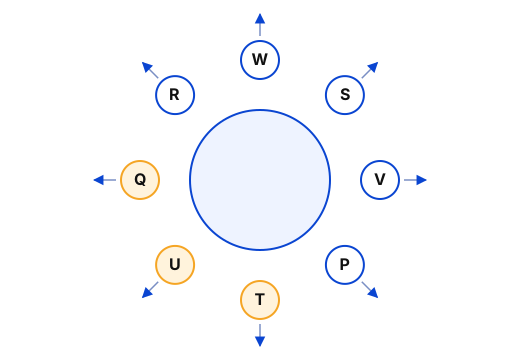
8 women P, Q, R, S, T, U, V and W are sitting around a circular table facing opposite to the centre (not necessarily in the same order). Q is second to the left of W. P is third to the left of Q. S is to the immediate right of W.U is fourth to the left of S.R is the immediate neighbour of W and Q , V is second to the right of W. Who are the immediate neighbours of U ?
8 महिलाएँ P, Q, R, S, T, U, V और W एक वृत्ताकार मेज़ के चारों ओर केंद्र के विपरीत दिशा में मुख करके बैठी हैं (आवश्यक नहीं कि इसी क्रम में)। Q, W के दूसरे बाएँ बैठी है। P, Q के तीसरे बाएँ बैठी है। S, W.U के ठीक दाएँ है S.R के चौथे बाएँ है, W और Q की निकटतम पड़ोसी है, V, W के दूसरे दाएँ है। U की निकटतम पड़ोसी कौन हैं?
  1. AR and TR और T
  2. BQ and TQ और T
  3. CV and RV और R
  4. DW and RW और R
Show answer

Concept: Facing outward: left = anticlockwise, right = clockwise.

  1. Seats 1–8 clockwise, W = 1. Q = 2nd left of W → 7; P = 3rd left of Q → 4.
  2. S = right of W → 2; U = 4th left of S → 6.
  3. R between W and Q → 8; V = 2nd right of W → 3; T → 5.
  4. U (6) sits between T (5) and Q (7).

Trick: For outward-facing circles, simply reverse the usual left/right directions.

Answer: (B) Q and T

अवधारणा: बाहर की ओर मुख: बायाँ = वामावर्त, दायाँ = दक्षिणावर्त।

  1. W = 1 (सीटें दक्षिणावर्त)। Q = W के दूसरे बाएँ → 7; P = Q के तीसरे बाएँ → 4।
  2. S = W के दाएँ → 2; U = S के चौथे बाएँ → 6।
  3. R, W और Q के बीच → 8; V = 3; T = 5।
  4. U (6) के पड़ोसी T (5) और Q (7)।

ट्रिक: बाहर मुख हो तो सामान्य बाएँ/दाएँ की दिशा उलट दें।

उत्तर: (B) Q और T

SSC CHSLGeneral IntelligenceCircular seating – facing outsideSSC CHSL 2025 · 27 Nov Shift 1 →
Q1144.
After interchanging the given two numbers (not digits), what will be the value of the given equation ?
8 and 4
5×8+4−12÷2= ?
दी गई दो संख्याओं (अंकों को नहीं) को आपस में बदलने के बाद, दिए गए समीकरण का मान क्या होगा?
8 और 4
5×8+4−12÷2= ?
  1. A25
  2. B22
  3. C34
  4. D40
Show answer

Concept: Swap the numbers, then apply BODMAS.

  1. New: 5×4+8−12÷2
  2. =20+8−6
  3. = 22

Yaad rakhein: Swap only whole numbers (8 ↔ 4), never digits inside other numbers like 12.

Answer: (B) 22

अवधारणा: संख्याएँ बदलें, फिर BODMAS लगाएँ।

  1. नया: 5×4+8−12÷2
  2. =20+8−6
  3. = 22

याद रखें: केवल पूरी संख्याएँ (8 ↔ 4) बदलें, 12 जैसी संख्या के अंक नहीं।

उत्तर: (B) 22

SSC CHSLGeneral IntelligenceInterchange of numbersSSC CHSL 2025 · 27 Nov Shift 1 →
Q1145.
Select the correct combination of mathematical signs to replace (*) signs sequentially and to balance the given equation.
84∗12∗15∗5∗2=12
(*) चिह्नों को क्रमिक रूप से प्रतिस्थापित करने तथा दिए गए समीकरण को संतुलित करने के लिए गणितीय चिह्नों का सही संयोजन चुनिए।
84∗12∗15∗5∗2=12
  1. A×,−,+,÷
  2. B÷,+,−,×
  3. C,,++×,−
  4. D÷,−,×,+
Show answer

Concept: Try options; division/multiplication first.

  1. Option B: 84÷12+15−5×2
  2. =7+15−10
  3. =12 ✓

Trick: 84 and 12: 84÷12=7 is clean, so first sign is likely ÷ – test only B and D.

Answer: (B) ÷,+,−,×

अवधारणा: options लगाकर देखें; पहले भाग/गुणा।

  1. Option B: 84÷12+15−5×2
  2. =7+15−10
  3. =12 ✓

ट्रिक: 84÷12=7 साफ़ बँटता है – पहला चिह्न ÷ होगा, केवल B, D जाँचें।

उत्तर: (B) ÷,+,−,×

SSC CHSLGeneral IntelligenceBalancing an equation with signsSSC CHSL 2025 · 27 Nov Shift 1 →
Q1146.
In the following question, four letter-number pairs are given. The letter-number on the left side of ( - ) is related to the letter-number on the right side of (-) with some Logic/Rule/Relation. Three pairs are similar on the basis of the same Logic/Rule/Relation. Select the odd one out from the given alternatives.
(NOTE: Operations should be performed on the whole numbers, without breaking down the number into its constituent digits. E.g. 13 - Operations on 13 such as adding /subtracting /multiplying etc. to 13 can be performed. Breaking down 13 into 1 and 3 and then performing mathematical operations on 1 and 3 is not allowed)
निम्नलिखित प्रश्न में, चार अक्षर-संख्या युग्म दिए गए हैं। ( - ) के बाईं ओर की अक्षर-संख्या, (-) के दाईं ओर की अक्षर-संख्या से किसी तर्क/नियम/संबंध द्वारा संबंधित है। तीन युग्म एक ही तर्क/नियम/संबंध के आधार पर समान हैं। दिए गए विकल्पों में से असंगत युग्म चुनिए।
(नोट: संक्रियाएँ पूर्ण संख्याओं पर की जानी चाहिए, संख्या को उसके अंकों में विभाजित किए बिना। जैसे 13 - 13 पर जोड़ने/घटाने/गुणा करने आदि जैसी संक्रियाएँ की जा सकती हैं। 13 को 1 और 3 में विभाजित करके 1 और 3 पर गणितीय संक्रियाएँ करना मान्य नहीं है।)
  1. AGL120-1060
  2. BPS440 - RV220
  3. CEK248 - GN124
  4. DJW360 - LZ190
Show answer

Concept: Find the common rule: 1st letter +2, 2nd letter +3, number ÷ 2.

  1. GL120 → IO60 ✓; PS440 → RV220 ✓; EK248 → GN124 ✓
  2. JW360 → LZ should have 180, but 190 is given ✗

Trick: Letters may all fit – check the number part first; it often hides the odd one.

Answer: (D) JW360 - LZ190

अवधारणा: सामान्य नियम: पहला अक्षर +2, दूसरा +3, संख्या ÷ 2।

  1. GL120 → IO60 ✓; PS440 → RV220 ✓; EK248 → GN124 ✓
  2. JW360 → LZ के साथ 180 होना चाहिए, 190 दिया है ✗

ट्रिक: अक्षर सब सही हों तो संख्या वाला भाग जाँचें।

उत्तर: (D) JW360 - LZ190

SSC CHSLGeneral IntelligenceOdd one out – letter-number pairsSSC CHSL 2025 · 27 Nov Shift 1 →
Q1147.
In a certain coded language 'SMILE' is coded as 'BHFIP' and 'TOWER' is coded as 'OATKQ'. How will 'PLANT' be coded in the same code language ?
एक निश्चित कूट भाषा में 'SMILE' को 'BHFIP' के रूप में कूटबद्ध किया जाता है तथा 'TOWER' को 'OATKQ' के रूप में कूटबद्ध किया जाता है। उसी कूट भाषा में 'PLANT' को किस प्रकार कूटबद्ध किया जाएगा?
  1. AQJYIN
  2. BQJXHM
  3. CPJXIM
  4. DRKXGN
Show answer

Concept: Reverse the word, then shift letters −3, −4 alternately.

  1. SMILE → ELIMS → B H F I P ✓
  2. PLANT → TNALP
  3. Shifts −3, −4, −3, −4, −3: T→Q, N→J, A→X, L→H, P→M → QJXHM

Trick: Last code letter = first word letter −3 (S→P, T→Q); use it to spot reversal fast.

Answer: (B) QJXHM

अवधारणा: शब्द उलटें, फिर अक्षरों को −3, −4 बारी-बारी से खिसकाएँ।

  1. SMILE → ELIMS → BHFIP ✓
  2. PLANT → TNALP
  3. Shifts −3, −4, −3, −4, −3: T→Q, N→J, A→X, L→H, P→M → QJXHM

ट्रिक: कोड का अंतिम अक्षर = शब्द का पहला अक्षर −3 (S→P) – इससे उलटा क्रम तुरंत पकड़ें।

उत्तर: (B) QJXHM

SSC CHSLGeneral IntelligenceCoding – reverse + alternate shiftSSC CHSL 2025 · 27 Nov Shift 1 →
Q1148.
In a certain coded language 'SPACE' is coded as 'JMBZX' and 'GHOST' is coded as 'VUNJI'. How will 'BRAIN' be coded in the same code language ?
एक निश्चित कूट भाषा में 'SPACE' को 'JMBZX' के रूप में कूटबद्ध किया जाता है तथा 'GHOST' को 'VUNJI' के रूप में कूटबद्ध किया जाता है। उसी कूट भाषा में 'BRAIN' को किस प्रकार कूटबद्ध किया जाएगा?
  1. AAKBTO
  2. BOKBTA
  3. CAOBTK
  4. DAKTBO
Show answer

Concept: Take the opposite letter (sum of positions = 27), then move +2.

  1. SPACE → H K Z X V → +2 → JMBZX ✓
  2. BRAIN → Y I Z R M
  3. +2 → A K B T O

Trick: Opposite pairs: A-Z, B-Y, … M-N (positions add to 27).

Answer: (A) AKBTO

अवधारणा: विपरीत अक्षर (स्थानों का योग 27) लें, फिर +2 करें।

  1. SPACE → H K Z X V → +2 → JMBZX ✓
  2. BRAIN → Y I Z R M
  3. +2 → A K B T O

ट्रिक: विपरीत जोड़े: A-Z, B-Y … M-N (योग 27)।

उत्तर: (A) AKBTO

SSC CHSLGeneral IntelligenceCoding – opposite letter + 2SSC CHSL 2025 · 27 Nov Shift 1 →
Q1149.
A series is given with one term missing. Select the correct alternative from the given ones that will complete the series.
HS600, GQ550, FO500, EM450, ?
एक शृंखला दी गई है जिसमें एक पद लुप्त है। दिए गए विकल्पों में से वह सही विकल्प चुनिए जो शृंखला को पूरा करेगा।
HS600, GQ550, FO500, EM450, ?
  1. ADK400
  2. BDL350
  3. CCK400
  4. DDJ400
Show answer

Concept: Track each part separately.

  1. 1st letter: H, G, F, E → D (−1)
  2. 2nd letter: S, Q, O, M → K (−2)
  3. Number: 600, 550, 500, 450 → 400 (−50)

Trick: Only A and D start 'D…400'; second letter K (not J) gives A.

Answer: (A) DK400

अवधारणा: हर भाग अलग से देखें।

  1. पहला अक्षर: H, G, F, E → D (−1)
  2. दूसरा अक्षर: S, Q, O, M → K (−2)
  3. संख्या: 600 … 450 → 400 (−50)

ट्रिक: केवल A और D में 'D…400' है; दूसरा अक्षर K → A।

उत्तर: (A) DK400

SSC CHSLGeneral IntelligenceAlpha-numeric seriesSSC CHSL 2025 · 27 Nov Shift 1 →
Q1150.
A series is given with one term wrong. Select that wrong term from the given alternatives.
BD10, HI50, NO250, TS1250, ZX6250
एक शृंखला दी गई है जिसमें एक पद गलत है। दिए गए विकल्पों में से उस गलत पद को चुनिए।
BD10, HI50, NO250, TS1250, ZX6250
  1. AHI50
  2. BNO250
  3. CTS1250
  4. DZX6250
Show answer

Concept: Check all three parts; the term breaking any one pattern is wrong.

  1. 1st letters B, H, N, T, Z: +6 each ✓
  2. Numbers 10, 50, 250, 1250, 6250: ×5 ✓
  3. 2nd letters D, I, ?, S, X: +5 → should be N, but O is given ✗

Yaad rakhein: Letter positions: D = 4, I = 9, N = 14, S = 19, X = 24 (step 5).

Answer: (B) NO250

अवधारणा: तीनों भाग जाँचें; जो पद किसी एक पैटर्न को तोड़े वही गलत है।

  1. पहले अक्षर B, H, N, T, Z: +6 ✓
  2. संख्याएँ 10 … 6250: ×5 ✓
  3. दूसरे अक्षर D, I, ?, S, X: +5 → N होना चाहिए, O दिया है ✗

याद रखें: अक्षर स्थान: D = 4, I = 9, N = 14, S = 19, X = 24।

उत्तर: (B) NO250

SSC CHSLGeneral IntelligenceWrong term – alpha-numeric seriesSSC CHSL 2025 · 27 Nov Shift 1 →
Q1151.
In analyzing underground pressure, the expression is simplified from (a2+b2)2 −(2ab)2. What's the final expression?
भूमिगत दाब के विश्लेषण में, व्यंजक (a2+b2)2 −(2ab)2 को सरल किया जाता है। अंतिम व्यंजक क्या होगा?
  1. Aa4−2a2b2+b4
  2. Ba4+2a2b2+b4
  3. Ca4−6a2b2+b4
  4. Da4−b4
Show answer

Concept: x2−y2=(x−y)(x+y); here x=a2+b2, y=2ab.

  1. (a2+b2−2ab)(a2+b2+2ab)=(a−b)2(a+b)2
  2. =[(a−b)(a+b)]2=(a2−b2)2
  3. = a4−2a2b2+b4

Trick: Put a=2, b=1: (5)2−(4)2=9; option A gives 16−8+1=9 ✓.

Answer: (A) a4−2a2b2+b4

अवधारणा: x2−y2=(x−y)(x+y); यहाँ x=a2+b2, y=2ab।

  1. (a2+b2−2ab)(a2+b2+2ab)=(a−b)2(a+b)2
  2. =(a2−b2)2
  3. = a4−2a2b2+b4

ट्रिक: a=2, b=1 रखें: 25−16=9; option A: 16−8+1=9 ✓।

उत्तर: (A) a4−2a2b2+b4

SSC CHSLQuantitative AptitudeAlgebraic identity – difference of squaresSSC CHSL 2025 · 27 Nov Shift 1 →
Q1152.
Compare the values: 15,35, and 30. Which is the greatest ?
मानों की तुलना कीजिए: 15,35, तथा 30। इनमें से सबसे बड़ा कौन-सा है?
  1. A15
  2. B35
  3. C30
  4. DAll are equalसभी बराबर हैं
Show answer

Concept: Bring every surd under a single root and compare.

  1. 15 stays 15; 30 stays 30.
  2. 35=9×5=45
  3. 45>30>15 → 35 is greatest.

Trick: Square everything: 15, 45, 30 – largest square = largest number.

Answer: (B) 35

अवधारणा: सभी करणियों को एक ही root में लाकर तुलना करें।

  1. 15 और 30 वैसे ही।
  2. 35=9×5=45
  3. 45>30>15 → 35 सबसे बड़ा।

ट्रिक: सबका वर्ग करें: 15, 45, 30 – जिसका वर्ग बड़ा, वही बड़ा।

उत्तर: (B) 35

SSC CHSLQuantitative AptitudeComparing surdsSSC CHSL 2025 · 27 Nov Shift 1 →
Q1153.
The ratio of incomes of A and B is 5:4 and the ratio of their expenditures is 3 : 2. If both save ₹3000 per month, what is A's income?
A और B की आय का अनुपात 5:4 है तथा उनके व्यय का अनुपात 3 : 2 है। यदि दोनों प्रति माह ₹3000 की बचत करते हैं, तो A की आय कितनी है?
  1. A₹7500
  2. B₹6500
  3. C₹5200
  4. D₹6000
Show answer

Concept: Saving=Income−Expenditure; equate both savings.

  1. Incomes 5x, 4x; expenditures 3y, 2y.
  2. 5x−3y=3000 and 4x−2y=3000 → y=2x−1500
  3. 5x−6x+4500=3000 → x=1500
  4. A's income = 5×1500= ₹7500

Trick: Option check: A = 7500 → B = 6000; expenses 4500 and 3000 are in ratio 3 : 2 ✓.

Answer: (A) ₹7500

अवधारणा: बचत=आय−व्यय; दोनों बचतें बराबर रखें।

  1. आय 5x, 4x; व्यय 3y, 2y।
  2. 5x−3y=3000, 4x−2y=3000 → y=2x−1500
  3. 5x−6x+4500=3000 → x=1500
  4. A की आय = ₹7500

ट्रिक: Option से जाँचें: A = 7500, B = 6000; व्यय 4500 : 3000 = 3 : 2 ✓।

उत्तर: (A) ₹7500

SSC CHSLQuantitative AptitudeIncome–expenditure ratioSSC CHSL 2025 · 27 Nov Shift 1 →
Q1154.
What percent of Rs. 500 is Rs. 75 ?
Rs. 500 का कितना प्रतिशत Rs. 75 है?
  1. A10%
  2. B15%
  3. C20%
  4. D25%
Show answer

Concept: Percent=partwhole×100.

  1. 75500×100
  2. =7500500= 15%

Trick: 10% of 500 = 50, 5% = 25 → 50+25=75 → 15%.

Answer: (B) 15%

अवधारणा: प्रतिशत=भागपूर्ण×100।

  1. 75500×100
  2. = 15%

ट्रिक: 500 का 10% = 50, 5% = 25 → कुल 75 = 15%।

उत्तर: (B) 15%

SSC CHSLQuantitative AptitudePercentage of a quantitySSC CHSL 2025 · 27 Nov Shift 1 →
Q1155.
A dishonest shopkeeper professes to sell grains at the cost price, but he uses a weight of 920 gm for 1 kg weight. Find his gain percentage (round up to two decimal places).
एक बेईमान दुकानदार अनाज को क्रय मूल्य पर बेचने का दावा करता है, परंतु वह 1 kg के बाट के स्थान पर 920 gm के बाट का प्रयोग करता है। उसका लाभ प्रतिशत ज्ञात कीजिए (दो दशमलव स्थानों तक)।
  1. A7.90%
  2. B8.70%
  3. C8.50%
  4. D7.80%
Show answer

Concept: Gain %=errorweight actually given×100.

  1. Error=1000−920=80g
  2. Gain %=80920×100=8000920
  3. =8.6956…≈ 8.70%

Trick: Divide by the false weight (920), not by 1000 – so the answer is a little more than 8%.

Answer: (B) 8.70%

अवधारणा: लाभ %=कमीवास्तव में दिया गया वज़न×100।

  1. कमी=1000−920=80g
  2. लाभ %=80920×100
  3. =8.6956…≈ 8.70%

ट्रिक: हर में 920 (दिया गया वज़न) आता है, 1000 नहीं – इसलिए 8% से थोड़ा अधिक।

उत्तर: (B) 8.70%

SSC CHSLQuantitative AptitudeDishonest dealer – false weightSSC CHSL 2025 · 27 Nov Shift 1 →
Q1156.
A cyclist covers a certain distance in 4 hours. If his speed had been 5 km/h more, he would have taken 1 hour less. Find his original speed.
एक साइकिल चालक एक निश्चित दूरी 4 घंटे में तय करता है। यदि उसकी चाल 5 km/h अधिक होती, तो उसे 1 घंटा कम लगता। उसकी मूल चाल ज्ञात कीजिए।
  1. A10 km/h
  2. B12km/h
  3. C15 km/h
  4. D20km/h
Show answer

Concept: Distance is the same, so speed × time is constant.

  1. Let speed = s: 4s=(s+5)×3
  2. 4s=3s+15
  3. s= 15 km/h

Trick: Extra 5 km/h for 3 h = 15 km saved = what the old speed covers in 1 h → s=15.

Answer: (C) 15 km/h

अवधारणा: दूरी समान है, इसलिए चाल × समय स्थिर।

  1. चाल = s: 4s=(s+5)×3
  2. 4s=3s+15
  3. s= 15 km/h

ट्रिक: 3 घंटे में 5 km/h अधिक = 15 km = पुरानी चाल का 1 घंटा → s=15।

उत्तर: (C) 15 km/h

SSC CHSLQuantitative AptitudeSpeed and time – same distanceSSC CHSL 2025 · 27 Nov Shift 1 →
Q1157.
Two trains start from stations A and B towards each other and meet after 5 hours. A train from A travels 20% faster than a train from B. If the distance between A and B is 660 km , find the speed of the slower train.
दो रेलगाड़ियाँ स्टेशन A तथा B से एक-दूसरे की ओर चलना प्रारंभ करती हैं और 5 घंटे बाद मिलती हैं। A से चलने वाली रेलगाड़ी, B से चलने वाली रेलगाड़ी की अपेक्षा 20% तेज़ चलती है। यदि A और B के बीच की दूरी 660 km है, तो धीमी रेलगाड़ी की चाल ज्ञात कीजिए।
  1. A55 km/h
  2. B60 km/h
  3. C65 km/h
  4. D70 km/h
Show answer

Concept: Opposite directions: relative speed = sum of speeds.

  1. Sum of speeds = 660÷5=132km/h
  2. Slower : faster = 100 : 120 = 5 : 6
  3. Slower = 132×511= 60 km/h

Trick: 20% faster → ratio 5 : 6, total 11 parts; 132÷11=12 per part.

Answer: (B) 60 km/h

अवधारणा: विपरीत दिशा में सापेक्ष चाल = चालों का योग।

  1. चालों का योग = 660÷5=132km/h
  2. धीमी : तेज़ = 100 : 120 = 5 : 6
  3. धीमी = 132×511= 60 km/h

ट्रिक: 20% तेज़ → 5 : 6, कुल 11 भाग; 132÷11=12।

उत्तर: (B) 60 km/h

SSC CHSLQuantitative AptitudeTrains moving towards each otherSSC CHSL 2025 · 27 Nov Shift 1 →
Q1158.
A sum of Rs. 7290 amounts to Rs. 8410 in 2 years at compound interest. Find the rate per annum.
Rs. 7290 की राशि चक्रवृद्धि ब्याज पर 2 वर्षों में Rs. 8410 हो जाती है। वार्षिक ब्याज दर ज्ञात कीजिए।
  1. A8.41%
  2. B7.40 %
  3. C9.35%
  4. D7.35%
Show answer

Concept: AP=(1+R100)n; look for perfect squares.

  1. 84107290=841729=(2927)2
  2. 1+R100=2927→R100=227
  3. R=20027≈ 7.40%

Trick: 841=292, 729=272 – spot squares after cancelling the common 10.

Answer: (B) 7.40 %

अवधारणा: AP=(1+R100)n; पूर्ण वर्ग पहचानें।

  1. 84107290=841729=(2927)2
  2. 1+R100=2927→R100=227
  3. R=20027≈ 7.40%

ट्रिक: 841=292, 729=272 – 10 हटाकर वर्ग पहचानें।

उत्तर: (B) 7.40 %

SSC CHSLQuantitative AptitudeCompound interest – finding rateSSC CHSL 2025 · 27 Nov Shift 1 →
Q1159.
A can complete a work in 20 days, while B can complete the same work in 25 days. Both worked together for 10 days and then C alone completed the remaining work in 10 days. In how many days will A, B and C together complete the same work
A एक कार्य को 20 दिनों में पूरा कर सकता है, जबकि B उसी कार्य को 25 दिनों में पूरा कर सकता है। दोनों ने मिलकर 10 दिनों तक कार्य किया और फिर C ने अकेले शेष कार्य 10 दिनों में पूरा किया। A, B और C मिलकर उसी कार्य को कितने दिनों में पूरा करेंगे?
  1. A10 days10 दिन
  2. B5 days5 दिन
  3. C8 days8 दिन
  4. D12 days12 दिन
Show answer

Concept: Take total work = LCM of days; work in units per day.

  1. Work = 100 units; A = 5/day, B = 4/day.
  2. 10 days of A + B = 90 units; left = 10 units.
  3. C does 10 units in 10 days → 1/day.
  4. A + B + C = 10/day → 100÷10= 10 days

Yaad rakhein: Efficiency (units/day)=total workdays taken.

Answer: (A) 10 days

अवधारणा: कुल कार्य = दिनों का LCM; प्रतिदिन इकाइयों में सोचें।

  1. कार्य = 100 इकाई; A = 5/दिन, B = 4/दिन।
  2. 10 दिन में A + B = 90; बचा 10।
  3. C ने 10 इकाई 10 दिन में → 1/दिन।
  4. तीनों = 10/दिन → 10 दिन

याद रखें: क्षमता (इकाई/दिन)=कुल कार्यलिया गया समय।

उत्तर: (A) 10 दिन

SSC CHSLQuantitative AptitudeTime and work – LCM methodSSC CHSL 2025 · 27 Nov Shift 1 →
Q1160.
What sum will amount to ₹9000 in 2 years at 10% simple interest per annum?
10% वार्षिक साधारण ब्याज की दर से 2 वर्षों में कौन-सी राशि ₹9000 हो जाएगी?
  1. A₹7200
  2. B₹7333.33
  3. C₹7500
  4. D₹7600
Show answer

Concept: SI for 2 yrs at 10% = 20% of principal, so amount = 120% of P.

  1. 120% of P = 9000
  2. P=9000×100120
  3. P= ₹7500

Trick: Amount÷1.2=9000÷1.2=7500.

Answer: (C) ₹7500

अवधारणा: 2 वर्ष 10% पर SI = मूलधन का 20%, अतः मिश्रधन = 120%।

  1. P का 120% = 9000
  2. P=9000×100120
  3. P= ₹7500

ट्रिक: मिश्रधन÷1.2=9000÷1.2=7500।

उत्तर: (C) ₹7500

SSC CHSLQuantitative AptitudeSimple interest – principal from amountSSC CHSL 2025 · 27 Nov Shift 1 →