Question bank

Q&A: practice questions with answers

Search questions on any topic. Filter by exam category, exam, subject and topic, try the question, then open the answer and explanation.

Courses – airGurukul

5,000 questions found.

Q1241.
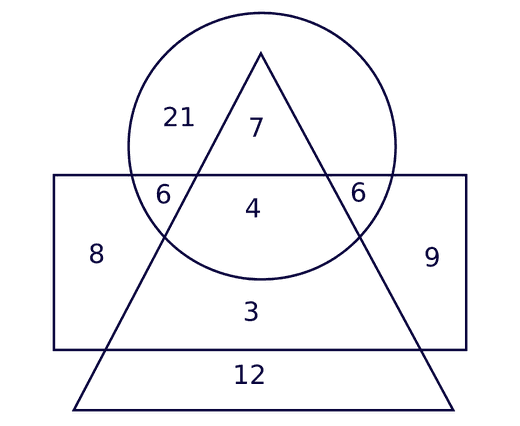
In the figure given below the circle represents books, the rectangle represents magazines and the triangle represents newspapers. The number in each area represents the number of items in that area.
figure
How many books are newspapers?
नीचे दी गई आकृति में वृत्त पुस्तकों को, आयत पत्रिकाओं को तथा त्रिभुज समाचार-पत्रों को निरूपित करता है। प्रत्येक क्षेत्र में लिखी संख्या उस क्षेत्र की वस्तुओं की संख्या दर्शाती है।
figure
कितनी पुस्तकें समाचार-पत्र हैं?
  1. A11
  2. B6
  3. C7
  4. D8
Show answer

Concept: 'Books that are newspapers' = region common to circle and triangle (with or without rectangle).

  1. Circle ∩ triangle only (outside rectangle) = 7.
  2. Circle ∩ triangle ∩ rectangle = 4.
  3. Total = 7 + 4 = 11.

Trick: 'A that are B' = full overlap of A and B — include the all-three region too.

Answer: (A) 11

अवधारणा: 'Books जो newspapers भी हैं' = वृत्त और त्रिभुज का साझा भाग (आयत सहित या रहित)।

हल:

  1. केवल वृत्त ∩ त्रिभुज (आयत के बाहर) = 7
  2. वृत्त ∩ त्रिभुज ∩ आयत = 4
  3. कुल = 7 + 4 = 11

ट्रिक: 'A जो B हैं' = A और B का पूरा overlap — तीनों वाला भाग भी जोड़ें।

उत्तर: (A) 11
SSC CHSLGeneral IntelligenceVenn diagram – reading regionsSSC CHSL 2025 · 26 Nov Shift 3 →
Q1242.
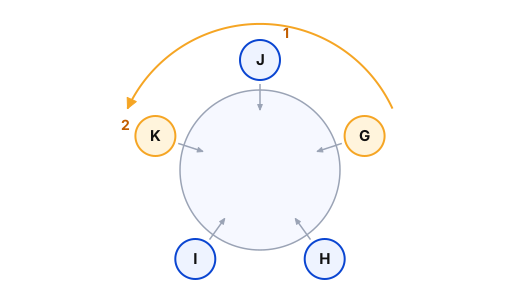
5 persons G, H, I, J and K are sitting around a circular table facing towards the centre. (not necessarily in the same order). Only one person is sitting between I and J, considering towards right of J. H is sitting second to the left of J. G is sitting second to the right of I. Who is sitting second to the right of G ?
5 व्यक्ति G, H, I, J और K एक वृत्ताकार मेज़ के चारों ओर केंद्र की ओर मुख करके बैठे हैं (आवश्यक नहीं कि इसी क्रम में)। J के दाईं ओर से गिनने पर I और J के बीच केवल एक व्यक्ति बैठा है। H, J के बाएँ से दूसरे स्थान पर बैठा है। G, I के दाएँ से दूसरे स्थान पर बैठा है। G के दाएँ से दूसरे स्थान पर कौन बैठा है?
  1. AJ
  2. B।
  3. CK
  4. DH
Show answer

Concept: Facing centre: right = anticlockwise, left = clockwise.

  1. Place J. I is 2 seats to J's right (one person between).
  2. H is 2 seats to J's left; G is 2 seats right of I, i.e. between J and H.
  3. K fills the seat between J and I. Seats clockwise: J, G, H, I, K.
  4. Second to the right of G (anticlockwise): J, then K.

Trick: In a 5-seat circle, 2nd to the right = 3rd to the left — count whichever side is easier.

Answer: (C) K

अवधारणा: केंद्र की ओर मुख: दायाँ = वामावर्त, बायाँ = दक्षिणावर्त।

हल:

  1. J को रखें। I, J के दाएँ दूसरे स्थान पर (बीच में एक)।
  2. H, J के बाएँ दूसरे स्थान पर; G, I के दाएँ दूसरा → J और H के बीच।
  3. K, J और I के बीच। दक्षिणावर्त क्रम: J, G, H, I, K
  4. G के दाएँ दूसरा: पहले J, फिर K।

ट्रिक: 5 सीटों के वृत्त में दाएँ दूसरा = बाएँ तीसरा — जो आसान हो वह गिनें।

उत्तर: (C) K

SSC CHSLGeneral IntelligenceCircular seating – facing centreSSC CHSL 2025 · 26 Nov Shift 3 →
Q1243.
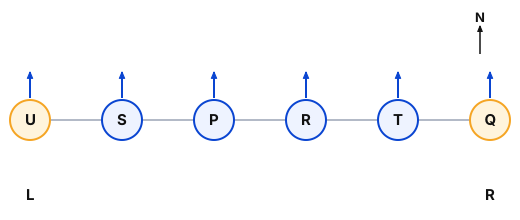
6 persons P, Q, R, S, T and U are sitting in a row facing north (not necessarily in the same order). T is to the immediate left of Q.R is the immediate neighbour of P and T . Some persons are to the right of U.S is not at any of the end of the row. Who are sitting at the extreme ends of the row?
6 व्यक्ति P, Q, R, S, T और U एक पंक्ति में उत्तर की ओर मुख करके बैठे हैं (आवश्यक नहीं कि इसी क्रम में)। T, Q.R के ठीक बाईं ओर बैठा है, जो P और T का निकटतम पड़ोसी है। कुछ व्यक्ति U के दाईं ओर बैठे हैं। S पंक्ति के किसी भी सिरे पर नहीं बैठा है। पंक्ति के अंतिम सिरों पर कौन बैठे हैं?
  1. AP and RP और R
  2. BR and TR और T
  3. CU and TU और T
  4. DU and QU और Q
Show answer

Concept: Build the fixed block first, then test positions against remaining clues.

  1. T immediately left of Q and R between P and T → block P R T Q.
  2. Block at seats 1–4 leaves U at an end with nobody to its right (or S at an end) ✗; seats 2–5 forces S to an end ✗.
  3. So block = seats 3–6; S = 2, U = 1 → U S P R T Q.
  4. Ends: U and Q.

Trick: Biggest block first — it has the fewest possible places, so trial is quick.

Answer: (D) U and Q

अवधारणा: पहले पक्का समूह (block) बनाएँ, फिर बाकी शर्तों से स्थान तय करें।

हल:

  1. T, Q के तुरंत बाएँ और R, P व T के बीच → block P R T Q
  2. Block 1–4 पर हो तो U के दाएँ कोई नहीं या S छोर पर ✗; 2–5 पर S छोर पर ✗
  3. इसलिए block 3–6; S = 2, U = 1 → U S P R T Q
  4. छोर: U और Q

ट्रिक: सबसे बड़ा block पहले रखें — उसके कम विकल्प होते हैं।

उत्तर: (D) U और Q

SSC CHSLGeneral IntelligenceLinear seating – facing northSSC CHSL 2025 · 26 Nov Shift 3 →
Q1244.
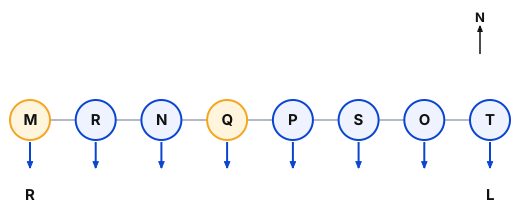
8 boys M, N, O, P, Q, R, S and T are sitting in a row facing south (not necessarily in the same order). M and T are at extreme ends of the row. Q and R are immediate neighbours of N. O is fourth to the left of N. R is to the immediate left of M. P is not the immediate neighbour of O . Who is sitting third to the right of Q ?
8 लड़के M, N, O, P, Q, R, S और T एक पंक्ति में दक्षिण की ओर मुख करके बैठे हैं (आवश्यक नहीं कि इसी क्रम में)। M और T पंक्ति के अंतिम सिरों पर बैठे हैं। Q और R, N के निकटतम पड़ोसी हैं। O, N के बाएँ से चौथे स्थान पर है। R, M के ठीक बाईं ओर बैठा है। P, O का निकटतम पड़ोसी नहीं है। Q के दाएँ से तीसरे स्थान पर कौन बैठा है?
  1. AN
  2. B0
  3. CM
  4. DT
Show answer

Concept: Number seats from the persons' own left to right (facing south flips the viewer's view).

  1. R immediately left of M, M at an end → M = 8, R = 7, T = 1.
  2. N has neighbours Q and R → N = 6, Q = 5.
  3. O is 4th left of N → O = 2; P not next to O → P = 4, S = 3.
  4. 3rd right of Q (seat 5) → seat 8 = M.

Trick: Work in the persons' own left/right throughout — don't switch to your view mid-way.

Answer: (C) M

अवधारणा: सीटें व्यक्तियों के अपने बाएँ से दाएँ गिनें (दक्षिण मुख पर हमारी दृष्टि उलटी होती है)।

हल:

  1. R, M के तुरंत बाएँ और M छोर पर → M = 8, R = 7, T = 1
  2. N के पड़ोसी Q और R → N = 6, Q = 5
  3. O, N के बाएँ चौथा → O = 2; P, O के बगल में नहीं → P = 4, S = 3
  4. Q (5) के दाएँ तीसरा → 8 = M

ट्रिक: पूरे प्रश्न में व्यक्तियों के ही बाएँ/दाएँ रखें — बीच में अपनी दृष्टि न बदलें।

उत्तर: (C) M

SSC CHSLGeneral IntelligenceLinear seating – facing southSSC CHSL 2025 · 26 Nov Shift 3 →
Q1245.
If ' P ' means ' ÷ ', ' Q ' means ' × ', ' R ' means '+' and 'S' means '-', then 24 Q 10 P5R6S8=?
यदि 'P' का अर्थ '÷' है, 'Q' का अर्थ '×' है, 'R' का अर्थ '+' है और 'S' का अर्थ '-' है, तो 24 Q 10 P5R6S8=?
  1. A46
  2. B50
  3. C44
  4. D40
Show answer

Concept: Replace letters with signs and solve by BODMAS.

  1. 24×10÷5+6−8
  2. 24×10=240; 240÷5=48
  3. 48+6−8=46

Trick: ÷5 cancels into 10 first: 24×2=48 — faster.

Answer: (A) 46

अवधारणा: अक्षरों को चिह्नों से बदलकर BODMAS से हल करें।

हल:

  1. 24×10÷5+6−8
  2. 24×10÷5=48
  3. 48+6−8=46

ट्रिक: पहले 10÷5=2 करें: 24×2=48 — तेज़ तरीका।

उत्तर: (A) 46

SSC CHSLGeneral IntelligenceLetter-to-sign substitutionSSC CHSL 2025 · 26 Nov Shift 3 →
Q1246.
Select the correct combination of mathematical signs to replace (*) signs sequentially and to balance the given equation.
96∗8∗7∗5∗11=36
दिए गए समीकरण को संतुलित करने के लिए (*) चिह्नों के स्थान पर क्रमिक रूप से रखे जाने वाले गणितीय चिह्नों का सही संयोजन चुनिए।
96∗8∗7∗5∗11=36
  1. A÷,+,×,−
  2. B÷,×,−,+
  3. Cx1−,+,÷
  4. Dx1÷,−,+
Show answer

Concept: Insert each option's signs in order and check with BODMAS.

  1. Option (A): 96÷8+7×5−11
  2. =12+35−11=36 ✓
  3. Option (B): 96÷8×7−5+11=84+6=90 ✗

Trick: 96÷8=12 is a clean start; then you need +24 from 7, 5, 11 → 7×5−11=24.

Answer: (A) ÷,+,×,−

अवधारणा: हर विकल्प के चिह्न क्रम से लगाकर BODMAS से जाँचें।

हल:

  1. विकल्प (A): 96÷8+7×5−11
  2. =12+35−11=36 ✓
  3. विकल्प (B): 96÷8×7−5+11=90 ✗

ट्रिक: 96÷8=12; बाकी 7, 5, 11 से +24 चाहिए → 7×5−11=24।

उत्तर: (A) ÷,+,×,−

SSC CHSLGeneral IntelligenceBalancing an equation with signsSSC CHSL 2025 · 26 Nov Shift 3 →
Q1247.
In the following question, four letter-number pairs are given. The letter-number on the left side of (-) is related to the letter-number on the right side of (-) with some Logic/Rule/Relation. Three pairs are similar on the basis of same Logic/Rule/Relation. Select the odd one out from the given alternatives.
(NOTE: Operations should be performed on the whole numbers, without breaking down the number into its constituent digits. E.g. 13 Operations on 13 such as adding /subtracting /multiplying etc, to 13 can be performed. Breaking down 13 into 1 and 3 and then performing mathematical operations on 1 and 3 is not allowed)
निम्नलिखित प्रश्न में चार अक्षर-संख्या युग्म दिए गए हैं। (-) के बाईं ओर का अक्षर-संख्या किसी तर्क/नियम/संबंध के आधार पर (-) के दाईं ओर के अक्षर-संख्या से संबंधित है। तीन युग्म समान तर्क/नियम/संबंध के आधार पर एक जैसे हैं। दिए गए विकल्पों में से असंगत युग्म चुनिए।
(नोट: संक्रियाएँ पूर्ण संख्याओं पर की जानी चाहिए, संख्या को उसके अंकों में तोड़े बिना। उदाहरणतः 13 पर संक्रियाएँ जैसे 13 में जोड़ना/घटाना/गुणा करना आदि की जा सकती हैं। 13 को 1 और 3 में तोड़कर 1 और 3 पर गणितीय संक्रियाएँ करना मान्य नहीं है।)
  1. ABW78 - CZ156
  2. BUD94 - VG198
  3. CME108 - NH216
  4. DNJ136 - OM272
Show answer

Concept: Find the common rule for letters and number; the pair breaking it is odd.

  1. Rule: 1st letter +1, 2nd letter +3, number × 2.
  2. B→C, W→Z, 78×2=156 ✓; M→N, E→H, 108×2=216 ✓; N→O, J→M, 136×2=272 ✓
  3. U→V, D→G fine, but 94×2=188≠198 ✗

Trick: Check the numbers first — doubling is fastest; 94×2 ends in 8, not 98.

Answer: (B) UD94 - VG198

अवधारणा: अक्षर और संख्या का साझा नियम खोजें; जो युग्म नियम तोड़े वही विषम।

हल:

  1. नियम: पहला अक्षर +1, दूसरा +3, संख्या × 2
  2. BW78 → CZ156 ✓, ME108 → NH216 ✓, NJ136 → OM272 ✓
  3. UD94: अक्षर ठीक, पर 94×2=188≠198 ✗

ट्रिक: पहले संख्याएँ जाँचें — दोगुना करना सबसे तेज़ है।

उत्तर: (B) UD94 - VG198

SSC CHSLGeneral IntelligenceOdd letter-number pairSSC CHSL 2025 · 26 Nov Shift 3 →
Q1248.
In a certain coded language 'TABLE' is coded as 'ZGWWP' and 'CHAIR' is coded as 'MDVDY'. How will 'PIANO' be coded in the same code language?
एक निश्चित कूट भाषा में 'TABLE' को 'ZGWWP' लिखा जाता है और 'CHAIR' को 'MDVDY' लिखा जाता है। उसी कूट भाषा में 'PIANO' को कैसे लिखा जाएगा?
  1. AKHUFM
  2. BJIVEL
  3. CIJUDK
  4. DJIWEM
Show answer

Concept: Reverse the word, then move letters back: first three −5, last two −4.

  1. TABLE → ELBAT; (E, L, B) − 5 = Z, G, W and (A, T) − 4 = W, P → ZGWWP ✓
  2. CHAIR → RIAHC → M D V D Y ✓
  3. PIANO → ONAIP; shift O, N, A back by 5 → J, I, V; shift I, P back by 4 → E, L; code = JIVEL

Trick: First code letter = last letter of word − 5: O − 5 = J → only (B) and (D) start with J; third letter V settles it.

Answer: (B) JIVEL

अवधारणा: शब्द उलटा करें, फिर अक्षर पीछे खिसकाएँ: पहले तीन −5, आखिरी दो −4।

हल:

  1. TABLE → ELBAT → Z G W W P ✓
  2. CHAIR → RIAHC → M D V D Y ✓
  3. PIANO → ONAIP; O, N, A को 5 पीछे → J, I, V; I, P को 4 पीछे → E, L; कोड = JIVEL

ट्रिक: कोड का पहला अक्षर = शब्द का अंतिम अक्षर − 5: O − 5 = J; तीसरा अक्षर V से (B) तय।

उत्तर: (B) JIVEL

SSC CHSLGeneral IntelligenceCoding – reverse then shiftSSC CHSL 2025 · 26 Nov Shift 3 →
Q1249.
In a certain coded language 'FRIEND' is coded as 'AKBFOC' and 'GLOBAL' is coded as 'IXYLID'. How will 'MODERN' be coded in the same code language?
एक निश्चित कूट भाषा में 'FRIEND' को 'AKBFOC' लिखा जाता है और 'GLOBAL' को 'IXYLID' लिखा जाता है। उसी कूट भाषा में 'MODERN' को कैसे लिखा जाएगा?
  1. ALPCMKI
  2. BKOBALJ
  3. CJNAZKI
  4. DKOBCMK
Show answer

Concept: Write the word backwards and shift every letter 3 places back.

  1. FRIEND → DNEIRF → −3 each → AKBFOC ✓
  2. GLOBAL → LABOLG → IXYLID ✓
  3. MODERN → NREDOM → K O B A L J

Trick: Last code letter = first letter of word − 3: M − 3 = J → only (B) ends in J.

Answer: (B) KOBALJ

अवधारणा: शब्द उलटा लिखकर हर अक्षर 3 स्थान पीछे करें।

हल:

  1. FRIEND → DNEIRF → हर अक्षर −3 → AKBFOC ✓
  2. GLOBAL → LABOLG → IXYLID ✓
  3. MODERN → NREDOM → K O B A L J

ट्रिक: कोड का अंतिम अक्षर = शब्द का पहला अक्षर − 3: M − 3 = J → केवल (B)।

उत्तर: (B) KOBALJ

SSC CHSLGeneral IntelligenceCoding – reverse and −3SSC CHSL 2025 · 26 Nov Shift 3 →
Q1250.
A series is given with one term missing. Select the correct alternative from the given ones that will complete the series.
MV186, NX206, OZ226, ?, QD266
एक शृंखला दी गई है जिसमें एक पद लुप्त है। दिए गए विकल्पों में से वह सही विकल्प चुनिए जो शृंखला को पूर्ण करे।
MV186, NX206, OZ226, ?, QD266
  1. APB246
  2. BPA236
  3. CPF246
  4. DPF256
Show answer

Concept: Track first letter, second letter and number separately.

  1. 1st letters: M, N, O, P, Q (+1).
  2. 2nd letters: V, X, Z, B, D (+2, wrapping Z → B).
  3. Numbers: 186, 206, 226, 246, 266 (+20).

Trick: Number 246 removes (B) and (D); the letter after Z by +2 is B → (A).

Answer: (A) PB246

अवधारणा: पहला अक्षर, दूसरा अक्षर और संख्या अलग-अलग देखें।

हल:

  1. पहला अक्षर: M, N, O, P, Q (+1)
  2. दूसरा अक्षर: V, X, Z, B, D (+2, Z के बाद B)
  3. संख्या: 186, 206, 226, 246, 266 (+20)

ट्रिक: 246 से (B), (D) हटते हैं; Z + 2 = B → (A)।

उत्तर: (A) PB246

SSC CHSLGeneral IntelligenceAlphanumeric seriesSSC CHSL 2025 · 26 Nov Shift 3 →
Q1251.
If the satellite signal equation is (4x−5)2, what is the expanded expression?
यदि उपग्रह संकेत का समीकरण (4x−5)2 है, तो इसका विस्तारित व्यंजक क्या होगा?
  1. A16x2−12x+25
  2. B16x2−40x+25
  3. C25x2−40x−16
  4. D16x2+40x+25
Show answer

Concept: (a−b)2=a2−2ab+b2.

  1. a=4x, b=5
  2. a2=16x2; 2ab=2×4x×5=40x; b2=25
  3. (4x−5)2=16x2−40x+25

Trick: Sign check: (a−b)2 always has a minus middle term and plus last term → only (B) and (A) qualify; middle term must be 40x.

Answer: (B) 16x2−40x+25

अवधारणा: (a−b)2=a2−2ab+b2

हल:

  1. a=4x, b=5
  2. a2=16x2; 2ab=40x; b2=25
  3. (4x−5)2=16x2−40x+25

ट्रिक: (a−b)2 में बीच का पद ऋणात्मक और अंतिम पद धनात्मक होता है; बीच का पद 2×4×5=40x।

उत्तर: (B) 16x2−40x+25

SSC CHSLQuantitative AptitudeAlgebraic identity – (a − b)²SSC CHSL 2025 · 26 Nov Shift 3 →
Q1252.
P and Q start a business. P invests ₹3500 for 10 months, Q invests ₹2500 for 14 months. Who gets more profit?
P और Q एक व्यवसाय आरंभ करते हैं। P, ₹3500 का निवेश 10 महीनों के लिए करता है तथा Q, ₹2500 का निवेश 14 महीनों के लिए करता है। अधिक लाभ किसे मिलेगा?
  1. AP
  2. BQ
  3. CEqualबराबर
  4. DCan't be determinedज्ञात नहीं किया जा सकता
Show answer

Concept: Profit share∝capital×time.

  1. P: 3500×10=35,000
  2. Q: 2500×14=35,000
  3. Ratio 1 : 1 → equal profit.

Trick: Cancel 500 first: P=7×10=70, Q=5×14=70 — equal in 5 seconds.

Answer: (C) Equal

अवधारणा: लाभ का हिस्सा∝पूँजी×समय

हल:

  1. P: 3500×10=35,000
  2. Q: 2500×14=35,000
  3. अनुपात 1 : 1 → बराबर लाभ

ट्रिक: पहले 500 से काटें: P=7×10=70, Q=5×14=70।

उत्तर: (C) बराबर

SSC CHSLQuantitative AptitudePartnership – capital × timeSSC CHSL 2025 · 26 Nov Shift 3 →
Q1253.
If A:B=5:7 and B:C=8:9, find A : C.
यदि A:B=5:7 तथा B:C=8:9 है, तो A : C ज्ञात कीजिए।
  1. A40 : 63
  2. B4 : 9
  3. C40 : 56
  4. D56 : 40
Show answer

Concept: Make the common term B equal in both ratios.

  1. A : B = 5 : 7, B : C = 8 : 9
  2. AC=AB×BC=57×89=4063
  3. A : C = 40 : 63

Trick: A : C = (product of antecedents) : (product of consequents) = 5×8:7×9.

Answer: (A) 40 : 63

अवधारणा: दोनों अनुपातों में साझा पद B को बराबर करें।

हल:

  1. A : B = 5 : 7, B : C = 8 : 9
  2. AC=57×89=4063
  3. A : C = 40 : 63

ट्रिक: A : C = पहले पदों का गुणनफल : दूसरे पदों का गुणनफल = 5×8:7×9।

उत्तर: (A) 40 : 63

SSC CHSLQuantitative AptitudeRatio – combining two ratiosSSC CHSL 2025 · 26 Nov Shift 3 →
Q1254.
The average of five numbers is 58 . When one number is removed, the average of the remaining four numbers becomes 55. What is the value of the number that was excluded?
पाँच संख्याओं का औसत 58 है। जब एक संख्या हटा दी जाती है, तो शेष चार संख्याओं का औसत 55 हो जाता है। हटाई गई संख्या का मान क्या है?
  1. A70
  2. B73
  3. C75
  4. D76
Show answer

Concept: Sum=average×count.

  1. Sum of 5 = 58×5=290
  2. Sum of 4 = 55×4=220
  3. Removed number = 290−220=70

Trick: Removed = new avg + (fall in avg × original count) = 55+3×5=70.

Answer: (A) 70

अवधारणा: योग=औसत×संख्या

हल:

  1. 5 संख्याओं का योग = 58×5=290
  2. 4 का योग = 55×4=220
  3. हटाई गई संख्या = 290−220=70

ट्रिक: हटाई संख्या = नया औसत + (औसत में कमी × पुरानी गिनती) = 55+3×5=70।

उत्तर: (A) 70

SSC CHSLQuantitative AptitudeAverage – removed numberSSC CHSL 2025 · 26 Nov Shift 3 →
Q1255.
If 80% of a number is 72, what is the number?
यदि किसी संख्या का 80% 72 है, तो वह संख्या क्या है?
  1. A80
  2. B85
  3. C90
  4. D95
Show answer

Concept: If x% of N = value, then N=value×100x.

  1. N=72×10080
  2. =72×54=90

Trick: 80%=45 → N=72÷4×5=90.

Answer: (C) 90

अवधारणा: यदि N का x% = मान, तो N=मान×100x

हल:

  1. N=72×10080
  2. =72×54=90

ट्रिक: 80%=45 → N=72÷4×5=90।

उत्तर: (C) 90

SSC CHSLQuantitative AptitudePercentage – finding the wholeSSC CHSL 2025 · 26 Nov Shift 3 →
Q1256.
A vendor sells an item at 15% loss. If he increases the selling price by Rs. 125 , he would have made a 10% gain. Find the cost price.
एक विक्रेता एक वस्तु को 15% हानि पर बेचता है। यदि वह विक्रय मूल्य में Rs. 125 की वृद्धि कर देता, तो उसे 10% का लाभ होता। क्रय मूल्य ज्ञात कीजिए।
  1. ARs. 500
  2. BRs. 550
  3. CRs. 525
  4. DRs. 530
Show answer

Concept: Difference in SP = difference in % × CP.

  1. Loss 15% → SP = 85% of CP; gain 10% → SP = 110% of CP.
  2. Gap = 25% of CP = ₹125
  3. CP=125×10025= ₹500

Trick: From −15% to +10% is a 25% swing = ₹125 → 1% = ₹5 → CP = ₹500.

Answer: (A) Rs. 500

अवधारणा: विक्रय मूल्य का अंतर = प्रतिशत अंतर × क्रय मूल्य

हल:

  1. 15% हानि → SP = CP का 85%; 10% लाभ → SP = CP का 110%
  2. अंतर = CP का 25% = ₹125
  3. CP=125×4= ₹500

ट्रिक: −15% से +10% = 25% का झूला = ₹125 → 1% = ₹5 → CP = ₹500।

उत्तर: (A) Rs. 500

SSC CHSLQuantitative AptitudeProfit & loss – change in SPSSC CHSL 2025 · 26 Nov Shift 3 →
Q1257.
A dealer allows 20% discount and still gains 12%. Find the marked price if the cost price is Rs. 800.
एक विक्रेता 20% की छूट देता है और फिर भी 12% का लाभ अर्जित करता है। यदि क्रय मूल्य Rs. 800 है, तो अंकित मूल्य ज्ञात कीजिए।
  1. ARs. 1100
  2. BRs. 1120
  3. CRs. 1600
  4. DRs. 1500
Show answer

Concept: MP×100−d100=CP×100+g100.

  1. SP=800×112100= ₹896
  2. SP = 80% of MP → MP=896×10080
  3. MP = ₹1120

Trick: MPCP=11280=75 → MP=800×75=1120.

Answer: (B) Rs. 1120

अवधारणा: MP×100−छूट100=CP×100+लाभ100

हल:

  1. SP=800×112100= ₹896
  2. SP = MP का 80% → MP=896×10080
  3. MP = ₹1120

ट्रिक: MPCP=11280=75 → MP=800×75=1120।

उत्तर: (B) Rs. 1120

SSC CHSLQuantitative AptitudeDiscount – marked priceSSC CHSL 2025 · 26 Nov Shift 3 →
Q1258.
A and B together can complete a work in 24 days. B and C together can complete it in 40 days. C and A together in 30 days. How many days will each take working alone?
A और B मिलकर एक कार्य को 24 दिनों में पूरा कर सकते हैं। B और C मिलकर उसी कार्य को 40 दिनों में पूरा कर सकते हैं। C और A मिलकर उसे 30 दिनों में पूरा करते हैं। अकेले कार्य करते हुए प्रत्येक को कितने दिन लगेंगे?
  1. AA=30,B=60,C=40
  2. BA=50,B=20,C=30
  3. CA=40,B=60,C=120
  4. DA=24,B=40,C=30
Show answer

Concept: Use LCM as total work; add pair rates, halve to get A + B + C.

  1. Total work = LCM(24,40,30)=120 units.
  2. A+B=5, B+C=3, C+A=4 units/day → 2(A+B+C)=12 → A+B+C=6
  3. A=6−3=3 → 40 days; B=6−4=2 → 60 days; C=6−5=1 → 120 days

Trick: Check options quickly: in (C) 140+160=5120=124 ✓ — first pair already matches.

Answer: (C) A=40,B=60,C=120

अवधारणा: LCM को कुल कार्य मानें; जोड़ियों की दरें जोड़कर आधा करें।

हल:

  1. कुल कार्य = LCM(24,40,30)=120 इकाई
  2. A+B=5, B+C=3, C+A=4 → A+B+C=122=6
  3. A = 3 → 40 दिन; B = 2 → 60 दिन; C = 1 → 120 दिन

ट्रिक: विकल्प जाँचें: (C) में 140+160=124 ✓ — तुरंत पुष्टि।

उत्तर: (C) A=40,B=60,C=120

SSC CHSLQuantitative AptitudeTime & work – pairs to individualsSSC CHSL 2025 · 26 Nov Shift 3 →
Q1259.
A sum of money triple in 20 years at simple interest. What is the rate of interest per annum?
साधारण ब्याज पर कोई धनराशि 20 वर्षों में तीन गुनी हो जाती है। प्रति वर्ष ब्याज की दर क्या है?
  1. A11%
  2. B15%
  3. C10%
  4. D12%
Show answer

Concept: Amount=n×P ⇒ SI=(n−1)P; R=SI×100P×T.

  1. Triple → SI=2P in 20 years.
  2. R=2×10020=10% p.a.

Trick: R=(n−1)×100T=2×10020=10%.

Answer: (C) 10%

अवधारणा: मिश्रधन=n×P ⇒ SI=(n−1)P; R=SI×100P×T

हल:

  1. तीन गुना → 20 वर्ष में SI=2P
  2. R=2×10020=10% वार्षिक

ट्रिक: R=(n−1)×100T=20020=10%।

उत्तर: (C) 10%

SSC CHSLQuantitative AptitudeSimple interest – sum triplesSSC CHSL 2025 · 26 Nov Shift 3 →
Q1260.
Train A running at 36km/h
crosses Train B (length 400 m), coming from the opposite direction, in 54 seconds. If Train A is 500 m long, find Train B's speed.
ट्रेन A, 36km/h की चाल से चलते हुए, विपरीत दिशा से आ रही ट्रेन B (लंबाई 400 मीटर) को 54 सेकंड में पार कर लेती है। यदि ट्रेन A की लंबाई 500 मीटर है, तो ट्रेन B की चाल ज्ञात कीजिए।
  1. A24km/h
  2. B28 km/h
  3. C21km/h
  4. D25 km/h
Show answer

Concept: Trains in opposite directions: relative speed = sum of speeds; crossing distance = sum of lengths.

  1. Distance = 500+400=900 m; time = 54 s
  2. Relative speed = 90054=503 m/s =503×185=60 km/h
  3. Speed of B = 60−36= 24 km/h

Trick: m/s → km/h: ×185. 503×185=60.

Answer: (A) 24km/h

अवधारणा: विपरीत दिशा में सापेक्ष चाल = चालों का योग; पार करने की दूरी = दोनों लंबाइयों का योग।

हल:

  1. दूरी = 500+400=900 m; समय = 54 s
  2. सापेक्ष चाल = 90054=503 m/s = 60 km/h
  3. B की चाल = 60−36= 24 km/h

ट्रिक: m/s → km/h के लिए ×185।

उत्तर: (A) 24km/h

SSC CHSLQuantitative AptitudeTrains – relative speedSSC CHSL 2025 · 26 Nov Shift 3 →