Question bank

Q&A: practice questions with answers

Search questions on any topic. Filter by exam category, exam, subject and topic, try the question, then open the answer and explanation.

Courses – airGurukul

5,000 questions found.

Q1941.
You have an earthquake relief vehicle that can evacuate only 8 people. There are 12 people waiting, including elderly, children, and healthy adults. Who should be given priority?
आपके पास एक भूकंप राहत वाहन है जो केवल 8 लोगों को ही निकाल सकता है। वहाँ 12 लोग प्रतीक्षा कर रहे हैं, जिनमें वृद्ध, बच्चे और स्वस्थ वयस्क शामिल हैं। किसे प्राथमिकता दी जानी चाहिए?
  1. AFirst come, first serveपहले आओ, पहले पाओ
  2. BHealthy adults, so they can help others laterस्वस्थ वयस्क, ताकि वे बाद में दूसरों की सहायता कर सकें
  3. CElderly and childrenवृद्ध और बच्चे
  4. DRandom selectionयादृच्छिक चयन
Show answer

Concept: In rescue, priority goes to those least able to help themselves.

  1. Elderly and children are most vulnerable physically.
  2. Healthy adults can wait longer or move on their own.
  3. First-come or random choice ignores need.

Yaad rakhein: Standard rescue order: injured/sick, children, elderly, then healthy adults.

Answer: (C) Elderly and children

अवधारणा: बचाव कार्य में प्राथमिकता उन्हें, जो खुद की मदद सबसे कम कर सकते हैं।

हल:

  1. वृद्ध और बच्चे शारीरिक रूप से सबसे कमज़ोर होते हैं।
  2. स्वस्थ वयस्क इंतज़ार कर सकते हैं या खुद निकल सकते हैं।
  3. पहले आओ या लॉटरी – ज़रूरत को अनदेखा करते हैं।

याद रखें: बचाव क्रम: घायल/बीमार, बच्चे, वृद्ध, फिर स्वस्थ वयस्क।

उत्तर: (C) वृद्ध और बच्चे
SSC CHSLGeneral IntelligenceDisaster relief – priority to the vulnerableSSC CHSL 2025 · 24 Nov Shift 2 →
Q1942.
Identify the next number.
1, 8, 27, 64, 125, ?
अगली संख्या ज्ञात कीजिए।
1, 8, 27, 64, 125, ?
  1. A217
  2. B216
  3. C343
  4. D512
Show answer

Concept: Terms are cubes of natural numbers.

  1. 1=13, 8=23, 27=33, 64=43, 125=53.
  2. Next = 63=216.

Trick: Learn cubes 1–15; 63=216, 73=343, 83=512 (traps in options).

Answer: (B) 216

अवधारणा: पद प्राकृतिक संख्याओं के घन हैं।

हल:

  1. 1=13, 8=23, 27=33, 64=43, 125=53।
  2. अगला = 63=216।

ट्रिक: 1–15 तक के घन याद रखें; 343=73, 512=83 विकल्पों में जाल हैं।

उत्तर: (B) 216

SSC CHSLGeneral IntelligenceNumber series – cubesSSC CHSL 2025 · 24 Nov Shift 2 →
Q1943.
Identify the next number in the sequence.
30, 56, 90, 132 , ?
शृंखला में अगली संख्या ज्ञात कीजिए।
30, 56, 90, 132 , ?
  1. A178
  2. B182
  3. C192
  4. D202
Show answer

Concept: Look for products of consecutive numbers.

  1. 5×6 gives 30, 7×8 gives 56, 9×10 gives 90, 11×12 gives 132.
  2. Next = 13×14=182.
  3. Check: gaps 26, 34, 42 grow by 8 → next gap 50.

Trick: Numbers like 30, 56, 90, 132 are 'pronic' numbers – think n(n+1) at once.

Answer: (B) 182

अवधारणा: क्रमागत संख्याओं के गुणनफल देखें।

हल:

  1. 5×6 से 30, 7×8 से 56, 9×10 से 90, 11×12 से 132।
  2. अगला = 13×14=182।
  3. जाँच: अंतर 26, 34, 42, 50 (हर बार +8)।

ट्रिक: 30, 56, 90, 132 जैसी संख्याएँ देखते ही n(n+1) सोचें।

उत्तर: (B) 182

SSC CHSLGeneral IntelligenceNumber series – n(n+1) patternSSC CHSL 2025 · 24 Nov Shift 2 →
Q1944.
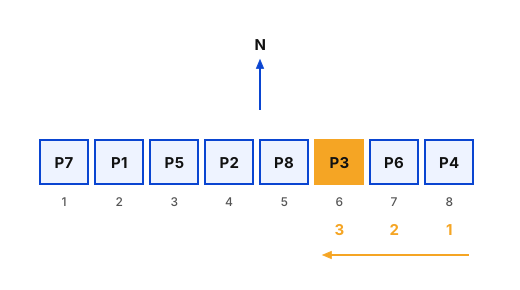
8 Persons P1, P2, P3, P4, P5, P6, P7 and P8 are sitting in a row facing north (not necessarily in the same order). P1 is fifth to the left of P6. P4 is fifth to the right of P5. P1 is to the immediate left of P5. Only two boys are sitting between P8 and P4. P2 is third to the right of P7, P7 is an immediate neighbour of P1. Who is at third position from the right end of the row?
8 व्यक्ति P1, P2, P3, P4, P5, P6, P7 तथा P8 एक पंक्ति में उत्तर की ओर मुख करके बैठे हैं (आवश्यक नहीं कि इसी क्रम में)। P1, P6 के बाईं ओर पाँचवाँ है। P4, P5 के दाईं ओर पाँचवाँ है। P1, P5 के ठीक बाईं ओर है। P8 तथा P4 के बीच केवल दो लड़के बैठे हैं। P2, P7 के दाईं ओर तीसरा है, P7, P1 का निकटतम पड़ोसी है। पंक्ति के दाएँ सिरे से तीसरे स्थान पर कौन है?
  1. AP3
  2. BP6
  3. CP8
  4. DP2
Show answer

Concept: Facing north: left/right are as on paper. Fix the longest chain first.

  1. P1, P5 adjacent; P6 = P1 + 5, P4 = P5 + 5 = P1 + 6 → P1 is at seat 1 or 2.
  2. P7 must be beside P1 (seat 2 is P5 if P1 = 1) → P1 = 2, P7 = 1, P5 = 3, P6 = 7, P4 = 8.
  3. P2 = 1 + 3 = seat 4; two between P8 and P4 → P8 = 5; P3 = 6.
  4. Third from right: seat 6 = P3.

Trick: When a person is '6th to the right', only 2 seats in a row of 8 are possible – try both.

Answer: (A) P3

अवधारणा: उत्तर की ओर मुख: बायाँ-दायाँ कागज़ जैसा। सबसे लंबी शृंखला पहले जमाएँ।

हल:

  1. P1, P5 साथ; P6 = P1 + 5, P4 = P1 + 6 → P1 स्थान 1 या 2 पर।
  2. P7, P1 का पड़ोसी: P1 = 1 हो तो जगह नहीं → P1 = 2, P7 = 1, P5 = 3, P6 = 7, P4 = 8।
  3. P2 = 4; P8 और P4 के बीच दो → P8 = 5; P3 = 6।
  4. दाएँ से तीसरा = स्थान 6 = P3।

ट्रिक: 8 की पंक्ति में '6 स्थान दाएँ' वाले केवल 2 ही विकल्प होते हैं – दोनों जाँचें।

उत्तर: (A) P3

SSC CHSLGeneral IntelligenceLinear seating – row facing northSSC CHSL 2025 · 24 Nov Shift 2 →
Q1945.
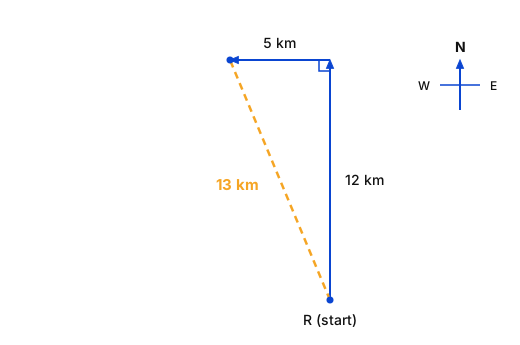
R walks 12 km straight. He turns left and walks 5 km . How far (in km ) is R now from the starting point?
R सीधे 12 km चलता है। वह बाएँ मुड़कर 5 km चलता है। अब R प्रारंभिक बिंदु से कितनी दूर (km में) है?
  1. A13
  2. B15
  3. C17
  4. D18
Show answer

Concept: A left turn makes a right angle, so use Pythagoras.

  1. Legs: 12 km and 5 km.
  2. Distance = 122+52=144+25=169=13 km.

Trick: 5-12-13 is a Pythagorean triplet – answer at a glance. (Others: 3-4-5, 8-15-17, 7-24-25.)

Answer: (A) 13

अवधारणा: बाएँ मुड़ने पर समकोण बनता है, इसलिए पाइथागोरस लगाएँ।

हल:

  1. भुजाएँ: 12 km और 5 km।
  2. दूरी = 144+25=169=13 km।

ट्रिक: 5-12-13 पाइथागोरस त्रिक है – तुरंत उत्तर।

उत्तर: (A) 13

SSC CHSLGeneral IntelligenceDirection sense – PythagorasSSC CHSL 2025 · 24 Nov Shift 2 →
Q1946.
Select the option that is related to the second number in the same way as the third number is related to the fourth number and fifth number is related to sixth number.
(NOTE: Operations should be performed on the whole numbers, without breaking down the numbers into its constituent digits. E.g. 13 - Operations on 13 such as adding /subtracting /multiplying etc. to 13 can be performed. Breaking down 13 into 1 and 3 and then performing mathematical operations on 1 and 3 is not allowed)
? : 5263 :: 6372 : 7214 :: 4831 : 5673
उस विकल्प का चयन कीजिए जो दूसरी संख्या से उसी प्रकार संबंधित है, जिस प्रकार तीसरी संख्या चौथी संख्या से तथा पाँचवीं संख्या छठी संख्या से संबंधित है।
(नोट: संक्रियाएँ पूर्ण संख्याओं पर की जानी चाहिए, संख्याओं को उनके अंकों में तोड़े बिना। उदाहरण के लिए 13 - 13 पर जोड़ने /घटाने /गुणा करने आदि जैसी संक्रियाएँ की जा सकती हैं। 13 को 1 और 3 में तोड़कर फिर 1 और 3 पर गणितीय संक्रियाएँ करने की अनुमति नहीं है)
? : 5263 :: 6372 : 7214 :: 4831 : 5673
  1. A4419
  2. B4421
  3. C4423
  4. D4425
Show answer

Concept: Treat each number as a whole and find the operation between pair members.

  1. 7214 − 6372 = 842; 5673 − 4831 = 842.
  2. Rule: second = first + 842.
  3. Missing = 5263 − 842 = 4421.

Trick: Unit digit check: ?+2 must end in 3 → ? ends in 1 → only 4421.

Answer: (B) 4421

अवधारणा: हर संख्या को पूर्ण मानकर जोड़ी के बीच संक्रिया खोजें।

हल:

  1. 7214 − 6372 = 842; 5673 − 4831 = 842।
  2. नियम: दूसरी = पहली + 842।
  3. अज्ञात = 5263 − 842 = 4421।

ट्रिक: इकाई अंक: ? + 2 का अंत 3 → ? का अंत 1 → केवल 4421.

उत्तर: (B) 4421

SSC CHSLGeneral IntelligenceNumber analogy – constant differenceSSC CHSL 2025 · 24 Nov Shift 2 →
Q1947.
If '+' means '÷', '-' means '+', 'x' means ' - ' and ' ÷ ' means ' × ', then 36+4− 12×3÷6= ?
यदि '+' का अर्थ '÷' है, '-' का अर्थ '+' है, 'x' का अर्थ ' - ' है तथा ' ÷ ' का अर्थ ' × ' है, तो 36+4− 12×3÷6= ?
  1. A3
  2. B7
  3. C5
  4. D9
Show answer

Concept: Swap symbols as told, then apply BODMAS.

  1. 36+4−12×3÷6→36÷4+12−3×6.
  2. =9+12−18.
  3. = 3.

Trick: Write the new expression fully before calculating – most mistakes come from solving half-converted signs.

Answer: (A) 3

अवधारणा: दिए अनुसार चिह्न बदलें, फिर BODMAS लगाएँ।

हल:

  1. 36+4−12×3÷6→36÷4+12−3×6।
  2. =9+12−18।
  3. = 3।

ट्रिक: गणना से पहले पूरा नया व्यंजक लिख लें।

उत्तर: (A) 3

SSC CHSLGeneral IntelligenceSymbol substitution – BODMASSSC CHSL 2025 · 24 Nov Shift 2 →
Q1948.
After interchanging the given two signs, what will be the value of the given equation?
 and +
40+8÷10−2×3= ?
दिए गए दो चिह्नों को आपस में बदलने पर, दिए गए समीकरण का मान क्या होगा?
और +
40+8÷10−2×3= ?
  1. A29
  2. B9
  3. C12
  4. D39
Show answer

Concept: Swap the two signs everywhere, then solve by BODMAS.

  1. 40+8÷10−2×3→40÷8+10−2×3.
  2. =5+10−6.
  3. = 9.

Trick: Swap both signs at every place – a single missed swap gives a trap option.

Answer: (B) 9

अवधारणा: दोनों चिह्न हर जगह बदलें, फिर BODMAS से हल करें।

हल:

  1. 40+8÷10−2×3→40÷8+10−2×3।
  2. =5+10−6।
  3. = 9।

ट्रिक: हर स्थान पर दोनों चिह्न बदलें – एक भी छूटा तो जाल वाला विकल्प मिलेगा।

उत्तर: (B) 9

SSC CHSLGeneral IntelligenceInterchanging signs (÷ and +)SSC CHSL 2025 · 24 Nov Shift 2 →
Q1949.
By interchanging the given two numbers (not digits) which of the following equation will NOT be correct?
3 and 6
I. 6×4−3+8÷2=18
II. 3×2+6−12÷4=13
दी गई दो संख्याओं (अंकों को नहीं) को आपस में बदलने पर निम्नलिखित में से कौन-सा समीकरण सही नहीं होगा?
3 और 6
I. 6×4−3+8÷2=18
II. 3×2+6−12÷4=13
  1. AOnly Iकेवल I
  2. BOnly IIकेवल II
  3. CBoth I and III और II दोनों
  4. DNeither I nor IIन तो I और न ही II
Show answer

Concept: Swap only standalone 3 and 6 (not digits inside 12 etc.), then check with BODMAS.

  1. I: 3×4−6+8÷2=12−6+4=10≠18 → not correct.
  2. II: 6×2+3−12÷4=12+3−3=12≠13 → not correct.
  3. Both equations fail.

Trick: The '12' in II stays 12 – digits are not swapped.

Answer: (C) Both I and II

अवधारणा: केवल स्वतंत्र संख्या 3 और 6 बदलें (12 के अंदर का अंक नहीं), फिर BODMAS से जाँचें।

हल:

  1. I: 3×4−6+8÷2=12−6+4=10≠18 → गलत।
  2. II: 6×2+3−12÷4=12+3−3=12≠13 → गलत।
  3. दोनों समीकरण सही नहीं।

ट्रिक: II में '12' वैसा ही रहेगा – अंक नहीं बदलते।

उत्तर: (C) I और II दोनों

SSC CHSLGeneral IntelligenceInterchanging numbers (3 and 6)SSC CHSL 2025 · 24 Nov Shift 2 →
Q1950.
A word has been given in the question. This word CANNOT be formed by using the letters of the word given in one of the alternatives only. Select that alternative.
PEARL
प्रश्न में एक शब्द दिया गया है। यह शब्द विकल्पों में दिए गए शब्दों में से केवल एक शब्द के अक्षरों का प्रयोग करके नहीं बनाया जा सकता। उस विकल्प का चयन कीजिए।
PEARL
  1. APARCEL
  2. BPLAYER
  3. CPLEASE
  4. DPARLEY
Show answer

Concept: The given word can be formed only if every letter is present in the option word.

  1. PEARL needs P, E, A, R, L.
  2. PARCEL, PLAYER, PARLEY contain all five.
  3. PLEASE has no R → PEARL cannot be formed.

Trick: Search for the rarest letter (R) in each option first.

Answer: (C) PLEASE

अवधारणा: शब्द तभी बनेगा जब उसका हर अक्षर विकल्प वाले शब्द में हो।

हल:

  1. PEARL के लिए P, E, A, R, L चाहिए।
  2. PARCEL, PLAYER, PARLEY – सबमें पाँचों अक्षर हैं।
  3. PLEASE में R नहीं है → PEARL नहीं बनेगा।

ट्रिक: पहले हर विकल्प में सबसे कम आने वाला अक्षर (R) खोजें।

उत्तर: (C) PLEASE

SSC CHSLGeneral IntelligenceWord formation – letters checkSSC CHSL 2025 · 24 Nov Shift 2 →
Q1951.
Find the mean proportion between 9 and 25.
9 और 25 के बीच मध्यानुपाती ज्ञात कीजिए।
  1. A15
  2. B225
  3. C17
  4. D8
Show answer

Concept: Mean proportional of a and b = ab, since a : x = x : b.

  1. x=9×25=225.
  2. x=15.
  3. Check: 9 : 15 = 15 : 25 = 3 : 5 ✓.

Trick: For two perfect squares: 9×25=3×5=15.

Answer: (A) 15

अवधारणा: a और b का मध्यानुपाती = ab, क्योंकि a : x = x : b।

हल:

  1. x=9×25=225।
  2. x=15।
  3. जाँच: 9 : 15 = 15 : 25 = 3 : 5 ✓।

ट्रिक: दोनों पूर्ण वर्ग हों तो: 9×25=3×5=15.

उत्तर: (A) 15

SSC CHSLQuantitative AptitudeMean proportionalSSC CHSL 2025 · 24 Nov Shift 2 →
Q1952.
The average of 10 consecutive even numbers starting from 14 is:
14 से आरंभ होने वाली 10 क्रमागत सम संख्याओं का औसत ज्ञात कीजिए:
  1. A22
  2. B23
  3. C24
  4. D25
Show answer

Concept: For numbers in AP, average = first+last2.

  1. 10 even numbers from 14: last =14+9×2=32.
  2. Average = 14+322=462=23.

Trick: Average of n consecutive even numbers starting at a = a+(n−1)=14+9=23.

Answer: (B) 23

अवधारणा: समांतर श्रेणी में औसत = पहला+अंतिम2।

हल:

  1. 14 से 10 सम संख्याएँ: अंतिम =14+9×2=32।
  2. औसत = 14+322=23।

ट्रिक: a से शुरू n क्रमागत सम संख्याओं का औसत = a+(n−1)=14+9=23.

उत्तर: (B) 23

SSC CHSLQuantitative AptitudeAverage of consecutive even numbersSSC CHSL 2025 · 24 Nov Shift 2 →
Q1953.
A number is first increased by 15% and then decreased by 15%. What is the overall percentage change in the number?
एक संख्या में पहले 15% की वृद्धि की जाती है और फिर 15% की कमी की जाती है। संख्या में कुल प्रतिशत परिवर्तन क्या है?
  1. A0%
  2. B2.25% decrease2.25% की कमी
  3. C2.25% increase2.25% की वृद्धि
  4. D5% decrease5% की कमी
Show answer

Concept: Net change for x% and y% = x+y+xy100.

  1. x=+15, y=−15.
  2. Net = 15−15−15×15100=−2.25%.
  3. Check: 100 → 115 → 115×0.85=97.75.

Trick: Same % up then down (or down then up) = always a loss of x2100% → 152100=2.25%.

Answer: (B) 2.25% decrease

अवधारणा: x% और y% के क्रमिक परिवर्तन का कुल प्रभाव = x+y+xy100।

हल:

  1. x=+15, y=−15।
  2. कुल = 15−15−225100=−2.25%।
  3. जाँच: 100 → 115 → 97.75।

ट्रिक: समान % वृद्धि फिर कमी = हमेशा x2100% की कमी → 2.25%.

उत्तर: (B) 2.25% की कमी

SSC CHSLQuantitative AptitudeSuccessive percentage change – equal rise and fallSSC CHSL 2025 · 24 Nov Shift 2 →
Q1954.
A number is first increased by 25% and then decreased by 25%. What is the net percentage change?
एक संख्या में पहले 25% की वृद्धि की जाती है और फिर 25% की कमी की जाती है। कुल प्रतिशत परिवर्तन क्या है?
  1. A6.25% decrease6.25% की कमी
  2. B6.25% increase6.25% की वृद्धि
  3. C0%
  4. D12.5% decrease12.5% की कमी
Show answer

Concept: Equal % increase and decrease gives a net decrease of x2100%.

  1. x=25⇒252100=625100=6.25%.
  2. Check: 100 → 125 → 125×34=93.75 → 6.25% less.

Trick: Never 0%: the decrease is taken on a bigger base, so the loss is always more.

Answer: (A) 6.25% decrease

अवधारणा: बराबर % वृद्धि और कमी से कुल x2100% की कमी होती है।

हल:

  1. x=25⇒625100=6.25%।
  2. जाँच: 100 → 125 → 125×34=93.75 → 6.25% कम।

ट्रिक: उत्तर कभी 0% नहीं – कमी बड़े आधार पर लगती है।

उत्तर: (A) 6.25% की कमी

SSC CHSLQuantitative AptitudeSuccessive percentage change – 25% up and downSSC CHSL 2025 · 24 Nov Shift 2 →
Q1955.
A product marked at Rs. 1,800 is sold for Rs. 1,440. Find the discount percentage.
Rs. 1,800 अंकित मूल्य वाला एक उत्पाद Rs. 1,440 में बेचा जाता है। छूट प्रतिशत ज्ञात कीजिए।
  1. A15%
  2. B18%
  3. C20%
  4. D25%
Show answer

Concept: Discount%=MP−SPMP×100.

  1. Discount = 1800−1440= ₹360.
  2. Discount % = 3601800×100=20%.

Trick: SPMP=14401800=45=80% → discount = 20%.

Answer: (C) 20%

अवधारणा: छूट%=अंकित मूल्य−विक्रय मूल्यअंकित मूल्य×100।

हल:

  1. छूट = 1800−1440= ₹360।
  2. छूट % = 3601800×100=20%।

ट्रिक: 14401800=45=80% → छूट 20%.

उत्तर: (C) 20%

SSC CHSLQuantitative AptitudeDiscount percentageSSC CHSL 2025 · 24 Nov Shift 2 →
Q1956.
How far will a car travel in 6 hours at 45 km/h ?
45 km/h की चाल से चलती हुई एक कार 6 घंटे में कितनी दूरी तय करेगी?
  1. A240 km
  2. B260 km
  3. C270 km
  4. D250 km
Show answer

Concept: Distance=Speed×Time.

  1. Distance =45×6.
  2. = 270 km.

Trick: 45×6=(45×2)×3=90×3=270.

Answer: (C) 270 km

अवधारणा: दूरी=चाल×समय।

हल:

  1. दूरी =45×6।
  2. = 270 km।

ट्रिक: 45×6=90×3=270.

उत्तर: (C) 270 km

SSC CHSLQuantitative AptitudeDistance = speed × timeSSC CHSL 2025 · 24 Nov Shift 2 →
Q1957.
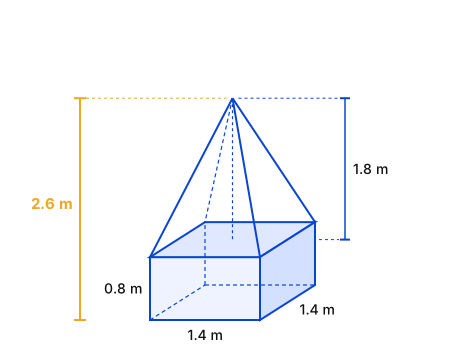
A monument shaped like a square-based pyramid is placed on top of a cuboidal stone base ( 1.4m×1.4m× 0.8m). The pyramid has the same base and is 1.8 m tall. Find the total height of the monument and its total volume.
वर्गाकार आधार वाले पिरामिड के आकार का एक स्मारक एक घनाभाकार पत्थर के आधार ( 1.4m×1.4m× 0.8m) के ऊपर रखा गया है। पिरामिड का आधार भी वही है तथा उसकी ऊँचाई 1.8 m है। स्मारक की कुल ऊँचाई तथा उसका कुल आयतन ज्ञात कीजिए।
  1. A2.0m,2.74m3
  2. B2.6m,2.50m3
  3. C2.6m,2.74m3
  4. D3.0m,3.00m3
Show answer

Concept: Cuboid volume = l×b×h; pyramid volume = 13×base area×height.

  1. Total height = 0.8+1.8=2.6 m.
  2. Base area = 1.4×1.4=1.96m2; cuboid = 1.96×0.8=1.568m3.
  3. Pyramid = 13×1.96×1.8=1.96×0.6=1.176m3.
  4. Cuboid 1.568 plus pyramid 1.176 gives 2.744, i.e. about 2.74 m³.

Trick: Height 2.6 m leaves (B) and (C); combined: 1.96×(0.8+0.6)=1.96×1.4=2.744.

Answer: (C) 2.6m,2.74m3

अवधारणा: घनाभ का आयतन = l×b×h; पिरामिड = 13×आधार क्षेत्रफल×ऊँचाई।

हल:

  1. कुल ऊँचाई = 0.8+1.8=2.6 m।
  2. आधार = 1.96 m²; घनाभ = 1.96×0.8=1.568m3।
  3. पिरामिड = 13×1.96×1.8=1.176m3।
  4. कुल =2.744≈2.74m3।

ट्रिक: एक साथ: 1.96×(0.8+0.6)=1.96×1.4=2.744.

उत्तर: (C) 2.6m,2.74m3

SSC CHSLQuantitative AptitudeVolume – cuboid + pyramidSSC CHSL 2025 · 24 Nov Shift 2 →
Q1958.
Which one of the following statements is FALSE ?
निम्नलिखित में से कौन-सा कथन असत्य है?
  1. AEvery natural number is an integerप्रत्येक प्राकृत संख्या एक पूर्णांक है
  2. BEvery rational number is realप्रत्येक परिमेय संख्या वास्तविक है
  3. CEvery real number is rationalप्रत्येक वास्तविक संख्या परिमेय है
  4. DEvery integer is realप्रत्येक पूर्णांक वास्तविक है
Show answer

Concept: Natural⊂Whole⊂Integers⊂Rational⊂Real.

  1. (A), (B), (D) follow this chain → true.
  2. Real numbers also include irrationals like 2 and π, which are not rational.
  3. So 'Every real number is rational' is false.

Trick: Moving left to right in the chain is always true; right to left ('every real is …') is usually false.

Answer: (C) Every real number is rational

अवधारणा: प्राकृत⊂पूर्ण⊂पूर्णांक⊂परिमेय⊂वास्तविक।

हल:

  1. (A), (B), (D) इसी क्रम के अनुसार सत्य हैं।
  2. वास्तविक संख्याओं में 2, π जैसी अपरिमेय संख्याएँ भी हैं।
  3. इसलिए 'हर वास्तविक संख्या परिमेय है' असत्य है।

ट्रिक: छोटे समुच्चय से बड़े की ओर कथन सत्य; उल्टी दिशा में प्रायः असत्य।

उत्तर: (C) प्रत्येक वास्तविक संख्या परिमेय है

SSC CHSLQuantitative AptitudeNumber system – sets of numbersSSC CHSL 2025 · 24 Nov Shift 2 →
Q1959.
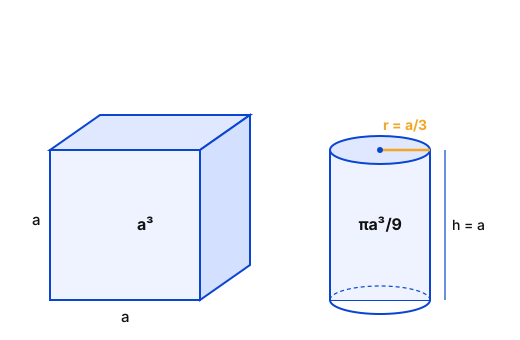
A prototype engineer models a container as a cube and a cylinder, both with the same height and the cylinder's radius being one-third the cube's side. What is the ratio of their volumes?
एक प्रोटोटाइप इंजीनियर एक कंटेनर को एक घन तथा एक बेलन के रूप में दर्शाता है, दोनों की ऊँचाई समान है तथा बेलन की त्रिज्या घन की भुजा की एक-तिहाई है। उनके आयतनों का अनुपात क्या है?
  1. Aπ:3
  2. Bπ:6
  3. Cπ:12
  4. Dπ:9
Show answer

Concept: Cube =a3; cylinder =πr2h.

  1. Let cube side = a; cylinder h=a, r=a3.
  2. Cylinder = π(a3)2×a=πa39.
  3. Cylinder : cube = πa39:a3=π:9.

Trick: Put a=3: cylinder = π×12×3=3π, cube = 27 → 3π:27=π:9.

Answer: (D) π:9

अवधारणा: घन =a3; बेलन =πr2h।

हल:

  1. घन की भुजा = a; बेलन h=a, r=a3।
  2. बेलन = π(a3)2×a=πa39।
  3. बेलन : घन = π:9।

ट्रिक: a=3 रखें: बेलन =3π, घन = 27 → π:9.

उत्तर: (D) π:9

SSC CHSLQuantitative AptitudeVolume ratio – cylinder : cubeSSC CHSL 2025 · 24 Nov Shift 2 →
Q1960.
At an organization, 4 events were organized. The average attendance for the first two events was 168.5 people. The next two events had an average of 182.5 people. Later, due to a correction, it was found that the attendance at one of the first two events was 15 more than what was originally recorded, and one of the last two events was 7 less. Find the corrected overall average attendance for all 4 events.
एक संगठन में 4 कार्यक्रम आयोजित किए गए। पहले दो कार्यक्रमों में औसत उपस्थिति 168.5 लोगों की थी। अगले दो कार्यक्रमों में औसत उपस्थिति 182.5 रही। बाद में संशोधन के कारण यह पाया गया कि पहले दो कार्यक्रमों में से एक की उपस्थिति मूल रूप से दर्ज संख्या से 15 अधिक थी तथा अंतिम दो कार्यक्रमों में से एक की उपस्थिति 7 कम थी। चारों कार्यक्रमों की संशोधित कुल औसत उपस्थिति ज्ञात कीजिए।
  1. A176.50
  2. B177.50
  3. C178.00
  4. D177.25
Show answer

Concept: Corrected total=old total+net correction; then divide.

  1. Old total = 2×168.5+2×182.5=337+365=702.
  2. Net correction = +15−7=+8⇒710.
  3. New average = 7104=177.5.

Trick: Old average = 168.5+182.52=175.5; change = 84=+2⇒177.5.

Answer: (B) 177.50

अवधारणा: संशोधित योग=पुराना योग+कुल सुधार; फिर भाग दें।

हल:

  1. पुराना योग = 337+365=702।
  2. सुधार = +15−7=+8⇒710।
  3. नया औसत = 7104=177.5।

ट्रिक: पुराना औसत 175.5, बदलाव 84=+2⇒177.5.

उत्तर: (B) 177.50

SSC CHSLQuantitative AptitudeCorrected averageSSC CHSL 2025 · 24 Nov Shift 2 →