Question bank

Q&A: practice questions with answers

Search questions on any topic. Filter by exam category, exam, subject and topic, try the question, then open the answer and explanation.

Courses – airGurukul

6,600 questions found.

Q1.
Which two signs should be interchanged to make the given equation correct?
30 + 3 × 990 − 11 ÷ 63 = 237
दिए गए समीकरण को सही बनाने के लिए किन दो चिह्नों को आपस में बदला जाना चाहिए?
30 + 3 × 990 − 11 ÷ 63 = 237
  1. A× and +× और +
  2. B÷ and −÷ और −
  3. C− and ×− और ×
  4. D+ and −+ और −
Show answer

Concept: Swap the two signs in each option and evaluate using BODMAS until the result equals 237.

  1. Swap ÷ and −: 30+3×990÷11−63.
  2. 990÷11=90, so 3×90=270.
  3. 30+270−63=237 ✓ — the equation balances.

Trick: A division like 990÷11 or ÷63 giving a whole number hints which numbers the ÷ sign should sit between.

Answer: (B) ÷ and −

अवधारणा: हर विकल्प के दो चिह्न बदलकर BODMAS से हल करें, जब तक परिणाम 237 न आए।

  1. ÷ और − बदलें: 30+3×990÷11−63.
  2. 990÷11=90, इसलिए 3×90=270.
  3. 30+270−63=237 ✓ — समीकरण सही।

ट्रिक: जहाँ भाग पूरा-पूरा बँटे (जैसे 990÷11), वहीं ÷ चिह्न आने की संभावना होती है।

उत्तर: (B) ÷ और −
SSC CPO Paper IGeneral Intelligence and ReasoningInterchange of signsSSC CPO Paper I 2024 · 29 Jun Shift 3 →
Q2.
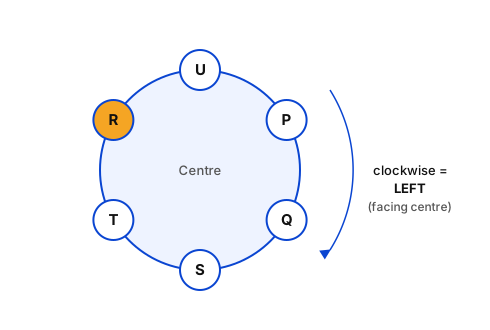
Six students - P, Q, R, S T and U - are sitting around a circular table, facing the centre. Q is sitting second to the left of U.
T is sitting third to the right of P.
P is the immediate neighbour of Q and U.
S is not the neighbour of U. Who among the following is the neighbour of both U and T?
छह विद्यार्थी - P, Q, R, S T और U - एक वृत्ताकार मेज़ के चारों ओर केंद्र की ओर मुख करके बैठे हैं। Q, U के बाएँ से दूसरे स्थान पर बैठा है।
T, P के दाएँ से तीसरे स्थान पर बैठा है।
P, Q और U का निकटतम पड़ोसी है।
S, U का पड़ोसी नहीं है। निम्नलिखित में से कौन U और T दोनों का पड़ोसी है?
  1. AP
  2. BS
  3. CR
  4. DQ
Show answer

Concept: For people facing the centre, moving to their left means moving clockwise and to their right means anticlockwise.

  1. P is the neighbour of both Q and U, and Q is second to the left of U → U, P, Q sit consecutively clockwise.
  2. T is third to the right of P → T is exactly opposite P.
  3. Two seats remain (between Q–T and between T–U). S is not U's neighbour → S sits between Q and T, R between T and U.
  4. Order clockwise: U, P, Q, S, T, R. R is the neighbour of both U and T.

Trick: In a 6-seat circle, 'third to the left/right' is always the person directly opposite.

Answer: (C) R

अवधारणा: केंद्र की ओर मुख होने पर बाएँ जाना = घड़ी की दिशा (clockwise), दाएँ = वामावर्त (anticlockwise)।

  1. P, Q और U दोनों का पड़ोसी है तथा Q, U के बाएँ दूसरे स्थान पर है → क्रम U, P, Q (clockwise)।
  2. T, P के दाएँ तीसरा है → T ठीक P के सामने।
  3. बची दो सीटें: Q–T के बीच और T–U के बीच। S, U का पड़ोसी नहीं → S, Q और T के बीच; R, T और U के बीच।
  4. क्रम: U, P, Q, S, T, R. U और T दोनों का पड़ोसी R है।

ट्रिक: 6 लोगों के वृत्त में 'तीसरा बाएँ/दाएँ' हमेशा ठीक सामने वाला व्यक्ति होता है।

उत्तर: (C) R

SSC CPO Paper IGeneral Intelligence and ReasoningCircular seating arrangementSSC CPO Paper I 2024 · 29 Jun Shift 3 →
Q3.
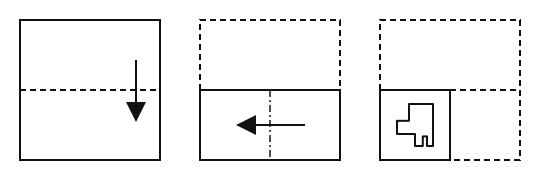
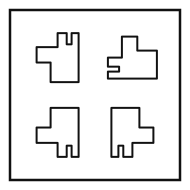
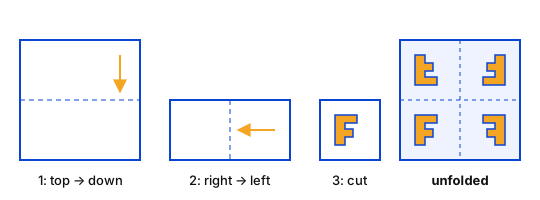
The sequence of folding a piece of paper and the manner in which the folded paper has been cut is shown below. Choose the figure which would most closely resemble the unfolded form of the paper.
एक कागज़ को मोड़ने का क्रम और मुड़े हुए कागज़ को काटने का तरीका नीचे दर्शाया गया है। उस आकृति का चयन कीजिए जो कागज़ के खुले रूप से सर्वाधिक मिलती-जुलती होगी।
  1. A
  2. B
  3. C
  4. D
Show answer

Concept: When a folded paper is opened, every cut is reflected across each fold line; each unfolding doubles the number of cuts.

  1. Fold 1: top half onto bottom half. Fold 2: right half onto left. The cut is made in the bottom-left quarter.
  2. Opening fold 2: a mirror copy appears in the bottom-right quarter (left–right flip).
  3. Opening fold 1: both shapes are reflected upward into the top quarters (upside-down copies).
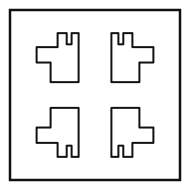
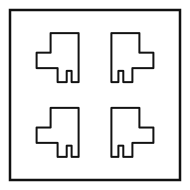
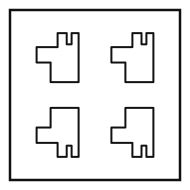
  4. So the sheet shows 4 shapes: bottom row upright and mirrored side to side, top row the upside-down images of the bottom row — this matches option (A).

Trick: Unfold in reverse order of folding; shapes on opposite sides of a fold line are always mirror images of each other.

Answer: (A)

अवधारणा: मुड़े कागज़ को खोलने पर हर कटाव मोड़-रेखा (fold line) के पार प्रतिबिंबित होता है; हर बार खोलने पर कटाव दोगुने होते हैं।

  1. पहला मोड़: ऊपर का आधा नीचे; दूसरा मोड़: दायाँ आधा बाएँ पर। कटाव नीचे-बाएँ चौथाई में।
  2. दूसरा मोड़ खोलने पर नीचे-दाएँ में दर्पण प्रतिलिपि (बाएँ–दाएँ उलटी) बनती है।
  3. पहला मोड़ खोलने पर दोनों आकृतियाँ ऊपर की ओर उलटी (upside-down) बनती हैं।
  4. कुल 4 आकृतियाँ — नीचे वाली पंक्ति सीधी और आपस में दर्पण, ऊपर वाली उनकी उलटी छवि — विकल्प (A) से मेल।

ट्रिक: मोड़ने के उलटे क्रम में खोलें; किसी मोड़-रेखा के दोनों ओर की आकृतियाँ हमेशा एक-दूसरे का दर्पण प्रतिबिंब होती हैं।

उत्तर: (A)

SSC CPO Paper IGeneral Intelligence and ReasoningPaper folding and cuttingSSC CPO Paper I 2024 · 29 Jun Shift 3 →
Q4.
In a code language, ‘TREE’ is written as ‘WSHF’, and ‘BALL’ is written as ‘EBOM’. How will ‘WALL’ be written in that language?
एक कूट भाषा में, ‘TREE’ को ‘WSHF’ लिखा जाता है, और ‘BALL’ को ‘EBOM’ लिखा जाता है। उसी भाषा में ‘WALL’ को किस प्रकार लिखा जाएगा?
  1. AZOMB
  2. BZBOM
  3. CMOZB
  4. DOZBM
Show answer

Concept: Find the shift applied to each letter position and apply the same shifts to the new word.

  1. TREE → WSHF: T+3=W, R+1=S, E+3=H, E+1=F → pattern +3,+1,+3,+1.
  2. Check BALL → EBOM: B+3=E, A+1=B, L+3=O, L+1=M ✓.
  3. WALL: W+3=Z, A+1=B, L+3=O, L+1=M → ZBOM.

Trick: Alternating +3,+1 — just check the first two letters of each option: only ZBOM starts with Z, B.

Answer: (B) ZBOM

अवधारणा: हर अक्षर पर लगे खिसकाव (shift) को पहचानकर नए शब्द पर वही लगाएँ।

  1. TREE → WSHF: T+3=W, R+1=S, E+3=H, E+1=F → पैटर्न +3,+1,+3,+1.
  2. जाँच BALL → EBOM: B+3=E, A+1=B, L+3=O, L+1=M ✓.
  3. WALL: W+3=Z, A+1=B, L+3=O, L+1=M → ZBOM.

ट्रिक: पैटर्न +3,+1 बारी-बारी — विकल्पों के पहले दो अक्षर Z, B देखें; केवल ZBOM।

उत्तर: (B) ZBOM

SSC CPO Paper IGeneral Intelligence and ReasoningLetter codingSSC CPO Paper I 2024 · 29 Jun Shift 3 →
Q5.
In a certain code language,
'A x B' means ‘A is the son of B’,
'A – B' means ‘A is the brother of B’,
'A + B' means ‘A is the wife of B’,
'A % B' means ‘A is the father of B’.
How is M related to T if ‘M x N % P – S + T’?
एक निश्चित कूट भाषा में,
'A x B' का अर्थ है ‘A, B का पुत्र है’,
'A – B' का अर्थ है ‘A, B का भाई है’,
'A + B' का अर्थ है ‘A, B की पत्नी है’,
'A % B' का अर्थ है ‘A, B का पिता है’।
यदि ‘M x N % P – S + T’ है, तो M का T से क्या संबंध है?
  1. AWife's father's mother's brotherपत्नी के पिता की माँ का भाई
  2. BBrother's wife's mother's fatherभाई की पत्नी की माँ का पिता
  3. C​Wife's brotherपत्नी का भाई
  4. DWife's mother's fatherपत्नी की माँ का पिता
Show answer

Concept: Decode each symbol one by one and build a family tree.

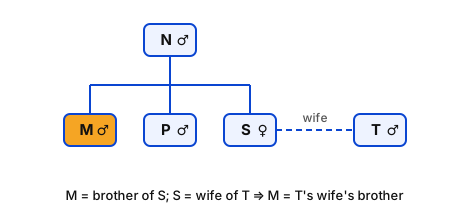
  1. M × N: M is the son of N.
  2. N % P: N is the father of P. P – S: P is the brother of S → N is also the father of S, so M is S's brother.
  3. S + T: S is the wife of T.
  4. Hence M is the brother of T's wife.

Trick: Read the chain from T's side: T → wife (S) → her brother (M).

Answer: (C) Wife's brother

अवधारणा: हर चिह्न का अर्थ लगाकर वंश-वृक्ष (family tree) बनाएँ।

  1. M × N: M, N का पुत्र है।
  2. N % P: N, P का पिता। P – S: P, S का भाई → N, S का भी पिता; अतः M, S का भाई।
  3. S + T: S, T की पत्नी है।
  4. इसलिए M, T की पत्नी का भाई है।

ट्रिक: T की ओर से पढ़ें: T → पत्नी (S) → उसका भाई (M)।

उत्तर: (C) Wife's brother (पत्नी का भाई)

SSC CPO Paper IGeneral Intelligence and ReasoningCoded blood relationsSSC CPO Paper I 2024 · 29 Jun Shift 3 →
Q6.
In a certain code language,
A+ B means ‘A is the mother of B’
A − B means ‘A is the brother of B’
A × B means ‘A is the wife of B’
A ÷ B means ‘A is the father of B’
Based on the above, how is R related to U if ‘U − P × Q ÷ R + S − T’?
एक निश्चित कूट भाषा में,
A+ B का अर्थ है ‘A, B की माँ है’
A − B का अर्थ है ‘A, B का भाई है’
A × B का अर्थ है ‘A, B की पत्नी है’
A ÷ B का अर्थ है ‘A, B का पिता है’
उपर्युक्त के आधार पर, यदि ‘U − P × Q ÷ R + S − T’ है, तो R का U से क्या संबंध है?
  1. ADaughterपुत्री
  2. BSister’s daughterबहन की पुत्री
  3. CWife’s sisterपत्नी की बहन
  4. DSisterबहन
Show answer

Concept: Decode each sign and draw the family tree; gender comes from words like mother, wife, brother.

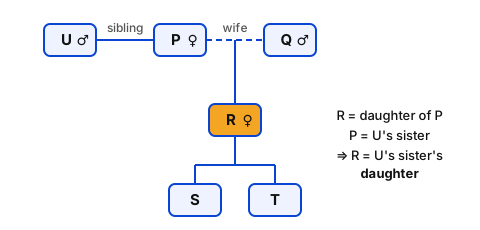
  1. U − P: U is the brother of P. P × Q: P is the wife of Q (so P is female, U's sister).
  2. Q ÷ R: Q is the father of R, so R is the child of P.
  3. R + S: R is the mother of S → R is female, i.e. P's daughter.
  4. R is the daughter of U's sister.

Trick: Mark gender as soon as you decode a sign — 'mother' instantly tells you R is female.

Answer: (B) Sister's daughter

अवधारणा: हर चिह्न को डिकोड करके वंश-वृक्ष बनाएँ; mother, wife, brother जैसे शब्दों से लिंग (gender) तय होता है।

  1. U − P: U, P का भाई। P × Q: P, Q की पत्नी (P महिला = U की बहन)।
  2. Q ÷ R: Q, R का पिता → R, P की संतान।
  3. R + S: R, S की माता → R महिला, अर्थात P की पुत्री।
  4. R, U की बहन की पुत्री है।

ट्रिक: हर चिह्न डिकोड करते ही लिंग लिख लें — 'mother' से तुरंत पता चलता है कि R महिला है।

उत्तर: (B) Sister's daughter (बहन की पुत्री)

SSC CPO Paper IGeneral Intelligence and ReasoningCoded blood relationsSSC CPO Paper I 2024 · 29 Jun Shift 3 →
Q7.
Which of the following letter-clusters will replace the question mark (?) in the given series?
aaabcccccccc, aaabbcccc, aaabbbbcc, ?
दी गई शृंखला में प्रश्न चिह्न (?) के स्थान पर निम्नलिखित में से कौन-सा अक्षर-समूह आएगा?
aaabcccccccc, aaabbcccc, aaabbbbcc, ?
  1. Aaabbbbbbbbc
  2. Baaabbbbbbccc
  3. Caaabbbbbbbbc
  4. Daaabbbbbbbcc
Show answer

Concept: Count how many times each letter repeats in every term.

  1. aaabcccccccc → a:3, b:1, c:8
  2. aaabbcccc → a:3, b:2, c:4; aaabbbbcc → a:3, b:4, c:2
  3. a stays 3, b doubles (1,2,4,8), c halves (8,4,2,1).
  4. Next term: a:3, b:8, c:1 → aaabbbbbbbbc.

Trick: Write counts as numbers (3-1-8, 3-2-4, 3-4-2) — the doubling/halving jumps out.

Answer: (C) aaabbbbbbbbc

अवधारणा: हर पद में प्रत्येक अक्षर कितनी बार आया है, गिनें।

  1. aaabcccccccc → a:3, b:1, c:8
  2. aaabbcccc → a:3, b:2, c:4; aaabbbbcc → a:3, b:4, c:2
  3. a हमेशा 3, b दोगुना (1,2,4,8), c आधा (8,4,2,1).
  4. अगला पद: a:3, b:8, c:1 → aaabbbbbbbbc.

ट्रिक: गिनती को संख्या में लिखें (3-1-8, 3-2-4, 3-4-2) — दोगुना/आधा तुरंत दिखता है।

उत्तर: (C) aaabbbbbbbbc

SSC CPO Paper IGeneral Intelligence and ReasoningLetter cluster seriesSSC CPO Paper I 2024 · 29 Jun Shift 3 →
Q8.
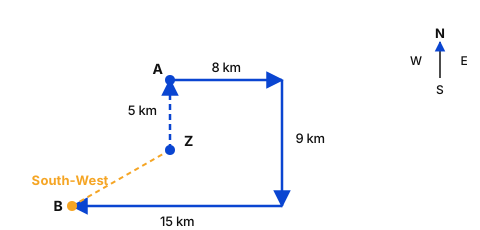
Kiara starts from Point A, which is 5 km towards the north of Z. From Point A, she
turns towards the east and drives 8 km. She then takes a right turn and drives 9 km. Finally, she takes a right turn, drives for 15 km and stops at Point B. In which direction is Point B with respect to Point Z?
किआरा बिंदु A से चलना आरंभ करती है, जो Z के उत्तर में 5 km की दूरी पर है। बिंदु A से, वह
पूर्व की ओर मुड़ती है और 8 km ड्राइव करती है। फिर वह दाएँ मुड़ती है और 9 km ड्राइव करती है। अंत में, वह दाएँ मुड़ती है, 15 km ड्राइव करती है और बिंदु B पर रुक जाती है। बिंदु Z के सापेक्ष बिंदु B किस दिशा में है?
  1. ANorth-Eastउत्तर-पूर्व
  2. BSouth-Westदक्षिण-पश्चिम
  3. CSouthदक्षिण
  4. DNorth-Westउत्तर-पश्चिम
Show answer

Concept: Take Z as the origin, plot every move on a grid and compare the final point with Z.

  1. A is 5 km north of Z: A = (0,5).
  2. 8 km east → (8,5); right turn = south, 9 km → (8,−4).
  3. Right turn = west, 15 km → B = (−7,−4).
  4. B is 7 km west and 4 km south of Z → South-West.

Trick: Net E–W =8−15=−7 (west), net N–S =5−9=−4 (south) → West + South = South-West.

Answer: (B) South-West

अवधारणा: Z को मूल बिंदु (origin) मानकर हर चाल ग्रिड पर लगाएँ और अंतिम बिंदु की तुलना Z से करें।

  1. A, Z से 5 km उत्तर: A = (0,5).
  2. 8 km पूर्व → (8,5); दाएँ मुड़ना = दक्षिण, 9 km → (8,−4).
  3. दाएँ मुड़ना = पश्चिम, 15 km → B = (−7,−4).
  4. B, Z से 7 km पश्चिम और 4 km दक्षिण → दक्षिण-पश्चिम (South-West)।

ट्रिक: कुल पूर्व–पश्चिम =8−15=−7 (पश्चिम), उत्तर–दक्षिण =5−9=−4 (दक्षिण) → South-West.

उत्तर: (B) South-West

SSC CPO Paper IGeneral Intelligence and ReasoningDirection and distanceSSC CPO Paper I 2024 · 29 Jun Shift 3 →
Q9.
Two statements are given, followed by three conclusions numbered I, II and III.
Assuming the statements to be true, even if they seem to be at variance with
commonly known facts, decide which of the conclusions logically follow(s) from the statements.
Statements:
All scanners are printers.
Some scanners are copiers.
Conclusions:
I. Some printers are copiers.
II. No copier is a printer.
III. Some printers are scanners.
दो कथन दिए गए हैं, जिनके बाद I, II और III क्रमांकित तीन निष्कर्ष दिए गए हैं।
कथनों को सत्य मानते हुए, भले ही वे सामान्यतः ज्ञात तथ्यों से भिन्न प्रतीत होते हों,
निर्णय कीजिए कि कौन-सा/से निष्कर्ष तार्किक रूप से कथनों का अनुसरण करता है/करते हैं।
कथन:
सभी स्कैनर, प्रिंटर हैं।
कुछ स्कैनर, कॉपियर हैं।
निष्कर्ष:
I. कुछ प्रिंटर, कॉपियर हैं।
II. कोई कॉपियर, प्रिंटर नहीं है।
III. कुछ प्रिंटर, स्कैनर हैं।
  1. AAll of the conclusions followसभी निष्कर्ष अनुसरण करते हैं
  2. BOnly conclusions I and II followकेवल निष्कर्ष I और II अनुसरण करते हैं
  3. COnly conclusions I and III followकेवल निष्कर्ष I और III अनुसरण करते हैं
  4. DOnly conclusions II and III followकेवल निष्कर्ष II और III अनुसरण करते हैं
Show answer

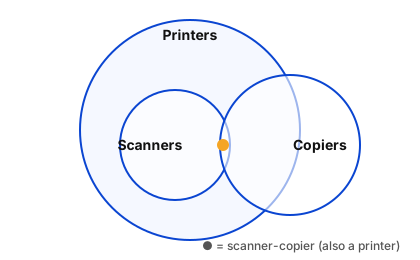
Concept: Draw the least-overlap Venn diagram; a conclusion follows only if it is true in every possible diagram.

  1. All scanners are printers → Scanners circle lies inside Printers.
  2. Some scanners are copiers → those copiers are also printers, so I (Some printers are copiers) follows.
  3. II (No copier is a printer) contradicts I → does not follow.
  4. III (Some printers are scanners) is the conversion of 'All scanners are printers' → follows.

Trick: 'All A are B' always gives 'Some B are A'.

Answer: (C) Only conclusions I and III follow

अवधारणा: न्यूनतम ओवरलैप वाला वेन आरेख बनाएँ; निष्कर्ष तभी मान्य जब हर संभव आरेख में सत्य हो।

  1. All scanners are printers → Scanners का वृत्त Printers के अंदर।
  2. Some scanners are copiers → ये copiers, printers भी हैं, अतः I (Some printers are copiers) सही।
  3. II (No copier is a printer), I के विपरीत → गलत।
  4. III (Some printers are scanners), 'All scanners are printers' का रूपांतरण (conversion) → सही।

ट्रिक: 'All A are B' से हमेशा 'Some B are A' निकलता है।

उत्तर: (C) Only conclusions I and III follow

SSC CPO Paper IGeneral Intelligence and ReasoningSyllogismSSC CPO Paper I 2024 · 29 Jun Shift 3 →
Q10.
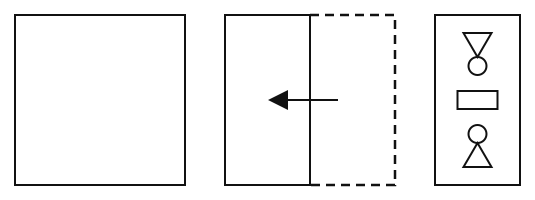
A sheet of paper is folded along the dotted line successively along the directions
shown and is then punched in the last. How would the paper look when unfolded?
कागज़ की एक शीट को दर्शाई गई दिशाओं में बिंदीदार रेखा के अनुदिश क्रमिक रूप से मोड़ा जाता है
और फिर अंत में उसमें छेद किया जाता है। खोलने पर यह कागज़ कैसा दिखाई देगा?
  1. A
  2. B
  3. C
  4. D
Show answer

Concept: On unfolding, each punched/cut design is reflected across the fold line.

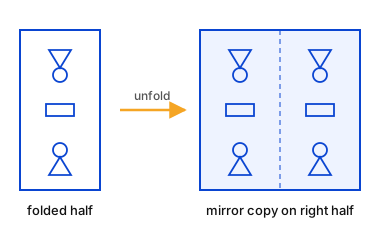
  1. The right half is folded onto the left half (vertical fold in the middle).
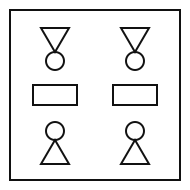
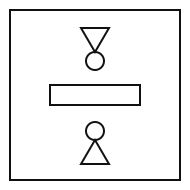
  2. On the folded half the design is: inverted triangle with circle, a rectangle, and circle with triangle — one column.
  3. Opening the fold copies this column as a mirror image into the right half.
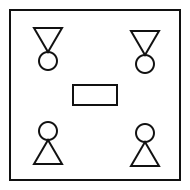
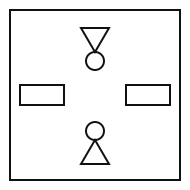
  4. So the open sheet has two identical columns (each: ▽○, ▭, ○△) — option (B).

Trick: One vertical fold → every design appears twice, side by side, at equal distance from the fold.

Answer: (B)

अवधारणा: खोलने पर हर छेद/आकृति मोड़-रेखा के पार प्रतिबिंबित होती है।

  1. दायाँ आधा भाग बाएँ आधे पर मोड़ा गया (बीच में ऊर्ध्वाधर मोड़)।
  2. मुड़े भाग पर एक स्तंभ में: उलटा त्रिभुज-वृत्त, आयत, वृत्त-त्रिभुज।
  3. खोलने पर यही स्तंभ दाएँ आधे में दर्पण-प्रतिलिपि बनकर आता है।
  4. अतः दो समान स्तंभ (हर एक: ▽○, ▭, ○△) — विकल्प (B)।

ट्रिक: एक ऊर्ध्वाधर मोड़ → हर आकृति दो बार, मोड़ से बराबर दूरी पर अगल-बगल।

उत्तर: (B)

SSC CPO Paper IGeneral Intelligence and ReasoningPaper folding and punchingSSC CPO Paper I 2024 · 29 Jun Shift 3 →
Q11.
In a certain code language, ‘NODE’ is coded as ‘6297’ and ‘BONE’ is coded as ‘9716’. What is the code for ‘D’ in that language?
एक निश्चित कूट भाषा में, ‘NODE’ को ‘6297’ के रूप में कूटबद्ध किया जाता है और ‘BONE’ को ‘9716’ के रूप में कूटबद्ध किया जाता है। उस भाषा में ‘D’ का कूट क्या है?
  1. A6
  2. B2
  3. C7
  4. D1
Show answer

Concept: Letters common to both words share the common digits; the leftover letter takes the leftover digit.

  1. NODE = {N, O, D, E} → {6, 2, 9, 7}; BONE = {B, O, N, E} → {9, 7, 1, 6}.
  2. Common letters O, N, E ↔ common digits 6, 9, 7.
  3. Remaining letter of NODE is D and remaining digit is 2 → D = 2 (and B = 1).

Trick: Eliminate the common part; what is left over in each word pairs up directly.

Answer: (B) 2

अवधारणा: दोनों शब्दों के उभयनिष्ठ अक्षरों के कोड भी उभयनिष्ठ होंगे; बचा अक्षर बचे अंक से जुड़ता है।

  1. NODE = {N, O, D, E} → {6, 2, 9, 7}; BONE = {B, O, N, E} → {9, 7, 1, 6}.
  2. उभयनिष्ठ अक्षर O, N, E ↔ उभयनिष्ठ अंक 6, 9, 7.
  3. NODE का बचा अक्षर D, बचा अंक 2 → D = 2 (और B = 1)।

ट्रिक: उभयनिष्ठ भाग हटाएँ; बचा हुआ सीधा जोड़ा बनाता है।

उत्तर: (B) 2

SSC CPO Paper IGeneral Intelligence and ReasoningLetter–digit codingSSC CPO Paper I 2024 · 29 Jun Shift 3 →
Q12.
Which of the following terms will replace the question mark (?) in the given series? DIQ, EJR, FKS,?
दी गई शृंखला में प्रश्न चिह्न (?) के स्थान पर निम्नलिखित में से कौन-सा पद आएगा? DIQ, EJR, FKS,?
  1. AGLT
  2. BDKO
  3. CETH
  4. DDLS
Show answer

Concept: Check the movement of each letter position separately.

  1. 1st letters: D, E, F → next G.
  2. 2nd letters: I, J, K → next L.
  3. 3rd letters: Q, R, S → next T.
  4. Each position moves +1 → GLT.

Trick: Every letter moves +1 — just add 1 to each letter of FKS.

Answer: (A) GLT

अवधारणा: हर स्थान के अक्षर की चाल अलग-अलग देखें।

  1. पहले अक्षर: D, E, F → अगला G.
  2. दूसरे अक्षर: I, J, K → अगला L.
  3. तीसरे अक्षर: Q, R, S → अगला T.
  4. हर स्थान पर +1 → GLT.

ट्रिक: FKS के हर अक्षर में 1 जोड़ दें।

उत्तर: (A) GLT

SSC CPO Paper IGeneral Intelligence and ReasoningLetter seriesSSC CPO Paper I 2024 · 29 Jun Shift 3 →
Q13.
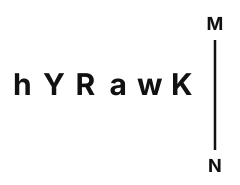
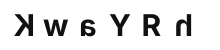
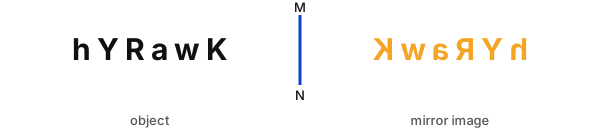
Select the correct mirror image of the given figure when the mirror is placed at MN as shown below.
नीचे दर्शाए अनुसार दर्पण को MN पर रखे जाने पर दी गई आकृति के सही दर्पण प्रतिबिंब का चयन कीजिए।
  1. A
  2. B
  3. C
  4. D
Show answer

Concept: With the mirror on the right (vertical line MN), the order of characters is reversed and each character is flipped left–right; top and bottom do not change.

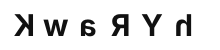
  1. Object: h Y R a w K. Reading in the mirror from left: K w a R Y h.
  2. Each letter is laterally inverted: K faces left, R faces left, h's stem goes to the right; letters stay upright.
  3. Symmetric letters (Y, w) look the same.
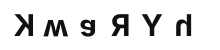
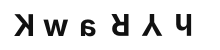
  4. Option (A) shows exactly this; options with upside-down letters or swapped Y/R are wrong.

Trick: Vertical mirror: first character becomes last, nothing turns upside down.

Answer: (A)

अवधारणा: दर्पण दाईं ओर (ऊर्ध्वाधर रेखा MN) हो तो अक्षरों का क्रम उलट जाता है और हर अक्षर बाएँ–दाएँ पलटता है; ऊपर-नीचे नहीं बदलता।

  1. वस्तु: h Y R a w K. दर्पण में बाएँ से: K w a R Y h.
  2. हर अक्षर पार्श्व रूप से उलटा (lateral inversion): K और R बाईं ओर मुख, h का डंडा दाईं ओर; अक्षर सीधे खड़े रहते हैं।
  3. सममित अक्षर (Y, w) वैसे ही दिखते हैं।
  4. विकल्प (A) ठीक यही दिखाता है; उलटे (upside-down) अक्षर या Y/R की अदला-बदली वाले विकल्प गलत।

ट्रिक: ऊर्ध्वाधर दर्पण: पहला अक्षर अंतिम बनता है, कुछ भी उल्टा (ऊपर-नीचे) नहीं होता।

उत्तर: (A)

SSC CPO Paper IGeneral Intelligence and ReasoningMirror imageSSC CPO Paper I 2024 · 29 Jun Shift 3 →
Q14.
Which letter cluster will replace the question mark (?) to complete the given series? TEKS, YLBD, ?, IZJZ, NGAK
दी गई शृंखला को पूरा करने के लिए कौन-सा अक्षर-समूह प्रश्न चिह्न (?) का स्थान लेगा? TEKS, YLBD, ?, IZJZ, NGAK
  1. AJKDO
  2. BDSSO
  3. CDXTO
  4. DFGCW
Show answer

Concept: Use alphabet positions (A = 1 … Z = 26) and check each position of the cluster separately (wrap around after Z).

  1. 1st: T(20), Y(25), ?, I(9), N(14) → +5 each: 25+5=30→4 = D.
  2. 2nd: E(5), L(12), ?, Z(26), G(7) → +7: 12+7=19 = S.
  3. 3rd: K(11), B(2), ?, J(10), A(1) → −9: 2−9=−7→19 = S.
  4. 4th: S(19), D(4), ?, Z(26), K(11) → +11: 4+11=15 = O. Missing term = DSSO.

Trick: Verify with the next term: D+5 = I, S+7 = Z, S−9 = J, O+11 = Z ✓.

Answer: (B) DSSO

अवधारणा: अक्षरों की स्थिति (A = 1 … Z = 26) लेकर हर स्थान अलग से जाँचें (Z के बाद फिर A)।

  1. पहला: T(20), Y(25), ?, I(9), N(14) → हर बार +5: 25+5=30→4 = D.
  2. दूसरा: E(5), L(12), ?, Z(26), G(7) → +7: 12+7=19 = S.
  3. तीसरा: K(11), B(2), ?, J(10), A(1) → −9: 2−9=−7→19 = S.
  4. चौथा: S(19), D(4), ?, Z(26), K(11) → +11: 4+11=15 = O. उत्तर DSSO.

ट्रिक: अगले पद से जाँचें: D+5 = I, S+7 = Z, S−9 = J, O+11 = Z ✓.

उत्तर: (B) DSSO

SSC CPO Paper IGeneral Intelligence and ReasoningLetter cluster seriesSSC CPO Paper I 2024 · 29 Jun Shift 3 →
Q15.
If + means −, − means ×, × means ÷, ÷ means +, what will come in place of the question mark (?) in the given equation.
60+378×18÷23−2=?
यदि + का अर्थ − है, − का अर्थ × है, × का अर्थ ÷ है, ÷ का अर्थ + है, तो दिए गए समीकरण में प्रश्न चिह्न (?) के स्थान पर क्या आएगा।
60+378×18÷23−2=?
  1. A85
  2. B58
  3. C57
  4. D75
Show answer

Concept: Replace each sign as instructed, then solve with BODMAS.

  1. Given: 60+378×18÷23−2.
  2. After replacement (+→−, ×→÷, ÷→+, −→×): 60−378÷18+23×2.
  3. 378÷18=21, 23×2=46.
  4. 60−21+46=85.

Trick: Rewrite the whole expression first, then calculate — never substitute and solve at the same time.

Answer: (A) 85

अवधारणा: दिए अनुसार चिह्न बदलें, फिर BODMAS से हल करें।

  1. दिया: 60+378×18÷23−2.
  2. बदलने पर (+→−, ×→÷, ÷→+, −→×): 60−378÷18+23×2.
  3. 378÷18=21, 23×2=46.
  4. 60−21+46=85.

ट्रिक: पहले पूरा व्यंजक नए चिह्नों के साथ लिखें, फिर गणना करें।

उत्तर: (A) 85

SSC CPO Paper IGeneral Intelligence and ReasoningMathematical operationsSSC CPO Paper I 2024 · 29 Jun Shift 3 →
Q16.
Based on the English alphabetical order, three of the following four letter-clusters are alike in a certain way and thus form a group. Which letter-cluster does not belong to that group?
(Note: The odd letter-cluster is not based on the number of consonants/vowels or their position in the letter-cluster.)
अंग्रेज़ी वर्णमाला क्रम के आधार पर, निम्नलिखित चार अक्षर-समूहों में से तीन किसी निश्चित प्रकार से एकसमान हैं और इस प्रकार एक समूह बनाते हैं। कौन-सा अक्षर-समूह उस समूह से संबंधित नहीं है?
(ध्यान दें: असंगत अक्षर-समूह, उस अक्षर-समूह में व्यंजनों/स्वरों की संख्या या उनके स्थान पर आधारित नहीं है।)
  1. AIFM
  2. BOLR
  3. CTQX
  4. DGDK
Show answer

Concept: Find the gaps between consecutive letters using alphabet positions.

  1. IFM: I(9) → F(6) → M(13): −3,+7.
  2. TQX: T(20) → Q(17) → X(24): −3,+7; GDK: G(7) → D(4) → K(11): −3,+7.
  3. OLR: O(15) → L(12) → R(18): −3,+6 — different.

Trick: Check the second gap only; the first gap (−3) is the same in all four.

Answer: (B) OLR

अवधारणा: अक्षरों की स्थिति लेकर लगातार अक्षरों का अंतर निकालें।

  1. IFM: I(9) → F(6) → M(13): −3,+7.
  2. TQX: T(20) → Q(17) → X(24): −3,+7; GDK: G(7) → D(4) → K(11): −3,+7.
  3. OLR: O(15) → L(12) → R(18): −3,+6 — अलग।

ट्रिक: पहला अंतर (−3) सबमें समान है, केवल दूसरा अंतर जाँचें।

उत्तर: (B) OLR

SSC CPO Paper IGeneral Intelligence and ReasoningOdd one out (letters)SSC CPO Paper I 2024 · 29 Jun Shift 3 →
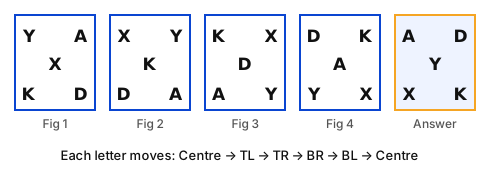
Q17.
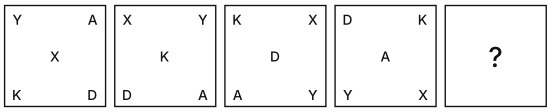
Identify the figure given in the options which when put in place of (?) will logically
complete the series.
विकल्पों में दी गई उस आकृति की पहचान कीजिए जिसे (?) के स्थान पर रखने पर शृंखला तार्किक रूप से
पूरी हो जाएगी।
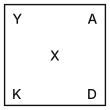
  1. A
  2. B
  3. C
  4. D
Show answer

Concept: Track one letter at a time through the five positions: four corners and the centre.

  1. X: centre (Fig 1) → top-left (Fig 2) → top-right (Fig 3) → bottom-right (Fig 4).
  2. Every letter follows the same cycle: Centre → TL → TR → BR → BL → Centre.
  3. Fig 5: A (centre) → TL, D (TL) → TR, K (TR) → BR, X (BR) → BL, Y (BL) → centre.
  4. Result: A, D on top; Y in the centre; X, K at the bottom — option (C).

Trick: Follow just one letter to find the rule, then fill the other positions in seconds.

Answer: (C)

अवधारणा: पाँच स्थानों (चार कोने और केंद्र) में एक-एक अक्षर की चाल देखें।

  1. X: केंद्र (Fig 1) → ऊपर-बाएँ (Fig 2) → ऊपर-दाएँ (Fig 3) → नीचे-दाएँ (Fig 4)।
  2. हर अक्षर का चक्र: केंद्र → TL → TR → BR → BL → केंद्र।
  3. Fig 5: A (केंद्र) → TL, D (TL) → TR, K (TR) → BR, X (BR) → BL, Y (BL) → केंद्र।
  4. परिणाम: ऊपर A, D; केंद्र में Y; नीचे X, K — विकल्प (C)।

ट्रिक: पहले एक अक्षर का नियम निकालें, बाकी स्थान तुरंत भर जाएँगे।

उत्तर: (C)

SSC CPO Paper IGeneral Intelligence and ReasoningFigure seriesSSC CPO Paper I 2024 · 29 Jun Shift 3 →
Q18.
Which of the following numbers will replace the question mark (?) in the given series?
167, 117, ?, 47, 27
दी गई शृंखला में प्रश्न चिह्न (?) के स्थान पर निम्नलिखित में से कौन-सी संख्या आएगी?
167, 117, ?, 47, 27
  1. A77
  2. B87
  3. C37
  4. D107
Show answer

Concept: Look at the differences between consecutive terms.

  1. 167−117=50, and from the end 47−27=20.
  2. Differences decrease by 10: 50,40,30,20.
  3. Missing term =117−40=77; check 77−30=47 ✓.

Trick: When a gap is in the middle, use both ends to fix the pattern of differences.

Answer: (A) 77

अवधारणा: लगातार पदों का अंतर देखें।

  1. 167−117=50, और अंत से 47−27=20.
  2. अंतर 10-10 घटते हैं: 50,40,30,20.
  3. लुप्त पद =117−40=77; जाँच 77−30=47 ✓.

ट्रिक: बीच में रिक्त हो तो दोनों छोरों से अंतर का पैटर्न तय करें।

उत्तर: (A) 77

SSC CPO Paper IGeneral Intelligence and ReasoningNumber seriesSSC CPO Paper I 2024 · 29 Jun Shift 3 →
Q19.
824 is related to 329 following a certain logic. Following the same logic, 271 is related to 505. Which of the following numbers is related to 408 using the same logic?
एक निश्चित तर्क का अनुसरण करते हुए 824 का संबंध 329 से है। उसी तर्क का अनुसरण करते हुए, 271 का संबंध 505 से है। उसी तर्क का उपयोग करते हुए, निम्नलिखित में से किस संख्या का संबंध 408 से है?
  1. A612
  2. B434
  3. C822
  4. D325
Show answer

Concept: Compare the digit sums of the related numbers.

  1. 824: 8+2+4=14; 329: 3+2+9=14 — equal.
  2. 271: 2+7+1=10; 505: 5+0+5=10 — equal.
  3. 408: 4+0+8=12. Options: 612→9, 434→11, 822→12, 325→10.
  4. Only 822 has digit sum 12.

Trick: When the pairs look unrelated in size, test the digit sum first — it is a common SSC logic.

Answer: (C) 822

अवधारणा: संबंधित संख्याओं के अंकों का योग (digit sum) तुलना करें।

  1. 824: 8+2+4=14; 329: 3+2+9=14 — बराबर।
  2. 271: 2+7+1=10; 505: 5+0+5=10 — बराबर।
  3. 408: 4+0+8=12. विकल्प: 612→9, 434→11, 822→12, 325→10.
  4. केवल 822 का अंक-योग 12 है।

ट्रिक: जब संख्याओं में कोई सीधा गणितीय संबंध न दिखे, पहले अंक-योग जाँचें।

उत्तर: (C) 822

SSC CPO Paper IGeneral Intelligence and ReasoningNumber analogySSC CPO Paper I 2024 · 29 Jun Shift 3 →
Q20.
In a code language, 'KIRAT' is coded as 50-40-85-0-95 and 'WASIM' is coded as 110-0- 90-40-60. How will 'MRINAL' be coded in the same language?
एक कूट भाषा में, 'KIRAT' को 50-40-85-0-95 के रूप में कूटबद्ध किया जाता है और 'WASIM' को 110-0- 90-40-60 के रूप में कूटबद्ध किया जाता है। उसी भाषा में 'MRINAL' को किस प्रकार कूटबद्ध किया जाएगा?
  1. A85-40-50-75-0-65
  2. B55-60-45-65-0-85
  3. C75-50-60-55-0-65
  4. D60-85-40-65-0-55
Show answer

Concept: Each letter is coded as (position−1)×5.

  1. K(11): (11−1)×5=50; I(9): 40; R(18): 85; A(1): 0; T(20): 95 ✓.
  2. W(23): 22×5=110; S(19): 90; M(13): 60 ✓.
  3. MRINAL: M 60, R 85, I 40, N(14) 65, A 0, L(12) 55.
  4. Code: 60-85-40-65-0-55.

Trick: A = 0 is the giveaway: the code is (position − 1) times 5.

Answer: (D) 60-85-40-65-0-55

अवधारणा: हर अक्षर का कोड (position−1)×5 है।

  1. K(11): (11−1)×5=50; I(9): 40; R(18): 85; A(1): 0; T(20): 95 ✓.
  2. W(23): 22×5=110; S(19): 90; M(13): 60 ✓.
  3. MRINAL: M 60, R 85, I 40, N(14) 65, A 0, L(12) 55.
  4. कोड: 60-85-40-65-0-55.

ट्रिक: A = 0 देखते ही समझें: कोड = (स्थान − 1) × 5.

उत्तर: (D) 60-85-40-65-0-55

SSC CPO Paper IGeneral Intelligence and ReasoningLetter–number codingSSC CPO Paper I 2024 · 29 Jun Shift 3 →