Q2641.
Two statements are given, followed by three conclusions numbered I, II and III. Assuming the statements to be true, even if they seem to be at variance with commonly known facts, decide which of the conclusions logically follow(s) from the statements.
Statements:
All plums are pomegranates.
Some plums are lemons.
Conclusions:
I. Some pomegranates are lemons.
II. No lemon is a pomegranate.
III. Some pomegranates are plums.
Statements:
All plums are pomegranates.
Some plums are lemons.
Conclusions:
I. Some pomegranates are lemons.
II. No lemon is a pomegranate.
III. Some pomegranates are plums.
दो कथन दिए गए हैं, जिनके बाद तीन निष्कर्ष I, II और III दिए गए हैं। कथनों को सत्य मानते हुए, भले ही वे सामान्यतः ज्ञात तथ्यों से भिन्न प्रतीत होते हों, निर्णय कीजिए कि कौन-सा/से निष्कर्ष कथनों का तार्किक रूप से अनुसरण करता है/करते हैं।
कथन:
सभी आलूबुखारे, अनार हैं।
कुछ आलूबुखारे, नींबू हैं।
निष्कर्ष:
I. कुछ अनार, नींबू हैं।
II. कोई नींबू, अनार नहीं है।
III. कुछ अनार, आलूबुखारे हैं।
कथन:
सभी आलूबुखारे, अनार हैं।
कुछ आलूबुखारे, नींबू हैं।
निष्कर्ष:
I. कुछ अनार, नींबू हैं।
II. कोई नींबू, अनार नहीं है।
III. कुछ अनार, आलूबुखारे हैं।
- AOnly conclusion III followsकेवल निष्कर्ष III अनुसरण करता है
- BOnly conclusion I followsकेवल निष्कर्ष I अनुसरण करता है
- COnly conclusions I and III followकेवल निष्कर्ष I और III अनुसरण करते हैं
- DOnly conclusions I and II followकेवल निष्कर्ष I और II अनुसरण करते हैं
Show answer
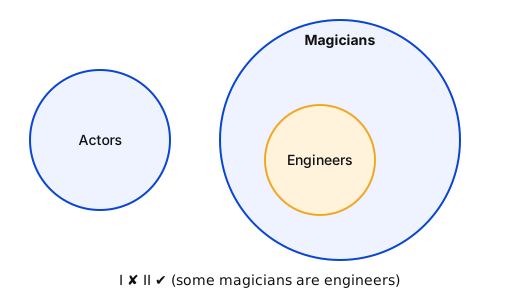
Concept: Draw the least possible Venn diagram for the statements and test each conclusion.
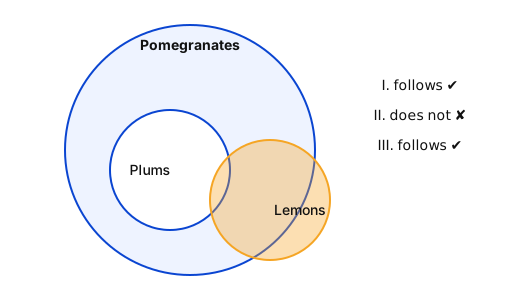
- All plums are pomegranates → Plums circle lies inside Pomegranates.
- Some plums are lemons → the lemons that are plums are also pomegranates, so ‘Some pomegranates are lemons’ (I) follows.
- II (No lemon is a pomegranate) contradicts I, so it does not follow.
- ‘All plums are pomegranates’ gives ‘Some pomegranates are plums’ (III) follows.
Trick: ‘All A are B’ always gives ‘Some B are A’.
Answer: (C) Only conclusions I and III follow
अवधारणा: कथनों का न्यूनतम वेन आरेख बनाकर हर निष्कर्ष जाँचें।
- All plums are pomegranates → Plums वृत्त Pomegranates के अंदर।
- Some plums are lemons → ये lemons pomegranates भी हैं, अतः I (Some pomegranates are lemons) सही।
- II (No lemon is a pomegranate) I के विपरीत है, अनुसरण नहीं करता।
- ‘All plums are pomegranates’ से III (Some pomegranates are plums) सही।
ट्रिक: ‘All A are B’ से हमेशा ‘Some B are A’ निकलता है।
उत्तर: (C) Only conclusions I and III follow