Question bank

Q&A: practice questions with answers

Search questions on any topic. Filter by exam category, exam, subject and topic, try the question, then open the answer and explanation.

Courses – airGurukul

6,600 questions found.

Q5101.
Study the following pie chart and answer the below question:
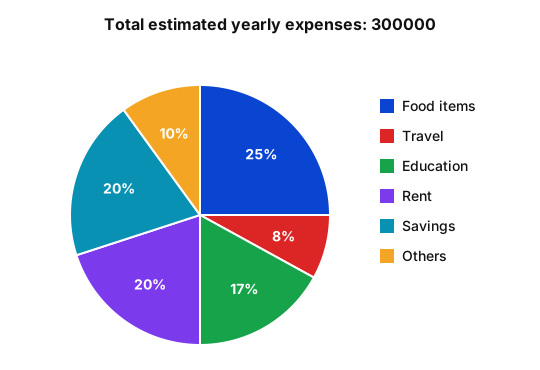
How much per cent is more expense on rent than the expense on others?
निम्नलिखित पाई चार्ट का अध्ययन कीजिए और नीचे दिए गए प्रश्न का उत्तर दीजिए:

किराए पर व्यय, अन्य पर व्यय से कितने प्रतिशत अधिक है?
  1. A10%
  2. B150%
  3. C50%
  4. D100%
Show answer

Concept: When two sectors of the same pie are compared, compare their percentages directly – the total cancels out.

  1. Rent =20%, Others =10% of the total.
  2. Rent is more by 20−10=10 percentage points.
  3. Required%=20−1010×100=100%

Trick: Rent is exactly double Others, and "double" always means 100% more.

Answer: (D) 100%

अवधारणा: एक ही पाई चार्ट के दो भागों की तुलना में सीधे प्रतिशत की तुलना करें – कुल राशि कट जाती है।

  1. Rent (किराया) =20%, Others (अन्य) =10%।
  2. अंतर =20−10=10 प्रतिशत अंक।
  3. अभीष्ट%=20−1010×100=100%

ट्रिक: किराया, अन्य का ठीक दोगुना है – और दोगुना मतलब हमेशा 100% अधिक।

उत्तर: (D) 100%
SSC CPO Paper IQuantitative AptitudePie Chart (DI)SSC CPO Paper I 2023 · 5 Oct Shift 2 →
Q5102.
A person sold two cars for ₹60,000 each. On one, he gained 20% while on the other he lost 20%. Find the percentage of his gain or loss.
एक व्यक्ति ने दो कारें ₹60,000 प्रत्येक में बेचीं। एक पर उसे 20% का लाभ हुआ, जबकि दूसरी पर उसे 20% की हानि हुई। उसके लाभ या हानि का प्रतिशत ज्ञात कीजिए।
  1. AGain 4%4% लाभ
  2. BLoss 4%4% हानि
  3. CLoss 2%2% हानि
  4. DNo profit and no lossन लाभ न हानि
Show answer

Concept: If two articles are sold at the same selling price, one at x% gain and the other at x% loss, there is always a loss of x2100%.

  1. Here x=20.
  2. Loss%=202100=4%
  3. Check: CPs are ₹50,000 and ₹75,000 (total ₹1,25,000); SP ₹1,20,000; loss ₹5,000 =4%.

Trick: Same SP, same ±x% ⇒ always a LOSS of x2100% – never "no profit no loss".

Answer: (B) Loss 4%

अवधारणा: जब दो वस्तुएँ समान विक्रय मूल्य पर बिकें, एक पर x% लाभ और दूसरी पर x% हानि, तो कुल मिलाकर हमेशा x2100% हानि होती है।

  1. यहाँ x=20।
  2. हानि%=202100=4%
  3. जाँच: क्रय मूल्य ₹50,000 और ₹75,000 (कुल ₹1,25,000); विक्रय ₹1,20,000; हानि ₹5,000 =4%।

ट्रिक: समान SP और ±x% ⇒ हमेशा x2100% की हानि।

उत्तर: (B) 4% हानि

SSC CPO Paper IQuantitative AptitudeProfit and LossSSC CPO Paper I 2023 · 5 Oct Shift 2 →
Q5103.
The LCM of 96, 132 and 438 is:
96, 132 और 438 का लघुत्तम समापवर्त्य (LCM) है:
  1. A86084
  2. B67055
  3. C85046
  4. D77088
Show answer

Concept: LCM = product of the highest powers of all prime factors.

  1. 96=25×3
  2. 132=22×3×11
  3. 438=2×3×73
  4. LCM=25×3×11×73=96×803=77088

Trick: The LCM must be divisible by 96, so it must be even and divisible by 3 – 67055 and 85046 fail at once (odd / digit sum not a multiple of 3).

Answer: (D) 77088

अवधारणा: LCM = सभी अभाज्य गुणनखंडों की सबसे बड़ी घातों का गुणनफल।

  1. 96=25×3
  2. 132=22×3×11
  3. 438=2×3×73
  4. LCM=25×3×11×73=96×803=77088

ट्रिक: LCM, 96 से विभाज्य होना चाहिए, यानी सम और 3 से विभाज्य – 67055 (विषम) और 85046 (अंकों का योग 3 का गुणज नहीं) तुरंत बाहर।

उत्तर: (D) 77088

SSC CPO Paper IQuantitative AptitudeLCMSSC CPO Paper I 2023 · 5 Oct Shift 2 →
Q5104.
Three candidates contested an election and won 1136, 7636 and 11628 votes,
respectively. What percentage of the total votes did the winning candidate get?
तीन उम्मीदवारों ने एक चुनाव लड़ा और उन्हें क्रमशः 1136, 7636 और 11628 मत
प्राप्त हुए। विजेता उम्मीदवार को कुल मतों का कितना प्रतिशत प्राप्त हुआ?
  1. A45
  2. B49
  3. C33
  4. D57
Show answer

Concept: Winner's share =winner's votestotal valid votes×100.

  1. Total =1136+7636+11628=20400
  2. Winner got 11628 votes.
  3. 1162820400×100=57%

Trick: 57% of 20400 =204×57=11628 – verify the option directly instead of dividing.

Answer: (D) 57

अवधारणा: विजेता का प्रतिशत =विजेता के मतकुल मत×100।

  1. कुल मत =1136+7636+11628=20400
  2. विजेता को 11628 मत मिले।
  3. 1162820400×100=57%

ट्रिक: 20400 का 57% =204×57=11628 – भाग करने की बजाय विकल्प से सीधे जाँचें।

उत्तर: (D) 57

SSC CPO Paper IQuantitative AptitudePercentage (Election)SSC CPO Paper I 2023 · 5 Oct Shift 2 →
Q5105.
Ram has 12 hens and 5 cows, Shyam has 18 hens and 9 cows, Preetham has 4 hens and 8 cows, and Vinay has 10 hens and 7 cows. Who has a greater ratio of hens to
cows?
Ram के पास 12 मुर्गियाँ और 5 गायें हैं, Shyam के पास 18 मुर्गियाँ और 9 गायें हैं, Preetham के पास 4 मुर्गियाँ और 8 गायें हैं, और Vinay के पास 10 मुर्गियाँ और 7 गायें हैं। किसके पास मुर्गियों और
गायों का अनुपात अधिक है?
  1. APreetham
  2. BShyam
  3. CRam
  4. DVinay
Show answer

Concept: Convert each ratio hens : cows to a decimal (hens ÷ cows) and compare.

  1. Ram =125=2.4
  2. Shyam =189=2
  3. Preetham =48=0.5; Vinay =107≈1.43
  4. Greatest is 2.4 ⇒ Ram.

Trick: Shyam has the most hens, but the ratio depends on hens per cow – Ram has the most hens per cow.

Answer: (C) Ram

अवधारणा: हर अनुपात मुर्गी : गाय को दशमलव (मुर्गी ÷ गाय) में बदलकर तुलना करें।

  1. राम =125=2.4
  2. श्याम =189=2
  3. प्रीतम =48=0.5; विनय =107≈1.43
  4. सबसे बड़ा 2.4 ⇒ राम।

ट्रिक: श्याम के पास मुर्गियाँ सबसे अधिक हैं, पर अनुपात "प्रति गाय मुर्गी" पर निर्भर है – वह राम का सबसे अधिक है।

उत्तर: (C) राम

SSC CPO Paper IQuantitative AptitudeRatio ComparisonSSC CPO Paper I 2023 · 5 Oct Shift 2 →
Q5106.
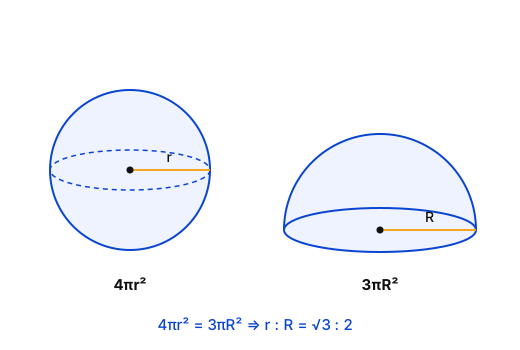
A sphere and another solid hemisphere have the same surface area. The ratio of their volumes is:
एक गोले और एक अन्य ठोस अर्धगोले का पृष्ठीय क्षेत्रफल समान है। उनके आयतनों का अनुपात है:
  1. A23:8
  2. B33:8
  3. C33:4
  4. D3:4
Show answer

Concept: Sphere: TSA=4πr2, V=43πr3. Solid hemisphere: TSA=3πR2, V=23πR3.

  1. 4πr2=3πR2⇒rR=32
  2. V1V2=43πr323πR3=2(rR)3
  3. =2×338=334

Trick: A solid hemisphere includes its flat circular base, so its surface is 3πR2, not 2πR2.

Answer: (C) 33:4

अवधारणा: गोला: TSA=4πr2, V=43πr3। ठोस अर्धगोला: TSA=3πR2, V=23πR3।

  1. 4πr2=3πR2⇒rR=32
  2. V1V2=43πr323πR3=2(rR)3
  3. =2×338=334

याद रखें: ठोस अर्धगोले में समतल वृत्ताकार आधार भी शामिल है, इसलिए पृष्ठ 3πR2 है, 2πR2 नहीं।

उत्तर: (C) 33:4

SSC CPO Paper IQuantitative AptitudeMensuration – Sphere and HemisphereSSC CPO Paper I 2023 · 5 Oct Shift 2 →
Q5107.
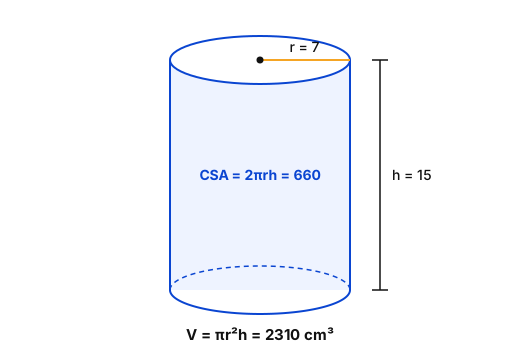
The curved surface area of a solid cylinder of height 15 cm is 660 cm2. What is the volume (in cm3) of the cylinder? (Take π=227)
15 cm ऊँचाई वाले एक ठोस बेलन का वक्र पृष्ठीय क्षेत्रफल 660 cm2 है। बेलन का आयतन (cm3 में) कितना है? (π=227 लीजिए)
  1. A2060
  2. B2540
  3. C2310
  4. D3210
Show answer

Concept: Curved surface area =2πrh; volume =πr2h.

  1. 2×227×r×15=660
  2. r=660×72×22×15=7cm
  3. V=227×72×15=22×7×15=2310cm3

Trick: V=CSA×r2=660×72=2310 – one step once r is known.

Answer: (C) 2310

अवधारणा: वक्र पृष्ठीय क्षेत्रफल (CSA) =2πrh; आयतन =πr2h।

  1. 2×227×r×15=660
  2. r=660×72×22×15=7cm
  3. V=227×72×15=2310cm3

ट्रिक: V=CSA×r2=660×72=2310।

उत्तर: (C) 2310

SSC CPO Paper IQuantitative AptitudeMensuration – CylinderSSC CPO Paper I 2023 · 5 Oct Shift 2 →
Q5108.
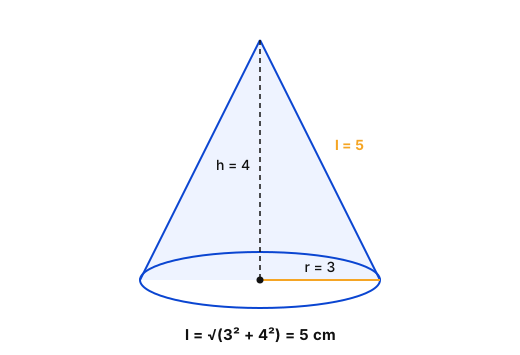
The total surface area of a cone whose radius is 3 cm and height is 4 cm is:
एक शंकु, जिसकी त्रिज्या 3 cm और ऊँचाई 4 cm है, का संपूर्ण पृष्ठीय क्षेत्रफल है:
  1. A4257cm2
  2. B5019cm2
  3. C4758cm2
  4. D5287cm2
Show answer

Concept: Slant height l=r2+h2; total surface area =πr(l+r).

  1. l=32+42=5cm
  2. TSA=π×3×(5+3)=24π
  3. =24×227=5287cm2

Trick: 3-4-5 is a Pythagorean triplet – the slant height is 5 at sight.

Answer: (D) 5287cm2

अवधारणा: तिर्यक ऊँचाई l=r2+h2; सम्पूर्ण पृष्ठीय क्षेत्रफल =πr(l+r)।

  1. l=32+42=5cm
  2. TSA=π×3×(5+3)=24π
  3. =24×227=5287cm2

ट्रिक: 3-4-5 पाइथागोरस त्रिक है – तिर्यक ऊँचाई तुरंत 5।

उत्तर: (D) 5287cm2

SSC CPO Paper IQuantitative AptitudeMensuration – ConeSSC CPO Paper I 2023 · 5 Oct Shift 2 →
Q5109.
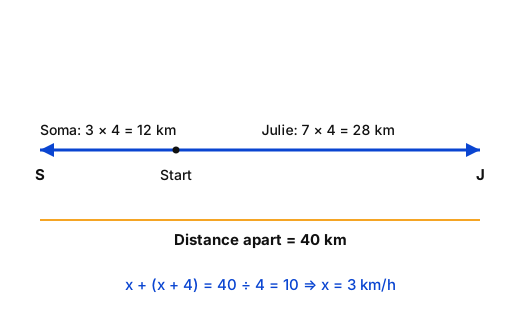
Julie and Soma start from the same point and walk in opposite directions. Julie walks 4 km/h faster than Soma. After 4 hours they are 40 km apart. How fast did each walk?
Julie और Soma एक ही बिंदु से चलना आरंभ करती हैं और विपरीत दिशाओं में चलती हैं। Julie, Soma से 4 km/h अधिक तेज़ चलती है। 4 घंटे के बाद वे एक-दूसरे से 40 km दूर हैं। प्रत्येक की चाल कितनी थी?
  1. AJulie – 8 km/h; Soma – 4 km/h
  2. BJulie – 7 km/h; Soma – 3 km/h
  3. CJulie – 9 km/h; Soma – 5 km/h
  4. DJulie – 10 km/h; Soma – 6 km/h
Show answer

Concept: Moving in opposite directions, the gap grows at the sum of the speeds.

  1. Let Soma =xkm/h, Julie =x+4.
  2. (x+x+4)×4=40⇒2x+4=10
  3. x=3 ⇒ Soma 3 km/h, Julie 7 km/h.

Trick: Sum of speeds =404=10; only option B has speeds adding to 10 with a difference of 4.

Answer: (B) Julie – 7 km/h; Soma – 3 km/h

अवधारणा: विपरीत दिशाओं में चलने पर दूरी, दोनों चालों के योग से बढ़ती है।

  1. माना सोमा =xkm/h, जूली =x+4।
  2. (x+x+4)×4=40⇒2x+4=10
  3. x=3 ⇒ सोमा 3 km/h, जूली 7 km/h।

ट्रिक: चालों का योग =404=10; केवल विकल्प B में योग 10 और अंतर 4 है।

उत्तर: (B) जूली – 7 km/h; सोमा – 3 km/h

SSC CPO Paper IQuantitative AptitudeSpeed – Opposite DirectionsSSC CPO Paper I 2023 · 5 Oct Shift 2 →
Q5110.
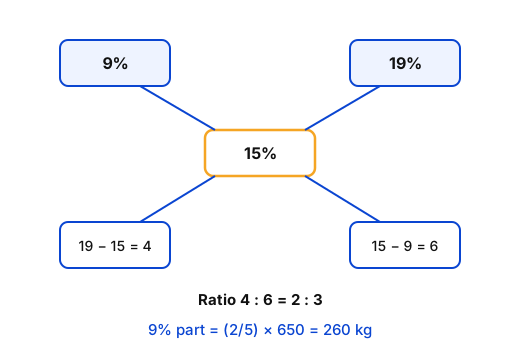
Arbind has 650 kg of wheat. A part of which he sells at 9% profit and the rest at 19% profit to get 15% profit on the whole. What is the quantity (in kg) of wheat sold by
Arbind at 9% profit?
Arbind के पास 650 kg गेहूँ है। वह उसका एक भाग 9% लाभ पर और शेष 19% लाभ पर बेचता है, जिससे उसे पूरे पर 15% लाभ प्राप्त होता है। Arbind द्वारा 9% लाभ पर बेचे गए
गेहूँ की मात्रा (kg में) कितनी है?
  1. A260
  2. B195
  3. C455
  4. D390
Show answer

Concept: Alligation: quantities are in the ratio (higher − mean) : (mean − lower).

  1. 9% part : 19% part =(19−15):(15−9)=4:6=2:3
  2. 9% part =25×650=260kg

Trick: The mean 15% is closer to 19%, so the 19% part is larger – the 9% part must be less than half of 650 (rules out 455, 390).

Answer: (A) 260

अवधारणा: एलीगेशन नियम: मात्राएँ (बड़ा − औसत) : (औसत − छोटा) के अनुपात में होती हैं।

  1. 9% भाग : 19% भाग =(19−15):(15−9)=4:6=2:3
  2. 9% भाग =25×650=260kg

ट्रिक: औसत 15%, 19% के अधिक निकट है, इसलिए 9% वाला भाग 650 के आधे से कम होगा (455, 390 बाहर)।

उत्तर: (A) 260

SSC CPO Paper IQuantitative AptitudeAlligation – ProfitSSC CPO Paper I 2023 · 5 Oct Shift 2 →
Q5111.
What is the LCM of 0.15, 0.18 and 0.45?
0.15, 0.18 और 0.45 का लघुत्तम समापवर्त्य (LCM) क्या है?
  1. A0.9
  2. B0.09
  3. C0.81
  4. D0.6
Show answer

Concept: Make the decimal places equal, find the LCM of the whole numbers and put back the same number of decimal places.

  1. 0.15, 0.18, 0.45 → 15, 18, 45 (2 decimal places).
  2. 15=3×5, 18=2×32, 45=32×5
  3. LCM=2×32×5=90 ⇒ 0.90

Trick: The LCM can never be smaller than the largest number 0.45, so 0.09 is out at once.

Answer: (A) 0.9

अवधारणा: दशमलव स्थान बराबर करें, पूर्ण संख्याओं का LCM निकालें और उतने ही दशमलव स्थान वापस लगाएँ।

  1. 0.15, 0.18, 0.45 → 15, 18, 45 (2 दशमलव स्थान)।
  2. 15=3×5, 18=2×32, 45=32×5
  3. LCM=2×32×5=90 ⇒ 0.90

ट्रिक: LCM सबसे बड़ी संख्या 0.45 से छोटा नहीं हो सकता – 0.09 तुरंत बाहर।

उत्तर: (A) 0.9

SSC CPO Paper IQuantitative AptitudeLCM of DecimalsSSC CPO Paper I 2023 · 5 Oct Shift 2 →
Q5112.
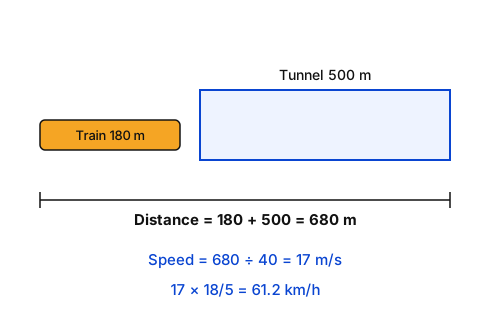
A train of length 180 m takes 40 seconds to cross a tunnel of length 500 m. What is the speed of the train, in km/h?
180 m लंबी एक रेलगाड़ी 500 m लंबी एक सुरंग को पार करने में 40 सेकंड लेती है। रेलगाड़ी की चाल km/h में कितनी है?
  1. A71.2
  2. B61.2
  3. C80.5
  4. D52.5
Show answer

Concept: To cross a tunnel a train covers (its own length + tunnel length).

  1. Distance =180+500=680m
  2. Speed =68040=17m/s
  3. 17×185=61.2km/h

Trick: m/s → km/h: multiply by 185 (i.e. 3.6).

Answer: (B) 61.2

अवधारणा: सुरंग पार करने में ट्रेन (अपनी लंबाई + सुरंग की लंबाई) की दूरी तय करती है।

  1. दूरी =180+500=680m
  2. चाल =68040=17m/s
  3. 17×185=61.2km/h

ट्रिक: m/s से km/h: 185 (यानी 3.6) से गुणा करें।

उत्तर: (B) 61.2

SSC CPO Paper IQuantitative AptitudeTrain and TunnelSSC CPO Paper I 2023 · 5 Oct Shift 2 →
Q5113.
Find the value of sin239∘+sin2(90∘−39∘)cos235∘+cos2(90∘−35∘)+3tan25∘tan75∘:
sin239∘+sin2(90∘−39∘)cos235∘+cos2(90∘−35∘)+3tan25∘tan75∘ का मान ज्ञात कीजिए:
  1. A2
  2. B4
  3. C3
  4. D1
Show answer

Concept: sin(90∘−θ)=cosθ, cos(90∘−θ)=sinθ and tanθtan(90∘−θ)=1.

  1. Numerator =sin239∘+cos239∘=1
  2. Denominator =cos235∘+sin235∘=1, so the fraction =1.
  3. The tangent pair is meant to be complementary: tan25∘tan65∘=1, giving 3×1=3.
  4. Value =1+3=4

Yaad rakhein: Two angles adding to 90∘: tanAtanB=1. (Note: tan25∘tan75∘≈1.74, which matches no option.)

Answer: (B) 4

अवधारणा: sin(90∘−θ)=cosθ, cos(90∘−θ)=sinθ तथा tanθtan(90∘−θ)=1।

  1. अंश =sin239∘+cos239∘=1
  2. हर =cos235∘+sin235∘=1, अतः भिन्न =1।
  3. tan वाला युग्म पूरक कोणों का माना गया है: tan25∘tan65∘=1, अतः 3×1=3।
  4. मान =1+3=4

याद रखें: दो कोणों का योग 90∘ हो तो tanAtanB=1। (tan25∘tan75∘≈1.74 किसी विकल्प से मेल नहीं खाता।)

उत्तर: (B) 4

SSC CPO Paper IQuantitative AptitudeTrigonometry – Complementary AnglesSSC CPO Paper I 2023 · 5 Oct Shift 2 →
Q5114.
Which of the following ratios is the greatest?
निम्नलिखित में से कौन-सा अनुपात सबसे बड़ा है?
  1. A2 : 5
  2. B7 : 10
  3. C5 : 6
  4. D1 : 3
Show answer

Concept: Write each ratio as a fraction/decimal and compare.

  1. 2:5=0.4
  2. 7:10=0.7
  3. 5:6≈0.833
  4. 1:3≈0.333 ⇒ greatest is 5:6.

Trick: Only 5:6 is within one part of being equal (56 is closest to 1), so it is the largest.

Answer: (C) 5 : 6

अवधारणा: हर अनुपात को भिन्न/दशमलव में लिखकर तुलना करें।

  1. 2:5=0.4
  2. 7:10=0.7
  3. 5:6≈0.833
  4. 1:3≈0.333 ⇒ सबसे बड़ा 5:6।

ट्रिक: 56 सबसे अधिक 1 के निकट है, इसलिए वही सबसे बड़ा।

उत्तर: (C) 5 : 6

SSC CPO Paper IQuantitative AptitudeComparison of RatiosSSC CPO Paper I 2023 · 5 Oct Shift 2 →
Q5115.
Find the LCM of 20, 30, 45 and 65.
20, 30, 45 और 65 का लघुत्तम समापवर्त्य (LCM) ज्ञात कीजिए।
  1. A2000
  2. B2340
  3. C2240
  4. D180
Show answer

Concept: LCM = product of the highest powers of the prime factors.

  1. 20=22×5, 30=2×3×5
  2. 45=32×5, 65=5×13
  3. LCM=22×32×5×13=2340

Trick: The LCM must be a multiple of 13 and of 9 – only 2340 qualifies (2340=13×180).

Answer: (B) 2340

अवधारणा: LCM = अभाज्य गुणनखंडों की सबसे बड़ी घातों का गुणनफल।

  1. 20=22×5, 30=2×3×5
  2. 45=32×5, 65=5×13
  3. LCM=22×32×5×13=2340

ट्रिक: LCM, 13 और 9 दोनों का गुणज होना चाहिए – केवल 2340 (=13×180) सही।

उत्तर: (B) 2340

SSC CPO Paper IQuantitative AptitudeLCMSSC CPO Paper I 2023 · 5 Oct Shift 2 →
Q5116.
The greatest possible length that can be used to measure exactly the lengths of 3 m 15 cm, 5 m, and 6 m 85 cm is:
वह अधिकतम संभव लंबाई, जिसका उपयोग 3 m 15 cm, 5 m और 6 m 85 cm की लंबाइयों को ठीक-ठीक मापने के लिए किया जा सकता है, है:
  1. A9 cm
  2. B11 cm
  3. C7 cm
  4. D5 cm
Show answer

Concept: The greatest length that measures all lengths exactly = HCF of the lengths (in the same unit).

  1. Lengths: 315 cm, 500 cm, 685 cm.
  2. 315=32×5×7, 500=22×53, 685=5×137
  3. Common factor only 5 ⇒ HCF =5cm.

Trick: 500 has only factors 2 and 5, and 315, 685 are odd – so the answer is 5 straight away.

Answer: (D) 5 cm

अवधारणा: सभी लंबाइयों को ठीक-ठीक मापने वाली सबसे बड़ी लंबाई = उनका HCF (एक ही इकाई में)।

  1. लंबाइयाँ: 315 cm, 500 cm, 685 cm।
  2. 315=32×5×7, 500=22×53, 685=5×137
  3. उभयनिष्ठ गुणनखंड केवल 5 ⇒ HCF =5cm।

ट्रिक: 500 के गुणनखंड केवल 2 और 5 हैं, और 315, 685 विषम हैं – उत्तर सीधे 5।

उत्तर: (D) 5 cm

SSC CPO Paper IQuantitative AptitudeHCF – Measuring LengthSSC CPO Paper I 2023 · 5 Oct Shift 2 →
Q5117.
If x4y=34, then the value of 2x+3yx−2y is:
यदि x4y=34 है, तो 2x+3yx−2y का मान है:
  1. A7
  2. B9
  3. C6
  4. D8
Show answer

Concept: Express x in terms of y and substitute.

  1. x4y=34⇒x=3y
  2. 2x+3y=6y+3y=9y
  3. x−2y=3y−2y=y
  4. Value =9yy=9

Trick: Put y=1, x=3: 6+33−2=9.

Answer: (B) 9

अवधारणा: x को y के रूप में लिखकर रखें।

  1. x4y=34⇒x=3y
  2. 2x+3y=6y+3y=9y
  3. x−2y=3y−2y=y
  4. मान =9yy=9

ट्रिक: y=1, x=3 रखें: 6+33−2=9।

उत्तर: (B) 9

SSC CPO Paper IQuantitative AptitudeAlgebra – RatioSSC CPO Paper I 2023 · 5 Oct Shift 2 →
Q5118.
The difference between a discount of 30% on ₹5,000 and two successive discounts of 15% and 25% on the same amount is:
₹5,000 पर 30% की छूट और उसी राशि पर 15% और 25% की दो क्रमिक छूटों के बीच का अंतर है:
  1. A₹315.50
  2. B₹350.50
  3. C₹312.50
  4. D₹412.50
Show answer

Concept: Two successive discounts a% and b% = single discount (a+b−ab100)%.

  1. Single 30% on ₹5,000 = ₹1,500.
  2. Successive: 15+25−15×25100=36.25% ⇒ ₹1,812.50.
  3. Difference =1812.50−1500= ₹312.50

Trick: Difference =(36.25−30)% of 5000 =6.25%×5000= ₹312.50.

Answer: (C) ₹312.50

अवधारणा: दो क्रमिक छूटें a% और b% = एकल छूट (a+b−ab100)%।

  1. ₹5,000 पर 30% = ₹1,500।
  2. क्रमिक: 15+25−15×25100=36.25% ⇒ ₹1,812.50।
  3. अंतर =1812.50−1500= ₹312.50

ट्रिक: अंतर =(36.25−30)% × 5000 =6.25%×5000= ₹312.50।

उत्तर: (C) ₹312.50

SSC CPO Paper IQuantitative AptitudeSuccessive DiscountSSC CPO Paper I 2023 · 5 Oct Shift 2 →
Q5119.
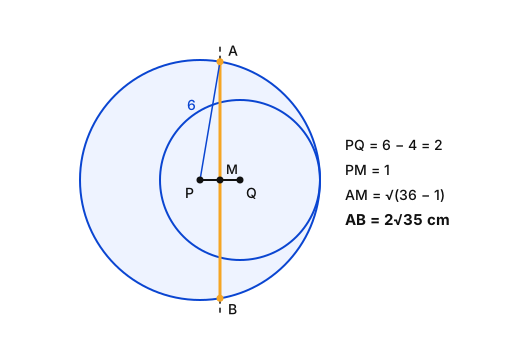
Two circles with centres P and Q of radii 6 cm and 4 cm, respectively, touch each other internally. If the perpendicular bisector of PQ meets the bigger circle in A and B, then the value of AB is:
केंद्र P और Q वाले तथा क्रमशः 6 cm और 4 cm त्रिज्या वाले दो वृत्त एक-दूसरे को अंतःस्पर्श करते हैं। यदि PQ का लंब समद्विभाजक बड़े वृत्त को A और B पर मिलता है, तो AB का मान है:
  1. A5cm
  2. B235cm
  3. C35cm
  4. D25cm
Show answer

Concept: Circles touching internally: distance between centres = difference of radii. A chord at distance d from the centre has length 2r2−d2.

  1. PQ=6−4=2cm
  2. The perpendicular bisector of PQ passes through M with PM=1cm; AB is a chord of the bigger circle at distance 1 from P.
  3. AM=62−12=35
  4. AB=235cm

Trick: Internal touch ⇒ subtract radii; external touch ⇒ add radii.

Answer: (B) 235cm

अवधारणा: आंतरिक स्पर्श में केंद्रों की दूरी = त्रिज्याओं का अंतर। केंद्र से d दूरी पर जीवा की लंबाई =2r2−d2।

  1. PQ=6−4=2cm
  2. PQ का लंब समद्विभाजक M से जाता है, PM=1cm; AB बड़े वृत्त की जीवा है जो P से 1 cm दूर है।
  3. AM=62−12=35
  4. AB=235cm

ट्रिक: आंतरिक स्पर्श ⇒ त्रिज्याएँ घटाएँ; बाह्य स्पर्श ⇒ जोड़ें।

उत्तर: (B) 235cm

SSC CPO Paper IQuantitative AptitudeCircles – Internal TouchingSSC CPO Paper I 2023 · 5 Oct Shift 2 →
Q5120.
The monthly income of an employee was ₹26,500 and his monthly expenditure was ₹22,000. Next year his income increased by 20% and his expenditure increased by
15%. Find the percentage increase in his savings.
एक कर्मचारी की मासिक आय ₹26,500 थी और उसका मासिक व्यय ₹22,000 था। अगले वर्ष उसकी आय में 20% की वृद्धि हुई और उसके व्यय में
15% की वृद्धि हुई। उसकी बचत में प्रतिशत वृद्धि ज्ञात कीजिए।
  1. A4479%
  2. B4489%
  3. C4459%
  4. D4449%
Show answer

Concept: Savings = Income − Expenditure; % increase =increaseoriginal×100.

  1. Old saving =26500−22000= ₹4,500.
  2. New income =26500×1.2=31800; new expenditure =22000×1.15=25300.
  3. New saving =31800−25300= ₹6,500; increase ₹2,000.
  4. 20004500×100=4009=4449%

Trick: Increase in saving =5300−3300=2000 (20% of income − 15% of expenditure).

Answer: (D) 4449%

अवधारणा: बचत = आय − व्यय; प्रतिशत वृद्धि =वृद्धिमूल×100।

  1. पुरानी बचत =26500−22000= ₹4,500।
  2. नई आय =26500×1.2=31800; नया व्यय =22000×1.15=25300।
  3. नई बचत =31800−25300= ₹6,500; वृद्धि ₹2,000।
  4. 20004500×100=4009=4449%

ट्रिक: बचत में वृद्धि = आय का 20% − व्यय का 15% =5300−3300=2000।

उत्तर: (D) 4449%

SSC CPO Paper IQuantitative AptitudePercentage – SavingsSSC CPO Paper I 2023 · 5 Oct Shift 2 →