Question bank

Q&A: practice questions with answers

Search questions on any topic. Filter by exam category, exam, subject and topic, try the question, then open the answer and explanation.

Courses – airGurukul

6,600 questions found.

Q5721.
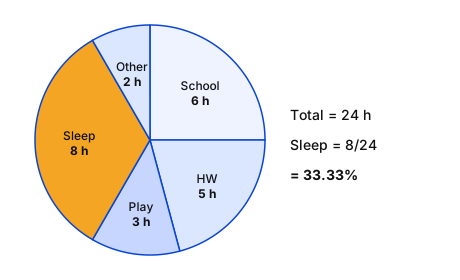
The number of hours spent by a student on different activities as shown in the following pie chart:
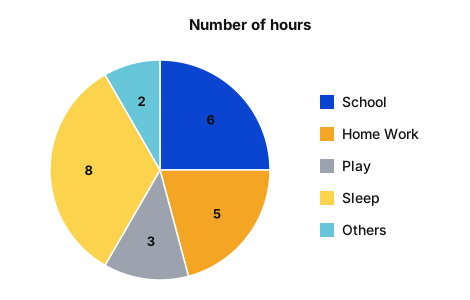
The central angle corresponding to the sleeping time is what percentage of the whole central angle?
निम्नलिखित पाई चार्ट में एक छात्र द्वारा विभिन्न गतिविधियों पर व्यतीत किए गए घंटों की संख्या दर्शाई गई है:

सोने के समय के संगत केंद्रीय कोण, संपूर्ण केंद्रीय कोण का कितना प्रतिशत है?
  1. A66.66%
  2. B33.33%
  3. C55%
  4. D50%
Show answer

Concept: A sector’s angle is the same fraction of 360∘ as its value is of the total.

  1. Total hours =6+5+3+8+2=24
  2. Sleep =8 h, so fraction =824=13
  3. Percentage =33.33% (angle =120∘)

Trick: Percentage of central angle = percentage of the data itself – no need to find degrees.

Answer: (B) 33.33%

अवधारणा: किसी भाग का कोण 360∘ का उतना ही भाग होता है जितना उसका मान कुल का।

  1. कुल घंटे =6+5+3+8+2=24
  2. नींद =8 घंटे, भिन्न =824=13
  3. प्रतिशत =33.33% (कोण =120∘)

ट्रिक: केंद्रीय कोण का प्रतिशत = आँकड़े का प्रतिशत – डिग्री निकालने की ज़रूरत नहीं।

उत्तर: (B) 33.33%
SSC CPO Paper IQuantitative AptitudeData Interpretation – Pie chartSSC CPO Paper I 2023 · 4 Oct Shift 2 →
Q5722.
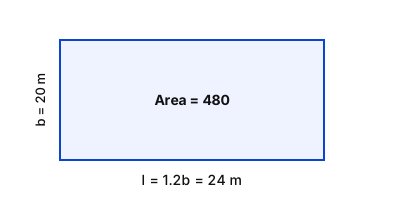
The area of a rectangular field is 480 m. If the length is 20% more than the breadth, then the length of the rectangular field is:
एक आयताकार मैदान का क्षेत्रफल 480 m है। यदि लंबाई, चौड़ाई से 20% अधिक है, तो आयताकार मैदान की लंबाई है:
  1. A30 m
  2. B20 m
  3. C24 m
  4. D27 m
Show answer

Concept: Area of rectangle =l×b (area in m2).

  1. l=1.2b=6b5
  2. 6b5×b=480⇒b2=400⇒b=20m
  3. l=1.2×20=24m

Trick: Ratio l:b=6:5; 6k×5k=30k2=480⇒k=4, l=24.

Answer: (C) 24 m

अवधारणा: आयत का क्षेत्रफल =l×b (क्षेत्रफल m2 में)।

  1. l=1.2b=6b5
  2. 6b5×b=480⇒b2=400⇒b=20m
  3. l=1.2×20=24m

ट्रिक: अनुपात l:b=6:5; 30k2=480⇒k=4, l=24।

उत्तर: (C) 24 m

SSC CPO Paper IQuantitative AptitudeMensuration – RectangleSSC CPO Paper I 2023 · 4 Oct Shift 2 →
Q5723.
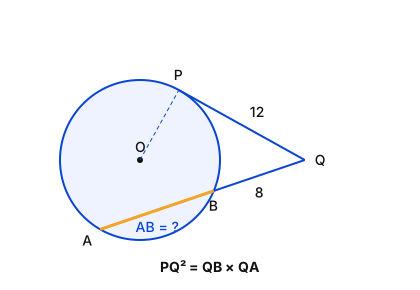
In a circle centred at O, PQ is a tangent at P. Furthermore, AB is the chord of the circle and is extended to Q. If PQ = 12 cm and QB = 8 cm, then the length of AB is equal to:
O केंद्र वाले एक वृत्त में, PQ, P पर एक स्पर्श रेखा है। इसके अतिरिक्त, AB वृत्त की जीवा है और इसे Q तक बढ़ाया गया है। यदि PQ = 12 cm और QB = 8 cm है, तो AB की लंबाई किसके बराबर है?
  1. A20 cm
  2. B4 cm
  3. C10 cm
  4. D8 cm
Show answer

Concept: If a tangent from Q touches at P and a secant from Q cuts the circle at B and A, then QP2=QB×QA.

  1. 122=8×QA⇒QA=18cm
  2. AB=QA−QB=18−8=10cm

Trick: Don’t stop at QA = 18 – the question asks for the chord AB.

Answer: (C) 10 cm

अवधारणा: बिंदु Q से स्पर्शरेखा P पर स्पर्श करे और छेदक B, A पर काटे, तो QP2=QB×QA।

  1. 122=8×QA⇒QA=18cm
  2. AB=QA−QB=18−8=10cm

ट्रिक: QA = 18 पर न रुकें – जीवा AB पूछी गई है।

उत्तर: (C) 10 cm

SSC CPO Paper IQuantitative AptitudeCircles – Tangent-secant theoremSSC CPO Paper I 2023 · 4 Oct Shift 2 →
Q5724.
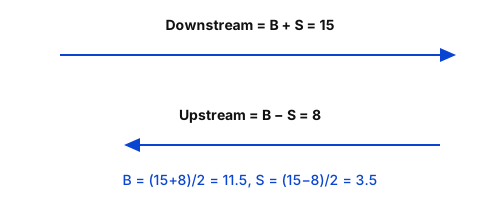
The upstream speed of a boat is 8 km/h and the downstream is 15 km/h. What is the speed of the boat in still water and the speed of the stream (in km/h), respectively?
एक नाव की धारा के प्रतिकूल चाल 8 km/h और धारा के अनुकूल चाल 15 km/h है। स्थिर जल में नाव की चाल और धारा की चाल (km/h में) क्रमशः क्या है?
  1. A11 and 311 और 3
  2. B3 and 113 और 11
  3. C11.5 and 3.511.5 और 3.5
  4. D3.5 and 11.53.5 और 11.5
Show answer

Concept: Downstream =B+S, upstream =B−S.

  1. B=15+82=11.5km/h
  2. S=15−82=3.5km/h

Trick: Boat = half the sum, stream = half the difference; boat speed is always the larger one.

Answer: (C) 11.5 and 3.5

अवधारणा: धारा के साथ =B+S, धारा के विरुद्ध =B−S।

  1. B=15+82=11.5km/h
  2. S=15−82=3.5km/h

ट्रिक: नाव = योग का आधा, धारा = अंतर का आधा; नाव की चाल हमेशा बड़ी।

उत्तर: (C) 11.5 and 3.5

SSC CPO Paper IQuantitative AptitudeBoats and StreamsSSC CPO Paper I 2023 · 4 Oct Shift 2 →
Q5725.
A number is first decreased by 28% and then increased by 28%. The number so
obtained is 784 less than the original number. Find the value of the original number.
एक संख्या में पहले 28% की कमी की जाती है और फिर 28% की वृद्धि की जाती है। इस प्रकार
प्राप्त संख्या, मूल संख्या से 784 कम है। मूल संख्या का मान ज्ञात कीजिए।
  1. A1000
  2. B15000
  3. C10000
  4. D1500
Show answer

Concept: Decrease x% then increase x% gives a net loss of x2100%.

  1. Net loss =282100=7.84%
  2. 7.84% of N=784⇒N=10000

Trick: 0.72×1.28=0.9216, so loss =0.0784N=784.

Answer: (C) 10000

अवधारणा: पहले x% घटाकर फिर x% बढ़ाने पर शुद्ध कमी x2100%।

  1. शुद्ध कमी =282100=7.84%
  2. N का 7.84%=784⇒N=10000

ट्रिक: 0.72×1.28=0.9216, अतः कमी =0.0784N=784।

उत्तर: (C) 10000

SSC CPO Paper IQuantitative AptitudePercentage – Successive changeSSC CPO Paper I 2023 · 4 Oct Shift 2 →
Q5726.
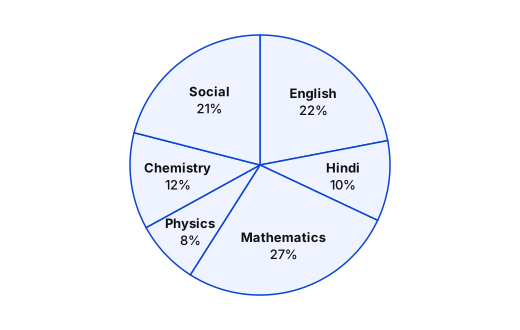
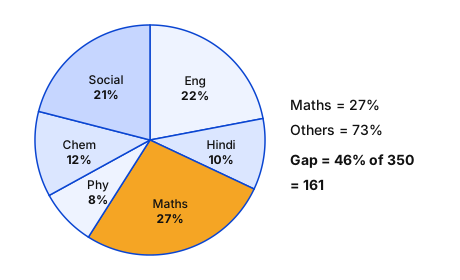
The following pie chart shows the number of students who failed in different subjects in an examination. Examine the chart and answer the following question. The total
number of students who have failed is 350.

The number of students failed in mathematics is less than the number of students
failed in all other subjects by:
निम्नलिखित पाई चार्ट एक परीक्षा में विभिन्न विषयों में अनुत्तीर्ण होने वाले विद्यार्थियों की संख्या दर्शाता है। चार्ट का अध्ययन कीजिए और निम्नलिखित प्रश्न का उत्तर दीजिए। अनुत्तीर्ण होने वाले
विद्यार्थियों की कुल संख्या 350 है।

गणित में अनुत्तीर्ण होने वाले विद्यार्थियों की संख्या, अन्य सभी विषयों में अनुत्तीर्ण होने वाले
विद्यार्थियों की संख्या से कितनी कम है?
  1. A190
  2. B256
  3. C95
  4. D161
Show answer

Concept: Work with percentages first, convert to numbers at the end.

  1. Mathematics =27%; all other subjects =100−27=73%
  2. Difference =73−27=46%
  3. 46% of 350=161

Trick: Never compute 27% and 73% separately – take the gap of percentages directly.

Answer: (D) 161

अवधारणा: पहले प्रतिशत में काम करें, अंत में संख्या में बदलें।

  1. गणित =27%; बाकी सभी विषय =73%
  2. अंतर =73−27=46%
  3. 350 का 46%=161

ट्रिक: 27% और 73% अलग-अलग न निकालें – सीधे प्रतिशत का अंतर लें।

उत्तर: (D) 161

SSC CPO Paper IQuantitative AptitudeData Interpretation – Pie chartSSC CPO Paper I 2023 · 4 Oct Shift 2 →
Q5727.
Simplify the following.
19÷5 of (27−15−21―)+37
निम्नलिखित को सरल कीजिए।
19÷5 of (27−15−21―)+37
  1. A6124165
  2. B19165
  3. C6142165
  4. D37165
Show answer

Concept: Order: Vinculum (bar) → Brackets → "of" → Division → Multiplication → Addition → Subtraction.

  1. Bar: 15−21=−6
  2. Bracket: 27−(−6)=33
  3. "of": 5×33=165, so 19÷165=19165
  4. 19165+37=19+6105165=6124165

Trick: "of" is done before ÷: 19÷5 of 33=19165, not 195×33.

Answer: (A) 6124165

अवधारणा: क्रम: रेखा कोष्ठक (vinculum) → कोष्ठक → "of" → भाग → गुणा → जोड़ → घटाव।

  1. रेखा: 15−21=−6
  2. कोष्ठक: 27−(−6)=33
  3. "of": 5×33=165, अतः 19÷165=19165
  4. 19165+37=6124165

ट्रिक: "of" भाग से पहले: 19÷5 of 33=19165।

उत्तर: (A) 6124165

SSC CPO Paper IQuantitative AptitudeSimplification – VBODMASSSC CPO Paper I 2023 · 4 Oct Shift 2 →
Q5728.
The price of a stock increased by 30% in the first year and decreased by 20% in the second year. If an investor bought 100 shares of the stock for ₹1,000, then what is the final value of the investment after 2 years?
एक स्टॉक के मूल्य में पहले वर्ष में 30% की वृद्धि हुई और दूसरे वर्ष में 20% की कमी हुई। यदि किसी निवेशक ने स्टॉक के 100 शेयर ₹1,000 में खरीदे, तो 2 वर्ष बाद निवेश का अंतिम मूल्य क्या है?
  1. A₹960
  2. B₹1,040
  3. C₹1,400
  4. D₹1,020
Show answer

Concept: Final value =Initial×(1+r1)(1−r2).

  1. 1000×1.3=1300 after year 1
  2. 1300×0.8=1040 after year 2

Trick: Net change =30−20−30×20100=+4% → ₹1,040.

Answer: (B) ₹1,040

अवधारणा: अंतिम मान =प्रारंभिक×(1+r1)(1−r2)।

  1. पहले वर्ष बाद 1000×1.3=1300
  2. दूसरे वर्ष बाद 1300×0.8=1040

ट्रिक: शुद्ध परिवर्तन =30−20−30×20100=+4% → ₹1,040।

उत्तर: (B) ₹1,040

SSC CPO Paper IQuantitative AptitudePercentage – Successive changeSSC CPO Paper I 2023 · 4 Oct Shift 2 →
Q5729.
The LCM of two numbers is 660 and their HCF is 5. If one of the numbers is 55, find the other.
दो संख्याओं का LCM 660 है और उनका HCF 5 है। यदि उनमें से एक संख्या 55 है, तो दूसरी संख्या ज्ञात कीजिए।
  1. A275
  2. B12
  3. C110
  4. D60
Show answer

Concept: Product of two numbers = HCF × LCM.

  1. Other =660×555=330055=60
  2. Check: HCF(55, 60) = 5, LCM = 660 ✓

Trick: Both numbers must be multiples of the HCF 5 – 12 is ruled out at once.

Answer: (D) 60

अवधारणा: दो संख्याओं का गुणनफल = HCF × LCM।

  1. दूसरी संख्या =660×555=60
  2. जाँच: HCF(55, 60) = 5, LCM = 660 ✓

ट्रिक: दोनों संख्याएँ HCF 5 की गुणज होंगी – 12 तुरंत बाहर।

उत्तर: (D) 60

SSC CPO Paper IQuantitative AptitudeHCF and LCMSSC CPO Paper I 2023 · 4 Oct Shift 2 →
Q5730.
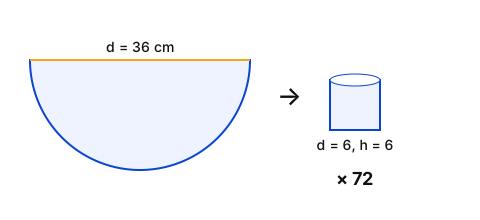
Some medicine in liquid form is prepared in a hemispherical container of diameter 36 cm. When the container is full of medicine, the medicine is transferred to small
cylindrical bottles of diameter 6 cm and height 6 cm. How many bottles are required to empty the container?
तरल रूप में कुछ दवा 36 cm व्यास वाले एक अर्धगोलाकार पात्र में तैयार की जाती है। जब पात्र दवा से पूरा भर जाता है, तो दवा को 6 cm व्यास और 6 cm ऊँचाई वाली छोटी
बेलनाकार बोतलों में स्थानांतरित किया जाता है। पात्र को खाली करने के लिए कितनी बोतलों की आवश्यकता होगी?
  1. A76
  2. B72
  3. C70
  4. D75
Show answer

Concept: Number of bottles =Volume of hemisphereVolume of one cylinder.

  1. Hemisphere: r=18, V=23π(18)3=3888π
  2. Bottle: r=3, h=6, V=π(3)2(6)=54π
  3. Bottles =3888π54π=72

Trick: π cancels – never substitute 227 in a ratio of volumes.

Answer: (B) 72

अवधारणा: बोतलों की संख्या =अर्धगोले का आयतनएक बेलन का आयतन।

  1. अर्धगोला: r=18, V=23π(18)3=3888π
  2. बोतल: r=3, h=6, V=54π
  3. बोतलें =3888π54π=72

ट्रिक: π कट जाता है – आयतन के अनुपात में 227 न रखें।

उत्तर: (B) 72

SSC CPO Paper IQuantitative AptitudeMensuration – Hemisphere and cylinderSSC CPO Paper I 2023 · 4 Oct Shift 2 →
Q5731.
Tom can do a piece of work in 7 days, whereas Jay can do the same work in 14 days. How long will they take to finish the work if both work together?
टॉम किसी कार्य को 7 दिनों में पूरा कर सकता है, जबकि जय उसी कार्य को 14 दिनों में पूरा कर सकता है। यदि दोनों एक साथ मिलकर कार्य करें, तो उन्हें कार्य पूरा करने में कितना समय लगेगा?
  1. A523 days523 दिन
  2. B423 days423 दिन
  3. C723 days723 दिन
  4. D223 days223 दिन
Show answer

Concept: Together time =aba+b.

  1. 7×147+14=9821=143 days
  2. 143=423 days

Trick: Total work = 14 units: Tom 2/day, Jay 1/day → 143 days.

Answer: (B) 423 days

अवधारणा: साथ में समय =aba+b।

  1. 7×147+14=9821=143 दिन
  2. 143=423 दिन

ट्रिक: कुल कार्य 14 इकाई: Tom 2/दिन, Jay 1/दिन → 143 दिन।

उत्तर: (B) 423 days

SSC CPO Paper IQuantitative AptitudeTime and WorkSSC CPO Paper I 2023 · 4 Oct Shift 2 →
Q5732.
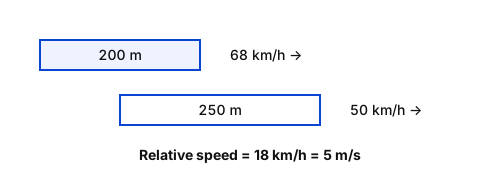
Two trains of lengths 200 m and 250 m are running on parallel rail tracks at speeds of 68 km/h and 50 km/h, respectively. In how much time (in seconds) will they cross each other if they are running in the same direction?
200 m और 250 m लंबाई वाली दो रेलगाड़ियाँ समानांतर रेल पटरियों पर क्रमशः 68 km/h और 50 km/h की चाल से चल रही हैं। यदि वे समान दिशा में चल रही हैं, तो वे कितने समय (सेकंड में) में एक-दूसरे को पार करेंगी?
  1. A90
  2. B85
  3. C80
  4. D75
Show answer

Concept: Same direction: relative speed = difference; distance = sum of lengths.

  1. Relative speed =68−50=18km/h=18×518=5m/s
  2. Distance =200+250=450m
  3. Time =4505=90s

Trick: 18km/h=5m/s – a pair worth remembering.

Answer: (A) 90

अवधारणा: एक ही दिशा: सापेक्ष चाल = अंतर; दूरी = लंबाइयों का योग।

  1. सापेक्ष चाल =68−50=18km/h=5m/s
  2. दूरी =200+250=450m
  3. समय =4505=90s

ट्रिक: 18km/h=5m/s याद रखें।

उत्तर: (A) 90

SSC CPO Paper IQuantitative AptitudeTrains – Relative speedSSC CPO Paper I 2023 · 4 Oct Shift 2 →
Q5733.
Travelling a distance of 1000 km, a train slowed down due to repairs of the tracks. Its average speed for the trip reduced by 75 km/h and the time of travel increased by 3 hours. The original duration of the travel is:
1000 km की दूरी तय करते समय, एक रेलगाड़ी पटरियों की मरम्मत के कारण धीमी हो गई। यात्रा के लिए उसकी औसत चाल 75 km/h कम हो गई और यात्रा का समय 3 घंटे बढ़ गया। यात्रा की मूल अवधि है:
  1. A6 hours6 घंटे
  2. B5 hours5 घंटे
  3. C5.5 hours5.5 घंटे
  4. D6.5 hours6.5 घंटे
Show answer

Concept: Speed =DistanceTime; form an equation in original time t.

  1. 1000t−1000t+3=75
  2. 3000t(t+3)=75⇒t(t+3)=40
  3. t2+3t−40=0⇒(t+8)(t−5)=0⇒t=5

Trick: Option check: t=5 → speeds 200 and 10008=125; difference 75 ✓.

Answer: (B) 5 hours

अवधारणा: चाल =दूरीसमय; मूल समय t में समीकरण बनाएँ।

  1. 1000t−1000t+3=75
  2. 3000t(t+3)=75⇒t(t+3)=40
  3. (t+8)(t−5)=0⇒t=5

ट्रिक: विकल्प जाँच: t=5 → चाल 200 और 125; अंतर 75 ✓।

उत्तर: (B) 5 hours

SSC CPO Paper IQuantitative AptitudeSpeed, Time and DistanceSSC CPO Paper I 2023 · 4 Oct Shift 2 →
Q5734.
If 7sin2A+3cos2A=4, then find cotA:
यदि 7sin2A+3cos2A=4 है, तो cotA ज्ञात कीजिए:
  1. A3
  2. B2
  3. C12
  4. D13
Show answer

Concept: Use sin2A+cos2A=1 to reduce to one ratio.

  1. 7sin2A+3cos2A=3(sin2A+cos2A)+4sin2A=3+4sin2A
  2. 3+4sin2A=4⇒sin2A=14⇒A=30∘
  3. cot30∘=3

Trick: Split the bigger coefficient: 7=3+4, so only 4sin2A=1 remains.

Answer: (A) 3

अवधारणा: sin2A+cos2A=1 से एक ही अनुपात में बदलें।

  1. 7sin2A+3cos2A=3+4sin2A
  2. 3+4sin2A=4⇒sin2A=14⇒A=30∘
  3. cot30∘=3

ट्रिक: बड़े गुणांक को तोड़ें: 7=3+4, बचता है 4sin2A=1।

उत्तर: (A) 3

SSC CPO Paper IQuantitative AptitudeTrigonometrySSC CPO Paper I 2023 · 4 Oct Shift 2 →
Q5735.
If secA−tanA=p, then find the value of secA.
यदि secA−tanA=p है, तो secA का मान ज्ञात कीजिए।
  1. Ap2−1p2+1
  2. Bp2+1p2−1
  3. Cp2+1p
  4. Dp2+12p
Show answer

Concept: sec2A−tan2A=1⇒(secA−tanA)(secA+tanA)=1.

  1. secA−tanA=p⇒secA+tanA=1p
  2. Add: 2secA=p+1p=p2+1p
  3. secA=p2+12p

Trick: Add the two equations for sec, subtract them for tan (tanA=1−p22p).

Answer: (D) p2+12p

अवधारणा: sec2A−tan2A=1⇒(secA−tanA)(secA+tanA)=1।

  1. secA−tanA=p⇒secA+tanA=1p
  2. जोड़ें: 2secA=p2+1p
  3. secA=p2+12p

ट्रिक: sec के लिए दोनों समीकरण जोड़ें, tan के लिए घटाएँ।

उत्तर: (D) p2+12p

SSC CPO Paper IQuantitative AptitudeTrigonometric identitiesSSC CPO Paper I 2023 · 4 Oct Shift 2 →
Q5736.
2(sin 1° × sec 89° ) + 3 (cos 11° × cosec 79°) + 5 (tan 21° × tan 69°) = ?
मान ज्ञात कीजिए:
2(sin 1° × sec 89° ) + 3 (cos 11° × cosec 79°) + 5 (tan 21° × tan 69°) = ?
  1. A11
  2. B12
  3. C20
  4. D10
Show answer

Concept: sec(90∘−θ)=cscθ, csc(90∘−θ)=secθ, tan(90∘−θ)=cotθ.

  1. sin1∘sec89∘=sin1∘csc1∘=1
  2. cos11∘csc79∘=cos11∘sec11∘=1
  3. tan21∘tan69∘=tan21∘cot21∘=1
  4. Sum =2+3+5=10

Trick: Angles adding to 90∘ with "co" partners give 1 – just add the coefficients.

Answer: (D) 10

अवधारणा: sec(90∘−θ)=cscθ, csc(90∘−θ)=secθ, tan(90∘−θ)=cotθ।

  1. sin1∘sec89∘=1
  2. cos11∘csc79∘=1
  3. tan21∘tan69∘=1
  4. योग =2+3+5=10

ट्रिक: जिन कोणों का योग 90∘ हो और "co" जोड़ी बने, गुणनफल 1 – बस गुणांक जोड़ें।

उत्तर: (D) 10

SSC CPO Paper IQuantitative AptitudeTrigonometry – Complementary anglesSSC CPO Paper I 2023 · 4 Oct Shift 2 →
Q5737.
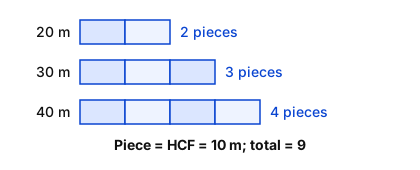
A person has three iron bars whose lengths are 20, 30 and 40 metres, respectively. He wants to cut pieces of the same length from each of the three bars. What is the least number of total pieces if he cuts without any wastage?
एक व्यक्ति के पास लोहे की तीन छड़ें हैं जिनकी लंबाई क्रमशः 20, 30 और 40 मीटर है। वह तीनों छड़ों में से प्रत्येक से समान लंबाई के टुकड़े काटना चाहता है। यदि वह बिना किसी बर्बादी के काटता है, तो टुकड़ों की कुल न्यूनतम संख्या कितनी होगी?
  1. A8
  2. B10
  3. C9
  4. D11
Show answer

Concept: Largest equal piece length = HCF of the lengths → least number of pieces.

  1. HCF(20, 30, 40) =10m
  2. Pieces =2010+3010+4010=2+3+4=9

Yaad rakhein: Least pieces ↔ longest piece ↔ HCF.

Answer: (C) 9

अवधारणा: सबसे लंबा समान टुकड़ा = लंबाइयों का HCF → न्यूनतम टुकड़े।

  1. HCF(20, 30, 40) =10m
  2. टुकड़े =2+3+4=9

याद रखें: न्यूनतम टुकड़े ↔ सबसे लंबा टुकड़ा ↔ HCF।

उत्तर: (C) 9

SSC CPO Paper IQuantitative AptitudeHCF – ApplicationSSC CPO Paper I 2023 · 4 Oct Shift 2 →
Q5738.
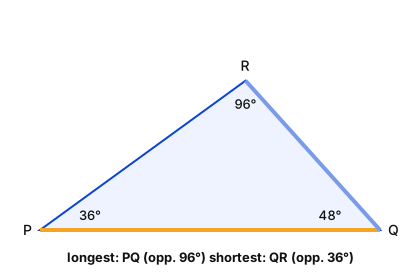
In a ΔPQR,∠P:∠Q:∠R=3∶4∶8. The shortest side and the longest side of the triangle, respectively, are:
एक ΔPQR में, ∠P:∠Q:∠R=3∶4∶8 है। त्रिभुज की सबसे छोटी भुजा और सबसे लंबी भुजा क्रमशः हैं:
  1. APQ and PRPQ और PR
  2. BQR and PRQR और PR
  3. CPQ and QRPQ और QR
  4. DQR and PQQR और PQ
Show answer

Concept: In a triangle, the side opposite the smallest angle is shortest and opposite the largest angle is longest.

  1. 15k=180∘⇒k=12: ∠P=36∘, ∠Q=48∘, ∠R=96∘
  2. Smallest angle P → opposite side QR (shortest)
  3. Largest angle R → opposite side PQ (longest)

Trick: Side opposite a vertex = the two other letters: opposite P is QR, opposite R is PQ.

Answer: (D) QR and PQ

अवधारणा: त्रिभुज में सबसे छोटे कोण के सामने की भुजा सबसे छोटी और सबसे बड़े कोण के सामने सबसे लंबी।

  1. 15k=180∘⇒k=12: ∠P=36∘, ∠Q=48∘, ∠R=96∘
  2. सबसे छोटा कोण P → सामने QR (सबसे छोटी)
  3. सबसे बड़ा कोण R → सामने PQ (सबसे लंबी)

ट्रिक: शीर्ष के सामने की भुजा = बाकी दो अक्षर: P के सामने QR, R के सामने PQ।

उत्तर: (D) QR and PQ

SSC CPO Paper IQuantitative AptitudeTriangles – Angle-side relationSSC CPO Paper I 2023 · 4 Oct Shift 2 →
Q5739.
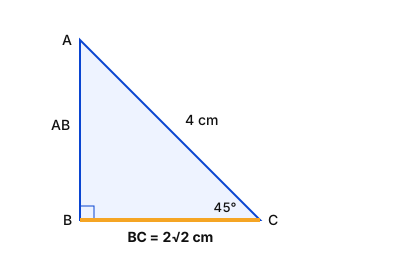
In a triangle ABC, if ∠B=90∘, ∠C=45∘ and AC = 4 cm, then the value of BC is:
एक त्रिभुज ABC में, यदि ∠B=90∘, ∠C=45∘ और AC = 4 cm है, तो BC का मान है:
  1. A2 cm
  2. B4 cm
  3. C22 cm
  4. D42 cm
Show answer

Concept: With ∠B=90∘, AC is the hypotenuse; ∠C=45∘ makes the triangle isosceles.

  1. BC=ACcos45∘=4×12
  2. =42=22cm

Yaad rakhein: In a 45∘-45∘-90∘ triangle each leg =hypotenuse2.

Answer: (C) 22cm

अवधारणा: ∠B=90∘ होने से AC कर्ण है; ∠C=45∘ से त्रिभुज समद्विबाहु।

  1. BC=ACcos45∘=4×12
  2. =22cm

याद रखें: 45∘-45∘-90∘ त्रिभुज में प्रत्येक भुजा =कर्ण2।

उत्तर: (C) 22cm

SSC CPO Paper IQuantitative AptitudeTrigonometry – Right triangleSSC CPO Paper I 2023 · 4 Oct Shift 2 →
Q5740.
Study the given pie-chart and answer the question that follows.
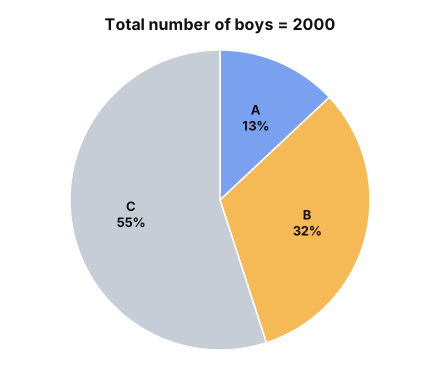
The pie-chart shows the number of boys studying in play group of various schools (A, B, C).

What is the average number of boys studying in schools A and C?
दिए गए पाई-चार्ट का अध्ययन कीजिए और उसके बाद आने वाले प्रश्न का उत्तर दीजिए।
पाई-चार्ट विभिन्न स्कूलों (A, B, C) के प्ले ग्रुप में पढ़ने वाले लड़कों की संख्या को दर्शाता है।

स्कूल A और C में पढ़ने वाले लड़कों की औसत संख्या कितनी है?
  1. A740
  2. B920
  3. C560
  4. D680
Show answer

Concept: Number in a school = its percentage of 2000.

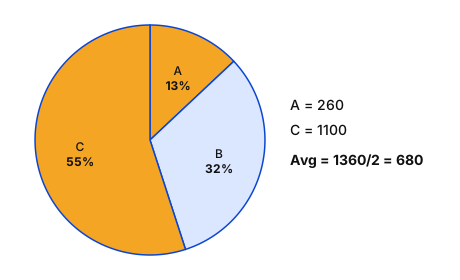
  1. A =13% of 2000 =260
  2. C =55% of 2000 =1100
  3. Average =260+11002=680

Trick: Average of percentages first: 13+552=34% of 2000 =680.

Answer: (D) 680

अवधारणा: किसी विद्यालय में संख्या =2000 का उसका प्रतिशत।

  1. A =2000 का 13%=260
  2. C =2000 का 55%=1100
  3. औसत =260+11002=680

ट्रिक: पहले प्रतिशतों का औसत: 13+552=34%, 2000 का 34%=680।

उत्तर: (D) 680

SSC CPO Paper IQuantitative AptitudeData Interpretation – Pie chartSSC CPO Paper I 2023 · 4 Oct Shift 2 →