Question bank

Q&A: practice questions with answers

Search questions on any topic. Filter by exam category, exam, subject and topic, try the question, then open the answer and explanation.

Courses – airGurukul

6,600 questions found.

Q6201.
Which of the following numbers will replace the question mark (?) in the given series? 91, 111, 133, ?, 183, 211
निम्नलिखित में से कौन-सी संख्या दी गई श्रृंखला में प्रश्न चिह्न (?) का स्थान लेगी? 91, 111, 133, ?, 183, 211
  1. A149
  2. B156
  3. C167
  4. D157
Show answer

Concept: Find the differences between consecutive terms.

  1. Differences: 111−91=20, 133−111=22.
  2. They increase by 2: 20,22,24,26,28.
  3. Missing term =133+24=157.
  4. Check: 157+26=183 and 183+28=211 ✔

Trick: Even differences rising by 2 – just keep adding the next even number.

Answer: (D) 157

अवधारणा: क्रमागत पदों का अंतर निकालें।

  1. अंतर: 111−91=20, 133−111=22।
  2. अंतर 2-2 बढ़ रहा है: 20,22,24,26,28।
  3. लुप्त पद =133+24=157।
  4. जाँच: 157+26=183, 183+28=211 ✔

ट्रिक: अंतर क्रमशः 2 बढ़ रहे हैं – अगला सम अंतर जोड़ते जाएँ।

उत्तर: (D) 157
SSC CPO Paper IGeneral Intelligence and ReasoningNumber SeriesSSC CPO Paper I 2023 · 3 Oct Shift 2 →
Q6202.
Three Statements are given followed by Three conclusions numbered I, II and III.
Assuming the statements to be true, even if they seem to be at variance with
commonly known facts, decide which of the conclusions logically follow(s) from the statements.
Statements:
All valleys are mountains.
No sea is a mountain.
Some plains are seas.
Conclusions:
I. Some valleys are plains.
II. No plain is a mountain.
III. No sea is a valley.
तीन कथन दिए गए हैं जिनके बाद I, II और III क्रमांकित तीन निष्कर्ष दिए गए हैं।
कथनों को सत्य मानते हुए, भले ही वे सामान्य रूप से ज्ञात तथ्यों से भिन्न प्रतीत होते हों,
निर्णय कीजिए कि कौन-सा/से निष्कर्ष कथनों का तार्किक रूप से अनुसरण करता है/करते हैं।
कथन:
सभी घाटियाँ, पहाड़ हैं।
कोई समुद्र, पहाड़ नहीं है।
कुछ मैदान, समुद्र हैं।
निष्कर्ष:
I. कुछ घाटियाँ, मैदान हैं।
II. कोई मैदान, पहाड़ नहीं है।
III. कोई समुद्र, घाटी नहीं है।
  1. AOnly conclusion II follows.केवल निष्कर्ष II अनुसरण करता है।
  2. BOnly conclusion III follows.केवल निष्कर्ष III अनुसरण करता है।
  3. COnly conclusion I follows.केवल निष्कर्ष I अनुसरण करता है।
  4. DBoth conclusions I and II follow.निष्कर्ष I और II दोनों अनुसरण करते हैं।
Show answer

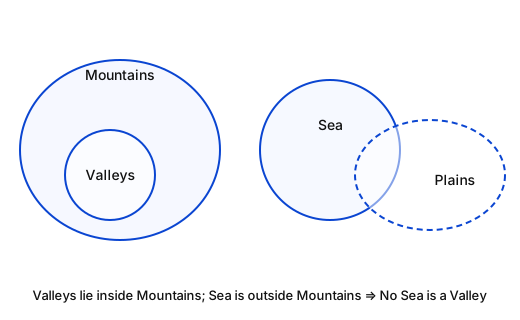
Concept: Draw the least-overlap Venn diagram and test each conclusion.

  1. All valleys are mountains → Valleys circle lies inside Mountains.
  2. No sea is a mountain → Sea is outside Mountains, so Sea is also outside Valleys. Hence III (No sea is a valley) is definitely true.
  3. Plains touch Sea only; they may or may not touch Valleys or Mountains, so I and II are only possibilities – not certain.

Trick: "All A are B" + "No C is B" ⇒ "No C is A" always.

Answer: (B) Only conclusion III follows.

अवधारणा: न्यूनतम संभव Venn आरेख बनाकर हर निष्कर्ष जाँचें।

  1. All valleys are mountains → Valleys, Mountains के अंदर।
  2. No sea is a mountain → Sea, Mountains के बाहर, इसलिए Valleys के भी बाहर। अतः III (No sea is a valley) निश्चित है।
  3. Plains केवल Sea से जुड़ा है; Valleys/Mountains से इसका संबंध केवल संभावना है, इसलिए I और II निश्चित नहीं।

ट्रिक: "All A are B" + "No C is B" ⇒ "No C is A" हमेशा सत्य।

उत्तर: (B) Only conclusion III follows.

SSC CPO Paper IGeneral Intelligence and ReasoningSyllogismSSC CPO Paper I 2023 · 3 Oct Shift 2 →
Q6203.
Select the set in which the numbers are related in the same way as are the numbers of the following set.
(NOTE : Operations should be performed on the whole numbers, without breaking
down the numbers into its constituent digits. E.g. 13 – Operations on 13 such as
adding /subtracting /multiplying etc. to 13 can be performed. Breaking down 13 into 1 and 3 and then performing mathematical operations on 1 and 3 is NOT allowed)
(25, 3, 150)
(13, 7, 182)
उस समुच्चय का चयन कीजिए जिसमें संख्याएँ उसी प्रकार संबंधित हैं जिस प्रकार निम्नलिखित समुच्चय की संख्याएँ संबंधित हैं।
(नोट: संक्रियाएँ संख्याओं को उनके घटक अंकों में विभक्त किए बिना, पूर्ण संख्याओं पर की जानी चाहिए। उदाहरण के लिए 13 – 13 पर संक्रियाएँ जैसे 13 में जोड़ना/घटाना/गुणा करना आदि किया जा सकता है। 13 को 1 और 3 में विभक्त करना और फिर 1 और 3 पर गणितीय संक्रियाएँ करना वर्जित है।)
(25, 3, 150)
(13, 7, 182)
  1. A(5,8,184)
  2. B(6,13,234)
  3. C(10,5,100)
  4. D(3,4,45)
Show answer

Concept: Find the rule linking the three numbers in the given sets.

  1. (25,3,150): 25×3×2=150.
  2. (13,7,182): 13×7×2=182.
  3. Rule: third = first × second ×2.
  4. Option (C): 10×5×2=100 ✔; (A) 5×8×2=80≠184, (B) 156≠234, (D) 24≠45.

Trick: If the third number is large, try product of the first two first.

Answer: (C) (10, 5, 100)

अवधारणा: दिए गए समुच्चयों में तीनों संख्याओं का नियम खोजें।

  1. (25,3,150): 25×3×2=150।
  2. (13,7,182): 13×7×2=182।
  3. नियम: तीसरी = पहली × दूसरी ×2।
  4. विकल्प (C): 10×5×2=100 ✔; (A) 80≠184, (B) 156≠234, (D) 24≠45।

ट्रिक: तीसरी संख्या बड़ी हो तो पहले दोनों का गुणनफल आज़माएँ।

उत्तर: (C) (10, 5, 100)

SSC CPO Paper IGeneral Intelligence and ReasoningNumber Analogy (Sets)SSC CPO Paper I 2023 · 3 Oct Shift 2 →
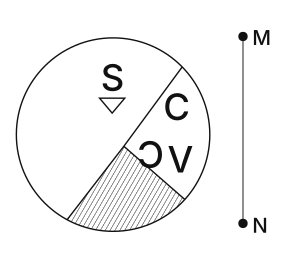
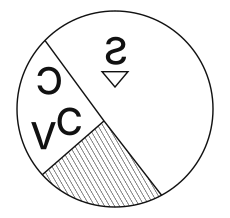
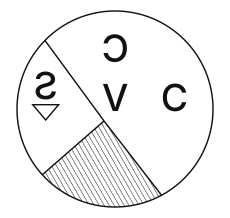
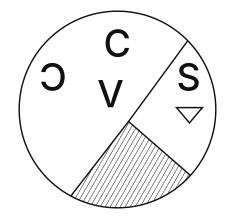
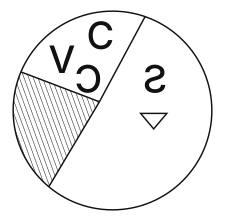
Q6204.
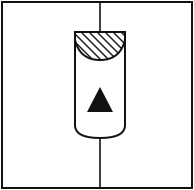
Select the correct mirror image of the given figure, when the mirror is placed at line MN as shown.
दी गई आकृति की सही दर्पण छवि का चयन कीजिए, जब दर्पण को दर्शाए गए अनुसार MN रेखा पर रखा जाता है।
  1. A
  2. B
  3. C
  4. D
Show answer

Concept: A vertical mirror MN placed on the right side swaps left and right; top and bottom stay the same.

  1. The cut line that runs from upper-right to lower-left becomes a line from upper-left to lower-right, so the hatched sector moves to the lower-left.
  2. The small segment with C, C, V shifts to the left side; S with its triangle shifts right of centre but stays at the top.
  3. Every letter is laterally inverted (S, C appear reversed).
  4. Only option (A) shows all these changes together.

Trick: Vertical mirror: left ↔ right only; anything at the top stays at the top.

Answer: (A)

अवधारणा: दाईं ओर रखा ऊर्ध्वाधर दर्पण MN बाएँ-दाएँ को उलट देता है; ऊपर-नीचे वैसे ही रहते हैं।

  1. ऊपर-दाएँ से नीचे-बाएँ जाने वाली रेखा, ऊपर-बाएँ से नीचे-दाएँ हो जाती है; छायांकित भाग नीचे-बाएँ आ जाता है।
  2. C, C, V वाला छोटा खंड बाईं ओर चला जाता है; S और त्रिभुज ऊपर ही रहते हैं।
  3. हर अक्षर पार्श्व रूप से उल्टा (laterally inverted) दिखता है।
  4. ये सभी बदलाव केवल विकल्प (A) में हैं।

ट्रिक: ऊर्ध्वाधर दर्पण: केवल बाएँ ↔ दाएँ; ऊपर की चीज़ ऊपर ही रहेगी।

उत्तर: (A)

SSC CPO Paper IGeneral Intelligence and ReasoningMirror ImageSSC CPO Paper I 2023 · 3 Oct Shift 2 →
Q6205.
In a certain code language, ‘COUNTY’ is written as ‘ULCYGN’ and 'FOREST' is written as 'RLFTHE'. How will ‘MARGIN’ be written in that language?
एक निश्चित कूट भाषा में, 'COUNTY' को 'ULCYGN' लिखा जाता है और 'FOREST' को 'RLFTHE' लिखा जाता है। उसी भाषा में 'MARGIN' को किस प्रकार लिखा जाएगा?
  1. ARJMDSZ
  2. BZMTPRH
  3. CZMMRGI
  4. DRZMNRG
Show answer

Concept: Split the word into two halves of three letters; reverse each half and change the middle letter to its opposite letter (A↔Z, B↔Y …).

  1. COUNTY: COU → U O C → O→L gives ULC; NTY → Y T N → T→G gives YGN. Code ULCYGN ✔
  2. FOREST: FOR → R O F → RLF; EST → T S E → THE ✔
  3. MARGIN: MAR → R A M, A→Z gives RZM.
  4. GIN → N I G, I→R gives NRG. Code: RZMNRG

Trick: Opposite pairs: sum of positions =27 (e.g. A+Z=1+26).

Answer: (D) RZMNRG

अवधारणा: शब्द को तीन-तीन अक्षरों के दो भागों में बाँटें; हर भाग उल्टा लिखें और बीच वाला अक्षर उसके विपरीत अक्षर (A↔Z, B↔Y …) से बदलें।

  1. COUNTY: COU → U O C → O→L, ULC; NTY → Y T N → T→G, YGN। ULCYGN ✔
  2. FOREST: FOR → RLF; EST → THE ✔
  3. MARGIN: MAR → R A M, A→Z = RZM।
  4. GIN → N I G, I→R = NRG। कोड: RZMNRG

ट्रिक: विपरीत अक्षरों के स्थानों का योग =27 होता है।

उत्तर: (D) RZMNRG

SSC CPO Paper IGeneral Intelligence and ReasoningCoding-DecodingSSC CPO Paper I 2023 · 3 Oct Shift 2 →
Q6206.
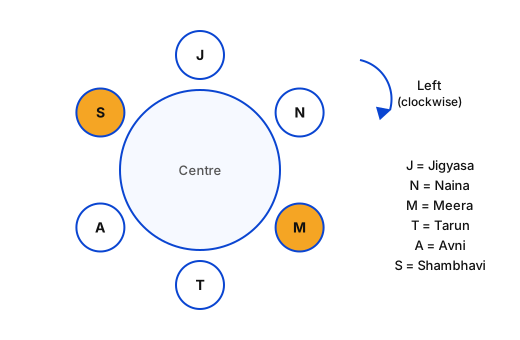
Six students Meera, Jigyasa, Tarun, Naina, Shambhavi and Avni are sitting around a circular table facing the centre (not necessarily in the same order). Shambhavi is an immediate neighbour of both Jigyasa and Avni. Tarun is sitting third to the left of
Jigyasa. Meera is sitting second to the right of Avni.
Who is sitting third to the right of Meera?
छह विद्यार्थी Meera, Jigyasa, Tarun, Naina, Shambhavi और Avni एक वृत्ताकार मेज़ के परितः केंद्र की ओर मुख करके बैठे हैं (आवश्यक नहीं कि इसी क्रम में हों)। Shambhavi, Jigyasa और Avni दोनों की निकटतम पड़ोसी है। Tarun, Jigyasa के बाएँ से तीसरे स्थान पर बैठा है।
Meera, Avni के दाएँ से दूसरे स्थान पर बैठी है।
Meera के दाएँ से तीसरे स्थान पर कौन बैठा है?
  1. AAvni
  2. BNaina
  3. CJigyasa
  4. DShambhavi
Show answer

Concept: Facing the centre: left = clockwise, right = anticlockwise.

  1. Fix Jigyasa (J) at the top. Tarun is third to the left of J, i.e. exactly opposite.
  2. Shambhavi sits between J and Avni. If S is clockwise of J, Meera (second to the right of Avni) would fall on J's seat – impossible. So S is anticlockwise of J and A next to S.
  3. Meera is second to the right of Avni; Naina takes the last seat.
  4. Clockwise: J, N, M, T, A, S. Counting to the right (anticlockwise) of Meera: Naina (1), Jigyasa (2), Shambhavi (3).

Trick: In a circle of 6, the third person on either side is the one directly opposite.

Answer: (D) Shambhavi

अवधारणा: केंद्र की ओर मुख होने पर: बायाँ = दक्षिणावर्त (clockwise), दायाँ = वामावर्त।

  1. जिज्ञासा (J) को ऊपर रखें। तरुण J के बाएँ तीसरा है, यानी ठीक सामने।
  2. शाम्भवी, J और अवनि के बीच है। यदि S, J के clockwise ओर हो तो मीरा J की सीट पर आएगी – असंभव। अतः S, J की anticlockwise ओर और A उसके बगल में।
  3. मीरा, अवनि के दाएँ दूसरी है; बची सीट पर नैना।
  4. Clockwise: J, N, M, T, A, S। मीरा के दाएँ (anticlockwise) गिनें: नैना (1), जिज्ञासा (2), शाम्भवी (3)।

ट्रिक: 6 लोगों के वृत्त में किसी भी ओर तीसरा व्यक्ति ठीक सामने बैठा होता है।

उत्तर: (D) Shambhavi

SSC CPO Paper IGeneral Intelligence and ReasoningCircular Seating ArrangementSSC CPO Paper I 2023 · 3 Oct Shift 2 →
Q6207.
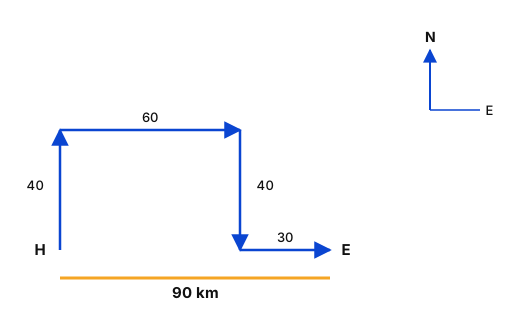
Shilpa goes to a park every day for walking. One morning, she started walking from her home and walked 40 km towards the north. Then she turned to the right and
walked 60 km. Again, she turned right and walked 40 km. Lastly, she took a left turn and walked 30 km. How far is she from her home?
Shilpa प्रतिदिन टहलने के लिए एक पार्क में जाती है। एक सुबह, वह अपने घर से चलना शुरू करती है और उत्तर की ओर 40 km चलती है। फिर वह दाएँ मुड़ती है और
60 km चलती है। वह फिर से दाएँ मुड़ती है और 40 km चलती है। अंत में, वह बाएँ मुड़ती है और 30 km चलती है। वह अपने घर से कितनी दूर है?
  1. A140 km
  2. B90 km
  3. C100 km
  4. D60 km
Show answer

Concept: Plot the path step by step on axes (North up, East right).

  1. Home H (0,0) → 40 km north → (0,40).
  2. Right turn = east, 60 km → (60,40).
  3. Right turn = south, 40 km → (60,0) – back on the starting line.
  4. Left turn = east, 30 km → (90,0).
  5. Distance from home =60+30=90km.

Trick: The two 40 km legs (north and south) cancel; add only the east legs.

Answer: (B) 90 km

अवधारणा: उत्तर ऊपर और पूर्व दाएँ मानकर रास्ता चरणबद्ध बनाएँ।

  1. घर H (0,0) → 40 km उत्तर → (0,40)।
  2. दाएँ मुड़ना = पूर्व, 60 km → (60,40)।
  3. दाएँ = दक्षिण, 40 km → (60,0), यानी फिर उसी सीध में।
  4. बाएँ = पूर्व, 30 km → (90,0)।
  5. घर से दूरी =60+30=90km।

ट्रिक: उत्तर-दक्षिण के 40-40 km कट जाते हैं; केवल पूर्व की दूरियाँ जोड़ें।

उत्तर: (B) 90 km

SSC CPO Paper IGeneral Intelligence and ReasoningDirection and DistanceSSC CPO Paper I 2023 · 3 Oct Shift 2 →
Q6208.
Which two mathematical signs should be interchanged to make the given equation correct?
(75 + 15) × 27 × 1 – 9 ÷ 7 × (135 + 3) – 10 ÷ (189 + 63) = 434
दिए गए समीकरण को सही बनाने के लिए किन दो गणितीय चिह्नों को परस्पर बदला जाना चाहिए?
(75 + 15) × 27 × 1 – 9 ÷ 7 × (135 + 3) – 10 ÷ (189 + 63) = 434
  1. A+ and ÷+ और ÷
  2. B+ and –+ और –
  3. C× and +× और +
  4. D÷ and –÷ और –
Show answer

Concept: Interchange the signs given in an option and evaluate using BODMAS.

  1. Swap + and ÷: (75÷15)×27×1−9+7×(135÷3)−10+(189÷63)
  2. Brackets: 5, 45, 3 → 5×27×1−9+7×45−10+3
  3. =135−9+315−10+3
  4. =434 ✔ = RHS

Trick: Brackets like (189?63) and (135?3) divide exactly – a strong hint that + must become ÷.

Answer: (A) + and ÷

अवधारणा: विकल्प के चिह्न आपस में बदलें और BODMAS से हल करें।

  1. + और ÷ बदलने पर: (75÷15)×27×1−9+7×(135÷3)−10+(189÷63)
  2. कोष्ठक: 5, 45, 3 → 5×27×1−9+7×45−10+3
  3. =135−9+315−10+3
  4. =434 ✔ = दायाँ पक्ष

ट्रिक: (189?63) व (135?3) पूरे-पूरे भाग होते हैं – संकेत कि + को ÷ बनाना है।

उत्तर: (A) + and ÷

SSC CPO Paper IGeneral Intelligence and ReasoningMathematical Operations (Sign Interchange)SSC CPO Paper I 2023 · 3 Oct Shift 2 →
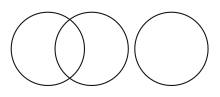
Q6209.
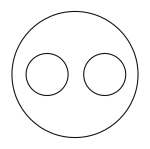
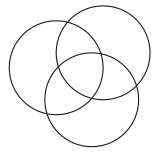
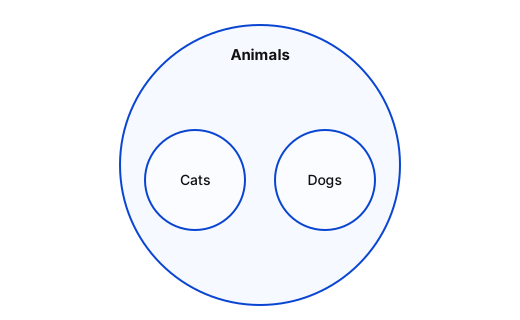
Select the Venn diagram that best illustrates the relationship between the following classes.
Animals, Cats, Dogs
उस वेन आरेख का चयन कीजिए जो निम्नलिखित वर्गों के बीच संबंध को सर्वोत्तम रूप से दर्शाता है।
जानवर, बिल्लियाँ, कुत्ते
  1. A
  2. B
  3. C
  4. D
Show answer

Concept: Show the inclusion/exclusion between the three classes.

  1. Cats are animals and dogs are animals → both circles lie inside Animals.
  2. No cat is a dog → the Cats and Dogs circles do not overlap.
  3. Hence two separate small circles inside one big circle – option (C).

Trick: Two different types of the same class = two separate circles inside the big circle.

Answer: (C)

अवधारणा: तीनों वर्गों के बीच संबंध दिखाएँ।

  1. बिल्लियाँ (Cats) और कुत्ते (Dogs) दोनों जानवर (Animals) हैं → दोनों वृत्त Animals के अंदर।
  2. कोई बिल्ली कुत्ता नहीं → Cats और Dogs के वृत्त अलग-अलग।
  3. अतः एक बड़े वृत्त के अंदर दो अलग छोटे वृत्त – विकल्प (C)।

ट्रिक: एक ही वर्ग की दो अलग किस्में = बड़े वृत्त में दो अलग वृत्त।

उत्तर: (C)

SSC CPO Paper IGeneral Intelligence and ReasoningVenn DiagramSSC CPO Paper I 2023 · 3 Oct Shift 2 →
Q6210.
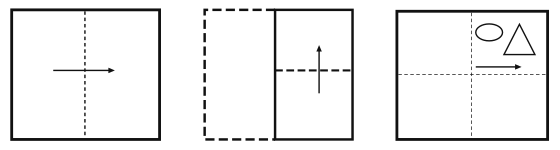
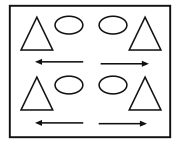
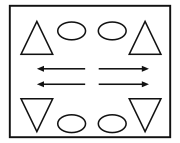
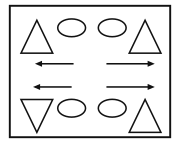
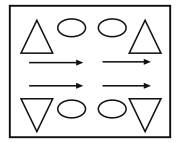
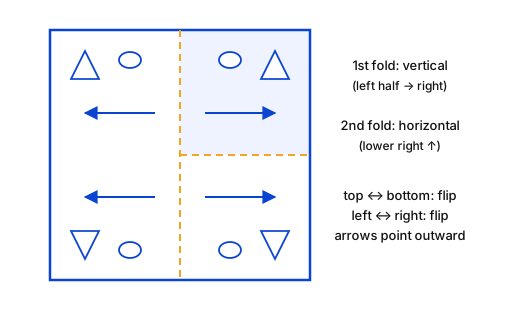
A paper is folded and cut as shown below. How will it appear when unfolded?
एक कागज़ को नीचे दर्शाए गए अनुसार मोड़ा और काटा जाता है। खोलने पर यह कैसा दिखाई देगा?
  1. A
  2. B
  3. C
  4. D
Show answer

Concept: Unfold in reverse order; each unfolding gives a mirror image of the cuts across the fold line.

  1. The cut (oval, triangle, arrow →) is made in the top-right quarter.
  2. Undo the 2nd (horizontal) fold: the lower-right quarter gets the mirror image – inverted triangle and oval below, arrow still →.
  3. Undo the 1st (vertical) fold: the left half mirrors the right half – arrows now point ←, triangles at the far left.
  4. Result: upright triangles at top, inverted at bottom, four arrows pointing outward – option (B).

Trick: Across a horizontal fold, up ↔ down flips; across a vertical fold, left ↔ right flips.

Answer: (B)

अवधारणा: उल्टे क्रम में खोलें; हर बार कट का मोड़-रेखा पर दर्पण प्रतिबिंब बनता है।

  1. कट (अंडाकार, त्रिभुज, तीर →) ऊपरी-दाएँ चौथाई में है।
  2. दूसरा (क्षैतिज) मोड़ खोलें: नीचे-दाएँ में प्रतिबिंब – उल्टा त्रिभुज, अंडाकार नीचे, तीर फिर भी →।
  3. पहला (ऊर्ध्वाधर) मोड़ खोलें: बायाँ आधा, दाएँ का प्रतिबिंब – तीर ←, त्रिभुज सबसे बाएँ।
  4. परिणाम: ऊपर सीधे, नीचे उल्टे त्रिभुज, चारों तीर बाहर की ओर – विकल्प (B)।

ट्रिक: क्षैतिज मोड़ पर ऊपर ↔ नीचे; ऊर्ध्वाधर मोड़ पर बाएँ ↔ दाएँ उलटता है।

उत्तर: (B)

SSC CPO Paper IGeneral Intelligence and ReasoningPaper Folding and CuttingSSC CPO Paper I 2023 · 3 Oct Shift 2 →
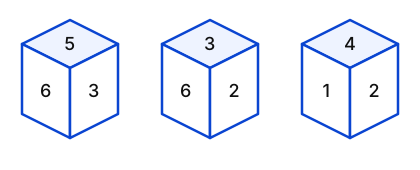
Q6211.
Three different positions of the same dice are shown. Find the number on the face
opposite the face showing ‘5’.
एक ही पासे की तीन अलग-अलग स्थितियाँ दर्शाई गई हैं। '5' दर्शाने वाले फलक के विपरीत फलक
पर कौन-सी संख्या है, ज्ञात कीजिए।
  1. A2
  2. B3
  3. C4
  4. D1
Show answer

Concept: A number seen together with another on the same die can never be opposite to it.

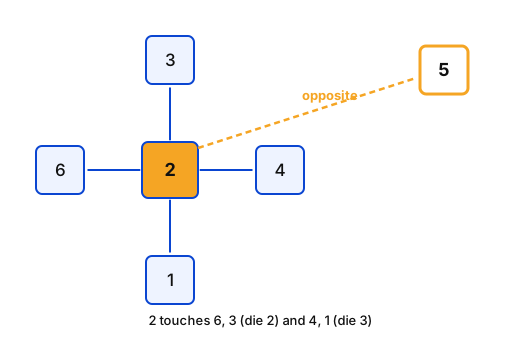
  1. Die 2: 2 is adjacent to 3 and 6.
  2. Die 3: 2 is adjacent to 4 and 1.
  3. So 2 touches 1, 3, 4 and 6 – four faces. The only face left for its opposite is 5.
  4. Hence 5 and 2 are opposite faces.

Trick: Find the number that appears with four different numbers; the missing sixth number is its opposite.

Answer: (A) 2

अवधारणा: एक ही पासे पर साथ दिखने वाली संख्याएँ कभी आमने-सामने नहीं होतीं।

  1. पासा 2: 2 के साथ 3 और 6 दिखते हैं।
  2. पासा 3: 2 के साथ 4 और 1 दिखते हैं।
  3. अर्थात 2 के पड़ोसी 1, 3, 4, 6 हैं; बची संख्या 5 ही उसके सामने होगी।
  4. अतः 5 के विपरीत 2 है।

ट्रिक: जो संख्या चार अलग संख्याओं के साथ दिखे, छठी (बची) संख्या उसके सामने होती है।

उत्तर: (A) 2

SSC CPO Paper IGeneral Intelligence and ReasoningDiceSSC CPO Paper I 2023 · 3 Oct Shift 2 →
Q6212.
In a certain code language, ‘DOING’ is written as ‘BQTOV’ and 'ZEBRA' is written as 'FAAKB'. How will ‘STORM’ be written in that language?
एक निश्चित कूट भाषा में, 'DOING' को 'BQTOV' लिखा जाता है और 'ZEBRA' को 'FAAKB' लिखा जाता है। उसी भाषा में 'STORM' को किस प्रकार लिखा जाएगा?
  1. APETBK
  2. BMKYTS
  3. CPRYSK
  4. DMLNKP
Show answer

Concept: Each letter is replaced by its opposite letter (A↔Z) and then shifted: first two letters by +5, last three by +2.

  1. DOING: opposites W L R M T → W+5=B, L+5=Q, R+2=T, M+2=O, T+2=V → BQTOV ✔
  2. ZEBRA: A V Y I Z → F, A, A, K, B → FAAKB ✔
  3. STORM: opposites H G L I N.
  4. H+5=M, G+5=L, L+2=N, I+2=K, N+2=P → MLNKP

Trick: Opposite letter = 27− position; then add the shift (wrap Z → A).

Answer: (D) MLNKP

अवधारणा: हर अक्षर को उसके विपरीत अक्षर (A↔Z) से बदलकर आगे खिसकाया गया है: पहले दो अक्षर +5, अंतिम तीन +2।

  1. DOING: विपरीत W L R M T → B, Q, T, O, V → BQTOV ✔
  2. ZEBRA: A V Y I Z → F, A, A, K, B → FAAKB ✔
  3. STORM: विपरीत H G L I N।
  4. H+5=M, G+5=L, L+2=N, I+2=K, N+2=P → MLNKP

ट्रिक: विपरीत अक्षर का स्थान =27− मूल स्थान; फिर shift जोड़ें (Z के बाद A)।

उत्तर: (D) MLNKP

SSC CPO Paper IGeneral Intelligence and ReasoningCoding-DecodingSSC CPO Paper I 2023 · 3 Oct Shift 2 →
Q6213.
Two statements are given followed by two conclusions numbered I and II. Assuming the statements to be true, even if they seem to be at variance with commonly known facts, decide which of the conclusions logically follow(s) from the statements.
Statements:
Some shells are pebbles.
All pebbles are rocks.
Conclusions:
I. No shell is a rock.
II. Some shells are rocks.
दो कथन दिए गए हैं जिनके बाद I और II क्रमांकित दो निष्कर्ष दिए गए हैं। कथनों को सत्य मानते हुए, भले ही वे सामान्य रूप से ज्ञात तथ्यों से भिन्न प्रतीत होते हों, निर्णय कीजिए कि कौन-सा/से निष्कर्ष कथनों का तार्किक रूप से अनुसरण करता है/करते हैं।
कथन:
कुछ सीपियाँ, कंकड़ हैं।
सभी कंकड़, चट्टानें हैं।
निष्कर्ष:
I. कोई सीपी, चट्टान नहीं है।
II. कुछ सीपियाँ, चट्टानें हैं।
  1. AOnly conclusion I followsकेवल निष्कर्ष I अनुसरण करता है
  2. BNeither conclusion I nor II followsन तो निष्कर्ष I और न ही II अनुसरण करता है
  3. CBoth conclusions I and II followनिष्कर्ष I और II दोनों अनुसरण करते हैं
  4. DOnly conclusion II followsकेवल निष्कर्ष II अनुसरण करता है
Show answer

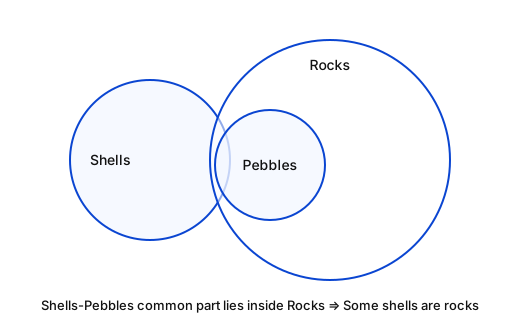
Concept: A 'Some' statement followed by an 'All' statement on the common term gives a definite 'Some' conclusion.

  1. Some shells are pebbles → Shells and Pebbles overlap.
  2. All pebbles are rocks → Pebbles lie inside Rocks.
  3. So the shells that are pebbles are also rocks → "Some shells are rocks" (II) is definite.
  4. Since II is definitely true, "No shell is a rock" (I) is false.

Trick: Some + All = Some (Some A are B, All B are C ⇒ Some A are C).

Answer: (D) Only conclusion II follows

अवधारणा: 'Some' कथन के बाद उभयनिष्ठ पद पर 'All' कथन हो तो निश्चित 'Some' निष्कर्ष मिलता है।

  1. Some shells are pebbles → Shells और Pebbles में कुछ भाग साझा।
  2. All pebbles are rocks → Pebbles, Rocks के अंदर।
  3. अतः वह साझा भाग Rocks में भी है → "Some shells are rocks" (II) निश्चित।
  4. II सत्य है, इसलिए "No shell is a rock" (I) असत्य।

ट्रिक: Some + All = Some (Some A are B, All B are C ⇒ Some A are C)।

उत्तर: (D) Only conclusion II follows

SSC CPO Paper IGeneral Intelligence and ReasoningSyllogismSSC CPO Paper I 2023 · 3 Oct Shift 2 →
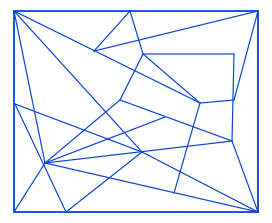
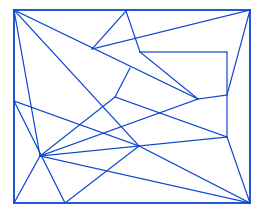
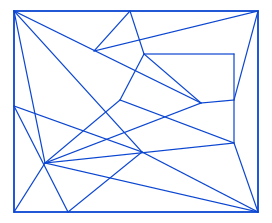
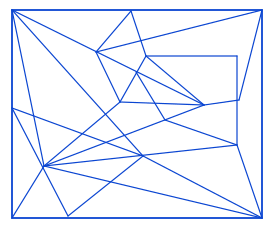
Q6214.
Select the option figure in which the given figure is embedded (rotation is NOT
allowed).
उस विकल्प आकृति का चयन कीजिए जिसमें दी गई आकृति सन्निहित है (घुमाने की
अनुमति नहीं है)।
  1. A
  2. B
  3. C
  4. D
Show answer

Concept: Look for the same shape, size and orientation inside the option figures – rotation is not allowed.

  1. The given figure is a four-sided shape whose longest side slopes down from the top vertex to the right vertex.
  2. Trace the lines of each option, looking for four segments with the same slopes and length ratio.
  3. Only in option (C) do four lines join to form exactly this quadrilateral in the same orientation; in the others one side is missing or tilted differently.

Trick: Fix one distinctive corner of the shape (here the top vertex) and search for it first.

Answer: (C)

अवधारणा: उसी आकार, माप और दिशा वाली आकृति विकल्पों में खोजें – घुमाना (rotation) मना है।

  1. दी गई आकृति एक चतुर्भुज है जिसकी सबसे लंबी भुजा ऊपरी शीर्ष से दाएँ शीर्ष तक तिरछी उतरती है।
  2. हर विकल्प में वही ढलान और लंबाई-अनुपात वाली चार रेखाएँ खोजें।
  3. केवल विकल्प (C) में चार रेखाएँ ठीक इसी दिशा में यह चतुर्भुज बनाती हैं; बाकी में कोई भुजा गायब या अलग झुकी है।

ट्रिक: आकृति का कोई विशिष्ट कोना (यहाँ ऊपरी शीर्ष) पहले खोजें।

उत्तर: (C)

SSC CPO Paper IGeneral Intelligence and ReasoningEmbedded FigureSSC CPO Paper I 2023 · 3 Oct Shift 2 →
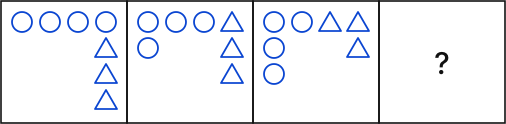
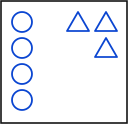
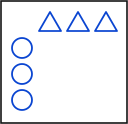
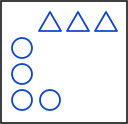
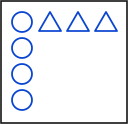
Q6215.
Select the figure that will come next in the following figure series.
उस आकृति का चयन कीजिए जो निम्नलिखित आकृति श्रृंखला में आगे आएगी।
  1. A
  2. B
  3. C
  4. D
Show answer

Concept: Track circles and triangles separately from figure to figure.

  1. Circles: each step one circle leaves the top row and joins the left column: top row 4 → 3 → 2 → 1.
  2. Triangles: each step one triangle leaves the right column and joins the top row (from the right): top row triangles 0 → 1 → 2 → 3.
  3. So figure 4: top row = 1 circle followed by 3 triangles; left column = that corner circle + 3 circles below it.
  4. Option (D) shows exactly this.

Trick: Count elements in each row/column; one moves per step.

Answer: (D)

अवधारणा: वृत्तों और त्रिभुजों को अलग-अलग ट्रैक करें।

  1. वृत्त: हर चरण में एक वृत्त ऊपरी पंक्ति से बाएँ स्तंभ में जाता है: ऊपर 4 → 3 → 2 → 1।
  2. त्रिभुज: हर चरण में एक त्रिभुज दाएँ स्तंभ से ऊपरी पंक्ति में आता है: 0 → 1 → 2 → 3।
  3. अतः चौथी आकृति: ऊपर 1 वृत्त + 3 त्रिभुज; बाएँ स्तंभ में कोने वाले वृत्त के नीचे 3 वृत्त।
  4. यह केवल विकल्प (D) में है।

ट्रिक: हर पंक्ति/स्तंभ के तत्व गिनें; हर बार एक ही तत्व खिसकता है।

उत्तर: (D)

SSC CPO Paper IGeneral Intelligence and ReasoningFigure SeriesSSC CPO Paper I 2023 · 3 Oct Shift 2 →
Q6216.
Select the correct option that indicates the arrangement of the given words in the
order in which they appear in an English dictionary.
1. Formal
2. Foreign
3. Forest
4. Forgotten
5. Forge
6. Forlorn
उस सही विकल्प का चयन कीजिए जो दिए गए शब्दों की उस क्रम में व्यवस्था को दर्शाता है
जिस क्रम में वे अंग्रेज़ी शब्दकोश में आते हैं।
1. Formal
2. Foreign
3. Forest
4. Forgotten
5. Forge
6. Forlorn
  1. A2, 3, 5, 4, 6, 1
  2. B2, 3, 6, 1, 5, 4
  3. C2, 3, 4, 5, 6, 1
  4. D2, 3, 5, 6, 4, 1
Show answer

Concept: Compare letters position by position; all words begin with F-O-R.

  1. Fourth letters: Foreign (e), Forest (e), Forge (g), Forgotten (g), Forlorn (l), Formal (m).
  2. Foreign vs Forest: 5th letter i < s → Foreign first.
  3. Forge vs Forgotten: 5th letter e < o → Forge first.
  4. Order: Foreign, Forest, Forge, Forgotten, Forlorn, Formal = 2, 3, 5, 4, 6, 1.

Trick: Group words by the first differing letter, then sort within each group.

Answer: (A) 2, 3, 5, 4, 6, 1

अवधारणा: सभी शब्द F-O-R से शुरू हैं, इसलिए अक्षर-दर-अक्षर तुलना करें।

  1. चौथा अक्षर: Foreign (e), Forest (e), Forge (g), Forgotten (g), Forlorn (l), Formal (m)।
  2. Foreign बनाम Forest: पाँचवाँ अक्षर i < s → Foreign पहले।
  3. Forge बनाम Forgotten: e < o → Forge पहले।
  4. क्रम: Foreign, Forest, Forge, Forgotten, Forlorn, Formal = 2, 3, 5, 4, 6, 1।

ट्रिक: पहले अलग होने वाले अक्षर से समूह बनाएँ, फिर समूह के अंदर क्रम लगाएँ।

उत्तर: (A) 2, 3, 5, 4, 6, 1

SSC CPO Paper IGeneral Intelligence and ReasoningDictionary OrderSSC CPO Paper I 2023 · 3 Oct Shift 2 →
Q6217.
If A denotes ‘+’, B denotes ‘×’, C denotes ‘−’, and D denotes ‘÷’, then what will be the value of the following equation?
13 B 7 A 64 D 4 C 23 = ?
यदि A का अर्थ '+', B का अर्थ '×', C का अर्थ '−' और D का अर्थ '÷' है, तो निम्नलिखित समीकरण का मान क्या होगा?
13 B 7 A 64 D 4 C 23 = ?
  1. A82
  2. B84
  3. C86
  4. D76
Show answer

Concept: Replace the letters by signs and apply BODMAS.

  1. 13 B 7 A 64 D 4 C 23 → 13×7+64÷4−23
  2. =91+16−23
  3. =84

Trick: Do ÷ and × first, then + and –.

Answer: (B) 84

अवधारणा: अक्षरों को चिह्नों से बदलकर BODMAS लगाएँ।

  1. 13 B 7 A 64 D 4 C 23 → 13×7+64÷4−23
  2. =91+16−23
  3. =84

ट्रिक: पहले ÷ और ×, फिर + और –।

उत्तर: (B) 84

SSC CPO Paper IGeneral Intelligence and ReasoningMathematical OperationsSSC CPO Paper I 2023 · 3 Oct Shift 2 →
Q6218.
Select the option that represents the letters which, when sequentially placed from left to right in the blanks below, will complete the letter series.
A _ _ D F _ K _ _ F A _ L _ _
उस विकल्प का चयन कीजिए जो उन अक्षरों को दर्शाता है जिन्हें नीचे दिए गए रिक्त स्थानों में बाएँ से दाएँ क्रमिक रूप से रखने पर अक्षर श्रृंखला पूरी हो जाएगी।
A _ _ D F _ K _ _ F A _ L _ _
  1. AD L K L F A L D
  2. BL A L K D F D K
  3. CK L A L D K D F
  4. DF D L A K F D L
Show answer

Concept: Look for a repeating block; the 15 places suggest a 5-letter block repeated thrice.

  1. Filled with option (C): A K L D F A K L D F A K L D F.
  2. This reads AKLDF | AKLDF | AKLDF.
  3. The block AKLDF repeats perfectly, so option (C) is correct.

Trick: Total length ÷ visible pattern length → guess block size (here 15÷3=5).

Answer: (C) K L A L D K D F

अवधारणा: दोहराने वाला खंड खोजें; 15 स्थान हैं, अतः 5 अक्षरों का खंड तीन बार।

  1. विकल्प (C) भरने पर: A K L D F A K L D F A K L D F।
  2. यह बनता है AKLDF | AKLDF | AKLDF।
  3. खंड AKLDF पूरी तरह दोहराता है, इसलिए (C) सही।

ट्रिक: कुल लंबाई ÷ खंड लंबाई से block size अनुमानित करें (यहाँ 15÷3=5)।

उत्तर: (C) K L A L D K D F

SSC CPO Paper IGeneral Intelligence and ReasoningLetter Series (Missing Letters)SSC CPO Paper I 2023 · 3 Oct Shift 2 →
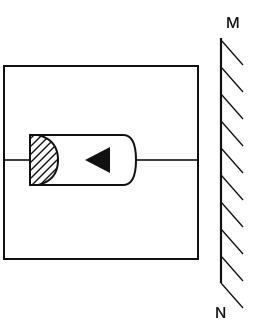
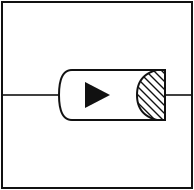
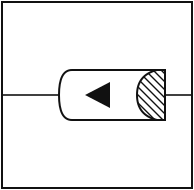
Q6219.
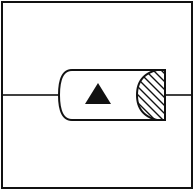
Select the correct mirror image of the given combination when the mirror is placed at 'MN' as shown below.
दिए गए संयोजन की सही दर्पण छवि का चयन कीजिए, जब दर्पण को नीचे दर्शाए गए अनुसार 'MN' पर रखा जाता है।
  1. A
  2. B
  3. C
  4. D
Show answer

Concept: The mirror MN stands vertically on the right, so only left and right interchange.

  1. In the figure the hatched semicircle is at the left end of the capsule and the rounded end at the right.
  2. In the mirror, the hatched part goes to the right end and the rounded end comes to the left.
  3. The black triangle pointing left will point right.
  4. The capsule stays horizontal (rules out C) – option (A) matches.

Trick: Vertical mirror: arrows/triangles pointing left ↔ right reverse; up/down pointing stay same.

Answer: (A)

अवधारणा: दर्पण MN दाईं ओर ऊर्ध्वाधर है, इसलिए केवल बाएँ-दाएँ बदलते हैं।

  1. आकृति में छायांकित अर्धवृत्त कैप्सूल के बाएँ सिरे पर और गोल सिरा दाएँ है।
  2. प्रतिबिंब में छायांकित भाग दाएँ और गोल सिरा बाएँ आ जाएगा।
  3. बाएँ इशारा करता काला त्रिभुज दाएँ इशारा करेगा।
  4. कैप्सूल क्षैतिज ही रहेगा – विकल्प (A) मेल खाता है।

ट्रिक: ऊर्ध्वाधर दर्पण: बाएँ ↔ दाएँ दिशा उलटती है; ऊपर/नीचे वाली दिशा नहीं।

उत्तर: (A)

SSC CPO Paper IGeneral Intelligence and ReasoningMirror ImageSSC CPO Paper I 2023 · 3 Oct Shift 2 →
Q6220.
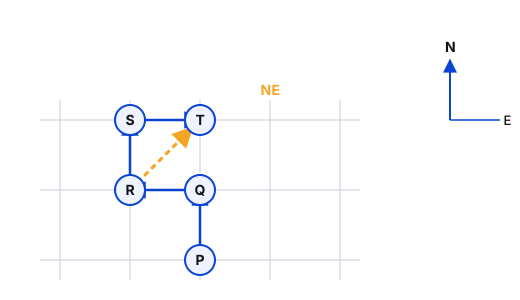
Town Q is to the north of Town P. Town R is to the west of Town Q. Town S is to the north of Town R. Town T is to the east of Town S. What is the position of Town T with respect to Town R? (All positions are arranged in GRID pattern).
शहर Q, शहर P के उत्तर में है। शहर R, शहर Q के पश्चिम में है। शहर S, शहर R के उत्तर में है। शहर T, शहर S के पूर्व में है। शहर R के सापेक्ष शहर T की स्थिति क्या है? (सभी स्थितियाँ ग्रिड (GRID) पैटर्न में व्यवस्थित हैं)।
  1. AEastपूर्व
  2. BSouthदक्षिण
  3. CNorth-eastउत्तर-पूर्व
  4. DSouth-eastदक्षिण-पूर्व
Show answer

Concept: Place the towns on a grid, starting with P at the origin.

  1. P at origin; Q is north of P.
  2. R is west of Q; S is north of R.
  3. T is east of S, so T is directly above Q and diagonally up-right of R.
  4. Up (north) + right (east) = north-east.

Trick: One step north + one step east from a point always gives north-east.

Answer: (C) North-east

अवधारणा: P को मूल बिंदु मानकर कस्बों को ग्रिड पर रखें।

  1. P मूल बिंदु; Q, P के उत्तर में।
  2. R, Q के पश्चिम में; S, R के उत्तर में।
  3. T, S के पूर्व में – यानी Q के ठीक ऊपर और R से तिरछा ऊपर-दाएँ।
  4. ऊपर (उत्तर) + दाएँ (पूर्व) = उत्तर-पूर्व।

ट्रिक: किसी बिंदु से एक कदम उत्तर + एक कदम पूर्व = उत्तर-पूर्व।

उत्तर: (C) North-east

SSC CPO Paper IGeneral Intelligence and ReasoningDirection SenseSSC CPO Paper I 2023 · 3 Oct Shift 2 →