Question bank

Q&A: practice questions with answers

Search questions on any topic. Filter by exam category, exam, subject and topic, try the question, then open the answer and explanation.

Courses – airGurukul

6,600 questions found.

Q6221.
In a certain code language, ‘FRIGHT’ is written as ‘FOCQED’ and ‘SHREDS’ is written as ‘OEPPAB’. How will ‘UPSETS’ be written in that language?
एक निश्चित कूट भाषा में, 'FRIGHT' को 'FOCQED' लिखा जाता है और 'SHREDS' को 'OEPPAB' लिखा जाता है। उसी भाषा में 'UPSETS' को किस प्रकार लिखा जाएगा?
  1. APMRSQB
  2. BPMROQB
  3. CPMRPQB
  4. DPMSPQB
Show answer

Concept: Split the word into halves of three letters; move each letter 3 back, then write each half in reverse.

  1. FRIGHT: FRI −3 = COF → reverse FOC; GHT −3 = DEQ → reverse QED → FOCQED ✔
  2. SHREDS: SHR −3 = PEO → OEP; EDS −3 = BAP → PAB → OEPPAB ✔
  3. UPSETS: UPS −3 = RMP → reverse PMR.
  4. ETS −3 = BQP → reverse PQB. Code: PMRPQB

Trick: When the code letters look scrambled, try a fixed shift plus reversal of halves.

Answer: (C) PMRPQB

अवधारणा: शब्द को तीन-तीन अक्षरों के दो भागों में बाँटें; हर अक्षर को 3 पीछे करें और फिर हर भाग उल्टा लिखें।

  1. FRIGHT: FRI −3 = COF → उल्टा FOC; GHT −3 = DEQ → QED → FOCQED ✔
  2. SHREDS: SHR −3 = PEO → OEP; EDS −3 = BAP → PAB ✔
  3. UPSETS: UPS −3 = RMP → उल्टा PMR।
  4. ETS −3 = BQP → उल्टा PQB। कोड: PMRPQB

ट्रिक: कोड बिखरा लगे तो fixed shift + आधे भागों को उल्टा करके देखें।

उत्तर: (C) PMRPQB
SSC CPO Paper IGeneral Intelligence and ReasoningCoding-DecodingSSC CPO Paper I 2023 · 3 Oct Shift 2 →
Q6222.
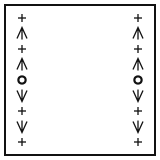
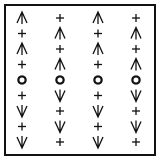
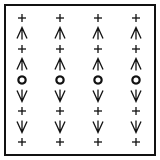
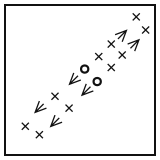
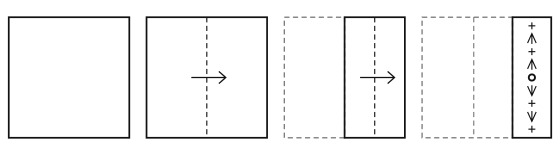
A paper is folded and cut as shown. How will it appear when unfolded?
एक कागज़ को दर्शाए गए अनुसार मोड़ा और काटा जाता है। खोलने पर यह कैसा दिखाई देगा?
  1. A
  2. B
  3. C
  4. D
Show answer

Concept: Each fold doubles the layers; a cut made through all layers repeats once in every layer when unfolded.

  1. The square is folded twice from left to right, so the final strip is one-quarter of the width and has 4 layers.
  2. The column of cuts (+, ∧, o, ∨) in the strip is punched through all 4 layers.
  3. On unfolding, the same column appears in each of the 4 vertical strips – four identical columns.
  4. All the symbols are left-right symmetric, so mirror images look the same: option (C).

Trick: Two vertical folds → 4 equal vertical strips → the cut pattern appears 4 times.

Answer: (C)

अवधारणा: हर मोड़ पर परतें दुगुनी होती हैं; सभी परतों में किया गया कट खोलने पर हर परत में दोहराता है।

  1. वर्ग को दो बार बाएँ से दाएँ मोड़ा गया, इसलिए अंतिम पट्टी चौड़ाई की एक-चौथाई और 4 परतों वाली है।
  2. पट्टी में कटों का स्तंभ (+, ∧, o, ∨) चारों परतों में बनता है।
  3. खोलने पर यही स्तंभ चारों ऊर्ध्वाधर पट्टियों में आता है – चार एक जैसे स्तंभ।
  4. सभी चिह्न बाएँ-दाएँ सममित हैं, अतः प्रतिबिंब भी वैसा ही: विकल्प (C)।

ट्रिक: दो ऊर्ध्वाधर मोड़ → 4 बराबर पट्टियाँ → कट का पैटर्न 4 बार।

उत्तर: (C)

SSC CPO Paper IGeneral Intelligence and ReasoningPaper Folding and CuttingSSC CPO Paper I 2023 · 3 Oct Shift 2 →
Q6223.
Select the set in which the numbers are related in the same way as are the numbers of the following sets.
(NOTE : Operations should be performed on the whole numbers, without breaking
down the numbers into its constituent digits. E.g. 13 – Operations on 13 such as
adding /subtracting /multiplying etc. to 13 can be performed. Breaking down 13 into 1 and 3 and then performing mathematical operations on 1 and 3 is NOT allowed)
(11, 33, 17), (18, 44, 21)
उस समुच्चय का चयन कीजिए जिसमें संख्याएँ उसी प्रकार संबंधित हैं जिस प्रकार निम्नलिखित समुच्चयों की संख्याएँ संबंधित हैं।
(नोट: संक्रियाएँ संख्याओं को उनके घटक अंकों में विभक्त किए बिना, पूर्ण संख्याओं पर की जानी चाहिए। उदाहरण के लिए 13 – 13 पर संक्रियाएँ जैसे 13 में जोड़ना/घटाना/गुणा करना आदि किया जा सकता है। 13 को 1 और 3 में विभक्त करना और फिर 1 और 3 पर गणितीय संक्रियाएँ करना वर्जित है।)
(11, 33, 17), (18, 44, 21)
  1. A(7, 32, 9)
  2. B(12, 40, 18)
  3. C(16, 43, 22)
  4. D(15, 34, 19)
Show answer

Concept: Find how the middle number is formed from the outer two.

  1. (11,33,17): 11+17+5=33.
  2. (18,44,21): 18+21+5=44.
  3. Rule: middle = first + third +5.
  4. (C) (16,43,22): 16+22+5=43 ✔; (A) 21≠32, (B) 35≠40, (D) 39≠34.

Trick: When the middle number is a bit more than the sum of the outer numbers, check a constant add-on.

Answer: (C) (16, 43, 22)

अवधारणा: बीच की संख्या बाहरी दो संख्याओं से कैसे बनी है, खोजें।

  1. (11,33,17): 11+17+5=33।
  2. (18,44,21): 18+21+5=44।
  3. नियम: बीच की = पहली + तीसरी +5।
  4. (C) (16,43,22): 16+22+5=43 ✔; (A) 21≠32, (B) 35≠40, (D) 39≠34।

ट्रिक: बीच की संख्या बाहरी संख्याओं के योग से थोड़ी अधिक हो तो एक स्थिर संख्या जोड़कर जाँचें।

उत्तर: (C) (16, 43, 22)

SSC CPO Paper IGeneral Intelligence and ReasoningNumber Analogy (Sets)SSC CPO Paper I 2023 · 3 Oct Shift 2 →
Q6224.
Which of the following numbers will replace the question mark (?) in the given series? 90, 110, 132, ? , 182
निम्नलिखित में से कौन-सी संख्या दी गई श्रृंखला में प्रश्न चिह्न (?) का स्थान लेगी? 90, 110, 132, ? , 182
  1. A156
  2. B169
  3. C148
  4. D146
Show answer

Concept: Each term is a product of two consecutive numbers.

  1. 90=9×10, 110=10×11, 132=11×12.
  2. Next: 12×13=156.
  3. Check: 13×14=182 ✔ (differences 20,22,24,26).

Trick: Numbers like 90, 110, 132, 156, 182 are n(n+1) – learn them.

Answer: (A) 156

अवधारणा: हर पद दो क्रमागत संख्याओं का गुणनफल है।

  1. 90=9×10, 110=10×11, 132=11×12।
  2. अगला: 12×13=156।
  3. जाँच: 13×14=182 ✔ (अंतर 20,22,24,26)।

ट्रिक: 90, 110, 132, 156, 182 – ये n(n+1) प्रकार की संख्याएँ हैं, याद रखें।

उत्तर: (A) 156

SSC CPO Paper IGeneral Intelligence and ReasoningNumber SeriesSSC CPO Paper I 2023 · 3 Oct Shift 2 →
Q6225.
Select the set in which the numbers are related in the same way as are the numbers of the following sets.
(NOTE : Operations should be performed on the whole numbers, without breaking
down the numbers into its constituent digits. E.g. 13 – Operations on 13 such as
adding /subtracting /multiplying etc. to 13 can be performed. Breaking down 13 into 1 and 3 and then performing mathematical operations on 1 and 3 is NOT allowed)
(13, 104, 16), (9, 63, 14)
उस समुच्चय का चयन कीजिए जिसमें संख्याएँ उसी प्रकार संबंधित हैं जिस प्रकार निम्नलिखित समुच्चयों की संख्याएँ संबंधित हैं।
(नोट: संक्रियाएँ संख्याओं को उनके घटक अंकों में विभक्त किए बिना, पूर्ण संख्याओं पर की जानी चाहिए। उदाहरण के लिए 13 – 13 पर संक्रियाएँ जैसे 13 में जोड़ना/घटाना/गुणा करना आदि किया जा सकता है। 13 को 1 और 3 में विभक्त करना और फिर 1 और 3 पर गणितीय संक्रियाएँ करना वर्जित है।)
(13, 104, 16), (9, 63, 14)
  1. A(23, 204, 26)
  2. B(8, 60, 15)
  3. C(12, 85, 15)
  4. D(10, 92, 17)
Show answer

Concept: Relate the middle number to the first and the third.

  1. (13,104,16): 13×162=13×8=104.
  2. (9,63,14): 9×142=9×7=63.
  3. Rule: middle = first ×third2.
  4. (B) (8,60,15): 8×7.5=60 ✔; (A) 23×13=299, (C) 12×7.5=90, (D) 10×8.5=85 – all fail.

Trick: Middle number is a multiple of the first? Divide and compare the quotient with the third number.

Answer: (B) (8, 60, 15)

अवधारणा: बीच की संख्या को पहली और तीसरी से जोड़ें।

  1. (13,104,16): 13×162=13×8=104।
  2. (9,63,14): 9×142=9×7=63।
  3. नियम: बीच की = पहली ×तीसरी2।
  4. (B) (8,60,15): 8×7.5=60 ✔; (A) 299, (C) 90, (D) 85 – मेल नहीं।

ट्रिक: बीच की संख्या पहली की गुणज हो तो भागफल की तुलना तीसरी संख्या से करें।

उत्तर: (B) (8, 60, 15)

SSC CPO Paper IGeneral Intelligence and ReasoningNumber Analogy (Sets)SSC CPO Paper I 2023 · 3 Oct Shift 2 →
Q6226.
Which of the following numbers will replace the question mark (?) in the given series? 18, 27, 31, 43, 44, 59, 57, ?
निम्नलिखित में से कौन-सी संख्या दी गई श्रृंखला में प्रश्न चिह्न (?) का स्थान लेगी? 18, 27, 31, 43, 44, 59, 57, ?
  1. A82
  2. B74
  3. C83
  4. D75
Show answer

Concept: Two series are mixed: odd positions and even positions.

  1. Odd places: 18,31,44,57 → +13 each time.
  2. Even places: 27,43,59,? → +16 each time.
  3. Missing term =59+16=75.

Trick: If differences jump up and down irregularly, split the series into alternate terms.

Answer: (D) 75

अवधारणा: दो श्रृंखलाएँ मिली हैं: विषम स्थान और सम स्थान।

  1. विषम स्थान: 18,31,44,57 → हर बार +13।
  2. सम स्थान: 27,43,59,? → हर बार +16।
  3. लुप्त पद =59+16=75।

ट्रिक: अंतर ऊपर-नीचे अनियमित हों तो एकांतर पदों में बाँटें।

उत्तर: (D) 75

SSC CPO Paper IGeneral Intelligence and ReasoningAlternate Number SeriesSSC CPO Paper I 2023 · 3 Oct Shift 2 →
Q6227.
Which letter-cluster will complete the given series?
BHERZ, DGHTX, FFKVV, _________
कौन-सा अक्षर-समूह दी गई श्रृंखला को पूरा करेगा?
BHERZ, DGHTX, FFKVV, _________
  1. AHENWT
  2. BGGNXU
  3. CHGMWU
  4. DHENXT
Show answer

Concept: Check each letter position separately across the clusters.

  1. 1st letters: B, D, F → +2 → H.
  2. 2nd: H, G, F → −1 → E. 3rd: E, H, K → +3 → N.
  3. 4th: R, T, V → +2 → X. 5th: Z, X, V → −2 → T.
  4. Next cluster: HENXT.

Trick: Write the clusters one below another and read each column.

Answer: (D) HENXT

अवधारणा: हर स्थान का अक्षर अलग-अलग जाँचें।

  1. पहला: B, D, F → +2 → H।
  2. दूसरा: H, G, F → −1 → E। तीसरा: E, H, K → +3 → N।
  3. चौथा: R, T, V → +2 → X। पाँचवाँ: Z, X, V → −2 → T।
  4. अगला समूह: HENXT।

ट्रिक: समूहों को एक के नीचे एक लिखकर हर स्तंभ पढ़ें।

उत्तर: (D) HENXT

SSC CPO Paper IGeneral Intelligence and ReasoningLetter Cluster SeriesSSC CPO Paper I 2023 · 3 Oct Shift 2 →
Q6228.
Select the option that is related to the third word in the same way as the second word is related to the first word. (The words must be considered as meaningful words and must not be related to each other based on the number of letters/number of
consonants/vowels in the word.)
Nun : Convent :: King : ?
उस विकल्प का चयन कीजिए जो तीसरे शब्द से उसी प्रकार संबंधित है जिस प्रकार दूसरा शब्द पहले शब्द से संबंधित है। (शब्दों को अर्थपूर्ण शब्द माना जाना चाहिए और शब्द में अक्षरों की संख्या/व्यंजनों/स्वरों की संख्या
के आधार पर एक-दूसरे से संबंधित नहीं किया जाना चाहिए।)
नन : कॉन्वेंट :: राजा : ?
  1. APalaceमहल
  2. BCottageकुटिया
  3. CPrisonकारागार
  4. DMonasteryमठ
Show answer

Concept: Relationship: person : place where that person lives.

  1. A nun lives in a convent.
  2. A king lives in a palace.
  3. Monastery is the home of monks, a prison is for prisoners, a cottage is a small house – none fit a king.

Trick: Frame a sentence: "A nun lives in a convent" → "A king lives in a ___".

Answer: (A) Palace

अवधारणा: संबंध: व्यक्ति : वह स्थान जहाँ वह रहता है।

  1. Nun (नन/साध्वी) convent (कॉन्वेंट/मठ) में रहती है।
  2. King (राजा) palace (महल) में रहता है।
  3. Monastery भिक्षुओं का, prison कैदियों का, cottage छोटा घर – राजा के लिए उपयुक्त नहीं।

ट्रिक: वाक्य बनाएँ: "Nun convent में रहती है" → "King ___ में रहता है"।

उत्तर: (A) Palace

SSC CPO Paper IGeneral Intelligence and ReasoningWord AnalogySSC CPO Paper I 2023 · 3 Oct Shift 2 →
Q6229.
Select the option that represents the correct order of the given words as they would appear in an English dictionary?
1.Authority
2.Automate
3.Authentic
4.Auspicious
5.Aureole
उस विकल्प का चयन कीजिए जो दिए गए शब्दों के उस सही क्रम को दर्शाता है जिस क्रम में वे अंग्रेज़ी शब्दकोश में आएँगे?
1.Authority
2.Automate
3.Authentic
4.Auspicious
5.Aureole
  1. A4, 5, 3, 1, 2
  2. B5, 3, 4, 1, 2
  3. C5, 4, 3, 1, 2
  4. D3, 4, 5, 1, 2
Show answer

Concept: All words start with AU; compare from the third letter onward.

  1. Third letters: Aureole (r), Auspicious (s), Authentic (t), Authority (t), Automate (t).
  2. r < s < t → Aureole, Auspicious first.
  3. Among AUT…: Authentic (h-e) < Authority (h-o) < Automate (o).
  4. Order: 5, 4, 3, 1, 2.

Trick: After the common prefix, the first differing letter decides the order.

Answer: (C) 5, 4, 3, 1, 2

अवधारणा: सभी शब्द AU से शुरू हैं; तीसरे अक्षर से तुलना करें।

  1. तीसरा अक्षर: Aureole (r), Auspicious (s), Authentic (t), Authority (t), Automate (t)।
  2. r < s < t → पहले Aureole, फिर Auspicious।
  3. AUT… में: Authentic (h-e) < Authority (h-o) < Automate (o)।
  4. क्रम: 5, 4, 3, 1, 2।

ट्रिक: साझा उपसर्ग के बाद पहला भिन्न अक्षर क्रम तय करता है।

उत्तर: (C) 5, 4, 3, 1, 2

SSC CPO Paper IGeneral Intelligence and ReasoningDictionary OrderSSC CPO Paper I 2023 · 3 Oct Shift 2 →
Q6230.
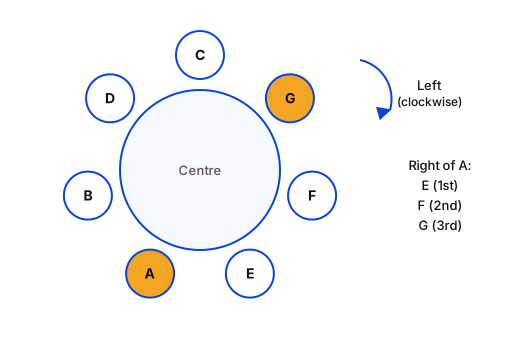
Seven friends, A, B, C, D, E, F and G, are sitting around a circular table facing the
centre (not necessarily in the same order). D is an immediate neighbour of B and C. A is sitting third to the right of C. E is an immediate neighbour of A and F. G is sitting immediate left of C. B is sitting third to the right of G. What is the position of G with respect to A when counted from the right side of A?
सात मित्र A, B, C, D, E, F और G एक वृत्ताकार मेज़ के परितः
केंद्र की ओर मुख करके बैठे हैं (आवश्यक नहीं कि इसी क्रम में हों)। D, B और C का निकटतम पड़ोसी है। A, C के दाएँ से तीसरे स्थान पर बैठा है। E, A और F का निकटतम पड़ोसी है। G, C के ठीक बाएँ बैठा है। B, G के दाएँ से तीसरे स्थान पर बैठा है। A के दाईं ओर से गिनने पर A के सापेक्ष G की स्थिति क्या है?
  1. AThird to the rightदाएँ से तीसरा
  2. BSecond to the rightदाएँ से दूसरा
  3. CThird to the leftबाएँ से तीसरा
  4. DSecond to the leftबाएँ से दूसरा
Show answer

Concept: Facing the centre: left = clockwise, right = anticlockwise.

  1. Fix C. G is immediately left of C (next clockwise).
  2. A is third to the right of C; B is third to the right of G, i.e. second to the right of C.
  3. D is neighbour of both B and C → D sits immediately right of C.
  4. E is next to A and F → clockwise order: C, G, F, E, A, B, D.
  5. From A, counting right (anticlockwise): E (1), F (2), G (3).

Trick: In a 7-seat circle, "3rd to the right" is the same seat as "4th to the left".

Answer: (A) Third to the right

अवधारणा: केंद्र की ओर मुख: बायाँ = दक्षिणावर्त (clockwise), दायाँ = वामावर्त।

  1. C को स्थिर करें। G, C के ठीक बाएँ (अगला clockwise)।
  2. A, C के दाएँ तीसरा; B, G के दाएँ तीसरा यानी C के दाएँ दूसरा।
  3. D, B और C दोनों का पड़ोसी → D, C के ठीक दाएँ।
  4. E, A और F के बीच → clockwise क्रम: C, G, F, E, A, B, D।
  5. A से दाएँ (anticlockwise) गिनें: E (1), F (2), G (3)।

ट्रिक: 7 सीटों के वृत्त में "दाएँ तीसरा" = "बाएँ चौथा"।

उत्तर: (A) Third to the right

SSC CPO Paper IGeneral Intelligence and ReasoningCircular Seating ArrangementSSC CPO Paper I 2023 · 3 Oct Shift 2 →
Q6231.
Four letter-clusters have been given, out of which three are alike in some manner and one is different. Select the odd letter-cluster.
चार अक्षर-समूह दिए गए हैं, जिनमें से तीन किसी प्रकार से एकसमान हैं और एक असंगत है। असंगत अक्षर-समूह का चयन कीजिए।
  1. AKNJZ
  2. BFIEU
  3. CMJLO
  4. DSVRH
Show answer

Concept: Check the gaps between consecutive letters.

  1. KNJZ: K→N +3, N→J −4, J→Z +16.
  2. FIEU: F→I +3, I→E −4, E→U +16. SVRH: S→V +3, V→R −4, R→H +16 (wrapping past Z).
  3. MJLO: M→J −3, J→L +2, L→O +3 – different pattern.

Trick: Compare just the first gap: three clusters go +3, MJLO goes −3.

Answer: (C) MJLO

अवधारणा: क्रमागत अक्षरों के बीच का अंतर जाँचें।

  1. KNJZ: K→N +3, N→J −4, J→Z +16।
  2. FIEU: +3, −4, +16। SVRH: +3, −4, +16 (Z के बाद फिर A से)।
  3. MJLO: M→J −3, J→L +2, L→O +3 – अलग पैटर्न।

ट्रिक: केवल पहला अंतर देखें: तीन में +3 है, MJLO में −3।

उत्तर: (C) MJLO

SSC CPO Paper IGeneral Intelligence and ReasoningOdd One Out (Letter Clusters)SSC CPO Paper I 2023 · 3 Oct Shift 2 →
Q6232.
Three of the following letter-clusters are alike in some manner and one is different. Select the one that is different.
निम्नलिखित में से तीन अक्षर-समूह किसी प्रकार से एकसमान हैं और एक असंगत है। असंगत का चयन कीजिए।
  1. AMRVY
  2. BGLPS
  3. CNSWZ
  4. DTGQJ
Show answer

Concept: Find the gaps between letters in each cluster.

  1. MRVY: +5,+4,+3.
  2. GLPS: +5,+4,+3. NSWZ: +5,+4,+3.
  3. TGQJ: T→G is a backward jump – it does not follow +5,+4,+3.

Trick: Clusters in increasing alphabetical order vs one jumping backward – spot it instantly.

Answer: (D) TGQJ

अवधारणा: हर समूह में अक्षरों का अंतर निकालें।

  1. MRVY: +5,+4,+3।
  2. GLPS: +5,+4,+3। NSWZ: +5,+4,+3।
  3. TGQJ: T→G पीछे की ओर छलांग – +5,+4,+3 का पालन नहीं।

ट्रिक: बाकी समूह बढ़ते क्रम में हैं, TGQJ पीछे जाता है – तुरंत पहचानें।

उत्तर: (D) TGQJ

SSC CPO Paper IGeneral Intelligence and ReasoningOdd One Out (Letter Clusters)SSC CPO Paper I 2023 · 3 Oct Shift 2 →
Q6233.
Which two numbers (not digits) should be interchanged to make the given equation correct?
(18 × 2) – 24 + 10 × 160 ÷ 16 + (10 × 4) = 170
दिए गए समीकरण को सही बनाने के लिए किन दो संख्याओं (अंकों को नहीं) को परस्पर बदला जाना चाहिए?
(18 × 2) – 24 + 10 × 160 ÷ 16 + (10 × 4) = 170
  1. A2 and 242 और 24
  2. B2 and 42 और 4
  3. C24 and 1824 और 18
  4. D16 and 1816 और 18
Show answer

Concept: Interchange the numbers given in an option and evaluate by BODMAS.

  1. Swap 24 and 18: (24×2)−18+10×160÷16+(10×4)
  2. =48−18+10×10+40
  3. =48−18+100+40=170 ✔

Trick: Unchanged parts give 100+40=140; you need the first part to give 30 → 48−18.

Answer: (C) 24 and 18

अवधारणा: विकल्प की संख्याएँ आपस में बदलकर BODMAS से हल करें।

  1. 24 और 18 बदलने पर: (24×2)−18+10×160÷16+(10×4)
  2. =48−18+10×10+40
  3. =48−18+100+40=170 ✔

ट्रिक: बाकी भाग 100+40=140 देता है; पहले भाग से 30 चाहिए → 48−18।

उत्तर: (C) 24 and 18

SSC CPO Paper IGeneral Intelligence and ReasoningMathematical Operations (Number Interchange)SSC CPO Paper I 2023 · 3 Oct Shift 2 →
Q6234.
Select the set in which the numbers are related in the same way as are the numbers of the following sets.
(NOTE : Operations should be performed on the whole numbers, without breaking
down the numbers into its constituent digits. E.g. 13- Operations on 13 such as
adding/subtracting/multiplying etc. to 13 can be performed. Breaking down 13 into 1 and 3 and then performing mathematical operations on 1 and 3 is not allowed.)
(15, 21, 66)
(9, 17, 44)
उस समुच्चय का चयन कीजिए जिसमें संख्याएँ उसी प्रकार संबंधित हैं जिस प्रकार निम्नलिखित समुच्चयों की संख्याएँ संबंधित हैं।
(नोट: संक्रियाएँ संख्याओं को उनके घटक अंकों में विभक्त किए बिना, पूर्ण संख्याओं पर की जानी चाहिए। उदाहरण के लिए 13 – 13 पर संक्रियाएँ जैसे 13 में जोड़ना/घटाना/गुणा करना आदि किया जा सकता है। 13 को 1 और 3 में विभक्त करना और फिर 1 और 3 पर गणितीय संक्रियाएँ करना वर्जित है।)
(15, 21, 66)
(9, 17, 44)
  1. A(2, 4, 12)
  2. B(5, 37, 52)
  3. C(7, 9, 86)
  4. D(11, 13, 35)
Show answer

Concept: Find the rule giving the third number from the first two.

  1. (15,21,66): 3×15+21=45+21=66.
  2. (9,17,44): 3×9+17=27+17=44.
  3. Rule: third =3× first + second.
  4. (B) (5,37,52): 15+37=52 ✔; (A) 10≠12, (C) 30≠86, (D) 46≠35.

Trick: Subtract the second from the third: 45,27 are multiples of the first (×3).

Answer: (B) (5, 37, 52)

अवधारणा: पहली दो संख्याओं से तीसरी बनाने का नियम खोजें।

  1. (15,21,66): 3×15+21=66।
  2. (9,17,44): 3×9+17=44।
  3. नियम: तीसरी =3× पहली + दूसरी।
  4. (B) (5,37,52): 15+37=52 ✔; (A) 10≠12, (C) 30≠86, (D) 46≠35।

ट्रिक: तीसरी में से दूसरी घटाएँ: 45,27 पहली संख्या के 3 गुने हैं।

उत्तर: (B) (5, 37, 52)

SSC CPO Paper IGeneral Intelligence and ReasoningNumber Analogy (Sets)SSC CPO Paper I 2023 · 3 Oct Shift 2 →
Q6235.
Which two signs should be interchanged to make the given equation correct?
13 + 145 ÷ 29 × 52 – 11 = 106
दिए गए समीकरण को सही बनाने के लिए किन दो चिह्नों को परस्पर बदला जाना चाहिए?
13 + 145 ÷ 29 × 52 – 11 = 106
  1. A– and ×– और ×
  2. Bx and +x और +
  3. C÷ and –÷ और –
  4. D÷ and +÷ और +
Show answer

Concept: Interchange the two signs and solve with BODMAS.

  1. Swap × and +: 13×145÷29+52−11
  2. 145÷29=5 → 13×5+52−11
  3. =65+52−11=106 ✔

Trick: 145=29×5 – exact division hints that 13 should multiply that result.

Answer: (B) x and +

अवधारणा: दोनों चिह्न बदलकर BODMAS से हल करें।

  1. × और + बदलने पर: 13×145÷29+52−11
  2. 145÷29=5 → 13×5+52−11
  3. =65+52−11=106 ✔

ट्रिक: 145=29×5 – पूरा भाग होना संकेत है कि 13 से गुणा होगा।

उत्तर: (B) x and +

SSC CPO Paper IGeneral Intelligence and ReasoningMathematical Operations (Sign Interchange)SSC CPO Paper I 2023 · 3 Oct Shift 2 →
Q6236.
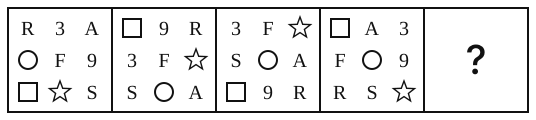
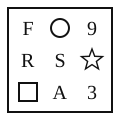
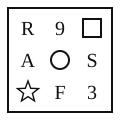
Which figure from the given options would replace the question mark (?) if the following figure series were to be continued?
यदि निम्नलिखित आकृति श्रृंखला को जारी रखा जाए, तो दिए गए विकल्पों में से कौन-सी आकृति प्रश्न चिह्न (?) का स्थान लेगी?
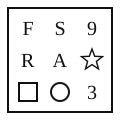
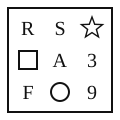
  1. A
  2. B
  3. C
  4. D
Show answer

Concept: Two movements alternate in the 3×3 grid of symbols.

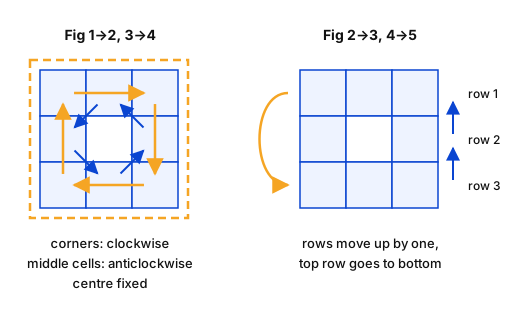
  1. Fig 1 → 2 (and Fig 3 → 4): corner symbols move one corner clockwise, middle-edge symbols move one step anticlockwise, the centre stays.
  2. Fig 2 → 3: the whole rows shift up by one – row 2 becomes row 1, row 3 becomes row 2, row 1 goes to the bottom.
  3. So Fig 4 → 5 is again a row shift: Fig 4 rows (□ A 3), (F O 9), (R S ☆) become (F O 9), (R S ☆), (□ A 3).
  4. This is option (C).

Trick: If consecutive pairs do not match, compare alternate figures (1→2 with 3→4).

Answer: (C)

अवधारणा: चिह्नों के 3×3 ग्रिड में दो गतियाँ बारी-बारी से होती हैं।

  1. आकृति 1 → 2 (और 3 → 4): कोनों के चिह्न एक कोना clockwise, किनारों के मध्य वाले चिह्न एक कदम anticlockwise, केंद्र स्थिर।
  2. आकृति 2 → 3: पूरी पंक्तियाँ एक ऊपर – पंक्ति 2 ऊपर, पंक्ति 3 बीच में, पंक्ति 1 नीचे।
  3. अतः 4 → 5 फिर पंक्ति-खिसकाव: (□ A 3), (F O 9), (R S ☆) → (F O 9), (R S ☆), (□ A 3)।
  4. यह विकल्प (C) है।

ट्रिक: क्रमागत जोड़े मेल न खाएँ तो एकांतर (1→2 व 3→4) की तुलना करें।

उत्तर: (C)

SSC CPO Paper IGeneral Intelligence and ReasoningFigure Series (Element Movement)SSC CPO Paper I 2023 · 3 Oct Shift 2 →
Q6237.
If M denotes ‘-’, N denotes ‘÷’, O denotes ‘×’, and P denotes ‘+’, then what will come in place of ‘?’ in the following equation?
255 N 5 O 4 P 16 O 3 M 29 = ?
यदि M का अर्थ '-', N का अर्थ '÷', O का अर्थ '×' और P का अर्थ '+' है, तो निम्नलिखित समीकरण में '?' के स्थान पर क्या आएगा?
255 N 5 O 4 P 16 O 3 M 29 = ?
  1. A223
  2. B216
  3. C211
  4. D230
Show answer

Concept: Replace letters with signs and apply BODMAS.

  1. 255÷5×4+16×3−29
  2. =51×4+48−29
  3. =204+48−29=223

Trick: Work left to right for ÷ and ×, then do + and –.

Answer: (A) 223

अवधारणा: अक्षरों को चिह्नों से बदलकर BODMAS लगाएँ।

  1. 255÷5×4+16×3−29
  2. =51×4+48−29
  3. =204+48−29=223

ट्रिक: ÷ और × बाएँ से दाएँ, फिर + और –।

उत्तर: (A) 223

SSC CPO Paper IGeneral Intelligence and ReasoningMathematical OperationsSSC CPO Paper I 2023 · 3 Oct Shift 2 →
Q6238.
'PRO 5' is related to 'OSQ 15' in a certain way. In the same way, 'OPO 10' is related to 'NQQ 30'. Which of the following is related to 'MAC 9' using the same logic?
'PRO 5' एक निश्चित प्रकार से 'OSQ 15' से संबंधित है। उसी प्रकार, 'OPO 10', 'NQQ 30' से संबंधित है। समान तर्क का उपयोग करते हुए, निम्नलिखित में से कौन 'MAC 9' से संबंधित है?
  1. ANZA 3
  2. BOZA 3
  3. CNZB 3
  4. DNZA 27
Show answer

Concept: Find the change from the first term to its pair and apply the same logic to MAC 9.

  1. PRO 5 → OSQ 15: P−1=O, R+1=S, O+2=Q, 5×3=15.
  2. OPO 10 → NQQ 30: same changes (−1,+1,+2, number ×3) ✔
  3. Test (A) NZA 3: N−1=M, Z+1=A (wraps), A+2=C, 3×3=9 → MAC 9.
  4. So NZA 3 is related to MAC 9 in the same way as PRO 5 is to OSQ 15.

Trick: Test each option by applying the rule forward – the one that produces MAC 9 is the answer.

Answer: (A) NZA 3

अवधारणा: पहले पद से जोड़ीदार तक का बदलाव खोजें और वही तर्क MAC 9 पर लगाएँ।

  1. PRO 5 → OSQ 15: P−1=O, R+1=S, O+2=Q, 5×3=15।
  2. OPO 10 → NQQ 30: वही बदलाव (−1,+1,+2, संख्या ×3) ✔
  3. (A) NZA 3 जाँचें: N−1=M, Z+1=A, A+2=C, 3×3=9 → MAC 9।
  4. अतः NZA 3 का MAC 9 से वही संबंध है जो PRO 5 का OSQ 15 से।

ट्रिक: हर विकल्प पर नियम लगाकर देखें – जो MAC 9 दे वही उत्तर।

उत्तर: (A) NZA 3

SSC CPO Paper IGeneral Intelligence and ReasoningLetter-Number AnalogySSC CPO Paper I 2023 · 3 Oct Shift 2 →
Q6239.
‘M $ K’ means ‘M is the mother of K’.
‘M # K’ means ‘M is the father of K’.
‘M @ K’ means ‘M is the husband of K’.
‘M% K’ means ‘M is the daughter of K’.
If A $ C @ R, then how is R related to A?
'M $ K' का अर्थ है 'M, K की माता है'।
'M # K' का अर्थ है 'M, K का पिता है'।
'M @ K' का अर्थ है 'M, K का पति है'।
'M% K' का अर्थ है 'M, K की पुत्री है'।
यदि A $ C @ R है, तो R का A से क्या संबंध है?
  1. AHusband's fatherपति के पिता
  2. BMotherमाता
  3. CSon's wifeपुत्र की पत्नी
  4. DDaughterपुत्री
Show answer

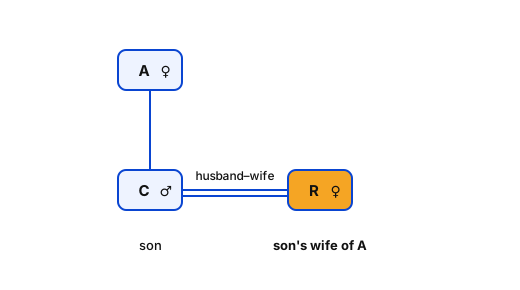
Concept: Decode each symbol and build the family tree.

  1. A $ C → A is the mother of C.
  2. C @ R → C is the husband of R, so C is male (A's son) and R is his wife.
  3. R is the wife of A's son → R is A's son's wife (daughter-in-law).

Trick: Read the chain left to right: A → C (son) → R (his wife).

Answer: (C) Son's wife

अवधारणा: हर चिह्न का अर्थ निकालकर वंश-वृक्ष बनाएँ।

  1. A $ C → A, C की माँ है।
  2. C @ R → C, R का पति है; अतः C पुरुष (A का बेटा) और R उसकी पत्नी।
  3. R, A के बेटे की पत्नी है → Son's wife (बहू)।

ट्रिक: श्रृंखला बाएँ से दाएँ पढ़ें: A → C (बेटा) → R (उसकी पत्नी)।

उत्तर: (C) Son's wife

SSC CPO Paper IGeneral Intelligence and ReasoningBlood Relation (Coded)SSC CPO Paper I 2023 · 3 Oct Shift 2 →
Q6240.
If ‘+’ means ‘divided by’, ‘ ̶ ’ means ‘added to’, ‘×’ means ‘subtracted from’ and ‘÷’
means ‘multiplied by’, then what will be the value of the following expression?
[{(25 × 13) - (3 ÷ 3)} + (3 - 4)] ÷ 5
यदि '+' का अर्थ 'से भाग देना', ' ̶ ' का अर्थ 'में जोड़ना', '×' का अर्थ 'में से घटाना' और '÷'
का अर्थ 'से गुणा करना' है, तो निम्नलिखित व्यंजक का मान क्या होगा?
[{(25 × 13) - (3 ÷ 3)} + (3 - 4)] ÷ 5
  1. A20
  2. B10
  3. C15
  4. D5
Show answer

Concept: Replace each sign by its meaning, then solve with BODMAS.

  1. + → ÷, − → +, × → −, ÷ → ×.
  2. Expression: [{(25−13)+(3×3)}÷(3+4)]×5
  3. =[(12+9)÷7]×5=[21÷7]×5
  4. =3×5=15

Trick: Rewrite the whole expression with new signs first; then solve – avoids mixing up symbols.

Answer: (C) 15

अवधारणा: हर चिह्न को उसके अर्थ से बदलें, फिर BODMAS लगाएँ।

  1. + → ÷, − → +, × → −, ÷ → ×।
  2. व्यंजक: [{(25−13)+(3×3)}÷(3+4)]×5
  3. =[(12+9)÷7]×5=[21÷7]×5
  4. =3×5=15

ट्रिक: पहले पूरा व्यंजक नए चिह्नों से दोबारा लिखें, फिर हल करें।

उत्तर: (C) 15

SSC CPO Paper IGeneral Intelligence and ReasoningMathematical OperationsSSC CPO Paper I 2023 · 3 Oct Shift 2 →